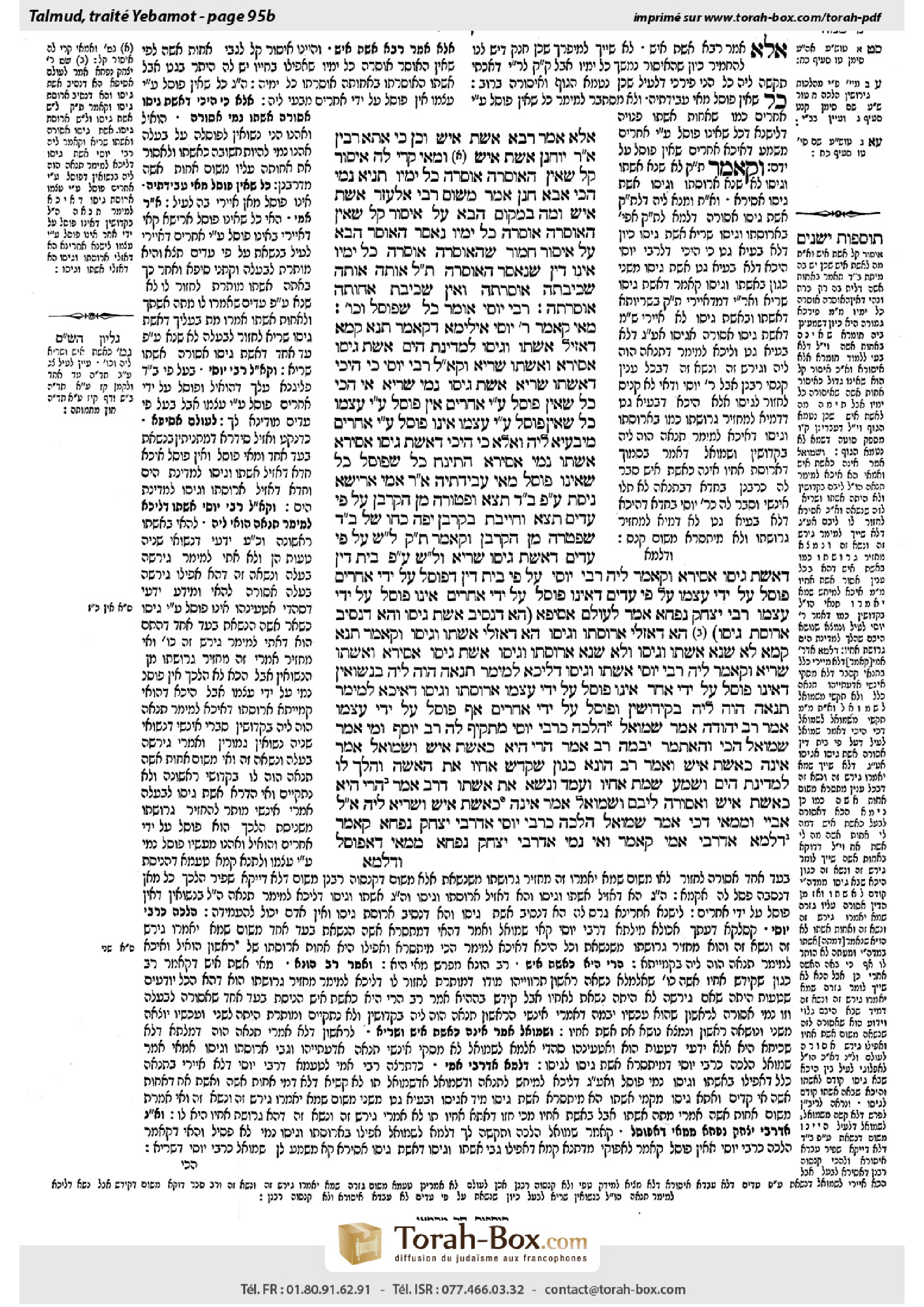
Yevamot 95b: Talmud study for Daf Yomi
Daf Yomi is the daily study of one Talmud folio. Explore 37 tractates with scans, Hebrew text, Sefaria English and AI-generated French translations where annotated.
Passage selection and English or AI-generated French translation are available where the scan has annotations. Daf Study is independent of Torah-Box and Sefaria.
Browse Yevamot · יבמות · All tractatesYevamot 95b text and translations
This page of Yevamot includes the Aramaic text, an English translation and an AI-generated French translation, alongside the scan above.
יבמות צ״ה ב · Aramaic and Hebrew text
אֶלָּא אָמַר רָבָא: אֵשֶׁת אִישׁ. וְכֵן כִּי אֲתָא רָבִין, אָמַר רַבִּי יוֹחָנָן: אֵשֶׁת אִישׁ. וּמַאי קָרֵי לַהּ ״אִיסּוּר קַל״ — שֶׁאֵין הָאוֹסְרָהּ אוֹסְרָהּ כׇּל יָמָיו. תַּנְיָא נָמֵי הָכִי: אַבָּא חָנָן אָמַר מִשּׁוּם רַבִּי אֶלְעָזָר: אֵשֶׁת אִישׁ.
וּמָה בִּמְקוֹם הַבָּא עַל אִיסּוּר קַל, שֶׁאֵין הָאוֹסְרָהּ אוֹסְרָהּ כׇּל יָמָיו — נֶאֱסָר הָאוֹסֵר, הַבָּא עַל אִיסּוּר חָמוּר, שֶׁהָאוֹסְרָהּ אוֹסְרָהּ כׇּל יָמָיו — אֵינוֹ דִּין שֶׁנֶּאֱסָר הָאוֹסְרָהּ?
תַּלְמוּד לוֹמַר: ״אוֹתָהּ״, אוֹתָהּ — שְׁכִיבָתָהּ אוֹסַרְתָּהּ, וְאֵין שְׁכִיבַת אֲחוֹתָהּ אוֹסַרְתָּהּ.
רַבִּי יוֹסֵי אוֹמֵר: כֹּל שֶׁפּוֹסֵל וְכוּ׳. מַאי קָאָמַר רַבִּי יוֹסֵי? אִילֵּימָא דְּקָאָמַר תַּנָּא קַמָּא, דְּאָזֵיל אִשְׁתּוֹ וְגִיסוֹ לִמְדִינַת הַיָּם — אֵשֶׁת גִּיסוֹ אֲסִירָא, וְאִשְׁתּוֹ שַׁרְיָא,
וְקָאָמַר לֵיהּ רַבִּי יוֹסֵי: כִּי הֵיכִי דְּאִשְׁתּוֹ שַׁרְיָא — אֵשֶׁת גִּיסוֹ נָמֵי שַׁרְיָא. אִי הָכִי, כׇּל שֶׁאֵין פּוֹסֵל עַל יְדֵי אֲחֵרִים — אֵין פּוֹסֵל עַל יְדֵי עַצְמוֹ, כֹּל שֶׁאֵין פּוֹסֵל עַל יְדֵי עַצְמוֹ — אֵינוֹ פּוֹסֵל עַל יְדֵי אֲחֵרִים, מִיבַּעְיָא לֵיהּ!
וְאֶלָּא כִּי הֵיכִי דְּאֵשֶׁת גִּיסוֹ אֲסִירָא — אִשְׁתּוֹ נָמֵי אֲסִירָא. הָתִינַח ״כֹּל שֶׁפּוֹסֵל״, — ״כֹּל שֶׁאֵינוֹ פּוֹסֵל״ מַאי עֲבִידְתֵּיהּ?
אָמַר רַבִּי אַמֵּי אַרֵישָׁא: נִיסֵּת עַל פִּי בֵּית דִּין — תֵּצֵא, וּפְטוּרָה מִן הַקׇּרְבָּן. עַל פִּי עֵדִים — תֵּצֵא, וְחַיֶּיבֶת בְּקׇרְבָּן. יִפָּה כֹּחוֹ שֶׁל בֵּית דִּין, שֶׁפֹּטְרָהּ מִן הַקׇּרְבָּן.
וְקָאָמַר תַּנָּא קַמָּא: לָא שְׁנָא עַל פִּי עֵדִים, דְּאֵשֶׁת גִּיסוֹ שַׁרְיָא. וְלָא שְׁנָא עַל פִּי בֵּית דִּין, דְּאֵשֶׁת גִּיסוֹ אֲסִירָא.
וְקָאָמַר לֵיהּ רַבִּי יוֹסֵי: עַל פִּי בֵּית דִּין, דְּפוֹסֵל עַל יְדֵי אֲחֵרִים — פּוֹסֵל עַל יְדֵי עַצְמוֹ. עַל פִּי עֵדִים, דְּאֵינוֹ פּוֹסֵל עַל יְדֵי אֲחֵרִים — אֵינוֹ פּוֹסֵל עַל יְדֵי עַצְמוֹ.
רַבִּי יִצְחָק נַפָּחָא אָמַר: לְעוֹלָם אַסֵּיפָא (הָא — דִּנְסֵיב אֵשֶׁת גִּיסוֹ, וְהָא — דִּנְסֵיב אֲרוּסַת גִּיסוֹ). הָא — דְּאָזְלִי אֲרוּסָתוֹ וְגִיסוֹ, הָא — דְּאָזְלִי אִשְׁתּוֹ וְגִיסוֹ, וְקָאָמַר תַּנָּא קַמָּא: לָא שְׁנָא אִשְׁתּוֹ וְגִיסוֹ, וְלָא שְׁנָא אֲרוּסָתוֹ וְגִיסוֹ — אֵשֶׁת גִּיסוֹ אֲסִירָא, וְאִשְׁתּוֹ שַׁרְיָא,
וְקָאָמַר לֵיהּ רַבִּי יוֹסֵי: אִשְׁתּוֹ וְגִיסוֹ, דְּלֵיכָּא לְמֵימַר תְּנָאָה הֲוָה לֵיהּ בְּנִשּׂוּאִין, דְּאֵינוֹ פּוֹסֵל עַל יְדֵי אַחֵר — אֵינוֹ פּוֹסֵל עַל יְדֵי עַצְמוֹ. אֲרוּסָתוֹ וְגִיסוֹ, דְּאִיכָּא לְמֵימַר תְּנָאָה הֲוָה לֵיהּ בְּקִידּוּשִׁין, וּפוֹסֵל עַל יְדֵי אֲחֵרִים — אַף פּוֹסֵל עַל יְדֵי עַצְמוֹ.
אָמַר רַב יְהוּדָה אָמַר שְׁמוּאֵל: הֲלָכָה כְּרַבִּי יוֹסֵי. מַתְקֵיף לַהּ רַב יוֹסֵף: וּמִי אָמַר שְׁמוּאֵל הָכִי? וְהָאִתְּמַר: יְבָמָה, רַב אָמַר: הֲרֵי הִיא כְּאֵשֶׁת אִישׁ, וּשְׁמוּאֵל אָמַר: אֵינָהּ כְּאֵשֶׁת אִישׁ. וְאָמַר רַב הוּנָא: כְּגוֹן שֶׁקִּדֵּשׁ אָחִיו אֶת הָאִשָּׁה, וְהָלַךְ לוֹ לִמְדִינַת הַיָּם, וְשָׁמַע שֶׁמֵּת אָחִיו, וְעָמַד וְנָשָׂא אֶת אִשְׁתּוֹ.
דְּרַב אָמַר: הֲרֵי הִיא כְּאֵשֶׁת אִישׁ — וַאֲסוּרָה לַיָּבָם, וּשְׁמוּאֵל אָמַר: אֵינָהּ כְּאֵשֶׁת אִישׁ, וְשַׁרְיָא לֵיהּ!
אֲמַר לֵיהּ אַבָּיֵי: וּמִמַּאי דְּכִי אָמַר שְׁמוּאֵל הֲלָכָה כְּרַבִּי יוֹסֵי — אַדְּרַבִּי יִצְחָק נַפָּחָא קָאָמַר? דִּלְמָא אַדְּרַבִּי אַמֵּי קָאָמַר! וְאִי נָמֵי אַדְּרַבִּי יִצְחָק נַפָּחָא, מִמַּאי דְּאַ״פּוֹסֵל״,
Yevamot 95b · English translation
Rather, Rava said that the light prohibition is actually that of a married woman. And similarly, when Ravin came from Eretz Yisrael, he said that Rabbi Yoḥanan said that the baraita is referring to a married woman. And for what reason does the tanna call this a light prohibition? The reason is that it differs from and is more lenient than other prohibitions in that her husband, who renders her forbidden, does not render her forbidden for his whole lifetime, as he can negate the prohibition by giving her a bill of divorce. This is also taught in a baraita: Abba Ḥanan said in the name of Rabbi Elazar: The baraita is referring to a married woman.
The Gemara explains that according to this opinion the a fortiori inference should be understood as follows: And if in a case where he has relations with a married woman, which is a light prohibition, due to the fact that he who renders her forbidden does not render her forbidden for his whole lifetime, and yet the one who renders her forbidden is forbidden, as the husband of a woman who committed adultery is permanently barred from having relations with her, then the following conclusion is correct: One who has relations subject to a severe transgression, e.g., a wife’s sister, which is severe because the one who renders his wife forbidden renders her forbidden for her whole lifetime, since as long as his wife remains alive he is forbidden to her sister, is it not right that the one who renders her forbidden should be forbidden?
The verse therefore states: “Her,” from which it is derived: It is her intercourse that renders her forbidden, but the intercourse of her sister does not render her forbidden.
§ The mishna taught: Rabbi Yosei says: Whoever disqualifies others also disqualifies himself, and whoever does not disqualify others does not disqualify himself. The Gemara asks: What is it Rabbi Yosei is saying? If we say that the first tanna said that one’s wife and brother-in-law went overseas and he mistakenly had relations with his wife’s sister, who is married to his brother-in-law, and consequently the wife of his brother-in-law is forbidden to the brother-in-law, and his wife is permitted to him, this is problematic.
The Gemara elaborates: And according to this explanation, Rabbi Yosei says to the first tanna: Just as his wife is permitted to him, the wife of his brother-in-law is also permitted to her husband. Rabbi Yosei’s reasoning is that if he has not disqualified his wife to himself, due to the accidental nature of his relations with her sister, he should not disqualify the sister to her husband either. The Gemara continues: If so, the formulation of Rabbi Yosei’s statement is imprecise, as instead of saying: Whoever does not disqualify others does not disqualify himself, he should have said: Whoever does not disqualify himself, i.e., his sexual relations do not render his wife forbidden to him, does not disqualify others, i.e., the wife of the other man.
But rather, one might explain Rabbi Yosei’s teaching in the reverse manner: Just as the wife of his brother-in-law is forbidden to her husband, his own wife is also forbidden to him. This works out well with regard to the clause that starts with: Whoever disqualifies, as he disqualifies others, i.e., his brother-in-law’s wife to his brother-in-law, and therefore he also disqualifies his wife to himself. However, the continuation of the statement: Whoever does not disqualify, what is its purpose? This clause has no apparent relevance to Rabbi Yosei’s statement.
Rabbi Ami said: Rabbi Yosei’s statement does not refer to this halakha, but to the first mishna of the chapter, which taught that if a woman whose husband went overseas was informed that he was dead and she married by permission of the court she must leave her new husband and is exempt from bringing an offering. If she married based on the testimony of witnesses, without the authorization of the court, she must leave and is liable to bring an offering. In this regard, the power of the court is enhanced, as she is exempt from an offering.
Rabbi Ami explains: And accordingly, if his wife and brother-in-law went overseas and witnesses came and testified that they were both dead, the first tanna says that it is no different whether the wife of his brother-in-law married him based on the testimony of witnesses alone, in which case the wife of his brother-in-law is permitted to her husband, as she is considered as having acted under duress, having heard testimony that her husband was dead, and it is no different if she married him by permission of the court, as although the wife of his brother-in-law is prohibited, his own wife remains permitted to him.
Rabbi Ami continues his explanation. And Rabbi Yosei says to the first tanna: One who married by permission of the court, who disqualifies others, he also disqualified himself to his own wife; however, in the case of one who married based on the testimony of witnesses who does not disqualify others, I agree that he does not disqualify himself, and his wife is permitted to him.
Rabbi Yitzḥak Nappaḥa said: Actually, Rabbi Yosei is referring to the latter clause of the mishna, and the explanation is as follows: This is referring to one who married his brother-in-law’s wife, and that case is referring to one who married his brother-in-law’s betrothed. Alternatively, this involves a situation where his betrothed and his brother-in-law went overseas, whereas that concerns a situation when his wife and his brother-in-law went abroad. And the first tanna said: It is no different whether the ones who left were his wife and his brother-in-law, and it is no different whether they were his betrothed and his brother-in-law. Either way his brother-in-law’s wife is forbidden to her husband and his own wife or betrothed is permitted to him.
Rabbi Yitzḥak Nappaḥa continues his interpretation. And Rabbi Yosei said to the first tanna: If his wife and his brother-in-law left, in which case it cannot be said that he had a condition with regard to his marriage to his wife, i.e., that the finalization of the marriage was pending on the fulfillment of some condition, everyone would realize that his marriage to her sister was a mistake and she is therefore permitted to his brother-in-law. Consequently, as he does not disqualify another, he does not disqualify himself either. If, however, it was his betrothed and his brother-in-law who left, when it can be mistakenly said that he had a condition with regard to his betrothal and the condition was unfulfilled, his brother-in-law’s wife is therefore prohibited from returning to his brother-in-law. And therefore, as he disqualifies others he also disqualifies himself, and his betrothed is forbidden to him.
§ Rav Yehuda said that Shmuel said: The halakha is in accordance with the opinion of Rabbi Yosei. Rav Yosef strongly objects to this: And did Shmuel actually say this? But wasn’t it stated that they disputed the status of a yevama: Rav said that she is like a married woman, and Shmuel said that she is not like a married woman. And Rav Huna said that this dispute concerns a case where his brother betrothed a woman and that brother went off overseas, and the one left behind heard that his brother was dead and he arose and married his brother’s wife, in levirate marriage, and subsequently the missing brother returned.
As Rav said that she is like a married woman who married another man based on testimony that her husband was dead and is therefore forbidden to the yavam, i.e., to her first husband, who is called the yavam after his brother married her. And Shmuel said that she is not like a married woman, and is permitted to him. This apparently contradicts Rav Yehuda’s ruling in the name of Shmuel that the halakha is in accordance with the opinion of Rabbi Yosei, as here too people might mistakenly think that the original betrothal included an unfulfilled condition and she should therefore be forbidden to him as the wife of his brother.
Abaye said to Rav Yosef: And from where do you know that when Shmuel said that the halakha is in accordance with the opinion of Rabbi Yosei, he was speaking of the explanation of Rabbi Yitzḥak Nappaḥa with regard to Rabbi Yosei’s opinion? Perhaps he was speaking of the explanation of Rabbi Ami, that Rabbi Yosei is referring to the difference between one who married by permission of the court and one who did so based on the testimony of witnesses. And even if one accepts the claim that Shmuel’s ruling endorses the interpretation of Rabbi Yitzḥak Nappaḥa, from where do you know that he was referring to the clause: One who disqualifies?
Yevamot 95b · Traduction française (IA)
Mais Rava a dit que l’interdiction légère est en réalité celle qui concerne une femme mariée. De même, lorsque Ravin vint d’Eretz Israël, il rapporta que Rabbi Yoḥanan disait que la baraïta parle d’une femme mariée. Pourquoi le tanna qualifie-t-il cette interdiction de légère ? Parce qu’elle se distingue des autres interdictions en ce qu’elle est plus clémente : son mari, qui la rend interdite, ne la lui interdit pas pour toute sa vie, puisqu’il peut lever cette interdiction en lui donnant un acte de divorce. C’est également enseigné dans une baraïta : Abba Ḥanan a dit au nom de Rabbi Elazar que la baraïta parle d’une femme mariée.
La Guemara explique que, selon cette opinion, le raisonnement a fortiori doit être compris ainsi : si, dans le cas où un homme a des relations avec une femme mariée — ce qui constitue une interdiction légère, puisque celui qui la rend interdite ne la lui interdit pas pour toute sa vie —, celui qui la rend interdite est pourtant lui-même interdit, car le mari d’une femme qui a commis un adultère ne peut plus jamais avoir de relations avec elle, alors la conclusion suivante s’impose : celui qui commet une transgression grave, par exemple en ayant des relations avec la sœur de son épouse — transgression grave parce que celui qui rend son épouse interdite la lui interdit pour toute sa vie, puisqu’il lui est interdit d’avoir des relations avec sa sœur tant que son épouse est en vie —, n’est-il pas d’autant plus évident que celui qui la rend interdite doit être interdit ?
Le verset dit donc : « Elle », d’où l’on déduit que ce sont ses propres relations qui la rendent interdite, mais que les relations avec sa sœur ne la rendent pas interdite.
§ La Michna enseigne : Rabbi Yosei dit : « Quiconque disqualifie autrui se disqualifie également lui-même, et quiconque ne disqualifie pas autrui ne se disqualifie pas lui-même. » La Guemara demande : que veut dire Rabbi Yosei ? Si l’on dit que le premier tanna enseigne que l’épouse d’un homme et son beau-frère sont partis outre-mer, qu’il a eu par erreur des relations avec la sœur de son épouse, mariée à son beau-frère, et que, par conséquent, l’épouse de son beau-frère est interdite à celui-ci tandis que sa propre épouse lui est permise, cela pose problème.
La Guemara précise : selon cette explication, Rabbi Yosei dit au premier tanna : de même que sa propre épouse lui est permise, l’épouse de son beau-frère est également permise à son mari. Le raisonnement de Rabbi Yosei est que, s’il n’a pas rendu sa propre épouse interdite à son égard, puisque ses relations avec sa sœur étaient accidentelles, il ne devrait pas non plus rendre cette sœur interdite à l’égard de son mari. La Guemara poursuit : si tel est le cas, la formulation de Rabbi Yosei manque de précision : au lieu de dire « Quiconque ne disqualifie pas autrui ne se disqualifie pas lui-même », il aurait dû dire : « Quiconque ne se disqualifie pas lui-même », c’est-à-dire que ses relations sexuelles ne rendent pas son épouse interdite à son égard, « ne disqualifie pas autrui », c’est-à-dire l’épouse de l’autre homme.
Mais on pourrait plutôt expliquer l’enseignement de Rabbi Yosei en sens inverse : de même que l’épouse de son beau-frère est interdite à son mari, sa propre épouse lui est également interdite. Cela convient bien à la première partie, qui commence par « Quiconque disqualifie » : il disqualifie autrui, c’est-à-dire l’épouse de son beau-frère à l’égard de celui-ci, et disqualifie donc aussi sa propre épouse à son égard. Mais à quoi sert la suite de la déclaration : « Quiconque ne disqualifie pas » ? Cette clause ne semble avoir aucun rapport avec la déclaration de Rabbi Yosei.
Rabbi Ami a dit : la déclaration de Rabbi Yosei ne concerne pas cette halakha, mais la première Michna du chapitre, qui enseigne que si une femme dont le mari est parti outre-mer apprend qu’il est mort et se remarie avec l’autorisation du tribunal, elle doit quitter son nouvel époux et est dispensée d’apporter un sacrifice. Si elle s’est remariée sur la foi du témoignage de témoins, sans l’autorisation du tribunal, elle doit le quitter et est tenue d’apporter un sacrifice. À cet égard, le pouvoir du tribunal est plus grand, puisqu’elle est dispensée d’apporter un sacrifice.
Rabbi Ami explique : en conséquence, si son épouse et son beau-frère sont partis outre-mer et que des témoins viennent déclarer qu’ils sont tous deux morts, le premier tanna dit qu’il n’y a pas de différence entre le cas où l’épouse de son beau-frère l’a épousé sur le seul témoignage de témoins — auquel cas elle est permise à son mari, puisqu’elle est considérée comme ayant agi sous la contrainte, ayant entendu le témoignage selon lequel son mari était mort — et celui où elle l’a épousé avec l’autorisation du tribunal. En effet, bien que l’épouse de son beau-frère soit interdite, sa propre épouse reste permise à son égard.
Rabbi Ami poursuit son explication. Rabbi Yosei dit au premier tanna : celui qui s’est marié avec l’autorisation du tribunal disqualifie autrui et se disqualifie également lui-même à l’égard de sa propre épouse ; en revanche, s’agissant de celui qui s’est marié sur la foi du témoignage de témoins et ne disqualifie pas autrui, je suis d’accord qu’il ne se disqualifie pas lui-même et que son épouse lui est permise.
Rabbi Yitzḥak Nappaḥa a dit : en réalité, Rabbi Yosei se rapporte à la dernière partie de la Michna, et l’explication est la suivante : un cas concerne celui qui a épousé l’épouse de son beau-frère, et l’autre celui qui a épousé la fiancée de son beau-frère. Autre possibilité : il s’agit d’une situation où sa fiancée et son beau-frère sont partis outre-mer, tandis que l’autre cas concerne une situation où son épouse et son beau-frère sont partis à l’étranger. Le premier tanna dit qu’il n’y a pas de différence selon que ceux qui sont partis sont son épouse et son beau-frère ou sa fiancée et son beau-frère. Dans les deux cas, l’épouse de son beau-frère est interdite à son mari, tandis que sa propre épouse ou sa fiancée lui est permise.
Rabbi Yitzḥak Nappaḥa poursuit son interprétation. Rabbi Yosei dit au premier tanna : si ce sont son épouse et son beau-frère qui sont partis, on ne peut pas prétendre qu’il avait posé une condition concernant son mariage avec son épouse, c’est-à-dire que la conclusion du mariage dépendait de la réalisation d’une certaine condition ; tous comprendraient que ses relations avec sa sœur étaient une erreur et qu’elle est donc permise à son beau-frère. Par conséquent, puisqu’il ne disqualifie pas autrui, il ne se disqualifie pas lui-même non plus. En revanche, si ce sont sa fiancée et son beau-frère qui sont partis, on pourrait penser à tort qu’il avait posé une condition concernant ses fiançailles et que celle-ci n’a pas été remplie ; l’épouse de son beau-frère serait donc interdite à celui-ci. Par conséquent, puisqu’il disqualifie autrui, il se disqualifie aussi lui-même, et sa fiancée lui est interdite.
§ Rav Yehuda a dit au nom de Shmuel : la halakha est conforme à l’opinion de Rabbi Yosei. Rav Yosef s’y oppose avec véhémence : Shmuel a-t-il vraiment dit cela ? N’a-t-on pas enseigné qu’ils étaient en désaccord sur le statut d’une yevama ? Rav a dit qu’elle est comme une femme mariée, tandis que Shmuel a dit qu’elle n’est pas comme une femme mariée. Rav Huna a dit que leur désaccord concerne le cas où le frère d’un homme a fiancé une femme puis est parti outre-mer, et où celui qui est resté a appris que son frère était mort ; il s’est alors levé et a épousé la femme de son frère par lévirat, puis le frère disparu est revenu.
Rav disait qu’elle est comme une femme mariée qui a épousé un autre homme sur la foi d’un témoignage selon lequel son mari était mort, et qu’elle est donc interdite au yavam, c’est-à-dire à son premier mari, appelé yavam après que son frère l’a épousée. Shmuel disait qu’elle n’est pas comme une femme mariée et qu’elle lui est permise. Cela semble contredire la décision de Rav Yehuda au nom de Shmuel selon laquelle la halakha est conforme à l’opinion de Rabbi Yosei, car ici aussi, les gens pourraient penser à tort que les fiançailles initiales comportaient une condition qui n’a pas été remplie et qu’elle devrait donc lui être interdite en tant qu’épouse de son frère.
Abaye dit à Rav Yosef : d’où sais-tu que, lorsque Shmuel a dit que la halakha est conforme à l’opinion de Rabbi Yosei, il parlait de l’explication que Rabbi Yitzḥak Nappaḥa donne de l’opinion de Rabbi Yosei ? Peut-être parlait-il de l’explication de Rabbi Ami, selon laquelle Rabbi Yosei fait référence à la différence entre celui qui s’est marié avec l’autorisation du tribunal et celui qui l’a fait sur la foi du témoignage de témoins. Et même si l’on accepte l’affirmation selon laquelle la décision de Shmuel confirme l’interprétation de Rabbi Yitzḥak Nappaḥa, d’où sais-tu qu’il faisait référence à la clause : « Quiconque disqualifie » ?
Traduction française générée par IA à partir de l’édition anglaise de Sefaria. Vérifie toujours un passage avec le texte source.
Text from Sefaria: William Davidson Edition - Vocalized Aramaic (CC BY NC); William Davidson Edition - English (CC BY NC).