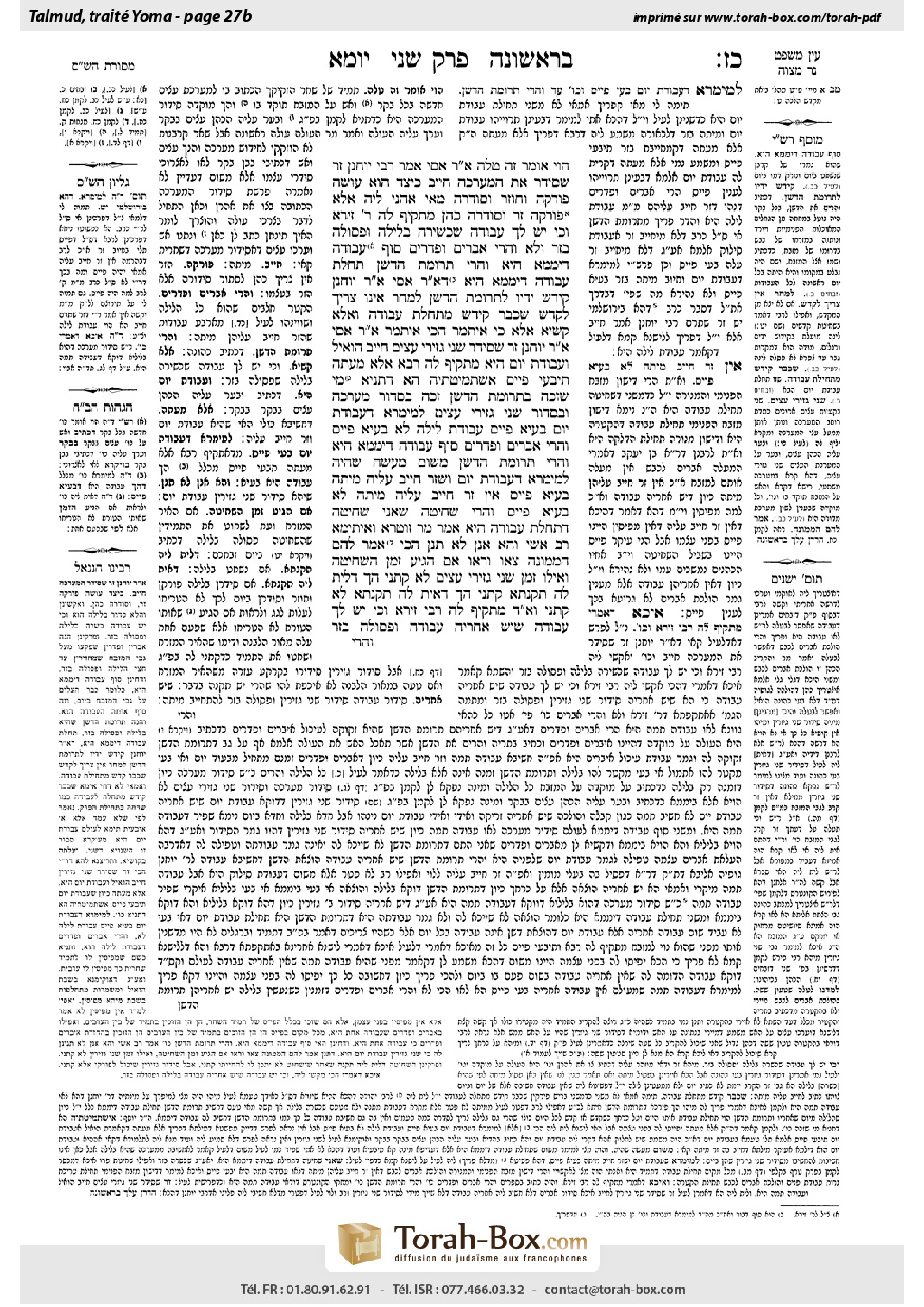
Yoma 27b: Talmud study for Daf Yomi
Daf Yomi is the daily study of one Talmud folio. Explore 37 tractates with scans, Hebrew text, Sefaria English and AI-generated French translations where annotated.
Passage selection and English or AI-generated French translation are available where the scan has annotations. Daf Study is independent of Torah-Box and Sefaria.
Browse Yoma · יומא · All tractatesYoma 27b text and translations
This page of Yoma includes the Aramaic text, an English translation and an AI-generated French translation, alongside the scan above.
יומא כ״ז ב · Aramaic and Hebrew text
הֱוֵי אוֹמֵר זֶה טָלֶה.
אָמַר רַבִּי אַסִּי אָמַר רַבִּי יוֹחָנָן: זָר שֶׁסִּידֵּר אֶת הַמַּעֲרָכָה חַיָּיב. כֵּיצַד הוּא עוֹשֶׂה — פּוֹרְקָהּ וְחוֹזֵר וְסוֹדְרָהּ. מַאי אַהֲנִי לֵיהּ? אֶלָּא: פּוֹרְקָהּ זָר, וְסוֹדְרָהּ כֹּהֵן.
מַתְקֵיף לַהּ רַבִּי זֵירָא: וְכִי יֵשׁ לְךָ עֲבוֹדָה שֶׁכְּשֵׁירָה בַּלַּיְלָה וּפְסוּלָה בְּזָר?
וְלָא? וַהֲרֵי אֵבָרִים וּפְדָרִים? סוֹף עֲבוֹדָה דִימָמָא הִיא.
וַהֲרֵי תְּרוּמַת הַדֶּשֶׁן! תְּחִלַּת עֲבוֹדָה דִּימָמָא הִיא. דְּאָמַר רַבִּי אַסִּי אָמַר רַבִּי יוֹחָנָן: קִידֵּשׁ יָדָיו לִתְרוּמַת הַדֶּשֶׁן, לְמָחָר אֵינוֹ צָרִיךְ לְקַדֵּשׁ, שֶׁכְּבָר קִידֵּשׁ מִתְּחִלַּת עֲבוֹדָה. וְאֶלָּא קַשְׁיָא!
אֶלָּא, כִּי אִיתְּמַר הָכִי אִיתְּמַר: אָמַר רַבִּי אַסִּי אָמַר רַבִּי יוֹחָנָן: זָר שֶׁסִּידֵּר שְׁנֵי גְּזִירֵי עֵצִים חַיָּיב, הוֹאִיל וַעֲבוֹדַת יוֹם הִיא. מַתְקֵיף לַהּ רָבָא: אֶלָּא מֵעַתָּה תִּיבְּעֵי פַּיִיס! אִשְׁתְּמִיטְתֵּיהּ הָא דְּתַנְיָא: מִי שֶׁזָּכָה בִּתְרוּמַת הַדֶּשֶׁן, זָכָה בְּסִדּוּר מַעֲרָכָה וּבְסִדּוּר שְׁנֵי גְּזִירֵי עֵצִים.
לְמֵימְרָא דַּעֲבוֹדַת יוֹם בָּעֲיָא פַּיִיס עֲבוֹדַת לַיְלָה לָא בָּעֲיָא פַּיִיס? וַהֲרֵי אֵבָרִים וּפְדָרִים! סוֹף עֲבוֹדָה דִימָמָא הִיא. וַהֲרֵי תְּרוּמַת הַדֶּשֶׁן! מִשּׁוּם מַעֲשֶׂה שֶׁהָיָה.
לְמֵימְרָא דַּעֲבוֹדַת יוֹם וְשֶׁזָּר חַיָּיב עָלֶיהָ מִיתָה בָּעֲיָא פַּיִיס, אֵין זָר חַיָּיב עָלֶיהָ מִיתָה לָא בָּעֲיָא פַּיִיס? וַהֲרֵי שְׁחִיטָה! שָׁאנֵי שְׁחִיטָה דִּתְחִלַּת עֲבוֹדָה הִיא.
אָמַר מָר זוּטְרָא, וְאִיתֵּימָא רַב אָשֵׁי, וְהָא אֲנַן לָא תְּנַן הָכִי: אָמַר לָהֶם הַמְמוּנֶּה צְאוּ וּרְאוּ אִם הִגִּיעַ זְמַן הַשְּׁחִיטָה. וְאִילּוּ ״זְמַן שְׁנֵי גְּזִירֵי עֵצִים״ לָא קָתָנֵי.
הָךְ דְּלֵית לַהּ תַּקַּנְתָּא — קָתָנֵי, הָךְ דְּאִית לַהּ תַּקַּנְתָּא — לָא קָתָנֵי.
וְאִיכָּא דְּאָמְרִי, מַתְקֵיף לַהּ רַבִּי זֵירָא: וְכִי יֵשׁ לְךָ עֲבוֹדָה שֶׁיֵּשׁ אַחֲרֶיהָ עֲבוֹדָה וּפְסוּלָה בְּזָר?
Yoma 27b · English translation
You must say that this is the lamb of the morning daily offering, concerning which the Torah commands that a new woodpile be prepared every day and that the altar must be lit anew each morning. Therefore, although the verse is ostensibly speaking of a bull, it also alludes to the lamb of the daily offering and to the fact that it should be brought by six priests.
§ Rabbi Asi said that Rabbi Yoḥanan said: A non-priest who set up the arrangement of wood on the altar is liable to receive the death penalty by God’s hand for having performed an act that is restricted to priests, and the woodpile that he placed is invalid. What should he do to repair the woodpile? He should dismantle it and then rearrange it. The Gemara is surprised at this: What good would this do for the woodpile? How would it help for the non-priest himself to rearrange the wood? It would be just as invalid as it was the first time. Rather, one must say that the non-priest should dismantle it, as there is nothing wrong with a non-priest dismantling the woodpile, and a priest then rearranges it.
Rabbi Zeira strongly objects to Rabbi Yoḥanan’s teaching: And do you have any service that is valid if performed at night and yet is invalid if performed by a non-priest? A bona fide Temple service must be performed during the day. That the wood on the altar may be arranged while it is still nighttime shows that it is not a bona fide service, and therefore it should be permitted for non-priests to perform it.
The Gemara expresses wonder at Rabbi Zeira’s equation of the two issues: And is there really no such thing as a service that may be performed at night but which is prohibited for a non-priest to perform? Isn’t there the burning of the limbs and the fats of offerings on the altar, which continues throughout the night, and yet it was taught earlier in this chapter that a non-priest who participates in that service incurs the death penalty? The Gemara rejects this objection: The burning of sacrificial limbs and fats, though it may be done at night, is not considered a nighttime service but the end of the daytime service, as it is merely the culmination of the sacrificial service that began during the day.
The Gemara asks further: But isn’t there the removal of the ashes from the altar, which may be performed at night, and yet may not be done by a non-priest? The Gemara rejects this too: The removal of ashes is also not considered a nighttime service but the start of the daytime service. And the proof for this is that Rabbi Asi said that Rabbi Yoḥanan said: If a priest has sanctified his hands at night by washing them for the removal of the ashes, the next day, i.e., after daybreak, he need not sanctify his hands again, as he already sanctified them at the start of the service. Rabbi Zeira’s equation between services performed at night and services that may be performed by non-priests therefore remains intact. If so, the objection that he raised to the opinion of Rabbi Yoḥanan remains difficult.
Rather, Rabbi Yoḥanan’s statement must be revised, and one must posit that when it was stated, this is how it was stated. Rabbi Asi said that Rabbi Yoḥanan said: A non-priest who arranges the two logs on the altar is liable to receive the death penalty by God’s hand, since it is a daytime service. Rava strongly objects to this: But if that is so, if arranging the two logs is a bona fide daytime service and is prohibited to non-priests on pain of death, it should require a lottery; and yet in practice this service is not assigned by a lottery. The Gemara comments that it must have escaped Rava’s mind that which is taught explicitly in a baraita: The priest who was privileged to perform the removal of the ashes was also privileged with setting up the arrangement of wood on the altar and with placing the two logs.
Another difficulty is raised with regard to Rava’s statement: Is that to say that a daytime service requires a lottery and, conversely, a nighttime service does not require a lottery? Isn’t there the burning of the limbs and the fats on the altar, which is done at night and yet is assigned through a lottery? The Gemara responds: That is not difficult, since the burning of the limbs and the fats is the end of the daytime service, as explained above. The Gemara asks: But isn’t there the removal of the ashes from the altar, which is a nighttime service and yet requires a lottery? The Gemara answers: Indeed, a lottery should not have been required for that service, but one was instituted due to the incident that occurred, when the priests came to danger, as related in the mishna.
The Gemara asks further: Is that to say that any service that is a daytime service and for which a non-priest would be liable to receive the death penalty requires a lottery, and conversely, a daytime service for which a non-priest would not be liable to receive the death penalty does not require a lottery? But isn’t there the slaughtering of the daily offering, which may be performed by a non-priest and yet requires a lottery? The Gemara rejects this point: Slaughtering is different, because it is the beginning of the service of the daily offering and is therefore considered important enough to warrant a lottery.
The Gemara asks with regard to the revised version of Rabbi Yoḥanan’s statement: Mar Zutra, and some say Rav Ashi, said: But didn’t we learn that it is not so that arranging the logs must be done during the day, as it was taught in a mishna: The appointed priest said to them: Go out and see if the time for slaughtering has arrived. The mishna does not teach that the appointee said: Go and see if the time for arranging the two logs has arrived. This shows that the logs need not be placed after daybreak but may be arranged while it is still night.
The Gemara rejects this argument: The reason the mishna mentions slaughtering is that it prefers to teach this statement with regard to that which has no rectification if it is done at night, such as slaughtering the offering, which is rendered irreparably invalid if done before daybreak. It does not want to teach something that has rectification if done at night, such as arranging the two logs, which can always be removed and replaced properly. However, the proper time for arranging the logs is indeed daytime.
And some say a different version of Rabbi Zeira’s objection: Rabbi Zeira strongly objects to Rabbi Yoḥanan’s statement that a non-priest who arranged the woodpile incurs the death penalty: And do you have any service that is not complete on its own but is followed by a different service, such as the arrangement of the two logs, and yet is invalid and is punishable by death if performed by a non-priest? It was taught earlier in the chapter that a non-priest incurs the death penalty only for performing a service that is complete, i.e., a service that is not followed by other services that complete the task being performed.
Yoma 27b · Traduction française (IA)
Il faut dire qu’il s’agit de l’agneau de l’offrande quotidienne du matin, au sujet duquel la Torah ordonne de préparer chaque jour un nouveau bûcher de bois et d’allumer de nouveau le feu sur l’autel chaque matin. Ainsi, bien que le verset semble parler d’un taureau, il fait également allusion à l’agneau de l’offrande quotidienne et au fait qu’il doit être apporté par six prêtres.
§ Rabbi Asi a dit que Rabbi Yoḥanan a dit : Un non-prêtre qui dispose le bûcher de bois sur l’autel est passible de mort par la main du Ciel, car il a accompli un acte réservé aux prêtres, et le bûcher qu’il a disposé est invalide. Que doit-il faire pour réparer le bûcher ? Il doit le démonter, puis le disposer de nouveau. La Guemara s’en étonne : En quoi cela serait-il utile ? Comment le fait que le non-prêtre lui-même dispose de nouveau le bois pourrait-il aider ? Le bûcher serait tout aussi invalide que la première fois. Il faut plutôt dire que le non-prêtre doit le démonter — car un non-prêtre peut parfaitement démonter le bûcher — puis qu’un prêtre le dispose de nouveau.
Rabbi Zeira s’oppose vivement à l’enseignement de Rabbi Yoḥanan : Existe-t-il un service qui soit valide lorsqu’il est accompli la nuit, mais invalide lorsqu’il est accompli par un non-prêtre ? Un véritable service du Temple doit être accompli le jour. Puisque le bois sur l’autel peut être disposé alors qu’il fait encore nuit, cela montre qu’il ne s’agit pas d’un véritable service ; les non-prêtres devraient donc être autorisés à l’accomplir.
La Guemara s’étonne de l’assimilation faite par Rabbi Zeira entre ces deux questions : N’existe-t-il vraiment aucun service qui puisse être accompli la nuit, mais qu’un non-prêtre n’a pas le droit d’accomplir ? Il y a pourtant la combustion des membres et des graisses des offrandes sur l’autel, qui se poursuit toute la nuit ; or, il a été enseigné plus tôt dans ce chapitre qu’un non-prêtre qui participe à ce service est passible de mort. La Guemara rejette cette objection : Bien que la combustion des membres et des graisses des offrandes puisse avoir lieu la nuit, elle n’est pas considérée comme un service nocturne, mais comme la fin du service diurne, puisqu’elle ne fait que conclure le service sacrificiel commencé pendant la journée.
La Guemara poursuit : Mais il y a aussi le retrait des cendres de l’autel, qui peut être effectué la nuit et qu’un non-prêtre n’a pourtant pas le droit d’accomplir. La Guemara rejette également cette objection : Le retrait des cendres n’est pas non plus considéré comme un service nocturne, mais comme le début du service diurne. La preuve en est que Rabbi Asi a dit que Rabbi Yoḥanan a dit : Si un prêtre a sanctifié ses mains la nuit en les lavant pour retirer les cendres, le lendemain, c’est-à-dire après le lever du jour, il n’a pas besoin de les sanctifier de nouveau, puisqu’il les a déjà sanctifiées au début du service. L’assimilation faite par Rabbi Zeira entre les services accomplis la nuit et ceux que les non-prêtres peuvent accomplir reste donc valable. Dès lors, l’objection qu’il a soulevée contre l’opinion de Rabbi Yoḥanan demeure difficile.
Il faut plutôt rectifier la déclaration de Rabbi Yoḥanan et supposer que voici ce qui a été dit : Rabbi Asi a dit que Rabbi Yoḥanan a dit : Un non-prêtre qui dispose les deux bûches sur l’autel est passible de mort par la main du Ciel, puisqu’il s’agit d’un service diurne. Rava s’y oppose vivement : Mais si tel est le cas, si disposer les deux bûches constitue un véritable service diurne dont l’accomplissement par un non-prêtre est interdit sous peine de mort, cette tâche devrait être attribuée par tirage au sort ; pourtant, en pratique, elle ne l’est pas. La Guemara remarque que Rava a dû oublier ce qui est enseigné explicitement dans une baraïta : Le prêtre qui avait obtenu par tirage au sort le retrait des cendres obtenait également la disposition du bûcher de bois sur l’autel et le placement des deux bûches.
Une autre difficulté est soulevée au sujet de la déclaration de Rava : Cela signifie-t-il qu’un service diurne nécessite un tirage au sort et, inversement, qu’un service nocturne n’en nécessite pas ? Il y a pourtant la combustion des membres et des graisses sur l’autel, qui a lieu la nuit et qui est néanmoins attribuée par tirage au sort. La Guemara répond que cela ne pose pas de difficulté, car, comme expliqué plus haut, la combustion des membres et des graisses constitue la fin du service diurne. La Guemara poursuit : Mais le retrait des cendres de l’autel n’est-il pas un service nocturne qui nécessite pourtant un tirage au sort ? La Guemara répond : En effet, ce service n’aurait pas dû nécessiter de tirage au sort ; on en a instauré un en raison de l’incident qui s’était produit, lorsque les prêtres avaient été mis en danger, comme le rapporte la Michna.
La Guemara poursuit : Cela signifie-t-il que tout service diurne dont l’accomplissement par un non-prêtre le rendrait passible de mort nécessite un tirage au sort et, inversement, qu’un service diurne dont l’accomplissement par un non-prêtre ne le rendrait pas passible de mort n’en nécessite pas ? Mais il y a l’abattage de l’offrande quotidienne, qu’un non-prêtre peut effectuer et qui nécessite pourtant un tirage au sort. La Guemara rejette cette objection : L’abattage est différent, car il constitue le début du service de l’offrande quotidienne et est donc considéré comme suffisamment important pour justifier un tirage au sort.
À propos de la version rectifiée de la déclaration de Rabbi Yoḥanan, la Guemara demande : Mar Zutra — et certains disent Rav Ashi — a dit : N’avons-nous pas appris que disposer les bûches ne doit pas nécessairement se faire le jour ? En effet, il est enseigné dans une Michna : Le prêtre préposé leur dit : « Sortez et voyez si l’heure de l’abattage est arrivée. » La Michna n’enseigne pas que le préposé leur a dit : « Allez voir si l’heure de disposer les deux bûches est arrivée. » Cela montre qu’il n’est pas nécessaire de placer les bûches après le lever du jour, mais qu’on peut les disposer alors qu’il fait encore nuit.
La Guemara rejette cet argument : Si la Michna mentionne l’abattage, c’est parce qu’elle préfère enseigner cette règle à propos de ce qui ne peut être réparé lorsqu’on l’accomplit la nuit, comme l’abattage de l’offrande, qui est définitivement invalide s’il est effectué avant le lever du jour. Elle ne veut pas l’enseigner à propos de ce qui peut être réparé après avoir été accompli la nuit, comme la disposition des deux bûches, que l’on peut toujours retirer puis replacer correctement. Toutefois, le moment approprié pour disposer les bûches est bien le jour.
Et certains rapportent une autre version de l’objection de Rabbi Zeira : Rabbi Zeira s’oppose vivement à la déclaration de Rabbi Yoḥanan selon laquelle un non-prêtre qui a disposé le bûcher est passible de mort : Existe-t-il un service qui ne soit pas complet à lui seul, mais qui soit suivi d’un autre service, comme la disposition des deux bûches, et qui soit néanmoins invalide et passible de mort lorsqu’il est accompli par un non-prêtre ? Il a été enseigné plus tôt dans ce chapitre qu’un non-prêtre n’est passible de mort que s’il accomplit un service complet, c’est-à-dire un service qui n’est pas suivi d’autres services venant achever la tâche en cours.
Traduction française générée par IA à partir de l’édition anglaise de Sefaria. Vérifie toujours un passage avec le texte source.
Text from Sefaria: William Davidson Edition - Vocalized Aramaic (CC BY NC); William Davidson Edition - English (CC BY NC).