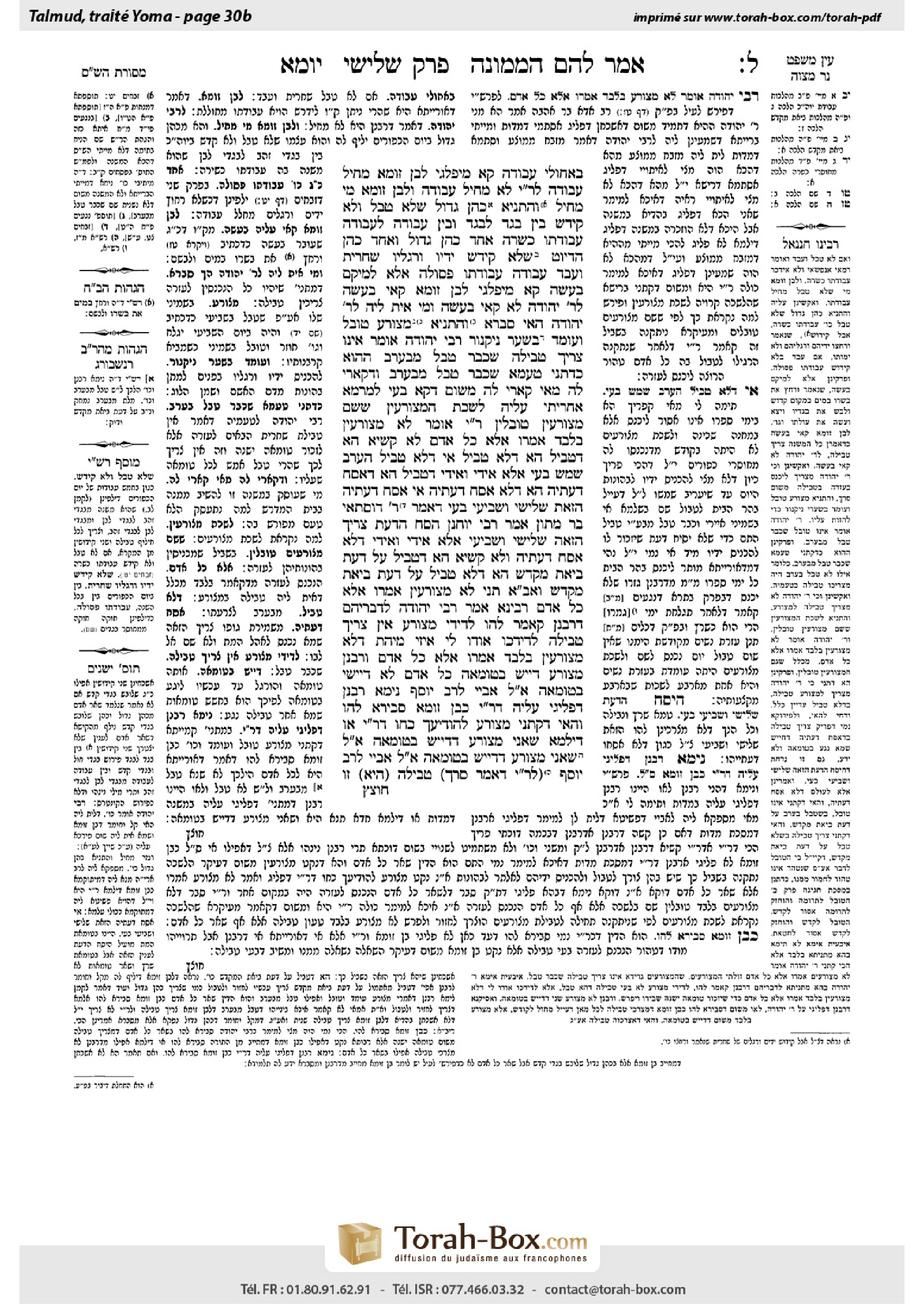
Yoma 30b: Talmud study for Daf Yomi
Daf Yomi is the daily study of one Talmud folio. Explore 37 tractates with scans, Hebrew text, Sefaria English and AI-generated French translations where annotated.
Passage selection and English or AI-generated French translation are available where the scan has annotations. Daf Study is independent of Torah-Box and Sefaria.
Browse Yoma · יומא · All tractatesYoma 30b text and translations
This page of Yoma includes the Aramaic text, an English translation and an AI-generated French translation, alongside the scan above.
יומא ל׳ ב · Aramaic and Hebrew text
בְּאַחוֹלֵי עֲבוֹדָה קָא מִיפַּלְגִי. לְבֶן זוֹמָא, מַחֵיל עֲבוֹדָה. לְרַבִּי יְהוּדָה לָא מַחֵיל עֲבוֹדָה.
וּלְבֶן זוֹמָא מִי מַחֵיל? וְהָתַנְיָא: כֹּהֵן גָּדוֹל שֶׁלֹּא טָבַל וְלֹא קִידֵּשׁ בֵּין בֶּגֶד לְבֶגֶד וּבֵין עֲבוֹדָה לַעֲבוֹדָה — עֲבוֹדָתוֹ כְּשֵׁרָה. אֶחָד כֹּהֵן גָּדוֹל וְאֶחָד כֹּהֵן הֶדְיוֹט שֶׁלֹּא קִידֵּשׁ יָדָיו וְרַגְלָיו שַׁחֲרִית וְעָבַד עֲבוֹדָה — עֲבוֹדָתוֹ פְּסוּלָה.
אֶלָּא: לְמֵיקַם בַּעֲשֵׂה קָא מִיפַּלְגִי. לְבֶן זוֹמָא קָאֵי בַּעֲשֵׂה, לְרַבִּי יְהוּדָה לָא קָאֵי בַּעֲשֵׂה.
וּמִי אִית לֵיהּ לְרַבִּי יְהוּדָה הַאי סְבָרָא? וְהָתַנְיָא: מְצוֹרָע — טוֹבֵל וְעוֹמֵד בְּשַׁעַר נִיקָנוֹר. רַבִּי יְהוּדָה אוֹמֵר: אֵינוֹ צָרִיךְ טְבִילָה, שֶׁכְּבָר טָבַל מִבָּעֶרֶב.
הָהוּא, כִּדְתָנֵי טַעְמָא: שֶׁכְּבָר טָבַל מִבָּעֶרֶב.
וּדְקָאָרֵי לַהּ מַאי קָאָרֵי לַהּ? מִשּׁוּם דְּקָא בָּעֵי לְמִרְמֵא אַחֲרִיתִי עֲלַיהּ: לִשְׁכַּת הַמְצוֹרָעִין שֶׁשָּׁם מְצוֹרָעִין טוֹבְלִין. רַבִּי יְהוּדָה אוֹמֵר: לֹא מְצוֹרָעִין בִּלְבַד אָמְרוּ, אֶלָּא כָּל אָדָם.
לָא קַשְׁיָא: הָא דִּטְבֵיל, הָא דְּלָא טְבֵיל. אִי דְּלָא טְבֵיל — הֶעֱרֵב שֶׁמֶשׁ בָּעֵי! אֶלָּא: אִידֵּי וְאִידֵּי דִּטְבֵיל. הָא דְּאַסַּח דַּעְתֵּיהּ, הָא דְּלָא אַסַּח דַּעְתֵּיהּ.
אִי אַסַּח דַּעְתֵּיהּ, הַזָּאַת שְׁלִישִׁי וּשְׁבִיעִי בָּעֵי. דְּאָמַר רַבִּי דּוֹסְתַּאי בַּר מָתוּן אָמַר רַבִּי יוֹחָנָן: הֶסַּח הַדַּעַת צָרִיךְ הַזָּאָה שְׁלִישִׁי וּשְׁבִיעִי!
אֶלָּא אִידֵּי וְאִידֵּי דְּלָא אַסַּח דַּעְתֵּיהּ, וְלָא קַשְׁיָא: הָא דִּטְבֵיל עַל דַּעַת בִּיאַת מִקְדָּשׁ, הָא דְּלָא טְבֵיל עַל דַּעַת בִּיאַת מִקְדָּשׁ. וְאִי בָּעֵית אֵימָא תָּנֵי: לֹא מְצוֹרָעִין אָמְרוּ, אֶלָּא כָּל אָדָם.
רָבִינָא אָמַר: רַבִּי יְהוּדָה לְדִבְרֵיהֶם דְּרַבָּנַן קָאָמַר לְהוּ: לְדִידִי — מְצוֹרָע אֵין צָרִיךְ טְבִילָה, לְדִידְכוּ — אוֹדוֹ לִי אִיזִי מִיהַת דְּלֹא מְצוֹרָעִין בִּלְבַד אָמְרוּ, אֶלָּא כָּל אָדָם. וְרַבָּנַן: מְצוֹרָע דָּיֵישׁ בְּטוּמְאָה, כׇּל אָדָם לָא דָּיְישִׁי בְּטוּמְאָה.
אֲמַר לֵיהּ אַבָּיֵי לְרַב יוֹסֵף: נֵימָא רַבָּנַן דִּפְלִיגִי עֲלֵיהּ דְּרַבִּי יְהוּדָה — כְּבֶן זוֹמָא סְבִירָא לְהוּ, וְהַאי דְּקָתָנֵי מְצוֹרָע, לְהוֹדִיעֲךָ כֹּחוֹ דְּרַבִּי יְהוּדָה. אוֹ דִילְמָא, שָׁאנֵי מְצוֹרָע דְּדָיֵישׁ בְּטוּמְאָה. אָמַר לֵיהּ: שָׁאנֵי מְצוֹרָע דְּדָיֵישׁ בְּטוּמְאָה.
אֲמַר לֵיהּ אַבָּיֵי לְרַב יוֹסֵף (לְרַבִּי יְהוּדָה דְּאָמַר: סֶרֶךְ) טְבִילָה (הִיא) זוֹ,
Yoma 30b · English translation
It is with regard to whether the Temple service is desecrated and disqualified if the priest failed to immerse before its performance that they disagree. According to the opinion of ben Zoma, this immersion is for the purpose of sanctification and is an integral part of the service; consequently, if the priest failed to immerse he desecrates the service. According to the opinion of Rabbi Yehuda he does not desecrate the service, because the immersion is merely a precautionary measure.
The Gemara wonders: And according to ben Zoma, is the service desecrated? But wasn’t it taught in a baraita: With regard to a High Priest who did not immerse and did not sanctify his hands and feet between donning the golden garments and the white linen garments, and similarly, with regard to a High Priest who did not immerse between performance of one service and another service, his service is valid. However, both a High Priest and a common priest who did not sanctify his hands and feet at all in the morning and performed the service, his service is disqualified. If the High Priest’s failure to immerse between services does not desecrate the service, all the more so that failure to perform the first immersion would not desecrate the service, as ben Zoma derives the first immersion from the immersion of the High Priest. Apparently, that is not the basis of their dispute.
Rather, it is with regard to whether one who fails to immerse before service stands in violation of a positive mitzva that they disagree. According to ben Zoma, he stands in violation of a positive mitzva because there is a special requirement to perform this immersion for the purpose of sanctification. According to Rabbi Yehuda, he does not stand in violation of a positive mitzva.
The Gemara wonders: And does Rabbi Yehuda hold in accordance with this line of reasoning? Wasn’t it taught in a baraita: A leper on the eighth day of his purification, after he has already immersed at the end of the seventh day, immerses again and stands at the Gate of Nicanor in the Temple to bring his purification offerings and to have the priest sprinkle the blood of the guilt-offering and the oil that accompanies his purification offerings on his thumbs and big toes to complete the purification process. Rabbi Yehuda says: He does not require an additional immersion, as he already immersed the previous evening. Apparently, Rabbi Yehuda does not require a special immersion in the morning to remind the leper of old impurity.
The Gemara answers: In that case of the leper, the reason that no immersion is required in the morning is as the reason was taught in the baraita: As he already immersed the previous evening. That immersion purified him and reminded him of any old impurity that he might have. This is in no way connected to the matter of ancillary immersion.
The Gemara asks: And the one who grasps this baraita as a contradiction to Rabbi Yehuda’s opinion, in what manner does he grasp it? The rationale for the halakha is explicit. The Gemara answers: Because the Gemara wants to raise a contradiction between another baraita and this baraita, and the question will be clarified through combination of the sources. As it was taught: Why was the chamber called the Chamber of the Lepers? It is because the lepers immerse there. Rabbi Yehuda says: It was not only lepers that they said immerse there; rather, all people immersed there. Rabbi Yehuda states that lepers and others immersed in this chamber in the Temple, contradicting his statement in the first baraita that a leper does not require immersion in the Temple, as he immersed the evening before.
The Gemara answers: This is not difficult; this baraita is referring to a case where the leper immersed the evening before and need not immerse again; that baraita is referring to a case where the leper did not immerse. In that case, there was a special chamber where lepers could immerse. The Gemara asks: If it is a case where the leper did not immerse at all the previous evening, he requires the sun to set after his immersion to be sufficiently purified to enter the Temple. Rather, both this baraita and that baraita refer to a case where the leper immersed, but this baraita that requires a second immersion is in a case where he was distracted from his efforts to avoid impurity imparted by a corpse; that baraita that does not require a second immersion is in a case where he was not distracted.
The Gemara asks: If he was distracted from his efforts to avoid impurity imparted by a corpse, it is sprinkling of purification waters on the third and the seventh days that he requires, not merely immersion. As Rabbi Dostai bar Matun said that Rabbi Yoḥanan said: Distraction from efforts to avoid impurity requires sprinkling of purification waters on the third and the seventh days.
Rather, both this baraita and that baraita refer to a case where the leper was not distracted, and this is not difficult; this baraita is referring to a case where the leper immersed the evening before with the intention of entering the Temple; that baraita is referring to a case where the leper did not immerse in the evening with the intention of entering the Temple. In that case, he requires a second immersion for purification even to enter the sacred area. And if you wish, say instead: Teach the baraita with a slight emendation: It was not lepers that they said immerse there; rather, all people immersed there. Rabbi Yehuda does not qualify the statement of the Rabbis but disputes it. In his opinion, lepers do not require immersion in the morning at all.
In an alternative resolution of the contradiction between the statements of Rabbi Yehuda, Ravina said: In the second baraita, Rabbi Yehuda is stating his opinion to them according to the statement of the Rabbis. His statement does not reflect his opinion. Rather, it is a contention that he raised in the framework of his dispute with the Rabbis. According to my opinion, a leper does not require a second immersion to enter the Temple. However, according to your opinion, concede to me then [izi] that it was not only lepers that they said immerse there; rather, all people immersed there. The Gemara asks: And how do the Rabbis explain their opinion? It answers that there is no comparison: A leper is accustomed to impurity; therefore, he could overlook other impurities that he may have contracted. The immersion reminds him to purify himself for those as well. However, all other people, who are not accustomed to impurity, will certainly be sensitive to and conscious of any impurity that they may have encountered and do not require a special immersion.
Abaye said to Rav Yosef: Let us say that the Rabbis, who disagree with Rabbi Yehuda with regard to immersions, hold in accordance with the opinion of ben Zoma, who maintains that this immersion is an obligation by Torah law for anyone entering the courtyard. And the fact that the dispute in the baraita is taught with regard to a leper, contrary to the opinion of ben Zoma, comes to convey the far-reaching nature of the opinion of Rabbi Yehuda that even a leper does not require immersion. Or perhaps fundamentally the Rabbis agree with Rabbi Yehuda; however, the halakha of a leper is different because he is accustomed to impurity, and that is why a second immersion was instituted for him. Rav Yosef said to him: A leper is different because he is accustomed to impurity.
Abaye said to Rav Yosef: According to Rabbi Yehuda, who said the immersion is not an actual obligation but it is an ancillary immersion to remind the individual of old impurity,
Yoma 30b · Traduction française (IA)
Ils sont en désaccord sur la question de savoir si le service du Temple est profané et invalidé lorsque le prêtre ne s’est pas immergé avant de l’accomplir. Selon ben Zoma, cette immersion a pour but la sanctification et fait partie intégrante du service ; par conséquent, si le prêtre ne s’est pas immergé, il profane le service. Selon Rabbi Yehuda, il ne profane pas le service, car l’immersion n’est qu’une mesure de précaution.
La Guemara s’interroge : Mais, selon ben Zoma, le service est-il profané ? Pourtant, il a été enseigné dans une baraïta : Le service d’un grand prêtre qui ne s’est pas immergé et n’a pas sanctifié ses mains et ses pieds entre le moment où il revêt les vêtements d’or et celui où il revêt les vêtements de lin blanc est valide. Il en va de même pour le service d’un grand prêtre qui ne s’est pas immergé entre l’accomplissement d’un service et celui d’un autre. En revanche, le service d’un grand prêtre ou d’un prêtre ordinaire qui n’a pas du tout sanctifié ses mains et ses pieds le matin est invalidé s’il l’accomplit. Si le fait que le grand prêtre ne s’immerge pas entre deux services ne profane pas le service, à plus forte raison le défaut de la première immersion ne le profanerait-il pas, puisque ben Zoma déduit la première immersion de celle du grand prêtre. Apparemment, ce n’est pas là le fondement de leur désaccord.
Ils sont plutôt en désaccord sur la question de savoir si celui qui ne s’immerge pas avant le service enfreint une mitsva positive. Selon ben Zoma, il enfreint une mitsva positive, car cette immersion doit spécialement être accomplie à des fins de sanctification. Selon Rabbi Yehuda, il n’enfreint pas de mitsva positive.
La Guemara s’interroge : Rabbi Yehuda soutient-il vraiment ce raisonnement ? Pourtant, il a été enseigné dans une baraïta : Un lépreux, au huitième jour de sa purification, après s’être déjà immergé à la fin du septième jour, s’immerge de nouveau et se tient à la porte de Nicanor, dans le Temple, pour apporter ses sacrifices de purification et pour que le prêtre asperge sur ses pouces et ses gros orteils le sang du sacrifice de culpabilité et l’huile qui accompagne ses sacrifices de purification, afin d’achever le processus de purification. Rabbi Yehuda dit : Il n’a pas besoin d’une immersion supplémentaire, puisqu’il s’est déjà immergé la veille au soir. Apparemment, Rabbi Yehuda n’exige pas d’immersion particulière le matin pour rappeler au lépreux ses anciennes impuretés.
La Guemara répond : Dans ce cas du lépreux, s’il n’est pas nécessaire de s’immerger le matin, c’est pour la raison enseignée dans la baraïta : il s’est déjà immergé la veille au soir. Cette immersion l’a purifié et lui a rappelé toute ancienne impureté qu’il pouvait avoir. Cela n’a aucun rapport avec la question de l’immersion accessoire.
La Guemara demande : Et celui qui considère cette baraïta comme une contradiction à l’opinion de Rabbi Yehuda, comment la comprend-il ? La raison de la halakha y est explicite. La Guemara répond : C’est parce que la Guemara veut soulever une contradiction entre une autre baraïta et celle-ci, et que la question sera clarifiée en rapprochant les sources. En effet, il a été enseigné : Pourquoi la salle a-t-elle été appelée la salle des lépreux ? Parce que les lépreux s’y immergent. Rabbi Yehuda dit : On n’a pas dit que seuls les lépreux s’y immergent ; tous les gens s’y immergeaient. Rabbi Yehuda affirme que les lépreux et les autres personnes s’immergeaient dans cette salle du Temple, ce qui contredit sa déclaration dans la première baraïta selon laquelle un lépreux n’a pas besoin de s’immerger dans le Temple, puisqu’il s’est immergé la veille au soir.
La Guemara répond : Il n’y a pas de difficulté : cette baraïta parle d’un cas où le lépreux s’est immergé la veille au soir et n’a pas besoin de s’immerger à nouveau ; l’autre baraïta parle d’un cas où le lépreux ne s’est pas immergé. Dans ce cas, il y avait une salle spéciale où les lépreux pouvaient s’immerger. La Guemara demande : S’il s’agit d’un cas où le lépreux ne s’est pas du tout immergé la veille au soir, après son immersion il doit attendre le coucher du soleil pour être suffisamment purifié afin d’entrer dans le Temple. Il faut plutôt dire que les deux baraïtot parlent d’un cas où le lépreux s’est immergé, mais que cette baraïta, qui exige une seconde immersion, concerne un cas où il a été distrait de ses précautions contre l’impureté transmise par un cadavre ; l’autre baraïta, qui n’exige pas de seconde immersion, concerne un cas où il n’a pas été distrait.
La Guemara demande : S’il a été distrait de ses précautions contre l’impureté transmise par un cadavre, il a besoin d’aspersion des eaux de purification aux troisième et septième jours, et pas seulement d’une immersion. Car Rabbi Dostai bar Matun a dit au nom de Rabbi Yoḥanan : Être distrait de ses précautions contre l’impureté exige l’aspersion des eaux de purification aux troisième et septième jours.
Il faut plutôt dire que les deux baraïtot parlent d’un cas où le lépreux n’a pas été distrait. Il n’y a pas de difficulté : cette baraïta parle d’un cas où le lépreux s’est immergé la veille au soir dans l’intention d’entrer dans le Temple ; l’autre baraïta parle d’un cas où il ne s’est pas immergé le soir dans l’intention d’entrer dans le Temple. Dans ce cas, il a besoin d’une seconde immersion pour être purifié, même en vue d’entrer dans l’enceinte sacrée. Et si tu le souhaites, dis plutôt : Enseigne la baraïta avec une légère correction : On n’a pas dit que les lépreux s’y immergeaient ; tous les gens s’y immergeaient. Rabbi Yehuda ne précise pas la déclaration des Sages, mais la conteste. Selon lui, les lépreux n’ont pas du tout besoin de s’immerger le matin.
Pour résoudre autrement la contradiction entre les déclarations de Rabbi Yehuda, Ravina dit : Dans la seconde baraïta, Rabbi Yehuda leur expose son opinion en se plaçant dans le cadre de la déclaration des Sages. Sa déclaration ne reflète pas son opinion ; elle constitue plutôt un argument qu’il avance dans le cadre de son désaccord avec les Sages. Selon mon opinion, un lépreux n’a pas besoin d’une seconde immersion pour entrer dans le Temple. Mais, selon votre opinion, accordez-moi alors [izi] qu’on n’a pas dit que seuls les lépreux s’y immergeaient ; tous les gens s’y immergeaient. La Guemara demande : Et comment les Sages expliquent-ils leur opinion ? Elle répond qu’il n’y a pas de comparaison : un lépreux est habitué à l’impureté ; il peut donc ne pas remarquer d’autres impuretés auxquelles il aurait pu être exposé. L’immersion lui rappelle de se purifier également de celles-ci. En revanche, toutes les autres personnes, qui ne sont pas habituées à l’impureté, seront certainement attentives à toute impureté à laquelle elles ont pu être exposées et en auront conscience ; elles n’ont pas besoin d’une immersion spéciale.
Abaye dit à Rav Yosef : Disons que les Sages, qui ne sont pas d’accord avec Rabbi Yehuda au sujet des immersions, soutiennent l’opinion de ben Zoma, selon laquelle cette immersion est une obligation de la Torah pour toute personne qui entre dans la cour. Et si la baraïta présente le désaccord à propos d’un lépreux, contrairement à l’opinion de ben Zoma, c’est pour mettre en évidence la portée extrême de l’opinion de Rabbi Yehuda : même un lépreux n’a pas besoin de s’immerger. Ou bien, les Sages sont fondamentalement d’accord avec Rabbi Yehuda ; toutefois, la halakha concernant un lépreux est différente, car il est habitué à l’impureté, et c’est pourquoi une seconde immersion a été instituée pour lui. Rav Yosef lui dit : Le cas d’un lépreux est différent, car il est habitué à l’impureté.
Abaye dit à Rav Yosef : Selon Rabbi Yehuda, qui a dit que l’immersion n’est pas une véritable obligation, mais une immersion accessoire destinée à rappeler à l’individu ses anciennes impuretés,
Traduction française générée par IA à partir de l’édition anglaise de Sefaria. Vérifie toujours un passage avec le texte source.
Text from Sefaria: William Davidson Edition - Vocalized Aramaic (CC BY NC); William Davidson Edition - English (CC BY NC).