Yoma 46a: Talmud study for Daf Yomi
Daf Yomi is the daily study of one Talmud folio. Explore 37 tractates with scans, Hebrew text, Sefaria English and AI-generated French translations where annotated.
Passage selection and English or AI-generated French translation are available where the scan has annotations. Daf Study is independent of Torah-Box and Sefaria.
Browse Yoma · יומא · All tractatesYoma 46a text and translations
This page of Yoma includes the Aramaic text, an English translation and an AI-generated French translation, alongside the scan above.
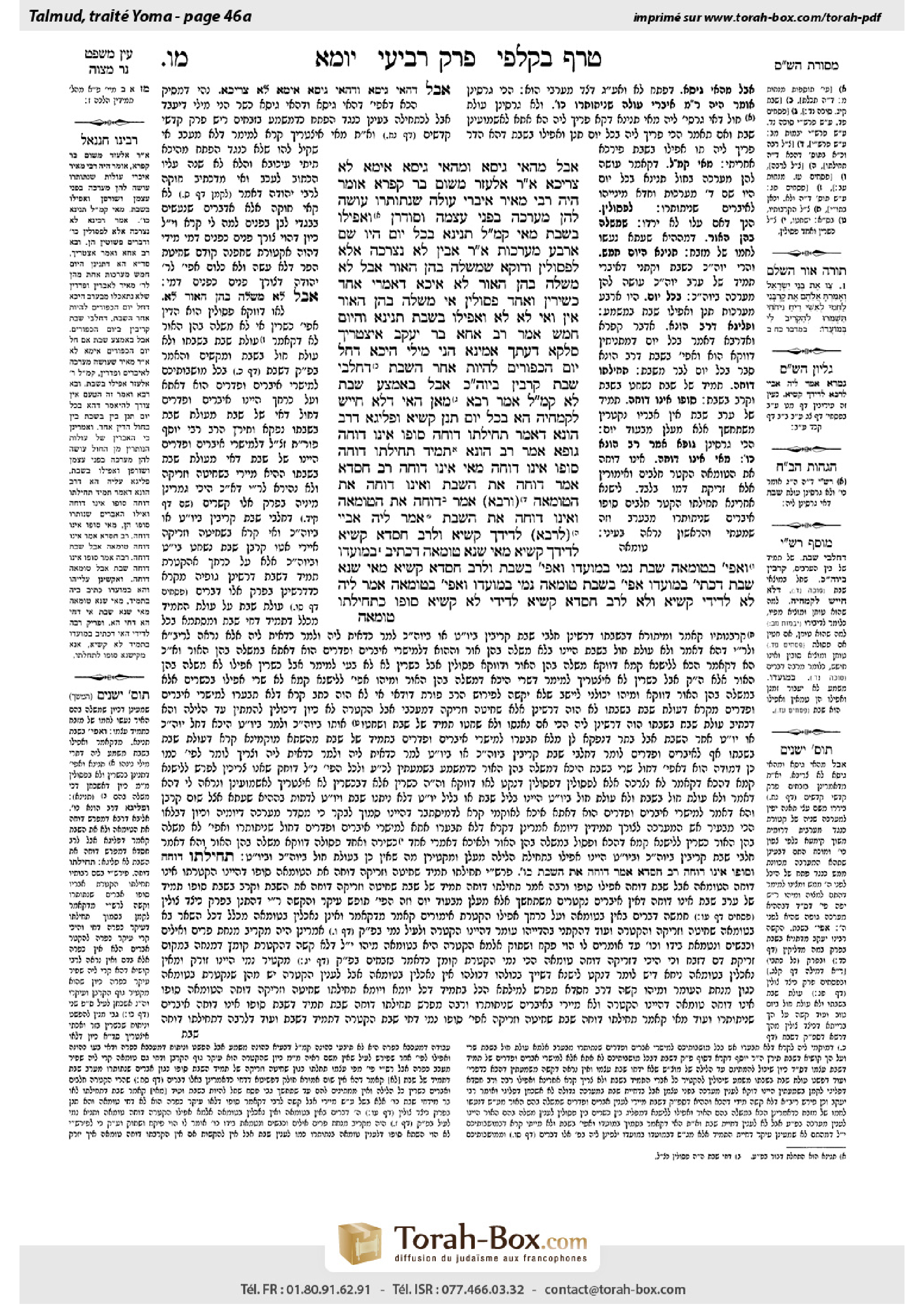
יומא מ״ו א · Aramaic and Hebrew text
אֲבָל מֵהַאי גִּיסָא וּמֵהַאי גִּיסָא אֵימָא לָא, צְרִיכָא.
אָמַר רַבִּי אֶלְעָזָר מִשּׁוּם בַּר קַפָּרָא, אוֹמֵר הָיָה רַבִּי מֵאִיר: אֵיבְרֵי עוֹלָה שֶׁנִּתּוֹתְרוּ — עוֹשֶׂה לָהֶן מַעֲרָכָה בִּפְנֵי עַצְמָהּ וְסוֹדְרָן, וַאֲפִילּוּ בְּשַׁבָּת.
מַאי קָא מַשְׁמַע לַן? תְּנֵינָא: בְּכׇל יוֹם הָיוּ שָׁם אַרְבַּע מַעֲרָכוֹת. אָמַר רַבִּי אָבִין: לֹא נִצְרְכָה אֶלָּא לִפְסוּלִין.
וְדַוְקָא שֶׁמָּשְׁלָה בָּהֶן הָאוּר, אֲבָל לֹא מָשְׁלָה בָּהֶן הָאוּר — לֹא.
אִיכָּא דְּאָמְרִי: אֶחָד כְּשֵׁירִין וְאֶחָד פְּסוּלִין, אִי מָשְׁלָה בָּהֶן הָאוּר — אִין, וְאִי לָא — לָא.
וַאֲפִילּוּ בְּשַׁבָּת — תְּנֵינָא: וְהַיּוֹם חָמֵשׁ!
אָמַר רַב אַחָא בַּר יַעֲקֹב: אִיצְטְרִיךְ, סָלְקָא דַּעְתָּךְ אָמֵינָא הָנֵי מִילֵּי הֵיכָא דְּחָל יוֹם הַכִּפּוּרִים לִהְיוֹת אַחַר הַשַּׁבָּת, דְּחֶלְבֵי שַׁבָּת קְרֵבִין בְּיוֹם הַכִּפּוּרִים, אֲבָל בְּאֶמְצַע שַׁבָּת — לָא, קָא מַשְׁמַע לַן.
אָמַר רָבָא: מַאן הַאי דְּלָא חָיֵישׁ לְקִמְחֵיהּ? הָא ״בְּכׇל יוֹם״ תְּנַן! קַשְׁיָא.
וּפְלִיגָא דְּרַב הוּנָא, דְּאָמַר: תְּחִילָּתוֹ דּוֹחָה, סוֹפוֹ אֵינוֹ דּוֹחֶה.
גּוּפָא. אָמַר רַב הוּנָא: תָּמִיד, תְּחִילָּתוֹ דּוֹחָה, סוֹפוֹ אֵינוֹ דּוֹחֶה.
מַאי אֵינוֹ דּוֹחֶה? רַב חִסְדָּא אָמַר: דּוֹחֶה אֶת הַשַּׁבָּת, וְאֵינוֹ דּוֹחֶה אֶת הַטּוּמְאָה. (וְרָבָא) אָמַר: דּוֹחֶה אֶת הַטּוּמְאָה, וְאֵינוֹ דּוֹחֶה אֶת הַשַּׁבָּת.
אֲמַר לֵיהּ אַבָּיֵי (לְרָבָא): לְדִידָךְ קַשְׁיָא, וּלְרַב חִסְדָּא קַשְׁיָא. לְדִידָךְ קַשְׁיָא: מַאי שְׁנָא טוּמְאָה, דִּכְתִיב ״בְּמוֹעֲדוֹ״ — וַאֲפִילּוּ בְּטוּמְאָה, שַׁבָּת נָמֵי — ״בְּמוֹעֲדוֹ״, וַאֲפִילּוּ בְּשַׁבָּת!
וּלְרַב חִסְדָּא קַשְׁיָא: מַאי שְׁנָא שַׁבָּת, דִּכְתִיב ״בְּמוֹעֲדוֹ״ — אֲפִילּוּ בְּשַׁבָּת, טוּמְאָה נָמֵי — ״בְּמוֹעֲדוֹ״, וַאֲפִילּוּ בְּטוּמְאָה?
אֲמַר לֵיהּ: לָא לְדִידִי קַשְׁיָא, וְלָא לְרַב חִסְדָּא קַשְׁיָא. לְדִידִי לָא קַשְׁיָא: סוֹפוֹ כִּתְחִילָּתוֹ,
Yoma 46a · English translation
but from this side or from that side of the altar, both of which are not directly in front of the Sanctuary’s entrance, I would say that no, the fire may not be taken from there. Therefore, it is necessary to write both terms in order to teach this halakha.
Rabbi Elazar said in the name of bar Kappara: Rabbi Meir would say: With regard to limbs of a burnt-offering that remained on the altar from the previous night and which were not fully consumed, one should make a separate arrangement of wood for them and arrange them upon it to be burned. And this is done even on Shabbat.
What is bar Kappara teaching us when he informs us that Rabbi Meir requires a separate arrangement to be made? Surely, we already learned this in the mishna that cites Rabbi Meir as saying: On every other day, there were four arrangements of wood there, upon the altar. The Gemara answers: Rabbi Avin said: Bar Kappara’s teaching is needed only in order to teach the requirement to set up a fourth arrangement, even though it is only for limbs of disqualified offerings. As certain disqualifications apply only ab initio, if the offering is nevertheless brought upon the altar it should not then be removed. Bar Kappara teaches that Rabbi Meir’s ruling applies in the event that limbs of such an offering were not fully consumed.
The Gemara qualifies this: But this applies specifically when the fire has already taken hold of them and they have begun to burn. But if the fire has not yet taken hold of them, no, a separate arrangement is not made in order to burn them.
There are those who say a different version of this qualification: Both with regard to the limbs of valid offerings and of disqualified offerings, if the fire has already taken hold of them and they have begun to burn, yes, a separate arrangement is made to burn them, but if the fire did not take hold of them, no, a separate arrangement is not made in order to burn them.
Bar Kappara concluded: And this is done even on Shabbat. But surely, we already learned this in the mishna that cites Rabbi Meir as saying: But on this day, on Yom Kippur, there are five. This means that the arrangement for burning any remaining limbs is made also on Yom Kippur, despite the fact that all the Shabbat prohibitions apply.
The Gemara answers: Rav Aḥa bar Ya’akov said: Nevertheless, bar Kappara’s teaching is necessary, for it could enter your mind to say that this applies only when Yom Kippur occurs after Shabbat, i.e., on Sunday. Perhaps only in such a case is a separate arrangement made, based on the accepted law that leftover fats of Shabbat offerings are sacrificed and burned on Yom Kippur. However, if Yom Kippur occurs in the middle of the week, then perhaps no, a separate arrangement is not made in order to burn them. Therefore, bar Kappara teaches us that Rabbi Meir’s ruling applies in all cases.
Rava said: Who is this that does not care about his flour, i.e., he does not truly care about what he says and speaks imprecisely? Did we not learn in the mishna: On every other day. This clearly implies that Rabbi Meir’s ruling applies equally to all days of the week. As such, Rav Aḥa bar Ya’akov’s justification for bar Kappara’s teaching is already implied in Rabbi Meir’s words in the mishna. The Gemara comments: Indeed, it is difficult.
The Gemara comments: Both Rava and bar Kappara hold that a separate arrangement is made even on Shabbat. This disagrees with the opinion of Rav Huna, who said: The beginning of the sacrificial service of the daily offering, i.e., its slaughter, the sprinkling of its blood, and its burning overrides Shabbat; the end of its service, i.e., the burning of its sacrificial parts, does not override Shabbat.
The Gemara analyzes Rav Huna’s statement: Returning to the matter itself: Rav Huna said: The beginning of the sacrificial service of the daily offering overrides a halakha, whereas the end of its service does not override a halakha.
Previously, the Gemara assumed that Rav Huna was discussing the possibility that the sacrifice of the daily offering overrides Shabbat. The Gemara now clarifies if this was his intention: What is meant by saying that the end of its service does not override the halakha? Rav Ḥisda said: Although the end of its service does override Shabbat, it does not override the halakha that it should not be brought in a state of ritual impurity. This is true although the beginning of the sacrificial service of the daily offering may, if necessary, be brought in a state of ritual impurity. And Rabba said: The end of its service overrides only the halakha that it should not be brought in a state of ritual impurity, but it does not override Shabbat.
Abaye said to Rabba: It poses a difficulty to your opinion, and it poses a difficulty to the opinion of Rav Ḥisda. It is difficult to your opinion as follows: What is different about the prohibition of bringing an offering in a state of ritual impurity that the daily offering overrides it? Because it is written with regard to the daily offering “in its season” (Numbers 28:2), to emphasize that it should be brought under all circumstances, even if that means that it will be brought in a state of ritual impurity. But, by that logic, the daily offering should also override Shabbat. Because the term “in its season” emphasizes that it should be brought under all circumstances, this means even on Shabbat.
And it is difficult to the opinion of Rav Ḥisda: What is different about Shabbat that the daily offering overrides it? Because it is written “in its season,” to emphasize that it should be brought under all circumstances, even on Shabbat. But by that logic, the daily offering should also override the prohibition of bringing an offering in a state of ritual impurity. Because the term “in its season” emphasizes that it should be brought under all circumstances, this means even in a state of ritual impurity.
Rabba said to him: It is not difficult to my opinion and it does not pose a difficulty to the opinion of Rav Ḥisda. It is not difficult to my opinion, because I hold that the end of its sacrificial rite is like its beginning.
Yoma 46a · Traduction française (IA)
mais de ce côté-ci ou de l’autre côté de l’autel, qui ne se trouvent ni l’un ni l’autre directement en face de l’entrée du Sanctuaire, j’aurais dit que non, on ne peut pas y prendre le feu. Il est donc nécessaire d’écrire les deux termes pour enseigner cette halakha.
Rabbi Elazar a dit au nom de bar Kappara : Rabbi Meir disait : quant aux membres d’un holocauste restés sur l’autel depuis la nuit précédente et qui n’ont pas été entièrement consumés, on doit préparer pour eux un dispositif de bois distinct et les y disposer afin qu’ils soient brûlés. Cela se fait même le Chabbat.
Que nous enseigne bar Kappara en nous informant que Rabbi Meir exige la préparation d’un dispositif distinct ? N’avons-nous pas déjà appris cela dans la Michna, qui cite Rabbi Meir disant : « Tous les autres jours, il y avait là quatre dispositifs de bois, sur l’autel » ? La Guemara répond : Rabbi Avin a dit : l’enseignement de bar Kappara est nécessaire uniquement pour enseigner qu’il faut préparer un quatrième dispositif, même s’il ne sert qu’aux membres d’offrandes invalides. Comme certaines invalidités ne s’appliquent qu’a priori, si l’offrande est néanmoins apportée sur l’autel, elle ne doit pas en être retirée. Bar Kappara enseigne que la décision de Rabbi Meir s’applique lorsque les membres d’une telle offrande n’ont pas été entièrement consumés.
La Guemara précise : cela s’applique spécifiquement lorsque le feu les a déjà saisis et qu’ils ont commencé à brûler. Mais si le feu ne les a pas encore saisis, non, on ne prépare pas de dispositif distinct pour les brûler.
Certains transmettent une autre version de cette précision : qu’il s’agisse des membres d’offrandes valides ou d’offrandes invalides, si le feu les a déjà saisis et qu’ils ont commencé à brûler, oui, on prépare un dispositif distinct pour les brûler ; mais si le feu ne les a pas saisis, non, on ne prépare pas de dispositif distinct pour les brûler.
Bar Kappara conclut : « Cela se fait même le Chabbat. » Mais n’avons-nous pas déjà appris cela dans la Michna, qui cite Rabbi Meir disant : « Mais ce jour-là, à Yom Kippour, il y en a cinq » ? Cela signifie que le dispositif destiné à brûler les membres restants est également préparé à Yom Kippour, bien que toutes les interdictions du Chabbat s’appliquent.
La Guemara répond : Rav Aḥa bar Ya’akov a dit : néanmoins, l’enseignement de bar Kappara est nécessaire, car on pourrait penser que cela ne s’applique que lorsque Yom Kippour tombe après le Chabbat, c’est-à-dire un dimanche. Peut-être ne prépare-t-on un dispositif distinct que dans ce cas, conformément à la loi admise selon laquelle les graisses restantes des offrandes du Chabbat sont offertes et brûlées à Yom Kippour. Cependant, si Yom Kippour tombe au milieu de la semaine, alors peut-être que non, on ne prépare pas de dispositif distinct pour les brûler. Bar Kappara nous enseigne donc que la décision de Rabbi Meir s’applique dans tous les cas.
Rava a dit : « Qui est donc celui qui ne se soucie pas de sa farine », c’est-à-dire qui ne se soucie pas vraiment de ce qu’il dit et s’exprime avec imprécision ? N’avons-nous pas appris dans la Michna : « Tous les autres jours » ? Cela implique clairement que la décision de Rabbi Meir s’applique de la même manière tous les jours de la semaine. Ainsi, la justification de Rav Aḥa bar Ya’akov concernant l’enseignement de bar Kappara est déjà sous-entendue par les paroles de Rabbi Meir dans la Michna. La Guemara fait remarquer : en effet, c’est difficile.
La Guemara fait remarquer : Rava et bar Kappara soutiennent tous deux qu’on prépare un dispositif distinct même le Chabbat. Cela contredit l’avis de Rav Huna, qui a dit : le début du service sacrificiel de l’offrande quotidienne, c’est-à-dire son abattage, l’aspersion de son sang et la combustion de ses parties sacrificielles, l’emporte sur le Chabbat ; la fin de son service, c’est-à-dire la combustion de ses parties sacrificielles, ne l’emporte pas sur le Chabbat.
La Guemara examine la déclaration de Rav Huna. Revenons à la question elle-même : Rav Huna a dit : le début du service sacrificiel de l’offrande quotidienne l’emporte sur une halakha, tandis que la fin de son service ne l’emporte pas sur une halakha.
Auparavant, la Guemara avait supposé que Rav Huna parlait de la possibilité que le sacrifice de l’offrande quotidienne l’emporte sur le Chabbat. La Guemara précise maintenant si telle était son intention : que signifie dire que la fin de son service ne l’emporte pas sur la halakha ? Rav Ḥisda a dit : bien que la fin de son service l’emporte sur le Chabbat, elle ne l’emporte pas sur la halakha selon laquelle l’offrande ne doit pas être apportée dans un état d’impureté rituelle. Cela reste vrai même si, lorsque cela est nécessaire, le début du service sacrificiel de l’offrande quotidienne peut être accompli dans un état d’impureté rituelle. Et Rabba a dit : la fin de son service l’emporte sur la halakha interdisant de l’apporter dans un état d’impureté rituelle, mais elle ne l’emporte pas sur le Chabbat.
Abaye a dit à Rabba : cela pose une difficulté à ton avis, et aussi à celui de Rav Ḥisda. Voici la difficulté à ton avis : pourquoi l’offrande quotidienne l’emporte-t-elle sur l’interdiction d’apporter une offrande dans un état d’impureté rituelle ? Parce qu’il est écrit au sujet de l’offrande quotidienne « en son temps » (Nombres 28, 2), pour souligner qu’elle doit être apportée en toutes circonstances, même si cela signifie qu’elle sera apportée dans un état d’impureté rituelle. Mais, selon cette logique, l’offrande quotidienne devrait également l’emporter sur le Chabbat. Puisque l’expression « en son temps » souligne qu’elle doit être apportée en toutes circonstances, cela signifie même le Chabbat.
Et voici la difficulté que pose l’avis de Rav Ḥisda : pourquoi l’offrande quotidienne l’emporte-t-elle sur le Chabbat ? Parce qu’il est écrit « en son temps », pour souligner qu’elle doit être apportée en toutes circonstances, même le Chabbat. Mais, selon cette logique, l’offrande quotidienne devrait également l’emporter sur l’interdiction d’apporter une offrande dans un état d’impureté rituelle. Puisque l’expression « en son temps » souligne qu’elle doit être apportée en toutes circonstances, cela signifie même dans un état d’impureté rituelle.
Rabba lui a dit : cela ne pose de difficulté ni à mon avis ni à celui de Rav Ḥisda. Cela ne pose pas de difficulté à mon avis, car je considère que la fin du rite sacrificiel est semblable à son début.
Traduction française générée par IA à partir de l’édition anglaise de Sefaria. Vérifie toujours un passage avec le texte source.
Text from Sefaria: William Davidson Edition - Vocalized Aramaic (CC BY NC); William Davidson Edition - English (CC BY NC).