Yoma 46b: Talmud study for Daf Yomi
Daf Yomi is the daily study of one Talmud folio. Explore 37 tractates with scans, Hebrew text, Sefaria English and AI-generated French translations where annotated.
Passage selection and English or AI-generated French translation are available where the scan has annotations. Daf Study is independent of Torah-Box and Sefaria.
Browse Yoma · יומא · All tractatesYoma 46b text and translations
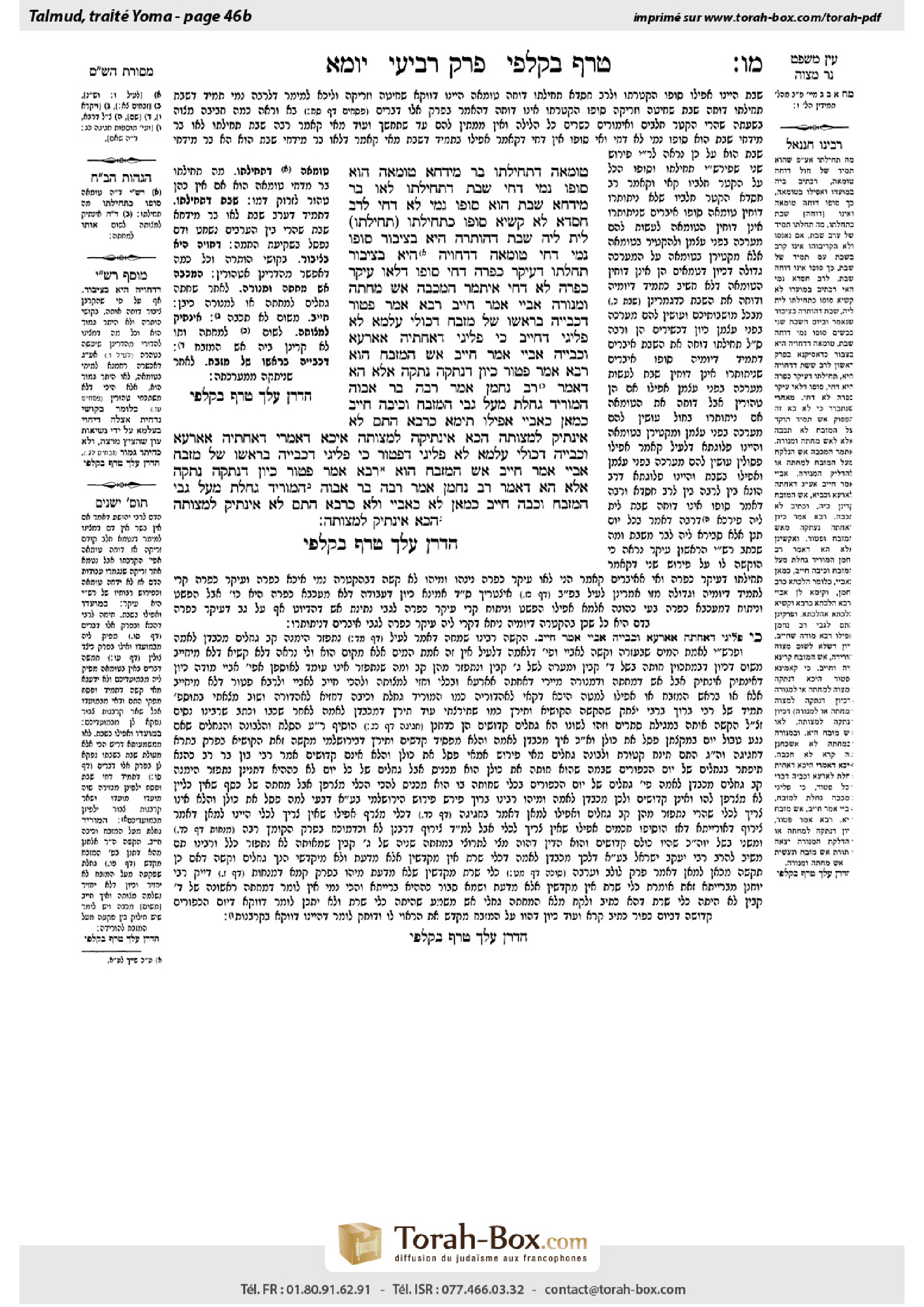
This page of Yoma includes the Aramaic text, an English translation and an AI-generated French translation, alongside the scan above.
יומא מ״ו ב · Aramaic and Hebrew text
טוּמְאָה, דִּתְחִילָּתוֹ בַּר מִידְחֵא טוּמְאָה הוּא — סוֹפוֹ נָמֵי דָּחֵי. שַׁבָּת, דִּתְחִילָּתוֹ לָאו בַּר מִידְחֵא שַׁבָּת הוּא — סוֹפוֹ נָמֵי לָא דָּחֵי.
לְרַב חִסְדָּא לָא קַשְׁיָא: סוֹפוֹ כִּתְחִילָּתוֹ (תְּחִילָּתוֹ) לֵית לֵיהּ. שַׁבָּת דְּהוּתְּרָה הִיא בְּצִיבּוּר — סוֹפוֹ נָמֵי דָּחֵי.
טוּמְאָה, דִּדְחוּיָה הִיא בְּצִיבּוּר, תְּחִלָּתוֹ דְּעִיקַּר כַּפָּרָה — דָּחֵי, סוֹפוֹ דְּלָאו עִיקַּר כַּפָּרָה — לָא דָּחֵי.
אִיתְּמַר: הַמְכַבֶּה אֵשׁ מַחְתָּה וּמְנוֹרָה, אַבָּיֵי אָמַר: חַיָּיב, רָבָא אָמַר: פָּטוּר.
דְּכַבְּיַיהּ בְּרֹאשׁוֹ שֶׁל מִזְבֵּחַ, דְּכוּלֵּי עָלְמָא לָא פְּלִיגִי דְּחַיָּיב. כִּי פְּלִיגִי דְּאַחֲתַיהּ אַאַרְעָא וְכַבְּיַיהּ. אַבָּיֵי אָמַר: חַיָּיב, אֵשׁ הַמִּזְבֵּחַ הוּא, רָבָא אָמַר: פָּטוּר, כֵּיוָן דְּנַתְּקַהּ — נַתְּקַהּ.
אֶלָּא הָא דְּאָמַר רַב נַחְמָן אָמַר רַבָּה בַּר אֲבוּהּ: הַמּוֹרִיד גַּחֶלֶת מֵעַל גַּבֵּי הַמִּזְבֵּחַ וְכִיבָּהּ חַיָּיב, כְּמַאן? כְּאַבַּיֵּי!
אֲפִילּוּ תֵּימָא כְּרָבָא, הָתָם לָא אִינְּתִיק לְמִצְוָתַהּ, הָכָא אִינְּתִיקָה לְמִצְוָתַהּ.
אִיכָּא דְּאָמְרִי.
דְּאַחֲתַיהּ אַאַרְעָא וְכַבְּיַיהּ, דְּכוּלֵּי עָלְמָא לָא פְּלִיגִי דְּפָטוּר. כִּי פְּלִיגִי, דְּכַבְּיַּיהּ בְּרֹאשׁוֹ שֶׁל מִזְבֵּחַ, אַבָּיֵי אָמַר: חַיָּיב, אֵשׁ הַמִּזְבֵּחַ הוּא, רָבָא אָמַר: פָּטוּר, כֵּיוָן דְּנַתְּקַהּ — נַתְּקַהּ.
אֶלָּא הָא דְּאָמַר רַב נַחְמָן אָמַר רַבָּה בַּר אֲבוּהּ: הַמּוֹרִיד גַּחֶלֶת מֵעַל גַּבֵּי הַמִּזְבֵּחַ וְכִבָּהּ — חַיָּיב, כְּמַאן? לָא כְּאַבַּיֵּי וְלָא כְּרָבָא! הָתָם לָא אִינְּתִיק לְמִצְוָתַהּ, הָכָא אִינְּתִיק לְמִצְוָתַהּ.
הֲדַרַן עֲלָךְ טָרַף בַּקַּלְפִּי
Yoma 46b · English translation
Therefore, with regard to overriding the prohibition to bring an offering in a state of ritual impurity, since the beginning of the sacrifice of the daily offering is fit to override the prohibition of offering it in a state of ritual impurity, so too, its end also overrides the prohibition. However, in the case of Shabbat, the beginning of a daily offering of the weekday is not fit to override Shabbat, since by definition it must be brought on its appropriate day. Therefore, its end also does not override Shabbat in the event that limbs remain from Friday’s daily offering.
And it is also not difficult to the opinion of Rav Ḥisda, because he does not hold that its end is like its beginning. Rather, he has the following reasoning: The prohibitions of Shabbat are not merely overridden in the case of a communal offering, but they are actually permitted, such that there is no need to try to avoid performing the necessary labors when sacrificing it. Therefore, its end also overrides Shabbat.
However, in the case of the prohibition to bring an offering in a state of ritual impurity, which is merely overridden in the case of a communal offering, it is preferable to avoid doing so. Therefore, the beginning of its sacrifice, i.e., its slaughter and the sprinkling of its blood, and its burning, which is the essential stage that provides atonement, overrides the prohibition and should be done even in a state of ritual impurity. However, its end, i.e., the burning of the sacrificial parts, which is not the essential stage that provides atonement, does not override the prohibitions.
The Torah prohibits the fire on the altar to be extinguished: “A perpetual fire shall be kept burning on the altar, it shall not go out” (Leviticus 6:6). With regard to this prohibition, an amoraic dispute was stated: With regard to one who extinguishes the fire of the coals that are taken with the coal pan for the incense on Yom Kippur or the fire of the coals that are taken in order to light the candelabrum, Abaye said: He is liable. Rava said: He is not liable.
The Gemara elaborates on the dispute: In a case where one extinguished a coal while still standing upon the top of the altar, everyone agrees that he is liable. This is because the verse explicitly is referring to extinguishing a flame “upon the altar.” When they disagree, it is in a case where he brought the coals down to ground level and extinguished a coal there. Abaye said: He is liable, since it is still considered fire of the altar. Rava said: He is not liable, because once it has been removed from the altar it is considered removed and no longer part of the altar’s fire. Therefore, the prohibition does not apply to it.
The Gemara asks: But if so, with regard to this ruling that Rav Naḥman said that Rabba bar Avuh said: One who takes down a coal from upon the altar and extinguishes it is liable, in accordance with whose opinion is he ruling? Could he possibly be ruling in accordance with the opinion of Abaye? Certainly not. In disputes between Abaye and Rava, the halakha follows Rava.
The Gemara explains: You can even say his ruling is in accordance with the opinion of Rava by making the following distinction: There, in the ruling of Rav Naḥman, the coal was not removed to fulfill its mitzva. Therefore, it is still considered to be part of the fire of the altar and the prohibition still applies. Whereas, here, in the dispute between Abaye and Rava, this is a case of coal that was removed to fulfill its mitzva. Therefore, it is associated with its mitzva and no longer considered the fire of the altar.
There are those who say a different version of the dispute:
In a case where he brought the coals down to the ground and extinguished a coal there, everyone agrees that he is not liable. When they disagree it is in a case where one extinguished a coal while still standing upon the top of the altar. Abaye said: He is liable, since it is still considered fire of the altar. Rava said: He is not liable, because once it has been removed from the altar it is considered removed and no longer part of the altar’s fire. Therefore, the prohibition does not apply to it.
The Gemara asks: But if so, with regard to this ruling that Rav Naḥman said that Rabba bar Avuh said: He who takes down a coal from upon the altar and extinguishes it is liable, in accordance with whose opinion is his ruling? It would appear that it is neither in accordance with the opinion of Abaye, nor in accordance with the opinion of Rava. The Gemara explains: You can even say that his ruling is in accordance with the opinion of Rava by making the following distinction: There, in the ruling of Rav Naḥman, the coal was not removed to fulfill its mitzva; it is therefore still considered to be part of the fire of the altar and the prohibition applies. Whereas, here, in the dispute between Abaye and Rava, this is a case of coal that was removed to fulfill its mitzva, and it is therefore associated with its mitzva and no longer considered the fire of the altar.
Yoma 46b · Traduction française (IA)
Par conséquent, concernant la dérogation à l’interdiction d’apporter un sacrifice en état d’impureté rituelle, puisque le début du sacrifice de l’offrande quotidienne peut déroger à cette interdiction, sa fin y déroge également. En revanche, pour Chabbat, le début du sacrifice d’une offrande quotidienne de jour ouvrable ne peut pas déroger à Chabbat, puisqu’elle doit par définition être apportée le jour qui lui est prescrit. Sa fin ne peut donc pas non plus déroger à Chabbat si des membres de l’offrande quotidienne du vendredi restent à brûler.
Cela ne pose pas non plus de difficulté selon l’opinion de Rav Ḥisda, car il ne considère pas que la fin soit comme le début. Il raisonne plutôt ainsi : les interdictions de Chabbat ne sont pas simplement écartées dans le cas d’un sacrifice communautaire ; les travaux interdits sont véritablement permis, de sorte qu’il n’est pas nécessaire de chercher à éviter d’accomplir les travaux nécessaires à son sacrifice. Par conséquent, sa fin déroge elle aussi à Chabbat.
En revanche, s’agissant de l’interdiction d’apporter un sacrifice en état d’impureté rituelle, qui est simplement écartée dans le cas d’un sacrifice communautaire, il est préférable de l’éviter. Par conséquent, le début de son sacrifice, c’est-à-dire son abattage et l’aspersion de son sang, ainsi que sa combustion, l’étape essentielle qui procure l’expiation, dérogent à l’interdiction et doivent avoir lieu même en état d’impureté rituelle. En revanche, sa fin, c’est-à-dire la combustion des parties sacrificielles, qui n’est pas l’étape essentielle procurant l’expiation, ne déroge pas aux interdictions.
La Torah interdit d’éteindre le feu de l’autel : « Un feu perpétuel brûlera sur l’autel ; il ne s’éteindra pas » (Lévitique 6:6). À propos de cette interdiction, une controverse entre amoraïm a été rapportée : celui qui éteint un charbon pris avec le brasier pour l’encens de Yom Kippour, ou un charbon pris pour allumer le candélabre, est passible, dit Abaye. Rava dit qu’il n’est pas passible.
La Guemara précise la controverse : si quelqu’un éteint un charbon alors qu’il se trouve encore au sommet de l’autel, tous conviennent qu’il est passible, car le verset parle explicitement d’éteindre une flamme « sur l’autel ». Leur désaccord porte sur le cas où il a descendu les charbons au niveau du sol et y a éteint un charbon. Abaye dit qu’il est passible, car le charbon est toujours considéré comme faisant partie du feu de l’autel. Rava dit qu’il n’est pas passible, car dès lors qu’il a été retiré de l’autel, il est considéré comme détaché et ne fait plus partie du feu de l’autel. L’interdiction ne s’applique donc pas à lui.
La Guemara demande : mais alors, concernant cette décision que Rav Naḥman rapporte au nom de Rabba bar Avuh — celui qui descend un charbon de l’autel et l’éteint est passible — selon l’opinion de qui statue-t-il ? Pourrait-il statuer selon l’opinion d’Abaye ? Certainement pas. Dans les controverses entre Abaye et Rava, la halakha suit Rava.
La Guemara explique : on peut même dire que sa décision suit l’opinion de Rava, en faisant la distinction suivante : là, dans la décision de Rav Naḥman, le charbon n’a pas été retiré pour accomplir sa mitsva. Il est donc toujours considéré comme faisant partie du feu de l’autel, et l’interdiction s’applique encore. Ici, en revanche, dans la controverse entre Abaye et Rava, il s’agit d’un charbon retiré pour accomplir sa mitsva. Il est donc associé à cette mitsva et n’est plus considéré comme faisant partie du feu de l’autel.
Certains rapportent une autre version de la controverse :
Si quelqu’un descend les charbons au sol et y éteint un charbon, tous conviennent qu’il n’est pas passible. Leur désaccord porte sur le cas où quelqu’un éteint un charbon alors qu’il se trouve encore au sommet de l’autel. Abaye dit qu’il est passible, car le charbon est toujours considéré comme faisant partie du feu de l’autel. Rava dit qu’il n’est pas passible, car dès lors qu’il a été retiré de l’autel, il est considéré comme détaché et ne fait plus partie du feu de l’autel. L’interdiction ne s’applique donc pas à lui.
La Guemara demande : mais alors, concernant cette décision que Rav Naḥman rapporte au nom de Rabba bar Avuh — celui qui descend un charbon de l’autel et l’éteint est passible — selon l’opinion de qui statue-t-il ? Il semblerait que sa décision ne suive ni l’opinion d’Abaye ni celle de Rava. La Guemara explique : on peut même dire que sa décision suit l’opinion de Rava, en faisant la distinction suivante : là, dans la décision de Rav Naḥman, le charbon n’a pas été retiré pour accomplir sa mitsva ; il est donc toujours considéré comme faisant partie du feu de l’autel et l’interdiction s’applique. Ici, en revanche, dans la controverse entre Abaye et Rava, il s’agit d’un charbon retiré pour accomplir sa mitsva ; il est donc associé à cette mitsva et n’est plus considéré comme faisant partie du feu de l’autel.
Traduction française générée par IA à partir de l’édition anglaise de Sefaria. Vérifie toujours un passage avec le texte source.
Text from Sefaria: William Davidson Edition - Vocalized Aramaic (CC BY NC); William Davidson Edition - English (CC BY NC).