Yoma 47a: Talmud study for Daf Yomi
Daf Yomi is the daily study of one Talmud folio. Explore 37 tractates with scans, Hebrew text, Sefaria English and AI-generated French translations where annotated.
Passage selection and English or AI-generated French translation are available where the scan has annotations. Daf Study is independent of Torah-Box and Sefaria.
Browse Yoma · יומא · All tractatesYoma 47a text and translations
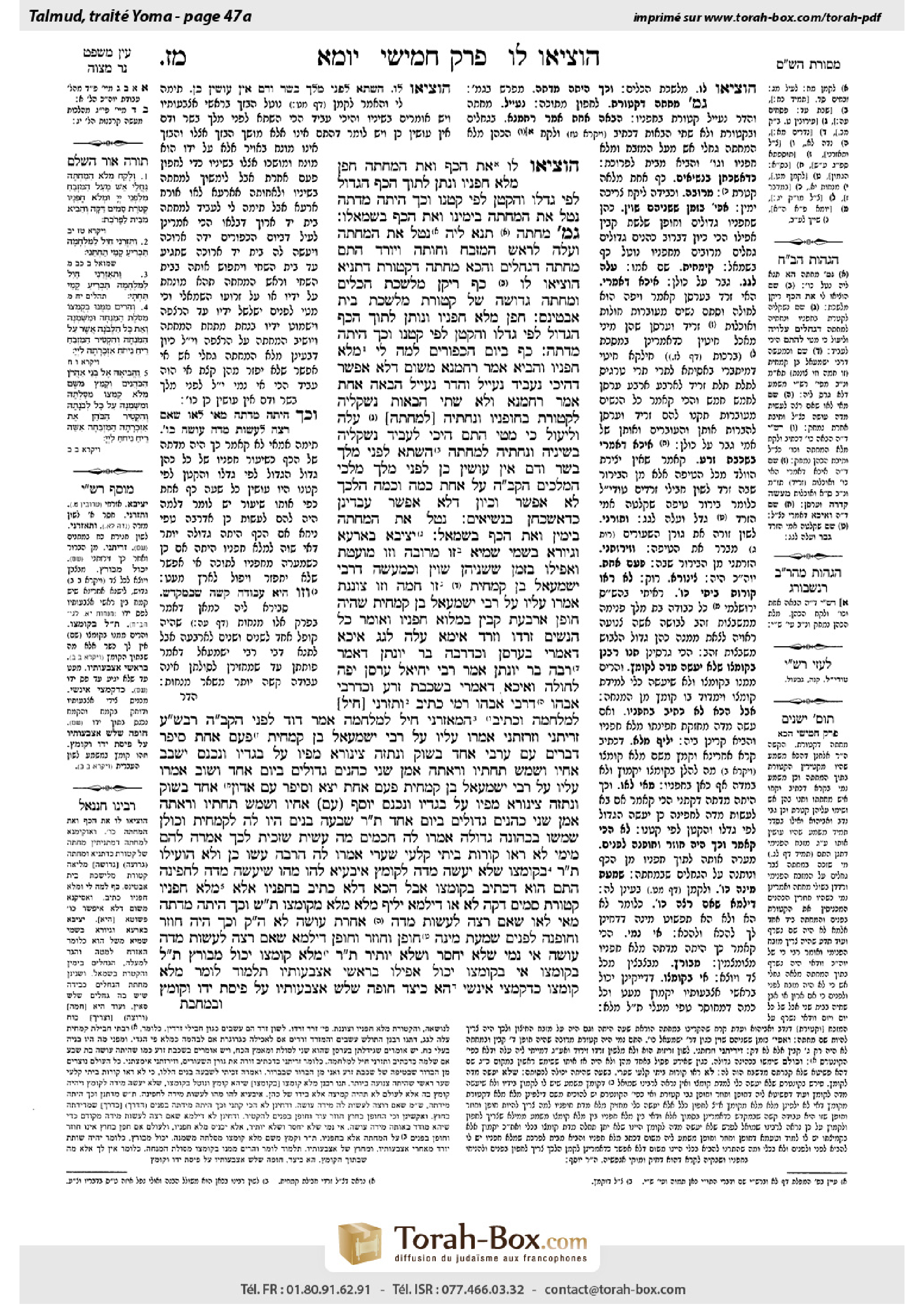
This page of Yoma includes the Aramaic text, an English translation and an AI-generated French translation, alongside the scan above.
יומא מ״ז א · Aramaic and Hebrew text
הוֹצִיאוּ לוֹ אֶת הַכַּף וְאֶת הַמַּחְתָּה, חָפַן מְלֹא חׇפְנָיו וְנָתַן לְתוֹךְ הַכַּף. הַגָּדוֹל לְפִי גׇדְלוֹ, וְהַקָּטָן לְפִי קׇטְנוֹ. וְכָךְ הָיְתָה מִדָּתָהּ. נָטַל אֶת הַמַּחְתָּה בִּימִינוֹ וְאֶת הַכַּף בִּשְׂמֹאלוֹ.
גְּמָ׳ מַחְתָּה? תְּנָא לֵיהּ: נָטַל אֶת הַמַּחְתָּה וְעָלָה לְרֹאשׁ הַמִּזְבֵּחַ וְחוֹתֶה וְיוֹרֵד! הָתָם מַחְתָּה דְגֶחָלִים, וְהָכָא מַחְתָּה דִקְטוֹרֶת, דְּתַנְיָא: הוֹצִיאוּ לוֹ כַּף רֵיקָן מִלִּשְׁכַּת הַכֵּלִים, וּמַחְתָּה גְּדוּשָׁה שֶׁל קְטוֹרֶת מִלִּשְׁכַּת בֵּית אַבְטִינָס.
חָפַן מְלֹא חׇפְנָיו וְנוֹתֵן לְתוֹךְ הַכַּף. הַגָּדוֹל — לְפִי גׇדְלוֹ, וְהַקָּטָן — לְפִי קׇטְנוֹ. וְכָךְ הָיְתָה מִדָּתָהּ. כַּף בְּיוֹם הַכִּפּוּרִים לְמָה לִי? ״מְלֹא חׇפְנָיו וְהֵבִיא״ אָמַר רַחֲמָנָא!
מִשּׁוּם דְּלָא אֶפְשָׁר, דְּהֵיכִי נֶעְבֵּיד? נְעַיֵּיל וַהֲדַר נְעַיֵּיל — הֲבָאָה אַחַת אָמַר רַחֲמָנָא, וְלָא שְׁתֵּי הֲבָאוֹת.
נִשְׁקְלַיהּ לִקְטוֹרֶת בְּחוֹפְנָיו וְנַחֲתַיהּ [לְמַחְתָּה] עֲלַהּ וְלֵיעוּל. כִּי מָטֵי הָתָם הֵיכִי לַעֲבֵיד? נִשְׁקְלַיהּ בְּשִׁינֵּיהּ וְנַחֲתַיהּ לְמַחְתָּה? הַשְׁתָּא לִפְנֵי מֶלֶךְ בָּשָׂר וְדָם אֵין עוֹשִׂין כֵּן, לִפְנֵי מֶלֶךְ מַלְכֵי הַמְּלָכִים הַקָּדוֹשׁ בָּרוּךְ הוּא — עַל אַחַת כַּמָּה וְכַמָּה.
הִלְכָּךְ — לָא אֶפְשָׁר, וְכֵיוָן דְּלָא אֶפְשָׁר — עָבְדִינַן כִּדְאַשְׁכְּחַן בִּנְשִׂיאִים.
נָטַל אֶת הַמַּחְתָּה בְּיָמִין וְאֶת הַכַּף בִּשְׂמֹאל. יַצִּיבָא בְּאַרְעָא וְגִיּוֹרָא בִּשְׁמֵי שְׁמַיָּא!
זוֹ מְרוּבָּה, וְזוֹ מוּעֶטֶת. וַאֲפִילּוּ בִּזְמַן שֶׁשְּׁנֵיהֶן שָׁוִין, וּכְמַעֲשֶׂה דְּרַבִּי יִשְׁמָעֵאל בֶּן קִמְחִית, זוֹ — חַמָּה, וְזוֹ — צוֹנֶנֶת.
אָמְרוּ עָלָיו עַל רַבִּי יִשְׁמָעֵאל בֶּן קִמְחִית שֶׁהָיָה חוֹפֵן אַרְבַּעַת קַבִּין בִּמְלוֹא חׇפְנָיו, וְאוֹמֵר: כׇּל הַנָּשִׁים [זֶרֶד] זָרְדוּ, וְזֶרֶד אִימָּא עָלָה לַגָּג. אִיכָּא דְּאָמְרִי: בְּעַרְסָן, וְכִדְרַבָּה בַּר יוֹנָתָן. דְּאָמַר רַבָּה בַּר יוֹנָתָן אָמַר רַבִּי יְחִיאֵל: עַרְסָן יָפֶה לַחוֹלֶה.
וְאִיכָּא דְּאָמְרִי בְּשִׁכְבַת זֶרַע, וְכִדְרַבִּי אֲבָהוּ. דְּרַבִּי אֲבָהוּ רָמֵי, כְּתִיב: ״וַתַּזְרֵנִי [חַיִל] לַמִּלְחָמָה״, וּכְתִיב: ״הַמְאַזְּרֵנִי חַיִל״? אָמַר דָּוִד לִפְנֵי הַקָּדוֹשׁ בָּרוּךְ הוּא: רִבּוֹנוֹ שֶׁל עוֹלָם! זֵרִיתַנִי וְזֵרַזְתַּנִי.
אָמְרוּ עָלָיו עַל רַבִּי יִשְׁמָעֵאל בֶּן קִמְחִית: פַּעַם אַחַת סִיפֵּר דְּבָרִים עִם עֲרָבִי אֶחָד בַּשּׁוּק, וְנִתְּזָה צִינּוֹרָא מִפִּיו עַל בְּגָדָיו. וְנִכְנַס יְשֵׁבָב אָחִיו וְשִׁמֵּשׁ תַּחְתָּיו. וְרָאֲתָה אִמָּן שְׁנֵי כֹּהֲנִים גְּדוֹלִים בְּיוֹם אֶחָד.
וְשׁוּב אָמְרוּ עָלָיו עַל רַבִּי יִשְׁמָעֵאל בֶּן קִמְחִית: פַּעַם אַחַת יָצָא וְסִיפֵּר עִם הֶגְמוֹן אֶחָד בַּשּׁוּק, וְנִתְּזָה צִינּוֹרָא מִפִּיו עַל בְּגָדָיו. וְנִכְנַס יוֹסֵף (עִם) אָחִיו וְשִׁמֵּשׁ תַּחְתָּיו, וְרָאֲתָה אִמָּן שְׁנֵי כֹּהֲנִים גְּדוֹלִים בְּיוֹם אֶחָד.
תָּנוּ רַבָּנַן: שִׁבְעָה בָּנִים הָיוּ לָהּ לְקִמְחִית, וְכוּלָּן שִׁמְּשׁוּ בִּכְהוּנָּה גְּדוֹלָה. אָמְרוּ לָהּ חֲכָמִים: מָה עָשִׂית שֶׁזָּכִית לְכָךְ? אָמְרָה לָהֶם: מִיָּמַי לֹא רָאוּ קוֹרוֹת בֵּיתִי קַלְעֵי שְׂעָרִי. אָמְרוּ לָהּ: הַרְבֵּה עָשׂוּ כֵּן וְלֹא הוֹעִילוּ.
תָּנוּ רַבָּנַן: בְּקוּמְצוֹ, שֶׁלֹּא יַעֲשֶׂה מִדָּה לַקּוֹמֶץ. אִיבַּעְיָא לְהוּ: מַהוּ שֶׁיַּעֲשֶׂה מִדָּה לַחֲפִינָה?
הָתָם הוּא דִכְתִיב ״בְּקוּמְצוֹ״: אֲבָל הָכָא דְּלָא כְּתִיב ״בְּחׇפְנָיו״, אֶלָּא: ״מְלֹא חׇפְנָיו קְטוֹרֶת סַמִּים דַּקָּה״, לָא. אוֹ דִילְמָא יָלֵיף ״מְלֹא״ ״מְלֹא״ מִקּוּמְצוֹ?
תָּא שְׁמַע: ״וְכָךְ הָיְתָה מִדָּתָהּ״, מַאי לָאו, שֶׁאִם רָצָה לַעֲשׂוֹת מִדָּה אַחֶרֶת עוֹשֶׂה? לֹא, הָכִי קָאָמַר: וְכָךְ הָיָה חוֹזֵר וְחוֹפְנָהּ לִפְנִים.
שָׁמְעַתְּ מִינַּהּ: חוֹפֵן וְחוֹזֵר וְחוֹפֵן!
דִּילְמָא: שֶׁאִם רָצָה לַעֲשׂוֹת מִדָּה — עוֹשֶׂה. אִי נָמֵי: שֶׁלֹּא יְחַסֵּר וְשֶׁלֹּא יוֹתִיר.
תָּנוּ רַבָּנַן: ״מְלֹא קוּמְצוֹ״. יָכוֹל מְבוֹרָץ — תַּלְמוּד לוֹמַר: ״בְּקוּמְצוֹ״. אִי בְּקוּמְצוֹ, יָכוֹל אֲפִילּוּ בְּרָאשֵׁי אֶצְבְּעוֹתָיו, תַּלְמוּד לוֹמַר: ״מְלֹא קוּמְצוֹ״, כִּדְקָמְצִי אִינָשֵׁי. הָא כֵּיצַד — חוֹפֶה שְׁלֹשׁ אֶצְבְּעוֹתָיו עַל פִּיסַּת יָדוֹ וְקוֹמֵץ.
Yoma 47a · English translation
MISHNA: They brought out the spoon and the coal pan to the High Priest so he may perform the service of the incense. He scoops his handfuls from the incense and places it into the spoon. The High Priest with large hands fills the spoon with incense in an amount corresponding to the large size of his hands, and the High Priest with small hands fills the spoon with incense in an amount corresponding to the small size of his hands. And this was the measure of the spoon, i.e., it was made to correspond to the size of his hands. He took the coal pan in his right hand and the spoon in his left hand.
GEMARA: The Gemara expresses surprise at the statement of the mishna. In an earlier mishna, the tanna already taught that the High Priest must bring the coal pan: He takes a coal pan and ascends to the top of the altar and rakes and descends. Why does the tanna mention the taking of the coal pan again? The Gemara explains: There the mishna deals with the coal pan of burning coals, and here the mishna is referring to the coal pan of incense, which he would later scoop out. As it was explicitly taught in a baraita: They brought out an empty spoon for him from the chamber of vessels, and a coal pan heaped with incense from the Chamber of the House of Avtinas.
§ The mishna taught: He scoops his handfuls from the incense and places it into the spoon. The High Priest with large hands fills the spoon with incense corresponding to the large size of his hands, and the High Priest with small hands fills the spoon corresponding to the small size of his hands, and this was the measure of the spoon, according to the size of his hands. The Gemara asks: Why do I need a spoon on Yom Kippur? After all, the Merciful One states: “And he shall take a coal pan full of coals of fire from off the altar from before the Lord, and his hands full of sweet incense beaten small and bring it within the veil” (Leviticus 16:12). This verse suggests that the handfuls are brought by hand rather than in a vessel.
The Gemara answers: The High Priest uses a spoon because it is impossible to perform the service otherwise. The Gemara elaborates: As what should we do? Let him bring in the coal pan and then bring in the incense? The Merciful One states one act of bringing for the coals and the incense, and not two acts of bringing.
Instead, let him take the incense by his handfuls and place the coal pan on top of his two handfuls and enter, carrying it all in one go. This suggestion is also impractical, as when he arrives there, in the Holy of Holies, what should he do? How can the High Priest put down the coal pan where it is? Let him take the coal pan in his teeth and lower it. Now, before a king of flesh and blood one would not do so, as it is disrespectful. All the more so, one would not act in this manner before the King of kings, the Holy One, Blessed be He.
The Gemara concludes: Therefore, it is impossible for the High Priest to behave in another way, and since it is impossible to act in any other manner, he acts as we find with regard to the sacrifices of the princes during the dedication of the Tabernacle. On that occasion, the princes brought spoons filled with incense: “One golden spoon of ten shekels full of incense” (Numbers 7:14).
§ The mishna taught that the High Priest took the coal pan in his right hand and the spoon in his left hand. The Gemara questions this arrangement by citing a well-known maxim: The native is on the ground and the stranger is in the heavens; i.e., this is the opposite of what one would expect. The main component of the mitzva is the incense, while the coal pan is required only for burning the incense. Consequently, the High priest should carry the spoon, which contains the main component of the service, in his right hand, and the accessory in his left hand.
The Gemara explains: The service is performed in this manner for reasons of comfort, as this coal pan is greater in weight, since it holds the coals, and that spoon of incense weighs less. And even when the two of them are equal, when the spoon contains three kav of incense like the action of Rabbi Yishmael ben Kimḥit, who could hold several kav in his exceptionally large hands, nevertheless, this coal pan is hot and must be held carefully in the right hand, and that spoon of incense is cold and is easily carried in the left.
§ Since the Gemara has mentioned Rabbi Yishmael ben Kimḥit, it discusses him further. They said about Rabbi Yishmael ben Kimḥit that his hands were so large that he would scoop up four kav, which he would hold by his handfuls, and say: All the women selected the best they could for their children, but the selection of my mother rose to the roof, i.e., my mother chose the best. Rabbi Yishmael ben Kimḥit is referring to himself, as he matured to a great height and stature. Some say he was referring to his mother’s selection of flour, in accordance with the statement of Rabba bar Yonatan. As Rabba bar Yonatan said that Rabbi Yeḥiel said: Flour is beneficial and healthy for the sick. Since his mother ate this flour when she was pregnant with him, her son grew heartily.
And some say this reference to selection is a euphemism for semen, in accordance with a statement of Rabbi Abbahu, as Rabbi Abbahu raised a contradiction between two verses. It is written: “For You have girded me [vatazreni] with strength for battle” (II Samuel 22:40), and it is written in a parallel verse: “Who girds me [hame’azreni] with strength” (Psalms 18:33). What is the difference between these two expressions? David said before the Holy One, Blessed be He: Master of the Universe: You selected me [zeritani] with the best drop of semen that my mother absorbed, with which, You fashioned me [zeraztani] within her. This accounts for the variant forms of this expression.
The Gemara continues to discuss Rabbi Yishmael ben Kimḥit. They said about Rabbi Yishmael ben Kimḥit: Once he was talking to a certain Arab in the market on Yom Kippur, and a drop of saliva sprayed from the Arab’s mouth onto the clothes of Rabbi Yishmael, who was the High Priest at the time. This spittle rendered him ritually impure by rabbinic law, like the ritual impurity of a zav, preventing him from serving in the Temple. And his brother Yeshevav entered and served as High Priest on that day in his stead. And, consequently, their mother saw two of her sons serving as High Priests on a single day.
And they further said about Rabbi Yishmael ben Kimḥit: Once he went out and talked to a certain officer [hegmon] in the market, and a drop of saliva sprayed from the officer’s mouth onto the clothes of Rabbi Yishmael, and his brother Yosef entered and served as High Priest in his stead. And, again, their mother saw two of her sons serving as High Priests on a single day.
The Sages taught in a baraita: Kimḥit had seven sons, and they all served in the office of the High Priesthood, as High Priests or as his substitute. The Sages said to her: What good deeds did you perform to merit this? She said to them: In all my days, the beams of my house never saw the braids of my hair, as she was extremely modest and was strict about covering her hair even inside her own house. They said to her: Many women did so and did not succeed to such a degree; you must have been granted a special gift from God.
§ The Sages taught: “And he shall take up from it his handful, of the fine flour of the meal-offering, and of its oil” (Leviticus 6:8). This verse teaches that he should not measure an amount for the handful of a meal-offering with a utensil, but he should separate it directly by hand. A dilemma was raised before the Sages: What is the halakha as to whether the High Priest may measure an amount for the handful of incense? Must the incense also be scooped by hand?
The Gemara explains the two sides of the dilemma: Perhaps there, in the case of the handful of a meal-offering, it is different, as it is written “in his handful,” which indicates that he must use his hand rather than a vessel. However here, where it is not written: In his hands, but “and his hands full of sweet incense beaten small” (Leviticus 16:12), perhaps this teaches that the handfuls of incense need not be taken directly by hand, and the High Priest may use a vessel to scoop out the required amount. Or perhaps this halakha is derived by means of a verbal analogy between “full” and “full,” from “his handful,” which is stated regarding the meal-offering. If this verbal analogy is accepted, the High Priest may likewise scoop the incense only by hand.
The Gemara suggests: Come and hear an answer from the mishna: And this was the measure of the spoon. What, is it not correct to infer from the mishna that although the required measure is a handful, the High Priest is not obligated to scoop with his hand, and if he wanted to measure a different amount, he may measure the incense with a vessel? The Gemara rejects this contention: No, this is what the mishna said; this is what it means: And so too, the High Priest would return and scoop the incense inside the Holy of Holies in precisely the same manner.
The Gemara asks: If so, I can learn from this that the High Priest scoops the incense, and again scoops. That is, after scooping once, the High Priest repeats the action and scoops again in the Holy of Holies. This issue is subject to a dispute in the Gemara below.
The Gemara rejects this claim: No; perhaps the mishna indeed means that if he wanted to measure a different amount, he may measure the incense with a vessel. The language of the mishna does not conclusively prove which interpretation is correct, and it is possible that the Gemara’s previous inference from the mishna is accurate. Consequently, the issue of whether or not the High Priest scoops incense a second time in the Holy of Holies cannot be considered resolved. Alternatively, the mishna may mean that the High Priest must take neither less nor more, and therefore this statement has no bearing on the dispute with regard to his scooping.
§ The Sages taught: “His handfuls” (Leviticus 2:2). I might have thought it should be overflowing from the handful, and therefore the verse states: “His handful” (Leviticus 6:8), which indicates a precise amount. If the halakha is based solely on the phrase “his handful,” I might have thought the priest may pinch a small amount even with just his fingertips, not with his entire finger. Therefore, the verse states: “His handfuls” (Leviticus 2:2), meaning as people usually take a handful, i.e., with their whole hand. How should he perform this service? He scoops by closing his three fingers over the palm of his hand, and takes a handful from the flour of the meal-offering.
Yoma 47a · Traduction française (IA)
MICHNA : On apportait au Grand Prêtre la cuillère et la pelle à braises afin qu’il accomplisse le service de l’encens. Il prélevait l’encens à pleines mains et le déposait dans la cuillère. Le Grand Prêtre qui avait de grandes mains remplissait la cuillère d’une quantité d’encens correspondant à la grande taille de ses mains, et celui qui avait de petites mains la remplissait d’une quantité correspondant à la petite taille de ses mains. Telle était la mesure de la cuillère : elle était adaptée à la taille de ses mains. Il prenait la pelle à braises dans sa main droite et la cuillère dans sa main gauche.
GUEMARA : La Guemara s’étonne de l’énoncé de la Michna. Dans une Michna précédente, le tanna avait déjà enseigné que le Grand Prêtre devait apporter la pelle à braises : « Il prend une pelle à braises, monte au sommet de l’autel, rassemble les braises et redescend. » Pourquoi le tanna mentionne-t-il de nouveau le fait de prendre la pelle à braises ? La Guemara explique : Là, la Michna traite de la pelle à braises ardentes ; ici, elle parle de la pelle à braises destinée à l’encens, qu’il devait ensuite prélever. Comme cela a été explicitement enseigné dans une baraïta : On lui apportait une cuillère vide depuis la chambre des ustensiles, et une pelle à braises remplie d’encens depuis la chambre de la Maison d’Avtinas.
§ La Michna a enseigné : Il prélevait l’encens à pleines mains et le déposait dans la cuillère. Le Grand Prêtre qui avait de grandes mains remplissait la cuillère d’une quantité d’encens correspondant à la grande taille de ses mains, et celui qui avait de petites mains la remplissait d’une quantité correspondant à la petite taille de ses mains ; telle était la mesure de la cuillère, adaptée à la taille de ses mains. La Guemara demande : Pourquoi fallait-il une cuillère à Yom Kippour ? Après tout, le Miséricordieux dit : « Il prendra une pelle à braises remplie de charbons ardents de l’autel, devant le Seigneur, ainsi que ses mains pleines d’encens parfumé finement pilé, et il l’apportera à l’intérieur du voile » (Lévitique 16:12). Ce verset laisse entendre que l’encens devait être apporté à pleines mains, et non dans un récipient.
La Guemara répond : Le Grand Prêtre se sert d’une cuillère parce qu’il est impossible d’accomplir le service autrement. La Guemara précise : Que pourrait-on faire ? Qu’il fasse entrer la pelle à braises, puis l’encens ? Le Miséricordieux prescrit une seule entrée pour les braises et l’encens, et non deux.
On pourrait plutôt proposer qu’il prenne l’encens à pleines mains, pose la pelle à braises sur ses deux mains et entre en portant le tout en une seule fois. Cette solution est également impraticable : une fois arrivé là-bas, dans le Saint des Saints, que devrait-il faire ? Comment le Grand Prêtre pourrait-il déposer la pelle à braises ? Qu’il la prenne entre ses dents et la dépose. Or, on n’agirait pas ainsi devant un roi de chair et de sang, car ce serait irrespectueux. À plus forte raison, on ne se comporterait pas ainsi devant le Roi des rois, le Saint, béni soit-Il.
La Guemara conclut : Le Grand Prêtre ne peut donc pas procéder autrement ; puisqu’il est impossible d’agir d’une autre manière, il agit comme on le voit dans le cas des sacrifices des princes lors de l’inauguration du Tabernacle. À cette occasion, les princes apportèrent des cuillères remplies d’encens : « Une cuillère d’or de dix sicles, pleine d’encens » (Nombres 7:14).
§ La Michna a enseigné que le Grand Prêtre prenait la pelle à braises dans sa main droite et la cuillère dans sa main gauche. La Guemara met en question cette disposition en citant un adage bien connu : « L’autochtone est à terre et l’étranger au ciel » ; autrement dit, c’est le contraire de ce à quoi on s’attendrait. L’élément principal de la mitsva est l’encens, tandis que la pelle à braises n’est nécessaire que pour le brûler. Par conséquent, le Grand Prêtre devrait porter dans sa main droite la cuillère contenant l’élément principal du service, et dans sa main gauche l’ustensile accessoire.
La Guemara explique : Le service est accompli de cette manière par commodité, car cette pelle à braises est plus lourde, puisqu’elle contient les braises, tandis que la cuillère d’encens pèse moins. Même lorsque les deux ont le même poids, comme lorsque la cuillère contient trois kav d’encens, selon la pratique de Rabbi Yishmaël ben Kimḥit, qui pouvait tenir plusieurs kav dans ses mains exceptionnellement grandes, la pelle à braises est chaude et doit être tenue avec précaution dans la main droite, tandis que la cuillère d’encens est froide et se porte facilement dans la main gauche.
§ Puisque la Guemara a mentionné Rabbi Yishmaël ben Kimḥit, elle parle davantage de lui. On disait de Rabbi Yishmaël ben Kimḥit que ses mains étaient si grandes qu’il pouvait prélever quatre kav d’encens à pleines mains et dire : « Toutes les femmes ont choisi ce qu’elles pouvaient de mieux pour leurs enfants, mais le choix de ma mère a atteint le toit », c’est-à-dire que ma mère a choisi ce qu’il y avait de meilleur. Rabbi Yishmaël ben Kimḥit parlait de lui-même, car il avait grandi en taille et en stature. Certains disent qu’il parlait du choix de farine de sa mère, conformément à l’enseignement de Rabba bar Yonatan. En effet, Rabba bar Yonatan a dit au nom de Rabbi Yeḥiel : La farine est bénéfique et bonne pour la santé des malades. Comme sa mère en avait mangé alors qu’elle était enceinte de lui, son fils avait grandi vigoureusement.
Certains disent que cette allusion au choix est un euphémisme pour désigner le sperme, conformément à l’enseignement de Rabbi Abbahu, car Rabbi Abbahu a relevé une contradiction entre deux versets. Il est écrit : « Car Tu m’as ceint [vatazreni] de force pour le combat » (II Samuel 22:40), et, dans un verset parallèle, il est écrit : « Celui qui me ceint [hame’azreni] de force » (Psaumes 18:33). Quelle est la différence entre ces deux expressions ? David dit devant le Saint, béni soit-Il : « Maître de l’Univers, Tu m’as choisi [zeritani] à partir de la meilleure goutte de sperme que ma mère a absorbée, avec laquelle Tu m’as façonné [zeraztani] en elle. » Cela explique les formes différentes de cette expression.
La Guemara continue de parler de Rabbi Yishmaël ben Kimḥit. On disait de lui qu’un jour, alors qu’il parlait à un Arabe sur le marché à Yom Kippour, une goutte de salive jaillit de la bouche de l’Arabe et atteignit les vêtements de Rabbi Yishmaël, qui était alors le Grand Prêtre. Cette salive le rendit rituellement impur selon la loi rabbinique, à l’instar de l’impureté rituelle d’un zav, l’empêchant d’officier dans le Temple. Son frère Yeshevav entra alors et officia comme Grand Prêtre à sa place ce jour-là. Leur mère vit ainsi deux de ses fils officier comme Grands Prêtres au cours d’une même journée.
On disait également de Rabbi Yishmaël ben Kimḥit qu’un jour, alors qu’il était sorti et parlait sur le marché à un dignitaire [hegmon], une goutte de salive jaillit de la bouche de celui-ci et atteignit les vêtements de Rabbi Yishmaël. Son frère Yosef entra alors et officia comme Grand Prêtre à sa place. Là encore, leur mère vit deux de ses fils officier comme Grands Prêtres au cours d’une même journée.
Les Sages ont enseigné dans une baraïta : Kimḥit avait sept fils, et ils ont tous exercé la fonction de Grand Prêtre, comme Grands Prêtres ou comme remplaçants de celui-ci. Les Sages lui demandèrent : « Quelles bonnes actions avez-vous accomplies pour mériter cela ? » Elle leur répondit : « De toute ma vie, les poutres de ma maison n’ont jamais vu les tresses de mes cheveux », car elle était extrêmement pudique et veillait à se couvrir les cheveux même dans sa propre maison. Ils lui dirent : « Beaucoup de femmes ont fait de même sans obtenir un tel résultat ; tu as dû recevoir un don particulier de Dieu. »
§ Les Sages ont enseigné : « Il en prélèvera une pleine poignée, de la fleur de farine de l’offrande de céréales et de son huile » (Lévitique 6:8). Ce verset enseigne qu’il ne doit pas mesurer à l’aide d’un ustensile la quantité à prélever pour la poignée de l’offrande de céréales, mais la prélever directement à la main. Les Sages ont soulevé une question : Quelle est la halakha concernant la possibilité, pour le Grand Prêtre, de mesurer la quantité d’encens qu’il doit prélever à pleines mains ? L’encens doit-il lui aussi être prélevé à la main ?
La Guemara expose les deux aspects de la question : Peut-être que, dans le cas de la poignée prélevée sur une offrande de céréales, la règle est différente, car il est écrit « dans sa poignée », ce qui indique qu’il doit se servir de sa main plutôt que d’un récipient. Mais ici, où il n’est pas écrit « dans ses mains », mais « ses mains pleines d’encens parfumé finement pilé » (Lévitique 16:12), cela enseigne peut-être que l’encens n’a pas nécessairement à être prélevé directement à la main et que le Grand Prêtre peut utiliser un récipient pour en prendre la quantité requise. Ou peut-être cette halakha est-elle déduite par une analogie verbale entre « plein » et « plein », à partir de « sa poignée », expression employée au sujet de l’offrande de céréales. Si cette analogie verbale est admise, le Grand Prêtre ne peut, de même, prélever l’encens qu’à la main.
La Guemara propose : Écoutons une réponse tirée de la Michna : « Telle était la mesure de la cuillère. » N’est-il pas juste d’en déduire que, bien que la quantité requise soit une poignée, le Grand Prêtre n’est pas tenu de la prélever à la main et que, s’il voulait mesurer une quantité différente, il pouvait mesurer l’encens à l’aide d’un ustensile ? La Guemara rejette cette déduction : Non, voici ce que disait la Michna, voici ce qu’elle signifie : « De la même manière, le Grand Prêtre prélevait de nouveau l’encens à l’intérieur du Saint des Saints. »
La Guemara demande : Dans ce cas, peut-on en déduire que le Grand Prêtre prélevait l’encens, puis le prélevait une seconde fois ? Autrement dit, après l’avoir prélevé une première fois, le Grand Prêtre répétait l’action et en prélevait de nouveau dans le Saint des Saints. Cette question fait l’objet d’une discussion plus loin dans la Guemara.
La Guemara rejette cette affirmation : Non ; peut-être la Michna veut-elle effectivement dire que, s’il voulait mesurer une quantité différente, il pouvait mesurer l’encens à l’aide d’un ustensile. La formulation de la Michna ne permet pas de déterminer avec certitude quelle interprétation est correcte, et il est possible que la déduction précédente de la Guemara à partir de la Michna soit exacte. Par conséquent, la question de savoir si le Grand Prêtre prélevait ou non une seconde fois l’encens dans le Saint des Saints ne peut être considérée comme résolue. Autre possibilité : la Michna peut vouloir dire que le Grand Prêtre ne devait en prendre ni moins ni plus ; cette déclaration n’a donc aucune incidence sur la discussion concernant le fait qu’il prélève l’encens.
§ Les Sages ont enseigné : « Ses poignées » (Lévitique 2:2). J’aurais pu penser que la poignée devait déborder ; c’est pourquoi le verset dit : « Sa poignée » (Lévitique 6:8), ce qui indique une quantité précise. Si la halakha reposait uniquement sur l’expression « sa poignée », j’aurais pu penser que le prêtre pouvait en pincer une petite quantité du bout des doigts, sans utiliser toute sa main. C’est pourquoi le verset dit : « Ses poignées » (Lévitique 2:2), c’est-à-dire comme on prend habituellement une poignée, avec toute la main. Comment doit-il accomplir ce service ? Il prélève la farine en repliant ses trois doigts sur la paume de sa main, et prend une poignée de la farine de l’offrande de céréales.
Traduction française générée par IA à partir de l’édition anglaise de Sefaria. Vérifie toujours un passage avec le texte source.
Text from Sefaria: William Davidson Edition - Vocalized Aramaic (CC BY NC); William Davidson Edition - English (CC BY NC).