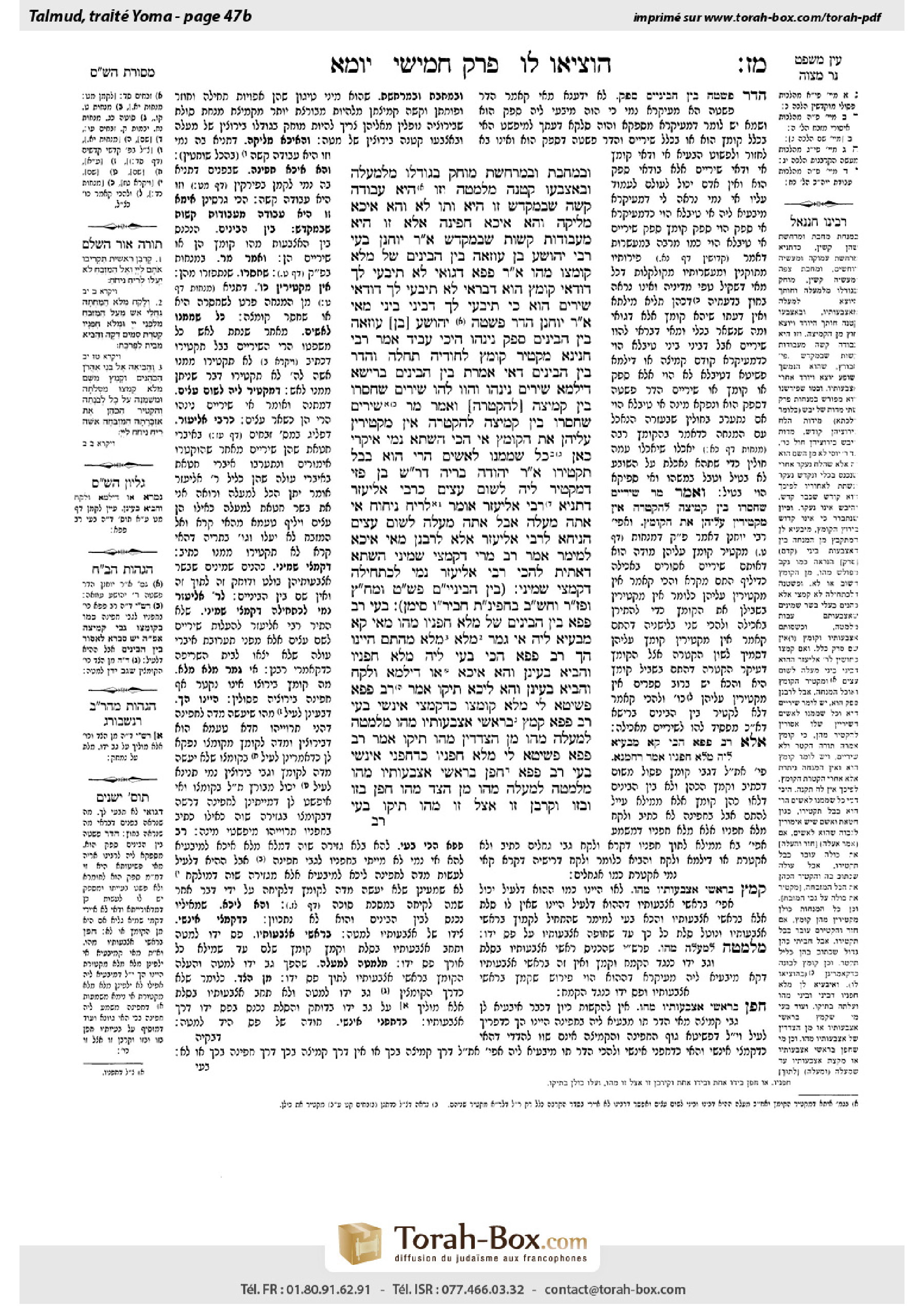
Yoma 47b: Talmud study for Daf Yomi
Daf Yomi is the daily study of one Talmud folio. Explore 37 tractates with scans, Hebrew text, Sefaria English and AI-generated French translations where annotated.
Passage selection and English or AI-generated French translation are available where the scan has annotations. Daf Study is independent of Torah-Box and Sefaria.
Browse Yoma · יומא · All tractatesYoma 47b text and translations
This page of Yoma includes the Aramaic text, an English translation and an AI-generated French translation, alongside the scan above.
יומא מ״ז ב · Aramaic and Hebrew text
וּבְמַחֲבַת וּבְמַרְחֶשֶׁת, מוֹחֵק בְּגוּדָלוֹ מִלְּמַעְלָה, וּבְאֶצְבָּעוֹ קְטַנָּה מִלְּמַטָּה. וְזוֹ הִיא עֲבוֹדָה קָשָׁה שֶׁבַּמִּקְדָּשׁ. זוֹ הִיא וְתוּ לָא? וְהָא אִיכָּא מְלִיקָה, וְהָא אִיכָּא חֲפִינָה! אֶלָּא: זוֹ הִיא מֵעֲבוֹדוֹת קָשׁוֹת שֶׁבַּמִּקְדָּשׁ.
אָמַר רַבִּי יוֹחָנָן, בָּעֵי רַבִּי יְהוֹשֻׁעַ בֶּן עוּזָּאָה: בֵּין הַבֵּינַיִם שֶׁל מְלֹא קוּמְצוֹ, מַהוּ? אָמַר רַב פָּפָּא: דְּגַוַּאי לָא תִּיבְּעֵי לָךְ — דְּוַדַּאי קוֹמֶץ הוּא. דְּבָרַאי לָא תִּיבְּעֵי לָךְ — דְּוַדַּאי שִׁירַיִם הוּא.
כִּי תִּיבְּעֵי לָךְ דְּבֵינֵי בֵּינֵי מַאי. אָמַר רַבִּי יוֹחָנָן: הֲדַר פַּשְׁטַהּ יְהוֹשֻׁעַ [בֶּן] עוּזָּאָה: בֵּין הַבֵּינַיִם סָפֵק נִינְהוּ.
הֵיכִי עָבֵיד? אָמַר רַבִּי חֲנִינָא: מַקְטִיר קוֹמֶץ לְחוֹדֵיהּ תְּחִלָּה, וַהֲדַר בֵּין הַבֵּינַיִם. דְּאִי אָמְרַתְּ בֵּין הַבֵּינַיִם בְּרֵישָׁא — דִּילְמָא שִׁירַיִם נִינְהוּ וְהָווּ לְהוּ שִׁירַיִם שֶׁחָסְרוּ בֵּין קְמִיצָה [לְהַקְטָרָה], וְאָמַר מָר: שִׁירַיִם שֶׁחָסְרוּ בֵּין קְמִיצָה לְהַקְטָרָה אֵין מַקְטִירִין עֲלֵיהֶן אֶת הַקּוֹמֶץ.
אִי הָכִי, הַשְׁתָּא נָמֵי אִיקְּרִי כָּאן: כֹּל שֶׁמִּמֶּנּוּ לָאִשִּׁים — הֲרֵי הוּא בְּבַל תַּקְטִירוּ.
אָמַר רַבִּי יְהוּדָה בְּרֵיהּ דְּרַבִּי שִׁמְעוֹן בֶּן פַּזִּי: דְּמַקְטֵיר לֵיהּ לְשׁוּם עֵצִים, כְּרַבִּי אֱלִיעֶזֶר. דְּתַנְיָא, רַבִּי אֱלִיעֶזֶר אוֹמֵר: ״לְרֵיחַ נִיחוֹחַ״ אִי אַתָּה מַעֲלֶה, אֲבָל אַתָּה מַעֲלֶה לְשׁוּם עֵצִים.
הָנִיחָא לְרַבִּי אֱלִיעֶזֶר, אֶלָּא לְרַבָּנַן מַאי אִיכָּא לְמֵימַר? אָמַר רַב מָרִי: דְּקָמְצִי שַׁמִּינֵי. הַשְׁתָּא דְּאָתֵית לְהָכִי, רַבִּי אֱלִיעֶזֶר נָמֵי לְכַתְּחִילָּה דְּקָמְצִי שַׁמִּינֵי.
(בֵּין הַבֵּינַיִים, פָּשַׁט, וּמָחַץ, וּפִזֵּר, וְחִשֵּׁב, בַּחֲפִינַת חֲבֵירוֹ — סִימָן). בָּעֵי רַב פָּפָּא: בֵּין הַבֵּינַיִם שֶׁל מְלֹא חׇפְנָיו מַהוּ? מַאי קָא מִבַּעְיָא לֵיהּ? אִי גָּמַר ״מְלֹא״ ״מְלֹא״ מֵהָתָם — הַיְינוּ הָךְ!
רַב פָּפָּא הָכִי בָּעֵי לֵיהּ: ״מְלֹא חׇפְנָיו וְהֵבִיא״ בָּעֵינַן — וְהָא אִיכָּא, אוֹ דִילְמָא: ״וְלָקַח״ ״וְהֵבִיא״ בָּעֵינַן — וְהָא לֵיכָּא? תֵּיקוּ.
אָמַר רַב פָּפָּא: פְּשִׁיטָא לִי מְלֹא קוּמְצוֹ כִּדְקָמְצִי אִינָשֵׁי. בָּעֵי רַב פָּפָּא: קָמַץ בְּרָאשֵׁי אֶצְבְּעוֹתָיו, מַהוּ?
מִלְּמַטָּה לְמַעְלָה, מַהוּ? מִן הַצְּדָדִין, מַהוּ? תֵּיקוּ.
אָמַר רַב פָּפָּא: פְּשִׁיטָא לִי ״מְלֹא חׇפְנָיו״ כִּדְחָפְנִי אִינָשֵׁי. בָּעֵי רַב פָּפָּא: חָפַן בְּרָאשֵׁי אֶצְבְּעוֹתָיו, מַהוּ? מִלְּמַטָּה לְמַעְלָה, מַהוּ? מִן הַצַּד, מַהוּ? חָפַן בְּזוֹ וּבָזוֹ וְקֵרְבָן זוֹ אֵצֶל זוֹ, מַהוּ? תֵּיקוּ.
בָּעֵי
Yoma 47b · English translation
And in a case of a meal-offering prepared in a pan and with regard to a meal-offering prepared in a deep container, when the flour was fried before being scooped and was therefore hard, the priest smooths with his thumb any flour that was overflowing above his handful, and with his little finger he smooths the flour that was pushing out below. And this precise taking of a handful of a meal-offering is the most difficult sacrificial rite in the Temple. The Gemara asks: This one is the hardest rite, and no other? But there is pinching, which is also considered extremely difficult, and there is taking the handful of incense, another complex rite. Rather, this taking of a handful of a meal-offering is one of the most difficult rites in the Temple.
§ Rabbi Yoḥanan said that Rabbi Yehoshua ben Uza’a raised a dilemma: What is the halakha with regard to the flour that remains between the fingers of his handfuls? Is this flour considered to be part of his handful, or is it considered part of the remainder of the meal-offering? The Gemara elaborates: Rav Pappa said that with regard to the flour that is on the inside, toward the hand, do not raise the dilemma, as it is certainly part of the handful. Likewise, with regard to the flour that is on the outside, do not raise the dilemma, as it is certainly part of the remainder of the flour, like the rest of the meal-offering.
Rather, let the dilemma be raised with regard to the flour between the inside and the outside. What is the status of this flour? Rav Yoḥanan said: Yehoshua ben Uza’a then resolved his own dilemma: The flour that is between is doubtful, and should be treated as questionable in status.
The Gemara asks: How does one perform the Temple service in this doubtful case? Rabbi Ḥanina said: The priest first burns the handful by itself, and then he burns the flour that was between. For if you say that he should first burn the flour that was between, perhaps they are remainders, and they are therefore considered like remainders that became reduced between taking the handful and burning, as the priest has taken flour from the remainders of the meal-offering. And the Master said: With regard to remainders that became reduced between taking the handful and the burning, one may not burn the handful on their account.
The Gemara asks: If so, that there is uncertainty as to whether or not this flour is considered part of the remainder of the meal-offering, now too, if the priest burns the in-between flour after burning the handful, one should apply here the principle: Whatever is partly burned in the fire of the altar is subject to the prohibition do not burn. This principle states that if part of an item is burned on the altar, one who burns any other part of it, which is not designated for burning, has violated a prohibition. In this case, if the in-between flour is considered part of the remainder of the meal-offering, the priest who burns it transgresses that prohibition.
Rav Yehuda, son of Rabbi Shimon ben Pazi, said that the priest does not burn the flour as part of the meal-offering but burns it for the purpose of wood. In other words, he does not burn the flour as part of an offering but merely as fuel for the altar, which is permitted in accordance with the opinion of Rabbi Eliezer. As it was taught in a baraita that Rabbi Eliezer says: “But they shall not come up for a sweet savor on the altar” (Leviticus 2:12). This verse indicates that you may not bring up leaven and honey as a “sweet savor,” an offering. However, you may bring up leaven and honey and other materials for the purpose of wood.
The Gemara asks: It works out well according to the opinion of Rabbi Eliezer, but according to the opinion of the Rabbis, who reject Rabbi Eliezer’s halakha, what can be said? Rav Mari said: The solution is that fat priests take the handfuls of meal-offerings, as their fleshy fingers press against everything between them, and therefore no flour remains between the fingers. The Gemara states: Now that you have arrived at this conclusion, according to Rabbi Eliezer as well, it is appropriate that fat priests should take the handfuls ab initio, to avoid a situation of doubt.
§ Bein habeinayim, pashat, umaḥatz, ufizer, veḥishev, baḥafinat, ḥaveiro: This is a mnemonic for the ensuing questions of Rav Pappa. Rav Pappa raised a dilemma: What is the halakha with regard to the in-between incense of his handfuls? The Gemara asks: What is his dilemma? If he derives the verbal analogy between “full” and “full” from his handfuls there, the case of the meal-offering handful, this case is the same as that one, and therefore the incense between his fingers is invalid. If Rav Pappa does not accept this verbal analogy, what is the basis of his dilemma?
The Gemara explains that Rav Pappa raised the dilemma as follows: When the verse states: “And his hands full of sweet incense beaten small, and bring it within the veil” (Leviticus 16:12), does it mean that we merely require him to bring his handfuls, and that is fulfilled here, as in practice the High Priest brought full handfuls? Or perhaps we require that he must fulfill the following two commands in a similar manner: “And he shall take…and he shall bring” (Leviticus 16:12)? In other words, just as he must have the intention to take the incense, so too, he must intend to bring all of it. And that requirement is not fulfilled here, as he did not intend to bring the extra incense between his fingers. No answer was found for this question, and the Gemara concludes: Let it stand unresolved.
Rav Pappa said: It is obvious to me that the act of his handfuls of a meal-offering should be performed ab initio in the manner that people usually take a handful, with their fingertips pointed downward. However, Rav Pappa raised a dilemma: What is the halakha if he took a handful with his fingertips, i.e., if he first put his palm into the vessel and filled his palm with flour by extending his fingers and drawing them in? Does this invalidate the taking of the handful or not?
Furthermore, what is the halakha if he took the handful with the back of his hand placed downward in the vessel, and with his fingers collected the flour upward into his palm? Lastly, what is the halakha if he took the flour from the sides, by passing the back of his hand to and fro over the flour in the vessel with his fingers spread apart, so that the flour collects in his palm? As no answers were found for these dilemmas, the Gemara states: Let it stand unresolved.
Likewise, Rav Pappa said: It is obvious to me that when the Torah states: “His hands full” (Leviticus 16:12), it means in the manner that people usually fill their hands, by placing the backs of their hands into the vessel and bringing their hands together. However, Rav Pappa raised a dilemma: What is the halakha if the High Priest scooped a handful with his fingertips? Again, what is the halakha if he took a handful from downward to upward? What is the halakha if he took a handful from the side? And what is the halakha if he scooped a handful with this hand and with this hand and brought them together? These questions are not answered either, and the Gemara states: Let it stand unresolved.
§ Another dilemma was raised by
Yoma 47b · Traduction française (IA)
Dans le cas d’une oblation cuite à la poêle ou d’une oblation cuite dans un récipient profond, lorsque la farine avait été frite avant le prélèvement de la poignée et qu’elle était donc dure, le prêtre lisse avec son pouce la farine qui dépasse au-dessus de sa poignée, et avec son auriculaire celle qui dépasse en dessous. Ce prélèvement précis d’une poignée d’oblation est le rite sacrificiel le plus difficile du Temple. La Guemara demande : Est-ce le seul rite le plus difficile ? Pourtant, il y a aussi la mélika, considérée comme extrêmement difficile, ainsi que le prélèvement d’une poignée d’encens, autre rite complexe. Il faut plutôt dire que le prélèvement d’une poignée d’oblation est l’un des rites les plus difficiles du Temple.
§ Rabbi Yoḥanan dit que Rabbi Yehoshua ben Uza’a souleva une question : quelle est la halakha concernant la farine qui reste entre les doigts de sa poignée ? Cette farine est-elle considérée comme faisant partie de la poignée, ou du reste de l’oblation ? La Guemara précise : Rav Pappa dit que, pour la farine située à l’intérieur, du côté de la main, il n’y a pas lieu de soulever la question, car elle fait certainement partie de la poignée. De même, pour la farine située à l’extérieur, il n’y a pas lieu de soulever la question, car elle fait certainement partie du reste de la farine, comme le reste de l’oblation.
Il faut plutôt soulever la question au sujet de la farine située entre l’intérieur et l’extérieur. Quel est le statut de cette farine ? Rav Yoḥanan dit que Yehoshua ben Uza’a résolut alors lui-même sa question : le statut de la farine intermédiaire est incertain.
La Guemara demande : Comment accomplit-on le service du Temple dans ce cas incertain ? Rabbi Ḥanina dit : Le prêtre brûle d’abord la poignée à elle seule, puis il brûle la farine intermédiaire. En effet, si tu dis qu’il doit d’abord brûler la farine intermédiaire, peut-être s’agit-il de restes, qui seraient alors considérés comme des restes dont la quantité a diminué entre le prélèvement de la poignée et la combustion, puisque le prêtre a prélevé de la farine sur le reste de l’oblation. Or, le Maître a dit : Lorsque la quantité des restes a diminué entre le prélèvement de la poignée et la combustion, on ne peut pas brûler la poignée à leur compte.
La Guemara demande : Si tel est le cas, puisqu’on ne sait pas si cette farine fait partie du reste de l’oblation, même si le prêtre brûle maintenant la farine intermédiaire après avoir brûlé la poignée, ne faut-il pas appliquer ici le principe suivant : tout élément dont une partie est brûlée sur le feu de l’autel est soumis à l’interdiction de brûler ? Ce principe signifie que si une partie d’un élément est brûlée sur l’autel, celui qui en brûle une autre partie, qui n’est pas destinée à être brûlée, transgresse une interdiction. Dans le cas présent, si la farine intermédiaire fait partie du reste de l’oblation, le prêtre qui la brûle transgresse cette interdiction.
Rav Yehuda, fils de Rabbi Shimon ben Pazi, dit que le prêtre ne brûle pas la farine comme partie de l’oblation, mais à titre de combustible. Autrement dit, il ne brûle pas la farine comme partie d’une offrande, mais simplement comme combustible pour l’autel, ce qui est permis selon l’opinion de Rabbi Eliezer. En effet, une baraïta enseigne que Rabbi Eliezer dit : « Mais elles ne monteront pas sur l’autel comme parfum agréable » (Lévitique 2:12). Ce verset indique qu’on ne peut pas apporter du levain et du miel comme « parfum agréable », c’est-à-dire comme offrande. Cependant, on peut apporter du levain et du miel, ainsi que d’autres matières, comme combustible.
La Guemara demande : Cela convient selon l’opinion de Rabbi Eliezer, mais que peut-on dire selon l’opinion des Rabbins, qui rejettent la halakha de Rabbi Eliezer ? Rav Mari dit : La solution consiste à faire prélever les poignées d’oblation par des prêtres corpulents, car leurs doigts charnus pressent tout ce qui se trouve entre eux ; ainsi, aucune farine ne reste entre leurs doigts. La Guemara ajoute : Maintenant que cette conclusion a été établie, même selon Rabbi Eliezer, il convient que des prêtres corpulents prélèvent les poignées d’emblée, afin d’éviter toute situation d’incertitude.
Bein habeinayim, pashat, umaḥatz, ufizer, veḥishev, baḥafinat, ḥaveiro : ce sont des mots-clés pour les questions qui suivent, soulevées par Rav Pappa. Rav Pappa souleva une question : quelle est la halakha concernant l’encens situé entre les doigts de sa poignée ? La Guemara demande : Quelle est sa question ? S’il déduit l’analogie verbale entre « plein » et « plein » du cas de la poignée d’oblation évoqué là-bas, alors le présent cas est identique à celui-là, et l’encens resté entre ses doigts est donc invalide. Si Rav Pappa n’accepte pas cette analogie verbale, sur quoi fonde-t-il sa question ?
La Guemara explique que Rav Pappa souleva la question suivante : Lorsque le verset dit : « Les mains pleines d’encens parfumé, réduit en poudre, et il l’apportera à l’intérieur du voile » (Lévitique 16:12), cela signifie-t-il qu’il suffit qu’il apporte ses poignées, condition qui est remplie ici puisque, dans les faits, le Grand Prêtre a apporté des poignées pleines ? Ou bien doit-il accomplir de manière semblable les deux commandements suivants : « Il prendra… et il apportera » (Lévitique 16:12) ? Autrement dit, de même qu’il doit avoir l’intention de prendre l’encens, il doit aussi avoir l’intention de l’apporter en totalité. Or, cette exigence n’est pas remplie ici, puisqu’il n’avait pas l’intention d’apporter l’encens supplémentaire resté entre ses doigts. Aucune réponse n’a été trouvée à cette question, et la Guemara conclut : la question reste sans réponse.
Rav Pappa dit : Il m’est évident que, d’emblée, le prélèvement d’une poignée d’oblation doit se faire de la manière habituelle, les extrémités des doigts dirigées vers le bas. Toutefois, Rav Pappa souleva une question : quelle est la halakha s’il a prélevé la poignée du bout des doigts, c’est-à-dire s’il a d’abord introduit sa paume dans le récipient, puis rempli sa paume de farine en tendant les doigts et en les ramenant vers lui ? Cela invalide-t-il le prélèvement de la poignée, ou non ?
En outre, quelle est la halakha s’il a prélevé la poignée en plaçant le dos de sa main vers le bas dans le récipient, puis en ramassant la farine vers le haut, dans sa paume, avec ses doigts ? Enfin, quelle est la halakha s’il a prélevé la farine sur les côtés, en faisant passer le dos de sa main de part et d’autre au-dessus de la farine dans le récipient, les doigts écartés, de façon que la farine s’accumule dans sa paume ? Comme aucune réponse n’a été trouvée à ces questions, la Guemara dit : la question reste sans réponse.
De même, Rav Pappa dit : Il m’est évident que lorsque la Torah dit : « Ses mains pleines » (Lévitique 16:12), cela signifie qu’il remplit ses mains de la manière habituelle, en plaçant le dos de ses mains dans le récipient et en les rapprochant l’une de l’autre. Toutefois, Rav Pappa souleva une question : quelle est la halakha si le Grand Prêtre a prélevé une poignée du bout des doigts ? Et s’il a prélevé une poignée de bas en haut ? Quelle est la halakha s’il a prélevé une poignée sur le côté ? Et s’il a prélevé une poignée avec cette main, puis avec l’autre, avant de les rapprocher ? Ces questions non plus ne reçoivent pas de réponse, et la Guemara dit : elles restent sans réponse.
§ Une autre question fut soulevée par
Traduction française générée par IA à partir de l’édition anglaise de Sefaria. Vérifie toujours un passage avec le texte source.
Text from Sefaria: William Davidson Edition - Vocalized Aramaic (CC BY NC); William Davidson Edition - English (CC BY NC).