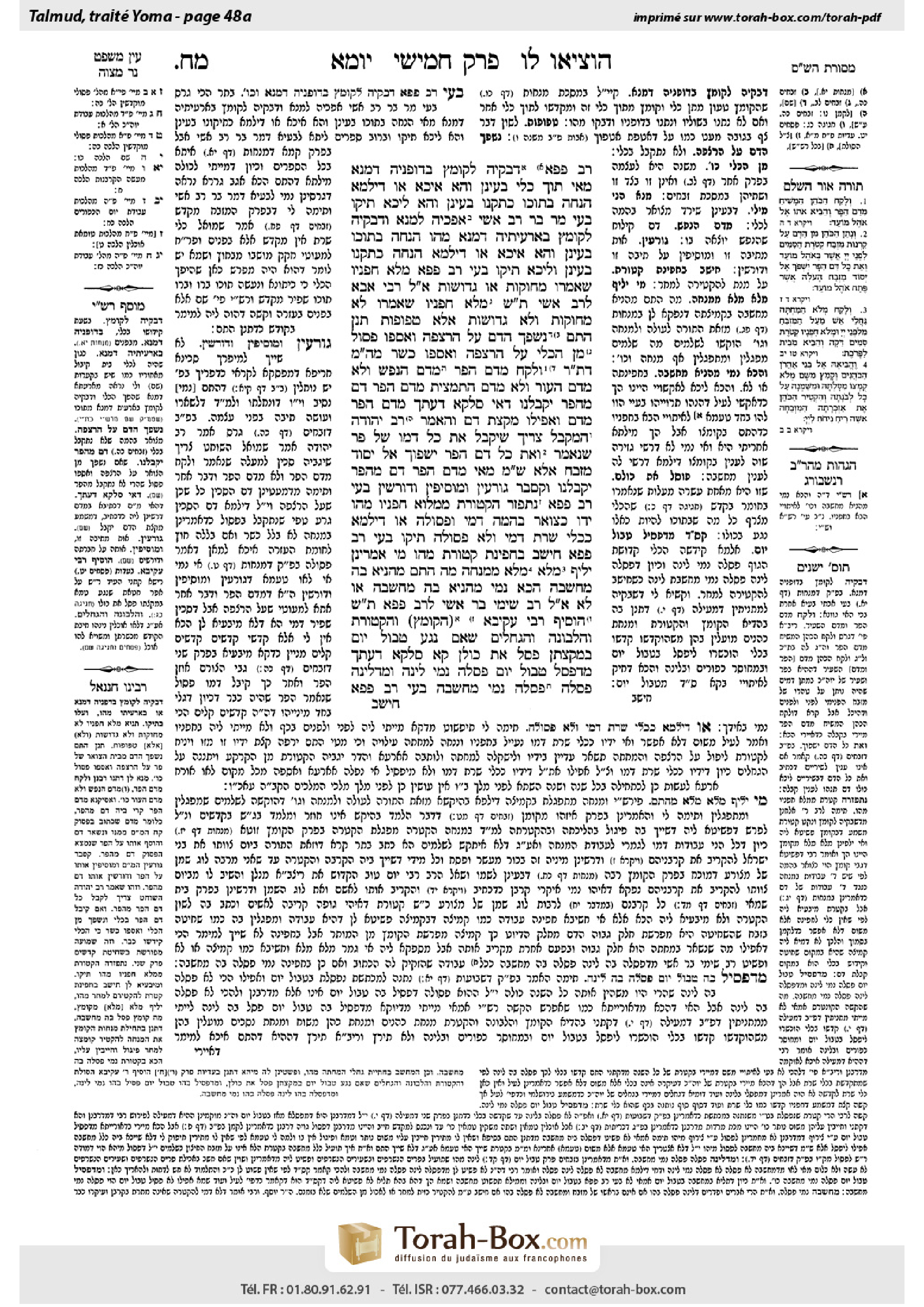
Yoma 48a: Talmud study for Daf Yomi
Daf Yomi is the daily study of one Talmud folio. Explore 37 tractates with scans, Hebrew text, Sefaria English and AI-generated French translations where annotated.
Passage selection and English or AI-generated French translation are available where the scan has annotations. Daf Study is independent of Torah-Box and Sefaria.
Browse Yoma · יומא · All tractatesYoma 48a text and translations
This page of Yoma includes the Aramaic text, an English translation and an AI-generated French translation, alongside the scan above.
יומא מ״ח א · Aramaic and Hebrew text
רַב פָּפָּא: דַּבְּקֵיהּ לְקוֹמֶץ בְּדוּפְנֵיהּ דְּמָנָא, מַאי? תּוֹךְ כְּלִי בָּעֵינַן — וְהָא אִיכָּא, אוֹ דִילְמָא: הַנָּחָה בְּתוֹכוֹ כְּתִקְנוֹ בָּעֵינַן — וְהָא לֵיכָּא. תֵּיקוּ.
בָּעֵי מָר בַּר רַב אָשֵׁי: אַפְכֵיהּ לְמָנָא וְדַבְּקֵיהּ לְקוֹמֶץ בְּאַרְעִיתֵיהּ דְמָנָא, מַהוּ? הַנָּחָה בְּתוֹכוֹ בָּעֵינַן — וְהָא אִיכָּא, אוֹ דִילְמָא הַנָּחָה כְּתִקְנוֹ בָּעִינַן — וְלֵיכָּא? תֵּיקוּ.
בָּעֵי רַב פָּפָּא: מְלֹא חׇפְנָיו שֶׁאָמְרוּ — מְחוּקוֹת, אוֹ גְדוּשׁוֹת? אֲמַר לֵיהּ רַבִּי אַבָּא לְרַב אָשֵׁי, תָּא שְׁמַע: מְלֹא חׇפְנָיו שֶׁאָמְרוּ — לֹא מְחוּקוֹת, וְלֹא גְּדוּשׁוֹת, אֶלָּא טְפוּפוֹת.
תְּנַן הָתָם: נִשְׁפַּךְ הַדָּם עַל הָרִצְפָּה וַאֲסָפוֹ פָּסוּל. מִן הַכְּלִי עַל הָרִצְפָּה וַאֲסָפוֹ — כָּשֵׁר.
מְנָא הָנֵי מִילֵּי? תָּנוּ רַבָּנַן: ״וְלָקַח מִדַּם הַפָּר״, מִדַּם הַנֶּפֶשׁ, וְלֹא מִדַּם הָעוֹר, וְלֹא מִדַּם הַתַּמְצִית.
״מִדַּם הַפָּר״, דָּם מֵהַפָּר יְקַבְּלֶנּוּ, דְּאִי סָלְקָא דַעְתָּךְ ״מִדַּם הַפָּר״ — ״מִדָּם״, וַאֲפִילּוּ מִקְצָת דָּם, וְהָאָמַר רַב יְהוּדָה: הַמְקַבֵּל, צָרִיךְ שֶׁיְּקַבֵּל אֶת כׇּל דָּמוֹ שֶׁל פַּר, שֶׁנֶּאֱמַר: ״וְאֵת כׇּל דַּם הַפָּר יִשְׁפּוֹךְ אֶל יְסוֹד מִזְבַּח״.
אֶלָּא שְׁמַע מִינַּהּ: מַאי ״מִדַּם הַפָּר״ — דָּם מֵהַפָּר יְקַבְּלֶנּוּ. וְקָסָבַר: גּוֹרְעִין וּמוֹסִיפִין וְדוֹרְשִׁין.
בָּעֵי רַב פָּפָּא: נִתְפַּזֵּר הַקְּטוֹרֶת מִמְּלוֹא חׇפְנָיו, מַהוּ? יָדוֹ כְּצַוַּאר בְּהֵמָה דָּמֵי — וּפְסוּלָה, אוֹ דִילְמָא כִּכְלִי שָׁרֵת דָּמֵי — וְלָא פְּסוּלָה? תֵּיקוּ.
בָּעֵי רַב פָּפָּא: חִישֵּׁב בַּחֲפִינַת קְטוֹרֶת, מַהוּ? מִי אָמְרִינַן יָלֵיף ״מְלֹא״ ״מְלֹא״ מִמִּנְחָה, מָה הָתָם מַהְנְיָא בַּהּ מַחְשָׁבָה, הָכָא נָמֵי מַהְנְיָא בַּהּ מַחְשָׁבָה, אוֹ לֹא?
אֲמַר לֵיהּ רַב שִׁימִי בַּר אָשֵׁי לְרַב פָּפָּא: תָּא שְׁמַע: הוֹסִיף רַבִּי עֲקִיבָא (הַקּוֹמֶץ) וְהַקְּטוֹרֶת, וְהַלְּבוֹנָה, וְהַגֶּחָלִים, שֶׁאִם נָגַע טְבוּל יוֹם בְּמִקְצָתָן — פָּסַל אֶת כּוּלָּן.
קָא סָלְקָא דַּעְתָּךְ: מִדְּפָסַל טְבוּל יוֹם — פָּסְלָה נָמֵי לִינָה. וּמִדְּלִינָה פָּסְלָה — פָּסְלָה נָמֵי מַחְשָׁבָה.
בָּעֵי רַב פָּפָּא:
Yoma 48a · English translation
Rav Pappa: What is the halakha in a case where he stuck the handful of flour onto the side of the vessel? After the flour of a meal-offering has been separated, it must be placed in a vessel for burning, an action that sanctifies the flour. Rav Pappa inquires as to what the halakha is if the priest places the flour on the sides, instead of on the bottom of the vessel. The Gemara clarifies the two sides of the dilemma: Do we require the handful to be inside the vessel, and that is the case here? Or perhaps we require the handful to be placed properly inside the vessel, and that is not fulfilled in this instance. No answer is found for this question, and the Gemara concludes: Let it stand unresolved.
Mar bar Rav Ashi raised a similar dilemma: What is the halakha if the priest overturned the vessel and stuck the handful to an indentation in the underside of the vessel? Do we require the handful to be inside the vessel, and that requirement is fulfilled here; or perhaps we require it to be placed properly in the vessel, and that is not the case here? With regard to this question as well, the Gemara states: Let it stand unresolved.
§ Rav Pappa raised a dilemma: Should the handfuls to which the Sages referred be smoothed over or slightly overflowing? Rabbi Abba said to Rav Ashi: Come and hear an explicit statement in a baraita: The handfuls to which the Sages referred should be neither smoothed over nor overflowing, but full, without any flour spilling out.
§ We learned in a mishna there, in Zevaḥim 32a: If the blood of the sacrificial animal spilled on the floor instead of being collected directly into a vessel, and a priest collected it from there into a vessel, it is disqualified, as it was not collected properly. Conversely, if the blood spilled from the vessel onto the floor, after it was collected properly, and a priest collected it and put it back in the vessel, it is valid.
The Gemara asks: From where are these matters derived? As the Sages taught in a halakhic midrash: “And the anointed priest shall take from the blood of the bull” (Leviticus 4:5); this means that the priest shall take from the blood of the soul, i.e., the bull’s blood that flows from the place of slaughter as the animal dies, and not from the blood of the skin, which bleeds out when the skin is cut before the slaughter, nor from the blood squeezed from an animal after the initial spurt.
The baraita interprets the phrase “from the blood of the bull,” as though these words were written in a different order: Blood from the bull, i.e., the priest shall receive it directly. For if it should enter your mind that the letter mem, which means “from” in the phrase “from the blood of the bull,” is limiting and indicates that even if the priest received some of the blood, his action is acceptable, didn’t Rav Yehuda say: He who receives the blood must receive all of the blood of the bull, as it is stated: “And all the blood of the bull he shall pour out on the base of the altar” (Leviticus 4:7)? This verse emphasizes that the priest must pour all of the bull’s blood, which is possible only if he has collected all of it.
Rather, learn from this that what is the meaning of the phrase: “From the blood of the bull”? It means that the priest must receive the blood directly from the bull. And this Sage maintains that the Sages subtract and add and interpret homiletically, i.e., one may take a letter from one word, insert it into a second word, and explain the phrase in that manner.
§ Rav Pappa raised a dilemma based on the above ruling: What is the halakha if the incense from his handfuls scattered? Is his hand considered like the neck of the animal, and the incense is disqualified? Or perhaps his hand is considered like a vessel used in the Temple service, and if the incense fell from his hand it is not disqualified. No answer was found for this question either, and the Gemara again concludes: Let it stand unresolved.
§ Rav Pappa raised another dilemma: What is the halakha if the High Priest thought a disqualifying thought during the taking of the handful of the incense, e.g., if he intended to burn it after its appropriate time? Does this thought invalidate the rite or not? Do we say that this halakha is derived by means of a verbal analogy of “handfuls” and “handfuls,” from the case of a meal-offering, as follows: Just as there, with regard to the meal-offering, thought is effective to invalidate it, so too here, with regard to taking a handful of incense, thought is effective to invalidate it? Or should the two cases not be compared?
Rav Shimi bar Ashi said to Rav Pappa: Come and hear a resolution to your dilemma: Rabbi Akiva added the handful of fine flour and the incense, and the frankincense, and the coals that are collected in a vessel, to the ruling of the Sages that if one who immersed himself during the day touched part of them, he disqualifies all of them. Due to the respect in which sacred objects are held, these objects are treated as one solid unit. This is so despite the fact that its parts are not really attached to each other but are separate small segments and therefore, logically, one who immersed himself during the day should disqualify only those parts of the item with which he came into direct contact.
The Gemara explains: It enters your mind that from the fact that one who immersed himself during the day disqualifies these items by touch, therefore leaving them after their permitted time likewise disqualifies them; and from the fact that leaving them after their time disqualifies them, therefore thought likewise disqualifies them. Consequently, as incense is similar to flour with regard to ritual impurity, it is also disqualified by the priest’s improper thought.
§ Rav Pappa raised another dilemma:
Yoma 48a · Traduction française (IA)
Rav Pappa demanda : Quelle est la halakha dans le cas où il a collé la poignée de farine contre la paroi du récipient ? Après avoir été prélevée, la poignée d’une offrande végétale doit être placée dans un récipient destiné à la combustion, acte qui sanctifie la farine. Rav Pappa s’interroge sur la halakha si le prêtre place la farine contre la paroi, au lieu de la déposer au fond du récipient. La Guemara précise les deux branches de l’hésitation : exige-t-on que la poignée se trouve à l’intérieur du récipient, condition qui est remplie ici ? Ou peut-être exige-t-on que la poignée soit déposée correctement dans le récipient, ce qui n’est pas le cas ici. Aucune réponse n’est trouvée à cette question, et la Guemara conclut : Que la question reste sans réponse.
Mar bar Rav Ashi souleva une hésitation similaire : quelle est la halakha si le prêtre a retourné le récipient et collé la poignée dans une cavité située sous le récipient ? Exige-t-on que la poignée se trouve à l’intérieur du récipient, condition qui est remplie ici ? Ou peut-être exige-t-on qu’elle soit déposée correctement dans le récipient, ce qui n’est pas le cas ici. À propos de cette question également, la Guemara dit : Que la question reste sans réponse.
§ Rav Pappa souleva une hésitation : les poignées auxquelles les Sages faisaient référence doivent-elles être arasées ou légèrement bombées ? Rabbi Abba dit à Rav Ashi : Viens et écoute une déclaration explicite dans une baraïta : les poignées auxquelles les Sages faisaient référence ne doivent être ni arasées ni bombées, mais pleines, sans que de la farine déborde.
§ Nous avons appris dans une Michna, là-bas, dans Zevaḥim 32a : si le sang de l’animal sacrificiel s’est répandu sur le sol au lieu d’être recueilli directement dans un récipient, et qu’un prêtre l’a recueilli du sol dans un récipient, le sacrifice est invalide, car le sang n’a pas été recueilli correctement. À l’inverse, si le sang s’est répandu du récipient sur le sol après avoir été recueilli correctement, et qu’un prêtre l’a ramassé et remis dans le récipient, le sacrifice est valide.
La Guemara demande : De quelle source ces règles sont-elles déduites ? Les Sages enseignent dans un midrach halakhique : « Le prêtre oint prendra du sang du taureau » (Lévitique 4:5). Cela signifie que le prêtre prendra le sang de la vie, c’est-à-dire le sang du taureau qui s’écoule du lieu de l’abattage au moment où l’animal meurt, et non le sang de la peau, qui coule lorsque celle-ci est entaillée avant l’abattage, ni le sang pressé de l’animal après la première giclée.
La baraïta interprète l’expression « du sang du taureau » comme si ces mots étaient écrits dans un ordre différent : le sang du taureau, c’est-à-dire que le prêtre doit le recevoir directement. Car si tu pensais que la lettre mem, qui signifie « de » dans l’expression « du sang du taureau », est restrictive et indique que même si le prêtre n’a reçu qu’une partie du sang, son acte est valide, Rav Yehouda n’a-t-il pas dit que celui qui reçoit le sang doit en recevoir la totalité, comme il est dit : « Il répandra tout le sang du taureau à la base de l’autel » (Lévitique 4:7) ? Ce verset souligne que le prêtre doit répandre tout le sang du taureau, ce qui n’est possible que s’il l’a recueilli en totalité.
Au contraire, déduis-en que l’expression « du sang du taureau » signifie que le prêtre doit recevoir le sang directement du taureau. Ce tanna considère que les Sages retranchent et ajoutent des lettres, puis interprètent de manière homilétique : on peut prendre une lettre d’un mot, l’insérer dans un autre mot et expliquer ainsi l’expression.
§ Rav Pappa souleva une hésitation à partir de la règle précédente : quelle est la halakha si l’encens prélevé par poignées s’est dispersé ? Sa main est-elle considérée comme le cou de l’animal, de sorte que l’encens est disqualifié ? Ou peut-être sa main est-elle considérée comme un récipient utilisé pour le service du Temple, auquel cas l’encens qui en tombe n’est pas disqualifié. Aucune réponse n’est trouvée non plus à cette question, et la Guemara conclut de nouveau : Que la question reste sans réponse.
§ Rav Pappa souleva une autre hésitation : quelle est la halakha si le grand prêtre a eu une pensée invalidante pendant le prélèvement de la poignée d’encens, par exemple s’il avait l’intention de la brûler après le délai prescrit ? Cette pensée invalide-t-elle le rite ou non ? Doit-on dire que cette halakha est déduite au moyen d’une analogie verbale entre « poignées » et « poignées », à partir du cas d’une offrande végétale, comme suit : de même que, dans le cas de l’offrande végétale, une pensée suffit à l’invalider, de même ici, lors du prélèvement d’une poignée d’encens, une pensée suffit à l’invalider ? Ou ne faut-il pas comparer les deux cas ?
Rav Shimi bar Ashi dit à Rav Pappa : Viens et écoute la résolution de ton hésitation : Rabbi Akiva a inclus la poignée de farine fine, l’encens, le oliban et les charbons recueillis dans un récipient parmi les éléments concernés par la règle des Sages selon laquelle celui qui s’est immergé dans la journée les disqualifie tous s’il en touche une partie. Par égard pour les objets sacrés, ces éléments sont traités comme une seule unité solide. Cela, bien que leurs parties ne soient pas réellement attachées les unes aux autres, mais constituent des éléments distincts et séparés. Logiquement, celui qui s’est immergé dans la journée ne devrait donc disqualifier que les parties de l’objet avec lesquelles il a été directement en contact.
La Guemara explique : Tu pourrais penser que, puisque celui qui s’est immergé dans la journée disqualifie ces éléments par le toucher, les laisser après le délai autorisé les disqualifie également ; et que, puisque les laisser après ce délai les disqualifie, une pensée les disqualifie également. Par conséquent, comme l’encens est comparable à la farine en matière d’impureté rituelle, il est également disqualifié par la pensée incorrecte du prêtre.
§ Rav Pappa souleva une autre hésitation :
Traduction française générée par IA à partir de l’édition anglaise de Sefaria. Vérifie toujours un passage avec le texte source.
Text from Sefaria: William Davidson Edition - Vocalized Aramaic (CC BY NC); William Davidson Edition - English (CC BY NC).