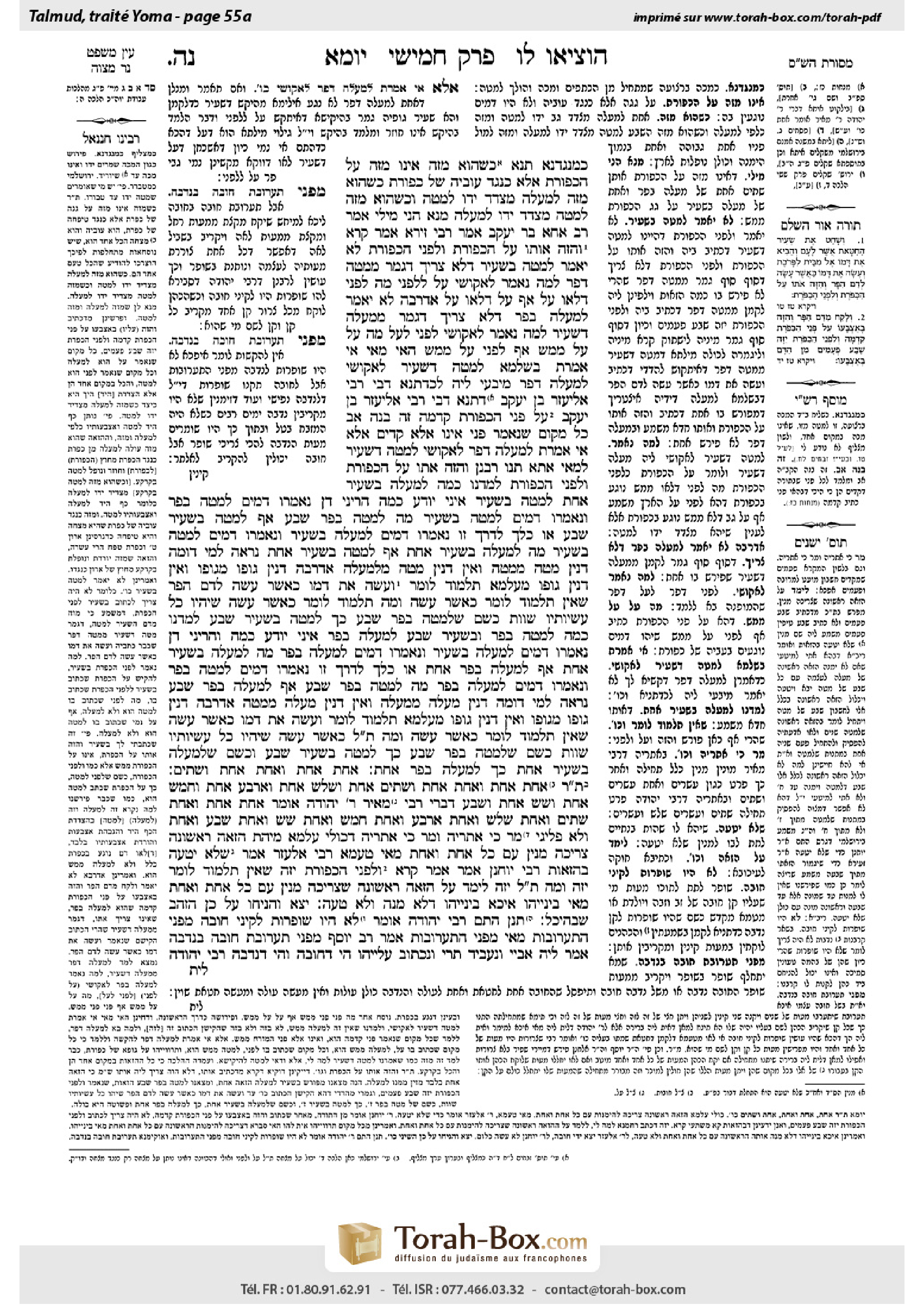
Yoma 55a: Talmud study for Daf Yomi
Daf Yomi is the daily study of one Talmud folio. Explore 37 tractates with scans, Hebrew text, Sefaria English and AI-generated French translations where annotated.
Passage selection and English or AI-generated French translation are available where the scan has annotations. Daf Study is independent of Torah-Box and Sefaria.
Browse Yoma · יומא · All tractatesYoma 55a text and translations
This page of Yoma includes the Aramaic text, an English translation and an AI-generated French translation, alongside the scan above.
יומא נ״ה א · Aramaic and Hebrew text
כִּמְנַגְּדָנָא. תָּנָא, כְּשֶׁהוּא מַזֶּה — אֵינוֹ מַזֶּה עַל הַכַּפּוֹרֶת, אֶלָּא כְּנֶגֶד עוֹבְיָהּ שֶׁל כַּפּוֹרֶת. כְּשֶׁהוּא מַזֶּה לְמַעְלָה — מְצַדֵּד יָדוֹ לְמַטָּה. וּכְשֶׁהוּא מַזֶּה לְמַטָּה — מְצַדֵּד יָדוֹ לְמַעְלָה.
מְנָא הָנֵי מִילֵּי? אָמַר רַב אַחָא בַּר יַעֲקֹב, אָמַר רַבִּי זֵירָא, אָמַר קְרָא: ״וְהִזָּה אוֹתוֹ עַל הַכַּפּוֹרֶת וְלִפְנֵי הַכַּפּוֹרֶת״, לֹא יֹאמַר ״לְמַטָּה״ בְּשָׂעִיר, דְּלָא צְרִיךְ, דְּגָמַר מִמַּטָּה דְּפַר,
לָמָּה נֶאֱמַר — לְאַקּוֹשֵׁי ״עַל״ לְ״לִפְנֵי״: מָה ״לִפְנֵי״ דְּלָאו עַל, אַף ״עַל״ דְּלָאו עַל.
אַדְּרַבָּה: לֹא יֵאָמֵר ״לְמַעְלָה״ בְּפַר דְּלָא צְרִיךְ, דְּגָמַר מִמַּעְלָה דְשָׂעִיר. לָמָּה נֶאֱמַר? לְאַקּוֹשֵׁי ״לִפְנֵי״ לְ״עַל״: מָה ״עַל״ — עַל מַמָּשׁ, אַף ״לִפְנֵי״ — עַל מַמָּשׁ!
הַאי מַאי?! אִי אָמְרַתְּ בִּשְׁלָמָא לְמַטָּה דְשָׂעִיר לְאַקּוֹשֵׁי לְמַעְלָה דְפַר — מִיבְּעֵי לֵיהּ לְכִדְתָנָא דְּבֵי רַבִּי אֱלִיעֶזֶר בֶּן יַעֲקֹב. דְּתָנָא דְּבֵי רַבִּי אֱלִיעֶזֶר בֶּן יַעֲקֹב: ״עַל פְּנֵי הַכַּפּוֹרֶת קֵדְמָה״ — זֶה בָּנָה אָב: כׇּל מָקוֹם שֶׁנֶּאֱמַר ״פְּנֵי״ אֵינוֹ אֶלָּא קָדִים. אֶלָּא אִי אָמְרַתְּ לְמַעְלָה דְפַר לְאַקּוֹשֵׁי לְמַטָּה דְשָׂעִיר — לְמַאי אֲתָא?
תָּנוּ רַבָּנַן: ״וְהִזָּה אֹתוֹ עַל הַכַּפּוֹרֶת וְלִפְנֵי הַכַּפּוֹרֶת״ — לָמַדְנוּ: כַּמָּה לְמַעְלָה בַּשָּׂעִיר — אַחַת. לְמַטָּה בַּשָּׂעִיר, אֵינִי יוֹדֵעַ כַּמָּה!
הֲרֵינִי דָּן: נֶאֶמְרוּ דָּמִים לְמַטָּה בַּפָּר, וְנֶאֶמְרוּ דָּמִים לְמַטָּה בַּשָּׂעִיר. מָה לְמַטָּה בַּפָּר — שֶׁבַע, אַף לְמַטָּה בַּשָּׂעִיר — שֶׁבַע.
אוֹ כְּלָךְ לְדֶרֶךְ זוֹ: נֶאֶמְרוּ דָּמִים לְמַעְלָה בַּשָּׂעִיר, וְנֶאֶמְרוּ דָּמִים לְמַטָּה בַּשָּׂעִיר. מָה לְמַעְלָה בַּשָּׂעִיר — אַחַת, אַף לְמַטָּה בַּשָּׂעִיר — אַחַת? נִרְאֶה לְמִי דּוֹמֶה: דָּנִין מַטָּה מִמַּטָּה, וְאֵין דָּנִין מַטָּה מִלְמַעְלָה.
אַדְּרַבָּה, דָּנִין גּוּפוֹ מִגּוּפוֹ, וְאֵין דָּנִין גּוּפוֹ מֵעָלְמָא! תַּלְמוּד לוֹמַר: ״וְעָשָׂה אֶת דָּמוֹ כַּאֲשֶׁר עָשָׂה לְדַם הַפָּר״, שֶׁאֵין תַּלְמוּד לוֹמַר ״כַּאֲשֶׁר עָשָׂה״, וּמָה תַּלְמוּד לוֹמַר ״כַּאֲשֶׁר עָשָׂה״ — שֶׁיִּהְיוּ כׇּל עֲשִׂיּוֹתָיו שָׁווֹת. כְּשֵׁם שֶׁלְּמַטָּה בַּפָּר — שֶׁבַע, כָּךְ לְמַטָּה בַּשָּׂעִיר — שֶׁבַע.
לָמַדְנוּ כַּמָּה לְמַטָּה? בַּפָּר וּבַשָּׂעִיר — שֶׁבַע. לְמַעְלָה בַּפָּר אֵינִי יוֹדֵעַ כַּמָּה, וַהֲרֵינִי דָּן: נֶאֶמְרוּ דָּמִים לְמַעְלָה בַּשָּׂעִיר, וְנֶאֶמְרוּ דָּמִים לְמַעְלָה בַּפָּר. מָה לְמַעְלָה בַּשָּׂעִיר — אַחַת, אַף לְמַעְלָה בַּפָּר — אַחַת.
אוֹ כְּלָךְ לַדֶּרֶךְ זוֹ: נֶאֶמְרוּ דָּמִים לְמַטָּה בַּפָּר, וְנֶאֶמְרוּ דָּמִים לְמַעְלָה בַּפָּר. מָה לְמַטָּה בַּפָּר — שֶׁבַע, אַף לְמַעְלָה בַּפָּר — שֶׁבַע! נִרְאֶה לְמִי דּוֹמֶה? דָּנִין מַעְלָה מִמַּעְלָה, וְאֵין דָּנִין מַעְלָה מִמַּטָּה!
אַדְּרַבָּה: דָּנִין גּוּפוֹ מִגּוּפוֹ, וְאֵין דָּנִין גּוּפוֹ מֵעָלְמָא! תַּלְמוּד לוֹמַר: ״וְעָשָׂה אֶת דָּמוֹ כַּאֲשֶׁר עָשָׂה״, שֶׁאֵין תַּלְמוּד לוֹמַר ״כַּאֲשֶׁר עָשָׂה״, וּמָה תַּלְמוּד לוֹמַר ״כַּאֲשֶׁר עָשָׂה״? שֶׁיִּהְיוּ כׇּל עֲשִׂיּוֹתָיו שָׁווֹת, כְּשֵׁם שֶׁלְּמַטָּה בַּפָּר — שֶׁבַע, כָּךְ לְמַטָּה בַּשָּׂעִיר — שֶׁבַע. וּכְשֵׁם שֶׁלְּמַעְלָה בַּשָּׂעִיר — אַחַת, כָּךְ לְמַעְלָה בַּפָּר — אַחַת.
אַחַת, אַחַת וְאַחַת, אַחַת וּשְׁתַּיִם. תָּנוּ רַבָּנַן: אַחַת, אַחַת וְאַחַת, אַחַת וּשְׁתַּיִם, אַחַת וְשָׁלֹשׁ, אַחַת וְאַרְבַּע, אַחַת וְחָמֵשׁ, אַחַת וָשֵׁשׁ, אַחַת וָשֶׁבַע, דִּבְרֵי רַבִּי מֵאִיר. רַבִּי יְהוּדָה אוֹמֵר: אַחַת, אַחַת וְאַחַת, שְׁתַּיִם וְאַחַת, שָׁלֹשׁ וְאַחַת, אַרְבַּע וְאַחַת, חָמֵשׁ וְאַחַת, שֵׁשׁ וְאַחַת, שֶׁבַע וְאַחַת.
וְלָא פְּלִיגִי: מָר כִּי אַתְרֵיהּ וּמָר כִּי אַתְרֵיהּ.
דְּכוּלֵּי עָלְמָא מִיהַת הַזָּאָה רִאשׁוֹנָה צְרִיכָה מִנְיָן עִם כׇּל אַחַת וְאַחַת, מַאי טַעְמָא? רַבִּי אֶלְעָזָר אָמַר: שֶׁלֹּא יִטְעֶה בַּהַזָּאוֹת.
רַבִּי יוֹחָנָן אָמַר, אָמַר קְרָא: ״וְלִפְנֵי הַכַּפּוֹרֶת יַזֶּה״, שֶׁאֵין תַּלְמוּד לוֹמַר ״יַזֶּה״, וּמָה תַּלְמוּד לוֹמַר ״יַזֶּה״? לִימֵּד עַל הַזָּאָה רִאשׁוֹנָה שֶׁצְּרִיכָה מִנְיָן עִם כׇּל אַחַת וְאַחַת.
מַאי בֵּינַיְיהוּ? אִיכָּא בֵּינַיְיהוּ דְּלֹא מָנָה וְלֹא טָעָה.
יָצָא וְהִנִּיחוֹ עַל כַּן הַזָּהָב שֶׁבַּהֵיכָל. תְּנַן הָתָם: רַבִּי יְהוּדָה אוֹמֵר: לֹא הָיוּ שׁוֹפָרוֹת לְקִינֵּי חוֹבָה, מִפְּנֵי הַתַּעֲרוֹבוֹת.
מַאי מִפְּנֵי הַתַּעֲרוֹבוֹת? אָמַר רַב יוֹסֵף: מִפְּנֵי תַּעֲרוֹבֶת חוֹבָה בִּנְדָבָה. אָמַר לֵיהּ אַבָּיֵי: וְנַעֲבֵיד תְּרֵי וְנִכְתּוֹב עֲלַיְיהוּ הֵי דְּחוֹבָה וְהֵי דִּנְדָבָה? רַבִּי יְהוּדָה
Yoma 55a · English translation
like one who lashes with a whip on the back of another and who occasionally strikes lower down. A Sage taught in the Tosefta: When the High Priest sprinkles the blood, he does not sprinkle on the top of the Ark cover; rather, he does so against the thickness of the Ark cover. When he sprinkles once upward, he turns his hand so that the back of his hand faces downward, and he then sprinkles upward. And when he sprinkles seven times downward, he turns his hand so its back is upward. However, he does not sprinkle on the Ark cover or below it, so that the blood does not actually come into contact with it.
The Gemara asks: From where are these matters, that the sprinklings do not actually touch the Ark cover, derived? Rav Aḥa bar Ya’akov said that Rabbi Zeira said: The verse states with regard to the goat sacrificed as a sin-offering: “And he shall do with its blood as he did with the blood of the bull, and sprinkle it upon the Ark cover and before the Ark cover” (Leviticus 16:15). The verse should not say downward, i.e., “before the Ark cover,” with regard to the goat, as this is unnecessary; this requirement is derived from the term downward in connection with the bull.
Since the rite performed with the blood of the goat is compared to the rite of the blood of the bull, why is the requirement that the High Priest must sprinkle downward stated twice? It is to juxtapose the phrase “upon the Ark cover” to “before the Ark cover”; just as “before” means that it is not actually on the Ark cover but merely in front of it, so too, “upon” means that it is not actually on the Ark cover but in front of it, and the High Priest simply turns his hand upward.
The Gemara raises a difficulty: On the contrary, the verse should not say upward, i.e., “before the Ark cover,” with regard to the bull, as this is unnecessary; it is derived from the term upward stated in connection to the goat. Since the verse equates the two rituals, why does it state the upward sprinkling of the blood of the bull? It is to juxtapose the phrase “before the Ark cover,” stated with regard to the bull, to “upon the Ark cover,” stated with regard to the goat; just as “upon” stated by the goat means actually upon, as indicated by the literal meaning of the verse, so too, “before” means actually upon it, i.e., the blood of the goat should touch the thickness of the Ark cover.
The Gemara expresses surprise at this suggestion: What is this comparison? Granted, if you say that downward stated with regard to the goat is mentioned to juxtapose it to upward stated with regard to the bull, one needs the phrase “upon the Ark cover,” which deals with the blood of the bull, for that which the school of Rabbi Eliezer ben Ya’akov taught. As the school of Rabbi Eliezer ben Ya’akov taught: “Upon [al penei] the Ark cover to the east” (Leviticus 16:14); this forms an analogy that applies to the entire Torah: Any place where it is stated “face [penei],” it is referring to nothing other than the eastern side. However, if you say, as suggested by the question, that upward with regard to the bull is mentioned to juxtapose it to “upward” stated with regard to the goat, for what purpose does downward stated with regard to the goat come; what do we learn from this phrase? Rather, the first interpretation of the verse must be correct.
§ The Sages taught: “And sprinkle it upon the Ark cover and before the Ark cover” (Leviticus 16:15). We have thereby learned how many times the High Priest must sprinkle upward for the goat, that is, one sprinkling, as it states: “And sprinkle.” However, with regard to the sprinkling downward for the goat, before the Ark cover, I do not know how many times he must sprinkle.
I therefore derive the halakha from the verses. It states that blood is sprinkled downward in the case of the bull, and it states that blood is sprinkled downward in the case of the goat. Just as the blood that he sprinkles downward in the case of the bull consists of seven sprinklings, as the verse explicitly states: “And before the Ark cover he shall sprinkle seven times” (Leviticus 16:14), so too, the sprinkling of the blood downward in the case of the goat is performed seven times.
The Gemara raises a difficulty: Or one can go and reason this way: It states that blood is sprinkled upward in the case of the goat, and likewise it states that blood is sprinkled downward in the case of the goat. Just as with regard to sprinkling upward in the case of the goat there is one sprinkling, so too, with regard to sprinkling downward in the case of the goat there is only one sprinkling. The Gemara comments: Let us see what case this resembles: One derives an act performed downward from another act that is downward, and one does not derive an act performed downward from an upward act.
The Gemara retorts: On the contrary, one derives one aspect of a matter from another aspect of that same matter, i.e., one should infer the halakha with regard to the blood of the goat from another halakha involving that same blood, and one does not derive the halakha of that matter from an external matter. Therefore, the verse states: “And he shall do with its blood as he did with the blood of the bull” (Leviticus 16:15). As there is no need for the verse to state: “As he did,” because the whole process is explicitly stated a second time, what then is the meaning when the verse states: “As he did”? It comes to teach that all his actions should be alike, down to every detail. Consequently, just as the sprinklings downward in the case of the bull are seven, so too, the sprinklings downward in the case of the goat are seven.
We have thereby learned how many sprinklings are performed downward in the case of the bull and by the goat: Seven. However, I do not know how many times the High Priest must sprinkle upward in the case of the bull. And I therefore derive the halakha as follows: It states that blood is sprinkled upward in the case of the goat, and it states that blood is sprinkled upward in the case of the bull. Just as with regard to the sprinkling upward in the case of the goat he sprinkles one time, as stated explicitly, so too, in the case of the bull he sprinkles upward one time.
The Gemara raises a difficulty: Or one can go and reason this way: It is stated that blood is sprinkled downward in the case of the bull, and likewise it is stated that blood is sprinkled upward in the case of the bull. Just as with regard to sprinkling downward in the case of the bull there are seven sprinklings, so too, with regard to sprinkling upward in the case of the bull there should be seven sprinklings. The Gemara comments: Let us see what case this resembles: One derives an act performed upward from another act that is performed upward, and one does not derive an act performed upward from a downward act.
The Gemara retorts: On the contrary, one derives one aspect of a matter from another aspect of that same matter, and one does not derive the halakha of that matter from an external matter. Therefore, the verse states: “And he shall do with its blood as he did.” As there is no need for the verse to state: “As he did,” because the whole process is explicitly stated a second time, what then is the meaning when the verse states: “As he did”? It comes to teach that all his actions should be alike: Just as the sprinklings downward in the case of the bull are seven, so too, the sprinklings downward in the case of the goat are seven; and just as the sprinkling upward in the case of the goat is one, so too, the sprinkling upward in the case of the bull is one.
§ The mishna states that the High Priest counted: One; one and one; one and two. The Sages taught in a baraita that when sprinkling, the High Priest counted: One; one and one; one and two; one and three; one and four; one and five; one and six; one and seven. This is the statement of Rabbi Meir. Rabbi Yehuda says that he counted: One; one and one; two and one; three and one; four and one; five and one; six and one; seven and one.
The Gemara comments: They do not disagree about the matter itself that the High Priest sprinkles once upward and seven times downward. Rather, this Sage rules in accordance with the norm in his place, and this Sage rules in accordance with the norm in his place. In one place they counted the smaller number first, while in the other place they would count the larger number first.
The Gemara asks: In any case, everyone, both Rabbi Meir and Rabbi Yehuda, agrees that the first sprinkling upward must be counted together with each and every one of the subsequent sprinklings. What is the reason for this? Why can’t the High Priest count the downward sprinklings separately? The Sages debated this matter. Rabbi Elazar said: The reason is so that he does not err in the sprinklings. If the High Priest were to count downward without including the first upward sprinkling, he might mistakenly think that his calculation includes the first sprinkling, which would lead him to add another one.
Rabbi Yoḥanan said that the reason is that the verse states: “And he shall sprinkle it with his finger upon the Ark cover, and before the Ark cover he shall sprinkle” (Leviticus 16:14). As there is no need for the verse to state: He shall sprinkle” again, what is the meaning when the verse states: “He shall sprinkle”? This teaches with regard to the first sprinkling that it must be counted with each and every subsequent one, i.e., he must mention the first sprinkling every time.
The Gemara asks: What is the practical difference between these two explanations? The Gemara answers: The practical difference between them concerns a case where he did not count the first sprinkling and did not err. That is acceptable according to the opinion of Rabbi Elazar, whereas according to Rabbi Yoḥanan the High Priest acted incorrectly, as it is a mitzva to count the first one.
§ The mishna taught that the High Priest emerged and placed the bowl with the remaining blood of the bull on the golden pedestal in the Sanctuary, and later he placed the goat’s blood on a second pedestal, whereas according to Rabbi Yehuda there was only one pedestal. The Gemara comments: We learned in a mishna there (Shekalim 6:6) that Rabbi Yehuda says: There were no collection horns for obligatory nests, i.e., the pairs of pigeons or turtledoves brought as sin- and burnt-offerings by women after childbirth or other individuals, due to the concern of mixtures.
The Gemara asks: What is the meaning of the phrase: Due to a mixture? Rav Yosef said: It means due to the possible mixture of obligatory nests with free-will ones. There was concern lest the priests mix the money given for obligatory nests, which are sacrificed as a sin-offering and a burnt-offering, with the money for free-will nests, which are sacrificed as a pair of burnt-offerings. Mixing the funds in this way would disqualify the birds. Abaye said to him: And let us prepare two collection horns and write on them which is the container for obligatory offerings and which is the one for free-will offerings. The Gemara answers: Rabbi Yehuda
Yoma 55a · Traduction française (IA)
comme quelqu’un qui fouette le dos d’une autre personne et frappe parfois plus bas. Un Sage enseigna dans la Tosefta : lorsque le grand prêtre asperge le sang, il ne l’asperge pas sur le dessus du couvercle de l’Arche, mais contre l’épaisseur de celui-ci. Lorsqu’il asperge une fois vers le haut, il tourne la main de sorte que le dos de sa main soit tourné vers le bas, puis il asperge vers le haut. Lorsqu’il asperge sept fois vers le bas, il tourne la main de sorte que le dos de sa main soit tourné vers le haut. Toutefois, il n’asperge ni sur le couvercle de l’Arche ni en dessous, afin que le sang ne le touche pas réellement.
La Guemara demande : D’où déduit-on que les aspersions ne touchent pas réellement le couvercle de l’Arche ? Rav Aḥa bar Ya’akov dit au nom de Rabbi Zeira : le verset dit, au sujet du bouc offert en sacrifice expiatoire : « Il fera avec son sang comme il a fait avec le sang du taureau, et il l’aspergera sur le couvercle de l’Arche et devant le couvercle de l’Arche » (Lévitique 16, 15). Le verset n’aurait pas dû préciser le mouvement vers le bas, c’est-à-dire « devant le couvercle de l’Arche », au sujet du bouc, car cette exigence est superflue ; elle se déduit du terme indiquant le mouvement vers le bas employé au sujet du taureau.
Puisque le rite accompli avec le sang du bouc est comparé à celui accompli avec le sang du taureau, pourquoi l’exigence selon laquelle le grand prêtre doit asperger vers le bas est-elle mentionnée deux fois ? C’est pour mettre en parallèle l’expression « sur le couvercle de l’Arche » et l’expression « devant le couvercle de l’Arche » : de même que « devant » signifie que l’aspersion ne se fait pas réellement sur le couvercle de l’Arche, mais seulement devant lui, de même « sur » signifie que l’aspersion ne se fait pas réellement sur le couvercle de l’Arche, mais devant lui ; le grand prêtre tourne simplement la main vers le haut.
La Guemara soulève une difficulté : au contraire, le verset n’aurait pas dû préciser le mouvement vers le haut, c’est-à-dire « devant le couvercle de l’Arche », au sujet du taureau, car cette précision est superflue ; elle se déduit du terme indiquant le mouvement vers le haut énoncé au sujet du bouc. Puisque le verset assimile les deux rites, pourquoi mentionne-t-il l’aspersion du sang du taureau vers le haut ? C’est pour mettre en parallèle l’expression « devant le couvercle de l’Arche », au sujet du taureau, et l’expression « sur le couvercle de l’Arche », au sujet du bouc : de même que « sur », au sujet du bouc, signifie réellement sur le couvercle, comme l’indique le sens littéral du verset, de même « devant » signifie réellement sur celui-ci ; autrement dit, le sang du bouc doit toucher l’épaisseur du couvercle de l’Arche.
La Guemara s’étonne de cette proposition : quelle est la pertinence de cette comparaison ? Certes, si l’on dit que le mouvement vers le bas mentionné au sujet du bouc sert à le mettre en parallèle avec le mouvement vers le haut mentionné au sujet du taureau, on a besoin de l’expression « sur le couvercle de l’Arche », qui concerne le sang du taureau, pour ce qu’a enseigné l’école de Rabbi Eliezer ben Ya’akov. En effet, l’école de Rabbi Eliezer ben Ya’akov a enseigné : « Sur [al penei] le couvercle de l’Arche, vers l’est » (Lévitique 16, 14). Cette expression établit une analogie valable dans toute la Torah : partout où figure le terme « face [penei] », il désigne uniquement le côté est. Cependant, si l’on dit, comme le suggère la question, que le mouvement vers le haut mentionné au sujet du taureau sert à le mettre en parallèle avec le mouvement « vers le haut » mentionné au sujet du bouc, à quoi sert alors le mouvement vers le bas mentionné au sujet du bouc ? Que déduit-on de cette expression ? Il faut donc retenir la première interprétation du verset.
§ Les Sages enseignèrent : « Il l’aspergera sur le couvercle de l’Arche et devant le couvercle de l’Arche » (Lévitique 16, 15). Nous avons ainsi appris combien de fois le grand prêtre doit asperger vers le haut pour le bouc : une fois, comme il est dit : « Il l’aspergera. » Mais, pour l’aspersion vers le bas du bouc, devant le couvercle de l’Arche, j’ignore combien de fois il doit asperger.
J’en déduis donc la halakha à partir des versets. Il est dit que le sang est aspergé vers le bas dans le cas du taureau, et il est également dit qu’il est aspergé vers le bas dans le cas du bouc. De même que, dans le cas du taureau, les aspersions du sang vers le bas sont au nombre de sept, comme le verset le précise explicitement : « Devant le couvercle de l’Arche, il aspergera sept fois » (Lévitique 16, 14), de même l’aspersion du sang vers le bas dans le cas du bouc se fait sept fois.
La Guemara soulève une difficulté : on pourrait aussi raisonner ainsi : il est dit que le sang est aspergé vers le haut dans le cas du bouc, et il est également dit qu’il est aspergé vers le bas dans le cas du bouc. De même que l’aspersion vers le haut dans le cas du bouc se fait une fois, de même l’aspersion vers le bas dans le cas du bouc ne se fait qu’une fois. La Guemara commente : voyons à quel cas cela ressemble : on déduit un acte accompli vers le bas d’un autre acte accompli vers le bas, et non d’un acte accompli vers le haut.
La Guemara réplique : au contraire, on déduit un aspect d’une chose d’un autre aspect de cette même chose, et non la halakha de cette chose d’un élément extérieur. Le verset dit donc : « Il fera avec son sang comme il a fait avec le sang du taureau » (Lévitique 16, 15). Le verset n’ayant pas besoin de dire « comme il a fait », puisque toute la procédure est explicitement reprise une seconde fois, que vient donc enseigner l’expression « comme il a fait » ? Elle enseigne que tous ses actes doivent être identiques jusque dans les moindres détails. Par conséquent, de même que les aspersions vers le bas dans le cas du taureau sont au nombre de sept, de même celles du bouc sont au nombre de sept.
Nous avons ainsi appris combien d’aspersions vers le bas sont effectuées dans le cas du taureau et du bouc : sept. Cependant, j’ignore combien de fois le grand prêtre doit asperger vers le haut dans le cas du taureau. J’en déduis donc la halakha ainsi : il est dit que le sang est aspergé vers le haut dans le cas du bouc, et il est également dit qu’il est aspergé vers le haut dans le cas du taureau. De même que, dans le cas du bouc, il asperge une fois vers le haut, comme cela est explicitement indiqué, de même, dans le cas du taureau, il asperge une fois vers le haut.
La Guemara soulève une difficulté : on pourrait aussi raisonner ainsi : il est dit que le sang est aspergé vers le bas dans le cas du taureau, et il est également dit qu’il est aspergé vers le haut dans le cas du taureau. De même que les aspersions vers le bas dans le cas du taureau sont au nombre de sept, de même les aspersions vers le haut dans son cas devraient être au nombre de sept. La Guemara commente : voyons à quel cas cela ressemble : on déduit un acte accompli vers le haut d’un autre acte accompli vers le haut, et non d’un acte accompli vers le bas.
La Guemara réplique : au contraire, on déduit un aspect d’une chose d’un autre aspect de cette même chose, et non la halakha de cette chose d’un élément extérieur. Le verset dit donc : « Il fera avec son sang comme il a fait. » Le verset n’ayant pas besoin de dire « comme il a fait », puisque toute la procédure est explicitement reprise une seconde fois, que vient donc enseigner cette expression ? Elle enseigne que tous ses actes doivent être identiques : de même que les aspersions vers le bas dans le cas du taureau sont au nombre de sept, de même celles du bouc sont au nombre de sept ; et de même que l’aspersion vers le haut dans le cas du bouc se fait une fois, de même celle du taureau se fait une fois.
§ La Michna indique que le grand prêtre comptait : « Un ; un et un ; un et deux. » Les Sages enseignèrent dans une baraïta que, pendant les aspersions, le grand prêtre comptait : « Un ; un et un ; un et deux ; un et trois ; un et quatre ; un et cinq ; un et six ; un et sept. » Telle est l’opinion de Rabbi Meïr. Rabbi Yehouda dit qu’il comptait : « Un ; un et un ; deux et un ; trois et un ; quatre et un ; cinq et un ; six et un ; sept et un. »
La Guemara commente : ils ne sont pas en désaccord sur le fond, à savoir que le grand prêtre asperge une fois vers le haut et sept fois vers le bas. Ce Sage suit l’usage de son lieu, et cet autre Sage suit l’usage de son lieu. Dans un endroit, on comptait d’abord le plus petit nombre, tandis que dans l’autre, on comptait d’abord le plus grand nombre.
La Guemara demande : Quoi qu’il en soit, tous, Rabbi Meïr comme Rabbi Yehouda, conviennent que la première aspersion vers le haut doit être comptée avec chacune des aspersions suivantes. Quelle en est la raison ? Pourquoi le grand prêtre ne peut-il pas compter séparément les aspersions vers le bas ? Les Sages ont débattu de cette question. Rabbi Elazar a dit : c’est pour qu’il ne se trompe pas dans le décompte des aspersions. Si le grand prêtre comptait les aspersions vers le bas sans inclure la première aspersion vers le haut, il pourrait croire à tort que son décompte inclut cette première aspersion, ce qui l’amènerait à en ajouter une autre.
Rabbi Yoḥanan a dit que la raison tient au verset : « Il aspergera avec son doigt sur le couvercle de l’Arche, et devant le couvercle de l’Arche, il aspergera » (Lévitique 16, 14). Puisqu’il n’était pas nécessaire que le verset dise de nouveau « il aspergera », que vient donc enseigner cette répétition ? Elle enseigne que la première aspersion doit être comptée avec chacune des aspersions suivantes ; autrement dit, il doit mentionner la première aspersion chaque fois.
La Guemara demande : Quelle est la différence pratique entre ces deux explications ? La Guemara répond : la différence pratique concerne le cas où il n’a pas compté la première aspersion et ne s’est pas trompé. Cela est acceptable selon l’opinion de Rabbi Elazar, tandis que, selon Rabbi Yoḥanan, le grand prêtre a agi incorrectement, car compter la première aspersion est une mitsva.
§ La Michna enseignait que le grand prêtre sortait et déposait la coupe contenant le reste du sang du taureau sur le support en or, dans le Sanctuaire, puis déposait le sang du bouc sur un second support ; selon Rabbi Yehouda, il n’y avait qu’un seul support. La Guemara commente : nous avons appris dans une Michna là-bas (Chekalim 6, 6) que Rabbi Yehouda dit : il n’y avait pas de troncs pour les offrandes de nids obligatoires, c’est-à-dire les couples de pigeons ou de tourterelles apportés par les femmes après un accouchement ou par d’autres personnes, en sacrifice expiatoire et en holocauste, par crainte des mélanges.
La Guemara demande : Que signifie l’expression « par crainte des mélanges » ? Rav Yossef dit : elle désigne le risque que les nids obligatoires soient mélangés aux nids offerts spontanément. On craignait que les prêtres ne mélangent l’argent donné pour les nids obligatoires, dont les oiseaux sont offerts en sacrifice expiatoire et en holocauste, avec l’argent destiné aux nids offerts spontanément, dont les oiseaux sont offerts en paire d’holocaustes. Un tel mélange des fonds disqualifierait les oiseaux. Abayé lui dit : installons donc deux troncs et inscrivons sur chacun lequel est destiné aux offrandes obligatoires et lequel aux offrandes spontanées. La Guemara répond : Rabbi Yehouda
Traduction française générée par IA à partir de l’édition anglaise de Sefaria. Vérifie toujours un passage avec le texte source.
Text from Sefaria: William Davidson Edition - Vocalized Aramaic (CC BY NC); William Davidson Edition - English (CC BY NC).