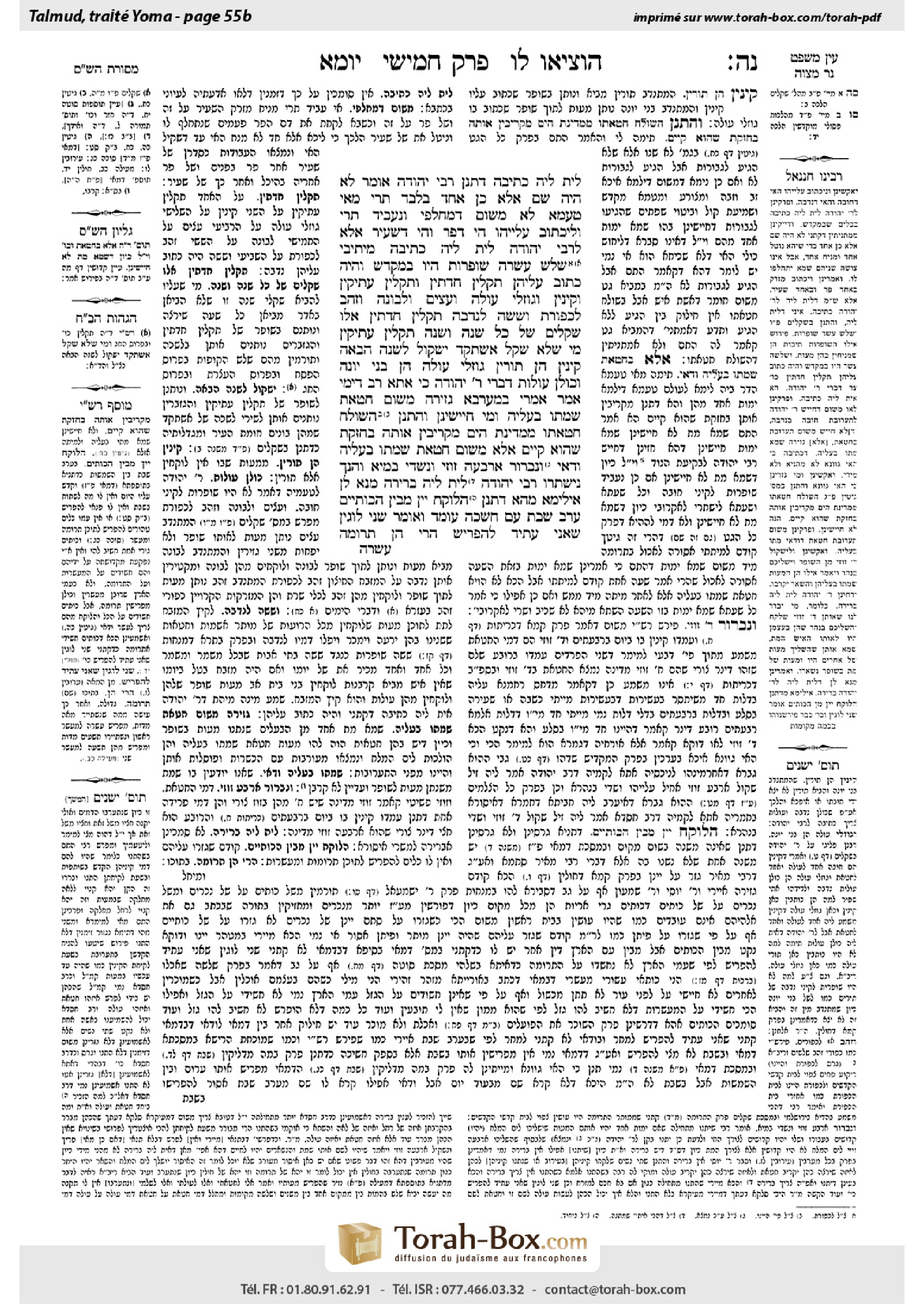
Yoma 55b: Talmud study for Daf Yomi
Daf Yomi is the daily study of one Talmud folio. Explore 37 tractates with scans, Hebrew text, Sefaria English and AI-generated French translations where annotated.
Passage selection and English or AI-generated French translation are available where the scan has annotations. Daf Study is independent of Torah-Box and Sefaria.
Browse Yoma · יומא · All tractatesYoma 55b text and translations
This page of Yoma includes the Aramaic text, an English translation and an AI-generated French translation, alongside the scan above.
יומא נ״ה ב · Aramaic and Hebrew text
לֵית לֵיהּ כְּתִיבָה. דִּתְנַן, רַבִּי יְהוּדָה אוֹמֵר: לֹא הָיָה שָׁם אֶלָּא כַּן אֶחָד בִּלְבַד. תְּרֵי מַאי טַעְמָא לָא — מִשּׁוּם דְּמִחַלְּפִי. וְנַעֲבֵיד תְּרֵי וְלִיכְתּוֹב עֲלַיְיהוּ הֵי דְפַר וְהֵי דְשָׂעִיר. אֶלָּא, לְרַבִּי יְהוּדָה לֵית לֵיהּ כְּתִיבָה.
מֵיתִיבִי: שְׁלֹשׁ עֶשְׂרֵה שׁוֹפָרוֹת הָיוּ בְּמִקְדָּשׁ, וְהָיָה כָּתוּב עֲלֵיהֶן: תִּקְלִין חַדְתִּין, וְתִקְלִין עַתִּיקִין, וְקִינִּין, וְגוֹזְלֵי עוֹלָה, וְעֵצִים, וּלְבוֹנָה, וְזָהָב לְכַפּוֹרֶת, וְשִׁשָּׁה לִנְדָבָה.
תִּקְלִין חַדְתִּין — אֵלּוּ שְׁקָלִים שֶׁל כׇּל שָׁנָה וְשָׁנָה, תִּקְלִין עַתִּיקִין — מִי שֶׁלֹּא שָׁקַל אֶשְׁתָּקַד, יִשְׁקוֹל לְשָׁנָה הַבָּאָה. קִינִּין — הֵן תּוֹרִין, גּוֹזְלֵי עוֹלָה — הֵן בְּנֵי יוֹנָה, וְכוּלָּן עוֹלוֹת, דִּבְרֵי רַבִּי יְהוּדָה.
כִּי אֲתָא רַב דִּימִי, אֲמַר: אָמְרִי בְּמַעְרְבָא, גְּזֵירָה מִשּׁוּם חַטָּאת שֶׁמֵּתוּ בְּעָלֶיהָ. וּמִי חָיְישִׁינַן? וְהָתְנַן: הַשּׁוֹלֵחַ חַטָּאתוֹ מִמְּדִינַת הַיָּם — מַקְרִיבִין אוֹתָהּ בְּחֶזְקַת שֶׁהוּא קַיָּים!
אֶלָּא: מִשּׁוּם חַטָּאת שֶׁמֵּתוּ בְּעָלֶיהָ וַדַּאי. וְנִבְרוֹר אַרְבָּעָה זוּזֵי וְנִשְׁדֵּי בְּמַיָּא, וְהָנָךְ נִישְׁתְּרוֹ? רַבִּי יְהוּדָה לֵית לֵיהּ בְּרֵירָה.
מְנָא לַן? אִילֵּימָא מֵהָא דִּתְנַן: הַלּוֹקֵחַ יַיִן מִבֵּין הַכּוּתִיִּים, עֶרֶב שַׁבָּת עִם חֲשֵׁכָה — עוֹמֵד וְאוֹמֵר: שְׁנֵי לוּגִּין שֶׁאֲנִי עָתִיד לְהַפְרִישׁ הֲרֵי הֵן תְּרוּמָה.
Yoma 55b · English translation
does not accept that one may rely on writing in a situation where an error is possible. As we learned in the mishna that Rabbi Yehuda says: There was only one pedestal in the Temple on which to place the blood. What is the reason that they did not place two pedestals there? The reason is because the pedestals might be exchanged for one another, and he might take the goat’s blood instead of that of the bull. But in that case, let us place two pedestals and write on them which one is for the bull and which is for the goat. Rather, it is clear that Rabbi Yehuda does not accept that one may rely on writing in a situation where error is possible.
The Gemara raises an objection against this conclusion: There were thirteen collection horns in the Temple, and they were each inscribed with different names. On one container was written: New shekels. In this horn they placed shekels that were donated at the correct time that year. And on another horn the phrase old shekels was written, referring to coins from the past year that did not reach the Temple during the allotted period. On the other horns, the following phrases were written: Nests, for obligatory offerings consisting of pairs of pigeons or turtledoves; young birds for burnt-offerings; wood, for anyone who wished to donate wood; frankincense; and gold for the Ark cover. And there were six additional boxes designated for communal free-will offerings of all kinds.
The Gemara explains: New shekels, these are the shekels of each and every year that arrive on time; old shekels, these are for one who did not donate a shekel the previous year, who must donate the next year; nests, these are the turtledoves brought as offerings; young birds for burnt-offerings, these are pigeons; and all these birds are burnt-offerings; this is the statement of Rabbi Yehuda. Rabbi Yehuda maintains that there was no container for nests of obligatory sin-offerings and burnt-offerings, due to the potential mixture between the two. In any case, this shows that Rabbi Yehuda does rely on inscriptions written on containers, which contradicts the above claim that he does not rely on writing in these situations.
When Rav Dimi came from Eretz Yisrael to Babylonia he said: They say in the West, Eretz Yisrael, that this is a rabbinic decree due to the possible presence in the mixture of a sin-offering whose owners have died. Since a sin-offering of this kind must be left to die, if one of the donors of the coins in the sin-offering horn passes away, his funds cannot be used. The Gemara asks: And are we concerned about the possible death of a donor? But didn’t we learn in a mishna: With regard to one who sends his sin-offering from overseas, they sacrifice it for him on the presumption that he is alive, although he might have died in the meantime. This shows that the possibility of death is not taken into account.
Rather, Rabbi Yehuda’s concern is due to a sin-offering whose owner has certainly died, lest it be confirmed that one of the people who donated money for a sin-offering bird has indeed died. The Gemara asks: Even so, this can be rectified, as let us select four zuz, the price of such an offering, and throw them into the water to be destroyed. It may be said that the money removed from the box was the money for the sin-offering whose owner died, and these other coins will be permitted. It will be clarified retroactively that these coins were designated for that purpose. The Gemara answers: Rabbi Yehuda does not accept the rule of retroactive clarification. In his opinion, one cannot issue a designation after the fact. Consequently, he rejects this solution.
The Gemara asks: From where do we derive that this is indeed Rabbi Yehuda’s opinion? If we say it is derived from that which we learned in the following mishna, there is a difficulty. The mishna states: With regard to one who buys wine from among the Samaritans, who do not tithe their produce properly, on Shabbat eve at nightfall and has no time to separate the tithe before Shabbat and to place the separated portions in distinct locations, he may arise and say: Two log of the one hundred log present here, which I will separate in the future, after Shabbat, shall be the teruma gedola given to a priest, as the Sages mandated that one-fiftieth of one’s produce constitutes an average measure of teruma;
Yoma 55b · Traduction française (IA)
n’admet pas que l’on puisse se fier à une inscription lorsqu’il existe un risque d’erreur. En effet, nous avons appris dans la Michna que Rabbi Yehouda dit : « Il n’y avait dans le Temple qu’un seul socle sur lequel déposer le sang. » Pourquoi n’en plaçait-on pas deux ? Parce que les socles risquaient d’être intervertis, et qu’il aurait pu prendre le sang du bouc au lieu de celui du taureau. Mais, dans ce cas, plaçons deux socles et inscrivons sur chacun lequel est destiné au taureau et lequel au bouc. Il est donc clair que Rabbi Yehouda n’admet pas que l’on puisse se fier à une inscription lorsqu’il existe un risque d’erreur.
La Guemara soulève une objection contre cette conclusion : il y avait dans le Temple treize troncs de collecte, chacun portant une inscription différente. Sur l’un d’eux était inscrit : « Nouveaux shekalim ». On y déposait les shekalim offerts au moment prévu cette année-là. Sur un autre était inscrit : « Anciens shekalim », c’est-à-dire les pièces de l’année précédente qui n’étaient pas parvenues au Temple dans le délai imparti. Sur les autres troncs figuraient les inscriptions suivantes : « Nids », pour les offrandes obligatoires composées de paires de pigeons ou de tourterelles ; « Jeunes oiseaux pour holocaustes » ; « Bois », pour quiconque souhaitait faire don de bois ; « Encens » ; et « Or pour le couvercle de l’Arche ». Il y avait en outre six autres caisses destinées aux offrandes volontaires communautaires de toutes sortes.
La Guemara explique : « Nouveaux shekalim », ce sont les shekalim de chaque année qui arrivent à temps ; « Anciens shekalim », ce sont ceux d’une personne qui n’a pas donné de shekel l’année précédente et qui doit en donner un l’année suivante ; « Nids », ce sont les tourterelles apportées comme offrandes ; « Jeunes oiseaux pour holocaustes », ce sont des pigeons ; et tous ces oiseaux sont des holocaustes. Telle est la déclaration de Rabbi Yehouda. Rabbi Yehouda estime qu’il n’y avait pas de tronc pour les nids destinés aux sacrifices expiatoires et aux holocaustes obligatoires, en raison du risque que les deux catégories soient mélangées. Quoi qu’il en soit, cela montre que Rabbi Yehouda se fie bien aux inscriptions apposées sur les récipients, ce qui contredit l’affirmation précédente selon laquelle il ne se fie pas aux inscriptions dans de telles situations.
Lorsque Rav Dimi arriva d’Erets Israël en Babylonie, il dit : « En Occident », c’est-à-dire en Erets Israël, « on dit qu’il s’agit d’un décret rabbinique motivé par la possibilité que le mélange contienne un sacrifice expiatoire dont les propriétaires sont morts. » Puisqu’un tel sacrifice expiatoire doit être laissé à mourir, si l’un des donateurs des pièces déposées dans le tronc destiné aux sacrifices expiatoires décède, ses fonds ne peuvent pas être utilisés. La Guemara demande : « Se soucie-t-on donc de la mort éventuelle d’un donateur ? Mais n’avons-nous pas appris dans une Michna : celui qui envoie son sacrifice expiatoire depuis l’étranger le voit offrir pour lui, en présumant qu’il est vivant, bien qu’il ait pu mourir entre-temps ? » Cela montre que la possibilité de son décès n’est pas prise en compte.
L’inquiétude de Rabbi Yehouda concerne plutôt un sacrifice expiatoire dont le propriétaire est certainement mort : on craint qu’il soit établi que l’une des personnes ayant donné de l’argent pour un oiseau destiné à un sacrifice expiatoire est effectivement morte. La Guemara demande : « Même dans ce cas, on peut régler le problème : prélevons quatre zouz, le prix d’une telle offrande, et jetons-les dans l’eau pour les détruire. On pourra alors dire que l’argent retiré de la caisse était celui du sacrifice expiatoire dont le propriétaire est mort, et que les autres pièces sont permises. Il sera ainsi établi rétroactivement que ces pièces étaient destinées à cet usage. » La Guemara répond : Rabbi Yehouda n’admet pas le principe de la clarification rétroactive. Selon lui, on ne peut pas procéder à une désignation après coup. Il rejette donc cette solution.
La Guemara demande : « D’où déduisons-nous que telle est bien l’opinion de Rabbi Yehouda ? Si nous disons qu’elle découle de ce que nous avons appris dans la Michna suivante, une difficulté se présente. » La Michna énonce : celui qui achète du vin aux Samaritains, qui ne prélèvent pas correctement les dîmes de leurs produits, le vendredi au crépuscule, et qui n’a pas le temps de séparer la dîme avant Chabbat ni de déposer les parts séparées en des endroits distincts, peut se lever et dire : « Deux logs sur les cent logs qui se trouvent ici, que je séparerai ultérieurement, après Chabbat, seront la terouma gedola donnée à un prêtre », car les Sages ont fixé qu’un cinquantième de la récolte constitue la mesure moyenne de terouma ;
Traduction française générée par IA à partir de l’édition anglaise de Sefaria. Vérifie toujours un passage avec le texte source.
Text from Sefaria: William Davidson Edition - Vocalized Aramaic (CC BY NC); William Davidson Edition - English (CC BY NC).