Yoma 65a: Talmud study for Daf Yomi
Daf Yomi is the daily study of one Talmud folio. Explore 37 tractates with scans, Hebrew text, Sefaria English and AI-generated French translations where annotated.
Passage selection and English or AI-generated French translation are available where the scan has annotations. Daf Study is independent of Torah-Box and Sefaria.
Browse Yoma · יומא · All tractatesYoma 65a text and translations
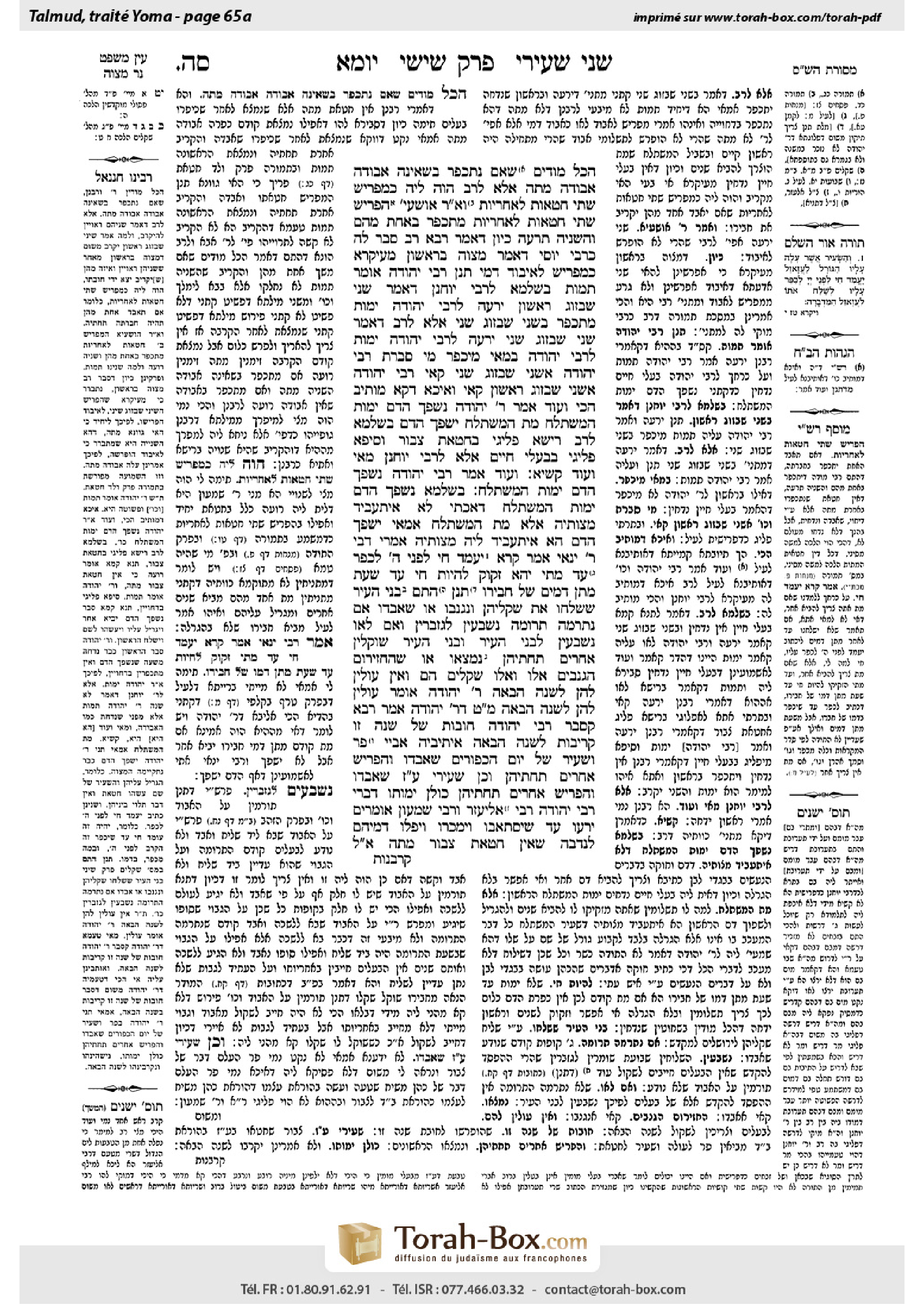
This page of Yoma includes the Aramaic text, an English translation and an AI-generated French translation, alongside the scan above.
יומא ס״ה א · Aramaic and Hebrew text
הַכֹּל מוֹדִים שֶׁאִם נִתְכַּפֵּר בְּשֶׁאֵינָהּ אֲבוּדָה — אֲבוּדָה מֵתָה.
אֶלָּא לְרַב הָוֵה לֵיהּ כְּמַפְרִישׁ שְׁתֵּי חַטָּאוֹת לְאַחְרָיוּת, וְאָמַר רַבִּי אוֹשַׁעְיָא: הִפְרִישׁ שְׁתֵּי חַטָּאוֹת לְאַחְרָיוּת — מִתְכַּפֵּר בְּאַחַת מֵהֶם, וְהַשְּׁנִיָּה תִּרְעֶה.
כֵּיוָן דְּאָמַר רָבָא: רַב סָבַר לַהּ כְּרַבִּי יוֹסֵי דְּאָמַר מִצְוָה בָּרִאשׁוֹן, מֵעִיקָּרָא כְּמַפְרִישׁ לְאִיבּוּד דָּמֵי.
תְּנַן, רַבִּי יְהוּדָה אוֹמֵר: תָּמוּת. בִּשְׁלָמָא לְרַבִּי יוֹחָנָן דְּאָמַר שֵׁנִי שֶׁבְּזוּג רִאשׁוֹן יִרְעֶה, לְרַבִּי יְהוּדָה יָמוּת — מִתְכַּפֵּר בַּשֵּׁנִי שֶׁבְּזוּג שֵׁנִי.
אֶלָּא לְרַב דְּאָמַר שֵׁנִי שֶׁבְּזוּג שֵׁנִי יִרְעֶה, לְרַבִּי יְהוּדָה יָמוּת — לְרַבִּי יְהוּדָה בְּמַאי מִיכַּפַּר? מִי סָבְרַתְּ רַבִּי יְהוּדָה אַשֵּׁנִי שֶׁבְּזוּג שֵׁנִי קָאֵי? רַבִּי יְהוּדָה אַשֵּׁנִי שֶׁבְּזוּג רִאשׁוֹן קָאֵי.
וְאִיכָּא דְּקָא מוֹתֵיב הָכִי: וְעוֹד אָמַר רַבִּי יְהוּדָה: נִשְׁפַּךְ הַדָּם יָמוּת הַמִּשְׁתַּלֵּחַ, מֵת הַמִּשְׁתַּלֵּחַ יִשָּׁפֵךְ הַדָּם.
בִּשְׁלָמָא לְרַב, רֵישָׁא פְּלִיגִי בְּחַטַּאת צִבּוּר וְסֵיפָא פְּלִיגִי בְּבַעֲלֵי חַיִּים. אֶלָּא לְרַבִּי יוֹחָנָן, מַאי ״וְעוֹד״. קַשְׁיָא.
וְעוֹד אָמַר רַבִּי יְהוּדָה: נִשְׁפַּךְ הַדָּם — יָמוּת הַמִּשְׁתַּלֵּחַ. בִּשְׁלָמָא נִשְׁפַּךְ הַדָּם יָמוּת הַמִּשְׁתַּלֵּחַ — דְּאַכַּתִּי לָא אִיתְעֲבִיד מִצְוְתֵיהּ.
אֶלָּא מֵת הַמִּשְׁתַּלֵּחַ, אַמַּאי יִשָּׁפֵךְ הַדָּם? הָא אִיתְעֲבִיד לֵיהּ מִצְוְתֵיהּ!
אָמְרִי דְּבֵי רַבִּי יַנַּאי: אָמַר קְרָא: ״יׇעֳמַד חַי לִפְנֵי ה׳ לְכַפֵּר״, עַד מָתַי יְהֵא זָקוּק לִהְיוֹת חַי — עַד שְׁעַת מַתַּן דָּמִים שֶׁל חֲבֵירוֹ.
תְּנַן הָתָם: בְּנֵי הָעִיר שֶׁשָּׁלְחוּ אֶת שִׁקְלֵיהֶן וְנִגְנְבוּ אוֹ שֶׁאָבְדוּ, אִם נִתְרְמָה תְּרוּמָה — נִשְׁבָּעִין לְגִזְבָּרִין.
וְאִם לָאו — נִשְׁבָּעִין לִבְנֵי הָעִיר, וּבְנֵי הָעִיר שׁוֹקְלִין אֲחֵרִים תַּחְתֵּיהֶן.
נִמְצְאוּ אוֹ שֶׁהֶחְזִירוּם הַגַּנָּבִים — אֵלּוּ וָאֵלּוּ שְׁקָלִים הֵם, וְאֵין עוֹלִין לָהֶן לְשָׁנָה הַבָּאָה. רַבִּי יְהוּדָה אוֹמֵר: עוֹלִין לָהֶן לְשָׁנָה הַבָּאָה.
מַאי טַעְמָא דְּרַבִּי יְהוּדָה? אָמַר רָבָא: קָסָבַר רַבִּי יְהוּדָה חוֹבוֹת שֶׁל שָׁנָה זוֹ קְרֵיבוֹת לְשָׁנָה הַבָּאָה.
אֵיתִיבֵיהּ אַבָּיֵי: פַּר וְשָׂעִיר שֶׁל יוֹם הַכִּפּוּרִים שֶׁאָבְדוּ וְהִפְרִישׁ אֲחֵרִים תַּחְתֵּיהֶן, וְכֵן שְׂעִירֵי עֲבוֹדָה זָרָה שֶׁאָבְדוּ וְהִפְרִישׁ אֲחֵרִים תַּחְתֵּיהֶן — כּוּלָּן יָמוּתוּ, דִּבְרֵי רַבִּי יְהוּדָה. רַבִּי אֱלִיעֶזֶר וְרַבִּי שִׁמְעוֹן אוֹמְרִים: יִרְעוּ עַד שֶׁיִּסְתָּאֲבוּ וְיִמָּכְרוּ, וְיִפְּלוּ דְּמֵיהֶם לִנְדָבָה, שֶׁאֵין חַטַּאת צִבּוּר מֵתָה. אֲמַר לֵיהּ:
Yoma 65a · English translation
Everyone concedes that if the animal one designated as a sin-offering became lost, and he designated another animal in its stead and then found the first animal, if he gained atonement through the one that was not lost, i.e., the second one, the one that was lost is left to die.
However, according to the opinion of Rav, who rules that the remaining goat from the first pair is the one that is sacrificed, that goat was never disqualified, and the extra goat from the second pair was designated to serve the same purpose as the remaining goat. This is like one who designates two sin-offerings as a guarantee, so that if he loses one of them he will still be able to bring the other one. And Rabbi Oshaya said that all agree that if one separated two sin-offerings as a guarantee, he gains atonement through one of them, and the second is left to graze until it becomes unfit. Consequently, even the sin-offering of an individual is not left to die in this case.
The Gemara answers: Since Rava said that Rav holds in accordance with the opinion of Rabbi Yosei, who said that the mitzva should be performed with the first animal, when one designates the second animal, it is considered from the beginning to be comparable to an offering separated in order to be lost. In that case, if it is the sin-offering of an individual, the second animal is left to die.
We learned in the mishna that Rabbi Yehuda says: It should be left to die. Granted, according to the opinion of Rabbi Yoḥanan, who said that the second goat of the first pair should be left to graze, according to Rabbi Yehuda, who said it should be left to die, he nonetheless gains atonement with the second goat of the second pair.
However, according to Rav, who said that the second goat of the second pair should be left to graze, and according to Rabbi Yehuda it should be left to die, then according to Rabbi Yehuda he cannot sacrifice either of the two goats: The first goat may not be sacrificed because Rabbi Yehuda holds that disqualified animals are permanently rejected, and the second goat must be left to die. With which goat will he gain atonement? The Gemara answers: Do you maintain that Rabbi Yehuda was referring to the second goat of the second pair when he said it should be left to die? Rabbi Yehuda was referring to the second goat of the first pair. The second goat of the second pair is sacrificed.
There are those who raised this objection from the statement of Rabbi Yehuda in the mishna. And furthermore, Rabbi Yehuda said: If the blood of the goat sacrificed to God spilled before it was sprinkled, the scapegoat is left to die. Similarly, if the scapegoat dies, the blood of the goat sacrificed to God should be spilled, and two other goats are brought and lots are drawn.
Granted, according to Rav, in the first clause of the mishna they disagree with regard to a communal sin-offering. According to the Rabbis the second animal is left to graze, whereas according to Rabbi Yehuda it is left to die. And in the latter clause they disagree with regard to whether animals that become disqualified as offerings are permanently rejected. According to the Rabbis they are not rejected and therefore the first goat is sacrificed, whereas Rabbi Yehuda holds that they are rejected and therefore the first goat is left to die and the second goat is sacrificed. However, according to Rabbi Yoḥanan, what does the term: And furthermore, in the mishna indicate? Even the Rabbis agree that the remaining goat from the first pair is permanently disqualified. The Gemara comments that indeed, this is difficult.
§ It was taught in the mishna: And furthermore, Rabbi Yehuda said: If the blood of the goat sacrificed to God spilled before it was sprinkled, the scapegoat should be left to die. Similarly, if the scapegoat dies, the blood of the goat sacrificed to God should be spilled. The Gemara asks: Granted, if the blood of the goat sacrificed to God spilled, the scapegoat should be left to die, as the mitzva of the blood has not yet been performed, as it was not sprinkled in the prescribed manner.
However, if the scapegoat dies, why should the blood of the goat sacrificed to God be spilled? The mitzva of the scapegoat has already been performed. The only essential detail with regard to the scapegoat is the lottery, which has already been performed by the priest. Sending it to Azazel and pushing it off a cliff are carried out by an appointed person and while they are prescribed ab initio, they are not indispensable. After the fact, if the goat dies in some other way, the obligation has been fulfilled.
The Sages of the house of Rabbi Yannai said that the verse states: “But the goat, on which the lot fell for Azazel, shall be stood alive before the Lord, to make atonement over him, to send him away to Azazel into the wilderness” (Leviticus 16:10). Until when must the scapegoat be alive? Until the blood of its counterpart is sprinkled, and if it dies before, the blood is disqualified.
We learned in a mishna there (Shekalim 2:1): If residents of a city sent their shekels to the Temple with a messenger, and the shekels were stolen or were lost along the way; if the funds were already collected, i.e., the coins for the new year’s offerings were taken from the chamber before the money was stolen, the messengers take an oath to the treasurers of the Temple that they did not unlawfully use the shekels, but that they were taken unbeknownst to them or by force. This is because once the necessary coins have been removed, all other coins that have been dedicated for this purpose are considered Temple property wherever they are, and their subsequent theft does not change that status. If the messengers take this oath, they are exempt from monetary liability.
And if the funds were not yet collected when these coins were stolen, the coins are still considered the property of those who dedicated them to the Temple, and therefore the messengers take an oath to the residents of the city, and the residents of the city donate other shekels to the Temple in their stead.
If the shekels that were lost are found or the thieves returned them, both these and those are shekels, i.e., they remain sanctified, but they do not count toward the amount due the following year. The next year the members of that city must donate new shekels; they have not fulfilled the second year’s obligation by having given twice the previous year. Rabbi Yehuda says: They do count toward the following year.
The Gemara asks: What is the reason for the opinion of Rabbi Yehuda? Rava said: Rabbi Yehuda holds that the obligations of this year are also brought the following year, and therefore it is possible to fulfill one’s obligation for the next year by using the shekels of this year.
Abaye raised an objection to this explanation. It was taught that if the bull and goat of Yom Kippur were lost and one designated others in their stead, and similarly if the goats which atone for a communal transgression of idol worship by instruction of the court were lost and he designated others in their stead, and the original animals were found, all the original animals should be left to die, and cannot be sacrificed at a later time. This is the statement of Rabbi Yehuda. Rabbi Eliezer and Rabbi Shimon say: They should be left to graze until they become unfit. Then they are sold, and the money received in their sale will go to the purchase of a public gift-offering, as a communal sin-offering is not left to die. According to Rabbi Yehuda, if the obligations of this year may be brought the following year, the bull and goat of Yom Kippur that were lost should be sacrificed the following year, and not left to die. Rava said to him:
Yoma 65a · Traduction française (IA)
Tous conviennent que si l’animal qu’un homme avait désigné comme sacrifice expiatoire s’est perdu, qu’il en a désigné un autre à sa place, puis qu’il a retrouvé le premier, et qu’il a obtenu l’expiation grâce à celui qui ne s’était pas perdu, c’est-à-dire le second, l’animal perdu est laissé mourir.
Toutefois, selon l’opinion de Rav, qui tranche que le bouc restant de la première paire est celui qui est sacrifié, ce bouc n’a jamais été disqualifié, et le bouc supplémentaire de la seconde paire a été désigné pour remplir la même fonction que le bouc restant. Cela revient au cas de quelqu’un qui désigne deux sacrifices expiatoires comme garantie, afin que, s’il en perd un, il puisse tout de même offrir l’autre. Or Rabbi Oshaya a dit que tous conviennent que si quelqu’un a mis à part deux sacrifices expiatoires comme garantie, il obtient l’expiation grâce à l’un d’eux, et le second est laissé au pâturage jusqu’à ce qu’il devienne impropre. Par conséquent, même dans ce cas, le sacrifice expiatoire d’un particulier n’est pas laissé mourir.
La Guemara répond : puisque Rava a dit que Rav suit l’opinion de Rabbi Yosei, selon laquelle la mitsva doit être accomplie avec le premier animal, lorsqu’on désigne le second animal, celui-ci est considéré dès le départ comme comparable à un sacrifice mis à part en vue d’être perdu. Dans ce cas, s’il s’agit du sacrifice expiatoire d’un particulier, le second animal est laissé mourir.
Nous avons appris dans la Michna que Rabbi Yehuda dit : il doit être laissé mourir. Certes, selon l’opinion de Rabbi Yoḥanan, qui dit que le second bouc de la première paire doit être laissé au pâturage, même d’après Rabbi Yehuda, qui dit qu’il doit être laissé mourir, l’homme obtient l’expiation grâce au second bouc de la seconde paire.
Toutefois, selon Rav, qui dit que le second bouc de la seconde paire doit être laissé au pâturage, et selon Rabbi Yehuda, qui dit qu’il doit être laissé mourir, Rabbi Yehuda ne peut alors sacrifier aucun des deux boucs : le premier ne peut être sacrifié, car Rabbi Yehuda estime que les animaux disqualifiés sont définitivement rejetés, et le second doit être laissé mourir. Avec quel bouc obtiendra-t-il l’expiation ? La Guemara répond : Penses-tu que, lorsqu’il a dit qu’il devait être laissé mourir, Rabbi Yehuda parlait du second bouc de la seconde paire ? Rabbi Yehuda parlait du second bouc de la première paire. Le second bouc de la seconde paire est sacrifié.
Certains ont soulevé cette objection à partir de la déclaration de Rabbi Yehuda dans la Michna. De plus, Rabbi Yehuda a dit : si le sang du bouc offert à Dieu s’est répandu avant d’être aspergé, le bouc émissaire est laissé mourir. De même, si le bouc émissaire meurt, le sang du bouc offert à Dieu doit être répandu, et l’on amène deux autres boucs et on procède au tirage au sort.
Certes, selon Rav, dans la première partie de la Michna, ils sont en désaccord au sujet d’un sacrifice expiatoire communautaire. Selon les Rabbins, le second animal est laissé au pâturage, tandis que, selon Rabbi Yehuda, il est laissé mourir. Dans la dernière partie, ils sont en désaccord sur la question de savoir si les animaux disqualifiés comme offrandes sont définitivement rejetés. Selon les Rabbins, ils ne sont pas rejetés et le premier bouc est donc sacrifié, tandis que Rabbi Yehuda estime qu’ils sont rejetés ; le premier bouc est donc laissé mourir et le second est sacrifié. Toutefois, selon Rabbi Yoḥanan, que signifie l’expression « de plus » dans la Michna ? Même les Rabbins conviennent que le bouc restant de la première paire est définitivement disqualifié. La Guemara fait remarquer qu’en effet, cette difficulté demeure.
§ Il a été enseigné dans la Michna : De plus, Rabbi Yehuda a dit : si le sang du bouc offert à Dieu s’est répandu avant d’être aspergé, le bouc émissaire doit être laissé mourir. De même, si le bouc émissaire meurt, le sang du bouc offert à Dieu doit être répandu. La Guemara demande : Certes, si le sang du bouc offert à Dieu s’est répandu, le bouc émissaire doit être laissé mourir, car la mitsva relative au sang n’a pas encore été accomplie, puisqu’il n’a pas été aspergé selon la procédure prescrite.
Toutefois, si le bouc émissaire meurt, pourquoi le sang du bouc offert à Dieu devrait-il être répandu ? La mitsva relative au bouc émissaire a déjà été accomplie. Le seul élément essentiel concernant le bouc émissaire est le tirage au sort, que le prêtre a déjà effectué. Son envoi à Azazel et sa précipitation du haut d’une falaise sont accomplis par une personne désignée ; bien que cela soit prescrit a priori, ce n’est pas indispensable. A posteriori, si le bouc meurt d’une autre manière, l’obligation est remplie.
Les Sages de l’école de Rabbi Yannai ont dit que le verset énonce : « Mais le bouc sur lequel est tombé le sort pour Azazel sera présenté vivant devant le Seigneur, afin de faire l’expiation pour lui, puis de l’envoyer à Azazel, dans le désert » (Lévitique 16:10). Jusqu’à quand le bouc émissaire doit-il rester vivant ? Jusqu’à l’aspersion du sang de son compagnon ; s’il meurt avant, le sang est disqualifié.
Nous avons appris dans une Michna, là-bas (Chekalim 2:1) : si les habitants d’une ville ont envoyé leurs sicles au Temple par l’intermédiaire d’un messager, et que les sicles ont été volés ou perdus en chemin, si les fonds avaient déjà été prélevés — c’est-à-dire si les pièces destinées aux sacrifices de la nouvelle année avaient déjà été retirées de la chambre avant le vol —, les messagers prêtent serment devant les trésoriers du Temple qu’ils n’ont pas fait un usage illicite des sicles, mais que ceux-ci ont été pris à leur insu ou par la force. En effet, une fois les pièces nécessaires prélevées, toutes les autres pièces consacrées à cette fin sont considérées comme appartenant au Temple, où qu’elles se trouvent, et leur vol ultérieur ne change pas ce statut. Si les messagers prêtent ce serment, ils sont dégagés de toute responsabilité pécuniaire.
Et si les fonds n’avaient pas encore été prélevés lorsque ces pièces ont été volées, celles-ci sont toujours considérées comme la propriété de ceux qui les ont consacrées au Temple. Les messagers prêtent donc serment devant les habitants de la ville, et ceux-ci donnent d’autres sicles au Temple à leur place.
Si les sicles qui avaient été perdus sont retrouvés ou si les voleurs les rendent, ceux-ci comme ceux-là restent des sicles, c’est-à-dire qu’ils demeurent consacrés, mais ils ne comptent pas pour le montant dû l’année suivante. L’année suivante, les habitants de cette ville doivent donner de nouveaux sicles ; ils ne se sont pas acquittés de l’obligation de la deuxième année en ayant donné deux fois la somme de l’année précédente. Rabbi Yehuda dit : ils comptent pour l’année suivante.
La Guemara demande : Quelle est la raison de l’opinion de Rabbi Yehuda ? Rava a dit : Rabbi Yehuda estime que les obligations de cette année peuvent également être acquittées l’année suivante ; il est donc possible de s’acquitter de son obligation pour l’année suivante au moyen des sicles de cette année.
Abaye objecta à cette explication. Il a été enseigné que si le taureau et le bouc de Yom Kippour se sont perdus et qu’on en a désigné d’autres à leur place, et de même si les boucs qui expient une transgression communautaire d’idolâtrie commise sur instruction du tribunal se sont perdus et qu’on en a désigné d’autres à leur place, puis que les animaux d’origine sont retrouvés, tous les animaux d’origine doivent être laissés mourir et ne peuvent être sacrifiés ultérieurement. Telle est la déclaration de Rabbi Yehuda. Rabbi Eliezer et Rabbi Shimon disent : ils doivent être laissés au pâturage jusqu’à ce qu’ils deviennent impropres. On les vend alors, et l’argent de leur vente servira à acheter une offrande publique volontaire, car un sacrifice expiatoire communautaire n’est pas laissé mourir. Selon Rabbi Yehuda, si les obligations de cette année peuvent être acquittées l’année suivante, le taureau et le bouc de Yom Kippour qui se sont perdus devraient être sacrifiés l’année suivante, et non laissés mourir. Rava lui dit :
Traduction française générée par IA à partir de l’édition anglaise de Sefaria. Vérifie toujours un passage avec le texte source.
Text from Sefaria: William Davidson Edition - Vocalized Aramaic (CC BY NC); William Davidson Edition - English (CC BY NC).