Yoma 66a: Talmud study for Daf Yomi
Daf Yomi is the daily study of one Talmud folio. Explore 37 tractates with scans, Hebrew text, Sefaria English and AI-generated French translations where annotated.
Passage selection and English or AI-generated French translation are available where the scan has annotations. Daf Study is independent of Torah-Box and Sefaria.
Browse Yoma · יומא · All tractatesYoma 66a text and translations
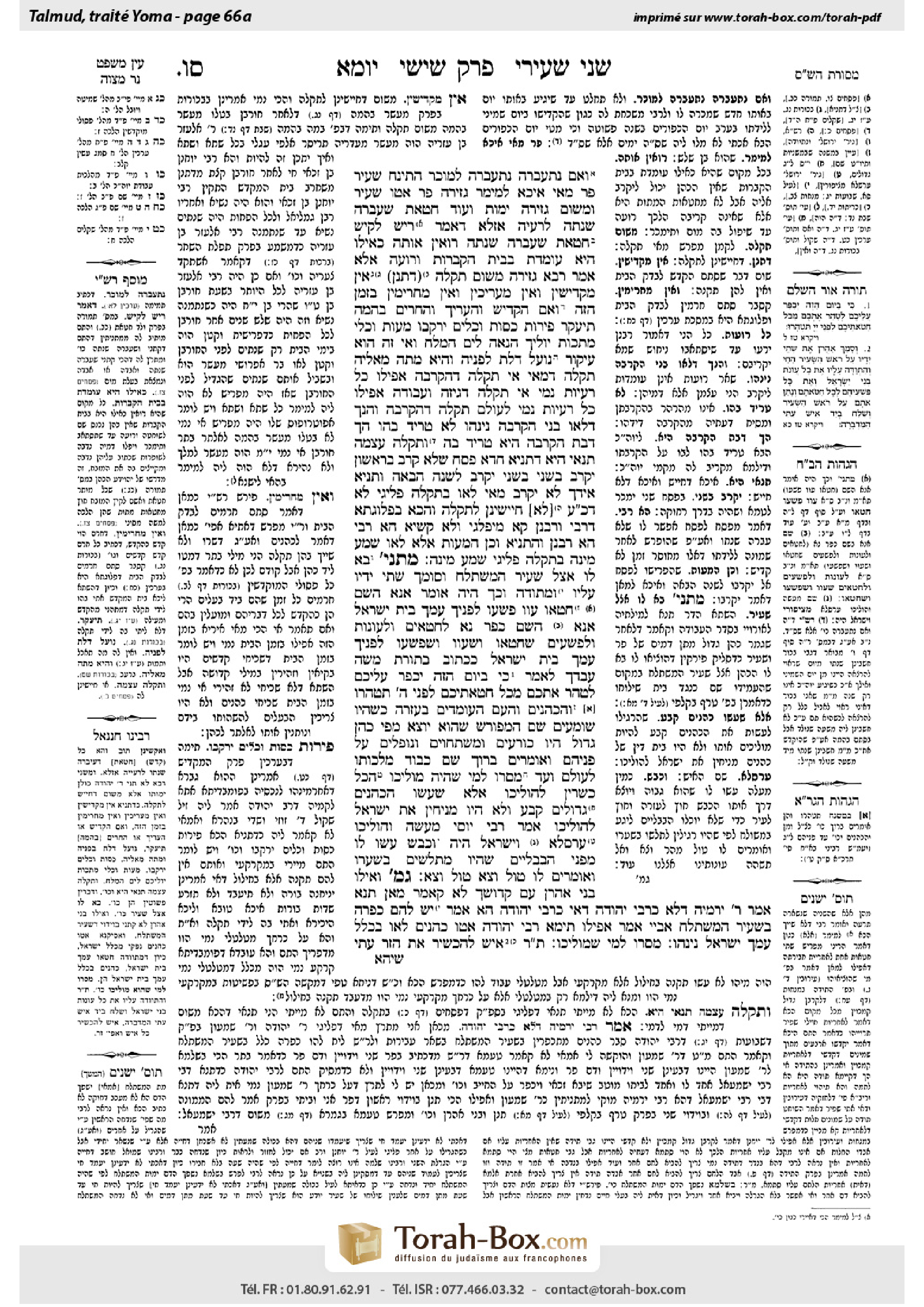
This page of Yoma includes the Aramaic text, an English translation and an AI-generated French translation, alongside the scan above.
יומא ס״ו א · Aramaic and Hebrew text
וְאִם נִתְעַבְּרָה — נִתְעַבְּרָה לַמּוֹכֵר. הָתִינַח שָׂעִיר, פַּר מַאי אִיכָּא לְמֵימַר? גְּזֵירָה פַּר אַטּוּ שָׂעִיר.
וּמִשּׁוּם גְּזֵירָה יָמוּת?! וְעוֹד, חַטָּאת שֶׁעִבְּרָה שְׁנָתָהּ — לִרְעִיָּה אָזְלָא! דְּאָמַר רֵישׁ לָקִישׁ: חַטָּאת שֶׁעִבְּרָה שְׁנָתָהּ, רוֹאִין אוֹתָהּ כְּאִילּוּ הִיא עוֹמֶדֶת בְּבֵית הַקְּבָרוֹת וְרוֹעָה.
אֶלָּא אָמַר רָבָא: גְּזֵירָה מִשּׁוּם תַּקָּלָה. אֵין מַקְדִּישִׁין, וְאֵין מַעֲרִיכִין, וְאֵין מַחְרִימִין בַּזְּמַן הַזֶּה.
וְאִם הִקְדִּישׁ וְהֶעֱרִיךְ וְהֶחְרִים, בְּהֵמָה — תֵּיעָקֵר. פֵּירוֹת כְּסוּת וְכֵלִים — יֵרָקְבוּ, מָעוֹת וּכְלֵי מַתָּכוֹת — יוֹלִיךְ הֲנָאָה לְיָם הַמֶּלַח. וְאֵי זֶה הוּא עִיקּוּר — נוֹעֵל דֶּלֶת לְפָנֶיהָ, וְהִיא מֵתָה מֵאֵלֶיהָ.
תַּקָּלָה דְּמַאי? אִי תַּקָּלָה דְּהַקְרָבָה, אֲפִילּוּ כׇּל רְעִיּוֹת נָמֵי! אִי תַּקָּלָה דְּגִיזָּה וַעֲבוֹדָה, אֲפִילּוּ כׇּל רְעִיּוֹת נָמֵי!
לְעוֹלָם תַּקָּלָה דְּהַקְרָבָה, וְהָנָךְ דְּלָאו בְּנֵי הַקְרָבָה נִינְהוּ — לָא טְרִיד בְּהוּ, הָךְ דְּבַת הַקְרָבָה הִיא — טְרִיד בַּהּ.
וְתַקָּלָה עַצְמָהּ תַּנָּאֵי הִיא. דְּתַנְיָא חֲדָא: פֶּסַח שֶׁלֹּא קָרַב בְּרִאשׁוֹן — יִקְרַב בַּשֵּׁנִי, בַּשֵּׁנִי — יִקְרַב לְשָׁנָה הַבָּאָה. וְתַנְיָא אִידַּךְ: לֹא יִקְרַב. מַאי לָאו, בְּתַקָּלָה פְּלִיגִי?
לָא, דְּכוּלֵּי עָלְמָא [לָא] חָיְישִׁינַן לְתַקָּלָה, וְהָכָא בִּפְלוּגְתָּא דְּרַבִּי וְרַבָּנַן קָא מִיפַּלְגִי, וְלָא קַשְׁיָא: הָא רַבִּי, הָא רַבָּנַן.
וְהָתַנְיָא: וְכֵן הַמָּעוֹת! אֶלָּא לָאו שְׁמַע מִינַּהּ — בְּתַקָּלָה פְּלִיגִי, שְׁמַע מִינַּהּ.
מַתְנִי׳ בָּא לוֹ אֵצֶל שָׂעִיר הַמִּשְׁתַּלֵּחַ, וְסוֹמֵךְ שְׁתֵּי יָדָיו עָלָיו וּמִתְוַדֶּה. וְכָךְ הָיָה אוֹמֵר: אָנָא הַשֵּׁם! חָטְאוּ, עָווּ, פָּשְׁעוּ לְפָנֶיךָ עַמְּךָ בֵּית יִשְׂרָאֵל. אָנָא הַשֵּׁם! כַּפֶּר נָא לַחֲטָאִים וְלָעֲוֹנוֹת וְלַפְּשָׁעִים שֶׁחָטְאוּ וְשֶׁעָווּ וְשֶׁפָּשְׁעוּ לְפָנֶיךָ עַמְּךָ בֵּית יִשְׂרָאֵל, כַּכָּתוּב בְּתוֹרַת מֹשֶׁה עַבְדֶּךָ לֵאמֹר: ״כִּי בַיּוֹם הַזֶּה יְכַפֵּר עֲלֵיכֶם לְטַהֵר אֶתְכֶם מִכֹּל חַטֹּאתֵיכֶם לִפְנֵי ה׳ תִּטְהָרוּ״.
וְהַכֹּהֲנִים וְהָעָם הָעוֹמְדִים בָּעֲזָרָה כְּשֶׁהָיוּ שׁוֹמְעִים שֵׁם הַמְּפוֹרָשׁ שֶׁהוּא יוֹצֵא מִפִּי כֹּהֵן גָּדוֹל, הָיוּ כּוֹרְעִים וּמִשְׁתַּחֲוִים וְנוֹפְלִים עַל פְּנֵיהֶם, וְאוֹמְרִים: ״בָּרוּךְ שֵׁם כְּבוֹד מַלְכוּתוֹ לְעוֹלָם וָעֶד״. מְסָרוֹ לְמִי שֶׁהָיָה מוֹלִיכוֹ. הַכֹּל כְּשֵׁרִין לְהוֹלִיכוֹ, אֶלָּא שֶׁעָשׂוּ הַכֹּהֲנִים גְּדוֹלִים קֶבַע, וְלֹא הָיוּ מַנִּיחִין אֶת יִשְׂרָאֵל לְהוֹלִיכוֹ.
אָמַר רַבִּי יוֹסֵי: מַעֲשֶׂה וְהוֹלִיכוֹ עַרְסְלָא, וְיִשְׂרָאֵל הָיָה. וְכֶבֶשׁ עָשׂוּ לוֹ מִפְּנֵי הַבָּבְלִיִּים, שֶׁהָיוּ מְתַלְּשִׁים בִּשְׂעָרוֹ וְאוֹמְרִים לוֹ: טוֹל וָצֵא טוֹל וָצֵא.
גְּמָ׳ וְאִילּוּ ״בְּנֵי אַהֲרֹן עַם קְדוֹשֶׁךָ״ לָא קָאָמַר. מַאן תַּנָּא? אָמַר רַבִּי יִרְמְיָה: דְּלָא כְּרַבִּי יְהוּדָה, דְּאִי כְּרַבִּי יְהוּדָה, הָא אָמַר: יֵשׁ לָהֶם כַּפָּרָה בְּשָׂעִיר הַמִּשְׁתַּלֵּחַ.
אַבָּיֵי אָמַר: אֲפִילּוּ תֵּימָא רַבִּי יְהוּדָה, אַטּוּ כֹּהֲנִים לָאו בִּכְלַל ״עַמְּךָ יִשְׂרָאֵל״ נִינְהוּ?
מְסָרוֹ לְמִי שֶׁמּוֹלִיכוֹ. תָּנוּ רַבָּנַן: ״אִישׁ״ — לְהַכְשִׁיר אֶת הַזָּר, ״עִתִּי״ —
Yoma 66a · English translation
And if the year was extended and made into a leap year, it is extended for the benefit of the seller, and according to the Sages he has an additional month in which to redeem his house. The Gemara asks: This works out well with regard to the goat, but with regard to the bull, what is there to say? The bull remains valid even if it is more than a year old. The Gemara answers: There is a rabbinic decree with regard to the bull due to the goat.
The Gemara asks: Is it right that due to a rabbinic decree the offerings should be left to die instead of being left to graze? And furthermore, a sin-offering whose year has passed is not left to die but rather goes to graze. As Reish Lakish said: We consider a sin-offering whose year has passed as though it stands in a cemetery, and the priest cannot take it out in order to sacrifice it because he is not permitted to become ritually defiled. Therefore, it grazes until it becomes unfit and is then sold.
Rather, Rava said: The bull and goat of Yom Kippur may not be left from one year to the next by rabbinic decree due to a concern that a mishap may occur. As it was taught in a baraita: One may neither consecrate objects, nor valuate, i.e., take a vow to donate one’s value to the Temple treasury, nor dedicate items for sacred use at this time, when the Temple no longer exists.
And if one did consecrate, valuate, or dedicate items for sacred use: If he dedicated an animal it is uprooted, i.e., he arranges for it to die quickly. If he dedicated agricultural produce, garments, or vessels made from materials that decompose, he should store them until they decompose. And if he dedicated money or metal vessels, he should redeem them and transport the value of their benefit to the Dead Sea. This baraita indicates that animals that cannot be sacrificed at this time must be left to die so that they are not used improperly. The Gemara explains: And what constitutes uprooting? He locks the door before it, and it dies on its own from hunger.
The Gemara asks: What mishap might occur if the bull and goat are left until the next year? If you say it is a mishap of offering the animal as a different offering, a similar concern should exist even with regard to all animals that have been disqualified for use as offerings that one leaves to graze. If it is a mishap of shearing the animal’s wool and working the animal, which would constitute unlawful use of consecrated property, a similar concern should exist even with regard to all animals that have been disqualified for use as offerings that are left to graze. Why are these animals in particular left to die?
The Gemara answers: Actually, the concern is for a mishap of sacrifice. And those other disqualified animals that are left to graze, which are not fit for sacrifice, he is not preoccupied with, and will not accidentally sacrifice them. This bull and goat, which are fit for sacrifice next year, he is preoccupied with them. Therefore, there is a greater concern that one may sacrifice them as offerings, and they may not be left to graze.
The Gemara comments: This issue itself, i.e., whether decrees are instituted due to a concern about a possible mishap, is a dispute between tanna’im. As it was taught in one baraita: A Paschal lamb that was not sacrificed on the first Pesaḥ is sold to someone who was impure on the first Pesaḥ or who was distant from Jerusalem, so that it may be sacrificed on the second Pesaḥ. If it was not sacrificed on the second Pesaḥ, it is sacrificed the following year. And it was taught in another baraita: If it was not sacrificed on the second Pesaḥ, it is not sacrificed the following year. What, is it not that they disagree about the question of whether a decree was issued prohibiting keeping the animal for an entire year due to a concern about the possibility of a mishap?
The Gemara responds: No, these sources do not prove that the tanna’im disputed this issue. It is possible that everyone agrees that we are not concerned about a mishap, and here they disagree about the dispute between Rabbi Yehuda HaNasi and the Rabbis with regard to whether it is possible that the lamb will still be fit for sacrifice the following year. And the apparent contradiction between the baraitot is not difficult. This baraita, which says that the lamb is brought the following year, is in accordance with the opinion of Rabbi Yehuda HaNasi. That baraita, which says that the lamb may not be sacrificed the following year, is in accordance with the opinion of the Rabbis, who hold that by the following year, the lamb will certainly be more than a year old and will therefore be unfit as a Paschal offering.
The Gemara challenges this rejection: Wasn’t it taught in a baraita: And, so too, money that was dedicated for purchasing a Paschal lamb is subject to dispute about whether it may be kept for the following year. In the case of money, the dispute between Rabbi Yehuda HaNasi and the Rabbis is irrelevant. Rather, isn’t it correct to conclude from this that they disagree with regard to whether a decree is issued due to a concern about a mishap? The Gemara concludes: Indeed, learn from this that it is so.
MISHNA: The Yom Kippur service continues: The High Priest comes over to the scapegoat, places both his hands upon it, and confesses. And he would say as follows: Please, God, Your people, the house of Israel, have sinned, and done wrong, and rebelled before You. Please, God, grant atonement, please, for the sins, and for the wrongs, and for the rebellions that they have sinned, and done wrong, and rebelled before You, Your people, the house of Israel, as it is written in the Torah of Moses Your servant, saying: “For on this day atonement shall be made for you to cleanse you of all your sins; before the Lord you shall be purified” (Leviticus 16:30).
And the priests and the people standing in the Temple courtyard, when they would hear the Explicit Name emerging from the mouth of the High Priest, when the High Priest did not use one of the substitute names for God, they would kneel and prostrate themselves and fall on their faces, and say: Blessed is the name of His glorious kingdom forever and ever. After the confession over the scapegoat, the priest passed the goat to the one who was to lead it to the wilderness. According to the halakha, everyone is eligible to lead it, but the High Priests established a fixed custom and did not allow an Israelite to lead it.
Rabbi Yosei said: That was not always the case. There was an incident where a person named Arsela led the goat to the wilderness, and he was an Israelite. And they made a ramp for the goat due to the Babylonian Jews who were in Jerusalem, who would pluck at the goat’s hair and would say to the goat: Take our sins and go, take our sins and go, and do not leave them with us.
GEMARA: In the confession over the scapegoat, the High Priest confessed the sins of the Jewish people, whereas he did not say: The children of Aaron, Your sacred people, in order to confess the sins of the priests. The Gemara asks: Who is the tanna that taught this mishna? Rabbi Yirmeya said: The mishna is not in accordance with the opinion of Rabbi Yehuda, for if it were in accordance with the opinion of Rabbi Yehuda, didn’t Rabbi Yehuda say: The priests receive atonement through the scapegoat, which indicates that their sins must be mentioned in the confession over the scapegoat?
Abaye said: Even if you say that the mishna is in accordance with the opinion of Rabbi Yehuda, is that to say that priests are not included among: Your people, the house of Israel? Nothing can be proven from the fact that the High Priest did not list every segment of the Jewish people separately.
It was taught in the mishna that the priest passed the goat to the one who was to lead it to the wilderness. The Sages taught, with regard to the verse: “And he shall send it away with an appointed man into the wilderness” (Leviticus 16:21), that the halakhic midrash interprets the word man as mentioned in order to qualify a non-priest for this task. The word appointed indicates
Yoma 66a · Traduction française (IA)
Et si l’année était prolongée et devenait une année embolismique, elle l’était au bénéfice du vendeur ; selon les Sages, celui-ci disposait d’un mois supplémentaire pour racheter sa maison. La Guemara demande : Cela s’explique bien pour le bouc, mais qu’en est-il du taureau ? Le taureau reste valide même s’il a plus d’un an. La Guemara répond : Il s’agit d’un décret rabbinique concernant le taureau, en raison du bouc.
La Guemara demande : Est-il logique qu’en vertu d’un décret rabbinique, on laisse les offrandes mourir au lieu de les laisser paître ? De plus, un sacrifice expiatoire dont l’année est écoulée n’est pas laissé à mourir, mais à paître. En effet, Reish Lakish a dit : Nous considérons un sacrifice expiatoire dont l’année est écoulée comme s’il se trouvait dans un cimetière ; le prêtre ne peut pas l’en faire sortir pour le sacrifier, car il lui est interdit de devenir rituellement impur. Il est donc laissé à paître jusqu’à ce qu’il devienne impropre, puis il est vendu.
Rava dit plutôt : Le taureau et le bouc de Yom Kippour ne peuvent pas être conservés d’une année à l’autre en vertu d’un décret rabbinique, par crainte qu’un incident ne survienne. En effet, il a été enseigné dans une baraïta : À cette époque, où le Temple n’existe plus, il est interdit de consacrer des biens, de les évaluer — c’est-à-dire de faire vœu de verser au trésor du Temple la valeur de sa personne — ou de les vouer à un usage sacré.
Et si quelqu’un a consacré des biens, les a évalués ou les a voués à un usage sacré : s’il a consacré un animal, celui-ci est voué à mourir, c’est-à-dire qu’on fait en sorte qu’il meure rapidement. S’il a consacré des produits agricoles, des vêtements ou des ustensiles faits de matières périssables, il doit les entreposer jusqu’à ce qu’ils se décomposent. Et s’il a consacré de l’argent ou des ustensiles en métal, il doit les racheter et transférer à la mer Morte la valeur de leur bénéfice. Cette baraïta indique que les animaux qui ne peuvent pas être sacrifiés à cette époque doivent être laissés à mourir, afin qu’ils ne soient pas utilisés à mauvais escient. La Guemara explique : Que signifie « vouer à mourir » ? Il ferme la porte devant l’animal, qui meurt de faim de lui-même.
La Guemara demande : Quel incident pourrait survenir si le taureau et le bouc étaient conservés jusqu’à l’année suivante ? Si vous dites qu’il s’agit du risque de sacrifier l’animal comme une autre offrande, la même inquiétude devrait exister pour tous les animaux disqualifiés comme offrandes et laissés à paître. Et s’il s’agit du risque de tondre la laine de l’animal ou de le faire travailler, ce qui constituerait un usage illicite de biens consacrés, la même inquiétude devrait exister pour tous les animaux disqualifiés comme offrandes et laissés à paître. Pourquoi ces animaux en particulier sont-ils laissés à mourir ?
La Guemara répond : En réalité, la crainte porte sur le risque de les sacrifier. Quant aux autres animaux disqualifiés, qui sont laissés à paître et ne peuvent pas être sacrifiés, on ne s’en préoccupe pas et on ne risque pas de les sacrifier par inadvertance. En revanche, on se préoccupe de ce taureau et de ce bouc, qui pourront être sacrifiés l’année suivante. Le risque qu’on les sacrifie comme offrandes est donc plus grand, et on ne peut pas les laisser paître.
La Guemara fait remarquer : Cette question même, à savoir si des décrets sont pris par crainte d’un incident éventuel, fait l’objet d’un désaccord entre des tannaim. En effet, il a été enseigné dans une baraïta : Un agneau pascal qui n’a pas été sacrifié lors du premier Pessa’h est vendu à une personne qui était rituellement impure lors du premier Pessa’h ou qui se trouvait loin de Jérusalem, afin qu’il puisse être sacrifié lors du second Pessa’h. S’il n’a pas été sacrifié lors du second Pessa’h, il est sacrifié l’année suivante. Une autre baraïta enseigne : S’il n’a pas été sacrifié lors du second Pessa’h, il n’est pas sacrifié l’année suivante. N’est-ce pas qu’ils sont en désaccord sur la question de savoir s’il faut décréter qu’il est interdit de conserver l’animal pendant une année entière, par crainte d’un incident éventuel ?
La Guemara répond : Non, ces sources ne prouvent pas que les tannaim soient en désaccord sur cette question. Il est possible que tous reconnaissent qu’on ne craint pas un incident et qu’ici, ils soient en désaccord au sujet de la controverse entre Rabbi Yehuda HaNasi et les Sages : l’agneau peut-il encore être apte au sacrifice l’année suivante ? La contradiction apparente entre les baraïtot ne pose pas de difficulté. Cette baraïta, qui dit que l’agneau est présenté l’année suivante, est conforme à l’opinion de Rabbi Yehuda HaNasi. Cette baraïta, qui dit que l’agneau ne peut pas être sacrifié l’année suivante, est conforme à l’opinion des Sages, qui considèrent que l’agneau aura certainement plus d’un an l’année suivante et sera donc inapte comme offrande pascale.
La Guemara conteste cette réponse : N’a-t-il pas été enseigné dans une baraïta : De même, l’argent consacré à l’achat d’un agneau pascal fait l’objet d’un désaccord quant à la possibilité de le conserver jusqu’à l’année suivante ? Dans le cas de l’argent, le désaccord entre Rabbi Yehuda HaNasi et les Sages n’est pas pertinent. Ne faut-il donc pas conclure qu’ils sont en désaccord sur la question de savoir s’il faut prendre un décret par crainte d’un incident éventuel ? La Guemara conclut : En effet, il faut en déduire que c’est bien le cas.
Michna : Le service de Yom Kippour se poursuit : le Grand Prêtre s’approche du bouc émissaire, pose ses deux mains sur lui et se confesse. Il disait : « De grâce, Dieu, ton peuple, la maison d’Israël, a péché, a commis des fautes et s’est rebellé contre toi. De grâce, Dieu, accorde, de grâce, l’expiation pour les péchés, les fautes et les rébellions que ton peuple, la maison d’Israël, a commis, perpétrées et suscitées contre toi, comme il est écrit dans la Torah de Moïse, ton serviteur : “Car en ce jour, il sera fait expiation pour vous afin de vous purifier de tous vos péchés ; devant le Seigneur, vous serez purifiés” » (Lévitique 16:30).
Et les prêtres et le peuple qui se tenaient dans le parvis du Temple, lorsqu’ils entendaient le Nom explicite sortir de la bouche du Grand Prêtre — celui-ci n’employant alors aucun des noms de substitution de Dieu — s’agenouillaient, se prosternaient et se jetaient face contre terre, en disant : « Béni soit le nom de Son royaume glorieux à jamais. » Après la confession sur le bouc émissaire, le prêtre remettait le bouc à celui qui devait le conduire au désert. Selon la halakha, toute personne peut le conduire, mais les grands prêtres établirent une coutume fixe et ne permettaient pas à un Israélite de le conduire.
Rabbi Yosei dit : Cela n’a pas toujours été le cas. Un homme nommé Arsela conduisit le bouc au désert ; or, c’était un Israélite. Ils aménagèrent une rampe pour le bouc à cause des Juifs de Babylonie qui se trouvaient à Jérusalem : ils arrachaient les poils du bouc et lui disaient : « Emporte nos péchés et va-t’en, emporte nos péchés et va-t’en, et ne les laisse pas avec nous. »
Guemara : Dans la confession sur le bouc émissaire, le Grand Prêtre confessait les péchés du peuple juif, sans dire : « Les fils d’Aaron, ton peuple saint », pour confesser les péchés des prêtres. La Guemara demande : Quel tanna a enseigné cette Michna ? Rabbi Yirmeya dit : La Michna n’est pas conforme à l’opinion de Rabbi Yehuda, car, si elle l’était, Rabbi Yehuda n’aurait-il pas dit que les prêtres obtiennent l’expiation par le bouc émissaire, ce qui indique que leurs péchés doivent être mentionnés dans la confession sur le bouc émissaire ?
Abaye dit : Même si tu dis que la Michna est conforme à l’opinion de Rabbi Yehuda, cela signifie-t-il que les prêtres ne sont pas inclus dans l’expression « ton peuple, la maison d’Israël » ? On ne peut rien déduire du fait que le Grand Prêtre n’a pas énuméré séparément chaque groupe du peuple juif.
La Michna enseigne que le prêtre remettait le bouc à celui qui devait le conduire au désert. Les Sages enseignèrent, à propos du verset : « Et il l’enverra au désert par un homme désigné » (Lévitique 16:21), que l’exégèse halakhique interprète le mot « homme » comme ayant été mentionné afin de permettre à un non-prêtre d’accomplir cette tâche. Le mot « désigné » indique
Traduction française générée par IA à partir de l’édition anglaise de Sefaria. Vérifie toujours un passage avec le texte source.
Text from Sefaria: William Davidson Edition - Vocalized Aramaic (CC BY NC); William Davidson Edition - English (CC BY NC).