Yoma 66b: Talmud study for Daf Yomi
Daf Yomi is the daily study of one Talmud folio. Explore 37 tractates with scans, Hebrew text, Sefaria English and AI-generated French translations where annotated.
Passage selection and English or AI-generated French translation are available where the scan has annotations. Daf Study is independent of Torah-Box and Sefaria.
Browse Yoma · יומא · All tractatesYoma 66b text and translations
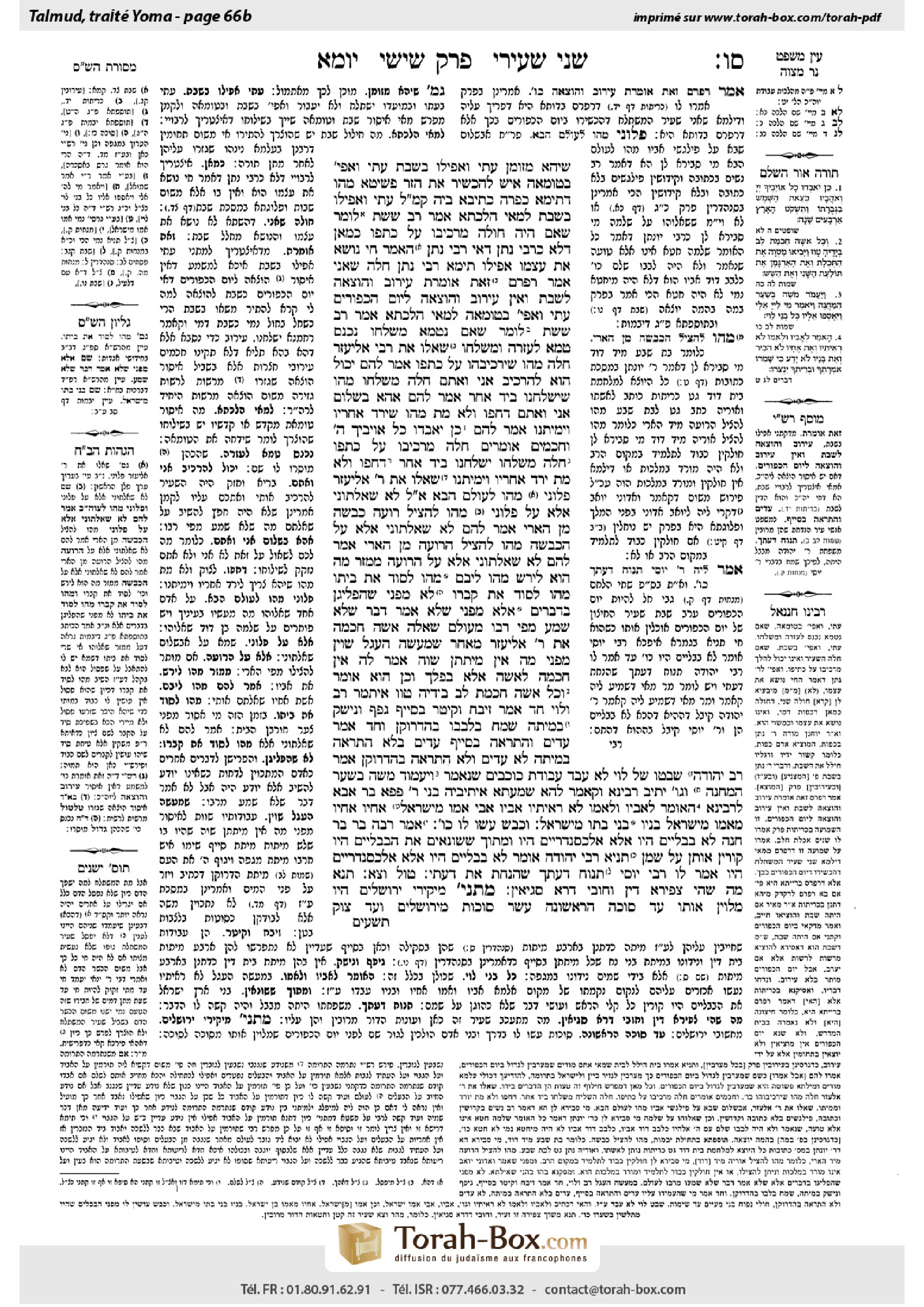
This page of Yoma includes the Aramaic text, an English translation and an AI-generated French translation, alongside the scan above.
יומא ס״ו ב · Aramaic and Hebrew text
שֶׁיְּהֵא מְזוּמָּן. ״עִתִּי״ — וַאֲפִילּוּ בְּשַׁבָּת, ״עִתִּי״ — וַאֲפִילּוּ בְּטוּמְאָה.
״אִישׁ״ — לְהַכְשִׁיר אֶת הַזָּר. פְּשִׁיטָא? מַהוּ דְּתֵימָא: ״כַּפָּרָה״ כְּתִיבָא בֵּיהּ, קָא מַשְׁמַע לַן.
״עִתִּי״ וַאֲפִילּוּ בְּשַׁבָּת. לְמַאי הִלְכְתָא? אָמַר רַב שֵׁשֶׁת: לוֹמַר, שֶׁאִם הָיָה חוֹלֶה — מַרְכִּיבוֹ עַל כְּתֵפוֹ.
כְּמַאן, דְּלָא כְּרַבִּי נָתָן. דְּאִי רַבִּי נָתָן, הָאָמַר: חַי נוֹשֵׂא אֶת עַצְמוֹ: אֲפִילּוּ תֵּימָא רַבִּי נָתָן, חָלָה שָׁאנֵי.
אָמַר רַפְרָם, זֹאת אוֹמֶרֶת: עֵירוּב וְהוֹצָאָה לְשַׁבָּת, וְאֵין עֵירוּב וְהוֹצָאָה לְיוֹם הַכִּפּוּרִים.
״עִתִּי״ וַאֲפִילּוּ בְּטוּמְאָה. לְמַאי הִלְכְתָא? אָמַר רַב שֵׁשֶׁת: לוֹמַר שֶׁאִם נִטְמָא מְשַׁלְּחוֹ — נִכְנָס טָמֵא לָעֲזָרָה, וּמְשַׁלְּחוֹ.
שָׁאֲלוּ אֶת רַבִּי אֱלִיעֶזֶר: חָלָה, מַהוּ שֶׁיַּרְכִּיבֵהוּ עַל כְּתֵפוֹ? אָמַר לָהֶם: יָכוֹל הוּא לְהַרְכִּיב אֲנִי וְאַתֶּם. חָלָה מְשַׁלְּחוֹ, מַהוּ שֶׁיְּשַׁלְּחֶנּוּ בְּיַד אַחֵר? אָמַר לָהֶם: אֱהֵא בְּשָׁלוֹם אֲנִי וְאַתֶּם.
דְּחָפוֹ וְלֹא מֵת, מַהוּ שֶׁיֵּרֵד אַחֲרָיו וִימִיתֶנּוּ? אָמַר לָהֶם: ״כֵּן יֹאבְדוּ כׇל אוֹיְבֶיךָ ה׳״. וַחֲכָמִים אוֹמְרִים: חָלָה — מַרְכִּיבוֹ עַל כְּתֵפוֹ, חָלָה מְשַׁלְּחוֹ — יְשַׁלְּחֶנּוּ בְּיַד אַחֵר. דְּחָפוֹ וְלֹא מֵת — יֵרֵד אַחֲרָיו וִימִיתֶנּוּ.
שָׁאֲלוּ אֶת רַבִּי אֱלִיעֶזֶר: פְּלוֹנִי, מַהוּ לָעוֹלָם הַבָּא? אָמַר לָהֶם לֹא שְׁאֶלְתּוּנִי אֶלָּא עַל פְּלוֹנִי.
מַהוּ לְהַצִּיל רוֹעֶה כִּבְשָׂה מִן הָאֲרִי? אָמַר לָהֶם: לֹא שְׁאֶלְתּוּנִי אֶלָּא עַל הַכִּבְשָׂה. מַהוּ לְהַצִּיל הָרוֹעֶה מִן הָאֲרִי? אָמַר לָהֶם: לֹא שְׁאֶלְתּוּנִי אֶלָּא עַל הָרוֹעֶה. מַמְזֵר, מַה הוּא לִירַשׁ? מַהוּ לְיַבֵּם? מַהוּ לָסוּד אֶת בֵּיתוֹ? מַהוּ לָסוּד אֶת קִבְרוֹ?
לֹא מִפְּנֵי שֶׁהִפְלִיגָן בִּדְבָרִים. אֶלָּא מִפְּנֵי שֶׁלֹּא אָמַר דָּבָר שֶׁלֹּא שָׁמַע מִפִּי רַבּוֹ מֵעוֹלָם.
שָׁאֲלָה אִשָּׁה חֲכָמָה אֶת רַבִּי אֱלִיעֶזֶר: מֵאַחַר שֶׁמַּעֲשֵׂה הָעֵגֶל שָׁוִין, מִפְּנֵי מָה אֵין מִיתָתָן שָׁוָה? אָמַר לָהּ: אֵין חׇכְמָה לָאִשָּׁה אֶלָּא בְּפֶלֶךְ, וְכֵן הוּא אוֹמֵר: ״וְכׇל אִשָּׁה חַכְמַת לֵב בְּיָדֶיהָ טָווּ״.
אִיתְּמַר, רַב וְלֵוִי. חַד אָמַר: זִיבֵּחַ וְקִיטֵּר — בְּסַיִיף. גִּפֵּף וְנִישֵּׁק — בְּמִיתָה. שָׂמַח בִּלְבָבוֹ — בְּהִדְרוֹקָן.
וְחַד אָמַר: עֵדִים וְהַתְרָאָה — בְּסַיִיף, עֵדִים בְּלֹא הַתְרָאָה — בְּמִיתָה, לֹא עֵדִים וְלֹא הַתְרָאָה — בְּהִדְרוֹקָן.
אָמַר רַב יְהוּדָה: שִׁבְטוֹ שֶׁל לֵוִי לֹא עָבַד עֲבוֹדָה זָרָה, שֶׁנֶּאֱמַר: ״וַיַּעֲמוֹד מֹשֶׁה בְּשַׁעַר הַמַּחֲנֶה וְגוֹ׳״.
יָתֵיב רָבִינָא וְקָאָמַר לְהָא שְׁמַעְתָּא. אֵיתִיבֵיהּ בְּנֵי רַב פָּפָּא בַּר אַבָּא לְרָבִינָא: ״הָאוֹמֵר לְאָבִיו וּלְאִמּוֹ לֹא רְאִיתִיו״.
״אָבִיו״ — אֲבִי אִמּוֹ מִיִּשְׂרָאֵל, ״אֶחָיו״ — אֶחָיו מֵאִמּוֹ מִיִּשְׂרָאֵל, ״בָּנָיו״ — בְּנֵי בִתּוֹ מִיִּשְׂרָאֵל.
וְכֶבֶשׁ עָשׂוּ לוֹ כּוּ׳. אָמַר רַבָּה בַּר בַּר חָנָה: לֹא בָּבְלִיִּים הָיוּ, אֶלָּא אֲלֶכְּסַנְדְּרִיִּים הָיוּ. וּמִתּוֹךְ שֶׁשּׂוֹנְאִים אֶת הַבָּבְלִיִּים הָיוּ קוֹרִין אוֹתָן עַל שְׁמָן. תַּנְיָא רַבִּי יְהוּדָה אוֹמֵר: לֹא בָּבְלִיִּים הָיוּ, אֶלָּא אֲלֶכְּסַנְדְּרִיִּים הָיוּ. אָמַר לוֹ רַבִּי יוֹסֵי: תָּנוּחַ דַּעְתְּךָ, שֶׁהִנַּחְתָּ אֶת דַּעְתִּי.
טוֹל וָצֵא. תָּנָא: מָה שָׁהֵי צָפִירָא דֵּין, וְחוֹבֵי דָרָא סַגִּיאִין.
מַתְנִי׳ מִיַּקִּירֵי יְרוּשָׁלַיִם הָיוּ מְלַוִּין אוֹתוֹ עַד סוּכָּה הָרִאשׁוֹנָה. עֶשֶׂר סוּכּוֹת מִירוּשָׁלַיִם וְעַד צוּק,
Yoma 66b · English translation
that he should be designated the day before. The word appointed also indicates that the scapegoat is always sent away at the appointed time, and even on Shabbat. Similarly, the word appointed indicates that the scapegoat is always sent away at the appointed time, and even when the appointed man is in a state of ritual impurity.
The baraita stated that the word man is mentioned to qualify a non-priest. The Gemara expresses surprise: It is obvious that a non-priest is qualified for this service; why would one have thought otherwise? The Gemara answers: Lest you say: The term atonement is written with regard to it, and atonement is achieved only through services performed by priests. Therefore, it teaches us that this atonement is not achieved through a sacrificial offering, and consequently the service may be performed even by an Israelite.
The baraita stated that the word appointed indicates that the service is performed even on Shabbat. The Gemara asks: With regard to what halakha is this stated? There is no apparent desecration of Shabbat by escorting the goat, since the halakha of Shabbat boundaries is merely Rabbinic. Rav Sheshet said: It is mentioned in order to state that if the goat were ill and could not walk the whole way, the one who escorts the goat carries it on his shoulder.
The Gemara comments: In accordance with whose opinion was this stated? It is not in accordance with the opinion of Rabbi Natan, as, if it were in accordance with the opinion of Rabbi Natan, didn’t he say that a living being carries itself? Because a living being is lighter than dead weight, the living being is considered to be aiding the one carrying it, and therefore carrying a living being is not considered an act of prohibited labor according to Torah law. The Gemara rejects this: Even if you say that it is in accordance with the opinion of Rabbi Natan, a living being that is ill is different. Since the goat cannot walk on its own strength, despite the fact that it is alive, all agree that the one who carries it is performing a prohibited labor.
Based on the fact that the word appointed indicates that the scapegoat is sent away even on Shabbat, Rafram said: That is to say that the concept of eiruv and the prohibition against carrying out apply to Shabbat, but eiruv and carrying out do not apply to Yom Kippur. If these halakhot applied equally to Yom Kippur, and nevertheless the Torah commanded that the scapegoat be sent away, it would be unnecessary to derive that the same is true even if Yom Kippur occurs on Shabbat.
The baraita stated that the word appointed indicates that the service is performed even in a state of ritual impurity. The Gemara asks: With regard to what halakha is this stated? Rav Sheshet said: The verse comes to tell you that if the one sending the goat away became impure, he nevertheless enters the Temple courtyard while he is impure and sends it away.
§ Apropos this discussion, the Gemara mentions that the students once asked Rabbi Eliezer: If the goat became ill, what is the halakha with regard to whether the escort may carry it on his shoulder? He said to them: That goat can carry me and you, meaning the goat designated healthy was unlikely to become ill. Rabbi Eliezer thereby avoided the question. They asked him: If the one sending the goat away became ill, what is the halakha with regard to whether they send it with someone else? He said to them dismissively: I and you shall be in peace, i.e., this would never happen.
The students continued to question Rabbi Eliezer: If he pushed the goat and it did not die upon its fall, what is the halakha with regard to whether he should follow it down and kill it? He said to them: “So may all your enemies perish, Lord” (Judges 5:31). In other words, the goat will certainly die on its own. Rabbi Eliezer did not wish to answer these questions, as will be explained below. However, the Sages say: If the goat became ill, the escort carries it on his shoulder. If the one sending out the goat became ill, he sends the goat with someone else. If he pushes it and it does not die, he follows it down and kills it.
The Gemara cites more questions that the students asked Rabbi Eliezer, which he refused to answer. They asked Rabbi Eliezer: What is the fate of so-and-so, a certain man who was known to be wicked, with regard to the World-to-Come? He evaded the question and said to them: You have only asked me about so-and-so, and not a different individual whom you believe to be righteous?
They asked him: What is the halakha with regard to whether a shepherd may save a ewe from a lion on Shabbat (Me’iri)? He said to them: You have only asked me about the ewe? They asked him: What is the halakha with regard to saving the shepherd from the lion on Shabbat? He said to them: You have only asked me about the shepherd? They asked him: What is the halakha with regard to whether a mamzer inherits from his parents? Rabbi Eliezer responded with a question: Did you not ask me what is the halakha with regard to whether he may perform levirate marriage? They asked him: What is the halakha with regard to whether it is permitted to plaster one’s house after the destruction of the Temple? Rabbi Eliezer responded: What is the halakha with regard to plastering one’s grave?
The Gemara explains: It was not because he was distancing them with words, and made irrelevant statements because he did not know the answers to these questions. Rather, Rabbi Eliezer responded in this way because he never said anything that he did not hear from the mouth of his teacher. Since he had not learned these points from his teacher, he did not answer directly, thereby indicating that he did not have a tradition with regard to these questions.
The Gemara cites another question posed to Rabbi Eliezer. A wise woman asked Rabbi Eliezer: Since all bore equal responsibility for the incident of the Golden Calf, due to what factor were their deaths not equal? Some of the people were killed by the sword of Moses and the Levites, some were killed in a plague, and others were struck with an intestinal illness. He said to her: There is no wisdom in a woman except weaving with a spindle, and so it states: “And any woman who was wise-hearted spun with her hands” (Exodus 35:25). Therefore, it is unbefitting for a woman to concern herself with such questions.
With regard to this issue, it was stated that the amora’im Rav and Levi disagreed: One of them said: One who sacrificed and burned incense to the calf, which are idolatrous practices that incur capital punishment, was punished by the sword. One who embraced and kissed it, which are not forms of idolatrous worship that incur capital punishment, was subject to a divine punishment of death by a plague. One who rejoiced inwardly but performed no act was killed by the intestinal illness known as hidrokan.
And one of them said: One who served the calf in the presence of witnesses and after a warning was punished by the sword. One who served the calf in the presence of witnesses but without warning was subject to death by a plague. One who served without witnesses and without warning was killed by hidrokan.
Rav Yehuda said: The entire tribe of Levi did not engage in idol worship, as it is stated: “Then Moses stood in the gate of the camp, and said: Who is for God, let him come to me; and all the children of Levi gathered to him” (Exodus 32:26).
Ravina sat and related this halakha with regard to the tribe of Levi. The sons of Rav Pappa bar Abba raised an objection to Ravina: The verse states in praise of the tribe of Levi: “Who said of his father and of his mother: I have not seen him, neither did he acknowledge his brothers, nor did he know his sons” (Deuteronomy 33:9). This indicates that some of them did engage in idol worship and were killed by their relatives.
Ravina answered them: “His father” does not refer to his actual father, but rather his mother’s father, who was an Israelite. Similarly, the term “his brothers” is referring to his half-brothers from his mother, who were fathered by an Israelite. “His sons” is referring to his daughter’s sons from an Israelite, who are considered Israelites. In fact, however, no one from the tribe of Levi worshipped the calf.
§ It was taught in the mishna that they made a ramp for the goat due to the Babylonian Jews in Jerusalem. Rabba bar bar Ḥana said: They were not actually Babylonians, rather they were Alexandrians from Egypt. And since in Eretz Yisrael they hate the Babylonians, they would call all foreigners who acted inappropriately by their name as an insult. Similarly, it was taught in a baraita that Rabbi Yehuda says: They were not Babylonians, rather they were Alexandrians. Rabbi Yosei, whose family was from Babylonia, said to him: May your mind be at ease, since you have put my mind at ease.
It was taught in the mishna that the Babylonians would say: Take our sins and go. It was taught in the Tosefta that they would say as follows: Why does this goat remain here with the many sins of the generation; let him hurry and leave.
MISHNA: People from among the prominent residents of Jerusalem would escort the one leading the goat until they reached the first booth. Booths were set up along the path to the wilderness to provide the escort a place to rest. There were ten booths from Jerusalem to the cliff,
Yoma 66b · Traduction française (IA)
afin qu’il soit désigné la veille. Le terme « désigné » indique également que le bouc émissaire est toujours envoyé au moment fixé, même le Chabbat. De même, ce terme indique que le bouc émissaire est toujours envoyé au moment fixé, même lorsque l’homme désigné est en état d’impureté rituelle.
La baraïta a indiqué que le terme « homme » permet que ce service soit accompli par un non-prêtre. La Guemara s’en étonne : il est évident qu’un non-prêtre est habilité à accomplir ce service ; pourquoi aurait-on pensé le contraire ? La Guemara répond : De peur que tu ne dises que le terme « expiation » est écrit à son sujet, et que l’expiation ne s’accomplit que par des services effectués par des prêtres. Le verset nous enseigne donc que cette expiation ne s’accomplit pas au moyen d’une offrande sacrificielle et que, par conséquent, le service peut être accompli même par un Israélite.
La baraïta a indiqué que le terme « désigné » enseigne que le service est accompli même le Chabbat. La Guemara demande : À propos de quelle halakha cela est-il dit ? Accompagner le bouc ne semble pas constituer une profanation du Chabbat, puisque la halakha des limites du Chabbat n’est que rabbinique. Rav Sheshet dit : Cela est mentionné pour enseigner que si le bouc était malade et ne pouvait pas parcourir tout le chemin, celui qui l’accompagne le porte sur son épaule.
La Guemara fait remarquer : Selon l’opinion de qui cela a-t-il été dit ? Ce n’est pas l’opinion de Rabbi Natan, car celui-ci a dit qu’un être vivant se porte lui-même. Puisqu’un être vivant est plus léger qu’une charge inerte, il est considéré comme aidant celui qui le porte ; porter un être vivant n’est donc pas considéré comme un travail interdit par la Torah. La Guemara rejette cette objection : Même si tu dis que cela est conforme à l’opinion de Rabbi Natan, le cas d’un être vivant malade est différent. Puisque le bouc ne peut pas marcher par ses propres forces, tous conviennent que celui qui le porte accomplit un travail interdit, bien qu’il soit vivant.
S’appuyant sur le fait que le terme « désigné » indique que le bouc émissaire est envoyé même le Chabbat, Rafram dit : Cela signifie que les règles de l’érouv et l’interdiction de transporter hors d’un domaine s’appliquent au Chabbat, mais pas à Yom Kippour. Si ces halakhot s’appliquaient également à Yom Kippour et que la Torah avait néanmoins ordonné d’envoyer le bouc émissaire, il serait inutile de déduire que cela vaut aussi lorsque Yom Kippour tombe un Chabbat.
La baraïta a indiqué que le terme « désigné » enseigne que le service est accompli même en état d’impureté rituelle. La Guemara demande : À propos de quelle halakha cela est-il dit ? Rav Sheshet dit : Le verset vient t’enseigner que si celui qui envoie le bouc est devenu impur, il entre néanmoins dans le parvis du Temple alors qu’il est impur et l’envoie.
§ À propos de cette discussion, la Guemara rapporte que des élèves demandèrent un jour à Rabbi Eliezer : Si le bouc tombait malade, quelle serait la halakha quant au fait que celui qui l’accompagne puisse le porter sur son épaule ? Il leur dit : « Ce bouc peut nous porter, toi et moi », c’est-à-dire qu’il était peu probable que le bouc, désigné comme étant en bonne santé, tombe malade. Rabbi Eliezer éluda ainsi la question. Ils lui demandèrent : Si celui qui envoie le bouc tombait malade, quelle serait la halakha quant au fait de l’envoyer avec quelqu’un d’autre ? Il leur répondit avec dédain : « Que nous soyons, toi et moi, en paix », c’est-à-dire qu’une telle situation ne se produirait jamais.
Les élèves continuèrent à interroger Rabbi Eliezer : S’il pousse le bouc et que celui-ci ne meurt pas dans sa chute, quelle est la halakha quant au fait de descendre à sa suite et de le tuer ? Il leur dit : « Ainsi périssent tous tes ennemis, Seigneur » (Juges 5:31). Autrement dit, le bouc mourra certainement de lui-même. Rabbi Eliezer ne souhaitait pas répondre à ces questions, comme cela sera expliqué plus loin. Cependant, les Sages disent : Si le bouc tombe malade, celui qui l’accompagne le porte sur son épaule. Si celui qui envoie le bouc tombe malade, il l’envoie avec quelqu’un d’autre. S’il le pousse et que le bouc ne meurt pas, il descend à sa suite et le tue.
La Guemara cite d’autres questions que les élèves posèrent à Rabbi Eliezer et auxquelles il refusa de répondre. Ils lui demandèrent : Quel est le sort d’un certain homme, connu pour être méchant, dans le Monde à venir ? Il éluda la question et leur dit : « Vous ne m’avez interrogé que sur cet homme, et non sur un autre individu que vous croyez juste ? »
Ils lui demandèrent : Quelle est la halakha quant au fait qu’un berger puisse sauver une brebis d’un lion le Chabbat (Meïri) ? Il leur dit : « Vous ne m’avez interrogé que sur la brebis ? » Ils lui demandèrent : Quelle est la halakha quant au fait de sauver le berger du lion le Chabbat ? Il leur dit : « Vous ne m’avez interrogé que sur le berger ? » Ils lui demandèrent : Quelle est la halakha quant au fait qu’un mamzer hérite de ses parents ? Rabbi Eliezer répondit par une question : « Ne m’avez-vous pas demandé quelle est la halakha quant au fait qu’il puisse contracter un mariage léviratique ? » Ils lui demandèrent : Quelle est la halakha quant à l’autorisation d’enduire sa maison de plâtre après la destruction du Temple ? Rabbi Eliezer répondit : « Quelle est la halakha quant au fait d’enduire sa tombe de plâtre ? »
La Guemara explique : Il ne les éconduisait pas par ses paroles et ne faisait pas de remarques hors de propos parce qu’il ignorait les réponses à ces questions. Rabbi Eliezer répondait ainsi parce qu’il ne disait jamais rien qu’il n’ait entendu de la bouche de son maître. Comme il n’avait pas appris ces points de son maître, il ne répondait pas directement, indiquant ainsi qu’il ne possédait pas de tradition concernant ces questions.
La Guemara rapporte une autre question posée à Rabbi Eliezer. Une femme sage lui demanda : Puisque tous portaient la même responsabilité dans l’épisode du Veau d’or, pourquoi leurs morts n’ont-elles pas été identiques ? Certains furent tués par l’épée de Moïse et des Lévites, certains périrent dans une épidémie et d’autres furent frappés d’une maladie intestinale. Il lui dit : « Il n’y a de sagesse chez une femme que dans le filage au fuseau », comme il est dit : « Toute femme au cœur sage filait de ses mains » (Exode 35:25). Il ne convient donc pas qu’une femme se préoccupe de telles questions.
À propos de cette question, il a été rapporté que les amoraïm Rav et Levi étaient en désaccord. L’un d’eux dit : Celui qui sacrifia au veau et lui offrit de l’encens, actes idolâtres passibles de la peine capitale, fut puni par l’épée. Celui qui l’embrassa et le serra dans ses bras, actes qui ne constituent pas des formes de culte idolâtre passibles de la peine capitale, fut frappé par le châtiment divin de la mort dans une épidémie. Celui qui se réjouit intérieurement sans accomplir aucun acte fut tué par la maladie intestinale appelée hidrokan.
Et l’un d’eux dit : Celui qui servit le veau en présence de témoins et après avoir reçu un avertissement fut puni par l’épée. Celui qui le servit en présence de témoins, mais sans avertissement, fut frappé par la mort dans une épidémie. Celui qui le servit sans témoins et sans avertissement fut tué par hidrokan.
Rav Yehouda dit : Toute la tribu de Lévi ne participa pas au culte idolâtre, comme il est dit : « Moïse se tint à la porte du camp et dit : “Qui est pour Dieu ? Qu’il vienne vers moi !” Et tous les fils de Lévi se rassemblèrent auprès de lui » (Exode 32:26).
Ravina était assis et rapportait cette halakha concernant la tribu de Lévi. Les fils de Rav Pappa bar Abba soulevèrent une objection contre Ravina : Le verset dit à la louange de la tribu de Lévi : « Celui qui a dit de son père et de sa mère : “Je ne les ai pas vus”, qui n’a pas reconnu ses frères et n’a pas connu ses fils » (Deutéronome 33:9). Cela indique que certains d’entre eux avaient participé au culte idolâtre et avaient été tués par leurs proches.
Ravina leur répondit : « Son père » ne désigne pas son père biologique, mais le père de sa mère, qui était un Israélite. De même, le terme « ses frères » désigne ses demi-frères du côté maternel, dont le père était un Israélite. « Ses fils » désigne les fils de sa fille issus d’un Israélite, lesquels sont considérés comme des Israélites. En réalité, toutefois, personne de la tribu de Lévi n’a adoré le veau.
§ Il a été enseigné dans la Michna qu’ils avaient aménagé une rampe pour le bouc à cause des Juifs de Babylone qui se trouvaient à Jérusalem. Rabba bar bar Ḥana dit : Ce n’étaient pas vraiment des Babyloniens, mais des Alexandrins venus d’Égypte. Et comme, en Eretz Yisrael, on déteste les Babyloniens, on appelait par leur nom, à titre d’insulte, tous les étrangers qui se conduisaient de façon inconvenante. De même, une baraïta rapporte que Rabbi Yehouda dit : Ce n’étaient pas des Babyloniens, mais des Alexandrins. Rabbi Yossei, dont la famille était originaire de Babylone, lui dit : « Que ton esprit soit apaisé, puisque tu as apaisé le mien. »
Il a été enseigné dans la Michna que les Babyloniens disaient : « Emporte nos fautes et va-t’en. » La Tosefta rapporte qu’ils disaient : « Pourquoi ce bouc reste-t-il ici, chargé des nombreuses fautes de la génération ? Qu’il se hâte de partir. »
MICHNA : Des habitants éminents de Jérusalem accompagnaient celui qui conduisait le bouc jusqu’à la première cabane. Des cabanes étaient installées le long du chemin menant au désert afin que celui qui accompagnait le bouc puisse s’y reposer. Il y avait dix cabanes entre Jérusalem et le précipice,
Traduction française générée par IA à partir de l’édition anglaise de Sefaria. Vérifie toujours un passage avec le texte source.
Text from Sefaria: William Davidson Edition - Vocalized Aramaic (CC BY NC); William Davidson Edition - English (CC BY NC).