Yoma 67a: Talmud study for Daf Yomi
Daf Yomi is the daily study of one Talmud folio. Explore 37 tractates with scans, Hebrew text, Sefaria English and AI-generated French translations where annotated.
Passage selection and English or AI-generated French translation are available where the scan has annotations. Daf Study is independent of Torah-Box and Sefaria.
Browse Yoma · יומא · All tractatesYoma 67a text and translations
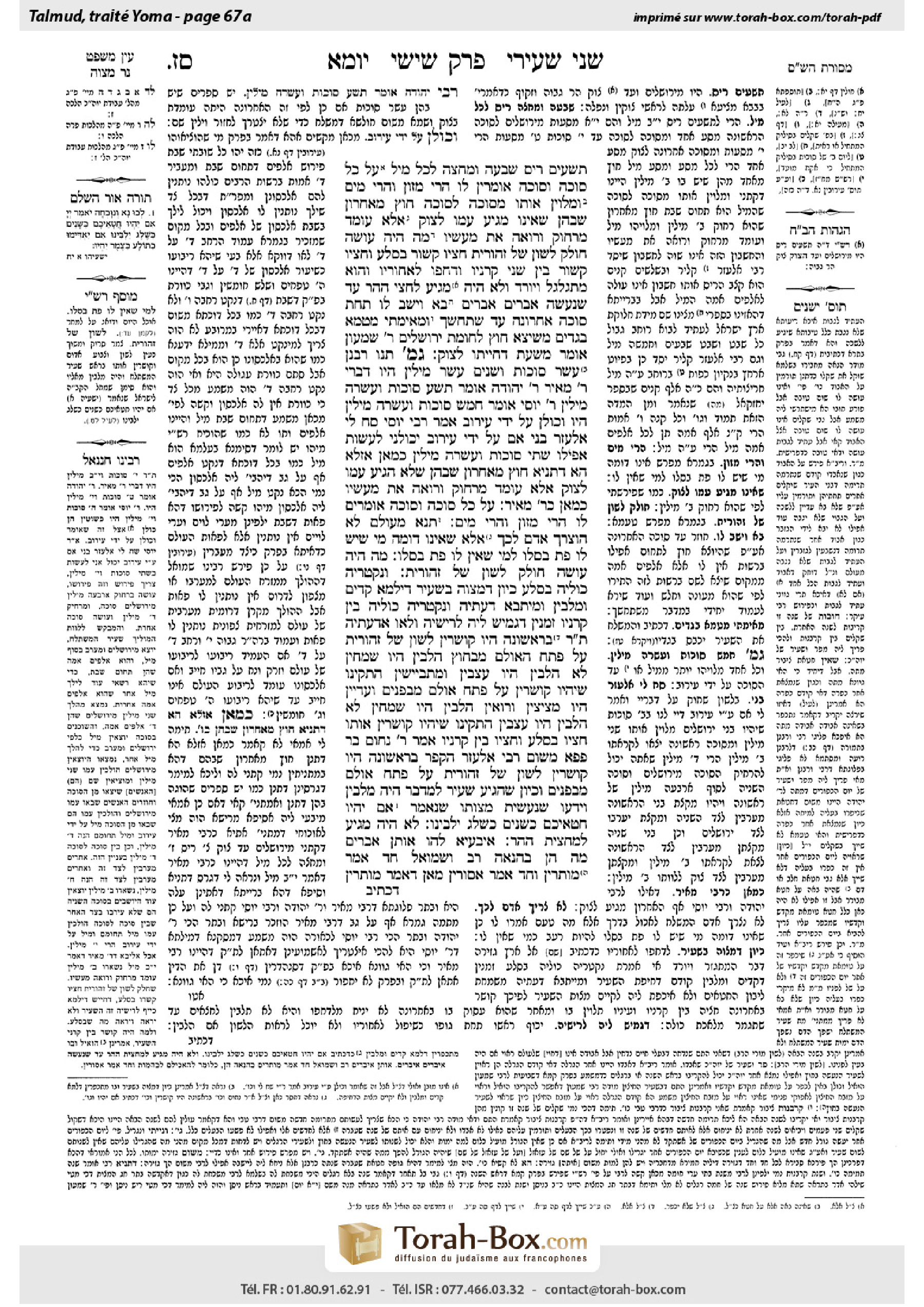
This page of Yoma includes the Aramaic text, an English translation and an AI-generated French translation, alongside the scan above.
יומא ס״ז א · Aramaic and Hebrew text
תִּשְׁעִים רִיס, שִׁבְעָה וּמֶחֱצָה לְכׇל מִיל. עַל כׇּל סוּכָּה וְסוּכָּה אוֹמְרִין לוֹ: הֲרֵי מָזוֹן, וַהֲרֵי מַיִם. וּמְלַוִּין אוֹתוֹ מִסּוּכָּה לְסוּכָּה, חוּץ מֵאַחֲרוֹן שֶׁבָּהֶן, שֶׁאֵינוֹ מַגִּיעַ עִמּוֹ לַצּוּק, אֶלָּא עוֹמֵד מֵרָחוֹק וְרוֹאֶה אֶת מַעֲשָׂיו.
מֶה הָיָה עוֹשֶׂה? חוֹלֵק לָשׁוֹן שֶׁל זְהוֹרִית חֶצְיוֹ קָשׁוּר בַּסֶּלַע, וְחֶצְיוֹ קָשׁוּר בֵּין שְׁנֵי קַרְנָיו. וּדְחָפוֹ לַאֲחוֹרָיו, וְהוּא מִתְגַּלְגֵּל וְיוֹרֵד. וְלֹא הָיָה מַגִּיעַ לַחֲצִי הָהָר עַד שֶׁנַּעֲשֶׂה אֵבָרִים אֵבָרִים. בָּא וְיָשַׁב לוֹ תַּחַת סוּכָּה אַחֲרוֹנָה עַד שֶׁתֶּחְשַׁךְ. וּמֵאֵימָתַי מְטַמֵּא בְּגָדִים — מִשֶּׁיֵּצֵא חוּץ לְחוֹמַת יְרוּשָׁלַיִם, רַבִּי שִׁמְעוֹן אוֹמֵר: מִשְּׁעַת דְּחִיָּיתוֹ לַצּוּק.
גְּמָ׳ תָּנוּ רַבָּנַן: עֶשֶׂר סוּכּוֹת, וּשְׁנֵים עָשָׂר מִילִין הָיוּ, דִּבְרֵי רַבִּי מֵאִיר. רַבִּי יְהוּדָה אוֹמֵר: תֵּשַׁע סוּכּוֹת, וַעֲשָׂרָה מִילִין. רַבִּי יוֹסֵי אוֹמֵר: חָמֵשׁ סוּכּוֹת, וַעֲשָׂרָה מִילִין הָיוּ. וְכוּלָּן עַל יְדֵי עֵירוּב.
אָמַר רַבִּי יוֹסֵי: סָח לִי אֶלְעָזָר בְּנִי: אִם עַל יְדֵי עֵירוּב — יָכוֹלְנִי לַעֲשׂוֹת אֲפִילּוּ שְׁתֵּי סוּכּוֹת וַעֲשָׂרָה מִילִין.
כְּמַאן אָזְלָא הָא דְּתַנְיָא: חוּץ מֵאַחֲרוֹן שֶׁבָּהֶן שֶׁלֹּא הִגִּיעַ עִמּוֹ לַצּוּק אֶלָּא עוֹמֵד מֵרָחוֹק וְרוֹאֶה אֶת מַעֲשָׂיו, כְּמַאן כְּרַבִּי מֵאִיר.
עַל כׇּל סוּכָּה וְסוּכָּה אוֹמְרִים לוֹ: הֲרֵי מָזוֹן וַהֲרֵי מַיִם. תָּנָא: מֵעוֹלָם לֹא הוּצְרַךְ אָדָם לְכָךְ, אֶלָּא שֶׁאֵינוֹ דּוֹמֶה מִי שֶׁיֵּשׁ לוֹ פַּת בְּסַלּוֹ, לְמִי שֶׁאֵין לוֹ פַּת בְּסַלּוֹ.
מֶה הָיָה עוֹשֶׂה — חוֹלֵק לָשׁוֹן שֶׁל זְהוֹרִית. וְנִקְטְרֵיהּ כּוּלֵּיהּ בְּסֶלַע? כֵּיוָן דְּמִצְוָה בְּשָׂעִיר, דִּילְמָא קָדֵים וּמַלְבִּין וּמִיַּתְּבָא דַּעְתֵּיהּ.
וְנִקְטְרֵיהּ כּוּלֵּיהּ בֵּין קַרְנָיו? זִמְנִין דְּגָמֵישׁ לֵיהּ לְרֵישֵׁיהּ, וְלָאו אַדַּעְתֵּיהּ.
תָּנוּ רַבָּנַן: בָּרִאשׁוֹנָה הָיוּ קוֹשְׁרִין לָשׁוֹן שֶׁל זְהוֹרִית עַל פֶּתַח הָאוּלָם מִבַּחוּץ, הִלְבִּין — הָיוּ שְׂמֵחִין, לֹא הִלְבִּין — הָיוּ עֲצֵבִין וּמִתְבַּיְּישִׁין. הִתְקִינוּ שֶׁיִּהְיוּ קוֹשְׁרִין עַל פֶּתַח אוּלָם מִבִּפְנִים. וַעֲדַיִין הָיוּ מְצִיצִין וְרוֹאִין, הִלְבִּין — הָיוּ שְׂמֵחִין, לֹא הִלְבִּין — הָיוּ עֲצֵבִין. הִתְקִינוּ שֶׁיִּהְיוּ קוֹשְׁרִין אוֹתוֹ חֶצְיוֹ בְּסֶלַע וְחֶצְיוֹ בֵּין קַרְנָיו.
אָמַר רַבִּי נַחוּם בַּר פָּפָּא מִשּׁוּם רַבִּי אֶלְעָזָר הַקַּפָּר: בָּרִאשׁוֹנָה הָיוּ קוֹשְׁרִין לָשׁוֹן שֶׁל זְהוֹרִית עַל פֶּתַח אוּלָם מִבִּפְנִים, וְכֵיוָן שֶׁהִגִּיעַ שָׂעִיר לַמִּדְבָּר הָיָה מַלְבִּין, וְיָדְעוּ שֶׁנַּעֲשֵׂית מִצְוָתוֹ. שֶׁנֶּאֱמַר: ״אִם יִהְיוּ חֲטָאֵיכֶם כַּשָּׁנִים כַּשֶּׁלֶג יַלְבִּינוּ״.
לֹא הָיָה מַגִּיעַ לְמַחֲצִית הָהָר. אִיבַּעְיָא לְהוּ: אוֹתָן אֵבָרִים מַה הֵן בַּהֲנָאָה? רַב וּשְׁמוּאֵל. חַד אָמַר: מוּתָּרִין, וְחַד אָמַר: אֲסוּרִין.
מַאן דְּאָמַר מוּתָּרִין,
Yoma 67a · English translation
with a distance of ninety ris between them. As there are seven and a half ris for each mil, the total distance was twelve mil. At each and every booth, people there say to him: Here is food; here is water, if you need it. And they escort him from booth to booth, except for the last person at the last booth, who does not reach the cliff with him. Rather, he stands from a distance and observes his actions to ensure that he fulfills the mitzva properly.
What did the one designated to dispatch the goat do there? He divided a strip of crimson into two parts, half of the strip tied to the rock, and half of it tied between the two horns of the goat. And he pushed the goat backward, and it rolls and descends. And it would not reach halfway down the mountain until it was torn limb from limb. The one designated to dispatch the goat came and sat under the roofing of last booth until it grows dark and only then went home. And from what point are the garments of the man rendered impure, as it is stated that he is impure and his clothes requires immersion? From the moment he emerges outside the wall of Jerusalem. Rabbi Shimon says: His clothes are rendered impure only from the moment that he pushes the goat from the cliff.
GEMARA: The Sages taught: There were ten booths, and the distance between Jerusalem and the cliff was twelve mil; this is the statement of Rabbi Meir. Rabbi Yehuda says: There were nine booths and the distance was ten mil. Rabbi Yosei says: There were five booths and the distance was ten mil, and all of them were able to escort the one leading the goat by establishing a joining of boundaries [eiruv teḥumin] before Yom Kippur, allowing those at each booth to walk to the next booth.
Rabbi Yosei said: Elazar my son told me: If they were able to walk to the next booth by establishing an eiruv, I could even make two booths suffice for the distance of ten mil. With the proper placement of an eiruv, an individual is permitted to walk a distance of two mil, which is four thousand cubits. Consequently, the people of Jerusalem could escort the one leading the goat a distance of two mil, and the people of the first booth could walk two mil from the booth toward Jerusalem to meet him, and escort him back to their booth. Others at that booth, who had established their eiruv in the direction of the second booth, could then escort the one leading the goat two mil toward the second booth, where he would be met by people from the second booth, who would escort him the remaining two mil to the booth. This booth would be located only two mil from the cliff.
The Gemara comments: In accordance with whose opinion is that which was taught in the baraita: People from all the booths would escort the one leading the goat, except for the last person in the last booth, who did not reach the cliff with him; rather, he stands from a distance and observes his actions? In accordance with whose opinion is this statement? It is in accordance with the opinion of Rabbi Meir, as he holds that the last booth was too far from the cliff for the people there to escort the one leading the goat the entire way.
It was taught in the mishna: At each and every booth people there say to him: Here is food; here is water, if you need it. It was taught: No man who escorted the goat ever needed this food and water. However, they would offer it to him anyway, because one who has bread in his basket is not similar to one who does not have bread in his basket. One who does not have food available to him is concerned that he will not be able to find any if he really needs it, and he therefore feels his hunger and thirst more acutely.
§ It was taught in the mishna: What did the person designated to dispatch the goat do there? He divided a strip of crimson into two parts, half of the strip tied to the rock, and half of it tied between the two horns of the goat. The Gemara asks: Let him tie the whole strip to the rock. The Gemara answers: Since it is a mitzva to push the goat from the cliff. If he tied the whole strip to the rock, perhaps it would turn white quickly, and his mind would be eased with the knowledge that the sins of the Jewish people had been forgiven. He would then not fulfill the mitzva of pushing the goat off the cliff. He therefore tied part of it between the horns of the goat and looked to see if it became white. Once he was actively involved with the goat, he would remember to push it off the cliff.
The Gemara asks: If so, let him tie the whole strip between the goat’s horns. The Gemara answers: Sometimes the goat turns its head and he will not know if the strip turns white or not.
The Sages taught: At first they would tie this strip of crimson to the opening of the Entrance Hall of the Temple on the outside. If the strip turned white they would rejoice, as this indicated that their sins had been atoned for. If it did not turn white they would be sad and ashamed. When the Sages saw that people were overly distressed on Yom Kippur, they established that they should tie the strip of crimson to the opening of the Entrance Hall on the inside, since only a few could actually go in to see it. And they would still peek and see: If it turned white, they would rejoice, and if it did not turn white they would be sad. Therefore, the Sages established that they should tie half of the strip to the rock and half of it between the goat’s horns, so that the people would not know what happened to the strip until after the conclusion of Yom Kippur.
Rabbi Naḥum bar Pappa said in the name of Rabbi Elazar HaKappar: At first they would tie the strip of crimson to the opening of the Entrance Hall of the Temple on the inside, and when the goat reached the wilderness, the strip of crimson would turn white, and they knew that the mitzva was fulfilled. The verse alludes to the use of the strip of crimson, as it is stated: “Though your sins be as scarlet, they will become white as snow; though they be red like crimson, they will be as wool” (Isaiah 1:18). This verse indicates that when something scarlet turns white, it is a sign of atonement and forgiveness for the sins of the Jewish people.
§ It was taught in the mishna that the goat would not reach halfway down the mountain before it was torn limb from limb. A dilemma was raised before the Sages: What is the status of those limbs? Is it permitted to derive pleasure from them? Rav and Shmuel disagreed with regard to this issue. One said they are permitted for benefit, and one said they are prohibited.
The Gemara explains their reasoning: The one who said they are permitted for benefit
Yoma 67a · Traduction française (IA)
à une distance de quatre-vingt-dix ris les unes des autres. Puisqu’il y a sept ris et demi par mil, la distance totale était de douze mil. À chacune des stations, les personnes présentes lui disent : « Voici de la nourriture ; voici de l’eau, si vous en avez besoin. » Elles l’accompagnent d’une station à l’autre, à l’exception de la dernière personne de la dernière station, qui ne va pas jusqu’à la falaise avec lui. Elle reste plutôt à distance et observe ses actes afin de s’assurer qu’il accomplit correctement la mitsva.
Que faisait là celui qui était chargé d’envoyer le bouc ? Il partageait une bande de laine cramoisie en deux parties : il en attachait une moitié au rocher et l’autre entre les deux cornes du bouc. Puis il poussait le bouc en arrière, et celui-ci roulait en descendant. Il n’atteignait pas la moitié de la montagne avant d’être démembré. Celui qui était chargé d’envoyer le bouc venait s’asseoir sous le toit de la dernière station jusqu’à la tombée de la nuit, et ne rentrait chez lui qu’ensuite. À partir de quel moment les vêtements de cet homme deviennent-ils impurs, puisqu’il est dit qu’il est impur et que ses vêtements doivent être immergés ? À partir du moment où il sort des murs de Jérusalem. Rabbi Shimon dit : Ses vêtements ne deviennent impurs qu’à partir du moment où il pousse le bouc du haut de la falaise.
GUEMARA : Les Sages ont enseigné : Il y avait dix stations, et la distance entre Jérusalem et la falaise était de douze mil ; telle est l’opinion de Rabbi Meïr. Rabbi Yehouda dit : Il y avait neuf stations et la distance était de dix mil. Rabbi Yosei dit : Il y avait cinq stations et la distance était de dix mil, et tous pouvaient accompagner celui qui conduisait le bouc en établissant une jonction des limites [eiruv teḥumin] avant Yom Kippour, ce qui permettait aux personnes présentes à chaque station de marcher jusqu’à la station suivante.
Rabbi Yosei dit : Mon fils Elazar m’a dit : S’ils pouvaient marcher jusqu’à la station suivante en établissant un eiruv, deux stations auraient même suffi pour couvrir la distance de dix mil. En plaçant correctement un eiruv, un individu est autorisé à marcher sur une distance de deux mil, soit quatre mille coudées. Par conséquent, les habitants de Jérusalem pouvaient accompagner celui qui conduisait le bouc sur une distance de deux mil, et les personnes de la première station pouvaient marcher deux mil depuis la station en direction de Jérusalem pour le rejoindre, puis l’accompagner jusqu’à leur station. D’autres personnes de cette station, qui avaient établi leur eiruv en direction de la deuxième station, pouvaient alors accompagner celui qui conduisait le bouc sur deux mil vers la deuxième station. Là, des personnes de la deuxième station le rejoignaient et l’accompagnaient sur les deux mil restants jusqu’à la station. Cette station ne se trouvait qu’à deux mil de la falaise.
La Guemara fait remarquer : De l’avis de qui est l’enseignement de la baraïta selon lequel des personnes de toutes les stations accompagnaient celui qui conduisait le bouc, à l’exception de la dernière personne de la dernière station, qui ne se rendait pas jusqu’à la falaise avec lui, mais restait à distance pour observer ses actes ? Cet enseignement est conforme à l’opinion de Rabbi Meïr, car selon lui, la dernière station était trop éloignée de la falaise pour que les personnes qui s’y trouvaient accompagnent celui qui conduisait le bouc jusqu’au bout.
Il a été enseigné dans la Michna : À chacune des stations, les personnes présentes lui disent : « Voici de la nourriture ; voici de l’eau, si vous en avez besoin. » Il a été enseigné qu’aucun homme accompagnant le bouc n’a jamais eu besoin de cette nourriture ni de cette eau. On les lui proposait néanmoins, car celui qui a du pain dans son panier n’est pas dans la même situation que celui qui n’en a pas. Celui qui n’a pas de nourriture à sa disposition craint de ne pas pouvoir en trouver s’il en a réellement besoin ; il ressent donc plus vivement sa faim et sa soif.
§ Il a été enseigné dans la Michna : Que faisait là celui qui était chargé d’envoyer le bouc ? Il partageait une bande de laine cramoisie en deux parties : il en attachait une moitié au rocher et l’autre entre les deux cornes du bouc. La Guemara demande : Qu’il attache toute la bande au rocher ! La Guemara répond : Puisqu’il y a une mitsva de pousser le bouc du haut de la falaise, s’il attachait toute la bande au rocher, peut-être blanchirait-elle rapidement et serait-il rassuré de savoir que les fautes du peuple juif avaient été pardonnées. Il n’accomplirait alors pas la mitsva de pousser le bouc du haut de la falaise. Il en attachait donc une partie entre les cornes du bouc et vérifiait si elle avait blanchi. Dès lors qu’il s’occupait activement du bouc, il se souviendrait de le pousser du haut de la falaise.
La Guemara demande : Dans ce cas, qu’il attache toute la bande entre les cornes du bouc ! La Guemara répond : Il arrive que le bouc tourne la tête, et il ne saura pas si la bande a blanchi ou non.
Les Sages ont enseigné : Au début, on attachait cette bande de laine cramoisie à l’entrée du vestibule du Temple, à l’extérieur. Si la bande blanchissait, on se réjouissait, car cela indiquait que les fautes avaient été expiées. Si elle ne blanchissait pas, on était triste et honteux. Lorsque les Sages virent que les gens étaient excessivement affligés le jour de Yom Kippour, ils établirent que la bande de laine cramoisie devait être attachée à l’entrée du vestibule, à l’intérieur, car seuls quelques-uns pouvaient effectivement y entrer pour la voir. Les gens continuaient toutefois à jeter un coup d’œil : si elle avait blanchi, ils se réjouissaient ; si elle n’avait pas blanchi, ils étaient tristes. Les Sages établirent donc qu’on attacherait la moitié de la bande au rocher et l’autre moitié entre les cornes du bouc, afin que les gens ne sachent pas ce qu’il était advenu de la bande avant la fin de Yom Kippour.
Rabbi Naḥum bar Pappa a dit au nom de Rabbi Elazar HaKappar : Au début, on attachait la bande de laine cramoisie à l’entrée du vestibule du Temple, à l’intérieur ; lorsque le bouc atteignait le désert, la bande de laine cramoisie blanchissait, et l’on savait que la mitsva avait été accomplie. Le verset fait allusion à l’utilisation de la bande de laine cramoisie, comme il est dit : « Quand vos fautes seraient comme l’écarlate, elles deviendraient blanches comme la neige ; quand elles seraient rouges comme le cramoisi, elles deviendraient comme la laine » (Isaïe 1:18). Ce verset indique que lorsqu’une chose écarlate blanchit, c’est le signe de l’expiation et du pardon des fautes du peuple juif.
§ Il a été enseigné dans la Michna que le bouc n’atteignait pas la moitié de la montagne avant d’être démembré. Les Sages ont soulevé un dilemme : quel est le statut de ces membres ? Est-il permis d’en tirer profit ? Rav et Shmuel étaient en désaccord sur cette question. L’un disait qu’il était permis d’en tirer profit, et l’autre qu’il était interdit.
La Guemara explique leur raisonnement : celui qui disait qu’il était permis d’en tirer profit
Traduction française générée par IA à partir de l’édition anglaise de Sefaria. Vérifie toujours un passage avec le texte source.
Text from Sefaria: William Davidson Edition - Vocalized Aramaic (CC BY NC); William Davidson Edition - English (CC BY NC).