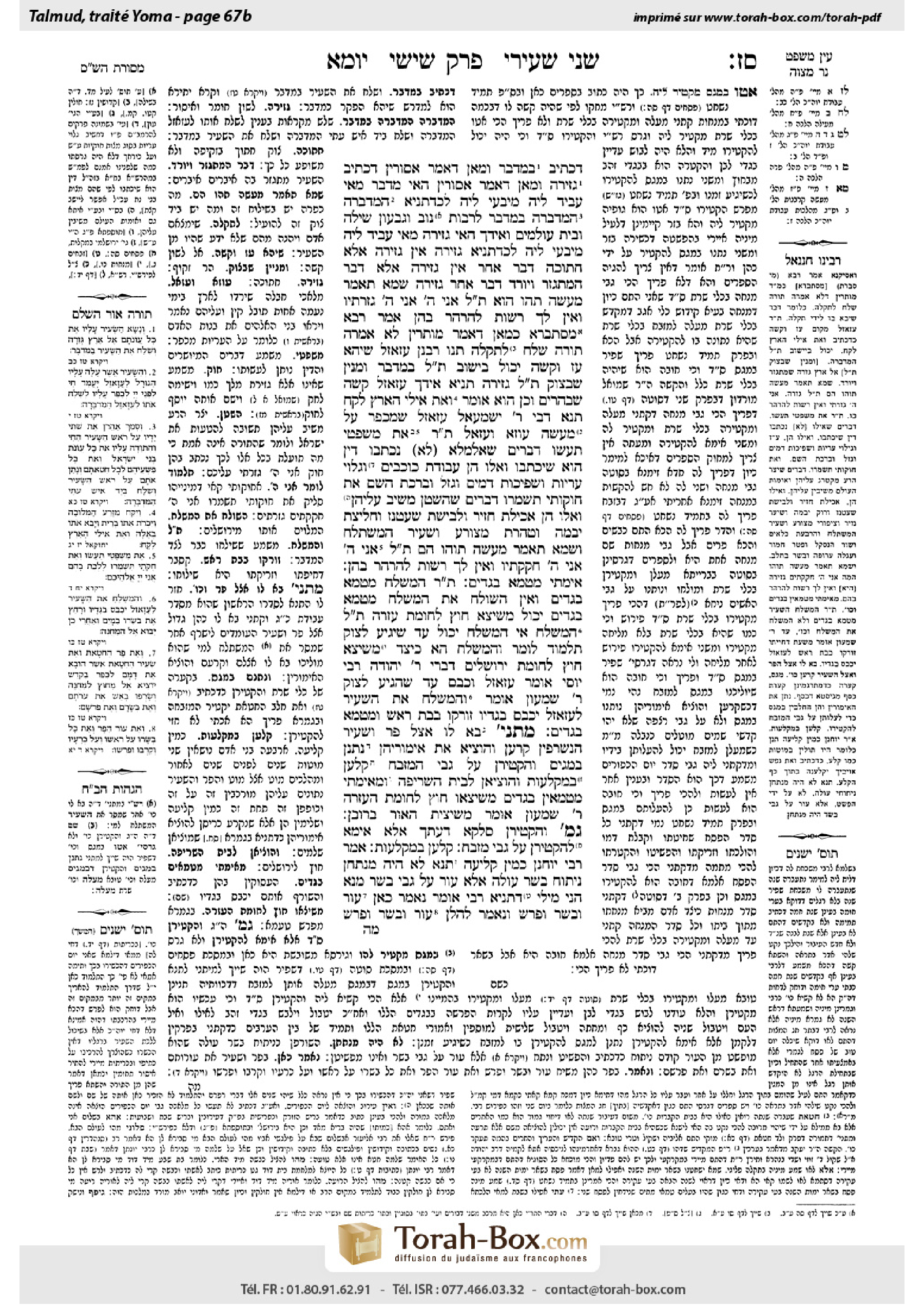
Yoma 67b: Talmud study for Daf Yomi
Daf Yomi is the daily study of one Talmud folio. Explore 37 tractates with scans, Hebrew text, Sefaria English and AI-generated French translations where annotated.
Passage selection and English or AI-generated French translation are available where the scan has annotations. Daf Study is independent of Torah-Box and Sefaria.
Browse Yoma · יומא · All tractatesYoma 67b text and translations
This page of Yoma includes the Aramaic text, an English translation and an AI-generated French translation, alongside the scan above.
יומא ס״ז ב · Aramaic and Hebrew text
דִּכְתִיב: ״בַּמִּדְבָּר״. וּמַאן דְּאָמַר אֲסוּרִין, דִּכְתִיב: ״גְּזֵירָה״.
וּמַאן דְּאָמַר אֲסוּרִין, הַאי ״מִדְבָּר״ מַאי עָבֵיד לֵיהּ? מִיבְּעֵי לֵיהּ לְכִדְתַנְיָא: ״הַמִּדְבָּרָה״, ״הַמִּדְבָּרָה״, ״בַּמִּדְבָּר״ — לְרַבּוֹת נוֹב וְגִבְעוֹן, שִׁילֹה, וּבֵית עוֹלָמִים.
וְאִידַּךְ, הַאי ״גְּזֵירָה״ מַאי עָבֵיד לֵיהּ? מִיבְּעֵי לֵיהּ לְכִדְתַנְיָא: ״גְּזֵירָה״ — אֵין גְּזֵירָה אֶלָּא חֲתוּכָה. דָּבָר אַחֵר: אֵין גְּזֵירָה אֶלָּא דָּבָר הַמִּתְגַּזֵּר וְיוֹרֵד.
דָּבָר אַחֵר: ״גְּזֵירָה״, שֶׁמָּא תֹּאמַר מַעֲשֵׂה תֹהוּ הוּא, תַּלְמוּד לוֹמַר: ״אֲנִי ה׳״, אֲנִי ה׳ גְּזַרְתִּיו, וְאֵין לְךָ רְשׁוּת לְהַרְהֵר בָּהֶן.
אָמַר רָבָא: מִסְתַּבְּרָא כְּמַאן דְּאָמַר מוּתָּרִין, לֹא אָמְרָה תּוֹרָה ״שַׁלַּח״ לְתַקָּלָה.
תָּנוּ רַבָּנַן: ״עֲזָאזֵל״ — שֶׁיְּהֵא עַז וְקָשֶׁה. יָכוֹל בַּיִּשּׁוּב, תַּלְמוּד לוֹמַר: ״בַּמִּדְבָּר״, וּמִנַּיִן שֶׁבְּצוּק? תַּלְמוּד לוֹמַר: ״גְּזֵירָה״. תַּנְיָא אִידַּךְ: ״עֲזָאזֵל״ — קָשֶׁה שֶׁבֶּהָרִים, וְכֵן הוּא אוֹמֵר: ״וְאֶת אֵילֵי הָאָרֶץ לָקָח״.
תָּנָא דְּבֵי רַבִּי יִשְׁמָעֵאל: ״עֲזָאזֵל״ — שֶׁמְּכַפֵּר עַל מַעֲשֵׂה עוּזָּא וְעַזָּאֵל.
תָּנוּ רַבָּנַן, ״אֶת מִשְׁפָּטַי תַּעֲשׂוּ״ — דְּבָרִים שֶׁאִלְמָלֵא (לֹא) נִכְתְּבוּ דִּין הוּא שֶׁיִּכָּתְבוּ, וְאֵלּוּ הֵן: עֲבוֹדָה זָרָה, וְגִלּוּי עֲרָיוֹת, וּשְׁפִיכוּת דָּמִים, וְגָזֵל, וּבִרְכַּת הַשֵּׁם.
״אֶת חוּקּוֹתַי תִּשְׁמְרוּ״ — דְּבָרִים שֶׁהַשָּׂטָן מֵשִׁיב עֲלֵיהֶן, וְאֵלּוּ הֵן: אֲכִילַת חֲזִיר, וּלְבִישַׁת שַׁעַטְנֵז, וַחֲלִיצַת יְבָמָה, וְטׇהֳרַת מְצוֹרָע, וְשָׂעִיר הַמִּשְׁתַּלֵּחַ. וְשֶׁמָּא תֹּאמַר מַעֲשֵׂה תוֹהוּ הֵם, תַּלְמוּד לוֹמַר: ״אֲנִי ה׳״, אֲנִי ה׳ חֲקַקְתִּיו, וְאֵין לְךָ רְשׁוּת לְהַרְהֵר בָּהֶן.
אֵימָתַי מְטַמֵּא בְּגָדִים. תָּנוּ רַבָּנַן: הַמְשַׁלֵּחַ מְטַמֵּא בְּגָדִים, וְאֵין הַשּׁוֹלֵחַ אֶת הַמְשַׁלֵּחַ מְטַמֵּא בְּגָדִים.
יָכוֹל מִשֶּׁיֵּצֵא חוּץ לְחוֹמַת עֲזָרָה — תַּלְמוּד לוֹמַר: ״הַמְשַׁלֵּחַ״. אִי ״הַמְשַׁלֵּחַ״, יָכוֹל עַד שֶׁיַּגִּיעַ לַצּוּק — תַּלְמוּד לוֹמַר: ״וְהַמְשַׁלֵּחַ״. הָא כֵּיצַד: מִשֶּׁיֵּצֵא חוּץ לְחוֹמַת יְרוּשָׁלַיִם, דִּבְרֵי רַבִּי יְהוּדָה.
רַבִּי יוֹסֵי אוֹמֵר: ״עֲזָאזֵל וְכִבֶּס״ — עַד שֶׁהִגִּיעַ לַצּוּק. רַבִּי שִׁמְעוֹן אוֹמֵר: ״וְהַמְשַׁלֵּחַ אֶת הַשָּׂעִיר לַעֲזָאזֵל יְכַבֵּס בְּגָדָיו״, זוֹרְקוֹ בְּבַת רֹאשׁ וּמְטַמֵּא בְּגָדִים.
מַתְנִי׳ בָּא לוֹ אֵצֶל פַּר וְשָׂעִיר הַנִּשְׂרָפִין, קְרָעָן, וְהוֹצִיא אֶת אֵימוּרֵיהֶן, נְתָנָן בְּמָגֵיס וְהִקְטִירָן עַל גַּבֵּי הַמִּזְבֵּחַ.
קְלָעָן בְּמִקְלָעוֹת וְהוֹצִיאָן לְבֵית הַשְּׂרֵיפָה. וּמֵאֵימָתַי מְטַמְּאִין בְּגָדִים — מִשֶּׁיֵּצְאוּ חוּץ לְחוֹמַת הָעֲזָרָה. רַבִּי שִׁמְעוֹן אוֹמֵר: מִשֶּׁיַּצִּית הָאוּר בְּרוּבָּן.
גְּמָ׳ ״וְהִקְטִירָן״ סָלְקָא דַּעְתָּךְ? אֶלָּא אֵימָא: לְהַקְטִירָן עַל גַּבֵּי מִזְבֵּחַ.
״קְלָעָן בְּמִקְלָעוֹת״. אָמַר רַבִּי יוֹחָנָן: כְּמִין קְלִיעָה. תָּנָא: לֹא הָיָה מְנַתְּחָן נִיתּוּחַ בְּשַׂר עוֹלָה, אֶלָּא עוֹר עַל גַּבֵּי בָּשָׂר. מְנָא הָנֵי מִילֵּי? דְּתַנְיָא: רַבִּי אוֹמֵר: נֶאֱמַר כָּאן עוֹר וּבָשָׂר וָפֶרֶשׁ, וְנֶאֱמַר לְהַלָּן עוֹר וּבָשָׂר וָפֶרֶשׁ,
Yoma 67b · English translation
established his opinion based on a verse, as it is written: “And the goat shall bear upon it all their iniquities to a land which is cut off; and he shall let go the goat in the wilderness” (Leviticus 16:22). The concluding phrase, “in the wilderness,” is unnecessary, and indicates that the goat shall be available for anyone to use, similar to a wilderness. And the one who said they are prohibited based his opinion on the same verse, as it is written, “cut off” [gezeira], which indicates a prohibition.
The Gemara asks: And the one who said they are prohibited, what does he do with this term wilderness, i.e., what does he derive from it? The Gemara answers: He needs it for that which was taught in a baraita: There are three expressions used to describe the location of the procedure with the scapegoat: “Into the wilderness” (Leviticus 16:10), “into the wilderness” (Leviticus 16:21), and “in the wilderness” (Leviticus 16:22), to include Nov and Givon and Shiloh, when the Tabernacle was located there, and the eternal Temple. The mitzva of the scapegoat applied during the time periods when communal offerings were sacrificed in any of these locations.
The Gemara asks: And the other, what does he do with this word gezeira? The Gemara answers: He needs it for that which was taught in a baraita with regard to the word gezeira: Gezeira means nothing other than cut. That is, he must send the goat away to a place cut up by rocks standing upright and sticking out. Alternatively, gezeira is referring to nothing other than something that breaks apart and falls, a reference to the goat, which is torn limb from limb.
Alternatively, the word gezeira is written lest you say the procedure of the scapegoat is a meaningless act, since what sanctity and atonement is achieved in sending the goat to Azazel and pushing it from the cliff? Therefore, the verse states: “I am the Lord” (Leviticus 18:5), i.e., I, the Lord, decreed it [gezartiv], and you have no right to question it.
Having clarified the reasoning of each opinion, the Gemara concludes its discussion of whether the limbs of the goat are permitted for benefit. Rava said: It is reasonable to rule in accordance with the one that said the limbs of the goat are permitted, since the Torah did not say: “And send the goat” to cause mishap. Once the man pushes the goat off the cliff, he is no longer responsible for it. Therefore, if it were prohibited to derive benefit from the goat’s remains, the mitzva itself could lead to a mishap if someone were to find the goat’s remains and make use of them.
§ The Sages taught: The word Azazel indicates that the cliff the goat is pushed from should be rough and hard. I might have thought that it may be located in a settled area. Therefore, the verse states: “In the wilderness.” And from where does one derive that the goat is pushed from a cliff? The verse states “gezeira,” indicating an area that is sharp, like a cliff. It was taught in another baraita: Azazel is a reference to the hardest mountain, and so it says: “And the mighty [eilei] of the land he took away” (Ezekiel 17:13). Azazel is interpreted as azaz-el, with the term el connoting something rough and hard.
The school of Rabbi Yishmael taught: Azazel is so called because it atones for the actions of Uzza and Azael. These are the names of “sons of God” who sinned with “daughters of men” (Genesis 6:2) and thereby caused the world to sin during the generation of the Flood.
The Gemara cites another baraita related to the scapegoat. The Sages taught with regard to the verse: “You shall do My ordinances, and you shall keep My statutes to follow them, I am the Lord your God” (Leviticus 18:4), that the phrase: My ordinances, is a reference to matters that, even had they not been written, it would have been logical that they be written. They are the prohibitions against idol worship, prohibited sexual relations, bloodshed, theft, and blessing God, a euphemism for cursing the Name of God.
The phrase: And you shall keep my statutes, is a reference to matters that Satan and the nations of the world challenge because the reason for these mitzvot are not known. They are: The prohibitions against eating pork; wearing garments that are made from diverse kinds of material, i.e., wool and linen; performing the ḥalitza ceremony with a yevama, a widow who must participate in a levirate marriage or ḥalitza; the purification ceremony of the leper; and the scapegoat. And lest you say these have no reason and are meaningless acts, therefore the verse states: “I am the Lord” (Leviticus 18:4), to indicate: I am the Lord, I decreed these statutes and you have no right to doubt them.
§ It was taught in the mishna that the tanna’im disagreed about from what point the garments of the man who leads the scapegoat are rendered impure. The Sages taught in a baraita: The garments of the one who dispatches the goat are rendered impure, but the garments of the one who dispatches the dispatcher, e.g., those who accompany him, are not rendered impure.
One might have thought that as soon as he leaves the wall of the Temple courtyard he becomes ritually impure. Therefore, the verse states: “He that dispatched” (Leviticus 16:26), to teach that he does not contract impurity until his journey has begun. On the other hand, if the verse had simply stated: He that dispatched, one might have thought he does not become impure until he reaches the cliff. Therefore, the verse states: “And he that dispatched,” with the inclusive term “and.” How is this to be understood? His garments are rendered impure only when he emerged outside the wall of Jerusalem. This is the statement of Rabbi Yehuda.
Rabbi Yosei says that the verse states: “And he that dispatched the goat to Azazel shall wash” (Leviticus 16:26), which indicates that his garments are not rendered impure until he has reached Azazel, i.e., the cliff. Rabbi Shimon says: His garments are rendered impure only when he pushes the goat from the cliff, as it says: “And he that dispatched the goat to Azazel shall wash his clothes” (Leviticus 16:26), to indicate that he throws it headlong and only then, once he has fulfilled the mitzva, his garments are rendered impure.
MISHNA: After the High Priest passed the goat to the man tasked with dispatching the goat, he came next to the bull and the goat that were to be burned. He tore their flesh but was not required to cut it into pieces, and removed the portions of the offering consumed on the altar and placed them in a large bowl [magis] and burned them on the altar.
He interwove and bound the bull and the goat together into braids as one mass. They were placed in that way upon two poles and carried by four people who took them out to the place designated for burning, outside of Jerusalem. And at what point do the bull and goat render the garments of those who carried them impure, as it is written: “And he who burns them shall wash his garments” (Leviticus 16:28)? They render the garments impure from the moment that they emerged outside the wall of the Temple courtyard. Rabbi Shimon says: They render the garments impure from the moment that the fire has ignited in most of the bull and the goat.
GEMARA: It was taught in the mishna that the High Priest removed the portions of the offering consumed on the altar and burned them on the altar. The Gemara expresses surprise: Would it enter your mind to say he burned them? He would not burn them right away, since he had to perform other services first. Rather, say that he placed them in a large bowl in order to burn them on the altar later.
It was taught in the mishna that the High Priest interwove and bound the bull and the goat together into braids as one mass before taking them to be burned. Rabbi Yoḥanan said: He made them like a braid, whose parts are interwoven. It was taught: He would not dissect the bull and goat in the manner of the dissection of the flesh of a burnt-offering, where the animal is skinned and then cut into parts. Rather, he would leave the skin on top of the flesh and would cut the animal into pieces without skinning it. The Gemara asks: From where are these matters derived? As it was taught in a baraita that Rabbi Yehuda HaNasi says: It is stated here with regard to the bull and goat, skin and flesh and dung (Leviticus 16:27), and it is stated below, with regard to the bull sin-offerings that are burned, skin and flesh and dung (Leviticus 4:11).
Yoma 67b · Traduction française (IA)
Il a fondé son opinion sur un verset, comme il est écrit : « Le bouc portera sur lui toutes leurs fautes vers une terre coupée [gezeira], et il laissera partir le bouc dans le désert » (Lévitique 16,22). La précision finale « dans le désert » est superflue et indique que le bouc doit être à la disposition de tous, comme dans le désert. Celui qui affirme qu’il est interdit d’en tirer profit fonde son opinion sur le même verset, où il est écrit « coupée » [gezeira], ce qui indique une interdiction.
La Guemara demande : Et celui qui affirme qu’il est interdit d’en tirer profit, que fait-il de ce terme « désert », c’est-à-dire qu’en déduit-il ? La Guemara répond : Il en a besoin pour ce qui a été enseigné dans une baraïta : trois expressions servent à décrire le lieu où se déroule le rituel du bouc émissaire : « vers le désert » (Lévitique 16,10), « vers le désert » (Lévitique 16,21) et « dans le désert » (Lévitique 16,22). Elles incluent Nov, Givon et Shilo, lorsque le Tabernacle s’y trouvait, ainsi que le Temple éternel. La mitsva du bouc émissaire s’appliquait pendant les périodes où des sacrifices communautaires étaient offerts dans chacun de ces lieux.
La Guemara demande : Et l’autre, que fait-il de ce mot gezeira ? La Guemara répond : Il en a besoin pour ce qui a été enseigné dans une baraïta au sujet du mot gezeira : gezeira ne signifie rien d’autre que « coupée ». Autrement dit, il faut envoyer le bouc dans un endroit découpé par des rochers dressés et saillants. Selon une autre interprétation, gezeira désigne quelque chose qui se brise et tombe, en référence au bouc, qui est démembré.
Selon une autre interprétation, le mot gezeira est écrit afin qu’on ne dise pas que le rituel du bouc émissaire est un acte dépourvu de sens, puisqu’on ne comprend pas quelle sainteté ni quelle expiation sont obtenues en envoyant le bouc à Azazel et en le précipitant du haut de la falaise. C’est pourquoi le verset dit : « Je suis le Seigneur » (Lévitique 18,5), c’est-à-dire : Moi, le Seigneur, l’ai décrété [gezartiv], et vous n’avez pas le droit de le remettre en question.
Après avoir clarifié le raisonnement de chaque opinion, la Guemara conclut sa discussion sur la question de savoir s’il est permis de tirer profit des membres du bouc. Rava dit : Il est raisonnable de trancher selon celui qui affirme qu’il est permis d’en tirer profit, car la Torah n’a pas dit : « Et renvoie le bouc » en vue de provoquer un incident. Une fois que l’homme a précipité le bouc du haut de la falaise, il n’en est plus responsable. Par conséquent, s’il était interdit de tirer profit des restes du bouc, la mitsva elle-même pourrait entraîner un incident si quelqu’un trouvait ces restes et les utilisait.
§ Les Sages ont enseigné : Le mot Azazel indique que la falaise d’où le bouc est précipité doit être escarpée et dure. J’aurais pu penser qu’elle pouvait se trouver dans une zone habitée. C’est pourquoi le verset dit : « Dans le désert ». Et d’où déduit-on que le bouc est précipité d’une falaise ? Le verset dit gezeira, ce qui indique un endroit abrupt, comme une falaise. Une autre baraïta enseigne : Azazel désigne la montagne la plus dure, comme il est dit : « Il emporta les puissants [eilei] du pays » (Ézéchiel 17,13). Azazel est interprété comme azaz-el, le terme el évoquant quelque chose d’abrupt et de dur.
L’école de Rabbi Yishmaël a enseigné : Azazel porte ce nom parce qu’il expie les actes d’Ouza et d’Azael. Ce sont les noms des « fils de Dieu » qui péchèrent avec les « filles des hommes » (Genèse 6,2) et firent ainsi pécher le monde à l’époque de la génération du Déluge.
La Guemara cite une autre baraïta concernant le bouc émissaire. Les Sages ont enseigné à propos du verset : « Vous mettrez en pratique Mes ordonnances et vous garderez Mes lois pour les suivre ; Je suis le Seigneur votre Dieu » (Lévitique 18,4), que l’expression « Mes ordonnances » fait référence aux choses qui, même si elles n’avaient pas été écrites, auraient dû l’être selon la logique. Il s’agit des interdictions de l’idolâtrie, des relations sexuelles interdites, du meurtre, du vol et de bénir Dieu, expression euphémique pour désigner le fait de maudire le Nom de Dieu.
L’expression « et vous garderez Mes lois » fait référence aux choses que Satan et les nations du monde contestent, car la raison de ces mitsvot n’est pas connue. Il s’agit des interdictions de manger du porc et de porter des vêtements faits de matières mélangées, c’est-à-dire de laine et de lin ; de la cérémonie de la ḥalitsa avec une yevama, une veuve qui doit participer à un mariage léviratique ou à une ḥalitsa ; du rituel de purification du lépreux ; et du bouc émissaire. Et de peur que l’on dise que ces commandements sont dépourvus de raison et n’ont aucun sens, le verset dit : « Je suis le Seigneur » (Lévitique 18,4), pour indiquer : Moi, le Seigneur, ai décrété ces lois et vous n’avez pas le droit d’en douter.
§ La Michna enseignait que les tannaïm étaient en désaccord sur le moment à partir duquel les vêtements de l’homme qui conduit le bouc émissaire deviennent impurs. Les Sages ont enseigné dans une baraïta : Les vêtements de celui qui renvoie le bouc deviennent impurs, mais ceux de celui qui accompagne l’envoyé, par exemple les personnes qui l’escortent, ne deviennent pas impurs.
J’aurais pu penser qu’il devient rituellement impur dès qu’il franchit le mur de la cour du Temple. C’est pourquoi le verset dit : « Celui qui l’a envoyé » (Lévitique 16,26), pour enseigner qu’il ne contracte l’impureté qu’une fois son trajet commencé. D’un autre côté, si le verset avait simplement dit « celui qui l’a envoyé », j’aurais pu penser qu’il ne devient impur qu’une fois arrivé à la falaise. C’est pourquoi le verset dit : « Et celui qui l’a envoyé », avec le terme inclusif « et ». Comment faut-il comprendre cela ? Ses vêtements ne deviennent impurs que lorsqu’il est sorti hors des limites de Jérusalem. Telle est l’opinion de Rabbi Yehouda.
Rabbi Yossei dit que le verset dit : « Et celui qui a envoyé le bouc à Azazel lavera » (Lévitique 16,26), ce qui indique que ses vêtements ne deviennent impurs qu’une fois qu’il a atteint Azazel, c’est-à-dire la falaise. Rabbi Shimon dit : Ses vêtements ne deviennent impurs que lorsqu’il précipite le bouc du haut de la falaise, comme il est dit : « Et celui qui a envoyé le bouc à Azazel lavera ses vêtements » (Lévitique 16,26), ce qui indique qu’il le lance tête la première et que ses vêtements ne deviennent impurs qu’à ce moment-là, une fois la mitsva accomplie.
MICHNA : Après avoir confié le bouc à l’homme chargé de le renvoyer, le grand prêtre s’approcha du taureau et du bouc qui devaient être brûlés. Il déchira leur chair sans être tenu de la découper en morceaux, retira les parties de l’offrande destinées à être consumées sur l’autel, les plaça dans une grande coupe [magis] et les brûla sur l’autel.
Il entrelaça le taureau et le bouc et les lia en tresses, formant une seule masse. Ils furent disposés ainsi sur deux perches et portés par quatre hommes, qui les emmenèrent à l’endroit désigné pour les brûler, à l’extérieur de Jérusalem. À partir de quel moment le taureau et le bouc rendent-ils impurs les vêtements de ceux qui les portent, comme il est écrit : « Celui qui les brûlera lavera ses vêtements » (Lévitique 16,28) ? Ils rendent ces vêtements impurs dès qu’ils franchissent le mur de la cour du Temple. Rabbi Shimon dit : Ils rendent ces vêtements impurs dès que le feu a pris sur la majeure partie du taureau et du bouc.
GUEMARA : La Michna enseignait que le grand prêtre retirait les parties de l’offrande destinées à être consumées sur l’autel et les brûlait sur l’autel. La Guemara s’étonne : Vous viendrait-il à l’esprit qu’il les brûlait ? Il ne les brûlait pas immédiatement, puisqu’il devait d’abord accomplir d’autres offices. Il faut plutôt dire qu’il les plaçait dans une grande coupe afin de les brûler plus tard sur l’autel.
La Michna enseignait que le grand prêtre entrelaçait le taureau et le bouc et les liait en tresses, formant une seule masse, avant de les emmener pour les brûler. Rabbi Yoḥanan dit : Il les disposait comme une tresse, dont les éléments sont entrelacés. Il a été enseigné : Il ne dépeçait pas le taureau et le bouc comme on dépèce la chair d’un holocauste, c’est-à-dire en dépouillant l’animal avant de le découper en morceaux. Il laissait plutôt la peau sur la chair et découpait l’animal en morceaux sans le dépouiller. La Guemara demande : D’où déduit-on ces choses ? Rabbi Yehuda HaNasi enseigne dans une baraïta : À propos du taureau et du bouc, il est dit ici « peau, chair et excréments » (Lévitique 16,27), et, plus loin, à propos des taureaux offerts en sacrifice expiatoire et brûlés, il est dit « peau, chair et excréments » (Lévitique 4,11).
Traduction française générée par IA à partir de l’édition anglaise de Sefaria. Vérifie toujours un passage avec le texte source.
Text from Sefaria: William Davidson Edition - Vocalized Aramaic (CC BY NC); William Davidson Edition - English (CC BY NC).