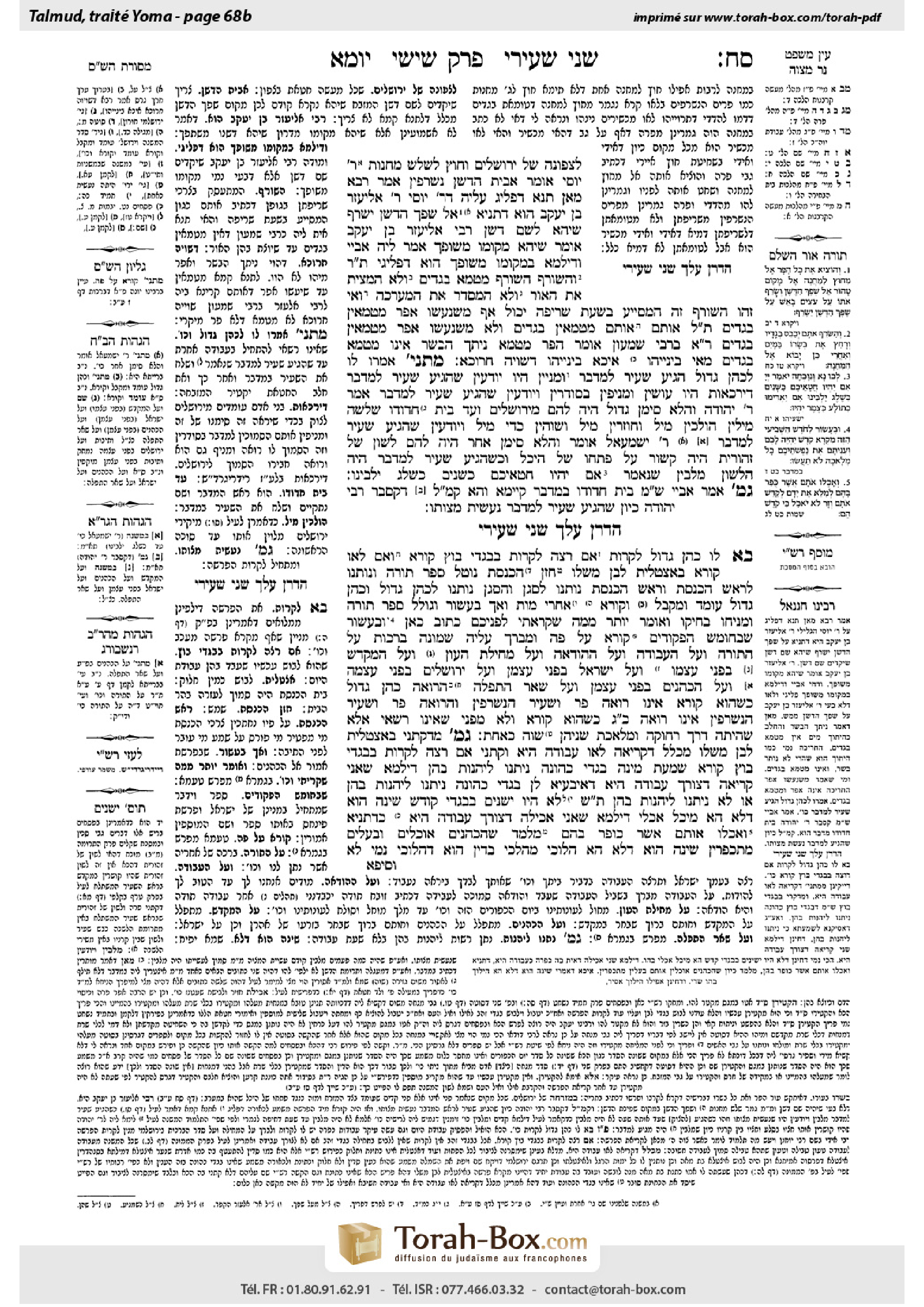
Yoma 68b: Talmud study for Daf Yomi
Daf Yomi is the daily study of one Talmud folio. Explore 37 tractates with scans, Hebrew text, Sefaria English and AI-generated French translations where annotated.
Passage selection and English or AI-generated French translation are available where the scan has annotations. Daf Study is independent of Torah-Box and Sefaria.
Browse Yoma · יומא · All tractatesYoma 68b text and translations
This page of Yoma includes the Aramaic text, an English translation and an AI-generated French translation, alongside the scan above.
יומא ס״ח ב · Aramaic and Hebrew text
לִצְפוֹנָהּ שֶׁל יְרוּשָׁלַיִם, וְחוּץ לְשָׁלֹשׁ מַחֲנוֹת. רַבִּי יוֹסֵי אוֹמֵר: אַבֵּית הַדֶּשֶׁן נִשְׂרָפִין.
אָמַר רָבָא: מַאן תְּנָא דִּפְלִיג עֲלֵיהּ דְּרַבִּי יוֹסֵי — רַבִּי אֱלִיעֶזֶר בֶּן יַעֲקֹב הוּא. דְּתַנְיָא: ״אֶל שֶׁפֶךְ הַדֶּשֶׁן יִשָּׂרֵף״, שֶׁיְּהֵא לְשֵׁם דֶּשֶׁן, רַבִּי אֱלִיעֶזֶר בֶּן יַעֲקֹב אוֹמֵר: שֶׁיְּהֵא מְקוֹמוֹ מְשׁוּפָּךְ.
אֲמַר לֵיהּ אַבָּיֵי: וְדִילְמָא בִּמְקוֹמוֹ מְשׁוּפָּךְ הוּא דִּפְלִיגִי.
תָּנוּ רַבָּנַן: ״וְהַשּׂוֹרֵף״ — הַשּׂוֹרֵף מְטַמֵּא בְּגָדִים וְלֹא הַמַּצִּית אֶת הָאוּר וְלֹא הַמְסַדֵּר אֶת הַמַּעֲרָכָה. וְאֵי זֶהוּ הַשּׂוֹרֵף? זֶה הַמְסַיֵּיעַ בִּשְׁעַת שְׂרֵיפָה.
יָכוֹל אַף מִשֶּׁנַּעֲשׂוּ אֵפֶר מְטַמְּאִין בְּגָדִים — תַּלְמוּד לוֹמַר: ״אוֹתָם״, אוֹתָם מְטַמְּאִין בְּגָדִים, וְלֹא מִשֶּׁנַּעֲשׂוּ אֵפֶר מְטַמְּאִין בְּגָדִים. רַבִּי אֶלְעָזָר בְּרַבִּי שִׁמְעוֹן אוֹמֵר: הַפָּר מְטַמֵּא, נִיתַּךְ הַבָּשָׂר אֵינוֹ מְטַמֵּא בְּגָדִים.
מַאי בֵּינַיְיהוּ? אִיכָּא בֵּינַיְיהוּ דְּשַׁוְּיֵהּ חֲרוֹכָא.
מַתְנִי׳ אָמְרוּ לוֹ לְכֹהֵן גָּדוֹל: הִגִּיעַ שָׂעִיר לַמִּדְבָּר. וּמִנַּיִין הָיוּ יוֹדְעִין שֶׁהִגִּיעַ שָׂעִיר לַמִּדְבָּר? דִּירְכָּאוֹת הָיוּ עוֹשִׂין וּמְנִיפִין בְּסוּדָרִין. וְיוֹדְעִין שֶׁהִגִּיעַ שָׂעִיר לַמִּדְבָּר.
אָמַר רַבִּי יְהוּדָה, וַהֲלֹא סִימָן גָּדוֹל הָיָה לָהֶם: מִירוּשָׁלַיִם וְעַד בֵּית חֲדוֹדוֹ, שְׁלֹשָׁה מִילִין, הוֹלְכִין מִיל וְחוֹזְרִין מִיל, וְשׁוֹהִין כְּדֵי מִיל וְיוֹדְעִין שֶׁהִגִּיעַ שָׂעִיר לַמִּדְבָּר.
רַבִּי יִשְׁמָעֵאל אוֹמֵר: וַהֲלֹא סִימָן אַחֵר הָיָה לָהֶם: לָשׁוֹן שֶׁל זְהוֹרִית הָיָה קָשׁוּר עַל פִּתְחוֹ שֶׁל הֵיכָל, וּכְשֶׁהִגִּיעַ שָׂעִיר לַמִּדְבָּר הָיָה הַלָּשׁוֹן מַלְבִּין, שֶׁנֶּאֱמַר: ״אִם יִהְיוּ חֲטָאֵיכֶם כַּשָּׁנִים כַּשֶּׁלֶג יַלְבִּינוּ״.
גְּמָ׳ אָמַר אַבָּיֵי: שְׁמַע מִינַּהּ בֵּית חֲדוֹדוֹ בַּמִּדְבָּר קָיְימָא, וְהָא קָא מַשְׁמַע לַן דְּקָסָבַר רַבִּי יְהוּדָה: כֵּיוָן שֶׁהִגִּיעַ שָׂעִיר לַמִּדְבָּר — נַעֲשֵׂית מִצְוָתוֹ.
הֲדַרַן עֲלָךְ שְׁנֵי שְׂעִירֵי
בָּא לוֹ כֹּהֵן גָּדוֹל לִקְרוֹת, אִם רָצָה לִקְרוֹת בְּבִגְדֵי בוּץ — קוֹרֵא, וְאִם לָאו — קוֹרֵא בְּאִצְטְלִית לָבָן מִשֶּׁלּוֹ.
חַזַּן הַכְּנֶסֶת נוֹטֵל סֵפֶר תּוֹרָה, וְנוֹתְנוֹ לְרֹאשׁ הַכְּנֶסֶת, וְרֹאשׁ הַכְּנֶסֶת נוֹתְנוֹ לַסְּגָן, וְהַסְּגָן נוֹתְנוֹ לְכֹהֵן גָּדוֹל, וְכֹהֵן גָּדוֹל עוֹמֵד וּמְקַבֵּל, וְקוֹרֵא בְּ״אַחֲרֵי מוֹת״ וְ״אַךְ בֶּעָשׂוֹר״, וְגוֹלֵל סֵפֶר תּוֹרָה וּמַנִּיחוֹ בְּחֵיקוֹ וְאוֹמֵר: יוֹתֵר מִמַּה שֶּׁקָּרָאתִי לִפְנֵיכֶם כָּתוּב כָּאן. ״וּבֶעָשׂוֹר״ שֶׁבְּחוֹמֶשׁ הַפְּקוּדִים קוֹרֵא עַל פֶּה.
וּמְבָרֵךְ עָלֶיהָ שְׁמוֹנֶה בְּרָכוֹת: עַל הַתּוֹרָה, וְעַל הָעֲבוֹדָה, וְעַל הַהוֹדָאָה, וְעַל מְחִילַת הֶעָוֹן, וְעַל הַמִּקְדָּשׁ בִּפְנֵי עַצְמוֹ, וְעַל יִשְׂרָאֵל בִּפְנֵי עַצְמָן, וְעַל יְרוּשָׁלַיִם בִּפְנֵי עַצְמָהּ, וְעַל הַכֹּהֲנִים בִּפְנֵי עַצְמָן, וְעַל שְׁאָר הַתְּפִלָּה.
הָרוֹאֶה כֹּהֵן גָּדוֹל כְּשֶׁהוּא קוֹרֵא — אֵינוֹ רוֹאֶה פַּר וְשָׂעִיר הַנִּשְׂרָפִין, וְהָרוֹאֶה פַּר וְשָׂעִיר הַנִּשְׂרָפִין — אֵינוֹ רוֹאֶה כֹּהֵן גָּדוֹל כְּשֶׁהוּא קוֹרֵא. וְלֹא מִפְּנֵי שֶׁאֵינוֹ רַשַּׁאי, אֶלָּא שֶׁהָיְתָה דֶּרֶךְ רְחוֹקָה, וּמְלֶאכֶת שְׁנֵיהֶן שָׁוָה כְּאַחַת.
גְּמָ׳ מִדְּקָתָנֵי בְּאִצְטְלִית לָבָן מִשֶּׁלּוֹ, מִכְּלָל דִּקְרִיאָה לָאו עֲבוֹדָה הִיא.
וְקָתָנֵי: אִם רָצָה לִקְרוֹת בְּבִגְדֵי בוּץ — קוֹרֵא, שָׁמְעַתְּ מִינַּהּ בִּגְדֵי כְהוּנָּה נִיתְּנוּ לֵיהָנוֹת בָּהֶן! דִּילְמָא שָׁאנֵי קְרִיאָה דְּצוֹרֶךְ עֲבוֹדָה הִיא.
דְּאִיבַּעְיָא לַן: בִּגְדֵי כְהוּנָּה נִיתְּנוּ לֵיהָנוֹת בָּהֶן, אוֹ לֹא נִיתְּנוּ לֵיהָנוֹת בָּהֶן.
תָּא שְׁמַע: לֹא הָיוּ יְשֵׁנִים בְּבִגְדֵי קוֹדֶשׁ. שֵׁינָה הוּא דְּלָא, הָא מֵיכָל — אָכְלִי! דִּילְמָא שָׁאנֵי אֲכִילָה דְּצוֹרֶךְ עֲבוֹדָה הִיא, כִּדְתַנְיָא: ״וְאָכְלוּ אוֹתָם אֲשֶׁר כּוּפַּר בָּהֶם״ — מְלַמֵּד שֶׁהַכֹּהֲנִים אוֹכְלִים וּבְעָלִים מִתְכַּפְּרִין.
שֵׁינָה הוּא דְּלָא, הָא הַלּוֹכֵי — מְהַלְּכִי! בְּדִין הוּא דְּהַלּוֹכֵי נָמֵי לָא,
Yoma 68b · English translation
North of Jerusalem, and outside of three camps. Rabbi Yosei says: They are burned in the place of the ashes.
Rava said: Who is the tanna who disagrees with Rabbi Yosei on this issue? It is Rabbi Eliezer ben Ya’akov, as it was taught in a baraita with regard to the verse: “Where the ashes are poured out [shefekh hadeshen] shall it be burned” (Leviticus 4:12), which means that there shall already be ash there in that place, so that it is known as the ash heap even before this animal is burned there. Rabbi Eliezer ben Ya’akov says: This verse indicates that its place should be slanted [meshupakh] so that ash that is deposited there will roll downhill. Rava understood that whereas Rabbi Yosei requires that there already be ash present when the bull is burned, Rabbi Eliezer ben Ya’akov does not.
Abaye said to him: There is no proof from here, as perhaps they disagree only about whether the place must be slanted. Rabbi Eliezer ben Ya’akov may agree there should be ash there to begin with, but he adds that the place must also be slanted. Therefore, there is no proof to support Rava’s statement.
The Sages taught: It states: “And he who burns them shall wash his garments” (Leviticus 16:28), to indicate that only the garments of the one who burns the bull and goat of Yom Kippur are rendered impure, but not the garments of the one who kindles the fire, and not the garments of the one who arranges the pile of wood. And who is the one who burns? It is the one who assists at the actual time of burning.
One might have thought that garments would be rendered impure even after the bull and goat have become ash. Therefore, the verse states: Them, to indicate that they themselves, the bull and goat of Yom Kippur, render garments impure, but they do not render garments impure once they become ash. Rabbi Elazar, son of Rabbi Shimon, says: The bull causes ritual impurity before it is burned, but once the flesh is burned it no longer renders garments impure.
The Gemara asks: What is the practical difference between the opinion of the first tanna and the opinion of Rabbi Elazar, son of Rabbi Shimon? The Gemara answers: There is a difference between them when he turned it into a charred mass and the form of the animal has already become distorted but has not actually become ash. According to Rabbi Elazar, son of Rabbi Shimon, it no longer causes impurity.
MISHNA: They said to the High Priest: The goat has reached the wilderness. And how did they know in the Temple that the goat reached the wilderness? They would build platforms [dirkaot] all along the way and people would stand on them and wave scarves [sudarin] to signal when the goat arrived. And therefore they knew that the goat reached the wilderness.
Rabbi Yehuda said: Why did they need these platforms? Didn’t they already have a reliable indicator? From Jerusalem to Beit Ḥiddudo, the edge of the wilderness, where the mitzva of dispatching the goat was performed, was a distance of three mil. Since the nobles of Jerusalem walked a mil to escort the dispatcher and returned a mil, and waited the time equivalent to the time it takes to walk a mil, they knew that the goat reached the wilderness. There was no need for the platforms.
Rabbi Yishmael says: Didn’t they have a different indicator? There was a strip of crimson tied to the entrance to the Sanctuary, and when the goat reached the wilderness and the mitzva was fulfilled the strip would turn white, as it is stated: “Though your sins be as scarlet, they will become white as snow” (Isaiah 1:18).
GEMARA: Abaye said: Learn from this that Beit Ḥiddudo is located in the wilderness, and this comes to teach us that Rabbi Yehuda holds that once the goat has reached the wilderness, its mitzva is complete even before it is pushed off the cliff, and there is no need to wait any longer.
MISHNA: The High Priest came to read the Torah. If he wished to read the Torah while still dressed in the fine linen garments, i.e., the priestly vestments he wore during the previous service, he may read wearing them; and if not he is permitted to read in a white robe of his own, which is not a priestly vestment.
The synagogue attendant takes a Torah scroll and gives it to the head of the synagogue that stood on the Temple Mount; and the head of the synagogue gives it to the deputy High Priest, and the Deputy gives it to the High Priest, and the High Priest stands and receives the scroll from his hands. And he reads from the scroll the Torah portion beginning with the verse: “After the death” (Leviticus 16:1) and the portion beginning with the verse: “But on the tenth” (Leviticus 23:26), and furls the Torah scroll and places it on his bosom and says: More than what I have read before you is written here. The Torah portion beginning with the verse: “And on the tenth,” from the book of Numbers (29:7), he then reads by heart.
And he recites after the reading the following eight blessings:
Concerning the Torah: Who has given us the Torah of truth;
and concerning the Temple service: Find favor in Your people Israel and accept the service in Your most holy House... for You alone do we serve with reverence;
and concerning thanksgiving: We give thanks to You;
and concerning pardon of iniquity: Pardon our iniquities on this Yom Kippur;
and concerning the Temple in and of itself, which concludes: Blessed…Who chose the Temple;
and concerning the Jewish People in and of itself, which concludes: Blessed…Who chose Israel;
and concerning Jerusalem in and of itself, which concludes: Blessed…Who chose Jerusalem;
and concerning the priests in and of themselves, which concludes: Blessed…Who chose the priests;
and concerning the rest of the prayer, which concludes: Blessed…Who listens to prayer.
The Mishna comments: One who sees the High Priest reading the Torah does not see the bull and goat that are burned; and one who sees the bull and goat that are burned does not see the High Priest reading the Torah. The Mishna explains: And this is not due to the fact that one is not permitted to see both, but because there was a distant path between them, and the performance of both of them is undertaken simultaneously.
GEMARA: From the fact that it is taught in the mishna that the High Priest is permitted to read in a white robe of his own, one may derive by inference that the reading of the Torah is not classified as a service, which would have required that he wear priestly vestments.
But the mishna also teaches: If he wished to read the Torah while still dressed in the fine linen garments, he may read wearing them. This is true even though they are consecrated as priestly vestments and the reading of the Torah is not a sacred service. Therefore, the Gemara suggests: Learn from this that it is permitted to derive benefit from priestly vestments, i.e., even when not engaged in performing a service, a priest may derive benefit from the priestly vestments, for example, by wearing them for his own needs. If so, this would settle a long-standing unresolved dilemma concerning this issue. The Gemara rejects this suggestion: A proof may not be adduced from here because perhaps reading from the Torah is different, since it is for the purpose of the service; therefore, even though it is not a true service in its own right, it is nevertheless permitted for the High Priest to continue wearing the priestly vestments.
As the dilemma was raised before us: Is it permitted to derive benefit from priestly vestments, or is it not permitted to derive benefit from priestly vestments?
Come and hear a resolution to this dilemma based on a mishna: The priests would not sleep in the sacred vestments out of concern they might pass wind while sleeping. One may infer: It is specifically sleep which is not permitted, but they may eat while wearing the priestly vestments, even though eating is not a service. This should prove that it is permitted to derive personal benefit from wearing priestly vestments. The Gemara rejects this proof: A proof may not be adduced from here because perhaps eating is different, since it is for the purpose of the Temple service. As it was taught in a baraita that the verse states: “And they shall eat those things with which atonement was made” (Exodus 29:33), which teaches that the priests eat the meat of the offerings and the owners of those offerings thereby achieve atonement.
The Gemara suggests making a different inference from that mishna cited above: One may infer that it is specifically sleep which is not permitted, but they may walk while wearing the sacred vestments even when not engaged in a service. This should prove that it is permitted to derive benefit from wearing priestly vestments. The Gemara rejects this proof: It is incorrect to make this inference since by right the mishna should have stated that walking in priestly vestments is also not permitted.
Yoma 68b · Traduction française (IA)
Au nord de Jérusalem, à l’extérieur des trois camps. Rabbi Yosei dit : On les brûle à l’emplacement des cendres.
Rava dit : Quel tanna est en désaccord avec Rabbi Yosei sur cette question ? C’est Rabbi Eliezer ben Ya’akov, comme on l’a enseigné dans une baraïta au sujet du verset : « Là où les cendres sont déversées [shefekh hadeshen], on le brûlera » (Lévitique 4, 12). Cela signifie qu’il doit déjà y avoir des cendres à cet endroit, afin que celui-ci soit connu comme le tas de cendres avant même qu’on y brûle cet animal. Rabbi Eliezer ben Ya’akov dit : Ce verset indique que l’emplacement doit être en pente [meshupakh], afin que les cendres qui y sont déposées roulent vers le bas. Rava comprend que, tandis que Rabbi Yosei exige qu’il y ait déjà des cendres lorsque le taureau est brûlé, Rabbi Eliezer ben Ya’akov ne l’exige pas.
Abaye lui dit : On ne peut pas en tirer de preuve, car leur désaccord porte peut-être uniquement sur la question de savoir si l’emplacement doit être en pente. Rabbi Eliezer ben Ya’akov peut convenir qu’il doit déjà y avoir des cendres à cet endroit, tout en ajoutant que l’emplacement doit aussi être en pente. Il n’y a donc aucune preuve à l’appui de l’affirmation de Rava.
Les Sages ont enseigné : Il est dit : « Celui qui les brûle lavera ses vêtements » (Lévitique 16, 28), ce qui indique que seuls les vêtements de celui qui brûle le taureau et le bouc de Yom Kippour deviennent impurs, mais pas ceux de celui qui allume le feu, ni ceux de celui qui dispose le tas de bois. Et qui est celui qui les brûle ? C’est celui qui participe à la combustion proprement dite.
On aurait pu penser que les vêtements deviennent impurs même après que le taureau et le bouc ont été réduits en cendres. C’est pourquoi le verset dit : « eux », pour indiquer que ce sont eux-mêmes, le taureau et le bouc de Yom Kippour, qui rendent les vêtements impurs, mais qu’ils ne les rendent plus impurs une fois réduits en cendres. Rabbi Elazar, fils de Rabbi Shimon, dit : Le taureau rend impur avant d’être brûlé, mais, une fois sa chair brûlée, il ne rend plus les vêtements impurs.
La Guemara demande : Quelle est la différence pratique entre l’opinion du premier tanna et celle de Rabbi Elazar, fils de Rabbi Shimon ? La Guemara répond : Ils diffèrent dans le cas où le taureau a été réduit à l’état de masse carbonisée et où sa forme est déjà défigurée, sans qu’il soit encore véritablement réduit en cendres. Selon Rabbi Elazar, fils de Rabbi Shimon, il ne rend alors plus impur.
MICHNA : On dit au grand prêtre : « Le bouc est arrivé au désert. » Et comment savait-on au Temple que le bouc était arrivé au désert ? On dressait des estrades [dirkaot] tout le long du chemin ; des gens s’y tenaient et agitaient des foulards [sudarin] pour signaler l’arrivée du bouc. C’est ainsi qu’on savait qu’il était arrivé au désert.
Rabbi Yehuda dit : Pourquoi avait-on besoin de ces estrades ? N’avait-on pas déjà un indicateur fiable ? De Jérusalem à Beit Ḥiddudo, à la limite du désert où s’accomplissait la mitsva de l’envoi du bouc, il y avait une distance de trois mil. Les notables de Jérusalem parcouraient un mil à pied pour accompagner celui qui conduisait le bouc, revenaient d’un mil, puis attendaient le temps nécessaire pour parcourir un mil. Ils savaient ainsi que le bouc était arrivé au désert. Les estrades étaient donc inutiles.
Rabbi Yishmael dit : N’avaient-ils pas un autre indicateur ? Une bande de laine cramoisie était attachée à l’entrée du Sanctuaire et, lorsque le bouc arrivait au désert et que la mitsva était accomplie, la bande devenait blanche, comme il est dit : « Même si vos péchés sont comme l’écarlate, ils deviendront blancs comme la neige » (Isaïe 1, 18).
GUEMARA : Abaye dit : Déduis de là que Beit Ḥiddudo se trouve dans le désert. Cela vient nous enseigner que, selon Rabbi Yehuda, dès que le bouc est arrivé au désert, sa mitsva est accomplie, même avant qu’il soit précipité du haut de la falaise, et qu’il n’est pas nécessaire d’attendre davantage.
MICHNA : Le grand prêtre vient lire la Torah. S’il le souhaite, il peut lire la Torah en conservant les vêtements de lin fin, c’est-à-dire les vêtements sacerdotaux qu’il portait pendant le service précédent ; sinon, il peut lire vêtu d’une robe blanche lui appartenant, qui n’est pas un vêtement sacerdotal.
Le préposé de la synagogue prend un rouleau de la Torah et le remet au chef de la synagogue qui se tenait sur le mont du Temple ; le chef de la synagogue le remet au suppléant du grand prêtre, et le suppléant le remet au grand prêtre. Le grand prêtre se lève et reçoit le rouleau de ses mains. Il lit dans le rouleau le passage de la Torah qui commence par les mots : « Après la mort » (Lévitique 16, 1), ainsi que celui qui commence par les mots : « Mais le dixième » (Lévitique 23, 26). Puis il enroule le rouleau de la Torah, le pose sur sa poitrine et dit : « Il est écrit ici davantage que ce que je vous ai lu. » Il lit ensuite de mémoire le passage de la Torah qui commence par les mots : « Et le dixième », dans le livre des Nombres (29, 7).
Après la lecture, il récite les huit bénédictions suivantes : Concernant la Torah : « Qui nous a donné la Torah de vérité » ; concernant le service du Temple : « Agrée ton peuple Israël et accueille le service dans ta très sainte Maison… car toi seul, nous servons avec révérence » ; concernant l’action de grâce : « Nous te rendons grâce » ; concernant le pardon des fautes : « Pardonne nos fautes en ce jour de Yom Kippour » ; concernant le Temple en lui-même, la bénédiction se conclut ainsi : « Béni soit… celui qui a choisi le Temple » ; concernant le peuple juif en lui-même, elle se conclut ainsi : « Béni soit… celui qui a choisi Israël » ; concernant Jérusalem en elle-même, elle se conclut ainsi : « Béni soit… celui qui a choisi Jérusalem » ; concernant les prêtres en eux-mêmes, elle se conclut ainsi : « Béni soit… celui qui a choisi les prêtres » ; concernant le reste de la prière, elle se conclut ainsi : « Béni soit… celui qui écoute la prière ».
La Michna fait remarquer : Celui qui voit le grand prêtre lire la Torah ne voit pas le taureau et le bouc qu’on brûle ; et celui qui voit le taureau et le bouc qu’on brûle ne voit pas le grand prêtre lire la Torah. La Michna explique : Ce n’est pas parce qu’il est interdit de voir les deux, mais parce qu’un long trajet les séparait et que les deux opérations avaient lieu simultanément.
GUEMARA : Du fait que la Michna enseigne que le grand prêtre peut lire vêtu d’une robe blanche lui appartenant, on peut déduire que la lecture de la Torah n’est pas considérée comme un service, auquel cas il aurait dû porter les vêtements sacerdotaux.
Mais la Michna enseigne aussi : S’il souhaite lire la Torah en conservant les vêtements de lin fin, il peut lire en les portant. Cela est vrai même si ces vêtements sont consacrés en tant que vêtements sacerdotaux et que la lecture de la Torah n’est pas un service sacré. La Guemara propose donc : Déduis de là qu’il est permis de tirer profit des vêtements sacerdotaux, c’est-à-dire qu’un prêtre peut en tirer profit même lorsqu’il n’accomplit pas de service, par exemple en les portant pour ses besoins personnels. Cela réglerait une question demeurée longtemps sans réponse à ce sujet. La Guemara rejette cette proposition : On ne peut pas en tirer de preuve, car la lecture de la Torah est peut-être différente, puisqu’elle est liée au service ; par conséquent, même si elle n’est pas en soi un véritable service, le grand prêtre peut néanmoins continuer à porter les vêtements sacerdotaux.
La question suivante avait été soulevée devant nous : Est-il permis de tirer profit des vêtements sacerdotaux, ou est-il interdit d’en tirer profit ?
On peut proposer une réponse à cette question à partir d’une Michna : Les prêtres ne dormaient pas dans les vêtements sacrés, de crainte d’émettre des gaz en dormant. On peut en déduire que seul le sommeil est interdit, mais qu’ils peuvent manger en portant les vêtements sacerdotaux, bien que manger ne soit pas un service. Cela prouverait qu’il est permis de tirer un profit personnel du port des vêtements sacerdotaux. La Guemara rejette cette preuve : On ne peut pas en tirer de preuve, car manger est peut-être différent, puisque cela est lié au service du Temple. En effet, une baraïta enseigne que le verset dit : « Ils mangeront ces choses par lesquelles l’expiation a été accomplie » (Exode 29, 33), ce qui enseigne que les prêtres mangent la viande des offrandes et que les propriétaires de ces offrandes obtiennent ainsi l’expiation.
La Guemara propose de tirer une autre déduction de la Michna citée plus haut : On peut en déduire que seul le sommeil est interdit, mais qu’ils peuvent marcher en portant les vêtements sacrés, même lorsqu’ils n’accomplissent pas de service. Cela prouverait qu’il est permis de tirer profit du port des vêtements sacerdotaux. La Guemara rejette cette preuve : Cette déduction est incorrecte, car, à juste titre, la Michna aurait dû préciser qu’il est également interdit de marcher en vêtements sacerdotaux.
Traduction française générée par IA à partir de l’édition anglaise de Sefaria. Vérifie toujours un passage avec le texte source.
Text from Sefaria: William Davidson Edition - Vocalized Aramaic (CC BY NC); William Davidson Edition - English (CC BY NC).