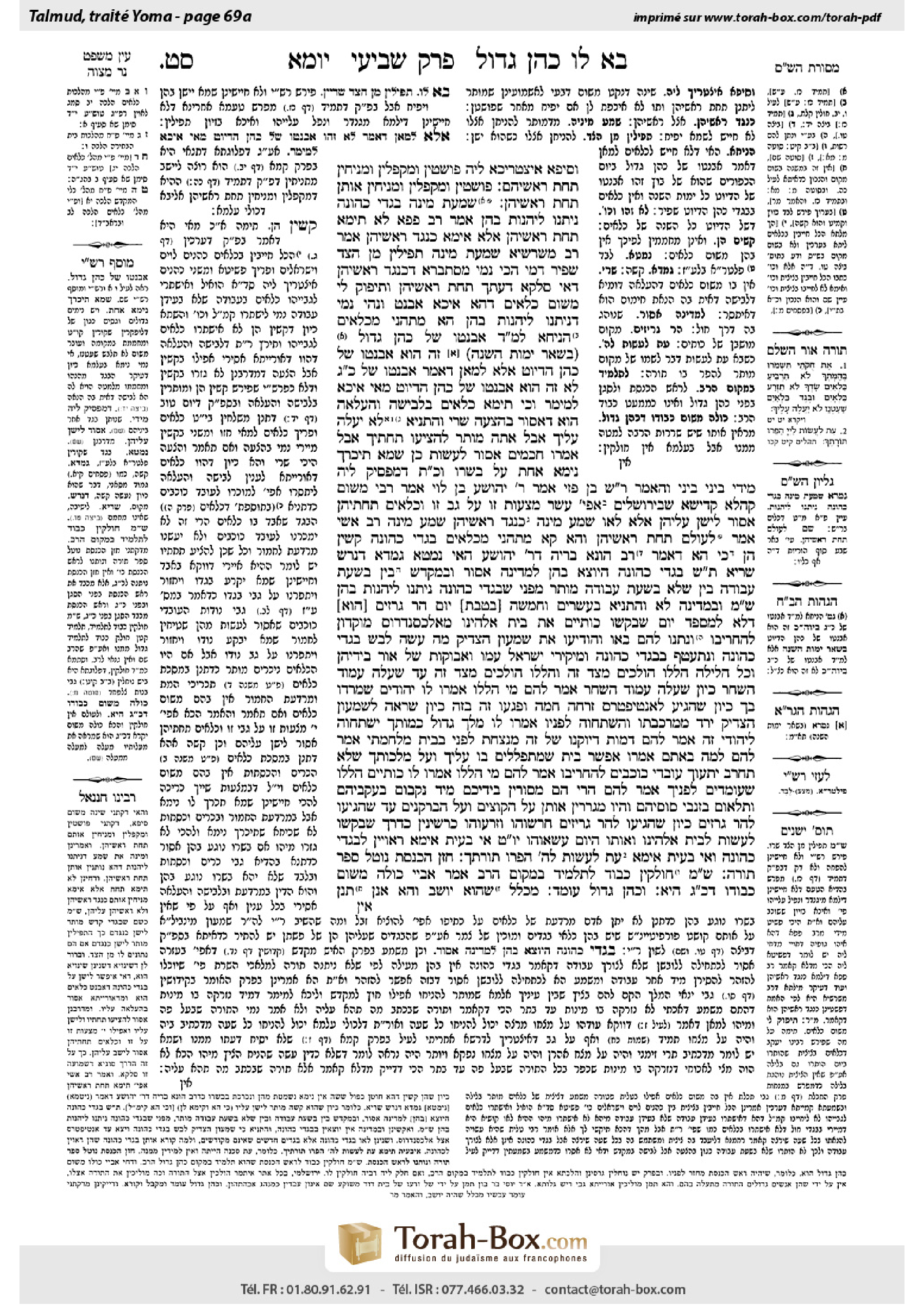
Yoma 69a: Talmud study for Daf Yomi
Daf Yomi is the daily study of one Talmud folio. Explore 37 tractates with scans, Hebrew text, Sefaria English and AI-generated French translations where annotated.
Passage selection and English or AI-generated French translation are available where the scan has annotations. Daf Study is independent of Torah-Box and Sefaria.
Browse Yoma · יומא · All tractatesYoma 69a text and translations
This page of Yoma includes the Aramaic text, an English translation and an AI-generated French translation, alongside the scan above.
יומא ס״ט א · Aramaic and Hebrew text
וְסֵיפָא אִיצְטְרִיכָא לֵיהּ: פּוֹשְׁטִין וּמְקַפְּלִין וּמַנִּיחִין תַּחַת רָאשֵׁיהֶם.
פּוֹשְׁטִין וּמְקַפְּלִין וּמַנִּיחִין אוֹתָן תַּחַת רָאשֵׁיהֶן, שָׁמְעַתְּ מִינַּהּ בִּגְדֵי כְּהוּנָּה נִיתְּנוּ לֵיהָנוֹת בָּהֶן! אָמַר רַב פָּפָּא: לָא תֵּימָא תַּחַת רָאשֵׁיהֶן, אֶלָּא אֵימָא כְּנֶגֶד רָאשֵׁיהֶן. אָמַר רַב מְשַׁרְשְׁיָא: שָׁמְעַתְּ מִינַּהּ תְּפִילִּין מִן הַצַּד שַׁפִּיר דָּמֵי.
הָכִי נָמֵי מִסְתַּבְּרָא דִּכְנֶגֶד רָאשֵׁיהֶן, דְּאִי סָלְקָא דַעְתָּךְ תַּחַת רָאשֵׁיהֶן, וְתִיפּוֹק לִי מִשּׁוּם כִּלְאַיִם — דְּהָא אִיכָּא אַבְנֵט. וּנְהִי נָמֵי דְּנִיתְּנוּ לֵיהָנוֹת בָּהֶן — הָא מִתְהֲנֵי מִכִּלְאַיִם!
הָנִיחָא לְמַאן דְּאָמַר אַבְנֵטוֹ שֶׁל כֹּהֵן גָּדוֹל זֶה הוּא אַבְנֵטוֹ שֶׁל כֹּהֵן הֶדְיוֹט. אֶלָּא לְמַאן דְּאָמַר אַבְנֵטוֹ שֶׁל כֹּהֵן גָּדוֹל לֹא זֶה הוּא אַבְנֵטוֹ שֶׁל כֹּהֵן הֶדְיוֹט, מַאי אִיכָּא לְמֵימַר!
וְכִי תֵּימָא: כִּלְאַיִם בִּלְבִישָׁה וְהַעֲלָאָה — הוּא דַּאֲסִיר, בְּהַצָּעָה שְׁרֵי, וְהָתַנְיָא: ״לֹא יַעֲלֶה עָלֶיךָ״, אֲבָל אַתָּה מוּתָּר לְהַצִּיעוֹ תַּחְתֶּיךָ. אֲבָל אָמְרוּ חֲכָמִים: אָסוּר לַעֲשׂוֹת כֵּן, שֶׁמָּא תִּיכָּרֵךְ נִימָא אַחַת עַל בְּשָׂרוֹ.
וְכִי תֵּימָא דְּמַפְסֵיק לֵיהּ מִידֵּי בֵּינֵי בֵּינֵי — וְהָאָמַר רַבִּי שִׁמְעוֹן בֶּן פַּזִּי אָמַר רַבִּי יְהוֹשֻׁעַ בֶּן לֵוִי אָמַר רַבִּי מִשּׁוּם קְהָלָא קַדִּישָׁא שֶׁבִּירוּשָׁלַיִם: אֲפִילּוּ עֶשֶׂר מַצָּעוֹת זוֹ עַל גַּב זוֹ וְכִלְאַיִם תַּחְתֵּיהֶן — אָסוּר לִישַׁן עֲלֵיהֶן. אֶלָּא לָאו שְׁמַע מִינַּהּ: כְּנֶגֶד רָאשֵׁיהֶן, שְׁמַע מִינַּהּ.
רַב אָשֵׁי אָמַר: לְעוֹלָם תַּחַת רָאשֵׁיהֶן, וְהָא קָא מִתְהֲנֵי מִכִּלְאַיִם — בִּגְדֵי כְהוּנָּה קָשִׁין הֵן. כִּי הָא דְּאָמַר רַב הוּנָא בְּרֵיהּ דְּרַבִּי יְהוֹשֻׁעַ: הַאי נַמְטָא גַּמְדָּא דְּנַרֶשׁ — שַׁרְיָא.
תָּא שְׁמַע: בִּגְדֵי כְהוּנָּה, הַיּוֹצֵא בָּהֶן לַמְּדִינָה — אָסוּר. וּבַמִּקְדָּשׁ, בֵּין בִּשְׁעַת עֲבוֹדָה בֵּין שֶׁלֹּא בִּשְׁעַת עֲבוֹדָה — מוּתָּר, מִפְּנֵי שֶׁבִּגְדֵי כְהוּנָּה נִיתְּנוּ לֵיהָנוֹת בָּהֶן. שְׁמַע מִינַּהּ.
וּבַמְּדִינָה לָא? וְהָתַנְיָא: בְּעֶשְׂרִים וַחֲמִשָּׁה [בְּטֵבֵת] יוֹם הַר גְּרִזִים [הוּא], דְּלָא לְמִסְפַּד?
יוֹם שֶׁבִּקְּשׁוּ כּוּתִיִּים אֶת בֵּית אֱלֹהֵינוּ מֵאֲלֶכְּסַנְדְּרוֹס מוֹקְדוֹן לְהַחְרִיבוֹ, וְנָתְנוּ לָהֶם. בָּאוּ וְהוֹדִיעוּ אֶת שִׁמְעוֹן הַצַּדִּיק. מֶה עָשָׂה? לָבַשׁ בִּגְדֵי כְהוּנָּה, וְנִתְעַטֵּף בְּבִגְדֵי כְהוּנָּה, וּמִיַּקִּירֵי יִשְׂרָאֵל עִמּוֹ, וַאֲבוּקוֹת שֶׁל אוֹר בִּידֵיהֶן. וְכׇל הַלַּיְלָה, הַלָּלוּ הוֹלְכִים מִצַּד זֶה, וְהַלָּלוּ הוֹלְכִים מִצַּד זֶה, עַד שֶׁעָלָה עַמּוּד הַשַּׁחַר.
כֵּיוָן שֶׁעָלָה עַמּוּד הַשַּׁחַר, אָמַר לָהֶם: מִי הַלָּלוּ? אָמְרוּ לוֹ: יְהוּדִים שֶׁמָּרְדוּ בְּךָ. כֵּיוָן שֶׁהִגִּיעַ לְאַנְטִיפַּטְרֵס זָרְחָה חַמָּה וּפָגְעוּ זֶה בָּזֶה. כֵּיוָן שֶׁרָאָה לְשִׁמְעוֹן הַצַּדִּיק, יָרַד מִמֶּרְכַּבְתּוֹ וְהִשְׁתַּחֲוָה לְפָנָיו. אָמְרוּ לוֹ: מֶלֶךְ גָּדוֹל כְּמוֹתְךָ יִשְׁתַּחֲוֶה לִיהוּדִי זֶה?! אָמַר לָהֶם: דְּמוּת דְּיוֹקְנוֹ שֶׁל זֶה מְנַצַּחַת לְפָנַי בְּבֵית מִלְחַמְתִּי.
אָמַר לָהֶם: לָמָּה בָּאתֶם? אָמְרוּ: אֶפְשָׁר בַּיִת שֶׁמִּתְפַּלְּלִים בּוֹ עָלֶיךָ וְעַל מַלְכוּתְךָ שֶׁלֹּא תֶּחְרַב, יַתְעוּךָ גּוֹיִם לְהַחְרִיבוֹ? אָמַר לָהֶם: מִי הַלָּלוּ? אָמְרוּ לוֹ: כּוּתִיִּים הַלָּלוּ, שֶׁעוֹמְדִים לְפָנֶיךָ. אָמַר לָהֶם: הֲרֵי הֵם מְסוּרִין בִּידֵיכֶם.
מִיָּד נְקָבוּם בְּעִקְבֵיהֶם וּתְלָאוּם בְּזַנְבֵי סוּסֵיהֶם, וְהָיוּ מְגָרְרִין אוֹתָן עַל הַקּוֹצִים וְעַל הַבַּרְקָנִים, עַד שֶׁהִגִּיעוּ לְהַר גְּרִיזִים. כֵּיוָן שֶׁהִגִּיעוּ לְהַר גְּרִיזִים — חֲרָשׁוּהוּ, וּזְרָעוּהוּ כַּרְשִׁינִין, כְּדֶרֶךְ שֶׁבִּקְּשׁוּ לַעֲשׂוֹת לְבֵית אֱלֹהֵינוּ. וְאוֹתוֹ הַיּוֹם עֲשָׂאוּהוּ יוֹם טוֹב.
אִי בָּעֵית אֵימָא: רְאוּיִין לְבִגְדֵי כְהוּנָּה. וְאִי בָּעֵית אֵימָא: ״עֵת לַעֲשׂוֹת לַה׳ הֵפֵרוּ תּוֹרָתֶךָ״.
חַזַּן הַכְּנֶסֶת נוֹטֵל סֵפֶר תּוֹרָה: שְׁמַע מִינַּהּ חוֹלְקִין כָּבוֹד לְתַלְמִיד בִּמְקוֹם הָרַב! אָמַר אַבָּיֵי: כּוּלָּהּ מִשּׁוּם כְּבוֹדוֹ דְּכֹהֵן גָּדוֹל הִיא.
וְכֹהֵן גָּדוֹל עוֹמֵד. מִכְּלָל שֶׁהוּא יוֹשֵׁב, וְהָא אֲנַן תְּנַן:
Yoma 69a · English translation
That mishna’s teaching highlighting the prohibition to sleep in priestly vestments is needed for the latter clause of that mishna, which states: They remove their priestly vestments and fold them and place them under their heads. Since they are allowed to sleep on them, it must be emphasized that they may not sleep while wearing them.
The Gemara considers resolving the dilemma from the latter clause: They remove their priestly vestments and fold them and place them under their heads. The Gemara suggests: Learn from this that it is permitted to derive benefit from priestly vestments. Rav Pappa said: Do not say that the mishna means they may actually place the vestments under their heads as a pillow; rather, say that the mishna permits the vestments to be placed only next to their heads. Rav Mesharshiyya said: Given this understanding of that mishna, one can learn from here that one who places phylacteries to the side of his head when he sleeps has done well; there is no concern that he will turn over in his sleep and lie upon them.
So too, it is reasonable to say that the mishna permits the vestments to be placed only next to their heads and not under their heads; as, if it could enter your mind to say that the mishna permits the vestments to be placed under their heads, and I would derive that it is prohibited due to the fact the priestly vestments contain a forbidden mixture of diverse kinds, as among them there is the belt, which is woven from a mixture of wool and linen. And even if it is assumed that it is permitted to derive benefit from priestly vestments, it would still be prohibited to lie upon them because by doing so the priests would be deriving benefit from a garment made of diverse kinds.
The Gemara elaborates on the preceding argument: If one claims that the mishna permits priests to sleep upon their vestments, it works out well according to the one who said: The belt of the High Priest worn on Yom Kippur, which does not contain diverse kinds, is the same as the belt of a common priest. According to this view, the common priest’s belt does not contain diverse kinds, and therefore it may be permitted for a priest to sleep upon it. However, according to the one who said that the High Priest’s belt on Yom Kippur is not the same as the belt of a common priest, and that the belt of the common priest is made of diverse kinds, what is there to say? How could the mishna possibly permit priests to sleep upon their vestments?
And if you say that with regard to the prohibition of diverse kinds only wearing or placing the garment upon oneself is prohibited, but spreading them out and lying upon them on is permitted, and as such it should be permitted for the priests to sleep upon their vestments, this is incorrect. As, wasn’t it taught in a baraita that the verse states: “Neither shall there come upon you a garment of diverse kinds”(Leviticus 19:19), which implies: But you are permitted to spread it beneath you to lie upon. This is true according to Torah law, but the Sages said: It is prohibited to do so, lest a fiber wrap upon his flesh, which would lead to the transgression of the Torah prohibition.
And if you say that a priest could still avoid the prohibition of diverse kinds by placing a separation between himself and the belt containing diverse kinds, didn’t Rabbi Shimon ben Pazi say that Rabbi Yehoshua ben Levi said that Rabbi Yehuda HaNasi said in the name of the holy community in Jerusalem: Even if there are ten mattresses piled one atop the other and a garment of diverse kinds is placed underneath them all, it is prohibited to sleep upon them? This is because the rabbinic decree is applied equally to all cases irrespective of whether the original concern exists. Therefore, there can be no way for the priests to sleep upon the vestments without transgressing the prohibition of diverse kinds. Rather, must one not conclude from the preceding discussion that the mishna permits the vestments to be placed only next to their heads? The Gemara concludes: Learn from it that this is indeed so.
Rav Ashi said: Actually, the mishna may be understood as permitting the vestments to be placed under their heads. One should not object that by doing so the priests would be deriving benefit from a garment made of diverse kinds because priestly vestments, and specifically the belt, are stiff, and therefore the prohibition of diverse kinds does not apply to them. This is in accordance with that which Rav Huna, son of Rabbi Yehoshua, said: This stiff felt [namta], made of diverse kinds, that is produced in the city of Neresh, is permitted, since a stiff object does not wrap around the body to provide warmth, and therefore the person wearing is not considered to have derived benefit from it.
Since the mishna’s intention is uncertain, it cannot provide a clear proof for the dilemma of whether it is permitted to derive benefit from priestly vestments. The Gemara therefore suggests another proof: Come and hear an explicit baraita concerning this issue: With regard to priestly vestments, it is prohibited to go out to the country, i.e., outside the Temple, while wearing them, but in the Temple it is permitted for the priests to wear them, whether during the Temple service or not during the service, due to the fact that it is permitted to derive benefit from priestly vestments. Learn from this that it is indeed permitted.
§ The baraita taught that the priestly vestments may not be worn outside the Temple. The Gemara challenges this: Is it really not permitted to wear priestly vestments in the country? Wasn’t it taught in another baraita, in Megillat Ta’anit: The twenty-fifth of Tevet is known as the day of Mount Gerizim, which was established as a joyful day, and therefore eulogizing is not permitted.
What occurred on that date? It was on that day that the Samaritans [kutim] requested the House of our Lord from Alexander the Macedonian in order to destroy it, and he gave it to them, i.e., he gave them permission to destroy it. People came and informed the High Priest, Shimon HaTzaddik, of what had transpired. What did he do? He donned the priestly vestments and wrapped himself in the priestly vestments. And the nobles of the Jewish People were with him, with torches of fire in their hands. And all that night, these, the representatives of the Jewish people, approached from this side, and those, the armies of Alexander and the Samaritans, approached from that side, until dawn, when they finally saw one another.
When dawn arrived, Alexander said to the Samaritans: Who are these people coming to meet us? They said to him: These are the Jews who rebelled against you. When he reached Antipatris, the sun shone and the two camps met each other. When Alexander saw Shimon HaTzaddik, he descended from his chariot and bowed before him. His escorts said to him: Should an important king such as you bow to this Jew? He said to them: I do so because the image of this man’s face is victorious before me on my battlefields, i.e., when I fight I see his image going before me as a sign of victory, and therefore I know that he has supreme sanctity.
He said to the representatives of the Jewish people: Why have you come? They said to him: Is it possible that the Temple, the house in which we pray for you and for your kingdom not to be destroyed, gentiles will try to mislead you into destroying it, and we would remain silent and not tell you? He said to them: Who are these people who want to destroy it? The Jews said to him: They are these Samaritans who stand before you. He said to them: If so, they are delivered into your hands to deal with them as you please.
Immediately, they stabbed the Samaritans in their heels and hung them from their horses’ tails and continued to drag them over the thorns and thistles until they reached Mount Gerizim. When they arrived at Mount Gerizim, where the Samaritans had their temple, they plowed it over and seeded the area with leeks, a symbol of total destruction. This was just as they had sought to do to the House of our Lord. And they made that day a festival to celebrate the salvation of the Temple and the defeat of the Samaritans.
It is apparent from the baraita that Shimon HaTzaddik wore the priestly vestments even outside the Temple. This would seem to be in contravention of the ruling of the other baraita prohibiting this. The Gemara resolves the contradiction: If you wish, say Shimon HaTzaddik did not wear a set of genuine, sanctified priestly vestments; rather, he wore garments that were fitting to be priestly vestments in that they were made of the same material and design. And if you wish, say instead that he indeed wore a set of genuine priestly vestments, but in times of great need, such as when one seeks to prevent the destruction of the Temple, it is permitted to violate the halakha, as indicated by the verse: “It is time to act for the Lord, they have nullified your Torah” (Psalms 119:126).
§ It was taught in the mishna: The synagogue attendant takes a Torah scroll and gives it to the head of the synagogue, who gives it to the deputy High Priest, who gives it to the High Priest. The Gemara suggests: Learn from here that honor may be given to a student in the presence of the teacher. Although the High Priest is considered everyone’s teacher and master, honor was nevertheless extended to other individuals without fear of impugning the High Priest’s honor. Abaye said: A proof may not be adduced from here because the entire process is for the honor of the High Priest. The passing of the Torah scroll to people of increasing importance demonstrates that the High Priest is considered the most important of all those present.
§ It was further taught in the mishna: The High Priest stands and receives the scroll from the Deputy. By inference, until that point he had been sitting. But didn’t we learn in a mishna:
Yoma 69a · Traduction française (IA)
La précision de cette Michna, qui souligne l’interdiction de dormir avec les vêtements sacerdotaux, est nécessaire pour la dernière partie de cette Michna, où il est dit : « Ils retirent leurs vêtements sacerdotaux, les plient et les placent sous leur tête. » Puisqu’ils ont le droit de dormir dessus, il faut préciser qu’ils ne peuvent pas dormir en les portant.
La Guemara envisage de résoudre le dilemme à partir de la dernière partie de la Michna : « Ils retirent leurs vêtements sacerdotaux, les plient et les placent sous leur tête. » La Guemara suggère : apprends-en qu’il est permis de tirer profit des vêtements sacerdotaux. Rav Pappa dit : ne dis pas que la Michna signifie qu’ils peuvent effectivement placer les vêtements sous leur tête, en guise d’oreiller ; dis plutôt qu’elle autorise à les placer seulement à côté de leur tête. Rav Mesharshiyya dit : selon cette interprétation de la Michna, on peut en déduire que celui qui place ses tefillin à côté de sa tête lorsqu’il dort agit bien ; il n’y a pas à craindre qu’il se retourne pendant son sommeil et s’allonge dessus.
Il est également raisonnable de dire que la Michna autorise à placer les vêtements seulement à côté de leur tête, et non sous leur tête. En effet, si l’on pouvait envisager que la Michna autorise à placer les vêtements sous leur tête, on en déduirait que cela est interdit en raison de l’interdit de chaatnez que comportent les vêtements sacerdotaux, puisque l’un d’eux est la ceinture, tissée d’un mélange de laine et de lin. Même si l’on supposait qu’il est permis de tirer profit des vêtements sacerdotaux, il resterait interdit de s’allonger dessus, car les prêtres tireraient ainsi profit d’un vêtement en chaatnez.
La Guemara développe l’argument précédent : si l’on soutient que la Michna autorise les prêtres à dormir sur leurs vêtements, cela fonctionne selon celui qui dit que la ceinture du grand prêtre portée à Yom Kippour, qui ne comporte pas de chaatnez, est identique à celle d’un prêtre ordinaire. Selon cet avis, la ceinture du prêtre ordinaire ne comporte pas de chaatnez ; il peut donc être permis à un prêtre de dormir dessus. Mais que peut-on dire selon celui qui affirme que la ceinture du grand prêtre à Yom Kippour n’est pas identique à celle d’un prêtre ordinaire, et que la ceinture du prêtre ordinaire est faite de chaatnez ? Comment la Michna pourrait-elle alors autoriser les prêtres à dormir sur leurs vêtements ?
Et si tu dis que, concernant l’interdit de chaatnez, seul le fait de porter le vêtement ou de le placer sur soi est interdit, mais qu’il est permis de l’étendre et de s’allonger dessus, de sorte que les prêtres pourraient dormir sur leurs vêtements, ce n’est pas exact. N’a-t-on pas enseigné dans une baraïta que le verset dit : « Un vêtement composé de deux sortes ne viendra pas sur toi » (Lévitique 19, 19), ce qui implique qu’il est permis de l’étendre sous soi pour s’y allonger ? Cela est vrai selon la Torah écrite ; mais les Sages ont dit qu’il est interdit d’agir ainsi, de peur qu’une fibre ne s’enroule autour de sa peau, ce qui entraînerait la transgression de l’interdit de la Torah.
Et si tu dis qu’un prêtre pourrait tout de même éviter l’interdit de chaatnez en interposant une séparation entre lui et la ceinture qui en contient, Rabbi Shimon ben Pazi n’a-t-il pas dit que Rabbi Yehoshua ben Levi a dit que Rabbi Yehuda HaNasi a dit au nom de la sainte communauté de Jérusalem : même s’il y a dix matelas empilés les uns sur les autres et qu’un vêtement de chaatnez est placé sous eux tous, il est interdit de dormir dessus ? En effet, le décret rabbinique s’applique de la même manière dans tous les cas, que la crainte initiale soit présente ou non. Il est donc impossible aux prêtres de dormir sur leurs vêtements sans transgresser l’interdit de chaatnez. Ne faut-il pas plutôt conclure de la discussion précédente que la Michna autorise à placer les vêtements seulement à côté de leur tête ? La Guemara conclut : apprends-en que c’est bien le cas.
Rav Ashi dit : en réalité, on peut comprendre que la Michna autorise à placer les vêtements sous leur tête. Il ne faut pas objecter qu’ils tireraient ainsi profit d’un vêtement en chaatnez, car les vêtements sacerdotaux, et en particulier la ceinture, sont rigides ; l’interdit de chaatnez ne s’applique donc pas à eux. Cela correspond à ce que Rav Huna, fils de Rabbi Yehoshua, a dit : ce feutre rigide [namta], fait de chaatnez et fabriqué dans la ville de Neresh, est permis, car un objet rigide ne s’enroule pas autour du corps pour lui procurer de la chaleur ; celui qui le porte n’est donc pas considéré comme en tirant profit.
Puisque l’intention de la Michna n’est pas certaine, elle ne peut fournir de preuve concluante quant au dilemme de savoir s’il est permis de tirer profit des vêtements sacerdotaux. La Guemara propose donc une autre preuve : viens et entends une baraïta explicite à ce sujet : il est interdit de sortir à la campagne, c’est-à-dire hors du Temple, en portant les vêtements sacerdotaux ; mais, dans le Temple, les prêtres peuvent les porter, qu’ils accomplissent le service ou non, car il est permis de tirer profit des vêtements sacerdotaux. Apprends-en que cela est effectivement permis.
§ La baraïta a enseigné qu’il est interdit de porter les vêtements sacerdotaux hors du Temple. La Guemara conteste : est-il vraiment interdit de porter les vêtements sacerdotaux à la campagne ? N’a-t-on pas enseigné dans une autre baraïta, dans la Meguilat Ta’anit : le vingt-cinquième jour de Tevet est appelé le jour du mont Garizim ; il fut institué comme jour de réjouissance, et il est donc interdit de prononcer une oraison funèbre.
Que s’est-il passé à cette date ? Ce jour-là, les Samaritains [kutim] demandèrent à Alexandre le Macédonien de leur remettre la Maison de notre Dieu afin de la détruire, et il la leur accorda, c’est-à-dire qu’il leur donna l’autorisation de la détruire. Des gens vinrent informer le grand prêtre Shimon HaTzaddik de ce qui s’était passé. Que fit-il ? Il revêtit les vêtements sacerdotaux et s’en enveloppa. Les notables du peuple juif étaient avec lui, tenant des torches enflammées à la main. Toute la nuit, les uns, les représentants du peuple juif, avancèrent de ce côté, et les autres, les armées d’Alexandre et des Samaritains, avancèrent de l’autre côté, jusqu’à l’aube, lorsqu’ils finirent par se voir.
À l’aube, Alexandre dit aux Samaritains : « Qui sont ces gens qui viennent à notre rencontre ? » Ils lui répondirent : « Ce sont les Juifs qui se sont rebellés contre toi. » Lorsqu’il arriva à Antipatris, le soleil brilla et les deux camps se rencontrèrent. Quand Alexandre vit Shimon HaTzaddik, il descendit de son char et se prosterna devant lui. Ses escorteurs lui dirent : « Un roi aussi important que toi doit-il se prosterner devant ce Juif ? » Il leur répondit : « Je le fais parce que l’image du visage de cet homme m’apparaît victorieuse sur mes champs de bataille ; autrement dit, lorsque je combats, je vois son image marcher devant moi comme un signe de victoire, et je sais donc qu’il possède une sainteté suprême. »
Il dit aux représentants du peuple juif : « Pourquoi êtes-vous venus ? » Ils lui répondirent : « Est-il possible que des étrangers cherchent à te tromper et à t’inciter à détruire le Temple, cette maison où nous prions pour que ni toi ni ton royaume ne soient détruits, et que nous gardions le silence sans t’en avertir ? » Il leur dit : « Qui sont ces gens qui veulent le détruire ? » Les Juifs lui répondirent : « Ce sont ces Samaritains qui se tiennent devant toi. » Il leur dit : « Dans ce cas, ils sont livrés entre vos mains ; faites d’eux ce qui vous plaît. »
Aussitôt, ils poignardèrent les Samaritains aux talons, les suspendirent à la queue de leurs chevaux et continuèrent à les traîner sur les épines et les chardons jusqu’à ce qu’ils atteignent le mont Garizim. Arrivés au mont Garizim, où les Samaritains avaient leur temple, ils le labourèrent et y semèrent des poireaux, symbole d’une destruction totale. C’est précisément ce qu’ils avaient voulu faire à la Maison de notre Dieu. Ils firent de ce jour une fête pour célébrer le salut du Temple et la défaite des Samaritains.
Il ressort de la baraïta que Shimon HaTzaddik portait les vêtements sacerdotaux même hors du Temple. Cela semble contredire la règle de l’autre baraïta qui l’interdit. La Guemara résout la contradiction : si tu le souhaites, dis que Shimon HaTzaddik ne portait pas un ensemble authentique de vêtements sacerdotaux sanctifiés ; il portait plutôt des vêtements qui pouvaient tenir lieu de vêtements sacerdotaux, puisqu’ils étaient faits du même matériau et selon le même modèle. Ou bien, si tu le souhaites, dis qu’il portait effectivement un ensemble authentique de vêtements sacerdotaux, mais qu’en cas de grand besoin, par exemple pour empêcher la destruction du Temple, il est permis d’enfreindre la halakha, comme l’indique le verset : « Il est temps d’agir pour le Seigneur : ils ont annulé ta Torah » (Psaumes 119, 126).
§ Il a été enseigné dans la Michna : l’officiant de la synagogue prend un rouleau de la Torah et le remet au chef de la synagogue, qui le remet au délégué du grand prêtre, qui le remet au grand prêtre. La Guemara suggère : apprends-en qu’on peut honorer un élève en présence de son maître. Bien que le grand prêtre soit considéré comme le maître de tous, on a néanmoins honoré d’autres personnes sans craindre de porter atteinte à l’honneur du grand prêtre. Abaye dit : on ne peut pas en tirer de preuve, car toute cette procédure vise à honorer le grand prêtre. Le passage du rouleau de la Torah à des personnes de plus en plus importantes montre que le grand prêtre est considéré comme la personne la plus importante de tous ceux qui sont présents.
§ Il a également été enseigné dans la Michna : le grand prêtre se lève et reçoit le rouleau des mains du délégué. On en déduit que jusque-là, il était assis. Mais n’avons-nous pas appris dans une Michna :
Traduction française générée par IA à partir de l’édition anglaise de Sefaria. Vérifie toujours un passage avec le texte source.
Text from Sefaria: William Davidson Edition - Vocalized Aramaic (CC BY NC); William Davidson Edition - English (CC BY NC).