Yoma 69b: Talmud study for Daf Yomi
Daf Yomi is the daily study of one Talmud folio. Explore 37 tractates with scans, Hebrew text, Sefaria English and AI-generated French translations where annotated.
Passage selection and English or AI-generated French translation are available where the scan has annotations. Daf Study is independent of Torah-Box and Sefaria.
Browse Yoma · יומא · All tractatesYoma 69b text and translations
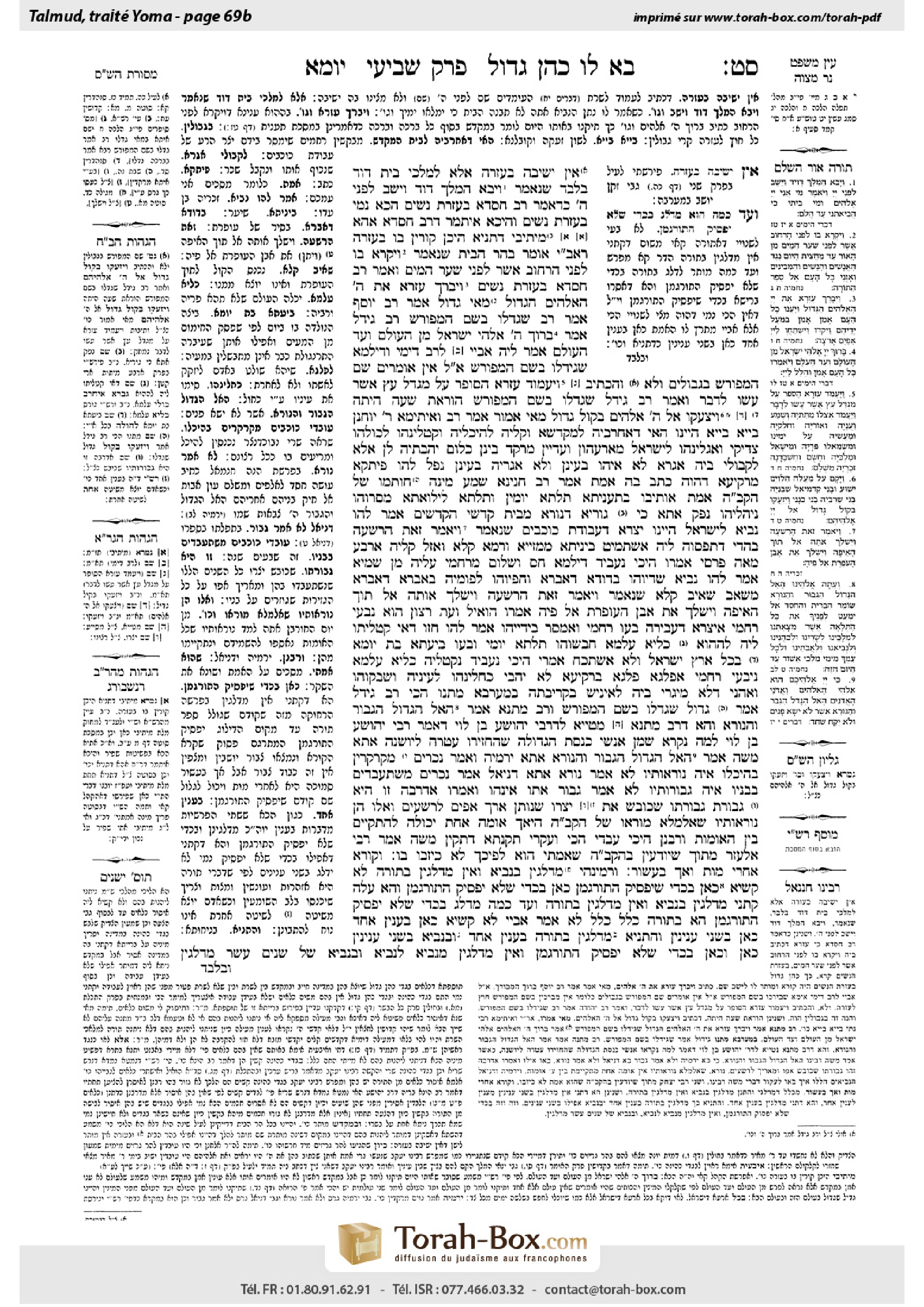
This page of Yoma includes the Aramaic text, an English translation and an AI-generated French translation, alongside the scan above.
יומא ס״ט ב · Aramaic and Hebrew text
אֵין יְשִׁיבָה בָּעֲזָרָה אֶלָּא לְמַלְכֵי בֵּית דָּוִד בִּלְבַד. שֶׁנֶּאֱמַר: ״וַיָּבֹא הַמֶּלֶךְ דָּוִד וַיֵּשֶׁב לִפְנֵי ה׳״? כִּדְאָמַר רַב חִסְדָּא — בְּעֶזְרַת נָשִׁים, הָכָא נָמֵי — בְּעֶזְרַת נָשִׁים.
וְהֵיכָא אִיתְּמַר דְּרַב חִסְדָּא? אַהָא. מֵיתִיבִי: דְּתַנְיָא, הֵיכָן קוֹרִין בּוֹ — בָּעֲזָרָה, רַבִּי אֱלִיעֶזֶר בֶּן יַעֲקֹב אוֹמֵר: בְּהַר הַבַּיִת, שֶׁנֶּאֱמַר: ״וַיִּקְרָא בוֹ לִפְנֵי הָרְחוֹב אֲשֶׁר לִפְנֵי שַׁעַר הַמַּיִם״, וְאָמַר רַב חִסְדָּא: בְּעֶזְרַת נָשִׁים.
״וַיְבָרֶךְ עֶזְרָא אֶת ה׳ הָאֱלֹהִים הַגָּדוֹל״. מַאי ״גָּדוֹל״? אָמַר רַב יוֹסֵף אָמַר רַב: שֶׁגִּדְּלוֹ בְּשֵׁם הַמְפוֹרָשׁ. רַב גִּידֵּל אָמַר: ״בָּרוּךְ ה׳ אֱלֹהֵי יִשְׂרָאֵל מִן הָעוֹלָם וְעַד הָעוֹלָם״.
אֲמַר לֵיהּ אַבָּיֵי לְרַב דִּימִי: וְדִילְמָא שֶׁגִּידְּלוֹ בְּשֵׁם הַמְפוֹרָשׁ? אֲמַר לֵיהּ: אֵין אוֹמְרִים שֵׁם הַמְפוֹרָשׁ בִּגְבוּלִים.
וְלָא? וְהָכְתִיב: ״וַיַּעֲמוֹד עֶזְרָא הַסּוֹפֵר עַל מִגְדַּל עֵץ אֲשֶׁר עָשׂוּ לַדָּבָר״. וְאָמַר רַב גִּידֵּל: שֶׁגִּדְּלוֹ בְּשֵׁם הַמְפוֹרָשׁ! הוֹרָאַת שָׁעָה הָיְתָה.
״וַיִּצְעֲקוּ אֶל ה׳ אֱלֹהִים בְּקוֹל גָּדוֹל״. מַאי אֲמוּר? אָמַר רַב, וְאִיתֵּימָא רַבִּי יוֹחָנָן: בִּיָּיא בִּיָּיא הַיְינוּ הַאי דְּאַחְרְבֵיהּ לְמַקְדְּשָׁא וְקַלְיֵהּ לְהֵיכְלֵיהּ וְקַטְלִינְהוּ לְכוּלְּהוּ צַדִּיקֵי וְאַגְלִינְהוּ לְיִשְׂרָאֵל מֵאַרְעֲהוֹן, וַעֲדַיִין מְרַקֵּד בֵּינַן. כְּלוּם יְהַבְתֵּיהּ לַן אֶלָּא לְקַבּוֹלֵי בֵּיהּ אַגְרָא? לָא אִיהוּ בָּעֵינַן, וְלָא אַגְרֵיהּ בָּעֵינַן!
נְפַל לְהוּ פִּיתְקָא מֵרְקִיעָא, דַּהֲוָה כְּתִב בֵּהּ ״אֱמֶת״.
אָמַר רַב חֲנִינָא: שְׁמַע מִינַּהּ חוֹתָמוֹ שֶׁל הַקָּדוֹשׁ בָּרוּךְ הוּא ״אֱמֶת״.
אוֹתִיבוּ בְּתַעֲנִיתָא תְּלָתָא יוֹמִין וּתְלָתָא לֵילָוָאתָא, מַסְרוּהוּ נִיהֲלַיְהוּ. נְפַק אֲתָא כִּי גוּרְיָא דְנוּרָא מִבֵּית קָדְשֵׁי הַקֳּדָשִׁים, אֲמַר לְהוּ נָבִיא לְיִשְׂרָאֵל: הַיְינוּ יִצְרָא דַעֲבוֹדָה זָרָה, שֶׁנֶּאֱמַר: ״וַיֹּאמֶר זֹאת הָרִשְׁעָה״.
בַּהֲדֵי דְּתַפְסוּהּ לֵיהּ אִשְׁתְּמִיט בִּינִיתָא מִמַּזְּיֵיא וּרְמָא קָלָא, וַאֲזַל קָלֵיהּ אַרְבַּע מְאָה פַּרְסֵי. אָמְרוּ: הֵיכִי נַעֲבֵיד? דִּילְמָא חַס וְשָׁלוֹם מְרַחֲמִי עֲלֵיהּ מִן שְׁמַיָּא. אֲמַר לְהוּ נָבִיא: שַׁדְיוּהוּ בְּדוּדָא דַאֲבָרָא, וְחַפְיוּהוּ לְפוּמֵּיהּ בַּאֲבָרָא, דַּאֲבָרָא מִשְׁאָב שָׁאֵיב קָלָא, שֶׁנֶּאֱמַר: ״וַיֹּאמֶר זֹאת הָרִשְׁעָה וַיַּשְׁלֵךְ אוֹתָהּ אֶל תּוֹךְ הָאֵיפָה וַיַּשְׁלֵךְ אֶת אֶבֶן הָעוֹפֶרֶת אֶל פִּיהָ״.
אֲמַרוּ: הוֹאִיל וְעֵת רָצוֹן הוּא, נִבְעֵי רַחֲמֵי אַיִּצְרָא דַעֲבֵירָה. בְּעוֹ רַחֲמֵי וְאִמְּסַר בִּידַיְיהוּ.
אֲמַר לְהוּ: חֲזוֹ, דְּאִי קָטְלִיתוּ לֵיהּ לְהָהוּא, כָּלֵי עָלְמָא. חַבְשׁוּהוּ תְּלָתָא יוֹמֵי, וּבָעוּ בֵּיעֲתָא בַּת יוֹמָא בְּכׇל אֶרֶץ יִשְׂרָאֵל וְלָא אִשְׁתְּכַח. אָמְרִי: הֵיכִי נַעֲבֵיד? נִקְטְלֵיהּ — כָּלֵי עָלְמָא, נִיבְעֵי רַחֲמֵי אַפַּלְגָא — פַּלְגָא בִּרְקִיעָא לָא יָהֲבִי. כַּחְלִינְהוּ לְעֵינֵיהּ וְשַׁבְקוּהוּ, וְאַהְנִי דְּלָא מִיגָּרֵי בֵּיהּ לְאִינִישׁ בְּקָרִיבְתֵּהּ.
בְּמַעְרְבָא מַתְנוּ הָכִי: רַב גִּידֵּל אָמַר: ״גָּדוֹל״ — שֶׁגִּדְּלוֹ בְּשֵׁם הַמְפוֹרָשׁ, וְרַב מַתְנָא אָמַר: ״הָאֵל הַגָּדוֹל הַגִּבּוֹר וְהַנּוֹרָא״.
וְהָא דְּרַב מַתְנָא מָטְיָיא לִדְרַבִּי יְהוֹשֻׁעַ בֶּן לֵוִי. דְּאָמַר רַבִּי יְהוֹשֻׁעַ בֶּן לֵוִי: לָמָּה נִקְרָא שְׁמָן אַנְשֵׁי כְּנֶסֶת הַגְּדוֹלָה — שֶׁהֶחְזִירוּ עֲטָרָה לְיוֹשְׁנָהּ. אֲתָא מֹשֶׁה, אָמַר: ״הָאֵל הַגָּדוֹל הַגִּבּוֹר וְהַנּוֹרָא״. אֲתָא יִרְמְיָה וַאֲמַר: גּוֹיִם מְקַרְקְרִין בְּהֵיכָלוֹ, אַיֵּה נוֹרְאוֹתָיו? לָא אֲמַר ״נוֹרָא״. אֲתָא דָּנִיאֵל אֲמַר: גּוֹיִם מִשְׁתַּעְבְּדִים בְּבָנָיו, אַיֵּה גְּבוּרוֹתָיו? לָא אֲמַר ״גִּבּוֹר״.
אֲתוֹ אִינְהוּ וְאָמְרוּ: אַדְּרַבָּה, זוֹ הִיא (גְּבוּרַת) גְּבוּרָתוֹ: שֶׁכּוֹבֵשׁ אֶת יִצְרוֹ — שֶׁנּוֹתֵן אֶרֶךְ אַפַּיִם לָרְשָׁעִים. וְאֵלּוּ הֵן נוֹרְאוֹתָיו — שֶׁאִלְמָלֵא מוֹרָאוֹ שֶׁל הַקָּדוֹשׁ בָּרוּךְ הוּא הֵיאַךְ אוּמָּה אַחַת יְכוֹלָה לְהִתְקַיֵּים בֵּין הָאוּמּוֹת?
וְרַבָּנַן: הֵיכִי עָבְדִי הָכִי וְעָקְרִי תַּקַּנְתָּא דְּתַקֵּין מֹשֶׁה? אָמַר רַבִּי אֶלְעָזָר: מִתּוֹךְ שֶׁיּוֹדְעִין בְּהַקָּדוֹשׁ בָּרוּךְ הוּא שֶׁאֲמִתִּי הוּא, לְפִיכָךְ לֹא כִּיזְּבוּ בּוֹ.
וְקוֹרֵא ״אַחֲרֵי מוֹת״ וְ״אַךְ בֶּעָשׂוֹר״. וּרְמִינְהִי: מְדַלְּגִין בַּנָּבִיא, וְאֵין מְדַלְּגִין בַּתּוֹרָה!
לָא קַשְׁיָא: כָּאן, בִּכְדֵי שֶׁיַּפְסִיק הַתּוּרְגְּמָן. כָּאן, בִּכְדֵי שֶׁלֹּא יַפְסִיק הַתּוּרְגְּמָן.
וְהָא עֲלַהּ קָתָנֵי: מְדַלְּגִין בַּנָּבִיא, וְאֵין מְדַלְּגִין בַּתּוֹרָה. וְעַד כַּמָּה מְדַלֵּג — בִּכְדֵי שֶׁלֹּא יַפְסִיק הַתּוּרְגְּמָן, הָא בַּתּוֹרָה — כְּלָל כְּלָל לָא!
אָמַר אַבָּיֵי, לָא קַשְׁיָא: כָּאן, בְּעִנְיָן אֶחָד. כָּאן, בִּשְׁנֵי עִנְיָנִין.
וְהָתַנְיָא: מְדַלְּגִין בַּתּוֹרָה בְּעִנְיָן אֶחָד, וּבַנָּבִיא בִּשְׁנֵי עִנְיָנִין. כָּאן וְכָאן בִּכְדֵי שֶׁלֹּא יַפְסִיק הַתּוּרְגְּמָן. וְאֵין מְדַלְּגִין מִנָּבִיא לְנָבִיא. וּבַנָּבִיא שֶׁל שְׁנֵים עָשָׂר מְדַלְּגִין,
Yoma 69b · English translation
Sitting in the Temple courtyard is permitted only for kings of the House of David, as it is stated: “Then King David went in and sat before the Lord” (I Chronicles 17:16)? How, then, could the High Priest have been sitting? The Gemara explains: As Rav Ḥisda said in a similar context: This took place not in the Israelite courtyard, where the prohibition against sitting applies, but in the women’s courtyard. Here, too, the reading was in the women’s courtyard, where it is permitted to sit.
§ The Gemara clarifies: And where was this statement of Rav Ḥisda originally stated? It was stated in relation to the following: The Sages raised an objection based on that which was taught in a baraita: Where did they read the Torah scroll in fulfillment of the mitzva of assembly, in which the Torah is publicly read on the Sukkot following the Sabbatical Year? It was read in the Temple courtyard. Rabbi Eliezer ben Ya’akov says: It is read on the Temple Mount, as it is stated concerning the public reading performed by Ezra: “And he read from it before the wide road that was before the Gate of the Water” (Nehemiah 8:3). And Rav Ḥisda said: The courtyard referred to by the first tanna is the women’s courtyard.
Apropos the verse in Nehemiah, the Gemara interprets an adjacent verse homiletically. It is stated: “And Ezra blessed the Lord, the great God” (Nehemiah 8:6). The Gemara asks: What is the meaning of “great” here? Rav Yosef said that Rav said: It means that he ascribed greatness to Him by enunciating God’s explicit name. Rav Giddel said: He established that one should say at the conclusion of every blessing: “Blessed be the Lord, God of Israel, from eternity to eternity” (I Chronicles 16:36).
Abaye said to Rav Dimi: Why does Rav Giddel interpret it this way? Perhaps the meaning of “great” is that he ascribed greatness to Him by enunciating God’s explicit name? Rav Dimi said to him: The explicit name may not be enunciated in the provinces, i.e., outside the Temple courtyard.
The Gemara asks: And is this really not permitted? Isn’t it written: “And Ezra the Scribe stood upon a pulpit of wood, which they had made for the purpose... and Ezra blessed the Lord, the great God” (Nehemiah 8:4-6); and Rav Giddel said: “Great” in this verse means that he ascribed greatness to Him by enunciating God’s explicit name. Since this event took place outside the Temple (see Nehemiah 8:3), it suggests that God’s explicit name may indeed be enunciated outside the Temple. The Gemara answers: That cannot be proven from here because the permission to use God’s explicit name in that context was a provisional edict issued in exigent circumstances, since the people had uniquely come together in a prayerful commitment to God.
The Gemara recounts the event described in the verses: The verse states: And they cried with a loud voice to the Lord their God (Nehemiah 9:4). What was said? Rav said, and some say it was Rabbi Yoḥanan who said: Woe, woe. It is this, i.e., the evil inclination for idol worship, that destroyed the Temple, and burned its Sanctuary, and murdered all the righteous ones, and caused the Jewish people to be exiled from their land. And it still dances among us, i.e., it still affects us. Didn’t You give it to us solely for the purpose of our receiving reward for overcoming it? We do not want it, and we do not want its reward. We are prepared to forgo the potential rewards for overcoming the evil inclination as long as it departs from us.
In response to their prayer a note fell to them from the heavens upon which was written: Truth, indicating that God accepted their request.
The Gemara makes a parenthetical observation. Rav Ḥanina said: Learn from this that the seal of the Holy One, Blessed be He, is truth.
In response to the indication of divine acceptance, they observed a fast for three days and three nights, and He delivered the evil inclination to them. A form of a fiery lion cub came forth from the chamber of the Holy of Holies. Zechariah the prophet said to the Jewish people: This is the evil inclination for idol worship, as it is stated in the verse that refers to this event: “And he said: This is the evil one” (Zechariah 5:8). The use of the word “this” indicates that the evil inclination was perceived in a physical form.
When they caught hold of it one of its hairs fell, and it let out a shriek of pain that was heard for four hundred parasangs. They said: What should we do to kill it? Perhaps, Heaven forfend, they will have mercy upon him from Heaven, since it cries out so much. The prophet said to them: Throw it into a container made of lead and seal the opening with lead, since lead absorbs sound. As it is stated: “And he said: This is the evil one. And he cast it down into the midst of the measure, and he cast a stone of lead upon its opening” (Zechariah 5:8). They followed this advice and were freed of the evil inclination for idol worship.
When they saw that the evil inclination for idol worship was delivered into their hands as they requested, the Sages said: Since it is an auspicious time, let us pray also concerning the evil inclination for sin in the area of sexual relationships. They prayed, and it was also delivered into their hands.
Zechariah the prophet said to them: See and understand that if you kill this evil inclination the world will be destroyed because as a result there will also no longer be any desire to procreate. They followed his warning, and instead of killing the evil inclination they imprisoned it for three days. At that time, people searched for a fresh egg throughout all of Eretz Yisrael and could not find one. Since the inclination to reproduce was quashed, the chickens stopped laying eggs. They said: What should we do? If we kill it, the world will be destroyed. If we pray for half, i.e., that only half its power be annulled, nothing will be achieved because Heaven does not grant half gifts, only whole gifts. What did they do? They gouged out its eyes, effectively limiting its power, and set it free. And this was effective to the extent that a person is no longer aroused to commit incest with his close relatives.
The Gemara returns to its discussion of the verse in Nehemiah cited above: In the West, i.e., Eretz Yisrael, they taught the debate concerning the verse “the Lord, the great God” as follows: Rav Giddel said: “Great” means that he ascribed greatness to Him by enunciating God’s explicit name. And Rav Mattana said: They reinserted the following appellations of God into their prayers: “The great, the mighty, and the awesome God” (Nehemiah 9:32).
The Gemara comments: This interpretation that Rav Mattana said leans to, i.e., is consonant with, the exposition of Rabbi Yehoshua ben Levi. As Rabbi Yehoshua ben Levi said: Why are the Sages of those generations called the members of the Great Assembly? It is because they returned the crown of the Holy One, Blessed be He, to its former glory. How so? Moses came and said in his prayer: “The great, the mighty, and the awesomeGod” (Deuteronomy 10:17). Jeremiah the prophet came and said: Gentiles, i.e., the minions of Nebuchadnezzar, are carousing in His sanctuary; where is His awesomeness? Therefore, he did not say awesome in his prayer: “The great God, the mighty Lord of Hosts, is His name” (Jeremiah 32:18). Daniel came and said: Gentiles are enslaving His children; where is His might? Therefore he did not say mighty in his prayer: “The great and awesome God” (Daniel 9:4).
The members of the Great Assembly came and said: On the contrary, this is the might of His might, i.e., this is the fullest expression of it, that He conquers His inclination in that He exercises patience toward the wicked. God’s anger is flared by the gentile nations’ enslavement of His people, yet He expresses tremendous might by suppressing His anger and holding back from punishing them immediately. Therefore, it is still appropriate to refer to God as mighty. And these acts also express His awesomeness: Were it not for the awesomeness of the Holy One, Blessed be He, how could one people, i.e., the Jewish people, who are alone and hated by the gentile nations, survive among the nations?
The Gemara asks: And the Rabbis, i.e., Jeremiah and Daniel, how could they do this and uproot an ordinance instituted by Moses, the greatest teacher, who instituted the mention of these attributes in prayer? Rabbi Elazar said: They did so because they knew of the Holy One Blessed be He, that He is truthful and hates a lie. Consequently, they did not speak falsely about Him. Since they did not perceive His attributes of might and awesomeness, they did not refer to them; therefore, they cannot be criticized for doing so.
§ It was taught in the mishna: And he reads from the scroll the Torah portion beginning with the verse: “After the death” (Leviticus 16:1), and the portion beginning with the verse: “But on the tenth” (Leviticus 23:26). Although both of these portions appear in the book of Leviticus, they are not adjacent to one another. Perforce, the High Priest skipped the sections in between the two portions. The Gemara raises a contradiction: It is taught in a mishna in tractate Megilla: One may skip sections when reading the haftara in the Prophets, but one may not skip sections when reading in the Torah.
The Gemara answers: This is not difficult: There, in the mishna in tractate Megilla that teaches that one may not skip, the intention is that one should not skip if the sections are so far apart from one another that the delay caused by doing so will be of such length that the translator who recites the Aramaic translation will conclude his translation before the next section is reached. In that case, the community would have to remain in silence while waiting for the next section to be reached, which is considered disrespectful of the community’s honor. Here, in the case of the mishna, where it is permitted to skip, the delay caused is of such short length that the translator will still not conclude his translation before the new section is reached.
The Gemara challenges this resolution: But it was taught concerning this statement in the continuation of that mishna: One may skip sections when reading in the Prophets, and one may not skip sections when reading in the Torah. And how much may one skip? One may skip when the section skipped is of such short length that when the furling of the scroll is completed the translator will still not have concluded his translation. The baraita implies that the qualification for the length of the section that may be skipped applies only to reading the Prophets, but when reading the Torah, one may not skip at all. The Gemara’s resolution is therefore refuted.
The Gemara offers a different resolution. Abaye said: This is not difficult. Here, in the case of the mishna here, where it is permitted to skip, it is referring to when both sections pertain to a single topic, and therefore the listeners will be unaware that sections were skipped. There, in the mishna in tractate Megilla, which teaches that one may not skip, it is referring to when the two sections pertain to two different topics.
As it was taught in a baraita: One may skip sections when reading in the Torah when both sections read pertain to one topic, and in the Prophets one may skip from one section to another even if they pertain to two different topics. Both here and there, one may skip only when the section skipped is of such short length that when furling is completed the translator will still not have concluded his translation. But one may not skip from one book of the Prophets to another book of the Prophets even if both pertain to the same topic, and even if the gap between them is short. However, among the books of the Twelve Prophets one may skip, as the twelve are considered one book for these purposes.
Yoma 69b · Traduction française (IA)
Il n’est permis de s’asseoir dans la cour du Temple qu’aux rois de la maison de David, comme il est dit : « Le roi David entra et s’assit devant le Seigneur » (I Chroniques 17:16). Comment le Grand Prêtre pouvait-il donc être assis ? La Guemara explique : comme l’a dit Rav Ḥisda dans un contexte similaire, cela se passait non pas dans la cour des Israélites, où il est interdit de s’asseoir, mais dans la cour des femmes. Ici aussi, la lecture avait lieu dans la cour des femmes, où il est permis de s’asseoir.
§ La Guemara précise : Où cette déclaration de Rav Ḥisda a-t-elle été énoncée à l’origine ? Elle l’a été à propos de ce qui suit. Les Sages soulevèrent une objection fondée sur ce qui a été enseigné dans une baraïta : Où lisait-on le rouleau de la Torah pour accomplir la mitsva du rassemblement, lors duquel la Torah est lue publiquement à Souccot, après l’année sabbatique ? On le lisait dans la cour du Temple. Rabbi Eliezer ben Ya’akov dit : On le lit sur le mont du Temple, comme il est dit au sujet de la lecture publique faite par Ezra : « Il en fit la lecture devant la grande place qui était devant la porte de l’Eau » (Néhémie 8:3). Et Rav Ḥisda dit : La cour mentionnée par le premier tanna est la cour des femmes.
À propos du verset de Néhémie, la Guemara interprète par homélie un verset voisin. Il est dit : « Ezra bénit le Seigneur, le grand Dieu » (Néhémie 8:6). La Guemara demande : Que signifie ici « grand » ? Rav Yosef dit au nom de Rav : Cela signifie qu’il lui attribua la grandeur en prononçant le Nom explicite de Dieu. Rav Giddel dit : Il institua que l’on dise à la fin de chaque bénédiction : « Béni soit le Seigneur, Dieu d’Israël, d’éternité en éternité » (I Chroniques 16:36).
Abaye dit à Rav Dimi : Pourquoi Rav Giddel interprète-t-il ainsi ? Peut-être que « grand » signifie qu’il lui attribua la grandeur en prononçant le Nom explicite de Dieu ? Rav Dimi lui dit : Le Nom explicite ne peut être prononcé dans les provinces, c’est-à-dire hors de la cour du Temple.
La Guemara demande : Est-il vraiment interdit de le faire ? N’est-il pas écrit : « Ezra le scribe se tenait sur une estrade de bois qu’ils avaient faite à cet effet […] et Ezra bénit le Seigneur, le grand Dieu » (Néhémie 8:4-6) ? Et Rav Giddel a dit que « grand », dans ce verset, signifie qu’il lui attribua la grandeur en prononçant le Nom explicite de Dieu. Puisque cet événement eut lieu hors du Temple (voir Néhémie 8:3), cela laisse entendre que le Nom explicite de Dieu peut bel et bien être prononcé hors du Temple. La Guemara répond : On ne peut pas le prouver à partir de là, car l’autorisation d’utiliser le Nom explicite de Dieu dans ce contexte était un décret provisoire pris dans une situation d’urgence, puisque le peuple s’était exceptionnellement rassemblé dans un engagement de prière envers Dieu.
La Guemara relate l’événement décrit dans les versets. Le verset dit : « Ils crièrent d’une voix forte vers le Seigneur, leur Dieu » (Néhémie 9:4). Que dirent-ils ? Rav dit — et certains disent que c’est Rabbi Yoḥanan qui le dit : « Malheur, malheur ! C’est cela, c’est-à-dire le mauvais penchant pour l’idolâtrie, qui a détruit le Temple, brûlé son sanctuaire, tué tous les justes et exilé le peuple juif de son pays. Et il danse encore parmi nous », c’est-à-dire qu’il continue à nous affecter. Ne nous l’as-tu pas donné uniquement afin que nous recevions une récompense en le surmontant ? Nous n’en voulons pas, et nous ne voulons pas de sa récompense. Nous sommes prêts à renoncer aux récompenses éventuelles liées au fait de surmonter le mauvais penchant, pourvu qu’il s’éloigne de nous.
En réponse à leur prière, une note tomba du ciel, sur laquelle était écrit : « Vérité », indiquant que Dieu avait accepté leur demande.
La Guemara fait une remarque incidente. Rav Ḥanina dit : Apprends de là que le sceau du Saint, béni soit-Il, est la vérité.
En réponse au signe d’acceptation divine, ils jeûnèrent pendant trois jours et trois nuits, et Il leur livra le mauvais penchant. Une sorte de lionceau de feu sortit de la chambre du Saint des Saints. Le prophète Zacharie dit au peuple juif : « C’est le mauvais penchant pour l’idolâtrie », comme le dit le verset qui se rapporte à cet événement : « Il dit : “C’est la méchanceté” » (Zacharie 5:8). L’emploi du mot « ceci » indique que le mauvais penchant était perçu sous une forme physique.
Quand ils s’en saisirent, un de ses poils tomba et il poussa un cri de douleur qui fut entendu à quatre cents parasanges. Ils dirent : Que devons-nous faire pour le tuer ? Peut-être, à Dieu ne plaise, aura-t-on pitié de lui au ciel, puisqu’il crie si fort. Le prophète leur dit : Jetez-le dans un récipient de plomb et scellez-en l’ouverture avec du plomb, car le plomb absorbe le son. Comme il est dit : « Il dit : “C’est la méchanceté.” Il le jeta au milieu de l’épha, puis jeta une masse de plomb sur son ouverture » (Zacharie 5:8). Ils suivirent ce conseil et furent débarrassés du mauvais penchant pour l’idolâtrie.
Quand ils virent que le mauvais penchant pour l’idolâtrie leur avait été livré, comme ils l’avaient demandé, les Sages dirent : Puisque le moment est favorable, prions aussi au sujet du mauvais penchant qui pousse au péché dans le domaine des relations sexuelles. Ils prièrent, et celui-ci leur fut également livré.
Le prophète Zacharie leur dit : Voyez et comprenez que si vous tuez ce mauvais penchant, le monde sera détruit, car il n’y aura alors plus non plus de désir de procréer. Ils tinrent compte de son avertissement et, au lieu de tuer le mauvais penchant, ils l’emprisonnèrent pendant trois jours. À cette époque, on chercha un œuf frais dans tout Eretz Yisrael sans pouvoir en trouver un seul. Comme le désir de procréer avait été étouffé, les poules cessèrent de pondre. Ils dirent : Que devons-nous faire ? Si nous le tuons, le monde sera détruit. Si nous prions pour que seule la moitié de sa puissance soit annulée, cela ne servira à rien, car le Ciel n’accorde pas de dons partiels, mais seulement des dons entiers. Que firent-ils ? Ils lui crevèrent les yeux, limitant ainsi sa puissance, puis le relâchèrent. Cela eut pour effet qu’une personne ne soit plus incitée à commettre l’inceste avec ses proches parents.
La Guemara revient à la discussion du verset de Néhémie cité plus haut. En Occident, c’est-à-dire en Eretz Yisrael, on enseignait le débat concernant le verset « le Seigneur, le grand Dieu » de la manière suivante : Rav Giddel dit que « grand » signifie qu’il lui attribua la grandeur en prononçant le Nom explicite de Dieu. Et Rav Mattana dit : Ils réintroduisirent dans leurs prières les épithètes suivantes de Dieu : « le grand, le puissant et le redoutable Dieu » (Néhémie 9:32).
La Guemara fait remarquer que l’interprétation de Rav Mattana concorde avec l’enseignement de Rabbi Yehoshua ben Levi. En effet, Rabbi Yehoshua ben Levi dit : Pourquoi les Sages de ces générations sont-ils appelés les membres de la Grande Assemblée ? Parce qu’ils rendirent à la couronne du Saint, béni soit-Il, son éclat d’antan. Comment cela ? Moïse vint et dit dans sa prière : « le grand, le puissant et le redoutable Dieu » (Deutéronome 10:17). Le prophète Jérémie vint et dit : Les nations, c’est-à-dire les sbires de Nabuchodonosor, festoient dans Son sanctuaire ; où est Sa puissance redoutable ? C’est pourquoi il ne dit pas « redoutable » dans sa prière : « Le grand Dieu, le Seigneur des armées puissantes, est Son nom » (Jérémie 32:18). Daniel vint et dit : Les nations asservissent Ses enfants ; où est Sa puissance ? C’est pourquoi il ne dit pas « puissant » dans sa prière : « le grand et redoutable Dieu » (Daniel 9:4).
Les membres de la Grande Assemblée vinrent et dirent : Au contraire, c’est là la pleine expression de Sa puissance : Il maîtrise Son inclination, en faisant preuve de patience envers les méchants. La colère de Dieu s’enflamme parce que les nations non juives asservissent Son peuple ; pourtant, Il manifeste une puissance immense en réprimant Sa colère et en s’abstenant de les punir immédiatement. Il convient donc toujours de qualifier Dieu de puissant. Ces actes expriment aussi Sa puissance redoutable : sans la puissance redoutable du Saint, béni soit-Il, comment un peuple, c’est-à-dire le peuple juif, seul et haï des nations non juives, pourrait-il survivre parmi les nations ?
La Guemara demande : Et les Sages, c’est-à-dire Jérémie et Daniel, comment pouvaient-ils agir ainsi et abolir une ordonnance instituée par Moïse, le plus grand des maîtres, qui avait institué la mention de ces attributs dans la prière ? Rabbi Elazar dit : Ils agirent ainsi parce qu’ils savaient que le Saint, béni soit-Il, est véridique et déteste le mensonge. Par conséquent, ils ne dirent rien de faux à Son sujet. Puisqu’ils ne percevaient pas en Lui les attributs de puissance et de caractère redoutable, ils ne les mentionnèrent pas ; on ne peut donc pas leur reprocher de l’avoir fait.
§ Il a été enseigné dans la Michna : Il lit dans le rouleau le passage de la Torah qui commence par les mots : « Après la mort » (Lévitique 16:1), puis celui qui commence par les mots : « Le dixième jour » (Lévitique 23:26). Bien que ces deux passages figurent dans le Lévitique, ils ne sont pas consécutifs. Le Grand Prêtre a donc nécessairement sauté les sections qui se trouvaient entre eux. La Guemara soulève une contradiction : une Michna du traité Meguila enseigne qu’il est permis de sauter des passages lors de la lecture de la haftara dans les Prophètes, mais qu’il est interdit de sauter des passages lors de la lecture de la Torah.
La Guemara répond : Il n’y a pas de difficulté. Là, dans la Michna du traité Meguila qui enseigne qu’il est interdit de sauter, il s’agit de passages si éloignés l’un de l’autre que le temps nécessaire pour les atteindre serait tel que le traducteur, qui récite la traduction araméenne, aurait terminé sa traduction avant qu’on arrive au passage suivant. Dans ce cas, la communauté devrait rester silencieuse en attendant qu’on atteigne le passage suivant, ce qui est considéré comme un manque de respect envers elle. Ici, dans le cas de la Michna où il est permis de sauter, le délai est assez court pour que le traducteur n’ait pas encore terminé sa traduction lorsqu’on arrive au nouveau passage.
La Guemara conteste cette résolution : Mais la suite de cette Michna enseigne à propos de cette règle : Il est permis de sauter des passages lors de la lecture des Prophètes, mais il est interdit de sauter des passages lors de la lecture de la Torah. Et jusqu’où peut-on sauter ? On peut sauter lorsque le passage omis est si court que, le rouleau ayant fini d’être enroulé, le traducteur n’a pas encore achevé sa traduction. La baraïta implique que la limite relative à la longueur du passage que l’on peut sauter ne s’applique qu’à la lecture des Prophètes ; mais lors de la lecture de la Torah, on ne peut pas sauter du tout. La résolution de la Guemara est donc réfutée.
La Guemara propose une autre résolution. Abaye dit : Il n’y a pas de difficulté. Ici, dans le cas de la Michna dont nous parlons, où il est permis de sauter, il s’agit de deux passages qui portent sur un même sujet ; les auditeurs ne se rendront donc pas compte que des sections ont été sautées. Là, dans la Michna du traité Meguila qui enseigne qu’il est interdit de sauter, il s’agit de deux passages qui portent sur des sujets différents.
Comme il a été enseigné dans une baraïta : Il est permis de sauter des passages lors de la lecture de la Torah lorsque les deux passages lus portent sur un même sujet ; et, dans les Prophètes, il est permis de passer d’un passage à un autre même s’ils portent sur des sujets différents. Dans les deux cas, on ne peut sauter que lorsque le passage omis est si court que, le rouleau ayant fini d’être enroulé, le traducteur n’a pas encore achevé sa traduction. Mais il est interdit de passer d’un livre des Prophètes à un autre, même si les deux portent sur le même sujet et même si l’intervalle entre eux est court. Toutefois, on peut passer d’un livre à un autre parmi les livres des Douze Prophètes, car, à cet égard, les douze sont considérés comme un seul livre.
Traduction française générée par IA à partir de l’édition anglaise de Sefaria. Vérifie toujours un passage avec le texte source.
Text from Sefaria: William Davidson Edition - Vocalized Aramaic (CC BY NC); William Davidson Edition - English (CC BY NC).