Yoma 70a: Talmud study for Daf Yomi
Daf Yomi is the daily study of one Talmud folio. Explore 37 tractates with scans, Hebrew text, Sefaria English and AI-generated French translations where annotated.
Passage selection and English or AI-generated French translation are available where the scan has annotations. Daf Study is independent of Torah-Box and Sefaria.
Browse Yoma · יומא · All tractatesYoma 70a text and translations
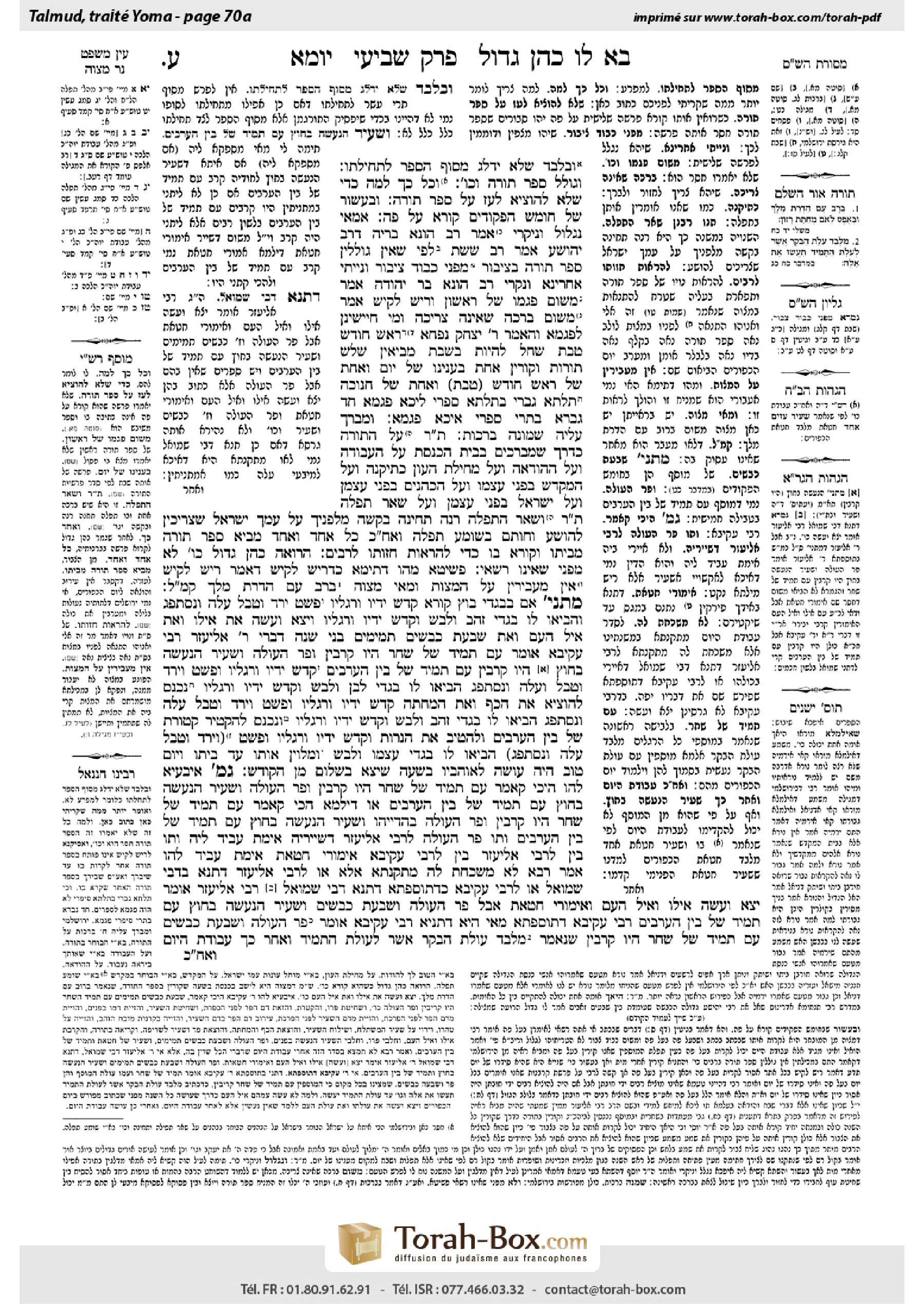
This page of Yoma includes the Aramaic text, an English translation and an AI-generated French translation, alongside the scan above.
יומא ע׳ א · Aramaic and Hebrew text
וּבִלְבַד שֶׁלֹּא יְדַלֵּג מִסּוֹף הַסֵּפֶר לִתְחִילָּתוֹ.
וְגוֹלֵל סֵפֶר תּוֹרָה וְכוּ׳. וְכׇל כָּךְ לָמָּה — כְּדֵי שֶׁלֹּא לְהוֹצִיא לַעַז עַל סֵפֶר תּוֹרָה.
״וּבֶעָשׂוֹר״ שֶׁל חוֹמֶשׁ הַפְּקוּדִים קוֹרֵא עַל פֶּה. אַמַּאי? נִגְלוֹל וְנִיקְרֵי! אָמַר רַב הוּנָא בְּרֵיהּ דְּרַב יְהוֹשֻׁעַ אָמַר רַב שֵׁשֶׁת: לְפִי שֶׁאֵין גּוֹלְלִין סֵפֶר תּוֹרָה בְּצִיבּוּר, מִפְּנֵי כְּבוֹד צִיבּוּר.
וְנַיְיתֵי אַחֲרִינָא וְנִקְרֵי! רַב הוּנָא בַּר יְהוּדָה אָמַר: מִשּׁוּם פְּגָמוֹ שֶׁל רִאשׁוֹן. וְרֵישׁ לָקִישׁ אָמַר: מִשּׁוּם בְּרָכָה שֶׁאֵינָהּ צְרִיכָה.
וּמִי חָיְישִׁינַן לִפְגָמָא? וְהָאָמַר רַבִּי יִצְחָק נַפָּחָא: רֹאשׁ חוֹדֶשׁ טֵבֵת שֶׁחָל לִהְיוֹת בְּשַׁבָּת מְבִיאִין שָׁלֹשׁ תּוֹרוֹת וְקוֹרִין אַחַת בְּעִנְיָנוֹ שֶׁל יוֹם, וְאַחַת שֶׁל רֹאשׁ חוֹדֶשׁ, וְאַחַת שֶׁל חֲנוּכָּה.
תְּלָתָא גַּבְרֵי בִּתְלָתָא סִפְרֵי — לֵיכָּא פְּגָמָא, חַד גַּבְרָא בִּתְרֵי סִפְרֵי — אִיכָּא פְּגָמָא.
וּמְבָרֵךְ עָלֶיהָ שְׁמוֹנֶה בְּרָכוֹת. תָּנוּ רַבָּנַן: עַל הַתּוֹרָה — כְּדֶרֶךְ שֶׁמְּבָרְכִים בְּבֵית הַכְּנֶסֶת, עַל הָעֲבוֹדָה, וְעַל הַהוֹדָאָה, וְעַל מְחִילַת הֶעָוֹן כְּתִיקְנָהּ. וְעַל הַמִּקְדָּשׁ בִּפְנֵי עַצְמוֹ, וְעַל הַכֹּהֲנִים בִּפְנֵי עַצְמָן, וְעַל יִשְׂרָאֵל בִּפְנֵי עַצְמָן, וְעַל שְׁאָר תְּפִלָּה.
תָּנוּ רַבָּנַן: וּשְׁאָר הַתְּפִלָּה ״רִנָּה תְּחִינָּה בַּקָּשָׁה מִלְּפָנֶיךָ עַל עַמְּךָ יִשְׂרָאֵל שֶׁצְּרִיכִין לְהִוָּשַׁע״ וְחוֹתֵם בְּשׁוֹמֵעַ תְּפִלָּה. וְאַחַר כָּךְ, כׇּל אֶחָד וְאֶחָד מֵבִיא סֵפֶר תּוֹרָה מִבֵּיתוֹ, וְקוֹרֵא בּוֹ כְּדֵי לְהַרְאוֹת חָזוּתוֹ לְרַבִּים.
הָרוֹאֶה כֹּהֵן גָּדוֹל כּוּ׳ לֹא מִפְּנֵי שֶׁאֵינוֹ רַשַּׁאי. פְּשִׁיטָא? מַהוּ דְּתֵימָא כִּדְרֵישׁ לָקִישׁ. דְּאָמַר רֵישׁ לָקִישׁ: אֵין מַעֲבִירִין עַל הַמִּצְוֹת.
וּמַאי מִצְוָה — ״בְּרׇב עָם הַדְרַת מֶלֶךְ״, קָא מַשְׁמַע לַן.
מַתְנִי׳ אִם בְּבִגְדֵי בוּץ קוֹרֵא, קִדֵּשׁ יָדָיו וְרַגְלָיו. פָּשַׁט, יָרַד וְטָבַל, עָלָה וְנִסְתַּפַּג, וְהֵבִיאוּ לוֹ בִּגְדֵי זָהָב וְלָבַשׁ, וְקִדֵּשׁ יָדָיו וְרַגְלָיו,
וְיָצָא וְעָשָׂה אֶת אֵילוֹ וְאֶת אֵיל הָעָם וְאֶת שִׁבְעַת כְּבָשִׂים תְּמִימִים בְּנֵי שָׁנָה, דִּבְרֵי רַבִּי אֱלִיעֶזֶר. רַבִּי עֲקִיבָא אוֹמֵר: עִם תָּמִיד שֶׁל שַׁחַר הָיוּ קְרֵבִין. וּפַר הָעוֹלָה וְשָׂעִיר הַנַּעֲשֶׂה בַּחוּץ — הָיוּ קְרֵבִין עִם תָּמִיד שֶׁל בֵּין הָעַרְבַּיִם.
קִדֵּשׁ יָדָיו וְרַגְלָיו וּפָשַׁט, וְיָרַד וְטָבַל וְעָלָה וְנִסְתַּפָּג.
הֵבִיאוּ לוֹ בִּגְדֵי לָבָן וְלָבַשׁ, וְקִדֵּשׁ יָדָיו וְרַגְלָיו. נִכְנַס לְהוֹצִיא אֶת הַכַּף וְאֶת הַמַּחְתָּה. קִדֵּשׁ יָדָיו וְרַגְלָיו וּפָשַׁט, וְיָרַד וְטָבַל עָלָה וְנִסְתַּפָּג.
הֵבִיאוּ לוֹ בִּגְדֵי זָהָב וְלָבַשׁ, וְקִדֵּשׁ יָדָיו וְרַגְלָיו, וְנִכְנַס לְהַקְטִיר קְטוֹרֶת שֶׁל בֵּין הָעַרְבָּיִם, וּלְהֵטִיב אֶת הַנֵּרוֹת, וְקִדֵּשׁ יָדָיו וְרַגְלָיו וּפָשַׁט, וְיָרַד וְטָבַל עָלָה וְנִסְתַּפָּג.
הֵבִיאוּ לוֹ בִּגְדֵי עַצְמוֹ וְלָבַשׁ, וּמְלַוִּין אוֹתוֹ עַד בֵּיתוֹ. וְיוֹם טוֹב הָיָה עוֹשֶׂה לְאוֹהֲבָיו בְּשָׁעָה שֶׁיָּצָא בְּשָׁלוֹם מִן הַקּוֹדֶשׁ.
גְּמָ׳ אִיבַּעְיָא לְהוּ: הֵיכִי קָאָמַר, עִם תָּמִיד שֶׁל שַׁחַר הָיוּ קְרֵבִין, וּפַר הָעוֹלָה וְשָׂעִיר הַנַּעֲשֶׂה בַּחוּץ עִם תָּמִיד שֶׁל בֵּין הָעַרְבַּיִם,
אוֹ דִילְמָא הָכִי קָאָמַר: עִם תָּמִיד שֶׁל שַׁחַר הָיוּ קְרֵבִין, וּפַר הָעוֹלָה בַּהֲדַיְיהוּ, וְשָׂעִיר הַנַּעֲשֶׂה בַּחוּץ עִם תָּמִיד שֶׁל בֵּין הָעַרְבַּיִם.
וְתוּ: פַּר הָעוֹלָה לְרַבִּי אֱלִיעֶזֶר דְּשַׁיְּירֵיהּ, אֵימַת עָבֵיד לֵיהּ?
וְתוּ: בֵּין לְרַבִּי אֱלִיעֶזֶר בֵּין לְרַבִּי עֲקִיבָא, אֵימוּרֵי חַטָּאת אֵימַת עָבֵיד לְהוּ?
אָמַר רָבָא: לָא מַשְׁכַּחַתְּ לַהּ מְתַקַּנְתָּא, אֶלָּא אוֹ לְרַבִּי אֱלִיעֶזֶר דְּתָנָא בִּדְבֵי שְׁמוּאֵל, אוֹ לְרַבִּי עֲקִיבָא כִּדְתוֹסֶפְתָּא.
דְּתָנָא דְּבֵי שְׁמוּאֵל: רַבִּי אֱלִיעֶזֶר אוֹמֵר: יָצָא וְעָשָׂה אֵילוֹ וְאֵיל הָעָם וְאֵימוּרֵי חַטָּאת, אֲבָל פַּר הָעוֹלָה וְשִׁבְעַת כְּבָשִׂים וְשָׂעִיר הַנַּעֲשֶׂה בַּחוּץ — עִם תָּמִיד שֶׁל בֵּין הָעַרְבַּיִם.
רַבִּי עֲקִיבָא דְּתוֹסֶפְתָּא מַאי הִיא? דְּתַנְיָא, רַבִּי עֲקִיבָא אוֹמֵר: פַּר הָעוֹלָה וְשִׁבְעַת כְּבָשִׁים עִם תָּמִיד שֶׁל שַׁחַר הָיוּ קְרֵבִין, שֶׁנֶּאֱמַר: ״מִלְּבַד עוֹלַת הַבֹּקֶר אֲשֶׁר לְעוֹלַת הַתָּמִיד״, וְאַחַר כָּךְ עֲבוֹדַת הַיּוֹם.
Yoma 70a · English translation
All this is provided that he does not skip from the end of the book to its beginning, since then it would be clear to everyone that he is skipping text.
§ It was taught in the mishna: The High Priest furls the Torah scroll and places it on his bosom and says: More than what I have read before you is written here. The Gemara comments: And why must he say all this? It is so as not to cast aspersions on the Torah scroll, because people might think that the portion he read by heart is not written there.
§ It was further taught in the mishna: The Torah portion beginning with the verse: “And on the tenth,” from the book of Numbers (29:7), he reads by heart. The Gemara asks: Why does he read it by heart? Let him furl the scroll to that portion and read it from the text. Rav Huna, son of Rav Yehoshua, said that Rav Sheshet said: It is because one may not furl a Torah scroll in public, out of respect for the community. It is inappropriate to make the community wait until they have reached the next section.
But why not let another Torah scroll be brought that has previously been furled to that portion and read from it? Rav Huna bar Yehuda said: People might mistakenly think the second scroll was brought due to a flaw that was found in the first one. And Reish Lakish said a different reason: A second scroll should not be brought due to the fact that doing do will cause an unnecessary blessing to be recited; before reading from a new scroll the High Priest would have to repeat the blessings required upon reading from the Torah. Therefore, it is preferable that he read by heart.
The Gemara questions Rav Huna bar Yehuda’s answer: Are we really concerned that people will think the first scroll had a flaw? Didn’t Rabbi Yitzḥak Nappaḥa say: When the New Moon of Tevet, which always occurs during Hanukkah, occurs on Shabbat, one brings and reads from three Torah scrolls. One reads from one scroll the topic of the day, i.e., the weekly portion; and from one scroll the portion of the New Moon; and from one scroll a passage related to Hanukkah. It is apparent from the statement of Rabbi Yitzḥak Nappaḥa that many Torah scrolls may be used, and there is no concern that people will mistakenly think one or more had a flaw.
The Gemara explains: When three men read from three scrolls there is no concern that people will think there was a flaw, since people assume that it is befitting for each individual to receive his own scroll. But when one man reads from two scrolls, there is a concern that people will think there is a flaw, and they will not realize that this was done only to avoid forcing the community to wait while the scroll was furled.
§ It was taught in the mishna: And the High Priest recites eight blessings after the reading. The Sages taught in a baraita that these are the eight blessings:
The blessing concerning the Torah is recited in the usual way one recites a blessing in the synagogue: Who gives the Torah;
The three blessings: concerning the Temple service, concerning thanksgiving, and concerning pardon of iniquity, are all recited according to their established forms in the prayers;
The blessing concerning the Temple in and of itself;
The blessing concerning the priests in and of themselves;
The blessing concerning the Jewish people in and of itself;
The blessing concerning the rest of the prayer.
The Sages taught in another baraita: And the blessing concerning the rest of the prayer reads: Song, supplication, petition before You for Your people Israel, who need to be saved. And he adds an additional supplication and concludes the blessing with: The One Who hears prayer. And after the High Priest concludes his reading, each and every person present brings a Torah scroll from his house, although in fact each person had already brought one on Yom Kippur eve, and reads from it for himself in order to show its beautiful appearance to the community. This is considered beautification of the mitzva.
§ It was taught in the mishna: One who sees the High Priest reading the Torah does not see the bull and goat that are burned, and vice versa. This is not because one is not permitted to see both but because there is a distance between them and they are performed simultaneously. The Gemara comments: It is obvious that this is not due to a prohibition; what possible reason could there be to prohibit this? The Gemara answers: This was taught explicitly lest you say that it is prohibited in accordance with the statement of Reish Lakish, as Reish Lakish said: One does not pass over the opportunity to perform mitzvot, even if it is in order to perform a different mitzva.
The Gemara clarifies why this principle might have applied here. And what mitzva is there in hearing the reading of the High Priest? It is a fulfillment of the principle expressed in the verse: “The king’s glory is in the multitude of people” (Proverbs 14:28). Having a large assembly involved in a mitzva gives honor to God. Therefore, the mishna teaches us that the problem with seeing both events was only a practical one.
MISHNA: If the High Priest read the Torah in sacred white fine linen garments, he then sanctified his hands and feet as he did each time before removing the priestly vestments. He then removed the linen garments, descended to the ritual bath, and immersed. Afterward he ascended and dried himself with a towel, and they brought him the golden garments of the High Priesthood, and he dressed in them and sanctified his hands and feet.
The mishna addresses those offerings whose sacrifice has still not been mentioned. The verses in Leviticus, chapter 16, detail the special offerings of the atonement service of Yom Kippur. Of those offerings, the ram of the High Priest and the ram of the people have still not been addressed. In addition to this, the additional offerings of Yom Kippur detailed in Numbers, chapter 29, have not yet been discussed. These include seven one-year-old lambs and a bull to be brought as a burnt-offering and a goat to be brought as a sin-offering. The mishna continues: He emerged and offered his ram and the ram of the people and the seven unblemished year-old lambs mandated to be offered that day. This is the statement of Rabbi Eliezer. Rabbi Akiva says: Those offerings were not sacrificed at this point; rather, they were sacrificed with the daily morning offering; and the bull of the Yom Kippur burnt-offering; and the goat whose services are performed outside of the Sanctuary, i.e., in the Temple courtyard, were sacrificed with the daily afternoon offering.
After sacrificing these offerings, he sanctified his hands and feet and removed the golden garments, and he descended into the ritual bath and immersed and ascended and dried himself.
They brought him the white garments again, and he dressed in them and sanctified his hands and feet. Afterward he entered the Holy of Holies to take out the incense spoon and the coal pan, which he had brought there earlier. He again sanctified his hands and feet and removed the white garments and descended to the ritual bath and immersed and ascended and dried himself with a towel.
They brought him the golden garments, and he dressed in them and sanctified his hands and feet and entered the Sanctuary to burn the afternoon incense and to remove the ashes from the lamps, which signified the end of the day’s service. And he sanctified his hands and feet and removed the golden garments, and he descended to the ritual bath and immersed and ascended and dried himself.
They then brought him his own clothing and he dressed, since the service was complete and Yom Kippur was over; and the people escort him to his house in deference to him. And the High Priest would make a feast for his loved ones and his friends when he emerged in peace from the Sanctuary.
GEMARA: It was taught in the mishna: Rabbi Akiva said the seven lambs were sacrificed with the daily morning offering; and the bull of the Yom Kippur burnt-offering; and the goat whose services are performed outside of the Sanctuary, i.e., in the Temple courtyard, with the daily afternoon offering. It is unclear whether the middle clause concerning the bull should be read as a continuation of the first clause, or as relating to the latter clause. The Gemara seeks to clarify this ambiguity. A dilemma was raised before the Sages: What is Rabbi Akiva saying? Does he mean to say the seven lambs were sacrificed with the daily morning offering, whereas the bull of the Yom Kippur burnt-offering and the goat whose services are performed outside were sacrificed with the daily afternoon offering?
Or perhaps this is what he is saying: The seven lambs were sacrificed with the daily morning offering and the bull of the Yom Kippur burnt-offering together with them, whereas the goat whose services are performed outside, i.e., in the Temple courtyard, was sacrificed with the daily afternoon offering.
And furthermore, another dilemma: With regard to the bull of the Yom Kippur burnt-offering, according to Rabbi Eliezer’s opinion: Since he omitted mention of it, it must be clarified when the High Priest performs its sacrifice. Is it sacrificed at this point in the day, or at another time?
And furthermore, another dilemma: According to both Rabbi Eliezer’s opinion and according to Rabbi Akiva’s opinion, since neither of them mentioned the portions of the sin-offering to be consumed on the altar, it must be clarified when the High Priest performs their service and places them on the altar.
Rava said: You will only find it properly explained either according to the opinion of Rabbi Eliezer as taught by the school of Shmuel, or according to the opinion of Rabbi Akiva as taught in the Tosefta.
The school of Shmuel taught that Rabbi Eliezer says: He came out and offered his ram and the ram of the people and the portions of the sin-offering to be consumed on the altar. But the bull of the Yom Kippur burnt-offering and the seven lambs and the goat whose services are performed outside were sacrificed with the daily afternoon offering.
What is Rabbi Akiva’s opinion as taught in the Tosefta? As it was taught that Rabbi Akiva says: The bull of the Yom Kippur burnt-offering and the seven lambs were sacrificed with the daily morning offering, as it is stated with regard to the additional offerings of other Festivals: “Besides the morning burnt-offering which is the daily burnt-offering you shall sacrifice these” (Numbers 28:23), indicating that the additional offerings of the day should be sacrificed together with the daily offering. And afterward the service of the day, which is unique to Yom Kippur, is performed.
Yoma 70a · Traduction française (IA)
Tout cela à condition qu’il ne saute pas de la fin du livre à son début, car tout le monde verrait alors clairement qu’il saute un passage.
§ Il a été enseigné dans la Michna : Le grand prêtre enroule le rouleau de la Torah, le pose sur sa poitrine et dit : « Plus que ce que j’ai lu devant vous est écrit ici. » La Guemara fait remarquer : Pourquoi doit-il dire tout cela ? C’est pour ne pas jeter le discrédit sur le rouleau de la Torah, car les gens pourraient penser que le passage qu’il a lu de mémoire n’y est pas écrit.
§ Il a également été enseigné dans la Michna : Il lit de mémoire le passage de la Torah qui commence par le verset « Le dixième jour » (Nombres 29,7). La Guemara demande : Pourquoi le lit-il de mémoire ? Qu’il déroule le rouleau jusqu’à ce passage et le lise dans le texte ! Rav Houna, fils de Rav Yehoshoua, rapporte au nom de Rav Chéchet : C’est parce qu’on ne doit pas dérouler un rouleau de la Torah en public, par égard pour l’assemblée. Il ne convient pas de faire attendre l’assemblée pendant qu’on déroule le rouleau jusqu’à la section suivante.
Mais pourquoi ne pas faire apporter un autre rouleau de la Torah, déjà déroulé jusqu’à ce passage, et y lire ? Rav Houna bar Yehouda dit : Les gens pourraient croire à tort que le second rouleau a été apporté parce qu’on a découvert un défaut dans le premier. Rech Lakich donne une autre raison : Il ne faut pas apporter un second rouleau, car cela entraînerait la récitation inutile d’une bénédiction ; avant de lire dans un nouveau rouleau, le grand prêtre devrait répéter les bénédictions requises pour la lecture de la Torah. Il est donc préférable qu’il lise de mémoire.
La Guemara met en doute la réponse de Rav Houna bar Yehouda : Craignons-nous vraiment que les gens pensent que le premier rouleau avait un défaut ? Rabbi Yitsḥak Nappaḥa n’a-t-il pas dit : Lorsque Roch Ḥodech tévet, qui tombe toujours pendant Ḥanoucca, tombe un Chabbat, on apporte trois rouleaux de la Torah et on y lit. Dans l’un, on lit le sujet du jour, c’est-à-dire la paracha hebdomadaire ; dans un autre, le passage de Roch Ḥodech ; et dans le troisième, un passage relatif à Ḥanoucca. La déclaration de Rabbi Yitsḥak Nappaḥa montre qu’on peut utiliser plusieurs rouleaux de la Torah sans craindre que les gens pensent à tort que l’un d’eux, ou plusieurs, avaient un défaut.
La Guemara explique : Lorsque trois hommes lisent dans trois rouleaux, on ne craint pas que les gens pensent qu’il y avait un défaut, car ils supposent qu’il convient que chacun ait son propre rouleau. Mais lorsqu’un seul homme lit dans deux rouleaux, on craint que les gens pensent qu’il y a un défaut et ne comprennent pas que cela a été fait uniquement pour éviter de faire attendre l’assemblée pendant qu’on déroule le rouleau.
§ Il a été enseigné dans la Michna : Le grand prêtre récite huit bénédictions après la lecture. Les Sages ont enseigné dans une baraïta que voici ces huit bénédictions : La bénédiction concernant la Torah est récitée selon la formule habituelle à la synagogue : « Celui qui donne la Torah » ; Les trois bénédictions concernant le service du Temple, l’action de grâce et le pardon des iniquités sont toutes récitées selon leur formulation habituelle dans les prières ; La bénédiction concernant le Temple lui-même ; La bénédiction concernant les prêtres eux-mêmes ; La bénédiction concernant le peuple juif lui-même ; La bénédiction concernant le reste de la prière.
Les Sages ont enseigné dans une autre baraïta : La bénédiction concernant le reste de la prière est ainsi formulée : « Chant, supplication et requête devant Toi pour Ton peuple Israël, qui a besoin d’être sauvé. » Il ajoute une supplication supplémentaire et conclut la bénédiction par ces mots : « Celui qui entend la prière. » Après que le grand prêtre a terminé sa lecture, chacune des personnes présentes apporte un rouleau de la Torah de chez elle, bien qu’en réalité chacun en ait déjà apporté un la veille de Yom Kippour, et y lit pour soi-même afin d’en montrer la belle apparence à l’assemblée. Cela constitue un embellissement de la mitsva.
§ Il a été enseigné dans la Michna : Celui qui voit le grand prêtre lire la Torah ne voit pas le taureau et le bouc qui sont brûlés, et inversement. Ce n’est pas parce qu’il est interdit de voir les deux, mais parce qu’ils se trouvent à distance l’un de l’autre et que les cérémonies ont lieu simultanément. La Guemara fait remarquer : Il est évident que cela ne tient pas à une interdiction ; quelle raison pourrait-il y avoir d’interdire cela ? La Guemara répond : Cela a été enseigné explicitement de peur que tu dises que c’est interdit conformément à l’enseignement de Rech Lakich. En effet, Rech Lakich a dit : On ne laisse pas passer une occasion d’accomplir des mitsvot, même si c’est pour accomplir une autre mitsva.
La Guemara précise pourquoi ce principe aurait pu s’appliquer ici. En quoi consiste la mitsva d’écouter la lecture du grand prêtre ? Elle consiste à mettre en œuvre le principe exprimé dans le verset : « La gloire du roi réside dans la multitude du peuple » (Proverbes 14,28). Une grande assemblée prenant part à une mitsva rend honneur à Dieu. La Michna nous enseigne donc que l’impossibilité de voir les deux événements était uniquement d’ordre pratique.
MICHNA : Si le grand prêtre a lu la Torah vêtu des vêtements sacrés de lin blanc, il sanctifie ensuite ses mains et ses pieds, comme il le faisait chaque fois avant de retirer ses vêtements sacerdotaux. Il retire alors les vêtements de lin, descend au bain rituel et s’immerge. Puis il remonte et se sèche avec une serviette. On lui apporte les vêtements d’or de la grande prêtrise ; il les revêt et sanctifie ses mains et ses pieds.
La Michna traite des sacrifices dont l’offrande n’a pas encore été mentionnée. Les versets de Lévitique, chapitre 16, détaillent les sacrifices particuliers du service expiatoire de Yom Kippour. Parmi eux, le bélier du grand prêtre et le bélier du peuple n’ont pas encore été abordés. En outre, les sacrifices supplémentaires de Yom Kippour, détaillés dans Nombres, chapitre 29, n’ont pas encore été discutés. Ils comprennent sept agneaux âgés d’un an et un taureau à offrir en holocauste, ainsi qu’un bouc à offrir en sacrifice expiatoire. La Michna poursuit : Il sort et offre son bélier, le bélier du peuple et les sept agneaux d’un an sans défaut dont l’offrande est prescrite pour ce jour. Telle est la déclaration de Rabbi Eliezer. Rabbi Akiva dit : Ces sacrifices ne sont pas offerts à ce moment-là ; ils sont offerts avec l’holocauste quotidien du matin. Quant au taureau de l’holocauste de Yom Kippour et au bouc dont le service est accompli à l’extérieur du Sanctuaire, c’est-à-dire dans la cour du Temple, ils sont offerts avec l’holocauste quotidien de l’après-midi.
Après avoir offert ces sacrifices, il sanctifie ses mains et ses pieds, retire les vêtements d’or, descend au bain rituel, s’immerge, remonte et se sèche.
On lui apporte de nouveau les vêtements blancs ; il les revêt et sanctifie ses mains et ses pieds. Ensuite, il entre dans le Saint des Saints pour en retirer la cuillère à encens et le brasier qu’il y avait apportés auparavant. Il sanctifie de nouveau ses mains et ses pieds, retire les vêtements blancs, descend au bain rituel, s’immerge, remonte et se sèche avec une serviette.
On lui apporte les vêtements d’or ; il les revêt, sanctifie ses mains et ses pieds, puis entre dans le Sanctuaire pour brûler l’encens de l’après-midi et retirer les cendres des lampes, ce qui marque la fin du service de la journée. Il sanctifie ensuite ses mains et ses pieds, retire les vêtements d’or, descend au bain rituel, s’immerge, remonte et se sèche.
On lui apporte alors ses vêtements personnels et il les revêt, car le service est achevé et Yom Kippour est terminé ; le peuple le raccompagne chez lui par égard pour lui. Le grand prêtre organisait un festin pour ses proches et ses amis lorsqu’il sortait sain et sauf du Sanctuaire.
GUEMARA : Il a été enseigné dans la Michna que Rabbi Akiva a dit que les sept agneaux sont offerts avec l’holocauste quotidien du matin, et que le taureau de l’holocauste de Yom Kippour ainsi que le bouc dont le service est accompli à l’extérieur du Sanctuaire, c’est-à-dire dans la cour du Temple, sont offerts avec l’holocauste quotidien de l’après-midi. On ne sait pas si la proposition intermédiaire concernant le taureau se rattache à la première proposition ou à la dernière. La Guemara cherche à clarifier cette ambiguïté. Une question fut posée aux Sages : Que veut dire Rabbi Akiva ? Veut-il dire que les sept agneaux sont offerts avec l’holocauste quotidien du matin, tandis que le taureau de l’holocauste de Yom Kippour et le bouc dont le service est accompli à l’extérieur sont offerts avec l’holocauste quotidien de l’après-midi ?
Ou peut-être veut-il dire ceci : Les sept agneaux sont offerts avec l’holocauste quotidien du matin, et le taureau de l’holocauste de Yom Kippour l’est également avec eux, tandis que le bouc dont le service est accompli à l’extérieur, c’est-à-dire dans la cour du Temple, est offert avec l’holocauste quotidien de l’après-midi.
Et une autre question se pose : concernant le taureau de l’holocauste de Yom Kippour, selon l’opinion de Rabbi Eliezer, puisqu’il a omis de le mentionner, il faut préciser à quel moment le grand prêtre en accomplit le sacrifice. Est-il offert à ce moment de la journée ou à un autre moment ?
Et une autre question se pose : selon l’opinion de Rabbi Eliezer comme selon celle de Rabbi Akiva, puisque ni l’un ni l’autre n’ont mentionné les parties du sacrifice expiatoire qui doivent être brûlées sur l’autel, il faut préciser à quel moment le grand prêtre en accomplit le service et les place sur l’autel.
Rava dit : On ne peut trouver une explication satisfaisante qu’en suivant soit l’opinion de Rabbi Eliezer telle qu’elle est enseignée par l’école de Chmouel, soit l’opinion de Rabbi Akiva telle qu’elle est enseignée dans la Tossefta.
L’école de Chmouel enseigne que Rabbi Eliezer dit : Il sort et offre son bélier, le bélier du peuple et les parties du sacrifice expiatoire qui doivent être brûlées sur l’autel. En revanche, le taureau de l’holocauste de Yom Kippour, les sept agneaux et le bouc dont le service est accompli à l’extérieur sont offerts avec l’holocauste quotidien de l’après-midi.
Quelle est l’opinion de Rabbi Akiva telle qu’elle est enseignée dans la Tossefta ? Il a été enseigné que Rabbi Akiva dit : Le taureau de l’holocauste de Yom Kippour et les sept agneaux sont offerts avec l’holocauste quotidien du matin, comme il est écrit au sujet des sacrifices supplémentaires des autres fêtes : « En plus de l’holocauste du matin, qui est l’holocauste quotidien, vous offrirez ceux-ci » (Nombres 28,23), ce qui indique que les sacrifices supplémentaires du jour doivent être offerts avec l’offrande quotidienne. Ensuite, on accomplit le service du jour, propre à Yom Kippour.
Traduction française générée par IA à partir de l’édition anglaise de Sefaria. Vérifie toujours un passage avec le texte source.
Text from Sefaria: William Davidson Edition - Vocalized Aramaic (CC BY NC); William Davidson Edition - English (CC BY NC).