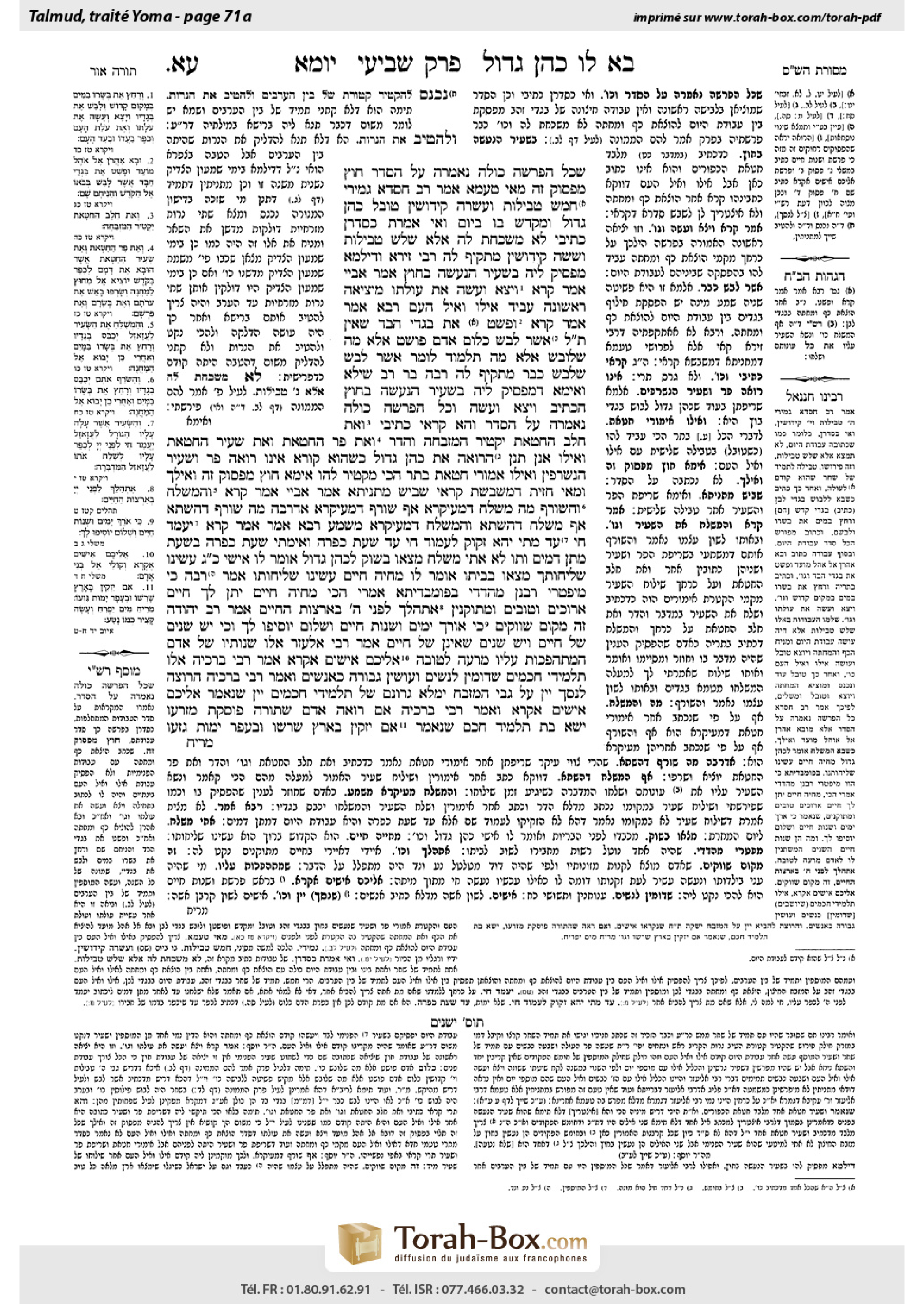
Yoma 71a: Talmud study for Daf Yomi
Daf Yomi is the daily study of one Talmud folio. Explore 37 tractates with scans, Hebrew text, Sefaria English and AI-generated French translations where annotated.
Passage selection and English or AI-generated French translation are available where the scan has annotations. Daf Study is independent of Torah-Box and Sefaria.
Browse Yoma · יומא · All tractatesYoma 71a text and translations
This page of Yoma includes the Aramaic text, an English translation and an AI-generated French translation, alongside the scan above.
יומא ע״א א · Aramaic and Hebrew text
שֶׁכׇּל הַפָּרָשָׁה כּוּלָּהּ נֶאֶמְרָה עַל הַסֵּדֶר, חוּץ מִפָּסוּק זֶה.
מַאי טַעְמָא? אָמַר רַב חִסְדָּא: גְּמִירִי, חָמֵשׁ טְבִילוֹת וַעֲשָׂרָה קִידּוּשִׁין טוֹבֵל כֹּהֵן גָּדוֹל וּמְקַדֵּשׁ בּוֹ בַּיּוֹם,
וְאִי אָמְרַתְּ כְּסִדְרָן כְּתִיבִי, לָא מַשְׁכַּחַתְּ לַהּ אֶלָּא שָׁלֹשׁ טְבִילוֹת וְשִׁשָּׁה קִידּוּשִׁין.
מַתְקֵיף לַהּ רַבִּי זֵירָא: וְדִילְמָא מַפְסֵיק לֵיהּ בְּשָׂעִיר הַנַּעֲשֶׂה בַּחוּץ!
אָמַר אַבָּיֵי, אָמַר קְרָא: ״וְיָצָא וְעָשָׂה אֶת עוֹלָתוֹ״, מִיצִיאָה רִאשׁוֹנָה עָבֵיד אֵילוֹ וְאֵיל הָעָם.
רָבָא אָמַר, אָמַר קְרָא: ״וּפָשַׁט אֶת בִּגְדֵי הַבָּד״, שֶׁאֵין תַּלְמוּד לוֹמַר ״אֲשֶׁר לָבַשׁ״, כְּלוּם אָדָם פּוֹשֵׁט אֶלָּא מַה שֶּׁלּוֹבֵשׁ?! אֶלָּא מָה תַּלְמוּד לוֹמַר ״אֲשֶׁר לָבַשׁ״ — שֶׁלָּבַשׁ כְּבָר.
מַתְקֵיף לַהּ רַבָּה בַּר רַב שֵׁילָא: וְאֵימָא דְּמַפְסֵיק לֵיהּ בְּשָׂעִיר הַנַּעֲשֶׂה בַּחוּץ! הָכְתִיב: ״וְיָצָא וְעָשָׂה״.
וְכׇל הַפָּרָשָׁה כּוּלָּהּ נֶאֶמְרָה עַל הַסֵּדֶר? וְהָא קְרָאֵי כְּתִיבִי: ״וְאֵת חֵלֶב הַחַטָּאת יַקְטִיר הַמִּזְבֵּחָה״, וַהֲדַר: ״וְאֵת פַּר הַחַטָּאת וְאֵת שְׂעִיר הַחַטָּאת״, וְאִילּוּ אֲנַן תְּנַן: הָרוֹאֶה אֶת כֹּהֵן גָּדוֹל כְּשֶׁהוּא קוֹרֵא — אֵינוֹ רוֹאֶה פַּר וְשָׂעִיר הַנִּשְׂרָפִין. וְאִילּוּ אֵמוּרֵי חַטָּאת בָּתַר הָכִי מַקְטֵיר לְהוּ!
אֵימָא: חוּץ מִפָּסוּק זֶה וְאֵילָךְ.
וּמַאי חָזֵית דִּמְשַׁבְּשַׁתְּ קְרָאֵי, שַׁבֵּישׁ מַתְנִיתָא!
אָמַר אַבָּיֵי, אָמַר קְרָא: ״וְהַמְשַׁלֵּחַ ... וְהַשּׂוֹרֵף״. מָה מְשַׁלֵּחַ דְּמֵעִיקָּרָא — אַף שׂוֹרֵף דְּמֵעִיקָּרָא.
אַדְּרַבָּה: מָה שׂוֹרֵף דְּהַשְׁתָּא — אַף מְשַׁלֵּחַ דְּהַשְׁתָּא!
״וְהַמְשַׁלֵּחַ״, דְּמֵעִיקָּרָא מַשְׁמַע. רָבָא אָמַר, אָמַר קְרָא: ״יׇעֳמַד חַי״, עַד מָתַי יְהֵא זָקוּק לַעֲמוֹד חַי? עַד שְׁעַת כַּפָּרָה. וְאֵימָתַי שְׁעַת כַּפָּרָה? בִּשְׁעַת מַתַּן דָּמִים, וְתוּ לָא.
אָתֵי מְשַׁלֵּחַ, מְצָאוֹ בַּשּׁוּק לְכֹהֵן גָּדוֹל, אוֹמֵר לוֹ: אִישִׁי כֹּהֵן גָּדוֹל! עָשִׂינוּ שְׁלִיחוּתְךָ. מְצָאוֹ בְּבֵיתוֹ, אוֹמֵר לוֹ: מְחַיֵּה חַיִּים, עָשִׂינוּ שְׁלִיחוּתוֹ.
אָמַר רַבָּה: כִּי מִיפַּטְרִי רַבָּנַן מֵהֲדָדֵי בְּפוּמְבְּדִיתָא אָמְרִי הָכִי: ״מְחַיֵּה חַיִּים יִתֵּן לְךָ חַיִּים אֲרוּכִּים וְטוֹבִים וּמְתוּקָּנִין״.
״אֶתְהַלֵּךְ לִפְנֵי ה׳ בְּאַרְצוֹת הַחַיִּים״, אָמַר רַב יְהוּדָה: זֶה מָקוֹם שְׁוָוקִים.
״כִּי אוֹרֶךְ יָמִים וּשְׁנוֹת חַיִּים וְשָׁלוֹם יוֹסִיפוּ לָךְ״, וְכִי יֵשׁ שָׁנִים שֶׁל חַיִּים וְיֵשׁ שָׁנִים שֶׁאֵינָן שֶׁל חַיִּים? אָמַר רַבִּי אֶלְעָזָר: אֵלּוּ שְׁנוֹתָיו שֶׁל אָדָם הַמִּתְהַפְּכוֹת עָלָיו מֵרָעָה לְטוֹבָה.
״אֲלֵיכֶם אִישִׁים אֶקְרָא״, אָמַר רַבִּי בֶּרֶכְיָה: אֵלּוּ תַּלְמִידֵי חֲכָמִים, שֶׁדּוֹמִין לְנָשִׁים וְעוֹשִׂין גְּבוּרָה כַּאֲנָשִׁים. וְאָמַר רַבִּי בֶּרֶכְיָה: הָרוֹצֶה לְנַסֵּךְ יַיִן עַל גַּבֵּי הַמִּזְבֵּחַ — יְמַלֵּא גְּרוֹנָם שֶׁל תַּלְמִידֵי חֲכָמִים יַיִן, שֶׁנֶּאֱמַר: ״אֲלֵיכֶם אִישִׁים אֶקְרָא״.
וְאָמַר רַבִּי בֶּרֶכְיָה: אִם רוֹאֶה אָדָם שֶׁתּוֹרָה פּוֹסֶקֶת מִזַּרְעוֹ — יִשָּׂא בַּת תַּלְמִיד חָכָם, שֶׁנֶּאֱמַר: ״אִם יַזְקִין בָּאָרֶץ שׇׁרְשׁוֹ וּבֶעָפָר יָמוּת גִּזְעוֹ
Yoma 71a · English translation
as the whole portion of the service of the day detailed in Leviticus is written in this order, and the service must be performed in that order, except for this verse, which is stated out of order and is performed only later. The verse detailing his reentry (Leviticus 16:23) is written before the verse detailing the sacrifice of the rams (Leviticus 16:24), but in fact the reentry occurs only after the sacrifice of the rams.
The Gemara asks: What is the reason to assume this verse is written out of order? Rav Ḥisda said: They learned as a tradition that the High Priest performs five immersions and ten sanctifications of his hands and feet when he changes clothing on that day. Each time the High Priest changes between the white and golden garments, he sanctifies his hands and feet, immerses, dresses in the new set of garments and then once again sanctifies his hands and feet.
And if you say that the verses, including this one, are written in order, you find only three immersions and six sanctifications. Read in order, the verses indicate only three changes of garments, which involve three immersions and six sanctifications. In order to arrive at the requisite numbers of five immersions and ten sanctifications one must assume that the High Priest’s reentry into the Holy of Holies takes place at a later time, after he has already changed into the golden garments. This would require him to change into the white garments and then back into the golden garments, providing an additional two immersions and four sanctifications.
Rabbi Zeira strongly objects to this: But perhaps the order of the verses in Leviticus can be maintained, and the requisite number of immersions and sanctifications still achieved, if he interrupts the service performed in the white garments with the goat whose services are performed outside of the Sanctuary, i.e., in the Temple courtyard, and are performed in the golden garments. The sacrifice of the goat is not mentioned in Leviticus but only in Numbers. Therefore, it could be inserted into the service of the day without compromising the order of the verses in Leviticus. The change into the golden garments and then back into the white garments would contribute an additional two immersions and four sanctifications, thus arriving at the requisite numbers.
Abaye said: It is clear that the verse detailing the reentry must be out of order, since the verse states: “And he shall exit and make his burnt-offering and the burnt-offering of the people” (Leviticus 16:24). This is the first exit stated in the verses and implies that immediately following his first exit from the Holy of Holies, he performs the sacrifice of his ram and the ram of the people without any other interruption. If so, the reentry must occur only afterward.
Rava said a different proof. The verse states: “And Aaron shall come into the Tent of Meeting and he shall remove the linen garments which he wore when he went into the Sanctuary” (Leviticus 16:23). Now, the verse does not need to state “which he wore,” as this is obvious; can one remove anything other than what he is wearing? Rather, what is the meaning when the verse states “which he wore”? It is referring to those garments which he had already worn previously, removed, and then worn again. It is therefore apparent that this verse occurs at a point when he had already changed out of the white garments and into the golden garments. Perforce, then, it must be out of order.
Rabba bar Rav Sheila strongly objects to this: Say that the order of the verses can be maintained, and the requisite number of immersions and sanctifications achieved, if he interrupts the services performed in the white garments with the goat whose services are performed outside and are performed in the golden garments. This would provide the additional two immersions and four sanctifications required. The Gemara answers: Isn’t it written: “And he shall exit and make his burnt-offering and the burnt-offering of the people” (Leviticus 16:24), which implies that immediately following his first exit he performs the sacrifice of his ram and the ram of the people and the reentry to the Holy of Holies occurs only later.
The Gemara questions the premise of the baraita: Is the entire passage really written in order? But among the verses it is written: “And he shall burn the fat of the sin-offering upon the altar”(Leviticus 16:25), and then in a later verse it is written: “And the bull of the sin-offering, and the goat of the sin-offering, whose blood was brought to make atonement in the Sanctuary, shall be carried outside the camp; and they shall burn...” (Leviticus 16:27). Yet we learned in the mishna: One who sees the High Priest reading the Torah does not see the bull and goat that are burned, which are referred to in verse 27, while according to all opinions concerning the order of the day, the portions of the sin-offering to be consumed on the altar, which are mentioned in verse 25, are burned only afterward. Therefore, it is apparent that these verses are also not in order.
The Gemara answers: Say that the intent of the baraita is that the verses are in order except for this verse and onward.
The Gemara asks: And what did you see that you preferred to rearrange the order of the verses? Instead, rearrange the order in the mishna.
Abaye said: It is clear that the verse detailing the burning of the remains of the bull is out of order, since the verse states: “And the one who sends the goat to Azazel” (Leviticus 16:26), and then states: “And the one who burns them” (Leviticus 16:28). The repeated use of the phrase “And the one who…” indicates that just as the one who sends the goat to Azazel does so earlier, before the portions of the sin-offering are placed on the altar to be consumed, so too, the one who burns the remains of the bull and goat does so earlier, even though the verse detailing this burning is written after the verse detailing the burning of the portions of the sin-offering.
The Gemara rejects this: On the contrary, one could make the opposite claim: Just as the one who burns the remains of the bull and goat does so now, so too, the one who sends the goat to Azazel does so only now, after the other sacrifices.
The Gemara explains a difficulty with this: The phrasing of: “And the one who sends” implies that it was performed earlier. Alternatively, Rava said: Sending the goat away definitely took place earlier, as the verse states: “But the goat on which the lot fell for Azazel shall be stood alive before the Lord, to make atonement over him” (Leviticus 16:10). This teaches: How long must it stand alive? It must do so until the moment of atonement. And when is the moment of atonement? It is at the moment of the presenting of the blood, but no later. At that point it is already sent away.
§ The Gemara describes the eventual meeting between the High Priest and the one who sends the goat to Azazel: When the one who sends the goat comes on the day following Yom Kippur, if he finds the High Priest in the market, which is a public place, he says to him: My Master, High Priest, we performed your mission, i.e., we fulfilled the mitzva of sending the goat to Azazel. He refers to the sending as the High Priest’s mission as a public display of respect. But if he finds him in his house, he says to him: The One Who grants life to the living, God, we performed His mission.
Apropos the phrase: The One Who grants life to the living, Rabba said: When the Sages take leave from one another in Pumbedita, they say as follows: May the One Who grants life to the living grant you a long, good, and established life.
Further apropos the phrase: The One Who grants life to the living, the Gemara explains a verse using a similar phrase and then additional verses. With regard to the verse: “I shall walk before the Lord in the lands of the living” (Psalms 116:9), Rav Yehuda said: This is the place of markets, where food and needs can be readily obtained. King David, who wandered from place to place, prayed to always find ready sustenance.
The verse states: “For length of days, and years of life, and peace, will they add to you” (Proverbs 3:2). The Gemara asks: Are there years of life and years that are not of life? The Gemara explains: Rabbi Elazar said: “Years of life” refers to good years. As such, these additional years of life referred to in the verse are the years of a person’s life which are transformed for him from bad to good.
The verse states: “To you men [ishim] do I call, and my voice is to the sons of men” (Proverbs 8:4). Rabbi Berekhya said: The word ishim, although it means men, is similar to the term isha, woman. It may therefore be taken to refer to these Torah scholars, who are similar to women in that they are physically weak and are not engaged in many activities that other men are, but nevertheless, they act mightily like men when engaged in Torah study. And Rabbi Berekhya said further about that same verse: Nowadays one who wishes to pour libations of wine over the altar should fill the throats of Torah scholars with wine, as it is stated: “To you men [ishim] do I call.” The use of the phrase ishim, which is similar to isheh, used for the altar’s fire, suggests that scholars may be compared to the fire of the altar.
And Rabbi Berekhya said: If a person sees that Torah is ceasing from his children, and they are not becoming Torah scholars like himself, he should marry the daughter of a Torah scholar. This will ensure that his children from her will be raised with Torah, as it is stated: “Though its root will grow old in the earth, and its trunk will die in the ground,
Yoma 71a · Traduction française (IA)
puisque toute la partie du service de ce jour détaillée dans le Lévitique est écrite dans cet ordre et que le service doit être accompli dans cet ordre, à l’exception de ce verset, qui est énoncé hors séquence et n’est mis en pratique que plus tard. Le verset qui détaille son retour (Lévitique 16:23) est écrit avant celui qui détaille le sacrifice des béliers (Lévitique 16:24), mais, en réalité, le retour n’a lieu qu’après le sacrifice des béliers.
La Guemara demande : Pourquoi supposer que ce verset est écrit hors séquence ? Rav Ḥisda dit : On a reçu par tradition que le Grand Prêtre effectue cinq immersions et dix ablutions des mains et des pieds lorsqu’il change de vêtements ce jour-là. Chaque fois que le Grand Prêtre passe des vêtements blancs aux vêtements d’or, ou inversement, il se trempe, se revêt du nouvel ensemble de vêtements, puis se sanctifie les mains et les pieds.
Et si tu dis que les versets, y compris celui-ci, sont écrits dans l’ordre, tu ne trouves que trois immersions et six sanctifications. Lus dans l’ordre, les versets n’indiquent que trois changements de vêtements, qui impliquent trois immersions et six sanctifications. Pour parvenir au nombre requis de cinq immersions et dix sanctifications, il faut supposer que le Grand Prêtre retourne dans le Saint des Saints plus tard, après avoir déjà revêtu les vêtements d’or. Il doit alors revêtir les vêtements blancs, puis de nouveau les vêtements d’or, ce qui ajoute deux immersions et quatre sanctifications.
Rabbi Zeira s’y oppose vivement : Mais peut-être peut-on maintenir l’ordre des versets du Lévitique et obtenir malgré tout le nombre requis d’immersions et de sanctifications en interrompant le service accompli avec les vêtements blancs pour accomplir le service du bouc à l’extérieur du Sanctuaire, c’est-à-dire dans la cour du Temple, avec les vêtements d’or. Le sacrifice du bouc n’est mentionné dans le Lévitique, mais seulement dans les Nombres. Il pourrait donc être inséré dans le service du jour sans compromettre l’ordre des versets du Lévitique. Le passage aux vêtements d’or, puis le retour aux vêtements blancs, ajouterait ainsi deux immersions et quatre sanctifications, permettant d’obtenir le nombre requis.
Abayé dit : Il est clair que le verset qui détaille le retour est hors séquence, car le verset dit : « Il sortira et offrira son holocauste et l’holocauste du peuple » (Lévitique 16:24). Il s’agit de la première sortie mentionnée dans les versets, ce qui implique qu’immédiatement après sa première sortie du Saint des Saints, il offre le sacrifice de son bélier et celui du bélier du peuple, sans aucune autre interruption. Si tel est le cas, le retour ne peut avoir lieu qu’ensuite.
Rava apporte une autre preuve. Le verset dit : « Aaron entrera dans la Tente d’assignation et ôtera les vêtements de lin qu’il avait portés lorsqu’il était entré dans le Sanctuaire » (Lévitique 16:23). Or, le verset n’a pas besoin de préciser « qu’il avait portés », car cela va de soi : peut-on ôter autre chose que ce que l’on porte ? Que signifie donc « qu’il avait portés » ? Cela désigne les vêtements qu’il avait déjà portés auparavant, qu’il avait ôtés, puis remis. Il apparaît donc que ce verset intervient à un moment où il avait déjà quitté les vêtements blancs pour revêtir les vêtements d’or. Il faut donc nécessairement qu’il soit hors séquence.
Rabba bar Rav Sheila s’y oppose vivement : Admettons que l’ordre des versets puisse être maintenu et que le nombre requis d’immersions et de sanctifications puisse être atteint en interrompant le service accompli avec les vêtements blancs pour accomplir le service du bouc à l’extérieur, avec les vêtements d’or. Cela fournirait les deux immersions et les quatre sanctifications supplémentaires requises. La Guemara répond : N’est-il pas écrit : « Il sortira et offrira son holocauste et l’holocauste du peuple » (Lévitique 16:24), ce qui implique qu’immédiatement après sa première sortie, il offre le sacrifice de son bélier et celui du bélier du peuple, et que le retour dans le Saint des Saints n’a lieu que plus tard ?
La Guemara remet en question la prémisse de la baraïta : Le passage entier est-il vraiment écrit dans l’ordre ? On lit en effet parmi les versets : « Il brûlera la graisse du sacrifice expiatoire sur l’autel » (Lévitique 16:25), puis, dans un verset ultérieur : « Le taureau du sacrifice expiatoire et le bouc du sacrifice expiatoire, dont le sang a été apporté pour faire l’expiation dans le Sanctuaire, seront emportés hors du camp ; et on les brûlera… » (Lévitique 16:27). Pourtant, nous avons appris dans la Michna : celui qui voit le Grand Prêtre lire la Torah ne voit pas le taureau et le bouc que l’on brûle, mentionnés au verset 27 ; or, selon toutes les opinions sur l’ordre du service du jour, les parties du sacrifice expiatoire destinées à être consumées sur l’autel, mentionnées au verset 25, ne sont brûlées que plus tard. Il apparaît donc que ces versets non plus ne sont pas dans l’ordre.
La Guemara répond : Dis que, selon la baraïta, les versets sont dans l’ordre, à l’exception de celui-ci et des suivants.
La Guemara demande : Qu’est-ce qui t’a fait préférer réorganiser l’ordre des versets ? Réorganise plutôt l’ordre de la Michna.
Abayé dit : Il est clair que le verset qui détaille la combustion des restes du taureau est hors séquence, car le verset dit : « Celui qui renvoie le bouc à Azazel » (Lévitique 16:26), puis : « Celui qui les brûle » (Lévitique 16:28). La répétition de l’expression « celui qui… » indique que, tout comme celui qui renvoie le bouc à Azazel le fait plus tôt, avant que les parties du sacrifice expiatoire soient placées sur l’autel pour y être consumées, celui qui brûle les restes du taureau et du bouc le fait également plus tôt, bien que le verset détaillant cette combustion soit écrit après celui qui détaille la combustion des parties du sacrifice expiatoire.
La Guemara rejette cette interprétation : Au contraire, on pourrait soutenir l’inverse : tout comme celui qui brûle les restes du taureau et du bouc le fait à ce moment-là, celui qui renvoie le bouc à Azazel ne le fait lui aussi qu’à ce moment-là, après les autres sacrifices.
La Guemara explique la difficulté que cela soulève : La formulation « celui qui renvoie » implique que cela a été fait plus tôt. Autre explication, Rava dit : Le renvoi du bouc a certainement eu lieu plus tôt, car le verset dit : « Mais le bouc sur lequel le sort est tombé pour Azazel sera placé vivant devant l’Éternel, afin de faire l’expiation par lui » (Lévitique 16:10). Cela enseigne : Combien de temps doit-il rester vivant ? Jusqu’au moment de l’expiation. Et quand a lieu le moment de l’expiation ? Au moment de la présentation du sang, mais pas après. À ce moment-là, il a déjà été renvoyé.
§ La Guemara décrit la rencontre qui finit par avoir lieu entre le Grand Prêtre et celui qui renvoie le bouc à Azazel : Lorsque celui qui renvoie le bouc revient le lendemain de Yom Kippour, s’il trouve le Grand Prêtre au marché, dans un lieu public, il lui dit : « Mon maître, Grand Prêtre, nous avons accompli ta mission », c’est-à-dire que nous avons accompli la mitsva de renvoyer le bouc à Azazel. Il présente le renvoi comme une mission du Grand Prêtre, par respect pour lui en public. Mais s’il le trouve chez lui, il lui dit : « Dieu, Celui qui accorde la vie aux vivants, nous avons accompli Sa mission. »
À propos de l’expression « Celui qui accorde la vie aux vivants », Rabba dit : Lorsque les Sages se séparent à Poumbedita, ils disent : « Que Celui qui accorde la vie aux vivants vous accorde une vie longue, bonne et stable. »
Toujours à propos de l’expression « Celui qui accorde la vie aux vivants », la Guemara explique un verset contenant une expression semblable, puis en cite d’autres. À propos du verset : « Je marcherai devant l’Éternel dans les pays des vivants » (Psaumes 116:9), Rav Yehouda dit : Cela désigne les marchés, où l’on peut facilement se procurer de la nourriture et les choses nécessaires. Le roi David, qui errait d’un endroit à l’autre, priait pour toujours trouver facilement de quoi subsister.
Le verset dit : « Car ils ajouteront pour toi longueur de jours, années de vie et paix » (Proverbes 3:2). La Guemara demande : Y a-t-il des années de vie et des années qui ne sont pas des années de vie ? La Guemara explique : Rabbi Elazar dit : « Années de vie » désigne les bonnes années. Ainsi, les années de vie supplémentaires mentionnées dans le verset sont des années de la vie d’une personne qui, pour elle, se transforment d’années mauvaises en années bonnes.
Le verset dit : « C’est à vous, hommes [ishim], que je m’adresse, et ma voix s’adresse aux fils des hommes » (Proverbes 8:4). Rabbi Berekhya dit : Le mot ishim, bien qu’il signifie « hommes », ressemble au terme isha, « femme ». Il peut donc désigner ces érudits de la Torah, qui ressemblent aux femmes en ce qu’ils sont physiquement faibles et ne se livrent pas à de nombreuses activités auxquelles s’adonnent les autres hommes ; néanmoins, lorsqu’ils étudient la Torah, ils agissent avec puissance, comme des hommes. Rabbi Berekhya ajoute à propos de ce même verset : De nos jours, celui qui souhaite verser des libations de vin sur l’autel doit remplir de vin la gorge des érudits de la Torah, comme il est dit : « C’est à vous, hommes [ishim], que je m’adresse. » L’emploi du mot ishim, qui ressemble à isheh, terme désignant le feu de l’autel, suggère que les érudits peuvent être comparés au feu de l’autel.
Et Rabbi Berekhya dit : Si quelqu’un voit que la Torah cesse d’être transmise à ses enfants, qui ne deviennent pas des érudits de la Torah comme lui, il doit épouser la fille d’un érudit de la Torah. Ainsi, ses enfants issus de cette union seront élevés dans la Torah, comme il est dit : « Même si sa racine vieillit dans la terre et que son tronc meurt dans le sol,
Traduction française générée par IA à partir de l’édition anglaise de Sefaria. Vérifie toujours un passage avec le texte source.
Text from Sefaria: William Davidson Edition - Vocalized Aramaic (CC BY NC); William Davidson Edition - English (CC BY NC).