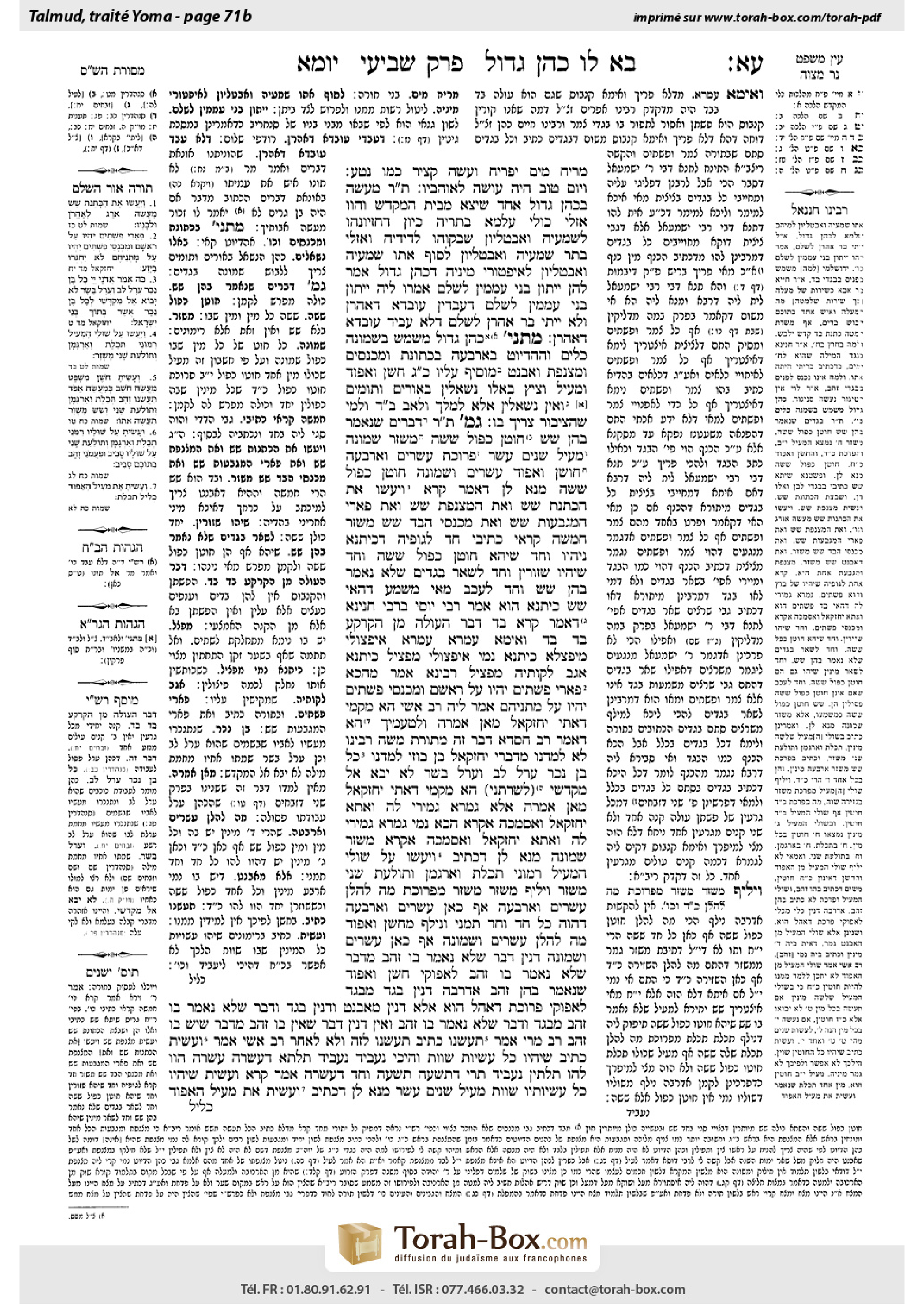
Yoma 71b: Talmud study for Daf Yomi
Daf Yomi is the daily study of one Talmud folio. Explore 37 tractates with scans, Hebrew text, Sefaria English and AI-generated French translations where annotated.
Passage selection and English or AI-generated French translation are available where the scan has annotations. Daf Study is independent of Torah-Box and Sefaria.
Browse Yoma · יומא · All tractatesYoma 71b text and translations
This page of Yoma includes the Aramaic text, an English translation and an AI-generated French translation, alongside the scan above.
יומא ע״א ב · Aramaic and Hebrew text
מֵרֵיחַ מַיִם יַפְרִיחַ וְעָשָׂה קָצִיר כְּמוֹ נָטַע״.
וְיוֹם טוֹב הָיָה עוֹשֶׂה לְאוֹהֲבָיו. תָּנוּ רַבָּנַן: מַעֲשֶׂה בְּכֹהֵן גָּדוֹל אֶחָד שֶׁיָּצָא מִבֵּית הַמִּקְדָּשׁ וַהֲווֹ אָזְלִי כּוּלֵּי עָלְמָא בָּתְרֵיהּ. כֵּיוָן דְּחַזְיוּנְהוּ לִשְׁמַעְיָה וְאַבְטַלְיוֹן, שַׁבְקוּהוּ לְדִידֵיהּ וְאָזְלִי בָּתַר שְׁמַעְיָה וְאַבְטַלְיוֹן.
לְסוֹף אֲתוֹ שְׁמַעְיָה וְאַבְטַלְיוֹן לְאִיפְּטוֹרֵי מִינֵּיהּ דְּכֹהֵן גָּדוֹל. אָמַר לָהֶן: יֵיתוֹן בְּנֵי עַמְמִין לִשְׁלָם. אֲמַרוּ לֵיהּ: יֵיתוֹן בְּנֵי עַמְמִין לִשְׁלָם דְּעָבְדִין עוֹבָדָא דְאַהֲרֹן, וְלָא יֵיתֵי בַּר אַהֲרֹן לִשְׁלָם דְּלָא עָבֵיד עוֹבָדָא דְאַהֲרֹן.
מַתְנִי׳ כֹּהֵן גָּדוֹל מְשַׁמֵּשׁ בִּשְׁמוֹנָה כֵּלִים, וְהַהֶדְיוֹט בְּאַרְבָּעָה: בִּכְתוֹנֶת וּמִכְנָסַיִם וּמִצְנֶפֶת וְאַבְנֵט. מוֹסִיף עָלָיו כֹּהֵן גָּדוֹל: חֹשֶׁן וְאֵפוֹד וּמְעִיל וְצִיץ. בְּאֵלּוּ נִשְׁאָלִין בְּאוּרִים וְתוּמִּים. וְאֵין נִשְׁאָלִין אֶלָּא לְמֶלֶךְ וּלְאַב בֵּית דִּין וּלְמִי שֶׁהַצִּיבּוּר צָרִיךְ בּוֹ.
גְּמָ׳ תָּנוּ רַבָּנַן, דְּבָרִים שֶׁנֶּאֱמַר בָּהֶן ״שֵׁשׁ״ חוּטָן כָּפוּל שִׁשָּׁה. ״מׇשְׁזָר״ שְׁמוֹנָה. מְעִיל שְׁנֵים עָשָׂר. פָּרוֹכֶת עֶשְׂרִים וְאַרְבָּעָה. חוֹשֶׁן וְאֵפוֹד עֶשְׂרִים וּשְׁמוֹנָה.
חוּטָן כָּפוּל שִׁשָּׁה מְנָא לַן — דְּאָמַר קְרָא: ״וַיַּעֲשׂוּ אֶת הַכׇּתְנֹת שֵׁשׁ ... וְאֵת הַמִּצְנֶפֶת שֵׁשׁ וְאֶת פַּאֲרֵי הַמִּגְבָּעֹת שֵׁשׁ וְאֶת מִכְנְסֵי הַבָּד שֵׁשׁ מׇשְׁזָר״. חַמְשָׁה קְרָאֵי כְּתִיבִי: חַד לְגוּפֵיהּ, דְּכִיתָּנָא נִיהְווֹ. וְחַד, שֶׁיְּהֵא חוּטָן כָּפוּל שִׁשָּׁה. וְחַד, שֶׁיִּהְיוּ שְׁזוּרִין. וְחַד, לִשְׁאָר בְּגָדִים שֶׁלֹּא נֶאֱמַר בָּהֶן שֵׁשׁ. וְחַד, לְעַכֵּב.
מַאי מַשְׁמַע דְּהַאי ״שֵׁשׁ״ כִּיתָּנָא הוּא? אָמַר רַבִּי יוֹסֵי בְּרַבִּי חֲנִינָא: דְּאָמַר קְרָא ״בַּד״ — דָּבָר הָעוֹלֶה מִן הַקַּרְקַע בַּד בַּד. וְאֵימָא עַמְרָא! עַמְרָא אִיפְּצוֹלֵי מִיפַּצְלָא. כִּיתָּנָא נָמֵי אִיפְּצוֹלֵי מִפְּצִיל! כִּיתָּנָא אַגַּב לָקוּתֵיהּ מִפְּצִיל.
רָבִינָא אָמַר מֵהָכָא: ״פַּאֲרֵי פִשְׁתִּים יִהְיוּ עַל רֹאשָׁם וּמִכְנְסֵי פִשְׁתִּים יִהְיוּ עַל מׇתְנֵיהֶם״.
אֲמַר לֵיהּ רַב אָשֵׁי: הָא מִקַּמֵּי דְּאָתֵי יְחֶזְקֵאל, מַאן אַמְרַהּ? וּלְטַעְמָיךְ, הָא דְּאָמַר רַב חִסְדָּא: דָּבָר זֶה מִתּוֹרַת מֹשֶׁה רַבֵּינוּ לֹא לָמַדְנוּ, מִדִּבְרֵי יְחֶזְקֵאל בֶּן בּוּזִי לָמַדְנוּ: ״כׇּל בֶּן נֵכָר עֶרֶל לֵב וְעֶרֶל בָּשָׂר לֹא יָבֹא אֶל מִקְדָּשִׁי״ — הָא מִקַּמֵּי דְּאָתֵי יְחֶזְקֵאל, מַאן אַמְרַהּ? אֶלָּא גְּמָרָא גְּמִירִי לַהּ, וַאֲתָא יְחֶזְקֵאל וְאַסְמְכַהּ אַקְּרָא. הָכָא נָמֵי: גְּמָרָא גְּמִירִי לַהּ, וַאֲתָא יְחֶזְקֵאל וְאַסְמְכַהּ אַקְּרָא.
״מׇשְׁזָר״ שְׁמוֹנָה. מְנָא לַן? דִּכְתִיב: ״וַיַּעֲשׂוּ עַל שׁוּלֵי הַמְּעִיל רִמּוֹנֵי תְּכֵלֶת וְאַרְגָּמָן וְתוֹלַעַת שָׁנִי מׇשְׁזָר״, וְיָלֵיף ״מׇשְׁזָר״ ״מׇשְׁזָר״ מִפָּרוֹכֶת, מָה לְהַלָּן עֶשְׂרִים וְאַרְבָּעָה — אַף כָּאן עֶשְׂרִים וְאַרְבָּעָה, דַּהֲוָה כׇּל חַד וְחַד תַּמְנֵי.
וְנֵילַף מֵחֹשֶׁן וְאֵפוֹד: מָה לְהַלָּן עֶשְׂרִים וּשְׁמוֹנָה, אַף כָּאן עֶשְׂרִים וּשְׁמוֹנָה! דָּנִין דָּבָר שֶׁלֹּא נֶאֱמַר בּוֹ זָהָב, מִדָּבָר שֶׁלֹּא נֶאֱמַר בּוֹ זָהָב, לְאַפּוֹקֵי חֹשֶׁן וְאֵפוֹד שֶׁנֶּאֱמַר בָּהֶן זָהָב. אַדְּרַבָּה: דָּנִין בֶּגֶד מִבֶּגֶד, לְאַפּוֹקֵי פָּרוֹכֶת — דְּאֹהֶל הוּא!
אֶלָּא: דָּנִין מֵאַבְנֵט, וְדָנִין בֶּגֶד וְדָבָר שֶׁלֹּא נֶאֱמַר בּוֹ זָהָב, מִבֶּגֶד וְדָבָר שֶׁלֹּא נֶאֱמַר בּוֹ זָהָב, וְאֵין דָּנִין דָּבָר שֶׁאֵין בּוֹ זָהָב מִדָּבָר שֶׁיֵּשׁ בּוֹ זָהָב.
רַב מָרִי אָמַר: ״תַּעֲשֶׂנּוּ״ כְּתִיב. תַּעֲשֶׂנּוּ לָזֶה, וְלֹא לְאַחֵר.
רַב אָשֵׁי אָמַר: ״וְעָשִׂיתָ״ כְּתִיב, שֶׁיִּהְיוּ כׇּל עֲשִׂיּוֹת שָׁווֹת. וְהֵיכִי נֶעְבֵּיד? נֶעְבֵּיד תְּלָתָא דְּעַשְׂרָה עַשְׂרָה — הָווּ לְהוּ תְּלָתִין! נֶעְבֵּיד תְּרֵי דְּתִשְׁעָה תִּשְׁעָה וְחַד דְּעַשְׂרָה — אֲמַר קְרָא: ״וְעָשִׂיתָ״, שֶׁיִּהְיוּ כׇּל עֲשִׂיּוֹתָיו שָׁווֹת.
מְעִיל שְׁנֵים עָשָׂר, מְנָא לַן — דִּכְתִיב: ״וְעָשִׂיתָ אֶת מְעִיל הָאֵפוֹד
Yoma 71b · English translation
from the scent of water it will blossom and put forth branches like a plant” (Job 14:8–9). If the figurative trunk of one’s family is drying up through lack of Torah, he should plant himself in a place of water, i.e., a family of scholars, water being a metaphor for Torah. This will ensure that his children will blossom into Torah scholars.
§ It was taught in the mishna: The people escort the High Priest to his house. And he would make a feast for his loved ones. The Sages taught in a baraita: There was an incident involving one High Priest who exited the Holy Temple and everyone followed him. When they saw Shemaya and Avtalyon, the heads of the Sanhedrin, walking along, in deference to them they left the High Priest by himself and walked after Shemaya and Avtalyon.
Eventually, Shemaya and Avtalyon came to take leave of the High Priest before returning to their homes. Envious of the attention they received, he angrily said to them: Let the descendants of the gentile nations come in peace. Shemaya and Avtalyon descended from converts, and he scornfully drew attention to that fact. They said to him: Let the descendants of the gentile nations come in peace, who perform the acts of Aaron, who loved and pursued peace; and let not a descendant of Aaron come in peace, who does not perform the acts of Aaron and who speaks condescendingly to descendants of converts.
MISHNA: Throughout the year the High Priest serves in eight garments, and the common priest serves in four: In a tunic and trousers and a mitre and a belt. The High Priest adds another four garments beyond those worn by the common priest: A breastplate, and an ephod, and a robe, and a frontplate. When dressed in these eight garments, the High Priest may be consulted for the decision of the Urim VeTummim. And he may be consulted for the decision of the Urim VeTummim only on behalf of the king, or on behalf of the president of the court, or on behalf of one whom the community needs. Individual inquiries are not posed to the Urim VeTummim.
GEMARA: The Sages taught in a baraita: With regard to those items of the priestly vestments about which it is stated they must be made with linen [shesh], their threads are spun six-fold, as suggested by the use of the term shesh, which also means six. When the Torah states that certain items are twined, it means their threads are spun eight-fold. Threads used to weave the robe were spun from twelve strands. The threads of the curtain were spun from twenty-four strands. The threads used to weave the breastplate and ephod were spun from twenty-eight strands.
The Gemara asks: That the threads made from shesh are spun six-fold, from where do we derive this? The verse states: “And they made the tunics of linen [shesh] of woven work for Aaron and for his sons. And the mitre of linen, and the adorning mitres of linen, and the linen [bad] trousers of twined linen” (Exodus 39:27–28). Five mentions of the word linen are written; four times as “shesh” and an additional instance of “bad,” both meaning linen. One mention is stated for that halakha itself, to teach that they should be made of linen. And one mention is written to teach that the threads should be spun six-fold, shesh being interpreted as six. And one mention teaches that the six strands should be spun together into one. And one mention teaches that this also applies to the other garments, even though the term shesh is not stated with regard to them. And one mention teaches that this requirement is indispensable and that garments not made this way are invalid.
The Gemara asks: From where may it be inferred that this term shesh means linen? Rabbi Yosei, son of Rabbi Ḥanina, said: As the verse also states: “Bad,” and uses it interchangeably with shesh. And bad refers to something which sprouts from the ground stalk by stalk [bad bad], each one by itself. This is a fitting description of flax, the plant used to produce linen, as opposed to other plants, such as cotton, whose fibers grow meshed together. The Gemara asks: And say that it refers to wool, since when it grows from the animal, each hair grows separately. The Gemara answers: Wool splits, with each hair dividing into several hairs, so it does not fully fit the description of sprouting stalk by stalk. The Gemara asks: But flax also splits into individual hairs. The Gemara answers: Flax, unlike wool, splits only when beaten.
Ravina said: We have a proof for the matter from here: The verse states: “They shall have linen [pishtim] mitres upon their heads, and linen trousers upon their loins” (Ezekiel 44:18). The term pishtim used in Ezekiel certainly refers to linen; therefore, it is clear that the terms shesh and bad, used in the Torah for the same garments, also refer to linen.
Rav Ashi said to him: But before Ezekiel came, who said this halakha? How was it known? Ravina retorted: And according to your reasoning, the same question could be asked with regard to that which Rav Ḥisda said concerning the disqualification of an uncircumcised priest from serving in the Temple: This matter we did not learn from the Torah of Moses our teacher, as it is not written explicitly in the Torah; rather, we learned it from the words of Ezekiel ben Buzi, as the verse states: “No foreigner, uncircumcised of heart or uncircumcised of flesh, shall enter into My sanctuary” (Ezekiel 44:9). One could ask here as well: Before Ezekiel came, who said this halakha? Rather, perforce, they learned it as a tradition and then Ezekiel came and supported it with a verse. Here, too, they learned it as a tradition and then Ezekiel came and supported it with a verse.
The Gemara continues to explain the baraita. That the use of the term twined implies that the thread should be spun from eight strands, from where do we derive this? As it is written: “And they made upon the skirts of the robe pomegranates of sky-blue, and purple, and scarlet, twined” (Exodus 39:24); and derive a verbal analogy from the term “twined” used in this verse and the term “twined” from the verse about the curtain: Just as there, with regard to the curtain, there are twenty-four strands, as will be explained, so too here, there are twenty-four strands in total. And since each pomegranate is made of three colors, sky-blue, purple, and scarlet, it must be that each one of them was spun from eight strands.
The Gemara challenges this derivation: Let us derive the number of strands instead from the breastplate and ephod and say: Just as there, with regard to the breastplate and ephod, there are twenty-eight strands, so too, here there are twenty-eight strands. The Gemara answers: It is preferable to derive the halakhot of an item, i.e., the pomegranates, with regard to which the use of gold threads is not stated, from the halakhot of an item, i.e., the curtain, with regard to which the use of gold threads is also not stated. This would come to exclude the possibility of deriving them from the breastplate and ephod, with regard to which the use of gold threads is stated. The Gemara asks: On the contrary, it should be preferable to derive the halakhot of one garment from another garment, i.e., the halakhot of the robe from the halakhot of the breastplate and ephod. This would come to exclude the possibility of deriving them from the curtain, which is a tent, i.e., part of the Temple building, and not a garment. The Gemara accepts that the derivation is flawed.
Rather, the need for thread of eight strands is derived from the belt, which had twenty-four threads in total, and a garment and an item with regard to which the use of gold thread is not stated, i.e., the pomegranates, are derived from a garment and an item with regard to which the use of gold thread is not stated. And an item with no gold, such as the pomegranates and robe, is not derived from an item that has gold in it, such as the breastplate and ephod.
Rav Mari said another reason not to derive the number of strands in a pomegranate from the breastplate and ephod: “Like the work of the ephod you shall make it” (Exodus 28:15) is written with regard to the breastplate to indicate that you shall make it, i.e., the breastplate, like the ephod, which indicates that for this, i.e., the breastplate, you shall use thread of twenty-eight strands, and not for anything else.
Rav Ashi said another reason that there could not be twenty-eight strands in a pomegranate: “And you shall make pomegranates of sky-blue, and of purple, and of scarlet” (Exodus 28:33) is written to indicate that all the makings of it must be equal, i.e., that each color thread should be made from the same number of strands. However, if there are twenty-eight strands in total, the three threads, each of a different color, cannot be made with an equal number of strands, as how should we do it? Let us make three colored threads of ten strands each; then they are thirty strands in total, which is too many. Let us make two colored threads of nine strands and one of ten; but the verse states: “And you shall make,” to indicate that all the makings of it must be equal. Perforce, the threads used for the pomegranates and the robe must be derived from an item woven from threads of a number of strands divisible by three, such as the curtain.
The Gemara continues to explain the baraita: That the robe must be woven from threads spun from twelve strands, from where do we derive this? As it is written: “And you shall make the robe of the ephod
Yoma 71b · Traduction française (IA)
« À l’odeur de l’eau, il bourgeonnera et produira des branches comme une plante » (Job 14, 8-9). Si le tronc figuré de sa famille se dessèche faute de Torah, qu’il s’établisse dans un lieu arrosé, c’est-à-dire au sein d’une famille de sages, l’eau étant une métaphore de la Torah. Ainsi, ses enfants s’épanouiront et deviendront des sages de la Torah.
§ La Michna enseigne : Le peuple accompagne le grand prêtre jusqu’à sa maison, et celui-ci organise un festin pour ses proches. Les Sages ont enseigné dans une baraïta : Un jour, un grand prêtre sortit du Temple et tout le monde le suivit. Lorsqu’ils virent Shemaya et Avtalyon, les chefs du Sanhédrin, qui marchaient sur la route, ils laissèrent le grand prêtre seul, par égard pour eux, et suivirent Shemaya et Avtalyon.
Finalement, Shemaya et Avtalyon vinrent prendre congé du grand prêtre avant de rentrer chez eux. Jaloux de l’attention qu’ils avaient reçue, il leur dit avec colère : « Que les descendants des nations étrangères viennent en paix ! » Shemaya et Avtalyon descendaient de convertis, et il attira avec mépris l’attention sur ce fait. Ils lui dirent : « Que les descendants des nations étrangères viennent en paix, eux qui accomplissent les actes d’Aaron, qui aimait la paix et la poursuivait ; mais qu’un descendant d’Aaron, qui n’accomplit pas les actes d’Aaron et parle avec condescendance aux descendants de convertis, ne vienne pas en paix. »
MICHNA : Tout au long de l’année, le grand prêtre officie avec huit vêtements, et le prêtre ordinaire avec quatre : une tunique, un pantalon, une tiare et une ceinture. Le grand prêtre porte quatre vêtements supplémentaires par rapport au prêtre ordinaire : un pectoral, un éphod, une robe et une plaque frontale. Lorsqu’il est vêtu de ces huit vêtements, on peut le consulter pour obtenir une réponse des Ourim et des Toumim. On ne peut toutefois le consulter à ce sujet qu’au nom du roi, du président du tribunal ou d’une personne dont la communauté a besoin. Les particuliers ne posent pas de questions aux Ourim et aux Toumim.
GUEMARA : Les Sages ont enseigné dans une baraïta : Les fils des éléments des vêtements sacerdotaux dont il est indiqué qu’ils doivent être faits de lin [shesh] sont filés à six brins, comme le suggère le terme shesh, qui signifie également six. Lorsque la Torah dit que certains éléments doivent être retors, cela signifie que leurs fils sont filés à huit brins. Les fils utilisés pour tisser la robe étaient filés à douze brins. Les fils du rideau étaient filés à vingt-quatre brins. Les fils utilisés pour tisser le pectoral et l’éphod étaient filés à vingt-huit brins.
La Guemara demande : D’où déduit-on que les fils faits de shesh sont filés à six brins ? Le verset dit : « Ils firent les tuniques de lin [shesh], tissées, pour Aaron et ses fils, ainsi que la tiare de lin, les tiares ornées de lin et les pantalons de lin [bad], en lin retors » (Exode 39, 27-28). Le mot « lin » apparaît cinq fois : quatre fois sous la forme « shesh » et une autre fois sous la forme « bad », les deux termes désignant le lin. Une occurrence est énoncée pour cette règle même, afin d’enseigner que les vêtements doivent être faits de lin. Une autre enseigne que les fils doivent être filés à six brins, shesh étant interprété comme signifiant six. Une autre enseigne que les six brins doivent être réunis en un seul fil. Une autre enseigne que cela s’applique également aux autres vêtements, bien que le terme shesh ne soit pas employé à leur sujet. Enfin, une autre enseigne que cette exigence est indispensable et que les vêtements qui ne sont pas faits de cette manière sont invalides.
La Guemara demande : D’où peut-on déduire que le terme shesh signifie lin ? Rabbi Yosei, fils de Rabbi Ḥanina, dit : Le verset emploie également le terme « bad », de façon interchangeable avec shesh. Or bad désigne une chose qui pousse de la terre tige par tige [bad bad], chacune séparément. Cela décrit bien le lin, la plante dont on tire le tissu de lin, contrairement à d’autres plantes, comme le coton, dont les fibres poussent entremêlées. La Guemara demande : Ne pourrait-il pas s’agir de laine, puisque, lorsqu’elle pousse sur l’animal, chaque poil pousse séparément ? La Guemara répond : La laine se divise, chaque poil se ramifiant en plusieurs poils ; elle ne correspond donc pas pleinement à la description de tiges qui poussent séparément. La Guemara demande : Mais le lin aussi se divise en fibres distinctes. La Guemara répond : Contrairement à la laine, le lin ne se divise que lorsqu’on le bat.
Ravina dit : Nous avons ici une preuve à ce sujet : le verset dit : « Ils porteront des tiares de lin [pishtim] sur la tête et des pantalons de lin sur les reins » (Ézéchiel 44, 18). Le terme pishtim employé dans Ézéchiel désigne certainement le lin ; il est donc clair que les termes shesh et bad, employés dans la Torah pour les mêmes vêtements, désignent également le lin.
Rav Ashi lui dit : Mais avant la venue d’Ézéchiel, qui enseignait cette halakha ? Comment la connaissait-on ? Ravina répliqua : Selon ton raisonnement, on pourrait poser la même question au sujet de ce que Rav Ḥisda a dit concernant l’inaptitude d’un prêtre incirconcis à officier dans le Temple : « Cette règle, nous ne l’avons pas apprise de la Torah de Moïse notre maître, car elle n’est pas explicitement écrite dans la Torah ; nous l’avons apprise des paroles d’Ézéchiel ben Bouzi », comme le dit le verset : « Aucun étranger, incirconcis de cœur ou incirconcis de chair, ne pénétrera dans Mon sanctuaire » (Ézéchiel 44, 9). On pourrait ici aussi demander : avant la venue d’Ézéchiel, qui enseignait cette halakha ? Il faut nécessairement répondre qu’ils l’avaient apprise par tradition, puis qu’Ézéchiel est venu l’appuyer au moyen d’un verset. Ici aussi, ils l’avaient apprise par tradition, puis Ézéchiel est venu l’appuyer au moyen d’un verset.
La Guemara poursuit l’explication de la baraïta. D’où déduit-on que l’emploi du terme « retors » implique que le fil doit être filé à huit brins ? Il est écrit : « Ils firent sur l’ourlet de la robe des grenades d’azur, de pourpre et d’écarlate, retorses » (Exode 39, 24). On établit une analogie verbale entre le terme « retors » employé dans ce verset et celui du verset concernant le rideau : de même que là, pour le rideau, il y a vingt-quatre brins, comme cela sera expliqué, de même ici, il y a vingt-quatre brins au total. Puisque chaque grenade est faite de trois couleurs — azur, pourpre et écarlate —, chacun des fils de couleur doit donc être filé à huit brins.
La Guemara conteste cette déduction : Déduisons plutôt le nombre de brins du pectoral et de l’éphod, et disons que, de même que pour le pectoral et l’éphod, il y a vingt-huit brins, de même ici, il y a vingt-huit brins. La Guemara répond : Il est préférable de déduire les règles d’un élément — les grenades — au sujet duquel l’emploi de fils d’or n’est pas mentionné, des règles d’un élément — le rideau — au sujet duquel l’emploi de fils d’or n’est pas non plus mentionné. Cela exclut la possibilité de les déduire du pectoral et de l’éphod, au sujet desquels l’emploi de fils d’or est mentionné. La Guemara demande : Au contraire, ne serait-il pas préférable de déduire les règles d’un vêtement à partir d’un autre vêtement, c’est-à-dire les règles de la robe à partir de celles du pectoral et de l’éphod ? Cela exclurait la possibilité de les déduire du rideau, qui appartient à la tente, c’est-à-dire au bâtiment du Temple, et n’est pas un vêtement. La Guemara reconnaît que cette déduction est défectueuse.
Il faut plutôt déduire du ceinturon l’exigence d’un fil à huit brins, puisqu’il comportait vingt-quatre fils au total ; les règles d’un vêtement et d’un élément au sujet desquels l’emploi de fils d’or n’est pas mentionné — c’est-à-dire les grenades — sont déduites des règles d’un vêtement et d’un élément au sujet desquels l’emploi de fils d’or n’est pas non plus mentionné. Un élément sans or, comme les grenades et la robe, ne se déduit pas d’un élément qui comporte de l’or, comme le pectoral et l’éphod.
Rav Mari donne une autre raison de ne pas déduire du pectoral et de l’éphod le nombre de brins d’une grenade : il est écrit, au sujet du pectoral : « Tu le feras comme le travail de l’éphod » (Exode 28, 15), pour indiquer que tu le feras, c’est-à-dire le pectoral, comme l’éphod. Cela signifie que, pour celui-ci, c’est-à-dire le pectoral, tu utiliseras un fil à vingt-huit brins, et non pour quoi que ce soit d’autre.
Rav Ashi donne une autre raison pour laquelle une grenade ne peut pas comporter vingt-huit brins : il est écrit : « Tu feras des grenades d’azur, de pourpre et d’écarlate » (Exode 28, 33), pour indiquer que tous les éléments qui la composent doivent être égaux, c’est-à-dire que les fils de chaque couleur doivent être faits du même nombre de brins. Or, s’il y a vingt-huit brins au total, les trois fils, chacun d’une couleur différente, ne peuvent pas comporter un nombre égal de brins. Comment procéder ? Faisons trois fils de couleur de dix brins chacun : ils comptent alors trente brins au total, ce qui est trop. Faisons deux fils de couleur de neuf brins et un de dix ; mais le verset dit : « Tu feras », pour indiquer que tous les éléments qui la composent doivent être égaux. Il faut nécessairement déduire les fils utilisés pour les grenades et la robe d’un élément tissé avec un nombre de brins divisible par trois, comme le rideau.
La Guemara poursuit l’explication de la baraïta : D’où déduit-on que la robe doit être tissée à partir de fils filés à douze brins ? Il est écrit : « Tu feras la robe de l’éphod
Traduction française générée par IA à partir de l’édition anglaise de Sefaria. Vérifie toujours un passage avec le texte source.
Text from Sefaria: William Davidson Edition - Vocalized Aramaic (CC BY NC); William Davidson Edition - English (CC BY NC).