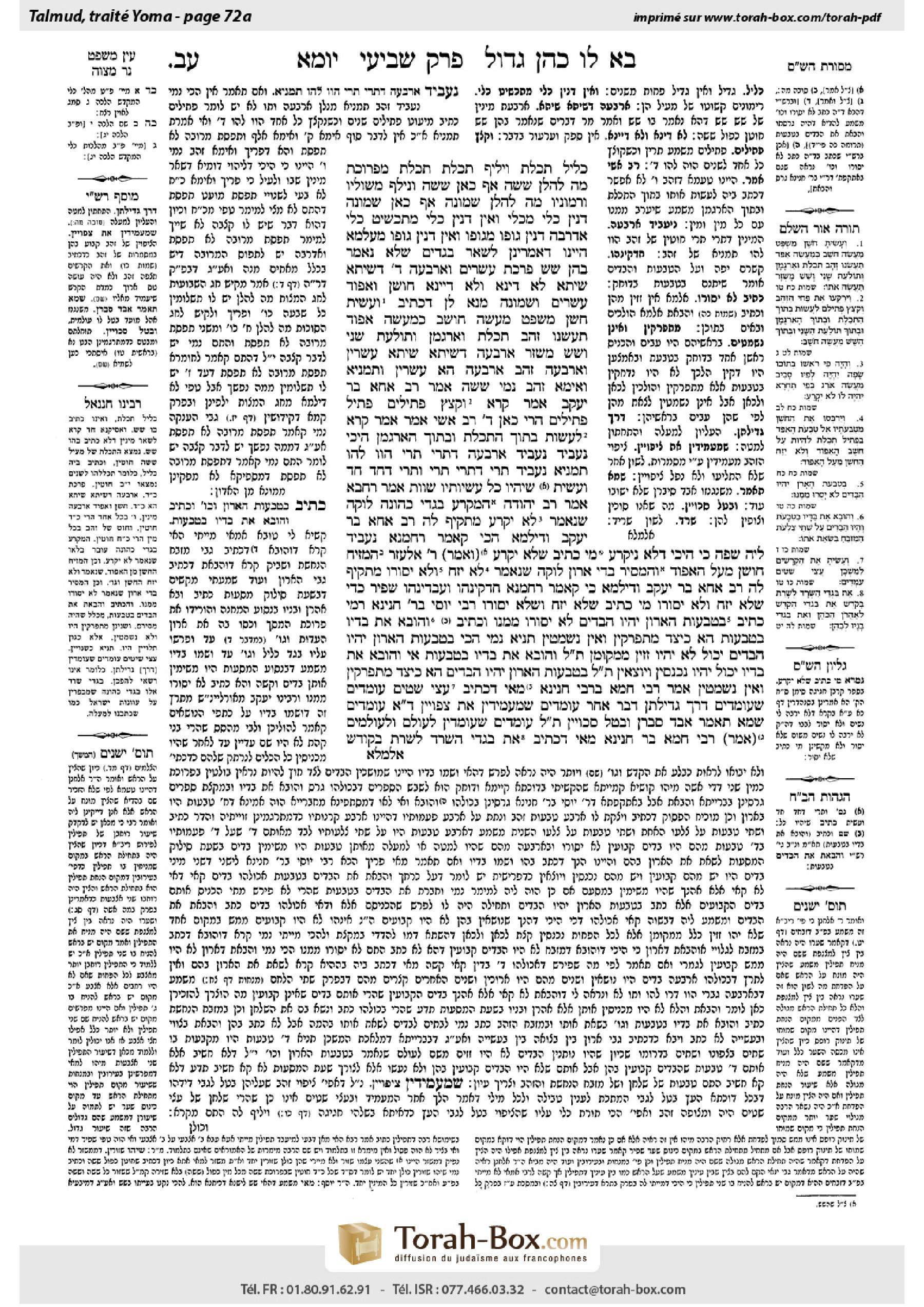
Yoma 72a: Talmud study for Daf Yomi
Daf Yomi is the daily study of one Talmud folio. Explore 37 tractates with scans, Hebrew text, Sefaria English and AI-generated French translations where annotated.
Passage selection and English or AI-generated French translation are available where the scan has annotations. Daf Study is independent of Torah-Box and Sefaria.
Browse Yoma · יומא · All tractatesYoma 72a text and translations
This page of Yoma includes the Aramaic text, an English translation and an AI-generated French translation, alongside the scan above.
יומא ע״ב א · Aramaic and Hebrew text
כְּלִיל תְּכֵלֶת״, וְיָלֵיף ״תְּכֵלֶת״ ״תְּכֵלֶת״ מִפָּרוֹכֶת: מָה לְהַלָּן שִׁשָּׁה, אַף כָּאן שִׁשָּׁה.
וְנֵילַף מִשּׁוּלָיו וְרִמּוֹנָיו — מָה לְהַלָּן שְׁמוֹנָה, אַף כָּאן שְׁמוֹנָה! דָּנִין כְּלִי מִכְּלִי, וְאֵין דָּנִין כְּלִי מִתַּכְשִׁיט כְּלִי.
אַדְּרַבָּה: דָּנִין גּוּפוֹ מִגּוּפוֹ, וְאֵין דָּנִין גּוּפוֹ מֵעָלְמָא. הַיְינוּ דְּאָמְרִינַן: לִשְׁאָר בְּגָדִים שֶׁלֹּא נֶאֱמַר בָּהֶן ״שֵׁשׁ״.
פָּרֹכֶת עֶשְׂרִים וְאַרְבָּעָה — אַרְבְּעָה דְּשִׁיתָּא שִׁיתָּא, לָא דִּינָא וְלָא דַּיָּינָא.
חוֹשֶׁן וְאֵפוֹד עֶשְׂרִים וּשְׁמוֹנָה מְנָא לַן? דִּכְתִיב: ״וְעָשִׂיתָ חֹשֶׁן מִשְׁפָּט מַעֲשֵׂה חוֹשֵׁב כְּמַעֲשֵׂה אֵפוֹד תַּעֲשֶׂנּוּ זָהָב תְּכֵלֶת וְאַרְגָּמָן וְתוֹלַעַת שָׁנִי וְשֵׁשׁ מׇשְׁזָר״, אַרְבְּעָה דְּשִׁיתָּא שִׁיתָּא — עֶשְׂרִין וְאַרְבְּעָה, זָהָב — אַרְבְּעָה, הָא עֶשְׂרִין וּתְמָנְיָא.
וְאֵימָא זָהָב נָמֵי שִׁשָּׁה! אָמַר רַב אַחָא בַּר יַעֲקֹב, אָמַר קְרָא: ״וְקִצֵּץ פְּתִילִים״. ״פְּתִיל״, ״פְּתִילִים״ — הֲרֵי כָּאן אַרְבָּעָה.
רַב אָשֵׁי אָמַר, אָמַר קְרָא: ״לַעֲשׂוֹת בְּתוֹךְ הַתְּכֵלֶת וּבְתוֹךְ הָאַרְגָּמָן״. הֵיכִי נַעֲבֵיד? נַעֲבֵיד אַרְבְּעָה דִּתְרֵי תְּרֵי — הָווּ לְהוּ תְּמָנְיָא. נַעֲבֵיד תְּרֵי דִּתְרֵי תְּרֵי, וּתְרֵי דְּחַד חַד — ״וְעָשִׂיתָ״, שֶׁיִּהְיוּ כׇּל עֲשִׂיּוֹתָיו שָׁווֹת.
אָמַר רַחֲבָא אָמַר רַב יְהוּדָה: הַמְקָרֵעַ בִּגְדֵי כְהוּנָּה לוֹקֶה, שֶׁנֶּאֱמַר: ״לֹא יִקָּרֵעַ״. מַתְקֵיף לַהּ רַב אַחָא בַּר יַעֲקֹב, וְדִילְמָא הָכִי קָאָמַר רַחֲמָנָא: נַעֲבֵיד לֵיהּ שָׂפָה כִּי הֵיכִי דְּלָא נִיקְּרַע! מִי כְּתִיב ״שֶׁלֹּא יִקָּרֵעַ״?
אָמַר רַבִּי אֶלְעָזָר: הַמַּזִּיחַ חוֹשֶׁן מֵעַל הָאֵפוֹד, וְהַמֵּסִיר בַּדֵּי אָרוֹן — לוֹקֶה, שֶׁנֶּאֱמַר: ״לֹא יִזַּח״ וְ״לָא יָסוּרוּ״. מַתְקֵיף לַהּ רַב אַחָא בַּר יַעֲקֹב: וְדִילְמָא כִּי קָאָמַר רַחֲמָנָא, חַדְּקִינְהוּ וְעַבְדִינְהוּ שַׁפִּיר כְּדֵי שֶׁלֹּא יִזַּח וְלֹא יָסוּרוּ! מִי כְּתִיב ״שֶׁלֹּא יִזַּח״ וְ״שֶׁלֹּא יָסוּרוּ״?!
רַבִּי יוֹסֵי בְּרַבִּי חֲנִינָא רָמֵי, כְּתִיב: ״בְּטַבְּעוֹת הָאָרוֹן יִהְיוּ הַבַּדִּים לֹא יָסוּרוּ מִמֶּנּוּ״, וּכְתִיב: ״וְהוּבָא אֶת בַּדָּיו בַּטַּבָּעוֹת״! הָא כֵּיצַד? מִתְפָּרְקִין וְאֵין נִשְׁמָטִין.
תַּנְיָא נָמֵי הָכִי: ״בְּטַבְּעוֹת הָאָרוֹן יִהְיוּ הַבַּדִּים״. יָכוֹל לֹא יִהְיוּ זָזִין מִמְּקוֹמָן? תַּלְמוּד לוֹמַר: ״וְהוּבָא אֶת בַּדָּיו בַּטַּבָּעוֹת״, אִי ״וְהוּבָא אֶת בַּדָּיו״, יָכוֹל יִהְיוּ נִכְנָסִין וְיוֹצְאִין — תַּלְמוּד לוֹמַר: ״בְּטַבְּעוֹת הָאָרוֹן יִהְיוּ הַבַּדִּים״. הָא כֵּיצַד? מִתְפָּרְקִין, וְאֵין נִשְׁמָטִין.
אָמַר רַבִּי חָמָא בְּרַבִּי חֲנִינָא, מַאי דִּכְתִיב: ״עֲצֵי שִׁטִּים עוֹמְדִים״, שֶׁעוֹמְדִים דֶּרֶךְ גְּדִילָתָן. דָּבָר אַחֵר: ״עוֹמְדִים״, שֶׁמַּעֲמִידִין אֶת צִפּוּיָין. דָּבָר אַחֵר: ״עוֹמְדִים״. שֶׁמָּא תֹּאמַר אָבַד סִבְרָן וּבָטֵל סִכּוּיָין — תַּלְמוּד לוֹמַר: ״עוֹמְדִים״, שֶׁעוֹמְדִין לְעוֹלָם וּלְעוֹלָמִים.
אָמַר רַבִּי חָמָא בַּר חֲנִינָא, מַאי דִּכְתִיב: ״אֶת בִּגְדֵי הַשְּׂרָד לְשָׁרֵת בַּקּוֹדֶשׁ״ —
Yoma 72a · English translation
spun of sky-blue” (Exodus 28:31). And derive a verbal analogy from the term “sky-blue” used here and the same term “sky-blue” from the verse about the curtain: Just as there, with regard to the curtain, there are six strands, so too here, there are six strands. Then, since the Torah also says the threads are spun, i.e., each strand is made of two thinner strands spun together, each thread must contain twelve strands.
The Gemara suggests: Let us derive the number of strands in the robe from its hem and pomegranates: Just as there, each thread is spun from eight strands, so too here, the threads should be spun from eight strands. The Gemara rejects this: It is preferable to derive the halakhot of a utensil, i.e., the robe, from the halakhot of another utensil, i.e., the curtain, and one should not derive the halakhot of a utensil from the halakhot of something that is merely an ornament of a utensil, i.e., the pomegranates of the robe.
The Gemara asks: On the contrary, it is preferable to derive the halakhot of an object from that object itself, i.e., to assume that the halakhot of the robe and its pomegranates are similar; and one should not derive the halakhot of an object from elsewhere. The Gemara explains: This is precisely what we said in the baraita: One of the five mentions of shesh in the verse is to teach that the requirement that threads be made from six strands applies also to other garments about which shesh is not explicitly stated, such as the robe.
The baraita further states: Each thread of the curtain was made of twenty-four strands. The Gemara explains: With regard to each thread being composed of four colored threads: White, purple, scarlet, and sky-blue, and each one of them being composed of six strands, there is neither judgment nor judge, i.e., it is absolutely clear that this is how the threads of the curtain are produced.
The baraita further states: Each thread of the breastplate and ephod was made of twenty-eight strands. From where do we derive this? As it is written: “And you shall make a breastplate of judgment, the work of the skilled craftsman; like the work of the ephod you shall make it: Of gold, sky-blue, and purple, and scarlet, and fine twined linen” (Exodus 28:15). There are four colored threads, each composed of six strands, which makes twenty-four. In addition, gold is spun together with each of the four colors, giving the total of twenty-eight.
But couldn’t one say the gold should be made as a thread of six strands, like the other colors? Rav Aḥa bar Ya’akov said that the verse states: “And they beat the gold into thin plates, and cut it into cords, to work it into the sky-blue, and into the purple, and into the scarlet, and into the fine linen, the work of a skilled craftsman” (Exodus 39:3). “Cord” implies a strand that is doubled over and can be twisted into a cord; “cords” is in the plural, meaning at least two of these. Accordingly, there are four strands here.
Rav Ashi said: This can be seen from that fact that the verse states with regard to the gold strands: “To work it into the sky-blue, and into the purple” (Exodus 39:3), indicating that the gold strands should be combined with the other colors. What should we do? If we make four gold threads of two strands each and combine each one with each of the colors, then there would be eight. If we make two gold threads of two strands each, and two gold threads of one strand each, it says: “And you shall make,” indicating that all its makings should be the same. Perforce, one strand of gold should be combined with each of the colors, producing a total of twenty-eight strands.
§ The Gemara discusses various halakhot concerning the priestly vestments and other sacred vessels: Raḥava said that Rav Yehuda said: One who intentionally tears any of the priestly vestments transgresses a prohibition and is flogged, as it is stated concerning the robe: “It shall have a hem of woven work around the opening of it, like the opening of a coat of mail, and it shall not be torn” (Exodus 28:32). Just as it is prohibited to tear the opening of the robe, so too, it is prohibited to tear any of the priestly vestments. Rav Aḥa bar Ya’akov strongly objects to this: But perhaps this is what the Merciful One is saying in the Torah: An opening should be made in order that it not tear. In other words, the Torah was giving an explanation, not a prohibition. The Gemara rejects this: Is it written: In order that it not be torn? Clearly, the intention of the verse is to state a prohibition.
Rabbi Elazar said: One who detaches the breastplate from upon the ephod or one who removes the staves of the Ark from their rings transgresses a Torah prohibition and is flogged, as it is stated: “And the breastplate shall not be detached from the ephod” (Exodus 28:28),and it is also stated: “The staves shall be in the rings of the Ark; they shall not be removed from it” (Exodus 25:15). Rav Aḥa bar Ya’akov strongly objects to this: But perhaps when the Merciful One said this in the Torah, the intention was to strengthen them and make them fast so that the breastplate not become detached from the ephod and the staves not be removed. He suggests that the Torah was giving an explanation, not a prohibition. The Gemara rejects this: Is it written: In order that it not become detached, and: In order that they not be removed? Clearly, the intention of the verse is to state a prohibition.
Rabbi Yosei, son of Rabbi Ḥanina, raised a contradiction. In one verse it is written: “The staves shall be in the rings of the Ark; they shall not be removed from it” (Exodus 25:15), implying the staves should remain there permanently. But in another verse it is written: “And its staves shall be put into the rings” (Exodus 27:7), implying that when the Ark is used the staves are inserted, which suggests that they do not remain there permanently. How is this contradiction resolved? The staves could be removed from their position, i.e., they were loosened, but did not come out. The staves were wider at their ends and thinner in the middle. Therefore, once they had been forced into the rings, although they could be shifted, they would not be removed entirely.
That was also taught in a baraita. The verse states: “The staves shall be in the rings of the Ark; they shall not be removed from it” (Exodus 25:15). One might have thought that they should not move from their place at all; therefore; the verse states: “And its staves shall be put into the rings” (Exodus 27:7). If it had stated: And its staves shall be put, one might have thought that they are inserted and removed entirely; therefore, the verse states: “The staves shall be in the rings of the Ark; they shall not be removed from it” (Exodus 25:15). How is this? They could be removed from their position, but did not come out.
The Gemara cites other statements concerning the ark. Rabbi Ḥama, son of Rabbi Ḥanina, said: What is the meaning of that which is written: “And you shall make the boards for the Tabernacle of acacia wood, standing” (Exodus 26:15)? This verse teaches that the boards of wood used for the Tabernacle should stand in the same direction in which they grew from the ground as a tree. Alternatively, “standing” means that they supported their gold plating and prevented it from falling. Alternatively, “standing” is written to hint at the following: Perhaps you will say that now that the Tabernacle is no longer in use, their hope is lost and their chance is abandoned, and after being stored away the boards will no longer return to use. Therefore, the verse states “standing” to indicate that they stand forever and ever.
§ The Gemara returns to its discussion of the priestly vestments: Rabbi Ḥama bar Ḥanina said: What is the meaning of that which is written: “The plaited [serad] garments, for serving in the Sanctuary” (Exodus 35:19)? Why does the verse refer to the priestly vestments as “serad garments”?
Yoma 72a · Traduction française (IA)
« Filé de bleu azur » (Exode 28,31). Déduisons une analogie verbale du terme « bleu azur » employé ici et du même terme dans le verset relatif au rideau : de même que là, à propos du rideau, il y a six brins, de même ici, il y a six brins. Or, puisque la Torah précise également que les fils sont filés, c’est-à-dire que chaque fil est composé de deux brins plus fins filés ensemble, chaque fil doit donc compter douze brins.
La Guemara propose : Déduisons le nombre de brins de la robe de son ourlet et de ses grenades : de même que là, chaque fil est composé de huit brins, de même ici, les fils devraient être composés de huit brins. La Guemara rejette cette proposition : il est préférable de déduire les halakhot d’un ustensile — la robe — de celles d’un autre ustensile — le rideau —, plutôt que de déduire les halakhot d’un ustensile de celles d’un élément qui n’en est qu’un ornement, à savoir les grenades de la robe.
La Guemara demande : Au contraire, il est préférable de déduire les halakhot d’un objet de celles de cet objet même, c’est-à-dire de supposer que les halakhot de la robe et de ses grenades sont semblables, et de ne pas déduire les halakhot d’un objet de celles d’un autre objet. La Guemara explique : C’est précisément ce que nous avons dit dans la baraïta : l’une des cinq occurrences de shesh dans le verset enseigne que l’exigence de fabriquer les fils à partir de six brins s’applique aussi à d’autres vêtements, pour lesquels shesh n’est pas explicitement mentionné, comme la robe.
La baraïta affirme ensuite : chaque fil du rideau était composé de vingt-quatre brins. La Guemara explique : Quant au fait que chaque fil soit composé de fils des quatre couleurs — blanc, pourpre, écarlate et bleu azur —, chacun étant lui-même composé de six brins, il n’y a là ni incertitude ni contestation : il est absolument clair que c’est ainsi que sont fabriqués les fils du rideau.
La baraïta affirme ensuite : chaque fil du pectoral et de l’éphod était composé de vingt-huit brins. D’où le déduisons-nous ? Car il est écrit : « Tu feras un pectoral du jugement, ouvrage d’artisan ; tu le feras comme l’ouvrage de l’éphod : en or, en bleu azur, en pourpre, en écarlate et en lin fin retors » (Exode 28,15). Il y a quatre fils de couleur, chacun composé de six brins, soit vingt-quatre. De plus, l’or est filé avec chacune des quatre couleurs, ce qui porte le total à vingt-huit.
Mais ne pourrait-on pas dire que l’or doit être filé en un fil de six brins, comme les autres couleurs ? Rav Aḥa bar Ya’akov dit que le verset enseigne : « On battit l’or en fines lames, puis on le découpa en cordons, pour l’incorporer au bleu azur, à la pourpre, à l’écarlate et au lin fin, ouvrage d’artisan » (Exode 39,3). Le mot « cordon » désigne un brin replié sur lui-même, qui peut être torsadé pour former un cordon ; le pluriel « cordons » signifie qu’il y en a au moins deux. Il y a donc ici quatre brins.
Rav Ashi dit : On peut le déduire du fait que le verset dit à propos des fils d’or : « Pour le travailler avec le bleu azur et la pourpre » (Exode 39,3), ce qui indique que les fils d’or doivent être associés aux autres couleurs. Comment procéder ? Si l’on fait quatre fils d’or de deux brins chacun et qu’on associe chacun d’eux à chacune des couleurs, on obtient huit brins. Si l’on fait deux fils d’or de deux brins chacun et deux fils d’or d’un seul brin chacun, le verset dit : « Tu feras », ce qui indique que toutes les parties doivent être faites de la même manière. Il faut donc associer un brin d’or à chacune des couleurs, ce qui donne un total de vingt-huit brins.
§ La Guemara examine diverses halakhot concernant les vêtements sacerdotaux et d’autres ustensiles sacrés. Raḥava a dit au nom de Rav Yehuda : Celui qui déchire intentionnellement l’un des vêtements sacerdotaux transgresse une interdiction et reçoit la flagellation, comme il est dit à propos de la robe : « Elle aura, autour de son ouverture, un ourlet tissé, comme l’ouverture d’une cotte de mailles, et elle ne sera pas déchirée » (Exode 28,32). De même qu’il est interdit de déchirer l’ouverture de la robe, il est également interdit de déchirer l’un des vêtements sacerdotaux. Rav Aḥa bar Ya’akov s’y oppose vivement : Mais peut-être le Miséricordieux dit-il ceci dans la Torah : il faut faire une ouverture afin qu’elle ne se déchire pas. Autrement dit, la Torah donnait une explication, et non une interdiction. La Guemara rejette cette interprétation : Est-il écrit « afin qu’elle ne soit pas déchirée » ? Il est clair que le verset entend formuler une interdiction.
Rabbi Elazar dit : Celui qui détache le pectoral de l’éphod, ou celui qui retire les barres de l’Arche de leurs anneaux, transgresse une interdiction de la Torah et reçoit la flagellation, comme il est dit : « Le pectoral ne sera pas détaché de l’éphod » (Exode 28,28), et aussi : « Les barres resteront dans les anneaux de l’Arche ; elles n’en seront pas retirées » (Exode 25,15). Rav Aḥa bar Ya’akov s’y oppose vivement : Mais peut-être, lorsque le Miséricordieux a dit cela dans la Torah, son intention était-elle de les fixer solidement, afin que le pectoral ne se détache pas de l’éphod et que les barres ne soient pas retirées. Il suggère que la Torah donnait une explication, et non une interdiction. La Guemara rejette cette interprétation : Est-il écrit « afin qu’il ne se détache pas » et « afin qu’elles ne soient pas retirées » ? Il est clair que le verset entend formuler une interdiction.
Rabbi Yosei, fils de Rabbi Ḥanina, soulève une contradiction. Dans un verset, il est écrit : « Les barres resteront dans les anneaux de l’Arche ; elles n’en seront pas retirées » (Exode 25,15), ce qui implique que les barres doivent y demeurer en permanence. Mais dans un autre verset, il est écrit : « On introduira ses barres dans les anneaux » (Exode 27,7), ce qui implique que les barres sont insérées lorsque l’Arche est utilisée, suggérant qu’elles n’y demeurent pas en permanence. Comment résoudre cette contradiction ? Les barres pouvaient être déplacées de leur position, c’est-à-dire desserrées, sans toutefois sortir des anneaux. Elles étaient plus larges à leurs extrémités et plus étroites au milieu. Ainsi, une fois enfoncées dans les anneaux, elles pouvaient être déplacées, mais pas entièrement retirées.
Cela a également été enseigné dans une baraïta. Le verset dit : « Les barres resteront dans les anneaux de l’Arche ; elles n’en seront pas retirées » (Exode 25,15). On aurait pu penser qu’elles ne devaient absolument pas bouger de leur place ; c’est pourquoi le verset dit : « On introduira ses barres dans les anneaux » (Exode 27,7). Si le verset avait seulement dit : « On introduira ses barres », on aurait pu penser qu’elles étaient insérées puis entièrement retirées ; c’est pourquoi le verset dit : « Les barres resteront dans les anneaux de l’Arche ; elles n’en seront pas retirées » (Exode 25,15). Comment comprendre cela ? Elles pouvaient être déplacées de leur position, mais ne sortaient pas des anneaux.
La Guemara cite d’autres enseignements concernant l’Arche. Rabbi Ḥama, fils de Rabbi Ḥanina, dit : Quel est le sens de ce qui est écrit : « Tu feras les planches du Tabernacle en bois d’acacia, debout » (Exode 26,15) ? Ce verset enseigne que les planches de bois utilisées pour le Tabernacle doivent être dressées dans le même sens qu’elles poussaient dans le sol, comme un arbre. Autre explication : « Debout » signifie qu’elles soutenaient leur revêtement d’or et l’empêchaient de tomber. Autre explication : le mot « debout » fait allusion à ce qui suit : Peut-être diras-tu que, maintenant que le Tabernacle n’est plus utilisé, tout espoir est perdu et que la possibilité de les réutiliser est abandonnée, et qu’après avoir été entreposées, les planches ne serviront plus. C’est pourquoi le verset dit « debout », pour indiquer qu’elles resteront debout à jamais.
§ La Guemara revient à sa discussion sur les vêtements sacerdotaux. Rabbi Ḥama bar Ḥanina dit : Quel est le sens de ce qui est écrit : « Les vêtements tressés [serad], pour servir dans le Sanctuaire » (Exode 35,19) ? Pourquoi le verset désigne-t-il les vêtements sacerdotaux par l’expression « vêtements serad » ?
Traduction française générée par IA à partir de l’édition anglaise de Sefaria. Vérifie toujours un passage avec le texte source.
Text from Sefaria: William Davidson Edition - Vocalized Aramaic (CC BY NC); William Davidson Edition - English (CC BY NC).