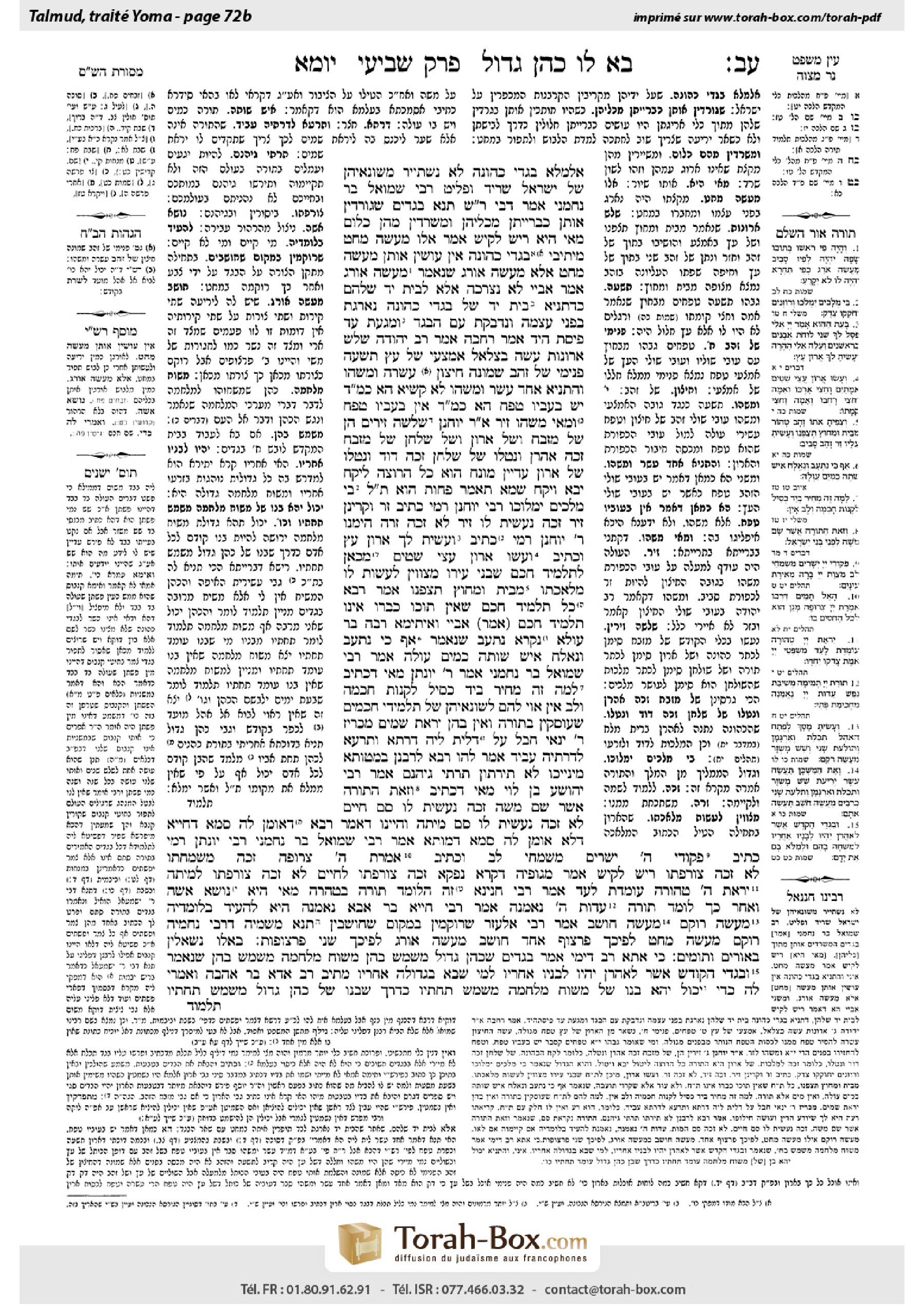
Yoma 72b: Talmud study for Daf Yomi
Daf Yomi is the daily study of one Talmud folio. Explore 37 tractates with scans, Hebrew text, Sefaria English and AI-generated French translations where annotated.
Passage selection and English or AI-generated French translation are available where the scan has annotations. Daf Study is independent of Torah-Box and Sefaria.
Browse Yoma · יומא · All tractatesYoma 72b text and translations
This page of Yoma includes the Aramaic text, an English translation and an AI-generated French translation, alongside the scan above.
יומא ע״ב ב · Aramaic and Hebrew text
אִלְמָלֵא בִּגְדֵי כְהוּנָּה, לֹא נִשְׁתַּיֵּיר מִשּׂוֹנְאֵיהֶן שֶׁל יִשְׂרָאֵל שָׂרִיד וּפָלִיט.
רַבִּי שְׁמוּאֵל בַּר נַחְמָנִי אָמַר: דְּבֵי רַבִּי שִׁמְעוֹן תָּנָא: בְּגָדִים שֶׁגּוֹרְדִין אוֹתָן כִּבְרִיָּיתָן מִכְּלֵיהֶן, וּמְשָׂרְדִין מֵהֶן כְּלוּם. מַאי הִיא? רֵישׁ לָקִישׁ אָמַר: אֵלּוּ מַעֲשֵׂה מַחַט.
מֵיתִיבִי: בִּגְדֵי כְהוּנָּה אֵין עוֹשִׂין אוֹתָן מַעֲשֵׂה מַחַט, אֶלָּא מַעֲשֵׂה אוֹרֵג, שֶׁנֶּאֱמַר: ״מַעֲשֵׂה אוֹרֵג״! אָמַר אַבָּיֵי: לֹא נִצְרְכָה אֶלָּא לְבֵית יָד שֶׁלָּהֶם. כִּדְתַנְיָא: בֵּית יָד שֶׁל בִּגְדֵי כְהוּנָּה נֶאֱרֶגֶת בִּפְנֵי עַצְמָהּ, וְנִדְבֶּקֶת עִם הַבֶּגֶד, וּמַגַּעַת עַד פִּיסַּת הַיָּד.
אָמַר רַחֲבָה אָמַר רַב יְהוּדָה: שָׁלֹשׁ אֲרוֹנוֹת עָשָׂה בְּצַלְאֵל, אֶמְצָעִי שֶׁל עֵץ תִּשְׁעָה, פְּנִימִי שֶׁל זָהָב שְׁמוֹנָה, חִיצוֹן עֲשָׂרָה וּמַשֶּׁהוּ.
וְהָתַנְיָא: אַחַד עָשָׂר וּמַשֶּׁהוּ! לָא קַשְׁיָא: הָא כְּמַאן דְּאָמַר יֵשׁ בְּעׇבְיוֹ טֶפַח, הָא כְּמַאן דְּאָמַר אֵין בְּעׇבְיוֹ טֶפַח. וּמַאי מַשֶּׁהוּ — זֵיר.
אָמַר רַבִּי יוֹחָנָן, שְׁלֹשָׁה זֵירִים הֵן: שֶׁל מִזְבֵּחַ, וְשֶׁל אָרוֹן, וְשֶׁל שֻׁלְחָן. שֶׁל מִזְבֵּחַ — זָכָה אַהֲרֹן וּנְטָלוֹ. שֶׁל שֻׁלְחָן — זָכָה דָּוִד וּנְטָלוֹ. שֶׁל אָרוֹן — עֲדַיִין מוּנָּח הוּא, כָּל הָרוֹצֶה לִיקַּח — יָבֹא וְיִקַּח. שְׁמָּא תֹּאמַר פָּחוּת הוּא, תַּלְמוּד לוֹמַר: ״בִּי מְלָכִים יִמְלוֹכוּ״.
רַבִּי יוֹחָנָן רָמֵי. כְּתִיב: ״זָר״, וְקָרֵינַן ״זֵיר״. זָכָה — נַעֲשֵׂית לוֹ זֵיר, לֹא זָכָה — זָרָה הֵימֶנּוּ.
רַבִּי יוֹחָנָן רָמֵי. כְּתִיב: ״וְעָשִׂיתָ לְּךָ אֲרוֹן עֵץ״, וּכְתִיב: ״וְעָשׂוּ אֲרוֹן עֲצֵי שִׁטִּים״, מִכָּאן לְתַלְמִיד חָכָם, שֶׁבְּנֵי עִירוֹ מְצֻוִּוין לַעֲשׂוֹת לוֹ מְלַאכְתּוֹ.
״מִבַּיִת וּמִחוּץ תְּצַפֶּנּוּ״. אָמַר רָבָא: כׇּל תַּלְמִיד חָכָם שֶׁאֵין תּוֹכוֹ כְּבָרוֹ — אֵינוֹ תַּלְמִיד חָכָם.
אָמַר אַבָּיֵי וְאִיתֵּימָא רַבָּה בַּר עוּלָּא: נִקְרָא נִתְעָב, שֶׁנֶּאֱמַר: ״אַף כִּי נִתְעָב וְנֶאֱלָח אִישׁ שׁוֹתֶה כַמַּיִם עַוְלָה״.
אָמַר רַבִּי שְׁמוּאֵל בַּר נַחְמָנִי אָמַר רַבִּי יוֹנָתָן, מַאי דִּכְתִיב: ״לָמָּה זֶּה מְחִיר בְּיַד כְּסִיל לִקְנוֹת חׇכְמָה וְלֶב אָיִן״ — אוֹי לָהֶם לְשׂוֹנְאֵיהֶן שֶׁל תַּלְמִידֵי חֲכָמִים, שֶׁעוֹסְקִין בַּתּוֹרָה וְאֵין בָּהֶן יִרְאַת שָׁמַיִם.
מַכְרִיז רַבִּי יַנַּאי: חֲבָל עַל דְּלֵית לֵיהּ דָּרְתָּא, וְתַרְעָא לְדָרְתֵּיהּ עָבֵיד.
אֲמַר לְהוּ רָבָא לְרַבָּנַן: בְּמָטוּתָא מִינַּיְיכוּ, לָא תִּירְתוּן תַּרְתֵּי גֵּיהִנָּם.
אָמַר רַבִּי יְהוֹשֻׁעַ בֶּן לֵוִי, מַאי דִּכְתִיב: ״וְזֹאת הַתּוֹרָה אֲשֶׁר שָׂם מֹשֶׁה״, זָכָה — נַעֲשֵׂית לוֹ סַם חַיִּים, לֹא זָכָה — נַעֲשֵׂית לוֹ סַם מִיתָה. וְהַיְינוּ דְּאָמַר רָבָא: דְּאוֹמֵן לַהּ — סַמָּא דְחַיָּיא, דְּלָא אוֹמֵן לַהּ — סַמָּא דְמוֹתָא.
אָמַר רַבִּי שְׁמוּאֵל בַּר נַחְמָנִי, רַבִּי יוֹנָתָן רָמֵי, כְּתִיב: ״פִּקּוּדֵי ה׳ יְשָׁרִים מְשַׂמְּחֵי לֵב״, וּכְתִיב: ״אִמְרַת ה׳ צְרוּפָה״. זָכָה — מְשַׂמַּחְתּוֹ, לֹא זָכָה — צוֹרַפְתּוֹ. רֵישׁ לָקִישׁ אָמַר, מִגּוּפֵיהּ דִּקְרָא נָפְקָא: זָכָה — צוֹרַפְתּוֹ לְחַיִּים, לֹא זָכָה — צוֹרַפְתּוֹ לְמִיתָה.
״יִרְאַת ה׳ טְהוֹרָה עוֹמֶדֶת לָעַד״. אָמַר רַבִּי חֲנִינָא: זֶה הַלּוֹמֵד תּוֹרָה בְּטָהֳרָה. מַאי הִיא? נוֹשֵׂא אִשָּׁה, וְאַחַר כָּךְ לוֹמֵד תּוֹרָה.
״עֵדוּת ה׳ נֶאֱמָנָה״, אָמַר רַבִּי חִיָּיא בַּר אַבָּא: נֶאֱמָנָה הִיא לְהָעִיד בְּלוֹמְדֶיהָ.
״מַעֲשֵׂה רוֹקֵם״, ״מַעֲשֵׂה חוֹשֵׁב״, אָמַר רַבִּי אֶלְעָזָר: שֶׁרוֹקְמִין בִּמְקוֹם שֶׁחוֹשְׁבִין.
תָּנָא מִשְּׁמֵיהּ דְּרַבִּי נְחֶמְיָה: ״רוֹקֵם״ — מַעֲשֵׂה מַחַט, לְפִיכָךְ פַּרְצוּף אֶחָד. ״חוֹשֵׁב״ — מַעֲשֵׂה אוֹרֵג, לְפִיכָךְ שְׁנֵי פַּרְצוּפוֹת.
בְּאֵלּוּ נִשְׁאָלִין בְּאוּרִים וְתוּמִּים. כִּי אֲתָא רַב דִּימִי, אָמַר: בְּגָדִים שֶׁכֹּהֵן גָּדוֹל מְשַׁמֵּשׁ בָּהֶן, מְשׁוּחַ מִלְחָמָה מְשַׁמֵּשׁ בָּהֶן, שֶׁנֶּאֱמַר: ״וּבִגְדֵי הַקּוֹדֶשׁ אֲשֶׁר לְאַהֲרֹן יִהְיוּ לְבָנָיו אַחֲרָיו״, לְמִי שֶׁבָּא בִּגְדוּלָּה אַחֲרָיו.
מֵתִיב רַב אַדָּא בַּר אַהֲבָה, וְאָמְרִי לַהּ כְּדִי: יָכוֹל יְהֵא בְּנוֹ שֶׁל מְשׁוּחַ מִלְחָמָה מְשַׁמֵּשׁ תַּחְתָּיו כְּדֶרֶךְ שֶׁבְּנוֹ שֶׁל כֹּהֵן גָּדוֹל מְשַׁמֵּשׁ תַּחְתָּיו —
Yoma 72b · English translation
He offers a homiletic interpretation: Were it not for the priestly vestments, which provide atonement for the Jewish people, there would not remain a remnant [sarid] or survivor from the haters of the Jewish people, a euphemism used to refer to the Jewish people themselves. Due to the atonement provided by the priestly vestments, a remnant [sarid] of the Jewish people does survive.
Another interpretation: Rabbi Shmuel bar Naḥmani said that the school of Rabbi Shimon taught: The priestly vestments are referred to as “serad garments” because they are garments that are woven in their completed form upon the loom, as opposed to weaving the material and then cutting and sewing pieces of the material together to create the required form, and then just a small part of them remains [masridin] which is not completed upon the loom. What is the remnant, the part that was not woven? Reish Lakish said: This is the needle-work required to complete the garment.
The Gemara raises an objection to this from a baraita: Priestly vestments should not be made through needle-work but though woven work, as it is stated: “Woven work” (Exodus 28:32). The Gemara answers that Abaye said: Reish Lakish’s statement is necessary only for, i.e., refers only to, the sleeves. As it was taught in a baraita: A sleeve made for the priestly vestments is woven separately and then attached to the garment by sewing, and the sleeve is made to reach as far as the palm of the hand. However, the main body of the garment must indeed be made exclusively though weaving.
§ The Gemara cites statements concerning other Temple vessels: Raḥava said that Rav Yehuda said: The Torah states that the Ark should be made of wood with gold plating inside and out (Exodus 25:10–11). In order to achieve this Bezalel made three arks: A middle one made of wood, whose height was nine handbreadths; an inner one made of gold, whose height was eight handbreadths; and an outer one of gold, whose height was ten handbreadths and a bit. These arks were nested.
The Gemara asks: But wasn’t it taught in a baraita that the outer ark was eleven handbreadths and a bit? The Gemara explains: This is not difficult: This statement in the baraita is in accordance with the one who said that the thickness of the gold plating was one handbreadth. According to this opinion, the outer ark’s base took up one handbreadth of its height, ten handbreadths were then needed to contain the middle ark within it, and then a bit more was needed so it could also contain the Ark’s cover. That statement of Rav Yehuda is in accordance with the one who said that the thickness of the gold plating was not one handbreadth but was a plate of gold of negligible thickness. According to this opinion, the outer ark needed to be only ten handbreadths and a bit and could still contain the outer ark and have room for the cover. And what is this additional bit? It is the ornamental crown on the edge of the outer ark.
Rabbi Yoḥanan said: There were three crowns on the sacred vessels in the Temple: The crown of the altar, and of the Ark, and of the table. The regal appearance they provided symbolized power and authority: The crown of the altar symbolized the crown of priesthood; Aaron was deserving and took it, and the priesthood continues exclusively through his descendants. The crown of the table symbolized the abundance and blessing associated with the crown of kingship; David was deserving and took it for himself and his descendants after him. The crown of the Ark symbolized the crown of Torah; it is still sitting and waiting to be acquired, and anyone who wishes to take it may come and take it and be crowned with the crown of Torah. Perhaps you will say it is inferior to the other two crowns and that is why nobody has taken it; therefore, the verse states about the wisdom of Torah: “Through me kings will reign” (Proverbs 8:15), indicating that the strength of the other crowns is derived from the crown of Torah, which is greater than them all.
§ The Gemara presents a number of statements based on the idea that the Ark symbolizes the Torah: Rabbi Yoḥanan raised a contradiction: According to the way the word crown is written in the Torah (Exodus 25:11), without vowels, it should be pronounced zar, meaning strange, but according to the traditional vocalization we read it as zeir, meaning crown. These two ways of understanding the word appear to contradict each other. Rabbi Yoḥanan explains: The two understandings apply to two different situations: If one is deserving by performing mitzvot, it becomes a crown [zeir] for him; but if one is not deserving, the Torah will be a stranger [zara] to him and he will forget his studies.
Rabbi Yoḥanan raised a contradiction: It is written: “And you shall make for yourself a wooden Ark” (Deuteronomy 10:1), implying that Moses alone was commanded to construct the Ark; and it is written: “And they shall make an Ark of acacia wood” (Exodus 25:10), implying that the Jewish people were all commanded to be involved in its construction. The apparent resolution to this contradiction is that although only Moses actually constructed the Ark, everyone was required to support the endeavor. So too, from here it is derived with regard to a Torah scholar that the members of his town should perform his work for him to support him and allow him to focus on his studies, since it is also the town’s responsibility to enable him to study.
The verse states concerning the Ark: “From within and from without you shall cover it” (Exodus 25:11). Rava said: This alludes to the idea that any Torah scholar whose inside is not like his outside, i.e., whose outward expression of righteousness is insincere, is not to be considered a Torah scholar.
Abaye said, and some say it was Rabba bar Ulla who said: Not only is such a person not to be considered a Torah scholar, but he is called loathsome, as it is stated: “What then of one loathsome and foul, man who drinks iniquity like water” (Job 15:16). Although he drinks the Torah like water, since he sins, his Torah is considered iniquitous and this makes him loathsome and foul.
Rabbi Shmuel bar Naḥmani said that Rabbi Yonatan said: What is the meaning of that which is written: “Why is there a price in the hand of a fool to buy wisdom, as he has no heart?” (Proverbs 17:16)? This expresses the following sentiment: Woe to them, haters of Torah scholars, a euphemism for the Torah scholars themselves, who immerse themselves in Torah and have no fear of Heaven. They are fools; they try to acquire the wisdom of Torah, but since they have no fear of Heaven in their hearts they lack the ability to do so.
Rabbi Yannai declared that the situation may be expressed by the following sentiment: Pity him who has no courtyard but senselessly makes a gate for his courtyard. Fear of Heaven is like the courtyard, and the study of Torah is the gate that provides entrance to the courtyard. The study of Torah is purposeful only if it leads to fear of Heaven.
Rava said to the Sages in the study hall: I beg of you, do not inherit Gehenna twice. By studying Torah without the accompanying fear of Heaven, not only are you undeserving of the World-to-Come, but even in this world you experience Gehenna, as you spend all your time in study and fail to benefit from worldly pleasure.
Rabbi Yehoshua ben Levi said: What is the meaning of that which is written: “And this is the Torah which Moses put [sam] before the children of Israel” (Deuteronomy 4:44)? The word sam is written with the letter sin and means put; it is phonetically similar to the word sam written with the letter samekh, meaning a drug. This use of this word therefore alludes to the following: If one is deserving, the Torah becomes a potion [sam] of life for him. If one is not deserving, the Torah becomes a potion of death for him. And this idea is what Rava said: For one who is skillful in his study of Torah and immerses himself in it with love, it is a potion of life; but for one who is not skillful in his studies, it is a potion of death.
Rabbi Shmuel bar Naḥmani said that Rabbi Yonatan raised a contradiction: It was written: “The precepts of the Lord are upright, gladdening the heart” (Psalms 19:9), but it is also written: “The word of the Lord is refining” (Psalms 18:31), which implies that the study of Torah can be a distressing process by which a person is refined like metal smelted in a smith’s fire. He reconciles these verses as follows: For one who is deserving, the Torah gladdens him; for one who is not deserving, it refines him. Reish Lakish said: This lesson emerges from that second verse itself: For one who is deserving, the Torah refines him for life; for one who is not deserving, it refines him for death.
The verse states: “Fear of the Lord is pure, it stands forever” (Psalms 19:10). Rabbi Ḥanina said: This is referring to one who studies Torah in purity; for such a person the Torah will remain with him forever. What is this; what does it mean to study in purity? One first marries a woman and afterward studies Torah. Since he is married, his heart will not be occupied with thoughts of sin, which could lead him to become impure.
In the same Psalm the verse states: “The testimony of God is faithful” (Psalms 19:8). Rabbi Ḥiyya bar Abba said: This alludes to the fact that the Torah is faithful to testify about those who study it and those who do not.
The Gemara returns to its discussion concerning the sacred vessels: The verse states with regard to the covers for the Tabernacle that they are “work of an embroiderer” (Exodus 26:36), and it also states they are “work of a designer” (Exodus 26:31). How can both descriptions be reconciled? Rabbi Elazar said: They embroidered the place where they had designed. They first marked a design on the material in paint, and then they embroidered it.
A Sage taught in the name of Rabbi Neḥemya: “Work of an embroiderer” refers to needlework, which therefore produces only one face. The design is made with a needle passing back and forth from both sides of the curtain, and consequently an identical parallel image, or one face, is formed on both sides. “Work of a designer” refers to woven work, which therefore produces two faces. Although formed together, the two sides of the material were not identical; for example, sometimes an eagle appeared on one side while a lion was on the other side.
§ It was taught in the mishna: When dressed in these eight garments, the High Priest may be consulted for the decision of the Urim VeTummim. When Rav Dimi came from Eretz Yisrael to Babylonia, he said: The garments in which the High Priest serves are also worn when the priest anointed for war serves. This priest is appointed to recite words of encouragement to the nation before it goes out to war (see Deuteronomy 20:2). As it is stated: “And the sacred garments of Aaron shall be for his sons after him” (Exodus 29:29), which is taken to refer to the one who comes after him in greatness, meaning the priest whose rank is one lower than the High Priest, i.e., the priest anointed for war.
Rav Adda bar Ahava raised an objection, and some say it unattributed: It is taught in a baraita: One might have thought that the son of the priest anointed for war serves in his place, i.e., he inherits the position, in the same way that the son of a High Priest serves in his place if he is fit for the job;
Yoma 72b · Traduction française (IA)
Il propose une interprétation homilétique : sans les vêtements sacerdotaux, qui assurent l’expiation du peuple juif, il ne resterait aucun survivant [sarid] parmi les ennemis du peuple juif, expression euphémistique désignant le peuple juif lui-même. Grâce à l’expiation assurée par les vêtements sacerdotaux, un survivant [sarid] du peuple juif subsiste.
Autre interprétation : Rabbi Shmuel bar Naḥmani dit que l’école de Rabbi Shimon enseignait : Les vêtements sacerdotaux sont appelés « vêtements de serad », car ils sont tissés sur le métier à tisser dans leur forme achevée, contrairement à un vêtement dont on tisse d’abord le tissu, puis dont on coupe et coud des morceaux pour obtenir la forme requise ; dans ce cas, seule une petite partie [masridin], qui n’est pas achevée sur le métier, reste à faire. Quelle est cette partie restante, celle qui n’a pas été tissée ? Reish Lakish dit : Il s’agit des travaux d’aiguille nécessaires pour achever le vêtement.
La Guemara soulève une objection à partir d’une baraïta : Les vêtements sacerdotaux ne doivent pas être confectionnés par des travaux d’aiguille, mais par tissage, comme il est dit : « Travail tissé » (Exode 28:32). La Guemara répond qu’Abaye dit : La déclaration de Reish Lakish ne concerne que les manches. En effet, il a été enseigné dans une baraïta : Une manche destinée aux vêtements sacerdotaux est tissée séparément, puis cousue au vêtement, et elle doit descendre jusqu’à la paume de la main. Cependant, le corps principal du vêtement doit bien être confectionné exclusivement par tissage.
§ La Guemara cite des déclarations concernant d’autres ustensiles du Temple : Raḥava dit au nom de Rav Yehuda : La Torah ordonne que l’Arche soit faite de bois et plaquée d’or à l’intérieur comme à l’extérieur (Exode 25:10–11). Pour ce faire, Betsalel fabriqua trois arches emboîtées : une arche centrale en bois, haute de neuf tefaḥim ; une arche intérieure en or, haute de huit tefaḥim ; et une arche extérieure en or, haute de dix tefaḥim et d’un peu plus.
La Guemara demande : Mais n’a-t-il pas été enseigné dans une baraïta que l’arche extérieure mesurait onze tefaḥim et un peu plus ? La Guemara explique : Il n’y a pas de contradiction. La déclaration de la baraïta correspond à l’opinion selon laquelle l’épaisseur du plaquage d’or était d’un tefaḥ. Selon cette opinion, le fond de l’arche extérieure occupait un tefaḥ de sa hauteur ; il fallait ensuite dix tefaḥim pour y loger l’arche centrale, puis un peu plus pour pouvoir aussi y placer le couvercle de l’Arche. La déclaration de Rav Yehuda correspond à l’opinion selon laquelle le plaquage d’or n’avait pas un tefaḥ d’épaisseur, mais consistait en une feuille d’or d’épaisseur négligeable. Selon cette opinion, l’arche extérieure ne devait mesurer que dix tefaḥim et un peu plus pour pouvoir contenir l’arche intérieure et laisser de la place au couvercle. Et quel est ce supplément ? C’est la couronne ornementale au bord de l’arche extérieure.
Rabbi Yoḥanan dit : Il y avait trois couronnes sur les ustensiles sacrés du Temple : celle de l’autel, celle de l’Arche et celle de la table. L’apparence royale qu’elles leur conféraient symbolisait le pouvoir et l’autorité. La couronne de l’autel symbolisait la couronne de la prêtrise : Aaron en était digne et l’a reçue, et la prêtrise se perpétue exclusivement parmi ses descendants. La couronne de la table symbolisait l’abondance et la bénédiction associées à la couronne de la royauté : David en était digne et l’a reçue pour lui-même et pour ses descendants après lui. La couronne de l’Arche symbolisait la couronne de la Torah : elle est toujours là, attendant d’être acquise, et quiconque souhaite la prendre peut venir la prendre et être couronné de la couronne de la Torah. Peut-être direz-vous qu’elle est inférieure aux deux autres couronnes, et que c’est pourquoi personne ne l’a prise. Le verset dit donc, au sujet de la sagesse de la Torah : « Par moi les rois règnent » (Proverbes 8:15), ce qui indique que la puissance des autres couronnes découle de la couronne de la Torah, qui les dépasse toutes.
§ La Guemara présente plusieurs déclarations fondées sur l’idée que l’Arche symbolise la Torah : Rabbi Yoḥanan soulève une contradiction. Selon la manière dont le mot « couronne » est écrit dans la Torah (Exode 25:11), sans voyelles, il devrait se prononcer zar, qui signifie « étranger », mais, selon la vocalisation traditionnelle, nous le lisons zeir, qui signifie « couronne ». Ces deux interprétations du mot semblent contradictoires. Rabbi Yoḥanan explique que chacune s’applique à une situation différente : si quelqu’un en est digne par l’accomplissement des mitsvot, elle devient pour lui une couronne [zeir] ; mais s’il n’en est pas digne, la Torah lui sera étrangère [zara] et il oubliera ses études.
Rabbi Yoḥanan soulève une contradiction : il est écrit : « Fais-toi une Arche de bois » (Deutéronome 10:1), ce qui implique que seul Moïse reçut l’ordre de construire l’Arche ; et il est écrit : « Ils feront une Arche en bois d’acacia » (Exode 25:10), ce qui implique que tout le peuple juif reçut l’ordre de participer à sa construction. La contradiction se résout ainsi : même si Moïse fut le seul à construire effectivement l’Arche, chacun devait contribuer à l’entreprise. De même, on déduit de là qu’à propos d’un érudit en Torah, les habitants de sa ville doivent accomplir son travail à sa place afin de le soutenir et de lui permettre de se consacrer à ses études, car il incombe aussi à la ville de lui permettre d’étudier.
Le verset dit au sujet de l’Arche : « Tu la recouvriras à l’intérieur et à l’extérieur » (Exode 25:11). Rava dit : Cela fait allusion à l’idée qu’un érudit en Torah dont l’intérieur n’est pas conforme à l’extérieur, c’est-à-dire dont la droiture affichée n’est pas sincère, ne doit pas être considéré comme un érudit en Torah.
Abaye dit — et certains disent que c’est Rabba bar Ulla qui l’a dit : une telle personne ne doit pas seulement être considérée comme un érudit en Torah ; elle est aussi qualifiée de répugnante, comme il est dit : « Combien plus l’homme répugnant et souillé, qui boit l’iniquité comme de l’eau » (Job 15:16). Bien qu’il boive la Torah comme de l’eau, puisqu’il pèche, sa Torah est considérée comme iniquité, ce qui le rend répugnant et souillé.
Rabbi Shmuel bar Naḥmani dit au nom de Rabbi Yonatan : Quel est le sens de ce qui est écrit : « Pourquoi le prix est-il dans la main d’un insensé pour acquérir la sagesse, alors qu’il n’a pas de cœur ? » (Proverbes 17:16). Cela exprime l’idée suivante : Malheur à eux, ennemis des érudits en Torah — expression euphémistique désignant les érudits en Torah eux-mêmes — qui s’immergent dans la Torah sans craindre le Ciel. Ce sont des insensés : ils tentent d’acquérir la sagesse de la Torah, mais, faute de crainte du Ciel dans leur cœur, ils en sont incapables.
Rabbi Yannai déclara que la situation peut s’exprimer ainsi : Malheur à celui qui n’a pas de cour, mais qui construit inutilement une porte pour sa cour. La crainte du Ciel est comme la cour, et l’étude de la Torah est la porte qui permet d’y entrer. L’étude de la Torah n’a de but que si elle conduit à la crainte du Ciel.
Rava dit aux Sages de la maison d’étude : Je vous en prie, ne recevez pas deux fois l’héritage de la Géhenne. En étudiant la Torah sans la crainte du Ciel qui doit l’accompagner, non seulement vous ne méritez pas le Monde à venir, mais vous faites aussi l’expérience de la Géhenne en ce monde, car vous passez tout votre temps à étudier et ne profitez pas des plaisirs de ce monde.
Rabbi Yehoshua ben Levi dit : Quel est le sens de ce qui est écrit : « Et voici la Torah que Moïse plaça [sam] devant les enfants d’Israël » (Deutéronome 4:44) ? Le mot sam s’écrit avec la lettre sin et signifie « placer » ; sa prononciation est semblable à celle du mot sam, écrit avec la lettre samekh, qui signifie « drogue ». Cet emploi du mot fait donc allusion à ce qui suit : si quelqu’un en est digne, la Torah devient pour lui une potion [sam] de vie ; s’il n’en est pas digne, la Torah devient pour lui une potion de mort. C’est aussi ce que disait Rava : pour celui qui étudie la Torah avec habileté et s’y plonge avec amour, elle est une potion de vie ; mais pour celui qui n’est pas habile dans ses études, elle est une potion de mort.
Rabbi Shmuel bar Naḥmani dit que Rabbi Yonatan souleva une contradiction : il est écrit : « Les préceptes du Seigneur sont droits, ils réjouissent le cœur » (Psaumes 19:9), mais il est aussi écrit : « La parole du Seigneur est éprouvée » (Psaumes 18:31), ce qui implique que l’étude de la Torah peut être une épreuve pénible, au cours de laquelle une personne est affinée comme un métal fondu dans le feu du forgeron. Il concilie ces versets ainsi : pour celui qui en est digne, la Torah le réjouit ; pour celui qui n’en est pas digne, elle l’éprouve. Reish Lakish dit que cet enseignement ressort de ce second verset lui-même : pour celui qui en est digne, la Torah l’affine pour la vie ; pour celui qui n’en est pas digne, elle l’affine pour la mort.
Le verset dit : « La crainte du Seigneur est pure, elle subsiste à jamais » (Psaumes 19:10). Rabbi Ḥanina dit : Cela désigne celui qui étudie la Torah dans la pureté ; pour une telle personne, la Torah demeurera à jamais. Que signifie étudier dans la pureté ? On épouse d’abord une femme, puis on étudie la Torah. Puisqu’il est marié, son esprit ne sera pas occupé par des pensées de péché, qui pourraient le conduire à devenir impur.
Dans le même psaume, le verset dit : « Le témoignage de Dieu est fidèle » (Psaumes 19:8). Rabbi Ḥiyya bar Abba dit : Cela fait allusion au fait que la Torah témoigne fidèlement au sujet de ceux qui l’étudient et de ceux qui ne l’étudient pas.
La Guemara revient à sa discussion sur les ustensiles sacrés : le verset dit au sujet des tentures du Tabernacle qu’elles sont un « ouvrage de brodeur » (Exode 26:36), et il dit aussi qu’elles sont un « ouvrage de dessinateur » (Exode 26:31). Comment concilier ces deux descriptions ? Rabbi Elazar dit : Ils brodaient là où ils avaient dessiné. Ils traçaient d’abord un motif à la peinture sur le tissu, puis le brodaient.
Un Sage enseigna au nom de Rabbi Neḥemya : « Ouvrage de brodeur » désigne un travail à l’aiguille, qui ne produit donc qu’une seule face. Le motif est réalisé à l’aide d’une aiguille qui passe d’un côté à l’autre de la tenture ; ainsi, une image identique apparaît sur les deux faces. « Ouvrage de dessinateur » désigne un ouvrage tissé, qui produit donc deux faces. Bien que formés ensemble, les deux côtés du tissu n’étaient pas identiques ; par exemple, un aigle apparaissait parfois d’un côté et un lion de l’autre.
§ La Michna enseignait que, lorsqu’il porte ces huit vêtements, le grand prêtre peut être consulté pour obtenir une décision au moyen des Ourim et des Toummim. Lorsque Rav Dimi vint de la terre d’Israël en Babylonie, il dit : Les vêtements dans lesquels le grand prêtre officie sont aussi portés par le prêtre oint pour la guerre lorsqu’il officie. Ce prêtre est désigné pour adresser des paroles d’encouragement au peuple avant qu’il ne parte à la guerre (voir Deutéronome 20:2). En effet, il est dit : « Les vêtements sacrés d’Aaron seront pour ses fils après lui » (Exode 29:29), ce qui est interprété comme désignant celui qui vient après lui en grandeur, c’est-à-dire le prêtre dont le rang est immédiatement inférieur à celui du grand prêtre : le prêtre oint pour la guerre.
Rav Adda bar Ahava souleva une objection — certains disent que celle-ci est anonyme : il est enseigné dans une baraïta : On aurait pu penser que le fils du prêtre oint pour la guerre officie à sa place, c’est-à-dire qu’il hérite de sa fonction, de la même manière que le fils d’un grand prêtre officie à sa place s’il est apte à exercer cette fonction ;
Traduction française générée par IA à partir de l’édition anglaise de Sefaria. Vérifie toujours un passage avec le texte source.
Text from Sefaria: William Davidson Edition - Vocalized Aramaic (CC BY NC); William Davidson Edition - English (CC BY NC).