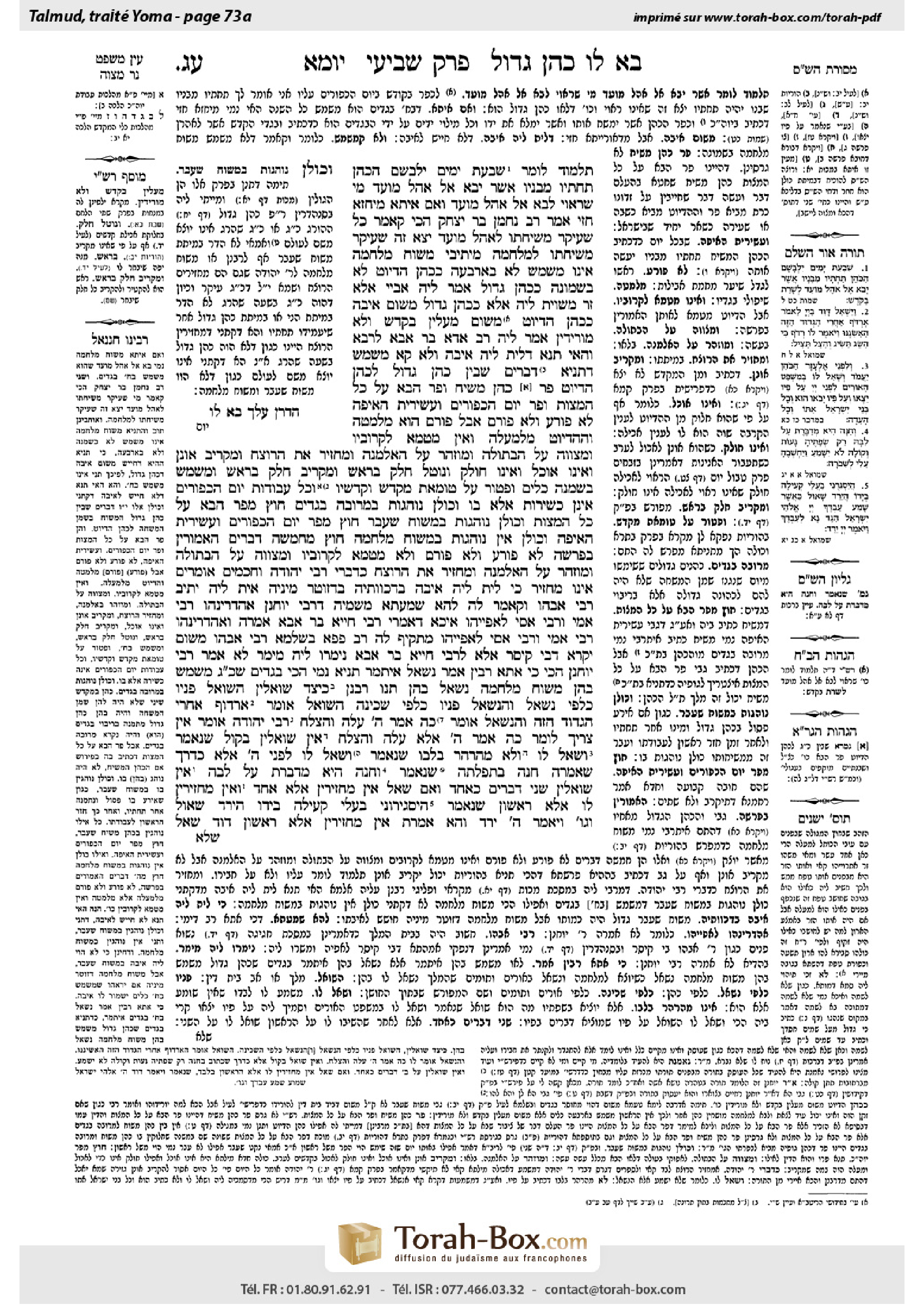
Yoma 73a: Talmud study for Daf Yomi
Daf Yomi is the daily study of one Talmud folio. Explore 37 tractates with scans, Hebrew text, Sefaria English and AI-generated French translations where annotated.
Passage selection and English or AI-generated French translation are available where the scan has annotations. Daf Study is independent of Torah-Box and Sefaria.
Browse Yoma · יומא · All tractatesYoma 73a text and translations
This page of Yoma includes the Aramaic text, an English translation and an AI-generated French translation, alongside the scan above.
יומא ע״ג א · Aramaic and Hebrew text
תַּלְמוּד לוֹמַר: ״שִׁבְעַת יָמִים יִלְבָּשָׁם הַכֹּהֵן תַּחְתָּיו מִבָּנָיו אֲשֶׁר יָבֹא אֶל אֹהֶל מוֹעֵד״, מִי שֶׁרָאוּי לָבֹא אֶל אֹהֶל מוֹעֵד. וְאִם אִיתָא — מִיחְזֵא חֲזֵי!
אָמַר רַב נַחְמָן בַּר יִצְחָק, הָכִי קָאָמַר: כׇּל שֶׁעִיקַּר מְשִׁיחָתוֹ לְאֹהֶל מוֹעֵד. יָצָא זֶה, שֶׁעִיקַּר מְשִׁיחָתוֹ לְמִלְחָמָה.
מֵיתִיבִי: מְשׁוּחַ מִלְחָמָה אֵינוֹ מְשַׁמֵּשׁ לֹא בְּאַרְבָּעָה כְּכֹהֵן הֶדְיוֹט, לֹא בִּשְׁמוֹנָה כְּכֹהֵן גָּדוֹל.
אֲמַר לֵיהּ אַבָּיֵי: אֶלָּא זָר מְשַׁוֵּית לֵיהּ! אֶלָּא: כְּכֹהֵן גָּדוֹל — מִשּׁוּם אֵיבָה, כְּכֹהֵן הֶדְיוֹט — מִשּׁוּם מַעֲלִין בַּקֹּדֶשׁ וְלֹא מוֹרִידִין.
אֲמַר לֵיהּ רַב אַדָּא בַּר אַבָּא לְרָבָא: וְהַאי תַּנָּא דְּלֵית לֵיהּ אֵיבָה, וְלָא קָא מְשַׁמֵּשׁ.
דְּתַנְיָא, דְּבָרִים שֶׁבֵּין כֹּהֵן גָּדוֹל לְכֹהֵן הֶדְיוֹט: פַּר כֹּהֵן מָשִׁיחַ, וּפַר הַבָּא עַל כׇּל הַמִּצְוֹת, וּפַר יוֹם הַכִּפּוּרִים, וַעֲשִׂירִית הָאֵיפָה.
לֹא פּוֹרֵעַ, וְלֹא פּוֹרֵם, אֲבָל פּוֹרֵם הוּא מִלְּמַטָּה, וְהַהֶדְיוֹט מִלְמַעְלָה. וְאֵין מִטַּמֵּא לִקְרוֹבָיו, וּמְצֻוֶּוה עַל הַבְּתוּלָה, וּמוּזְהָר עַל הָאַלְמָנָה, וּמַחֲזִיר אֶת הָרוֹצֵחַ.
וּמַקְרִיב אוֹנֵן, וְאֵינוֹ אוֹכֵל, וְאֵינוֹ חוֹלֵק, וְנוֹטֵל חֵלֶק בָּרֹאשׁ, וּמַקְרִיב חֵלֶק בָּרֹאשׁ. וּמְשַׁמֵּשׁ בִּשְׁמֹנָה כֵּלִים, וּפָטוּר עַל טוּמְאַת מִקְדָּשׁ וְקָדָשָׁיו, וְכׇל עֲבוֹדוֹת יוֹם הַכִּפּוּרִים אֵינָן כְּשֵׁירוֹת אֶלָּא בּוֹ.
וְכוּלָּן נוֹהֲגוֹת בִּמְרוּבֵּה בְּגָדִים, חוּץ מִפַּר הַבָּא עַל כׇּל הַמִּצְוֹת.
וְכוּלָּן נוֹהֲגוֹת בְּמָשׁוּחַ שֶׁעָבַר, חוּץ מִפַּר יוֹם הַכִּפּוּרִים וַעֲשִׂירִית הָאֵיפָה.
וְכוּלָּן אֵין נוֹהֲגוֹת בִּמְשׁוּחַ מִלְחָמָה, חוּץ מֵחֲמִשָּׁה דְּבָרִים הָאֲמוּרִין בַּפָּרָשָׁה: לֹא פּוֹרֵעַ, וְלֹא פּוֹרֵם, וְלֹא מִטַּמֵּא לִקְרוֹבָיו, וּמְצֻוֶּוה עַל הַבְּתוּלָה, וּמוּזְהָר עַל הָאַלְמָנָה, וּמַחְזִיר אֶת הָרוֹצֵחַ כְּדִבְרֵי רַבִּי יְהוּדָה, וַחֲכָמִים אוֹמְרִים: אֵינוֹ מַחְזִיר.
כִּי לֵית לֵיהּ אֵיבָה — בְּדִכְווֹתֵיהּ, בִּדְזוּטַר מִינֵּיהּ — אִית לֵיהּ.
יְתֵיב רַבִּי אֲבָהוּ וְקָאָמַר לַהּ לְהָא שְׁמַעְתָּא מִשְּׁמֵיהּ דְּרַבִּי יוֹחָנָן. אַהְדְּרִינְהוּ רַבִּי אַמֵּי וְרַבִּי אַסִּי לְאַפַּיְיהוּ. אִיכָּא דְּאָמְרִי, רַבִּי חִיָּיא בַּר אַבָּא אֲמַרָה, וְאַהְדְּרִינְהוּ רַבִּי אַמֵּי וְרַבִּי אַסִּי לְאַפַּיְיהוּ.
מַתְקֵיף לַהּ רַב פָּפָּא: בִּשְׁלָמָא רַבִּי אֲבָהוּ — מִשּׁוּם יְקָרָא דְבֵי קֵיסָר, אֶלָּא לְרַבִּי חִיָּיא בַּר אַבָּא — נֵימְרוּ לֵיהּ מֵימָר: לָא אָמַר רַבִּי יוֹחָנָן הָכִי.
כִּי אֲתָא רָבִין, אָמַר: נִשְׁאַל אִיתְּמַר. תַּנְיָא נָמֵי הָכִי: בְּגָדִים שֶׁכֹּהֵן גָּדוֹל מְשַׁמֵּשׁ בָּהֶן — מְשׁוּחַ מִלְחָמָה נִשְׁאָל בָּהֶן.
תָּנוּ רַבָּנַן: כֵּיצַד שׁוֹאֲלִין? הַשּׁוֹאֵל פָּנָיו כְּלַפֵּי נִשְׁאָל, וְהַנִּשְׁאָל פָּנָיו כְּלַפֵּי שְׁכִינָה.
הַשּׁוֹאֵל אוֹמֵר: ״אֶרְדּוֹף אַחֲרֵי הַגְּדוּד הַזֶּה״, וְהַנִּשְׁאָל אוֹמֵר: ״כֹּה אָמַר ה׳ עֲלֵה וְהַצְלַח״. רַבִּי יְהוּדָה אוֹמֵר: אֵין צָרִיךְ לוֹמַר ״כֹּה אָמַר ה׳״, אֶלָּא ״עֲלֵה וְהַצְלַח״.
אֵין שׁוֹאֲלִין בְּקוֹל, שֶׁנֶּאֱמַר: ״וְשָׁאַל לוֹ״. לֹא מְהַרְהֵר בְּלִבּוֹ, שֶׁנֶּאֱמַר: ״וְשָׁאַל לוֹ לִפְנֵי ה׳״, אֶלָּא כְּדֶרֶךְ שֶׁאָמְרָה חַנָּה בִּתְפִלָּתָהּ, שֶׁנֶּאֱמַר: ״וְחַנָּה הִיא מְדַבֶּרֶת עַל לִבָּהּ״.
אֵין שׁוֹאֲלִין שְׁנֵי דְבָרִים כְּאֶחָד. וְאִם שָׁאַל — אֵין מַחְזִירִין אֶלָּא אֶחָד, וְאֵין מַחְזִירִין לוֹ אֶלָּא רִאשׁוֹן, שֶׁנֶּאֱמַר: ״הֲיַסְגִּירוּנִי בַעֲלֵי קְעִילָה בְיָדוֹ הֲיֵרֵד שָׁאוּל וְגוֹ׳ וַיֹּאמֶר ה׳ יֵרֵד״. וְהָא אָמְרַתְּ אֵין מַחְזִירִין אֶלָּא רִאשׁוֹן! דָּוִד שָׁאַל
Yoma 73a · English translation
therefore, the verse states: “Seven days shall he wear them, the one who serves in his stead from among his sons, who comes into the Tent of Meeting to serve in the Sanctuary” (Exodus 29:30). The verse describes a son serving in the place of his father, indicating that the position is inherited. The conclusion of the verse implies that the rule that a son inherits his father’s position applies only to a High Priest who is fit to enter the Tent of Meeting, but not to the priest anointed for war. Based on this baraita, the following challenge is posed: And if it is so, since the priest anointed for war also serves wearing the same garments as the High Priest, he is also fit to enter the Tent of Meeting and should bequeath his position to his son.
Rav Naḥman bar Yitzḥak said that this is what the baraita is saying: The rule that a son inherits his father’s position applies to anyone for whom the primary purpose of his anointment is to come and serve in the Tent of Meeting. That excludes this priest for whom the primary purpose of his anointment is for war.
The Gemara raises an objection to Rav Dimi’s claim: It was taught in a baraita that the priest anointed for war serves neither in four garments, like a common priest, nor in eight garments, like a High Priest.
Abaye said to him: Would you make him like a non-priest? If he dresses like neither a High Priest nor a common priest, then effectively he is like a non-priest, but that is certainly not true. Rather, the meaning of the baraita is that the priest anointed for war does not dress like a High Priest due to the animosity that could be caused between him and the High Priest if they both wore similar garments. Therefore, although according to Torah law the priest anointed for war should dress like a High Priest, the Sages decreed that he should not, out of concern that animosity might result. And he does not dress like a common priest, due to the principle: One elevates to a higher level in matters of sanctity and one does not downgrade. Since the priest anointed for war attained the level of sanctity of a High Priest, he may not now be demoted to serve as an ordinary priest and dress accordingly.
Rav Adda bar Abba said to Rava: But there is this tanna of the following baraita who does not accept the concern of animosity as a reason to prevent one from wearing similar garments, and yet even according to him the priest anointed for war does not serve wearing the eight garments. Clearly, there must be a different reason.
As it was taught in a baraita: The matters in which there are differences between a High Priest and a common priest are as follows:
The bull of the anointed priest, also called the bull brought for all the mitzvot, which is brought for unwittingly deciding and following an erroneous halakhic ruling in a case for which one would be liable to receive the penalty of karet had he committed it intentionally;
And the bull of Yom Kippur;
And the tenth of an ephah that the High Priest offers each day.
Only the High Priest brings the above offerings.
In addition, when in mourning, a High Priest does not let his hair grow wild, nor does he rend his clothing in the way other mourners do. But he does rend his clothing from below, in a place that is not noticeable, while the common priest rends from above in the normal manner.
And he may not become ritually impure in the event of the death of his close relatives, but a common priest may.
And he is commanded to marry a virgin, and he is prohibited from marrying a widow, in contrast to a common priest who is prohibited to marry only a divorcee.
And his death allows the return of the accidental killer from the city of refuge.
And he sacrifices offerings even when he is an acute mourner, i.e., on the first day of his mourning, but he may not eat from the offerings on that day and he may not take a portion from them.
And he takes his portion first from any offering of his choice.
And he has the first right to sacrifice any offering he wants.
And he serves wearing eight garments.
And he is exempt from bringing an offering for unwittingly causing ritual impurity to the Temple and its sacred objects.
And all parts of the Yom Kippur service are valid only when performed by him.
And all these halakhot unique to the High Priest are not limited to one who was consecrated with anointing oil, but apply also to a High Priest of many garments. During the Second Temple period, when the oil used for anointing was no longer available for anointing High Priests, the High Priests were consecrated by virtue of wearing the eight garments. This is true except with regard to the bull brought for all the mitzvot, which is brought only by a High Priest consecrated with anointing oil.
And all these halakhot apply to a former High Priest who had been consecrated to substitute for a High Priest who had become disqualified. If the disqualification of the original High Priest is removed, he may return to his position. Although the substitute no longer serves as a High Priest, he retains the sanctity of a High Priest and the halakhot of the High Priest continue to apply to him. This is true except with regard to the sacrifice of the bull on Yom Kippur and the sacrifice of the tenth of an ephah each day.
And none of them applies to the priest anointed for war, except for the five items stated explicitly in the passage about the High Priest (Leviticus 21:10–15):
When in mourning, he does not let his hair grow wild nor does he rend his clothing in the way regular mourners do.
And he may not become ritually impure in the event of the death of his close relatives.
And he is commanded to marry a virgin, and he is prohibited from marrying a widow.
And his death allows the return of the accidental killer from the city of refuge, in accordance with the statement of Rabbi Yehuda in tractate Makkot (11a). And the Rabbis say: His death does not allow the return of the accidental killer from the city of refuge. The baraita teaches that a former High Priest also wears the eight garments of the High Priest. It is therefore apparent that the tanna of the baraita is not concerned about animosity which could be caused if the High Priest and the former High Priest wear similar garments. Despite this, the baraita agrees that the priest anointed for war does not wear the eight garments. This suggests that the reason for this is not out of concern that animosity might result.
The Gemara rejects this proof: When the High Priest has no animosity toward someone else wearing the same garments, it is only where that person is similar to him, such as a former High Priest who held the same rank. But toward someone inferior to him who wears the same garments, such as the priest anointed for war, he does feel animosity.
The Gemara relates: Rabbi Abbahu was sitting before the Sages and saying this halakha of Rav Dimi, that the priest anointed for war serves in the same garments as the High Priest, in the name of Rabbi Yoḥanan. Rabbi Ami and Rabbi Asi turned their faces away to show that they disagreed. Some say it was not Rabbi Abbahu but Rabbi Ḥiyya bar Abba who said it, and it was away from him that Rabbi Ami and Rabbi Asi turned their faces.
Rav Pappa strongly objects to the alternative account: Granted, if you say that Rabbi Abbahu reported the halakha, it is understandable that Rabbi Ami and Rabbi Asi did not state outright that they disagreed with him due to the honor of the house of the caesar, as Rabbi Abbahu was close to the government (see Ḥagiga 14a). But if the alternative account were true, then they should have said outright to Rabbi Ḥiyya bar Abba that they held that Rabbi Yoḥanan did not say this, since there would have been no reason not to have done so. Therefore, Rav Pappa claimed this account must be incorrect.
The Gemara cites an opinion that conflicts with that of Rav Dimi: When Ravin came from Eretz Yisrael to Babylonia he said: The teaching that the priest anointed for war wears the eight garments of the High Priest was stated only with regard to being consulted for the decision of the Urim VeTummim. To be consulted he must wear all eight garments; however, he never serves in them. That was also taught in a baraita: The garments in which the High Priest serves are also worn when the priest anointed for war is consulted for the decision of the Urim VeTummim.
§ The Sages taught: How does one consult the Urim VeTummim? The one asking stands with his face toward the one who is asked, i.e., the High Priest or the priest anointed for war. And the one who is asked, the High Priest, turns his face toward the Divine Presence, i.e., the Urim VeTummim, in which the explicit name of God is found, by tilting his head downward toward it.
The one who asks says his question, e.g.: “Shall I pursue after this troop?” (I Samuel 30:8). And the one who is asked answers him according to the response he receives and says, for example: Thus says God: Go up and succeed. Rabbi Yehuda says: He need not say the words: Thus says God; rather, it is sufficient to relay the content of the response and say: Go up and succeed, since he is obviously only repeating what he was told.
One does not ask in a loud voice, as it is stated: “And he shall stand before Elazar the priest, who shall inquire for him by the judgment of the Urim” (Numbers 27:21), which implies that the inquiry is to be audible only to the person asking. And he should not think his question in his heart but should enunciate it, as it is stated: “And…who shall inquire for him by the judgment of the Urim before God” (Numbers 27:21), and immediately afterward it states: “By his mouth” (Numbers 27:21). Rather, how shall he inquire? He should do so akin to the way that Hannah spoke in her prayer, as it is stated: “Now Hannah spoke in her heart; only her lips moved, but her voice could not be heard” (I Samuel 1:13), which indicates she did enunciate the words but spoke so quietly that no one else could hear.
One does not ask about two matters simultaneously; rather, one asks one question, and after he is answered he asks a second question. And even if he asks about two matters simultaneously, he is answered only with regard to one of them, and he is answered only with regard to the first question. As it is stated with regard to King David that he asked two questions simultaneously: “Will the men of Keilah deliver me into his hand? Will Saul come down?” (I Samuel 23:11). And he was answered with regard to only one: “And God said: He will come down.” (I Samuel 23:11). The Gemara asks: But didn’t you say that if one asks two questions, he is answered only with regard to the first question? Yet the verse states that David received an answer for his second question, not the first. The Gemara answers: David asked the questions
Yoma 73a · Traduction française (IA)
C’est pourquoi le verset dit : « Il les portera sept jours, celui de ses fils qui lui succédera, celui qui entrera dans la Tente d’assignation pour servir dans le Sanctuaire » (Exode 29:30). Le verset décrit un fils qui sert à la place de son père, ce qui indique que la fonction se transmet par héritage. La fin du verset implique que la règle selon laquelle un fils hérite de la fonction de son père ne s’applique qu’à un grand prêtre apte à entrer dans la Tente d’assignation, mais pas au prêtre oint pour la guerre. À partir de cette baraïta, on soulève la difficulté suivante : s’il en est ainsi, puisque le prêtre oint pour la guerre sert lui aussi avec les mêmes vêtements que le grand prêtre, il est également apte à entrer dans la Tente d’assignation et devrait transmettre sa fonction à son fils.
Rav Naḥman bar Yitzḥak dit que voici ce qu’enseigne la baraïta : la règle selon laquelle un fils hérite de la fonction de son père s’applique à toute personne dont l’onction a principalement pour but de venir servir dans la Tente d’assignation. Cela exclut ce prêtre, dont l’onction a principalement pour but la guerre.
La Guemara soulève une objection à l’affirmation de Rav Dimi : il a été enseigné dans une baraïta que le prêtre oint pour la guerre ne sert ni avec quatre vêtements, comme un prêtre ordinaire, ni avec huit vêtements, comme un grand prêtre.
Abayé lui dit : Le considérerais-tu comme un non-prêtre ? S’il ne s’habille ni comme un grand prêtre ni comme un prêtre ordinaire, il est en pratique semblable à un non-prêtre, ce qui est certainement faux. Le sens de la baraïta est plutôt que le prêtre oint pour la guerre ne s’habille pas comme un grand prêtre, en raison de l’animosité qui pourrait naître entre lui et le grand prêtre s’ils portaient des vêtements semblables. Ainsi, bien que, selon la Torah écrite, le prêtre oint pour la guerre doive s’habiller comme un grand prêtre, les Sages ont décrété qu’il ne le fasse pas, par crainte que cela ne suscite de l’animosité. Il ne s’habille pas non plus comme un prêtre ordinaire, en vertu du principe suivant : en matière de sainteté, on s’élève et l’on ne rétrograde pas. Puisque le prêtre oint pour la guerre a atteint le degré de sainteté d’un grand prêtre, il ne peut désormais être rétrogradé au rang de prêtre ordinaire et s’habiller en conséquence.
Rav Adda bar Abba dit à Rava : Pourtant, voici un tanna de la baraïta suivante qui ne retient pas la crainte de l’animosité comme motif pour interdire à quelqu’un de porter des vêtements semblables ; et pourtant, même selon lui, le prêtre oint pour la guerre ne sert pas avec les huit vêtements. Il doit donc y avoir une autre raison.
Car il a été enseigné dans une baraïta : voici les différences entre un grand prêtre et un prêtre ordinaire : Le taureau du prêtre oint, également appelé le taureau apporté pour toutes les mitsvot, qui est offert lorsqu’un homme rend par inadvertance une décision halakhique erronée et la suit, dans un cas où il aurait été passible de karet s’il avait agi intentionnellement ; le taureau de Yom Kippour ; et le dixième d’épha que le grand prêtre offre chaque jour. Seul le grand prêtre apporte les offrandes susmentionnées.
En outre, lorsqu’il est en deuil, un grand prêtre ne laisse pas pousser ses cheveux en désordre et ne déchire pas ses vêtements comme le font les autres endeuillés. Il déchire toutefois ses vêtements par le bas, à un endroit qui ne se voit pas, tandis que le prêtre ordinaire les déchire par le haut, comme il est d’usage. Il ne peut pas non plus devenir rituellement impur à la mort de ses proches parents, tandis qu’un prêtre ordinaire le peut. Il doit épouser une vierge, et il lui est interdit d’épouser une veuve, contrairement au prêtre ordinaire, à qui seul le mariage avec une femme divorcée est interdit. Et sa mort permet à l’homicide involontaire de quitter la ville de refuge.
Il offre des sacrifices même lorsqu’il est en deuil immédiat, c’est-à-dire le premier jour de son deuil, mais ce jour-là, il ne peut pas consommer les sacrifices ni en prendre une part. Il prend en premier sa part de toute offrande de son choix. Il a la priorité pour offrir tout sacrifice qu’il souhaite. Il sert avec huit vêtements. Il est dispensé d’apporter un sacrifice pour avoir causé involontairement une impureté rituelle au Temple et à ses objets sacrés. Et toutes les parties du service de Yom Kippour ne sont valides que si elles sont accomplies par lui.
Toutes ces halakhot propres au grand prêtre ne se limitent pas à celui qui a été consacré par l’huile d’onction : elles s’appliquent également à un grand prêtre consacré par le port des nombreux vêtements. À l’époque du Second Temple, lorsque l’huile utilisée pour oindre les grands prêtres n’était plus disponible, ceux-ci étaient consacrés par le port des huit vêtements. Cela vaut à l’exception du taureau apporté pour toutes les mitsvot, qui n’est offert que par un grand prêtre consacré par l’huile d’onction.
Toutes ces halakhot s’appliquent aussi à un ancien grand prêtre qui avait été consacré pour remplacer un grand prêtre devenu inapte. Si l’inaptitude du grand prêtre initial prend fin, celui-ci peut reprendre sa fonction. Bien que le remplaçant ne serve plus comme grand prêtre, il conserve la sainteté d’un grand prêtre, et les halakhot du grand prêtre continuent de s’appliquer à lui. Cela vaut à l’exception du sacrifice du taureau de Yom Kippour et du sacrifice quotidien du dixième d’épha.
Aucune de ces règles ne s’applique au prêtre oint pour la guerre, à l’exception des cinq éléments explicitement mentionnés dans le passage relatif au grand prêtre (Lévitique 21:10–15) : Lorsqu’il est en deuil, il ne laisse pas pousser ses cheveux en désordre et ne déchire pas ses vêtements comme le font les endeuillés ordinaires. Il ne peut pas non plus devenir rituellement impur à la mort de ses proches parents. Il doit épouser une vierge, et il lui est interdit d’épouser une veuve. Et sa mort permet à l’homicide involontaire de quitter la ville de refuge, conformément à l’avis de Rabbi Yehouda dans le traité Makot (11a). Les Rabbins disent : sa mort ne permet pas à l’homicide involontaire de quitter la ville de refuge. La baraïta enseigne qu’un ancien grand prêtre porte également les huit vêtements du grand prêtre. Il apparaît donc que le tanna de la baraïta ne craint pas l’animosité qui pourrait naître si le grand prêtre et l’ancien grand prêtre portaient des vêtements semblables. Malgré cela, la baraïta enseigne que le prêtre oint pour la guerre ne porte pas les huit vêtements. Cela suggère que la raison n’est pas la crainte que de l’animosité en résulte.
La Guemara rejette cette preuve : le grand prêtre n’éprouve aucune animosité envers quelqu’un d’autre qui porte les mêmes vêtements que lui que lorsque cette personne lui est comparable, comme un ancien grand prêtre qui avait le même rang. Mais il éprouve de l’animosité envers quelqu’un qui lui est inférieur et qui porte les mêmes vêtements, comme le prêtre oint pour la guerre.
La Guemara rapporte : Rabbi Abbahou était assis devant les Sages et leur enseignait, au nom de Rabbi Yoḥanan, cette halakha de Rav Dimi selon laquelle le prêtre oint pour la guerre sert avec les mêmes vêtements que le grand prêtre. Rabbi Ami et Rabbi Asi détournèrent le visage pour montrer leur désaccord. Certains disent que ce n’est pas Rabbi Abbahou, mais Rabbi Ḥiyya bar Abba qui l’enseignait, et que Rabbi Ami et Rabbi Asi détournèrent le visage de lui.
Rav Pappa formule une vive objection contre cette autre version : admettons que Rabbi Abbahou ait rapporté cette halakha ; on comprend alors que Rabbi Ami et Rabbi Asi n’aient pas déclaré ouvertement leur désaccord avec lui, par égard pour la maison de César, puisque Rabbi Abbahou était proche du pouvoir (voir Ḥagiga 14a). Mais si l’autre version était exacte, ils auraient dû dire ouvertement à Rabbi Ḥiyya bar Abba qu’ils estimaient que Rabbi Yoḥanan n’avait pas enseigné cela, puisqu’il n’y aurait eu aucune raison de s’en abstenir. Rav Pappa affirma donc que cette version devait être erronée.
La Guemara cite un avis contraire à celui de Rav Dimi : lorsque Ravin vint d’Eretz Israël en Babylonie, il dit que l’enseignement selon lequel le prêtre oint pour la guerre porte les huit vêtements du grand prêtre ne concerne que le cas où l’on consulte l’Ourim et le Toumim. Pour être consulté, il doit porter les huit vêtements ; toutefois, il ne sert jamais avec eux. Cela a également été enseigné dans une baraïta : les vêtements que porte le grand prêtre lorsqu’il sert sont également portés par le prêtre oint pour la guerre lorsqu’on le consulte au sujet de la décision de l’Ourim et du Toumim.
§ Les Sages enseignent : comment consulte-t-on l’Ourim et le Toumim ? Celui qui pose la question se tient face à celui qu’on interroge, c’est-à-dire le grand prêtre ou le prêtre oint pour la guerre. Celui qu’on interroge, le grand prêtre, tourne son visage vers la Présence divine, c’est-à-dire vers l’Ourim et le Toumim, où se trouve le Nom explicite de Dieu, en inclinant la tête vers eux.
Celui qui pose la question la formule, par exemple : « Dois-je poursuivre cette troupe ? » (I Samuel 30:8). Celui qu’on interroge lui répond selon la réponse qu’il reçoit et dit, par exemple : « Ainsi parle Dieu : Monte et réussis. » Rabbi Yehouda dit : il n’a pas besoin de prononcer les mots « Ainsi parle Dieu » ; il suffit de transmettre le contenu de la réponse et de dire : « Monte et réussis », puisqu’il ne fait manifestement que répéter ce qui lui a été dit.
On ne pose pas la question à voix haute, comme il est dit : « Il se tiendra devant Eléazar le prêtre, qui consultera pour lui le jugement de l’Ourim » (Nombres 27:21), ce qui implique que la consultation ne doit être audible que pour celui qui pose la question. Il ne doit pas non plus penser sa question en son cœur, mais la prononcer, comme il est dit : « Et […] qui consultera pour lui le jugement de l’Ourim devant Dieu » (Nombres 27:21), puis, juste après : « par sa bouche » (Nombres 27:21). Comment doit-il donc consulter ? Il doit le faire à la manière dont Hanna pria, comme il est dit : « Hanna parlait dans son cœur ; seuls ses lèvres remuaient, mais sa voix ne s’entendait pas » (I Samuel 1:13), ce qui indique qu’elle prononçait bien les mots, mais parlait si bas que personne d’autre ne pouvait l’entendre.
On ne pose pas simultanément deux questions ; on en pose une, puis, après avoir reçu une réponse, on en pose une seconde. Même s’il pose simultanément deux questions, on ne lui répond que sur l’une d’elles, et uniquement sur la première. En effet, au sujet du roi David, il est dit qu’il posa simultanément deux questions : « Les hommes de Keïla me livreront-ils entre ses mains ? Saül descendra-t-il ? » (I Samuel 23:11). Or, il ne reçut de réponse que sur l’une d’elles : « Et Dieu dit : Il descendra. » (I Samuel 23:11). La Guemara demande : mais n’as-tu pas dit que si quelqu’un pose deux questions, on ne lui répond que sur la première ? Pourtant, le verset indique que David reçut une réponse à sa seconde question, et non à la première. La Guemara répond : David posa les questions
Traduction française générée par IA à partir de l’édition anglaise de Sefaria. Vérifie toujours un passage avec le texte source.
Text from Sefaria: William Davidson Edition - Vocalized Aramaic (CC BY NC); William Davidson Edition - English (CC BY NC).