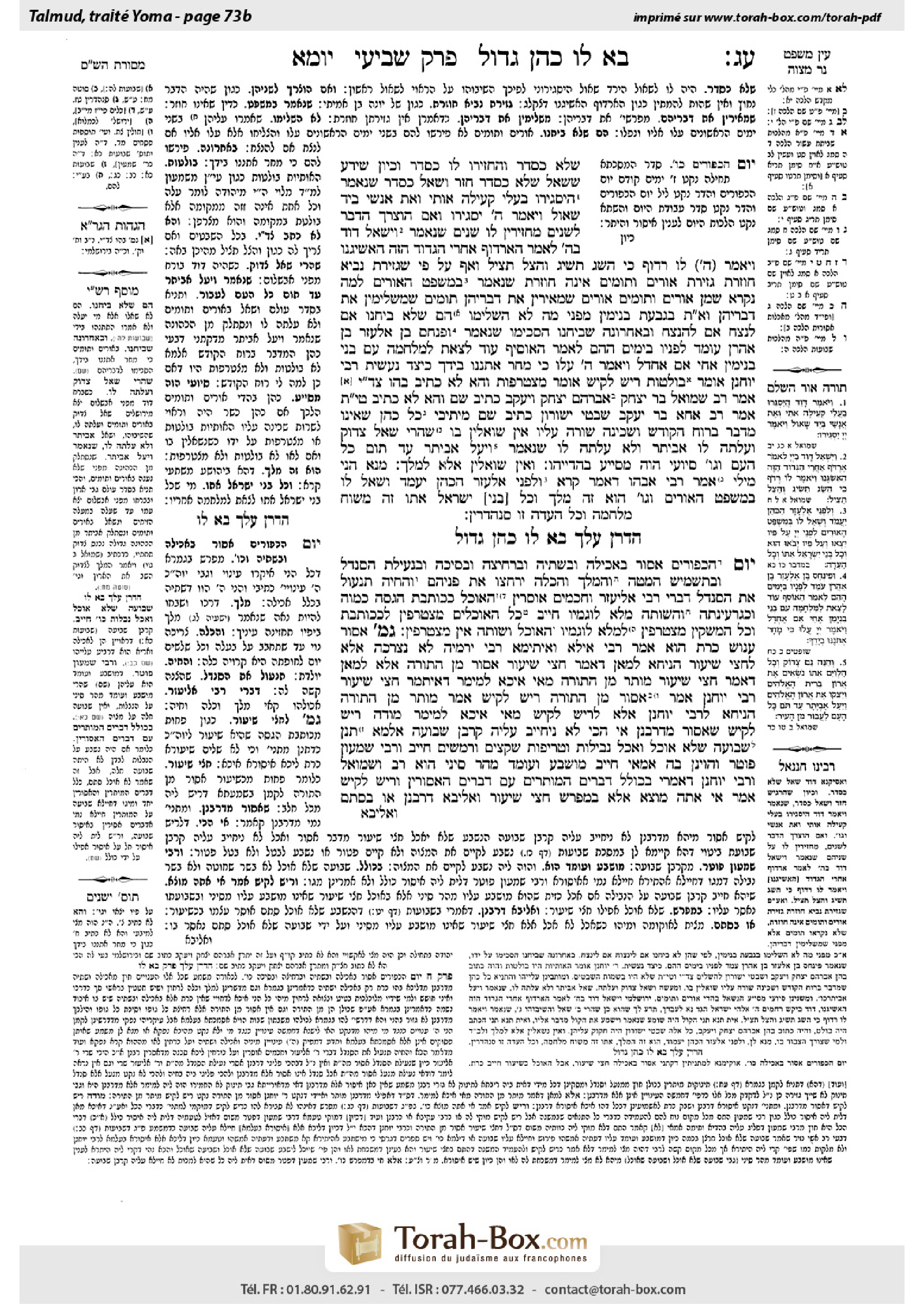
Yoma 73b: Talmud study for Daf Yomi
Daf Yomi is the daily study of one Talmud folio. Explore 37 tractates with scans, Hebrew text, Sefaria English and AI-generated French translations where annotated.
Passage selection and English or AI-generated French translation are available where the scan has annotations. Daf Study is independent of Torah-Box and Sefaria.
Browse Yoma · יומא · All tractatesYoma 73b text and translations
This page of Yoma includes the Aramaic text, an English translation and an AI-generated French translation, alongside the scan above.
יומא ע״ג ב · Aramaic and Hebrew text
שֶׁלֹּא כַּסֵּדֶר, וְהֶחְזִירוּ לוֹ כַּסֵּדֶר. וְכֵיוָן שֶׁיָּדַע שֶׁשָּׁאַל שֶׁלֹּא כַּסֵּדֶר, חָזַר וְשָׁאַל כַּסֵּדֶר, שֶׁנֶּאֱמַר: ״הֲיַסְגִּירוּ בַּעֲלֵי קְעִילָה אוֹתִי וְאֶת אֲנָשַׁי בְּיַד שָׁאוּל וַיֹּאמֶר ה׳ יַסְגִּירוּ״.
וְאִם הוּצְרַךְ הַדָּבָר לִשְׁנַיִם — מַחְזִירִין לוֹ שְׁנַיִם, שֶׁנֶּאֱמַר: ״וַיִּשְׁאַל דָּוִד בַּה׳ לֵאמֹר הַאֶרְדּוֹף אַחֲרֵי הַגְּדוּד הַזֶּה הַאַשִּׂיגֶנּוּ וַיֹּאמֶר (ה׳) לוֹ רְדוֹף כִּי הַשֵּׂג תַּשִּׂיג וְהַצֵּל תַּצִּיל״.
וְאַף עַל פִּי שֶׁגְּזֵירַת נָבִיא חוֹזֶרֶת — גְּזֵירַת אוּרִים וְתוּמִּים אֵינָהּ חוֹזֶרֶת, שֶׁנֶּאֱמַר: ״בְּמִשְׁפַּט הָאוּרִים״.
לָמָּה נִקְרָא שְׁמָן אוּרִים וְתוּמִּים? ״אוּרִים״ — שֶׁמְּאִירִין אֶת דִּבְרֵיהֶן, ״תּוּמִּים״ — שֶׁמַּשְׁלִימִין אֶת דִּבְרֵיהֶן.
וְאִם תֹּאמַר: בְּגִבְעַת בִּנְיָמִין מִפְּנֵי מָה לֹא הִשְׁלִימוּ?
הֵם שֶׁלֹּא בִּיחֲנוּ אִם לְנַצֵּחַ אִם לְהִנָּצֵחַ, וּבָאַחֲרוֹנָה שֶׁבִּיחֲנוּ הִסְכִּימוּ, שֶׁנֶּאֱמַר: ״וּפִנְחָס בֶּן אֶלְעָזָר בֶּן אַהֲרֹן עוֹמֵד לְפָנָיו בַּיָּמִים הָהֵם לֵאמֹר הַאוֹסִיף עוֹד לָצֵאת לַמִּלְחָמָה עִם בְּנֵי בִנְיָמִין אָחִי אִם אֶחְדָּל וַיֹּאמֶר ה׳ עֲלוּ כִּי מָחָר אֶתְּנֶנּוּ בְיָדֶךָ״.
כֵּיצַד נַעֲשֵׂית? רַבִּי יוֹחָנָן אוֹמֵר: בּוֹלְטוֹת. רֵישׁ לָקִישׁ אוֹמֵר: מִצְטָרְפוֹת.
וְהָא לָא כְּתִיב בְּהוּ צָדִי? אָמַר רַב שְׁמוּאֵל בַּר יִצְחָק: ״אַבְרָהָם יִצְחָק וְיַעֲקֹב״ כְּתִיב שָׁם. וְהָא לָא כְּתִיב טֵית! אָמַר רַב אַחָא בַּר יַעֲקֹב: ״שִׁבְטֵי יְשׁוּרוּן״ כְּתִיב שָׁם.
מֵיתִיבִי: כׇּל כֹּהֵן שֶׁאֵינוֹ מְדַבֵּר בְּרוּחַ הַקּוֹדֶשׁ וּשְׁכִינָה שׁוֹרָה עָלָיו אֵין שׁוֹאֲלִין בּוֹ, שֶׁהֲרֵי שָׁאַל צָדוֹק וְעָלְתָה לוֹ, אֶבְיָתָר וְלֹא עָלְתָה לוֹ, שֶׁנֶּאֱמַר: ״וַיַּעַל אֶבְיָתָר עַד תּוֹם כׇּל הָעָם וְגוֹ׳״!
סַיּוֹעֵי הֲוָה מְסַיַּיע בַּהֲדַיְיהוּ.
וְאֵין שׁוֹאֲלִין אֶלָּא לְמֶלֶךְ. מְנָא הָנֵי מִילֵּי? אָמַר רַבִּי אֲבָהוּ, דְּאָמַר קְרָא: ״וְלִפְנֵי אֶלְעָזָר הַכֹּהֵן יַעֲמֹד וְשָׁאַל לוֹ בְּמִשְׁפַּט הָאוּרִים וְגוֹ׳״. ״הוּא״ — זֶה מֶלֶךְ, ״וְכׇל [בְּנֵי] יִשְׂרָאֵל אִתּוֹ״ — זֶה מְשׁוּחַ מִלְחָמָה, ״וְכׇל הָעֵדָה״ — זוֹ סַנְהֶדְרִין.
הֲדַרַן עֲלָךְ בָּא לוֹ כֹּהֵן גָּדוֹל
מַתְנִי׳ יוֹם הַכִּפּוּרִים אָסוּר בַּאֲכִילָה וּבִשְׁתִיָּה וּבִרְחִיצָה וּבְסִיכָה וּבִנְעִילַת הַסַּנְדָּל, וּבְתַשְׁמִישׁ הַמִּטָּה. וְהַמֶּלֶךְ וְהַכַּלָּה יִרְחֲצוּ אֶת פְּנֵיהֶם, וְהַחַיָּה תִּנְעוֹל אֶת הַסַּנְדָּל, דִּבְרֵי רַבִּי אֱלִיעֶזֶר. וַחֲכָמִים אוֹסְרִין.
הָאוֹכֵל כְּכוֹתֶבֶת הַגַּסָּה, כָּמוֹהָ וּכְגַרְעִינָתָהּ, וְהַשּׁוֹתֶה מְלֹא לוּגְמָיו — חַיָּיב. כׇּל הָאוֹכָלִים מִצְטָרְפִין לְכַכּוֹתֶבֶת, וְכׇל הַמַּשְׁקִין מִצְטָרְפִין לִמְלֹא לוּגְמָיו. הָאוֹכֵל וְשׁוֹתֶה אֵין מִצְטָרְפִין.
גְּמָ׳ אָסוּר?! עָנוּשׁ כָּרֵת הוּא! אָמַר רַבִּי אִילָא, וְאִיתֵּימָא רַבִּי יִרְמְיָה: לֹא נִצְרְכָה אֶלָּא לַחֲצִי שִׁיעוּר.
הָנִיחָא לְמַאן דְּאָמַר חֲצִי שִׁיעוּר אָסוּר מִן הַתּוֹרָה, אֶלָּא לְמַאן דְּאָמַר חֲצִי שִׁיעוּר מוּתָּר מִן הַתּוֹרָה, מַאי אִיכָּא לְמֵימַר?
דְּאִיתְּמַר חֲצִי שִׁיעוּר, רַבִּי יוֹחָנָן אָמַר: אָסוּר מִן הַתּוֹרָה, רֵישׁ לָקִישׁ אָמַר: מוּתָּר מִן הַתּוֹרָה. הָנִיחָא לְרַבִּי יוֹחָנָן, אֶלָּא לְרֵישׁ לָקִישׁ מַאי אִיכָּא לְמֵימַר? מוֹדֶה רֵישׁ לָקִישׁ שֶׁאָסוּר מִדְּרַבָּנַן.
אִי הָכִי, לָא נִיחַיַּיב עֲלֵיהּ קׇרְבַּן שְׁבוּעָה, אַלְּמָא תְּנַן: שְׁבוּעָה שֶׁלֹּא אוֹכַל, וְאָכַל נְבֵילוֹת וּטְרֵיפוֹת שְׁקָצִים וּרְמָשִׂים — חַיָּיב. וְרַבִּי שִׁמְעוֹן פּוֹטֵר.
וְהָוֵינַן בַּהּ: אַמַּאי חַיָּיב? מוּשְׁבָּע וְעוֹמֵד מֵהַר סִינַי הוּא? רַב וּשְׁמוּאֵל וְרַבִּי יוֹחָנָן דְּאָמְרִי: בְּכוֹלֵל דְּבָרִים הַמּוּתָּרִים עִם דְּבָרִים הָאֲסוּרִין.
וְרֵישׁ לָקִישׁ אָמַר: אִי אַתָּה מוֹצֵא אֶלָּא בִּמְפָרֵשׁ חֲצִי שִׁיעוּר, וְאַלִּיבָּא דְרַבָּנַן, אוֹ בִּסְתָם,
Yoma 73b · English translation
out of order and he was answered in order. He should have asked first whether Saul would come down, and afterward what the people of Keilah would do. And once he realized that he had asked out of order he went back and asked in order, as it is stated immediately afterward: “Will the men of Keilah deliver me and my men into the hand of Saul? And God said: They will deliver you” (I Samuel 23:12).
But if the matter is urgent and requires asking two questions simultaneously, there being no time to follow the standard protocol, one may ask both questions simultaneously and he is answered with regard to the two questions together, as it is stated: “And David asked of God, saying: Shall I pursue after this troop? Will I overtake them? And He answered him: Pursue, for you will surely overtake them, and will surely rescue” (I Samuel 30:8).
The Gemara notes the reliability of the Urim VeTummim: Even though a decree of a prophet can be retracted, as sometimes a dire prophecy is stated as a warning and does not come true, a decree of the Urim VeTummim cannot be retracted. As it is stated: “By the judgment of the Urim” (Numbers 27:21). The use of the term judgment suggests that the decree is as final as a judicial decision.
Why is it called Urim VeTummim? Urim, which is based on the word or, light, is so called because it illuminates and explains its words. Tummim, which is based on the word tam, completed, is because it fulfills its words, which always come true.
And if you say: In the battles following the incidents in Gibeah of Benjamin (Judges 19–20), why did the Urim VeTummim not fulfill its words? The Jewish People consulted the Urim VeTummim three times with regard to their decision to attack the tribe of Benjamin, and each time they were instructed to go to battle. However, the first two times they were defeated and only on the third attempt were they successful. Is this not proof that the UrimVeTummim does not always fulfill its words?
The Gemara answers: The first two times they did not check with the Urim VeTummim whether they would be victorious or be defeated but only inquired how and whether they should go to battle. Had they asked, they indeed would have been told that they would not succeed. But on the last time, when they did check and inquire whether they would be successful, the UrimVeTummim agreed with them that they should go to battle and that they would succeed, as it is stated: “And Pinehas, the son of Elazar, the son of Aaron, stood before it in those days, saying: Shall I yet again go out to battle against the children of Benjamin my brother, or shall I cease? And God said: Go up, for tomorrow I will deliver him into your hand” (Judges 20:28).
How is it done? How does the Urim VeTummim provide an answer? The names of the twelve tribes were engraved upon the stones of the breastplate. These letters allowed for the answer to be received. Rabbi Yoḥanan says: The letters of the answer protrude, and the priest then combines those letters to form words in order to ascertain the message. Reish Lakish says: The letters rearrange themselves and join together to form words.
The Gemara asks: How was it possible to receive an answer to every question? But the letter tzadi is not written within the names of the twelve tribes engraved on the breastplate’s stones. Rav Shmuel bar Yitzḥak said: The names Abraham, Isaac, and Jacob were also written there. The name Yitzḥak, Isaac, contains the letter tzadi. The Gemara asks again: But surely the letter tet was not written on the breastplate, since it is not found in the names of the Patriarchs nor in the names of the twelve tribes. Rav Aḥa bar Ya’akov said: Shivtei Yeshurun, the tribes of Jeshurun, was also written there. The word shivtei, tribes, contains the letter tet. In this way the entire alphabet was represented.
The Gemara raises an objection from a baraita: Any priest who does not speak with Divine Spirit and upon whom the Divine Presence does not rest is not consulted to inquire of the Urim VeTummim. As Zadok inquired of the Urim VeTummim and it was effective for him, and he received an answer; but Ebiathar inquired and it was not effective for him, and he did not receive an answer. As it is stated: “But Ebiathar went up until all the people had finished” (II Samuel 15:24), which is taken to mean that he was removed from the High Priesthood since the Divine Spirit had departed from him.
The Gemara asks: If it is true that the letters of the breastplate protrude or even join together to form the answer, why does the High Priest need the Divine Spirit and Divine Presence to be with him? And if he has the Divine Spirit and Divine Presence with him, why does he need the Urim VeTummim? The Gemara answers: The Divine Spirit assisted the Urim VeTummim. In other words, the letters formed the answer only if the High Priest himself was worthy, but his divine inspiration was not great enough to provide an answer without them.
§ It was taught in the mishna: And the High Priest may be consulted for the decision of the Urim VeTummim only on behalf of the king, or on behalf of the president of the court, or on behalf of one whom the community needs. From where are these matters derived? Rabbi Abbahu said that the verse states: “And he shall stand before Elazar the priest, who shall inquire for him by the judgment of the Urim before God; by his mouth they shall go out, and by his mouth they shall come in, both he and all the children of Israel with him, even all the congregation” (Numbers 27:21). Each phrase describes a different circumstance in which the Urim VeTummim may be consulted: “He”; this is a reference to a king, as “he” refers to Joshua, who had the status of a king. “All the children of Israel with him”; this is a reference to the priest anointed for war, as all of the Jewish people follow him to war according to his instruction. “Even all the congregation”; this is a reference to the Sanhedrin, who are the heads of the Jewish people.
MISHNA: On Yom Kippur, the day on which there is a mitzva by Torah law to afflict oneself, it is prohibited to engage in eating and in drinking, and in bathing, and in smearing oil on one’s body, and in wearing shoes, and in conjugal relations. However, the king, in deference to his eminence, and a new bride within thirty days of her marriage, who wishes to look especially attractive at the beginning of her relationship with her husband, may wash their faces on Yom Kippur. A woman after childbirth, who is suffering, may wear shoes because going barefoot causes her pain. This is the statement of Rabbi Eliezer. The Rabbis prohibit these activities for a king, a new bride, and a woman after childbirth.
The mishna elaborates: One who eats a large date-bulk of food, equivalent to a date and its pit, or who drinks a cheekful of liquid on Yom Kippur is liable to receive the punishment of karet for failing to fulfill the mitzva to afflict oneself on Yom Kippur. All foods that one eats join together to constitute a date-bulk; and all liquids that one drinks join together to constitute a cheekful. However, if one eats and drinks, the food and beverage do not join together to constitute a measure that determines liability, as each is measured separately.
GEMARA: The Gemara expresses surprise at the mishna’s terminology, which states that it is prohibited to eat and drink on Yom Kippur. Why does the mishna use the word prohibited, which indicates that these activities are only sinful? It is, after all, punishable by karet if he eats, and the mishna should have used the more accurate word liable. Rabbi Ila said, and some say that Rabbi Yirmeya said: This term is needed only for a half-measure, meaning that if one eats less than the amount that incurs the punishment of karet, he still violates a prohibition.
The Gemara asks: This explanation works out well according to the one who said that a half-measure is prohibited by Torah law even though it does not incur a punishment. But according to the one who says that a half-measure is permitted by Torah law, and that it is the Sages who prohibit eating less than a full measure, what is there to say about the terminology?
The Gemara explains: as it was stated that amora’im debated the nature of a half-measure of a forbidden substance: Rabbi Yoḥanan said: It is prohibited by Torah law, and the Torah prohibits even a minute amount of forbidden substance. Reish Lakish said: It is permitted by Torah law. This explanation works out well according to the opinion of Rabbi Yoḥanan. However, according to the opinion of Reish Lakish, what can be said? The Gemara answers: Reish Lakish concedes that a half-measure is prohibited by rabbinic law. If so, Reish Lakish, too, will say that eating or drinking a half-measure is prohibited on Yom Kippur, by rabbinic law.
The Gemara asks: If so, if according to Reish Lakish there is a rabbinic prohibition to eat a half-measure, one should not be liable to bring an offering for breaking an oath to eat a half-measure of forbidden foods. Why, then, did we learn in a mishna otherwise: He who swore the following oath, an oath that I will not eat, and then ate unslaughtered animal carcasses, tereifot, reptiles, or creeping animals, he is liable to bring an offering for violating his oath. Rabbi Shimon exempts him.
And we discussed it: Why should he be liable for breaking an oath? He was already sworn and obligated at Mount Sinai, along with the rest of the Jewish people, not to eat these things. According to halakha, an oath does not take effect if it contradicts a previously existing oath. The second oath to not eat has no effect in terms of eating forbidden foods, so why should one be liable for breaking it? Rav, and Shmuel, and Rabbi Yoḥanan say with regard to this: Here we are dealing with a case where one includes permitted foods with forbidden foods. This means that had one sworn only not to eat unslaughtered animal carcasses or tereifot and then ate them, he would not be liable for breaking the oath because he was already sworn not to eat those foods. However, if one swore not to eat at all, his oath takes effect on permitted foods. Consequently, if he eats any food he is liable.
And Reish Lakish said: The only application of this mishna you will find is in a case where one explicitly says that he will not eat a half-measure, and this is in accordance with the opinion of the Rabbis. They say that when one swears that he will not eat, he prohibits himself only from eating a whole measure of food. If he eats a half-measure, he has not violated a prohibition. Therefore, in order for a half-measure to be prohibited, he needs to specify this in his oath. Or, you find it in the case of one who makes no specification at all of a half-measure,
Yoma 73b · Traduction française (IA)
dans le désordre, et il reçut une réponse dans l’ordre. Il aurait dû demander d’abord si Saül allait descendre, puis ce que feraient les habitants de Qeïla. Lorsqu’il comprit qu’il avait posé ses questions dans le désordre, il revint en arrière et les posa dans l’ordre, comme il est écrit immédiatement après : « Les hommes de Qeïla me livreront-ils, moi et mes hommes, entre les mains de Saül ? Et Dieu dit : Ils te livreront » (I Samuel 23, 12).
Mais si la situation est urgente et qu’il faut poser deux questions simultanément, faute de temps pour suivre la procédure habituelle, on peut poser les deux questions en même temps et recevoir une réponse concernant les deux à la fois, comme il est écrit : « David consulta Dieu en ces termes : Dois-je poursuivre cette troupe ? L’atteindrai-je ? Il lui répondit : Poursuis-la, car tu l’atteindras et tu délivreras certainement les captifs » (I Samuel 30, 8).
La Guemara relève la fiabilité des Ourim ve-Toumim : même si un décret prophétique peut être révoqué — car il arrive qu’une prophétie funeste soit prononcée à titre d’avertissement sans se réaliser —, un décret des Ourim ve-Toumim ne peut pas être révoqué. En effet, il est écrit : « Selon le jugement des Ourim » (Nombres 27, 21). L’emploi du terme « jugement » suggère que le décret est aussi définitif qu’une décision judiciaire.
Pourquoi les appelle-t-on Ourim ve-Toumim ? Ourim, qui vient du mot or, « lumière », est ainsi appelé parce qu’il éclaire et explique ses paroles. Toumim, qui vient du mot tam, « achevé », porte ce nom parce qu’il accomplit ses paroles, qui se réalisent toujours.
Et si tu objectes : lors des batailles qui suivirent les événements de Guibéa de Benjamin (Juges 19–20), pourquoi les Ourim ve-Toumim n’ont-ils pas accompli leurs paroles ? Le peuple juif consulta trois fois les Ourim ve-Toumim au sujet de sa décision d’attaquer la tribu de Benjamin, et chaque fois il reçut l’instruction de partir au combat. Pourtant, les deux premières fois, il fut vaincu, et ce n’est qu’à la troisième tentative qu’il l’emporta. N’est-ce pas la preuve que les Ourim ve-Toumim n’accomplissent pas toujours leurs paroles ?
La Guemara répond : les deux premières fois, ils ne consultèrent pas les Ourim ve-Toumim pour savoir s’ils seraient victorieux ou vaincus ; ils demandèrent seulement comment et s’ils devaient partir au combat. S’ils avaient demandé s’ils réussiraient, on leur aurait effectivement répondu qu’ils n’y parviendraient pas. Mais la dernière fois, lorsqu’ils consultèrent les Ourim ve-Toumim pour savoir s’ils réussiraient, ceux-ci leur confirmèrent qu’ils devaient partir au combat et qu’ils l’emporteraient, comme il est écrit : « Pinhas, fils d’Éléazar, fils d’Aaron, se tenait devant lui en ces jours-là et disait : Dois-je encore une fois partir au combat contre les fils de Benjamin, mon frère, ou dois-je m’arrêter ? Et Dieu dit : Monte, car demain je le livrerai entre tes mains » (Juges 20, 28).
Comment cela se passe-t-il ? Comment les Ourim ve-Toumim fournissent-ils une réponse ? Les noms des douze tribus étaient gravés sur les pierres du pectoral. Ces lettres permettaient de recevoir la réponse. Rabbi Yoḥanan dit : les lettres de la réponse ressortaient, et le prêtre les assemblait ensuite pour former des mots afin de comprendre le message. Reish Lakish dit : les lettres se réarrangeaient et se rejoignaient pour former des mots.
La Guemara demande : comment était-il possible de recevoir une réponse à chaque question ? Or, la lettre tsadi ne figure pas dans les noms des douze tribus gravés sur les pierres du pectoral. Rav Shmuel bar Yitzḥak dit : les noms Abraham, Isaac et Jacob y étaient également inscrits. Le nom Yitzḥak, Isaac, contient la lettre tsadi. La Guemara demande encore : mais la lettre tet ne figurait certainement pas sur le pectoral, puisqu’elle ne se trouve ni dans les noms des Patriarches ni dans ceux des douze tribus. Rav Aḥa bar Ya’akov dit : l’expression Shivtei Yeshurun, « les tribus de Yeshouroun », y était également inscrite. Le mot shivtei, « tribus », contient la lettre tet. Ainsi, tout l’alphabet était représenté.
La Guemara soulève une objection à partir d’une baraïta : on ne consulte un prêtre au sujet des Ourim ve-Toumim que s’il parle sous l’inspiration divine et que la Présence divine repose sur lui. Ainsi, Tsadoq consulta les Ourim ve-Toumim, qui furent efficaces pour lui, et il reçut une réponse ; mais Ebiatar les consulta sans succès et ne reçut pas de réponse. En effet, il est écrit : « Mais Ebiatar monta jusqu’à ce que tout le peuple ait achevé » (II Samuel 15, 24), ce qui est compris comme signifiant qu’il fut écarté de la grande prêtrise, car l’inspiration divine l’avait quitté.
La Guemara demande : s’il est vrai que les lettres du pectoral ressortent, ou même s’assemblent pour former la réponse, pourquoi le grand prêtre a-t-il besoin que l’inspiration divine et la Présence divine soient avec lui ? Et s’il bénéficie de l’inspiration divine et de la Présence divine, pourquoi a-t-il besoin des Ourim ve-Toumim ? La Guemara répond : l’inspiration divine assistait les Ourim ve-Toumim. Autrement dit, les lettres ne formaient la réponse que si le grand prêtre lui-même en était digne ; cependant, son inspiration divine n’était pas assez grande pour fournir une réponse sans elles.
§ Il a été enseigné dans la Michna : on ne peut consulter le grand prêtre au sujet d’une décision des Ourim ve-Toumim qu’au nom du roi, du président du tribunal ou d’une personne dont la communauté a besoin. D’où tire-t-on ces règles ? Rabbi Abbahu dit que le verset énonce : « Il se tiendra devant Éléazar le prêtre, qui consultera pour lui le jugement des Ourim devant Dieu ; sur son ordre, ils partiront et sur son ordre, ils reviendront, lui et tous les enfants d’Israël avec lui, toute la communauté » (Nombres 27, 21). Chaque expression décrit une situation différente où l’on peut consulter les Ourim ve-Toumim : « Lui » fait référence à un roi, car « lui » désigne Josué, qui avait le statut de roi. « Tous les enfants d’Israël avec lui » fait référence au prêtre oint pour la guerre, puisque tout le peuple juif le suit à la guerre selon ses instructions. « Toute la communauté » fait référence au Sanhédrin, qui représente les chefs du peuple juif.
Michna : À Yom Kippour, jour où la Torah impose la mitsva de s’affliger, il est interdit de manger, de boire, de se laver, de s’enduire le corps d’huile, de porter des chaussures et d’avoir des relations conjugales. Toutefois, le roi, par égard pour sa dignité, et une jeune mariée, pendant les trente jours qui suivent son mariage, qui souhaite paraître particulièrement belle au début de sa relation avec son mari, peuvent se laver le visage à Yom Kippour. Une femme après l’accouchement, qui souffre, peut porter des chaussures, car marcher pieds nus lui fait mal. Telle est l’opinion de Rabbi Eliezer. Les Sages interdisent ces pratiques au roi, à la jeune mariée et à la femme après l’accouchement.
La Michna précise : celui qui mange l’équivalent du volume d’une datte, noyau compris, ou qui boit à Yom Kippour une quantité de liquide pouvant remplir une joue est passible de karet pour ne pas avoir accompli la mitsva de s’affliger à Yom Kippour. Tous les aliments que l’on mange s’additionnent pour atteindre le volume d’une datte ; tous les liquides que l’on boit s’additionnent pour remplir une joue. En revanche, si l’on mange et que l’on boit, les aliments et les boissons ne s’additionnent pas pour atteindre une mesure entraînant la responsabilité, car ils sont mesurés séparément.
Guemara : La Guemara s’étonne de la terminologie de la Michna, qui dit qu’il est interdit de manger et de boire à Yom Kippour. Pourquoi la Michna emploie-t-elle le mot « interdit », qui indique que ces actes ne sont que des fautes ? Après tout, celui qui mange est passible de karet, et la Michna aurait dû employer le terme plus exact « passible ». Rabbi Ila dit — et certains disent que c’est Rabbi Yirmeya qui l’a dit : ce terme n’est nécessaire que pour une demi-mesure, c’est-à-dire que si l’on mange moins que la quantité entraînant la peine de karet, on transgresse tout de même une interdiction.
La Guemara demande : cette explication convient bien selon celui qui dit qu’une demi-mesure est interdite par la Torah, même si elle n’entraîne pas de peine. Mais selon celui qui dit qu’une demi-mesure est permise par la Torah et que ce sont les Sages qui interdisent de manger moins qu’une mesure entière, comment expliquer cette terminologie ?
La Guemara explique : les amoraïm ont débattu de la nature d’une demi-mesure d’une substance interdite. Rabbi Yoḥanan dit : elle est interdite par la Torah, qui interdit même une quantité infime d’une substance interdite. Reish Lakish dit : elle est permise par la Torah. Cette explication convient selon l’opinion de Rabbi Yoḥanan. Mais que peut-on dire selon l’opinion de Reish Lakish ? La Guemara répond : Reish Lakish reconnaît qu’une demi-mesure est interdite par la loi rabbinique. Si tel est le cas, Reish Lakish aussi dira que manger ou boire une demi-mesure est interdit à Yom Kippour par la loi rabbinique.
La Guemara demande : si tel est le cas, si, selon Reish Lakish, il est interdit par la loi rabbinique de manger une demi-mesure, on ne devrait pas être tenu d’apporter un sacrifice pour avoir enfreint un serment de ne pas manger une demi-mesure d’aliments interdits. Pourquoi avons-nous donc appris le contraire dans une Michna : celui qui a prêté le serment suivant — « Je jure que je ne mangerai pas » — puis a mangé des carcasses d’animaux non abattus rituellement, des animaux téréfa, des reptiles ou des animaux rampants, est tenu d’apporter un sacrifice pour avoir enfreint son serment. Rabbi Shimon l’en dispense.
Et nous avons discuté de ce cas : pourquoi serait-il tenu d’apporter un sacrifice pour avoir enfreint son serment ? Il avait déjà prêté serment et s’était engagé au mont Sinaï, comme le reste du peuple juif, à ne pas manger ces aliments. Selon la halakha, un serment ne prend pas effet s’il contredit un serment antérieur. Le second serment de ne pas manger n’a donc aucun effet concernant la consommation d’aliments interdits ; pourquoi serait-on alors tenu d’apporter un sacrifice pour l’avoir enfreint ? Rav, Shmuel et Rabbi Yoḥanan disent à ce sujet : il s’agit ici d’un cas où la personne inclut les aliments permis avec les aliments interdits. Cela signifie que si elle avait juré uniquement de ne pas manger de carcasses d’animaux non abattus rituellement ou d’animaux téréfa, puis les avait mangés, elle ne serait pas tenue d’apporter un sacrifice pour avoir enfreint son serment, puisqu’elle était déjà liée par un serment de ne pas manger ces aliments. Cependant, si elle a juré de ne rien manger du tout, son serment prend effet pour les aliments permis. Par conséquent, si elle mange quoi que ce soit, elle est tenue d’apporter un sacrifice.
Et Reish Lakish dit : la seule manière d’appliquer cette Michna est de se trouver dans un cas où la personne déclare explicitement qu’elle ne mangera pas une demi-mesure, conformément à l’opinion des Sages. Ils disent que lorsqu’on jure de ne pas manger, on s’interdit seulement de manger une mesure entière d’aliments. Si l’on mange une demi-mesure, on n’a transgressé aucune interdiction. Par conséquent, pour qu’une demi-mesure soit interdite, il faut le préciser dans son serment. On peut aussi appliquer la Michna au cas d’une personne qui ne précise aucunement la question d’une demi-mesure,
Traduction française générée par IA à partir de l’édition anglaise de Sefaria. Vérifie toujours un passage avec le texte source.
Text from Sefaria: William Davidson Edition - Vocalized Aramaic (CC BY NC); William Davidson Edition - English (CC BY NC).