Yoma 74b: Talmud study for Daf Yomi
Daf Yomi is the daily study of one Talmud folio. Explore 37 tractates with scans, Hebrew text, Sefaria English and AI-generated French translations where annotated.
Passage selection and English or AI-generated French translation are available where the scan has annotations. Daf Study is independent of Torah-Box and Sefaria.
Browse Yoma · יומא · All tractatesYoma 74b text and translations
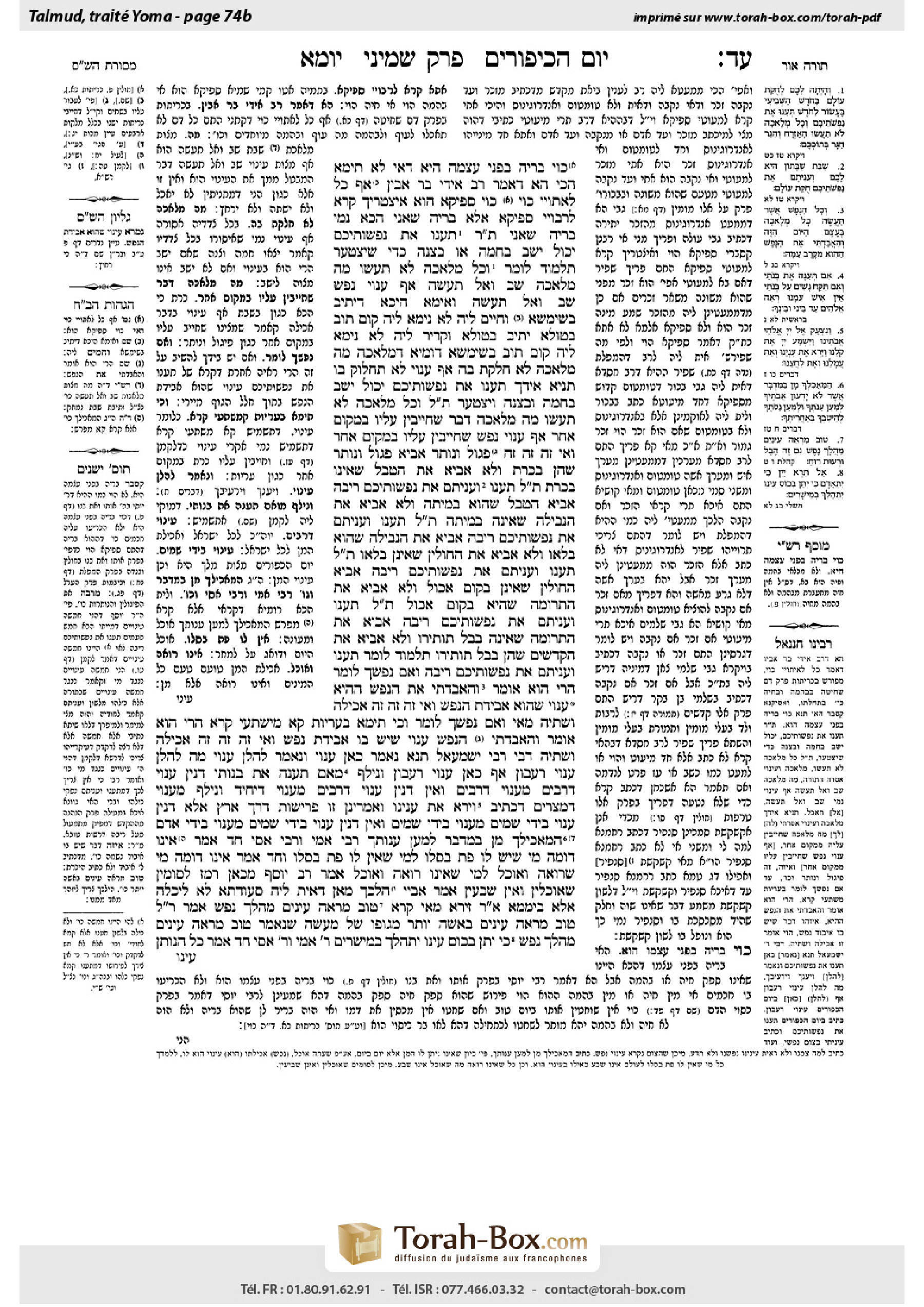
This page of Yoma includes the Aramaic text, an English translation and an AI-generated French translation, alongside the scan above.
יומא ע״ד ב · Aramaic and Hebrew text
כּוֹי בְּרִיָּה בִּפְנֵי עַצְמָהּ הִיא. דְּאִי לָא תֵּימָא הָכִי, הָא דְּאָמַר רַב אִידִי בַּר אָבִין: אַף ״כׇּל״ לְאֵתוֹיֵי כּוֹי, כּוֹי סְפֵיקָא הוּא, אִיצְטְרִיךְ קְרָא לְרַבּוֹיֵי סְפֵיקָא? אֶלָּא בְּרִיָּה שָׁאנֵי, הָכָא נָמֵי בְּרִיָּה שָׁאנֵי.
תָּנוּ רַבָּנַן: ״תְּעַנּוּ אֶת נַפְשׁוֹתֵיכֶם״, יָכוֹל יֵשֵׁב בַּחַמָּה אוֹ בַּצִּנָּה כְּדֵי שֶׁיִּצְטַעֵר — תַּלְמוּד לוֹמַר: ״וְכׇל מְלָאכָה לֹא תַעֲשׂוּ״. מָה מְלָאכָה שֵׁב וְאַל תַּעֲשֶׂה, אַף עִנּוּי נֶפֶשׁ שֵׁב וְאַל תַּעֲשֶׂה.
וְאֵימָא: הֵיכָא דְּיָתֵיב בְּשִׁימְשָׁא וְחָיֵים לֵיהּ לָא נֵימָא לֵיהּ קוּם תּוּב בְּטוּלָּא, יָתֵיב בְּטוּלָּא וְקָרֵיר לֵיהּ לָא נֵימָא לֵיהּ קוּם תּוּב בְּשִׁימְשָׁא! דּוּמְיָא דִּמְלָאכָה: מָה מְלָאכָה לֹא חִלַּקְתָּ בָּהּ, אַף עִנּוּי לֹא תַּחְלוֹק בּוֹ.
תַּנְיָא אִידַּךְ: ״תְּעַנּוּ אֶת נַפְשׁוֹתֵיכֶם״, יָכוֹל יֵשֵׁב בַּחַמָּה וּבַצִּנָּה וְיִצְטַעֵר — תַּלְמוּד לוֹמַר: ״וְכׇל מְלָאכָה לֹא תַעֲשׂוּ״, מָה מְלָאכָה דָּבָר שֶׁחַיָּיבִין עָלָיו בִּמְקוֹם אַחֵר, אַף עִנּוּי נֶפֶשׁ שֶׁחַיָּיבִין עָלָיו בִּמְקוֹם אַחֵר, וְאִי זֶה זֶה? זֶה פִּגּוּל וְנוֹתָר.
אָבִיא פִּגּוּל וְנוֹתָר שֶׁהֵן בְּכָרֵת, וְלֹא אָבִיא אֶת הַטֶּבֶל שֶׁאֵינוֹ בְּכָרֵת, תַּלְמוּד לוֹמַר: ״תְּעַנּוּ״, ״וְעִנִּיתֶם אֶת נַפְשׁוֹתֵיכֶם״ — רִיבָּה.
אָבִיא הַטֶּבֶל שֶׁהוּא בְּמִיתָה וְלֹא אָבִיא אֶת הַנְּבֵילָה שֶׁאֵינָהּ בְּמִיתָה — תַּלְמוּד לוֹמַר: ״תְּעַנּוּ״, ״וְעִנִּיתֶם אֶת נַפְשׁוֹתֵיכֶם״ — רִיבָּה.
אָבִיא אֶת הַנְּבֵילָה שֶׁהוּא בְּלָאו, וְלֹא אָבִיא אֶת הַחוּלִּין שֶׁאֵינָן בְּלָאו? תַּלְמוּד לוֹמַר: ״תְּעַנּוּ״, ״וְעִנִּיתֶם אֶת נַפְשׁוֹתֵיכֶם״ — רִיבָּה.
אָבִיא הַחוּלִּין שֶׁאֵינָן בְּקוּם אֱכוֹל, וְלֹא אָבִיא אֶת הַתְּרוּמָה שֶׁהִיא בְּקוּם אֱכוֹל, תַּלְמוּד לוֹמַר: ״תְּעַנּוּ״, ״וְעִנִּיתֶם אֶת נַפְשׁוֹתֵיכֶם״ — רִיבָּה. אָבִיא אֶת הַתְּרוּמָה שֶׁאֵינָהּ בְּבַל תּוֹתִירוּ, וְלֹא אָבִיא אֶת הַקֳּדָשִׁים שֶׁהֵן בְּבַל תּוֹתִירוּ, תַּלְמוּד לוֹמַר: ״תְּעַנּוּ״, ״וְעִנִּיתֶם אֶת נַפְשׁוֹתֵיכֶם״ — רִיבָּה.
וְאִם נַפְשְׁךָ לוֹמַר, הֲרֵי הוּא אוֹמֵר: ״וְהַאֲבַדְתִּי אֶת הַנֶּפֶשׁ הַהִיא״, עִנּוּי שֶׁהוּא אֲבֵידַת הַנֶּפֶשׁ, וְאֵי זֶה זֶה? זֶה אֲכִילָה וּשְׁתִיָּה.
מַאי ״וְאִם נַפְשְׁךָ לוֹמַר״? וְכִי תֵּימָא: בַּעֲרָיוֹת קָא מִישְׁתַּעֵי קְרָא, — הֲרֵי הוּא אוֹמֵר: ״וְהַאֲבַדְתִּי הַנֶּפֶשׁ״, עִנּוּי שֶׁיֵּשׁ בּוֹ אֲבֵידַת נֶפֶשׁ, וְאֵי זֶה זֶה? זֶה אֲכִילָה וּשְׁתִיָּה.
דְּבֵי רַבִּי יִשְׁמָעֵאל תָּנָא: נֶאֱמַר כָּאן עִנּוּי, וְנֶאֱמַר לְהַלָּן עִנּוּי. מָה לְהַלָּן עִנּוּי רְעָבוֹן, אַף כָּאן עִנּוּי רְעָבוֹן.
וְנֵילַף מֵ״אִם תְּעַנֶּה אֶת בְּנוֹתַי״? דָּנִין עִנּוּי דְּרַבִּים מֵעִנּוּי דְּרַבִּים, וְאֵין דָּנִין עִנּוּי דְּרַבִּים מֵעִנּוּי דְּיָחִיד.
וְנֵילַף מֵעִנּוּי דְּמִצְרַיִם, דִּכְתִיב: ״וַיַּרְא אֶת עׇנְיֵנוּ״, וְאָמְרִינַן: זוֹ פְּרִישׁוּת דֶּרֶךְ אֶרֶץ! אֶלָּא: דָּנִין עִנּוּי בִּידֵי שָׁמַיִם מֵעִנּוּי בִּידֵי שָׁמַיִם, וְאֵין דָּנִין עִנּוּי בִּידֵי שָׁמַיִם מֵעִנּוּי בִּידֵי אָדָם.
״הַמַּאֲכִילְךָ מָן בַּמִּדְבָּר ... לְמַעַן עַנּוֹתְךָ״? רַבִּי אַמֵּי וְרַבִּי אַסִּי, חַד אָמַר: אֵינוֹ דּוֹמֶה מִי שֶׁיֵּשׁ לוֹ פַּת בְּסַלּוֹ לְמִי שֶׁאֵין לוֹ פַּת בְּסַלּוֹ, וְחַד אָמַר: אֵינוֹ דּוֹמֶה מִי שֶׁרוֹאֶה וְאוֹכֵל לְמִי שֶׁאֵינוֹ רוֹאֶה וְאוֹכֵל.
אָמַר רַב יוֹסֵף: מִכָּאן רֶמֶז לְסוֹמִין, שֶׁאוֹכְלִין וְאֵין שְׂבֵעִין. אָמַר אַבָּיֵי: הִלְכָּךְ, מַאן דְּאִית לֵיהּ סְעוֹדְתָּא לָא לֵיכְלַהּ אֶלָּא בִּימָמָא. אֲמַר רַבִּי זֵירָא, מַאי קְרָא: ״טוֹב מַרְאֵה עֵינַיִם מֵהֲלׇךְ נָפֶשׁ״. אָמַר רֵישׁ לָקִישׁ: טוֹב מַרְאֵה עֵינַיִם בְּאִשָּׁה יוֹתֵר מִגּוּפוֹ שֶׁל מַעֲשֶׂה, שֶׁנֶּאֱמַר: ״טוֹב מַרְאֵה עֵינַיִם מֵהֲלׇךְ נָפֶשׁ״.
״כִּי יִתֵּן בַּכּוֹס עֵינוֹ יִתְהַלֵּךְ בְּמֵישָׁרִים״, רַבִּי אַמֵּי וְרַבִּי אַסִּי, חַד אָמַר: כׇּל הַנּוֹתֵן
Yoma 74b · English translation
that a koy is its own species, and the uncertainty pertains not only to whether it is a wild or domestic animal, but also to whether it even can fit into one of those two categories. For if you do not say so and maintain that it might be its own species, how can we understand that which Rav Idi bar Avin said, that also the word “all” stated in the verse: “All blood you may not eat, whether of birds or of beasts” (Leviticus 7:26), comes to include the koy. Now, if you say that the koy is a case of uncertainty, is a verse necessary to include an uncertainty? Rather, the koy is obviously its own species, and therefore it is different and needs a special verse to include it. Here too, in the case of the forbidden fat, we could say that the koy is its own species, and therefore it is different. Consequently, Reish Lakish’s opinion cannot be proven by this baraita.
§ After clarifying the wording of the mishna, the Gemara brings a halakhic midrash to analyze the mishna’s laws. The Sages taught: The verse states: “And this shall be a statute to you forever: In the seventh month on the tenth day of the month you shall afflict your souls” (Leviticus 16:29). I might have thought that one should sit in the sun or in the cold to suffer and afflict his soul; therefore the continuation of the verse states: “And you shall not do any labor, the home-born, or the stranger that lives among you” (Leviticus 16:29). This teaches that just as prohibited labor is a mitzva that requires one to sit and do nothing, as one is commanded to refrain from action, so too, affliction of one’s soul is also a mitzva requiring one to sit and do nothing. One is not commanded to be proactive in order to afflict his soul. Rather, one must refrain from specified actions such as eating and drinking.
The Gemara asks: And say that it means that when one sits in the sun and it is too hot for him, we do not say to him: Get up and sit in the shade. Or, if one sits in the shade and it is too cold for him, we do not say to him: Get up and sit in the sun. These are also cases of affliction involving sitting and doing nothing. The Gemara rejects this: It must be similar to the prohibition of labor. Just as with regard to prohibited labor you did not distinguish between situations, since the prohibition is independent of one’s personal circumstance, so too, you do not distinguish with regard to affliction, which is not affected by one’s circumstance.
It was taught in another baraita that as the verse states: “You shall afflict your souls” (Leviticus 16:29), I might have thought that one must sit in the sun or the cold and be uncomfortable; therefore, the continuation of the verse states: “And you shall not do any labor” (Leviticus 16:29). Just as prohibited labor is something that incurs karet in other circumstances, like Shabbat, so too, affliction relates to acts that in other circumstances incur karet. And what is that circumstance? That is referring to piggul and notar, which lead to karet if eaten, and which therefore may not be eaten on Yom Kippur.
The baraita continues: I will include the categories of piggul and notar, for which one is punished with karet if eaten during the year, but I will not include untithed produce, which does not cause one to incur the punishment of karet if eaten. Therefore, the verse states: “You shall afflict” (Leviticus 16:29), and it also states: “And you shall afflict your souls” (Leviticus 16:31). The Torah comes to include another affliction of a serious eating prohibition, i.e. untithed produce.
The baraita continues: I will include untithed produce, for which one receives death at the hand of Heaven; but I will not include an unslaughtered animal carcass, which, although it is prohibited for consumption, one who eats it is not punishable by death at the hands of Heaven. Therefore, the verse states “you shall afflict” and also “and you shall afflict your souls.” The Torah includes foods that are associated with a prohibition even if one who eats them is not punishable by death.
The baraita continues: I will include an unslaughtered animal carcass, which is prohibited by a negative mitzva, but I will not include non-sacred, regular food, which is not prohibited by a negative mitzva. Therefore, the verse states both “you shall afflict” and “and you shall afflict your souls.” Although non-sacred food is not prohibited in general, the Torah includes it in the prohibition of eating on Yom Kippur.
The baraita continues: I will include non-sacred food, which is not associated with any positive mitzva to arise and eat, i.e., there is no obligation to eat non-sacred food; but I will not include teruma, which one is required to arise and eat, as priests are commanded to eat teruma. Therefore, the verse states “you shall afflict” and “and you shall afflict your souls.” The Torah includes teruma as well in the foods one is prohibited to eat on Yom Kippur. I will include teruma, which is not subject to the command: “You shall not leave over” (Leviticus 22:30), since teruma need not be consumed within a specific time, but I will not include sacred food, which is subject to the command “you shall not leave over”; it is prohibited to leave the meat uneaten after a certain amount of time. Therefore, the verse states “you shall afflict” and “and you shall afflict your souls,” to include the category of sacred food in the prohibition of eating on Yom Kippur. Consequently, the Gemara has demonstrated that it is prohibited to eat any type of food on Yom Kippur.
And if it is your wish to say something to challenge this reasoning, the Gemara brings an additional proof: Surely, the verse states with regard to one who violates Yom Kippur: “I will destroy that soul from among his people” (Leviticus 23:30). Therefore, affliction is something that destroys a soul. And what is that? That is refraining from eating and drinking, since someone who does not eat and drink at all will die. The Torah is not referring to other afflictions that do not lead to death. These are the words of the baraita.
The Gemara explains: What is meant by: And if it is your wish to say? What flaw did the first proof have? The Gemara explains: And if you say the verse is discussing relations with those with whom relations are forbidden, avoidance of which is also called affliction, and it is not discussing eating and drinking, the verse states: I will destroy that soul, meaning an affliction that can cause death. And what is that? That is refraining from eating and drinking.
The school of Rabbi Yishmael taught the following concerning the nature of Yom Kippur: The word affliction is stated here with regard to Yom Kippur, and the word affliction is stated further on in a different place, concerning the Jews in the desert: “And He afflicted you and caused you to hunger” (Deuteronomy 8:3). Just as further on the meaning of affliction is hunger, so too, here, the meaning of the word affliction is hunger.
The Gemara asks: And let us derive it not from the verse that indicates affliction of hunger but from the verse where Laban warns Jacob: “If you shall afflict my daughters” (Genesis 31:50), which is referring not to hunger but to marital relations. The Gemara answers: We derive affliction commanded to the public on Yom Kippur from affliction relating to the public, i.e., the Jewish people in the desert, and we do not derive affliction of the public from affliction of an individual, as in the case of Jacob’s wives.
The Gemara continues to challenge the view of Rabbi Yishmael: And let us derive it from affliction stated with regard to Egypt, as it is written: “And He saw our affliction” (Deuteronomy 26:7). We say that this verse is referring to abstinence from conjugal relations. The Egyptians prevented the Jewish people from having relations. This affliction is an example of public affliction that is not abstention from eating or drinking. Rather, the prohibition to eat or drink on Yom Kippur should not be learned as stated previously, but as follows: We derive affliction by the hand of God from affliction by the hand of God, i.e., affliction caused directly by God or through His mitzvot; and we do not derive affliction by the hand of God from affliction by the hand of man.
§ Apropos the verse: “And he afflicted you and caused you to hunger, and fed you with manna” (Deuteronomy 8:3), the Gemara expounds related verses. The Torah states: “Who feeds you manna in the desert which your fathers did not know, in order to afflict you” (Deuteronomy 8:16). What affliction was there in eating the manna? Rabbi Ami and Rabbi Asi disagreed on the matter. One said: There is no comparison between one who has bread in his basket and one who does not have bread in his basket. The affliction in eating the manna lay in there being no leftover food for the next day. Each day the people worried that they might not have any food to eat the next day. And one said: There is no comparison between one who sees the food and eats it and one who does not see the food and eats it. Though the manna could taste like anything, it always looked the same and did not look as it tasted. Being unable to see the food that they tasted was an affliction.
Rav Yosef said: From here there is an allusion to the idea that blind people eat but are not fully satisfied when they eat because they cannot see their food. Seeing the food contributes to the enjoyment of eating. Abaye said: Therefore, from what we have just learned, one who has a meal should eat it only during daytime, when there is light to see the food that is being eaten. Rabbi Zeira said: What is the verse that alludes to this? “Better is the seeing of the eyes than the wandering of the desire” (Ecclesiastes 6:9). On the same verse, Reish Lakish said: The sight of a woman is better than the actual act of relations, as it is stated: “Better is the seeing of the eyes than the wandering of the desire.”
§ Apropos the dispute between Rabbi Ami and Rabbi Asi, the Gemara continues with another dispute they had with regard to the correct interpretation of a verse. It is stated: “Do not look upon the wine when it is red, when it gives its color in the cup, when it glides down smoothly [bemeisharim]” (Proverbs 23:31). Rabbi Ami and Rabbi Asi disagreed. One said: Whoever casts
Yoma 74b · Traduction française (IA)
que le koy est une espèce à part entière, et que l’incertitude ne porte pas seulement sur la question de savoir s’il s’agit d’un animal sauvage ou domestique, mais aussi sur celle de savoir s’il peut même être classé dans l’une de ces deux catégories. En effet, si l’on ne dit pas cela et que l’on soutient qu’il pourrait être une espèce à part entière, comment comprendre ce que Rav Idi bar Avin a dit, à savoir que le mot « tout » dans le verset : « Vous ne mangerez aucun sang, ni des oiseaux ni des bêtes » (Lévitique 7:26), vient aussi inclure le koy ? Or, si l’on dit que le koy est un cas d’incertitude, un verset est-il nécessaire pour inclure un cas d’incertitude ? Le koy est donc manifestement une espèce à part entière ; c’est pourquoi il est différent et nécessite un verset particulier pour l’inclure. Ici aussi, dans le cas de la graisse interdite, on pourrait dire que le koy est une espèce à part entière et qu’il est donc différent. Par conséquent, l’opinion de Reish Lakish ne peut pas être prouvée à partir de cette baraïta.
§ Après avoir clarifié la formulation de la Michna, la Guemara apporte un midrach halakhique afin d’analyser les lois de la Michna. Les Sages ont enseigné : le verset dit : « Ceci sera pour vous une loi éternelle : au septième mois, le dixième jour du mois, vous affligerez vos âmes » (Lévitique 16:29). J’aurais pu penser qu’il faut s’asseoir au soleil ou dans le froid pour souffrir et affliger son âme ; c’est pourquoi la suite du verset dit : « Vous ne ferez aucun travail, ni l’autochtone ni l’étranger qui réside parmi vous » (Lévitique 16:29). Cela enseigne que, de même que l’interdiction du travail est une mitsva qui exige de rester assis sans rien faire, puisqu’on a l’ordre de s’abstenir d’agir, de même, l’affliction de son âme est aussi une mitsva qui exige de rester assis sans rien faire. On n’a pas l’ordre d’agir délibérément pour s’affliger ; il faut plutôt s’abstenir de certains actes, comme manger et boire.
La Guemara demande : Ne peut-on pas dire que cela signifie que, si quelqu’un est assis au soleil et qu’il a trop chaud, on ne lui dit pas : « Lève-toi et assieds-toi à l’ombre » ? Ou que, s’il est assis à l’ombre et qu’il a trop froid, on ne lui dit pas : « Lève-toi et assieds-toi au soleil » ? Ce sont aussi des cas d’affliction où l’on reste assis sans rien faire. La Guemara rejette cette interprétation : cela doit être semblable à l’interdiction du travail. De même que, pour l’interdiction du travail, on ne fait aucune distinction entre les situations, puisque l’interdiction est indépendante de la situation personnelle de chacun, de même, on ne fait aucune distinction concernant l’affliction, qui n’est pas influencée par la situation de chacun.
Une autre baraïta enseigne : puisque le verset dit : « Vous affligerez vos âmes » (Lévitique 16:29), j’aurais pu penser qu’il faut s’asseoir au soleil ou dans le froid et être incommodé ; c’est pourquoi la suite du verset dit : « Vous ne ferez aucun travail » (Lévitique 16:29). De même que l’interdiction du travail entraîne le retranchement dans d’autres circonstances, comme à Chabbat, de même, l’affliction concerne des actes qui entraînent le retranchement dans d’autres circonstances. Et de quelle circonstance s’agit-il ? Cela fait référence au piggoul et au notar, qui entraînent le retranchement si on les mange et qui, par conséquent, ne doivent pas être mangés à Yom Kippour.
La baraïta poursuit : j’inclurai les catégories du piggoul et du notar, pour lesquelles on encourt le retranchement si on les mange au cours de l’année, mais je n’inclurai pas les produits auxquels la dîme n’a pas été prélevée, dont la consommation n’entraîne pas le retranchement. C’est pourquoi le verset dit : « Vous affligerez » (Lévitique 16:29), et il dit aussi : « Vous affligerez vos âmes » (Lévitique 16:31). La Torah vient inclure une autre affliction liée à une grave interdiction alimentaire, à savoir les produits auxquels la dîme n’a pas été prélevée.
La baraïta poursuit : j’inclurai les produits auxquels la dîme n’a pas été prélevée, dont la consommation entraîne la mort par la main du Ciel ; mais je n’inclurai pas la carcasse d’un animal qui n’a pas été abattu rituellement, alors que, bien qu’elle soit interdite à la consommation, celui qui en mange n’est pas passible de mort par la main du Ciel. C’est pourquoi le verset dit « vous affligerez » et aussi « vous affligerez vos âmes ». La Torah inclut les aliments associés à une interdiction, même si celui qui en mange n’est pas passible de mort.
La baraïta poursuit : j’inclurai la carcasse d’un animal qui n’a pas été abattu rituellement, qui est interdite par une mitsva négative, mais je n’inclurai pas les aliments ordinaires non consacrés, qui ne sont pas interdits par une mitsva négative. C’est pourquoi le verset dit à la fois « vous affligerez » et « vous affligerez vos âmes ». Bien que les aliments non consacrés ne soient pas interdits de façon générale, la Torah les inclut dans l’interdiction de manger à Yom Kippour.
La baraïta poursuit : j’inclurai les aliments non consacrés, qui ne sont liés à aucune mitsva positive imposant de se lever et de manger, c’est-à-dire qu’il n’y a aucune obligation de manger des aliments non consacrés ; mais je n’inclurai pas la terouma, qu’il faut se lever et manger, car les prêtres ont l’ordre de manger la terouma. C’est pourquoi le verset dit « vous affligerez » et « vous affligerez vos âmes ». La Torah inclut également la terouma parmi les aliments qu’il est interdit de manger à Yom Kippour. J’inclurai la terouma, qui n’est pas soumise à l’ordre : « Vous n’en laisserez rien jusqu’au matin » (Lévitique 22:30), puisque la terouma n’a pas à être consommée dans un délai déterminé ; mais je n’inclurai pas les aliments consacrés, qui sont soumis à l’ordre « vous n’en laisserez rien jusqu’au matin » : il est interdit de laisser la viande sans la manger au-delà d’un certain délai. C’est pourquoi le verset dit « vous affligerez » et « vous affligerez vos âmes », afin d’inclure les aliments consacrés dans l’interdiction de manger à Yom Kippour. La Guemara a donc démontré qu’il est interdit de manger toute sorte d’aliment à Yom Kippour.
Et si l’on souhaite avancer un autre argument pour contester ce raisonnement, la Guemara apporte une preuve supplémentaire : le verset dit assurément, à propos de celui qui transgresse Yom Kippour : « Je retrancherai cette personne du milieu de son peuple » (Lévitique 23:30). L’affliction est donc quelque chose qui détruit une personne. Et de quoi s’agit-il ? Il s’agit de s’abstenir de manger et de boire, car celui qui ne mange et ne boit absolument rien mourra. La Torah ne parle pas d’autres afflictions qui ne conduisent pas à la mort. Tels sont les termes de la baraïta.
La Guemara explique : que signifie « et si l’on souhaite avancer un autre argument » ? Quel défaut la première preuve présentait-elle ? La Guemara explique : si l’on dit que le verset parle des relations avec ceux avec qui elles sont interdites, dont l’abstention est également appelée affliction, et non de manger et de boire, le verset dit : « Je retrancherai cette personne », ce qui désigne une affliction susceptible de causer la mort. Et de quoi s’agit-il ? Il s’agit de s’abstenir de manger et de boire.
L’école de Rabbi Yishmael a enseigné ce qui suit concernant la nature de Yom Kippour : le terme « affliction » est employé ici à propos de Yom Kippour, et le terme « affliction » est employé plus loin, dans un autre passage, à propos des Juifs dans le désert : « Il t’a affligé et t’a fait avoir faim » (Deutéronome 8:3). De même que, plus loin, le sens de l’affliction est la faim, de même, ici, le sens du terme « affliction » est la faim.
La Guemara demande : Pourquoi ne pas le déduire du verset où Laban avertit Jacob : « Si tu affliges mes filles » (Genèse 31:50), qui ne parle pas de faim mais de relations conjugales ? La Guemara répond : nous déduisons l’affliction ordonnée au public à Yom Kippour d’une affliction concernant le public, c’est-à-dire le peuple juif dans le désert, et nous ne déduisons pas l’affliction du public de l’affliction d’un individu, comme dans le cas des femmes de Jacob.
La Guemara poursuit sa contestation de l’opinion de Rabbi Yishmael : pourquoi ne pas le déduire de l’affliction mentionnée à propos de l’Égypte, comme il est écrit : « Il a vu notre affliction » (Deutéronome 26:7) ? Nous disons que ce verset fait référence à l’abstinence de relations conjugales. Les Égyptiens empêchaient le peuple juif d’avoir des relations. Cette affliction est un exemple d’affliction publique qui ne consiste pas à s’abstenir de manger ou de boire. Il ne faut donc pas déduire l’interdiction de manger ou de boire à Yom Kippour comme on l’a fait précédemment, mais plutôt déduire une affliction causée par la main de Dieu d’une affliction causée par la main de Dieu, c’est-à-dire une affliction causée directement par Dieu ou par ses mitsvot ; et ne pas déduire une affliction causée par la main de Dieu d’une affliction causée par la main de l’homme.
§ À propos du verset : « Il t’a affligé et t’a fait avoir faim, puis t’a nourri de manne » (Deutéronome 8:3), la Guemara interprète des versets apparentés. La Torah dit : « Lui qui te nourrit de manne dans le désert, que tes pères n’ont pas connue, afin de t’affliger » (Deutéronome 8:16). Quelle affliction y avait-il à manger la manne ? Rabbi Ami et Rabbi Asi étaient en désaccord sur cette question. L’un disait : il n’y a pas de comparaison entre celui qui a du pain dans son panier et celui qui n’en a pas. L’affliction liée à la manne venait de ce qu’il ne restait aucune nourriture pour le lendemain. Chaque jour, le peuple craignait de n’avoir rien à manger le lendemain. L’autre disait : il n’y a pas de comparaison entre celui qui voit la nourriture qu’il mange et celui qui la mange sans la voir. Même si la manne pouvait avoir n’importe quel goût, elle avait toujours la même apparence et ne ressemblait pas à ce qu’elle avait comme goût. Ne pas pouvoir voir la nourriture que l’on goûtait constituait une affliction.
Rav Yosef a dit : on trouve ici une allusion à l’idée que les aveugles mangent, mais ne sont pas pleinement rassasiés lorsqu’ils mangent, parce qu’ils ne peuvent pas voir leur nourriture. Voir la nourriture contribue au plaisir de manger. Abaye a dit : par conséquent, d’après ce que nous venons d’apprendre, celui qui prend un repas ne doit le faire que pendant la journée, lorsqu’il y a de la lumière pour voir la nourriture qu’il mange. Rabbi Zeira a dit : quel est le verset qui y fait allusion ? « Mieux vaut ce que les yeux voient que l’errance du désir » (Ecclésiaste 6:9). À propos du même verset, Reish Lakish a dit : voir une femme vaut mieux que l’acte même des relations, comme il est dit : « Mieux vaut ce que les yeux voient que l’errance du désir. »
§ À propos du désaccord entre Rabbi Ami et Rabbi Asi, la Guemara rapporte un autre désaccord qu’ils avaient au sujet de l’interprétation correcte d’un verset. Il est écrit : « Ne regarde pas le vin lorsqu’il est rouge, lorsqu’il fait briller sa couleur dans la coupe, lorsqu’il glisse aisément [bemeisharim] » (Proverbes 23:31). Rabbi Ami et Rabbi Asi étaient en désaccord. L’un disait : quiconque jette
Traduction française générée par IA à partir de l’édition anglaise de Sefaria. Vérifie toujours un passage avec le texte source.
Text from Sefaria: William Davidson Edition - Vocalized Aramaic (CC BY NC); William Davidson Edition - English (CC BY NC).