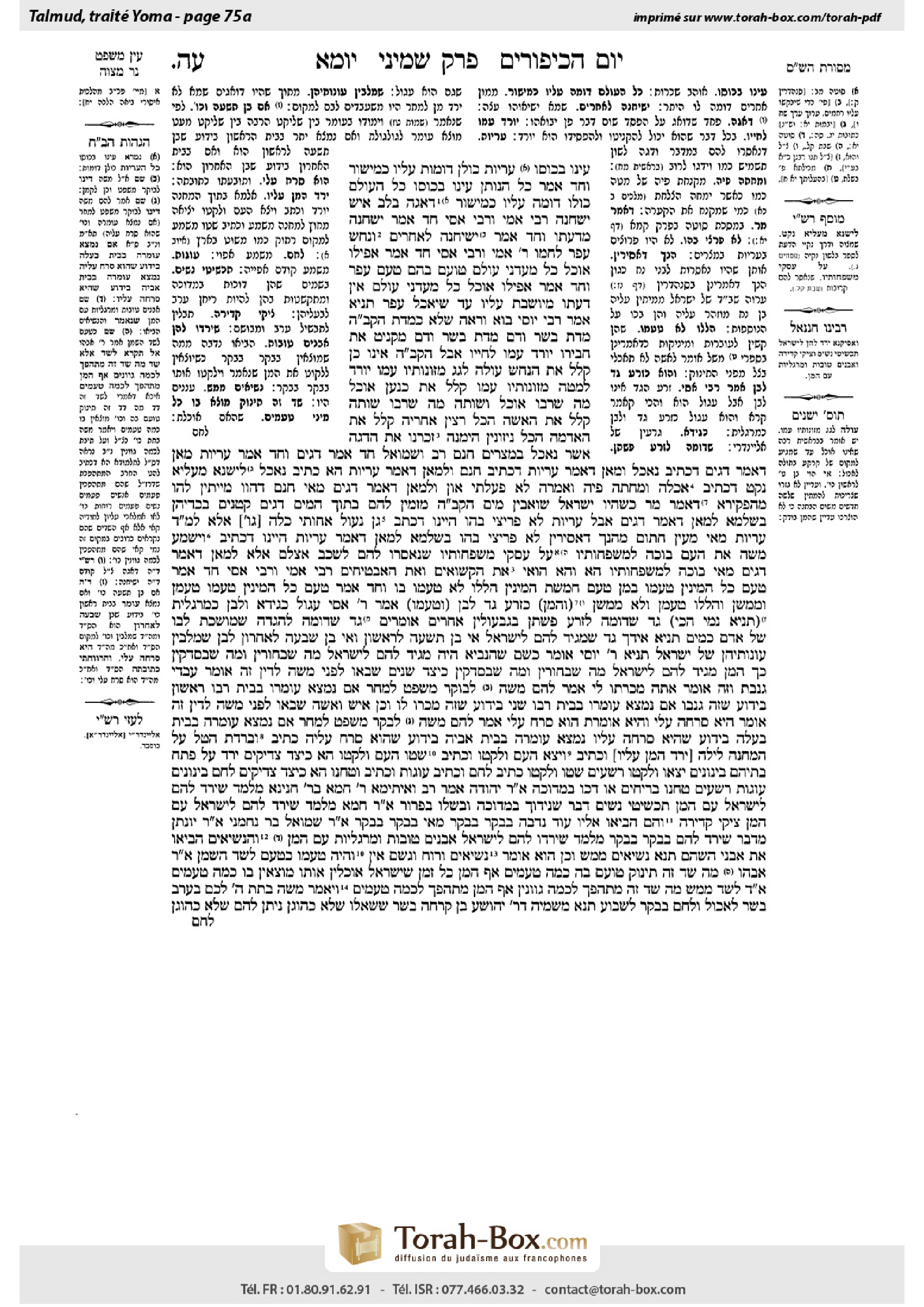
Yoma 75a: Talmud study for Daf Yomi
Daf Yomi is the daily study of one Talmud folio. Explore 37 tractates with scans, Hebrew text, Sefaria English and AI-generated French translations where annotated.
Passage selection and English or AI-generated French translation are available where the scan has annotations. Daf Study is independent of Torah-Box and Sefaria.
Browse Yoma · יומא · All tractatesYoma 75a text and translations
This page of Yoma includes the Aramaic text, an English translation and an AI-generated French translation, alongside the scan above.
יומא ע״ה א · Aramaic and Hebrew text
עֵינוֹ בְּכוֹסוֹ, עֲרָיוֹת כּוּלָּן דּוֹמוֹת עָלָיו כְּמִישׁוֹר. וְחַד אָמַר: כָּל הַנּוֹתֵן עֵינוֹ בְּכוֹסוֹ, כָּל הָעוֹלָם כּוּלּוֹ דּוֹמֶה עָלָיו כְּמִישׁוֹר.
״דְּאָגָה בְלֶב אִישׁ יַשְׁחֶנָּה״, רַבִּי אַמֵּי וְרַבִּי אַסִּי, חַד אָמַר: יַשִּׂחֶנָּה מִדַּעְתּוֹ, וְחַד אָמַר: יְשִׂיחֶנָּה לַאֲחֵרִים.
״וְנָחָשׁ עָפָר לַחְמוֹ״, רַבִּי אַמֵּי וְרַבִּי אַסִּי, חַד אָמַר: אֲפִילּוּ אוֹכֵל כָּל מַעֲדַנֵּי עוֹלָם — טוֹעֵם בָּהֶם טַעַם עָפָר, וְחַד אָמַר: אֲפִילּוּ אוֹכֵל כׇּל מַעֲדַנֵּי עוֹלָם — אֵין דַּעְתּוֹ מְיוּשֶּׁבֶת עָלָיו עַד שֶׁיֹּאכַל עָפָר.
תַּנְיָא, אָמַר רַבִּי יוֹסֵי: בּוֹא וּרְאֵה שֶׁלֹּא כְּמִדַּת הַקָּדוֹשׁ בָּרוּךְ הוּא מִדַּת בָּשָׂר וָדָם. מִדַּת בָּשָׂר וָדָם: מַקְנִיט אֶת חֲבֵירוֹ — יוֹרֵד עִמּוֹ לְחַיָּיו. אֲבָל הַקָּדוֹשׁ בָּרוּךְ הוּא אֵינוֹ כֵּן: קִלֵּל אֶת הַנָּחָשׁ, עוֹלֶה לַגָּג — מְזוֹנוֹתָיו עִמּוֹ, יוֹרֵד לְמַטָּה — מְזוֹנוֹתָיו עִמּוֹ.
קִלֵּל אֶת כְּנַעַן, אוֹכֵל מַה שֶּׁרַבּוֹ אוֹכֵל וְשׁוֹתֶה מַה שֶּׁרַבּוֹ שׁוֹתֶה. קִלֵּל אֶת הָאִשָּׁה — הַכֹּל רָצִין אַחֲרֶיהָ. קִלֵּל אֶת הָאֲדָמָה — הַכֹּל נִיזּוֹנִין הֵימֶנָּה.
״זָכַרְנוּ אֶת הַדָּגָה אֲשֶׁר נֹאכַל בְּמִצְרַיִם חִנָּם״, רַב וּשְׁמוּאֵל, חַד אָמַר: דָּגִים, וְחַד אָמַר: עֲרָיוֹת. מַאן דְּאָמַר דָּגִים, דִּכְתִיב: ״נֹאכַל״. וּמַאן דְּאָמַר עֲרָיוֹת, דִּכְתִיב: ״חִנָּם״.
וּלְמַאן דְּאָמַר עֲרָיוֹת, הָא כְּתִיב: ״נֹאכַל״! לִישָּׁנָא מְעַלְּיָא נָקֵט, דִּכְתִיב: ״אָכְלָה וּמָחֲתָה פִיהָ וְאָמְרָה לֹא פָעַלְתִּי אָוֶן״. וּלְמַאן דְּאָמַר דָּגִים, מַאי ״חִנָּם״? דַּהֲווֹ מַיְיתִין לְהוּ מֵהֶפְקֵירָא. דְּאָמַר מָר: כְּשֶׁהָיוּ יִשְׂרָאֵל שׁוֹאֲבִין מַיִם, הַקָּדוֹשׁ בָּרוּךְ הוּא מַזְמִין לָהֶם בְּתוֹךְ הַמַּיִם דָּגִים קְטַנִּים בְּכַדֵּיהֶן.
בִּשְׁלָמָא לְמַאן דְּאָמַר דָּגִים, אֲבָל עֲרָיוֹת לָא פְּרִיצִי בְּהוּ — הַיְינוּ דִּכְתִב: ״גַּן נָעוּל אֲחוֹתִי כַלָּה [גּוֹ׳]״. אֶלָּא לְמַאן דְּאָמַר עֲרָיוֹת, מַאי ״מַעְיָן חָתוּם״? מֵהָנָךְ דַּאֲסִירִין לָא פְּרִיצִי בְּהוּ.
בִּשְׁלָמָא לְמַאן דְּאָמַר עֲרָיוֹת, הַיְינוּ דִּכְתִיב: ״וַיִּשְׁמַע מֹשֶׁה אֶת הָעָם בּוֹכֶה לְמִשְׁפְּחוֹתָיו״, עַל עִסְקֵי מִשְׁפְּחוֹתָיו, שֶׁנֶּאֶסְרוּ לָהֶם לִשְׁכַּב אֶצְלָם. אֶלָּא לְמַאן דְּאָמַר דָּגִים, מַאי ״בּוֹכֶה לְמִשְׁפְּחוֹתָיו״? הָא וְהָא הֲוַאי.
״אֵת הַקִּשּׁוּאִים וְאֵת הָאֲבַטִּיחִים״, רַבִּי אַמֵּי וְרַבִּי אַסִּי, חַד אָמַר: טַעַם כׇּל הַמִּינִין טָעֲמוּ בַּמָּן, טַעַם חֲמֵשֶׁת הַמִּינִין הַלָּלוּ לֹא טָעֲמוּ בּוֹ, וְחַד אָמַר: טַעַם כָּל הַמִּינִין טָעֲמוּ טַעְמָן וּמַמָּשָׁן, וְהַלָּלוּ טַעְמָן וְלֹא מַמָּשָׁן.
״(וְהַמָּן) כְּזֶרַע גַּד לָבָן (וְטַעְמוֹ)״. אָמַר רַבִּי אַסִּי: עָגוֹל כְּגִידָּא וְלָבָן כְּמַרְגָּלִית. (תַּנְיָא נָמֵי הָכִי:) גַּד — שֶׁדּוֹמֶה לְזֶרַע פִּשְׁתָּן בַּגִּבְעוֹלִין.
אֲחֵרִים אוֹמְרִים: גַּד — שֶׁדּוֹמֶה לְהַגָּדָה שֶׁמּוֹשֶׁכֶת לִבּוֹ שֶׁל אָדָם כַּמַּיִם. תַּנְיָא אִידַּךְ: גַּד — שֶׁמַּגִּיד לָהֶם לְיִשְׂרָאֵל אִי בֶּן תִּשְׁעָה לָרִאשׁוֹן וְאִי בֶּן שִׁבְעָה לָאַחֲרוֹן.
״לָבָן״ — שֶׁמַּלְבִּין עֲוֹנוֹתֵיהֶן שֶׁל יִשְׂרָאֵל.
תַּנְיָא, רַבִּי יוֹסֵי אוֹמֵר: כְּשֵׁם שֶׁהַנָּבִיא הָיָה מַגִּיד לָהֶם לְיִשְׂרָאֵל מַה שֶּׁבְּחוֹרִין וּמַה שֶּׁבִּסְדָקִין, כָּךְ הַמָּן מַגִּיד לָהֶם לְיִשְׂרָאֵל מַה שֶּׁבְּחוֹרִין וּמַה שֶּׁבִּסְדָקִין. כֵּיצַד? שְׁנַיִם שֶׁבָּאוּ לִפְנֵי מֹשֶׁה לְדִין, זֶה אוֹמֵר: עַבְדִּי גָּנַבְתָּ, וְזֶה אוֹמֵר: אַתָּה מְכַרְתּוֹ לִי. אָמַר לָהֶם מֹשֶׁה: לַבּוֹקֶר מִשְׁפָּט. לְמָחָר, אִם נִמְצָא עוֹמְרוֹ בְּבֵית רַבּוֹ רִאשׁוֹן — בְּיָדוּעַ שֶׁזֶּה גְּנָבוֹ. אִם נִמְצָא עוֹמְרוֹ בְּבֵית רַבּוֹ שֵׁנִי — בְּיָדוּעַ שֶׁזֶּה מְכָרוֹ לוֹ.
וְכֵן אִישׁ וְאִשָּׁה שֶׁבָּאוּ לִפְנֵי מֹשֶׁה לַדִּין, זֶה אוֹמֵר הִיא סָרְחָה עָלַי, וְהִיא אוֹמֶרֶת הוּא סָרַח עָלַי. אָמַר לָהֶם מֹשֶׁה: לַבֹּקֶר מִשְׁפָּט. לְמָחָר, אִם נִמְצָא עוֹמְרָהּ בְּבֵית בַּעְלָהּ — בְּיָדוּעַ שֶׁהִיא סָרְחָה עָלָיו, נִמְצָא עוֹמְרָהּ בְּבֵית אָבִיהָ — בְּיָדוּעַ שֶׁהוּא סָרַח עָלֶיהָ.
כְּתִיב: ״וּבְרֶדֶת הַטַּל עַל הַמַּחֲנֶה לָיְלָה [יֵרֵד הַמָּן עָלָיו]״, וּכְתִיב: ״וְיָצָא הָעָם וְלָקְטוּ״, וּכְתִיב: ״שָׁטוּ הָעָם וְלָקְטוּ״, הָא כֵּיצַד? צַדִּיקִים, יָרַד עַל פֶּתַח בָּתֵּיהֶם. בֵּינוֹנִים, יָצְאוּ וְלָקְטוּ. רְשָׁעִים, שָׁטוּ וְלָקְטוּ.
כְּתִיב ״לֶחֶם״, וּכְתִיב ״עוּגוֹת״, וּכְתִיב ״וְטָחֲנוּ״, הָא כֵּיצַד? צַדִּיקִים — לֶחֶם, בֵּינוֹנִים — עוּגוֹת, רְשָׁעִים — טָחֲנוּ בָּרֵיחַיִם.
״אוֹ דָכוּ בַּמְּדוֹכָה״, אָמַר רַבִּי יְהוּדָה אָמַר רַב, וְאִיתֵּימָא רַבִּי חָמָא בְּרַבִּי חֲנִינָא: מְלַמֵּד שֶׁיָּרַד לָהֶם לְיִשְׂרָאֵל עִם הַמָּן תַּכְשִׁיטֵי נָשִׁים, דָּבָר שֶׁנִּידּוֹךְ בִּמְדוֹכָה. ״וּבִשְּׁלוּ בַּפָּרוּר״, אָמַר רַבִּי חָמָא: מְלַמֵּד שֶׁיָּרַד לָהֶם לְיִשְׂרָאֵל עִם הַמָּן צִיקֵי קְדֵירָה.
״וְהֵם הֵבִיאוּ אֵלָיו עוֹד נְדָבָה בַּבֹּקֶר בַּבֹּקֶר״, מַאי ״בַּבֹּקֶר בַּבֹּקֶר״? אָמַר רַבִּי שְׁמוּאֵל בַּר נַחְמָנִי אָמַר רַבִּי יוֹנָתָן: מִדָּבָר שֶׁיָּרַד לָהֶם ״בַּבֹּקֶר בַּבֹּקֶר״. מְלַמֵּד שֶׁיָּרְדוּ לָהֶם לְיִשְׂרָאֵל אֲבָנִים טוֹבוֹת וּמַרְגָּלִיּוֹת עִם הַמָּן. ״וְהַנְּשִׂיאִים הֵבִיאוּ אֵת אַבְנֵי הַשֹּׁהַם״, תָּנָא: נְשִׂיאִים מַמָּשׁ. וְכֵן הוּא אוֹמֵר: ״נְשִׂיאִים וְרוּחַ וְגֶשֶׁם אָיִן״.
״וְהָיָה טַעְמוֹ כְּטַעַם לְשַׁד הַשָּׁמֶן״. אָמַר רַבִּי אֲבָהוּ: מָה שַׁד זֶה תִּינוֹק טוֹעֵם בָּהּ כַּמָּה טְעָמִים, אַף הַמָּן, כׇּל זְמַן שֶׁיִּשְׂרָאֵל אוֹכְלִין אוֹתוֹ מוֹצְאִין בּוֹ כַּמָּה טְעָמִים. אִיכָּא דְּאָמְרִי: לְשֵׁד מַמָּשׁ. מָה שֵׁד זֶה מִתְהַפֵּךְ לְכַמָּה גְּווֹנִין — אַף הַמָּן מִתְהַפֵּךְ לְכַמָּה טְעָמִים.
״וַיֹּאמֶר מֹשֶׁה בְּתֵת ה׳ לָכֶם בָּעֶרֶב בָּשָׂר לֶאֱכוֹל וְלֶחֶם בַּבֹּקֶר לִשְׂבּוֹעַ״, תָּנָא מִשְּׁמֵיהּ דְּרַבִּי יְהוֹשֻׁעַ בֶּן קָרְחָה: בָּשָׂר שֶׁשָּׁאֲלוּ שֶׁלֹּא כַּהוֹגֶן — נִיתַּן לָהֶם שֶׁלֹּא כַּהוֹגֶן,
Yoma 75a · English translation
his eye on his cup, i.e., is habitually drunk, all the prohibitions of those with whom relations are forbidden seem to him like level [mishor] ground. He is unaware of the pitfalls of sin and continues walking along a twisted and dangerous path. And one said: Whoever casts his eye on his cup, the whole world seems to him like level [mishor] ground. Not only is such a person unconcerned by forbidden sexual relations, but all other prohibitions, e.g., monetary prohibitions, also seem permitted in his eyes.
§ The Gemara explains another verse in Proverbs: “If there is care in a man’s heart, let him quash it [yashḥena]” (Proverbs 12:25). Rabbi Ami and Rabbi Asi dispute the verse’s meaning. One said: He should forcefully push it [yasḥena] out of his mind. One who worries should banish his concerns from his thoughts. And one said: It means he should tell [yesiḥena] others his concerns, which will lower his anxiety.
§ Another verse states: “And dust shall be the serpent’s food” (Isaiah 65:25). Rabbi Ami and Rabbi Asi dispute the verse’s meaning. One said: Even if the serpent eats all the delicacies in the world, they will still taste like dust. And one said: Even if it eats all the delicacies in the world, its mind is unsettled until it also eats some dust.
With regard to the same topic, it was taught in a baraita: Rabbi Yosei said: Come and see that the attribute of the Holy One, Blessed be He, is different than the attribute of flesh and blood. The attribute of flesh and blood is that one who seeks to provoke another harasses him in all aspects of his life, but the Holy One, Blessed be He, does not act in this way. He cursed the serpent and what happened? When the serpent goes up to the roof its food is with it, and when it comes down its food is with it. Consequently, the curse that it suffers does not ruin its life but rather benefits it.
Similarly, He cursed Canaan that he should be the servant of servants, but he benefits somewhat from this. He eats what his master eats, and drinks what his master drinks, and does not worry like a free man does. He cursed the woman and everyone pursues her to marry her. He cursed the land after the sin of Adam and Eve, yet everyone is sustained from it. Even when God is angry, He does not punish His creations severely.
The Gemara cites more verses that pertain to the same issue. Rav and Shmuel disagree with regard to the following verse: “We remember the fish which we ate in Egypt for nothing” (Numbers 11:5). One said: The verse is referring literally to fish. And one said: The verse is referring to incestuous relations that the Torah had not yet forbidden. The people cried once the Torah prohibited certain relatives to them. The Gemara explains: The one who said that the verse is referring to fish bases his explanation on the verse, as it is written “which we ate.” This means what they actually ate. And the one who said that the verse is referring to forbidden sexual relations also bases his explanation on the verse, as it is written “for nothing.” Certainly, the people did not actually eat fish for free.
The Gemara asks: And according to the one who said that it is referring to forbidden relations, but isn’t it written “which we ate”? The Gemara answers: The Torah employed a euphemistic expression. Eating is used as a euphemism for sexual relations, as it is written: “So is the way of an adulterous woman; she eats, and wipes her mouth, and says I have done no wickedness” (Proverbs 30:20). And according to the one who said it is referring to fish, what is the meaning of the phrase “for nothing”? The people brought the fish from the river, which was ownerless property, since the Egyptians obviously would not have given them free food. The Master said: When the Jews drew water from the river, the Holy One, Blessed be He, prepared little fish for them in the water. They swam into their jugs.
The Gemara comments: Granted, according to the one who said that they cried over actual fish but were not promiscuous in having forbidden relations in Egypt, this is what is written to praise the Jewish people: “A garden enclosed is my sister the bride; a locked fountain, a sealed spring” (Song of Songs 4:12). This figurative language teaches that Jewish women are chaste. However, according to the one who said the Jewish people cried over forbidden sexual relations, what does the phrase “a sealed spring” mean? The Gemara answers: It means that they were not promiscuous with those relatives who were already forbidden to them. In Egypt, the Jewish people observed the laws of forbidden sexual relations that are included in the seven Noahide commandments. In the desert, they cried over the additional prohibitions imposed when the Torah was given.
The Gemara asks further: Granted, according to the one who said that they cried over the new prohibitions of forbidden sexual relations, this is as it is written: “And Moses heard the people weeping for their families” (Numbers 11:10). They cried with regard to the issue of their families, because now it became prohibited for them to cohabit with them. But according to the one who says that they cried over fish what does “weeping for their families” mean? The Gemara answers: Both this and that happened. They cried about the laws of forbidden sexual relations, and they also cried because they no longer had the fish of Egypt.
The Gemara returns to the same verse: It states: “We remember…the cucumbers, and the melons, and the leeks, and the onions, and the garlic” (Numbers 11:5). Rabbi Ami and Rabbi Asi debate the verse’s meaning. One said: They tasted the flavor of all types of food in the manna, but they cried because they could not taste the tastes of these five foods that they mentioned. And one said: They tasted the flavor of all types of food, as well as their textures. The sensation was so strong that it seemed to them like they were eating those very foods. However, with the foods they listed, the people tasted only their flavor but not their texture.
With regard to the manna, the Torah further states: “And it was white [lavan] like coriander seed; and its flavor was like wafers made of honey” (Exodus 16:31). The Gemara questions this, since coriander is brown, not white. Rabbi Asi said: The manna was round like coriander seed but white like a pearl. This was also taught in a baraita: Coriander [gad] is so named because it is similar to flax seeds on their stalks, which are bound [agud] in a bundle.
Others say: It was called coriander [gad] because it is similar to a tale [haggada], which draws a person’s heart toward it, just like water, which is essential for life, draws one. It was taught in another baraita: Why is it called gad? Because it told [maggid] the Jewish people the answer to issues of uncertainty, such as the paternity of a baby. If a woman remarries within two months after her divorce or the death of her husband and gives birth seven months after her remarriage, it is unclear if the baby gestated for seven months and is the son of the second husband or for nine months and is the son of the first husband. The manna would tell them if the baby was born after nine months and belongs to the first husband, or if the baby was born after seven months and belongs to the second husband. Since the manna was collected by each family based on the number of its biological members, the manna established the baby’s paternity.
The manna was called white because it whitened Israel’s sins. The people feared that if they sinned the manna would not continue to fall. Consequently, they devoted themselves to introspection and repentance.
Similarly, it was taught in a baraita: Rabbi Yosei says: Just like the prophet would tell the Jewish people what was in the holes and what was in the cracks of their souls, highlighting the sins of the people, so too, the manna clarified for Israel what was in the holes and what was in the cracks. How so? If two people came before Moses for a judgment, one saying: You stole my slave, and the other one saying: I did not steal him, rather you sold him to me, Moses would say to them: In the morning there will be a judgment. How was the matter resolved? If on the following day the slave found his omer of manna in his first master’s house, it would be clear that he was stolen, because the manna still came to the first owner. And if on the following day he found his omer of manna in his second master’s house, it would be clear that he had been sold.
Similarly, if a man and a woman came to Moses for a judgment, he saying: She sinned against me, and therefore I may divorce her and am not obligated to pay her divorce settlement, and she saying: He sinned against me and therefore I am entitled to the full settlement from the marriage contract, Moses would say to them: In the morning there will be a judgment. The following day, if her omer of manna was found in her husband’s house, it would be clear that she sinned against him. The fact that her nourishment was given to his household signifies the fact that he has respected her appropriately and is worthy of nourishing her. If her omer of manna was found in her father’s house, it would be clear that he sinned against her. Her nourishment has not been given to his household, signifying that he has been disrespectful to her and is not worthy of nourishing her.
§ The Gemara continues to discuss the manna: It is written: “And when the dew fell upon the camp in the night, the manna fell upon it” (Numbers 11:9). And it is written: “And the people shall go out and gather a day’s portion every day” (Exodus 16:4). And it is written: “The people went about and gathered it” (Numbers 11:8). How can these texts be reconciled? For the righteous, the manna fell at the opening of their homes. They expended no effort at all. The average people went out of the camp and gathered what fell there. The wicked had to go about farther to gather.
With regard to the manna, it is written “bread” (Exodus 16:4); and it is written “cakes” (Numbers 11:8); and it is also written “and ground it in mills,” (Numbers 11:8), implying that it was neither bread nor a cake. How can these texts be reconciled? For the righteous, it fell as baked bread; for average people, it fell as unbaked cakes; for the wicked it came in an unprocessed form and consequently they ground it in a mill.
The verse states: “Or beat it in a mortar” (Numbers 11:8). Rabbi Yehuda said that Rav said, and some say it was Rabbi Ḥama, son of Rabbi Ḥanina: This teaches that women’s perfumes fell for the Jewish people with the manna because they are an item that is beaten in a mortar. The verse continues: “And cooked it in a pot” (Numbers 11:8). Rabbi Ḥama said: This teaches that cooking spices fell for the Jewish people with the manna.
§ With regard to donations for the Tabernacle, the verse states: “And they brought yet to him free-will offerings every morning” (Exodus 36:3). The Gemara asks: What is the meaning of “every morning”? Rabbi Shmuel bar Naḥmani said that Rabbi Yonatan said: They brought donations from that which fell every morning with the manna. This teaches that pearls and precious stones fell for the Israelites with the manna. It states: “And the rulers [nesi’im] brought the onyx [shoham] stones” (Exodus 35:27). A tanna taught that the word nesi’im means actual clouds brought them. As it states: “As clouds [nesi’im] and wind without rain so is he that boasts himself of a false gift” (Proverbs 25:14). We learn from this that the precious stones fell from the clouds with the manna.
It was also said with regard to the manna: “And its taste was as the taste of a cake [shad] baked with oil [hashamen]” (Numbers 11:8). Rabbi Abbahu said: Shad means breast. Just as a baby tastes different flavors from the breast, since the taste of the milk changes somewhat depending on what foods his mother eats, so too with the manna, every time that the Jewish people ate the manna, they found in it many different flavors, based on their preferences. There are those who say that the word is written as shed and means literally a demon. How so? Just as a demon changes into different forms and colors, so too, the manna changed into different flavors.
The verse states: “And Moses said: This shall be, when the Lord will give you in the evening meat to eat, and in the morning bread to the full” (Exodus 16:8). A tanna taught in the name of Rabbi Yehoshua ben Korḥa: The meat that the Jewish people asked for inappropriately, since they had the manna and did not need meat, was given to them inappropriately, in a way that was unpleasant; they were punished afterward (Rabbeinu Elyakim).
Yoma 75a · Traduction française (IA)
Celui qui porte son regard sur sa coupe, c'est-à-dire qui est habituellement ivre, voit toutes les interdictions concernant les relations sexuelles interdites comme un terrain plat [mishor]. Il ne perçoit pas les pièges du péché et continue de marcher sur un chemin tordu et dangereux. Et l'on a dit : Quiconque porte son regard sur sa coupe, le monde entier lui semble être un terrain plat [mishor]. Non seulement une telle personne n'est pas préoccupée par les relations sexuelles interdites, mais toutes les autres interdictions, par exemple les interdictions monétaires, lui semblent également permises.
§ La Guemara explique un autre verset du Livre des Proverbes : « Si l'inquiétude est dans le cœur de l'homme, qu'il la réprime [yashḥena] » (Proverbes 12:25). Rabbi Ami et Rabbi Asi débattent du sens du verset. L'un a dit : Il doit la repousser [yasḥena] avec force de son esprit. Celui qui s'inquiète doit bannir ses soucis de ses pensées. Et l'autre a dit : Cela signifie qu'il doit raconter [yesiḥena] ses soucis aux autres, ce qui diminuera son anxiété.
§ Un autre verset énonce : « Et la poussière sera la nourriture du serpent » (Isaïe 65:25). Rabbi Ami et Rabbi Asi débattent du sens du verset. L'un a dit : Même si le serpent mangeait toutes les délicatesses du monde, elles lui goûteraient encore comme de la poussière. Et l'autre a dit : Même s'il mangeait toutes les délicatesses du monde, son esprit serait agité jusqu'à ce qu'il ait aussi mangé un peu de poussière.
Concernant le même sujet, il a été enseigné dans une baraïta : Rabbi Yosei a dit : Venez voir que l'attribut du Saint, béni soit-Il, est différent de l'attribut de la chair et du sang. L'attribut de la chair et du sang est que celui qui cherche à provoquer un autre le harcele dans tous les aspects de sa vie, mais le Saint, béni soit-Il, ne agit pas de cette manière. Il a maudit le serpent et qu'est-il arrivé ? Lorsque le serpent monte sur le toit, sa nourriture est avec lui, et lorsqu'il descend, sa nourriture est avec lui. Par conséquent, la malédiction qu'il subit ne ruine pas sa vie, mais lui profite plutôt.
De même, Il a maudit Canaan pour qu'il soit le serviteur des serviteurs, mais il en bénéficie quelque peu. Il mange ce que son maître mange, et boit ce que son maître boit, et ne s'inquiète pas comme le ferait un homme libre. Il a maudit la femme, et tout le monde la poursuit pour l'épouser. Il a maudit la terre après le péché d'Adam et Ève, et pourtant tout le monde en est nourri. Même lorsque Dieu est en colère, Il ne punit pas Ses créatures sévèrement.
La Guemara cite d'autres versets qui concernent le même problème. Rav et Chmuel ne sont pas d'accord concernant le verset suivant : « Nous nous souvenons des poissons que nous mangions en Égypte pour rien » (Nombres 11:5). L'un a dit : Le verset fait référence littéralement aux poissons. Et l'autre a dit : Le verset fait référence aux relations incestueuses que la Torah n'avait pas encore interdites. Le peuple a pleuré lorsque la Torah leur a interdit certains proches. La Guemara explique : Celui qui a dit que le verset fait référence aux poissons fonde son explication sur le verset, car il est écrit « que nous mangions ». Cela signifie ce qu'ils ont réellement mangé. Et celui qui a dit que le verset fait référence aux relations sexuelles interdites fonde également son explication sur le verset, car il est écrit « pour rien ». Certes, le peuple n'a pas réellement mangé des poissons gratuitement.
La Guemara demande : Et selon celui qui a dit que cela fait référence aux relations interdites, n'est-il pas écrit « que nous mangions » ? La Guemara répond : La Torah a employé une expression euphémique. Le terme « manger » est utilisé comme euphémisme pour les relations sexuelles, comme il est écrit : « Ainsi est la voie de la femme adultère ; elle mange, et s'essuie la bouche, et dit : Je n'ai pas fait de méchanceté » (Proverbes 30:20). Et selon celui qui a dit que cela fait référence aux poissons, quelle est la signification de l'expression « pour rien » ? Le peuple a apporté les poissons de la rivière, qui était une propriété sans maître, car les Égyptiens ne leur auraient évidemment pas donné de nourriture gratuite. Le Maître a dit : Lorsque les Juifs puisaient de l'eau dans la rivière, le Saint, béni soit-Il, leur préparait de petits poissons dans l'eau. Ils nageaient dans leurs jarres.
La Guemara commente : Certes, selon celui qui a dit qu'ils pleuraient à cause de vrais poissons mais n'étaient pas licencieux en ayant des relations interdites en Égypte, c'est ce qui est écrit pour louer le peuple juif : « Un jardin clos est ma sœur, l'épouse ; une fontaine scellée, une source close » (Cantique des Cantiques 4:12). Ce langage figuratif enseigne que les femmes juives sont chastes. Cependant, selon celui qui a dit que le peuple juif pleurait à cause des relations sexuelles interdites, que signifie l'expression « une source close » ? La Guemara répond : Cela signifie qu'ils n'étaient pas licencieux avec ces proches qui leur étaient déjà interdits. En Égypte, le peuple juif observait les lois des relations sexuelles interdites qui sont incluses dans les sept commandements noaïdes. Dans le désert, ils pleuraient à cause des interdictions supplémentaires imposées lorsque la Torah a été donnée.
La Guemara pose une question supplémentaire : Certes, selon celui qui a dit qu'ils pleuraient à cause des nouvelles interdictions concernant les relations sexuelles, cela correspond à ce qui est écrit : « Et Moïse entendit le peuple pleurer pour leurs familles » (Nombres 11:10). Ils pleuraient au sujet de leurs familles, car il leur était désormais interdit de cohabiter avec elles. Mais selon celui qui dit qu'ils pleuraient à cause des poissons, que signifie « pleurer pour leurs familles » ? La Guemara répond : Les deux choses se sont produites. Ils pleuraient à propos des lois des relations sexuelles interdites, et ils pleuraient aussi parce qu'ils n'avaient plus les poissons d'Égypte.
La Guemara revient au même verset : Il est écrit : « Nous nous souvenons… des concombres, et des melons, et des poireaux, et des oignons, et de l'ail » (Nombres 11:5). Rabbi Ami et Rabbi Asi débattent du sens du verset. L'un a dit : Ils goûtaient la saveur de tous les types de nourriture dans la manne, mais ils pleuraient parce qu'ils ne pouvaient pas goûter les saveurs de ces cinq aliments qu'ils ont mentionnés. Et l'autre a dit : Ils goûtaient la saveur de tous les types de nourriture, ainsi que leur texture. La sensation était si forte qu'il leur semblait qu'ils mangeaient ces aliments mêmes. Cependant, pour les aliments qu'ils ont énumérés, le peuple goûtait seulement leur saveur mais pas leur texture.
Concernant la manne, la Torah déclare par ailleurs : « Elle était blanche [lavan] comme la graine de coriandre ; et son goût était comme celui de gaufres faites de miel » (Exode 16:31). La Guemara s'interroge, car la coriandre est brune, et non blanche. Rabbi Asi a dit : La manne était ronde comme la graine de coriandre, mais blanche comme une perle. Cela a également été enseigné dans une baraïta : La coriandre [gad] porte ce nom parce qu'elle ressemble aux graines de lin sur leurs tiges, qui sont liées [agud] en faisceau.
D'autres disent : Elle était appelée coriandre [gad] parce qu'elle ressemble à un récit [haggada], qui attire le cœur d'une personne vers lui, tout comme l'eau, qui est essentielle à la vie, attire. Il a été enseigné dans une autre baraïta : Pourquoi est-elle appelée gad ? Parce qu'elle racontait [maggid] au peuple juif la réponse à des questions d'incertitude, telles que la paternité d'un bébé. Si une femme se remarie dans les deux mois suivant son divorce ou le décès de son mari et accouche sept mois après son remariage, il est incertain si le bébé a été gesté pendant sept mois et est le fils du second mari, ou pendant neuf mois et est le fils du premier mari. La manne leur indiquait si le bébé était né après neuf mois et appartenait au premier mari, ou s'il était né après sept mois et appartenait au second mari. Étant donné que la manne était recueillie par chaque famille en fonction du nombre de ses membres biologiques, la manne établissait la paternité du bébé.
La manne était appelée blanche parce qu'elle blanchissait les péchés d'Israël. Le peuple craignait que, s'ils pèchaient, la manne ne cesse de tomber. En conséquence, ils se consacraient à l'introspection et au repentir.
De même, il a été enseigné dans une baraïta : Rabbi Yosei dit : Tout comme le prophète révélait au peuple juif ce qui se trouvait dans les trous et dans les fissures de leurs âmes, en mettant en lumière les péchés du peuple, de même, la manne clarifiait pour Israël ce qui se trouvait dans les trous et dans les fissures. Comment cela se passait-il ? Si deux personnes venaient devant Moïse pour un jugement, l'une disant : « Tu as volé mon esclave », et l'autre disant : « Je ne l'ai pas volé, plutôt tu me l'as vendu », Moïse leur disait : « Demain matin, il y aura un jugement. » Comment l'affaire était-elle résolue ? Si le lendemain l'esclave trouvait son omer de manne dans la maison de son premier maître, il était clair qu'il avait été volé, car la manne venait encore au premier propriétaire. Et si le lendemain il trouvait son omer de manne dans la maison de son second maître, il était clair qu'il avait été vendu.
De même, si un homme et une femme venaient devant Moïse pour un jugement, lui disant : « Elle a péché contre moi, et par conséquent je peux la divorcer et ne suis pas obligé de lui payer sa pension de divorce », et elle disant : « Il a péché contre moi et par conséquent j'ai droit à la pension complète du contrat de mariage », Moïse leur disait : « Demain matin, il y aura un jugement. » Le lendemain, si son omer de manne était trouvé dans la maison de son mari, il était clair qu'elle avait péché contre lui. Le fait que sa nourriture ait été donnée à son foyer signifiait qu'il l'avait traitée avec respect et qu'il était digne de la nourrir. Si son omer de manne était trouvé dans la maison de son père, il était clair qu'il avait péché contre elle. Sa nourriture n'avait pas été donnée à son foyer, signifiant qu'il l'avait traitée avec irrespect et qu'il n'était pas digne de la nourrir.
§ La Guemara continue de discuter la manne : Il est écrit : « Et quand la rosée tomba sur le camp pendant la nuit, la manne tomba dessus » (Nombres 11:9). Et il est écrit : « Et le peuple sortira et recueillera une portion quotidienne chaque jour » (Exode 16:4). Et il est écrit : « Le peuple se répandait et la recueillait » (Nombres 11:8). Comment ces textes peuvent-ils être réconciliés ? Pour les justes, la manne tombait à l'ouverture de leurs maisons. Ils ne dépensaient aucun effort. Les gens moyens sortaient du camp et recueillaient ce qui tombait là. Les méchants devaient se répandre plus loin pour la recueillir.
Concernant la manne, il est écrit « pain » (Exode 16:4) ; et il est écrit « galettes » (Nombres 11:8) ; et il est également écrit « et ils la moulurent dans des meules » (Nombres 11:8), impliquant qu'elle n'était ni du pain ni une galette. Comment ces textes peuvent-ils être réconciliés ? Pour les justes, elle tombait sous forme de pain cuit ; pour les gens moyens, elle tombait sous forme de galettes non cuites ; pour les méchants, elle venait sous forme brute et par conséquent ils la moulurent dans une meule.
Le verset déclare : « Ou la pilèrent dans un mortier » (Nombres 11:8). Rabbi Yehuda a dit que Rav a dit, et certains disent que c'était Rabbi Ḥama, fils de Rabbi Ḥanina : Cela enseigne que les parfums des femmes tombaient pour le peuple juif avec la manne, car ce sont des articles qui sont pilés dans un mortier. Le verset continue : « Et ils la cuisaient dans une marmite » (Nombres 11:8). Rabbi Ḥama a dit : Cela enseigne que les épices de cuisine tombaient pour le peuple juif avec la manne.
§ Concernant les dons pour le Tabernacle, le verset déclare : « Et ils lui apportaient encore des offrandes volontaires chaque matin » (Exode 36:3). La Guemara demande : Quelle est la signification de « chaque matin » ? Rabbi Shmuel bar Naḥmani a dit que Rabbi Yonatan a dit : Ils apportaient des dons de ce qui tombait chaque matin avec la manne. Cela enseigne que des perles et des pierres précieuses tombaient pour les Israélites avec la manne. Il est déclaré : « Et les princes [nesi’im] apportèrent les pierres d'onyx [shoham] » (Exode 35:27). Un tanna a enseigné que le mot nesi’im signifie que des nuages les apportaient. Comme il est déclaré : « Comme les nuages [nesi’im] et le vent sans pluie, ainsi est celui qui se vante d'un faux don » (Proverbes 25:14). Nous en apprenons que les pierres précieuses tombaient des nuages avec la manne.
Il a également été dit concernant la manne : « Et son goût était comme le goût d'une galette [shad] cuite à l'huile [hashamen] » (Nombres 11:8). Rabbi Abbahu a dit : Shad signifie sein. Tout comme un bébé goûte différentes saveurs du sein, car le goût du lait change légèrement selon les aliments que sa mère mange, de même, avec la manne, chaque fois que le peuple juif mangeait la manne, ils y trouvaient de nombreuses saveurs différentes, selon leurs préférences. Il y a ceux qui disent que le mot est écrit shed et signifie littéralement un démon. Comment cela ? Tout comme un démon change en différentes formes et couleurs, de même, la manne changeait en différentes saveurs.
Le verset déclare : « Et Moïse dit : Ceci arrivera, lorsque l'Éternel vous donnera à manger de la chair le soir, et le matin du pain à satiété » (Exode 16:8). Un tanna a enseigné au nom de Rabbi Yehoshua ben Korḥa : La chair que le peuple juif a demandée de manière inappropriée, puisqu'il disposait de la manne et n'avait pas besoin de chair, lui a été accordée de manière inappropriée, d'une façon désagréable ; il a été puni par la suite (Rabbeinu Elyakim).
Traduction française générée par IA à partir de l’édition anglaise de Sefaria. Vérifie toujours un passage avec le texte source.
Text from Sefaria: William Davidson Edition - Vocalized Aramaic (CC BY NC); William Davidson Edition - English (CC BY NC).