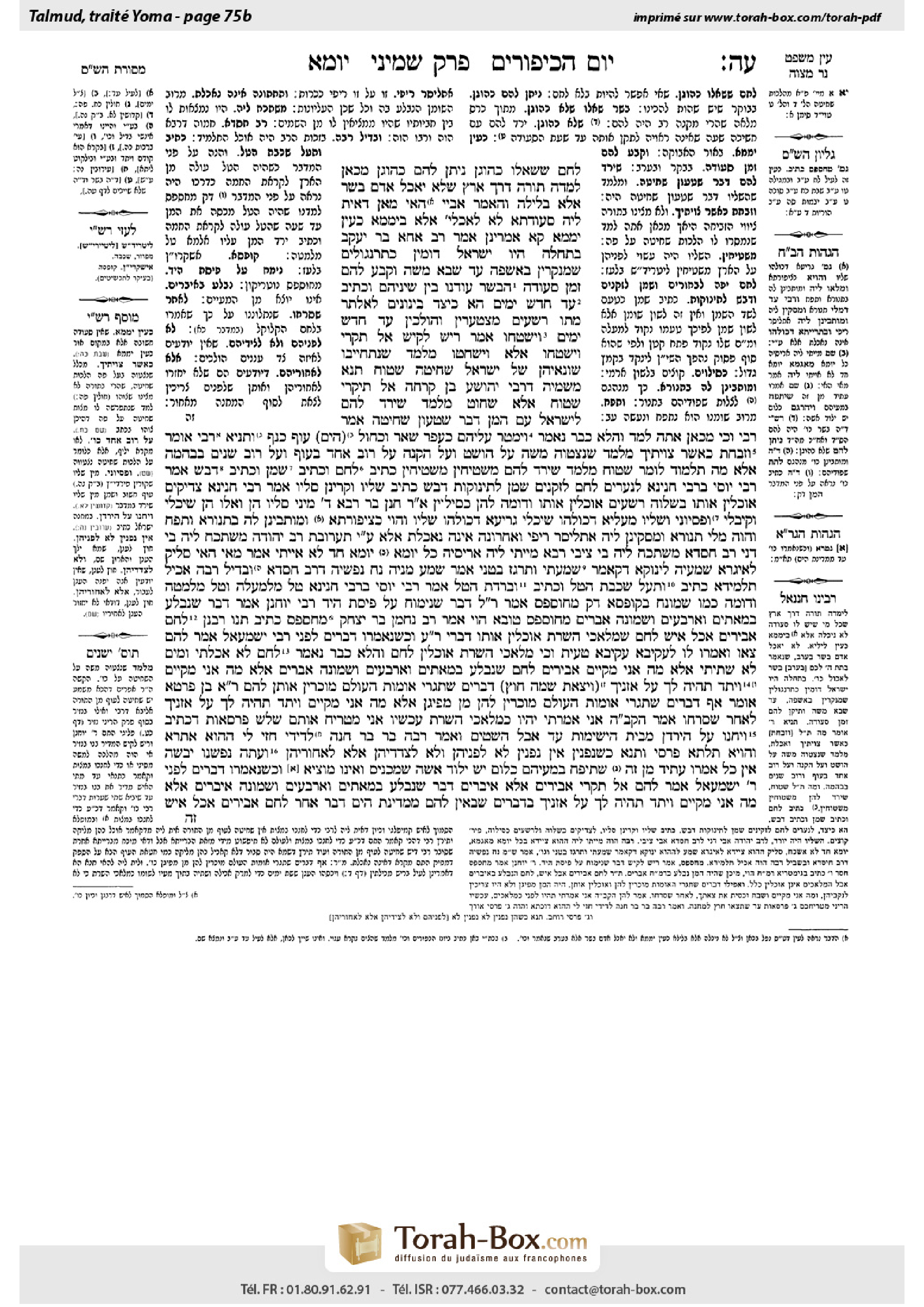
Yoma 75b: Talmud study for Daf Yomi
Daf Yomi is the daily study of one Talmud folio. Explore 37 tractates with scans, Hebrew text, Sefaria English and AI-generated French translations where annotated.
Passage selection and English or AI-generated French translation are available where the scan has annotations. Daf Study is independent of Torah-Box and Sefaria.
Browse Yoma · יומא · All tractatesYoma 75b text and translations
This page of Yoma includes the Aramaic text, an English translation and an AI-generated French translation, alongside the scan above.
יומא ע״ה ב · Aramaic and Hebrew text
לֶחֶם שֶׁשָּׁאֲלוּ כַּהוֹגֶן — נִיתַּן לָהֶם כַּהוֹגֶן. מִכָּאן לִמְּדָה תּוֹרָה דֶּרֶךְ אֶרֶץ שֶׁלֹּא יֹאכַל אָדָם בָּשָׂר אֶלָּא בַּלַּיְלָה. וְהָאָמַר אַבָּיֵי: הַאי מַאן דְּאִית לֵיהּ סְעוֹדְתָּא — לָא לֵאכְלַיהּ אֶלָּא בִּימָמָא! כְּעֵין יְמָמָא קָא אָמְרִינַן. אָמַר רַב אַחָא בַּר יַעֲקֹב: בַּתְּחִלָּה הָיוּ יִשְׂרָאֵל דּוֹמִין כְּתַרְנְגוֹלִים שֶׁמְּנַקְּרִין בָּאַשְׁפָּה, עַד שֶׁבָּא מֹשֶׁה וְקָבַע לָהֶם זְמַן סְעוּדָה.
״הַבָּשָׂר עוֹדֶנּוּ בֵּין שִׁינֵּיהֶם״, וּכְתִיב: ״עַד חֹדֶשׁ יָמִים״, הָא כֵּיצַד? בֵּינוֹנִים, לְאַלְתַּר מֵתוּ. רְשָׁעִים, מִצְטַעֲרִין וְהוֹלְכִין עַד חֹדֶשׁ יָמִים.
״וַיִּשְׁטְחוּ״, אָמַר רֵישׁ לָקִישׁ: אַל תִּקְרֵי ״וַיִּשְׁטְחוּ״, אֶלָּא ״וַיִּשְׁחֲטוּ״ — מְלַמֵּד שֶׁנִּתְחַיְּיבוּ שׂוֹנְאֵיהֶן שֶׁל יִשְׂרָאֵל שְׁחִיטָה. ״שָׁטוֹחַ״, תָּנָא מִשְּׁמֵיהּ דְּרַבִּי יְהוֹשֻׁעַ בֶּן קָרְחָה: אַל תִּיקְרֵי ״שָׁטוֹחַ״, אֶלָּא ״שָׁחוּט״, מְלַמֵּד שֶׁיָּרַד לָהֶם לְיִשְׂרָאֵל עִם הַמָּן דָּבָר שֶׁטָּעוּן שְׁחִיטָה. אָמַר רַבִּי: וְכִי מִכָּאן אַתָּה לָמֵד? וַהֲלֹא כְּבָר נֶאֱמַר: ״וַיַּמְטֵר עֲלֵיהֶם כֶּעָפָר שְׁאֵר וּכְחוֹל (הַיָּם) עוֹף כָּנָף״.
וְתַנְיָא, רַבִּי אוֹמֵר: ״וְזָבַחְתָּ כַּאֲשֶׁר צִוִּיתִיךְ״, מְלַמֵּד שֶׁנִּצְטַוָּה מֹשֶׁה עַל הַוֶּשֶׁט וְעַל הַקָּנֶה, עַל רוֹב אֶחָד בָּעוֹף, וְעַל רוֹב שְׁנַיִם בַּבְּהֵמָה. אֶלָּא מָה תַּלְמוּד לוֹמַר ״שָׁטוֹחַ״ — מְלַמֵּד שֶׁיָּרַד לָהֶם מַשְׁטִיחִין מַשְׁטִיחִין.
כְּתִיב ״לֶחֶם״, וּכְתִיב ״שֶׁמֶן״, וּכְתִיב ״דְּבַשׁ״. אֲמַר רַבִּי יוֹסֵי בְּרַבִּי חֲנִינָא: לִנְעָרִים — לֶחֶם, לִזְקֵנִים — שֶׁמֶן, לְתִינוֹקוֹת — דְּבַשׁ.
כְּתִיב: ״שָׁלֵיו״ וְקָרֵינַן סְלָיו? אָמַר רַבִּי חֲנִינָא: צַדִּיקִים אוֹכְלִין אוֹתוֹ בְּשַׁלְוָה, רְשָׁעִים אוֹכְלִין אוֹתוֹ וְדוֹמֶה לָהֶן כְּסִילְוִין.
אָמַר רַב חָנָן בַּר רָבָא: אַרְבָּעָה מִינֵי סְלָיו הֵן, וְאֵלּוּ הֵן: שִׁיכְלִי, וְקִיבְלִי, וּפַסְיוֹנִי, וּשְׂלָיו. מְעַלְּיָא דְּכוּלְּהוּ: שִׂיכְלִי, גְּרִיעָא דְּכוּלְּהוּ: שְׂלָיו. וְהָוֵי כְּצִיפַּורְתָּא, וּמוֹתְבִינַן לֵהּ בְּתַנּוּרָא וְתָפַח וְהָוֵה מְלֵי תַּנּוּרָא, וּמַסְּקִינַן לֵיהּ אַתְּלֵיסַר רִיפֵי, וְאַחֲרוֹנָה אֵינָהּ נֶאֱכֶלֶת אֶלָּא עַל יְדֵי תַּעֲרוֹבֶת.
רַב יְהוּדָה מִשְׁתְּכַח לֵיהּ בֵּי דַנֵּי, רַב חִסְדָּא מִשְׁתְּכַח לֵיהּ בֵּי צִיבֵי. רָבָא מַיְיתֵי לֵיהּ אֲרִיסֵיהּ כׇּל יוֹמָא. יוֹמָא חַד לָא אַיְיתִי. אֲמַר: מַאי הַאי? סְלֵיק לְאִיגָּרָא, שַׁמְעֵיהּ לְיָנוֹקָא דְּקָאָמַר: ״שָׁמַעְתִּי וַתִּרְגַּז בִּטְנִי״. אֲמַר: שְׁמַע מִנֵּיהּ נָח נַפְשֵׁיהּ דְּרַב חִסְדָּא, וּבְדִיל רַבָּה אָכֵיל תַּלְמִידָא.
כְּתִיב: ״וַתַּעַל שִׁכְבַת הַטָּל״, וּכְתִיב: ״וּבְרֶדֶת הַטַּל״? אָמַר רַבִּי יוֹסֵי בְּרַבִּי חֲנִינָא: טַל מִלְמַעְלָה, וְטַל מִלְּמַטָּה, וְדוֹמֶה כְּמוֹ שֶׁמּוּנָּח בְּקוּפְסָא.
״דַּק מְחוּסְפָּס״, אָמַר רֵישׁ לָקִישׁ: דָּבָר שֶׁנִּימּוֹחַ עַל פִּיסַּת הַיָּד. רַבִּי יוֹחָנָן אָמַר: דָּבָר שֶׁנִּבְלָע בְּמָאתַיִם וְאַרְבָּעִים וּשְׁמוֹנָה אֵבָרִים. מְחוּסְפָּס — טוּבָא הָוֵי! אָמַר רַב נַחְמָן בַּר יִצְחָק: ״מְחֻסְפָּס״ כְּתִיב.
תָּנוּ רַבָּנַן: ״לֶחֶם אַבִּירִים אָכַל אִישׁ״, לֶחֶם שֶׁמַּלְאֲכֵי הַשָּׁרֵת אוֹכְלִין אוֹתוֹ, דִּבְרֵי רַבִּי עֲקִיבָא. וּכְשֶׁנֶּאְמְרוּ דְּבָרִים לִפְנֵי רַבִּי יִשְׁמָעֵאל, אָמַר לָהֶם: צְאוּ וְאִמְרוּ לוֹ לַעֲקִיבָא: עֲקִיבָא טָעִיתָ! וְכִי מַלְאֲכֵי הַשָּׁרֵת אוֹכְלִין לֶחֶם? וַהֲלֹא כְּבָר נֶאֱמַר: ״לֶחֶם לֹא אָכַלְתִּי וּמַיִם לֹא שָׁתִיתִי״! אֶלָּא, מָה אֲנִי מְקַיֵּים ״אַבִּירִים״ — לֶחֶם שֶׁנִּבְלַע בְּמָאתַיִם וְאַרְבָּעִים וּשְׁמוֹנֶה אֵבָרִים.
אֶלָּא מָה אֲנִי מְקַיֵּים: ״וְיָתֵד תִּהְיֶה לְךָ עַל אֲזֵנֶיךָ (וְיָצָאתָ שָׁמָּה חוּץ)״, דְּבָרִים שֶׁתַּגָּרֵי אוּמּוֹת הָעוֹלָם מוֹכְרִין אוֹתָן לָהֶם.
רַבִּי אֶלְעָזָר בֶּן פַּרְטָא אוֹמֵר: אַף דְּבָרִים שֶׁתַּגָּרֵי אוּמּוֹת הָעוֹלָם מוֹכְרִין לָהֶן — מָן מְפִיגָן. אֶלָּא מָה אֲנִי מְקַיֵּים ״וְיָתֵד תִּהְיֶה לְךָ עַל אֲזֵנֶיךָ״ — לְאַחַר שֶׁסָּרְחוּ אָמַר הַקָּדוֹשׁ בָּרוּךְ הוּא: אֲנִי אָמַרְתִּי יִהְיוּ כְּמַלְאֲכֵי הַשָּׁרֵת, עַכְשָׁיו אֲנִי מַטְרִיחַ אוֹתָם שָׁלֹשׁ פַּרְסָאוֹת.
דִּכְתִיב: ״וַיַּחֲנוּ עַל הַיַּרְדֵּן מִבֵּית הַיְשִׁימוֹת עַד אָבֵל הַשִּׁטִּים״, וְאָמַר רַבָּה בַּר בַּר חָנָה: לְדִידִי חֲזֵי לִי הָהוּא אַתְרָא וְהָוְיָא תְּלָתָא פַּרְסֵי. וְתָנָא: כְּשֶׁנִּפְנִין, אֵין נִפְנִין לֹא לִפְנֵיהֶן, וְלֹא לְצִדְדֵיהֶן, אֶלָּא לַאֲחוֹרֵיהֶן.
״וְעַתָּה נַפְשֵׁנוּ יְבֵשָׁה אֵין כֹּל״. אָמְרוּ: עָתִיד מָן זֶה שֶׁתִּיפַּח בְּמֵעֵיהֶם, כְּלוּם יֵשׁ יְלוּד אִשָּׁה שֶׁמַּכְנִיס וְאֵינוֹ מוֹצִיא?
וּכְשֶׁנֶּאְמְרוּ דְּבָרִים לִפְנֵי רַבִּי יִשְׁמָעֵאל, אָמַר לָהֶם: אַל תִּקְרֵי ״אַבִּירִים״, אֶלָּא ״אֵיבָרִים״ — דָּבָר שֶׁנִּבְלַע בְּמָאתַיִם וְאַרְבָּעִים וּשְׁמוֹנָה אֵיבָרִים. אֶלָּא מָה אֲנִי מְקַיֵּים ״וְיָתֵד תִּהְיֶה לְךָ עַל אֲזֵנֶיךָ״ — בִּדְבָרִים שֶׁבָּאִין לָהֶם מִמְּדִינַת הַיָּם.
דָּבָר אַחֵר: ״לֶחֶם אַבִּירִים אָכַל אִישׁ״ —
Yoma 75b · English translation
However, bread, which is essential, they asked for appropriately. Therefore, it was given to them appropriately, in the morning, when there was time to prepare it. The Gemara comments: From here, the Torah teaches etiquette, that it is proper to eat meat only at night, as Moses said to the children of Israel: “This shall be, when the Lord will give you in the evening meat to eat” (Exodus 16:8). The Gemara asks: But didn’t Abaye say that someone who has a meal should eat it only in the day? The Gemara answers: We mean to say: Like day. It is not necessary to eat the food in the daytime, as long as one can see what he eats. Rabbi Aḥa bar Ya’akov said: At the beginning, the Jewish people were like chickens pecking at the garbage; any time there was food they grabbed it and ate it, until Moses came and set specific times to eat, as the verse implies. He set mealtimes for them in the morning and in the evening.
It was stated with regard to the quail: “While the meat was yet between their teeth, before it was chewed, the anger of the Lord was kindled against the people” (Numbers 11:33), which means that they died immediately. However, it also states: “You shall not eat it for only one day…but for an entire month until it comes out of your nostrils and becomes loathsome to you” (Numbers 11:19–20). How can these texts be reconciled? The average people died immediately, but the wicked continued to suffer in pain for a month and then died.
The verse states: “And they spread them [vayishteḥu] out for themselves round about the camp” (Numbers 11:32). Reish Lakish said: Do not read it as vayishteḥu. Rather, read it as vayishḥatu. This teaches that the enemies of the Jewish people, a euphemism for the Jewish people themselves, were liable to receive the punishment of slaughter due to their demand. The verse states: “Spread out [shato’aḥ]” (Numbers 11:32). A tanna taught in the name of Rabbi Yehoshua ben Korḥa: Do not read it as shato’aḥ but as shaḥot. This teaches that other food fell for the Jewish people along with the manna. The food was something that requires ritual slaughtering [sheḥita], referring to birds. Rabbi Yehuda HaNasi said: And do you learn this from here? Do we need to alter the word for this purpose? Isn’t it already stated explicitly: “And he rained meat upon them like dust, and winged birds like the sand of the seas” (Psalms 78:27)?
And it was taught in a related baraita: Rabbi Yehuda HaNasi says: The verse states: “Then you shall slaughter of your herd and of your flock which the Lord has given you, as I have commanded you” (Deuteronomy 12:21). This teaches that Moses was commanded in the laws of ritual slaughter to cut the gullet and the windpipe in the neck. And with a bird one must cut through the majority of one pipe, and with an animal one must cut through the majority of both pipes. Moses was commanded these laws along with the other details of slaughtering. According to Rabbi Yehuda HaNasi, the word shatoaḥ does not teach us about ritual slaughter. Rather, what is the meaning when the verse states: Shatoaḥ? It teaches that the manna fell in layers [mashtiḥin] in a straight row.
With regard to the manna, it is written “bread” (Exodus 16:4), and it is written “oil” (Numbers 11:8), and it is written “honey” (Exodus 16:31). How can we reconcile these verses? Rabbi Yosei, son of Rabbi Ḥanina, said: For the youth it was like bread, for the elderly it was like oil, and for the children it was like honey. Each received what was appropriate.
The Gemara comments further: The word quail is written shlav, with the letter shin, but we read it as slav, with the letter samekh. What does this teach us? Rabbi Ḥanina said: The righteous eat it in peace [shalva], based on the written form of the word; whereas the wicked eat it, and it seems to them like thorns [silvin], based on the way the word is read.
Furthermore, with regard to the quail: Rav Ḥanan bar Rava said: There are four types of quail and these are they: Sikhli, and kivli, and pasyoni, and slav. The best tasting of all is the sikhli. The worst of all is the slav. The Gemara relates how tasty even the quail was that the Jews ate in the desert: It was as small as a sparrow, and they would place it in the oven to roast, and it expanded until it filled the entire oven. They would place it upon thirteen loaves of bread, and even the last loaf on the bottom could be eaten only when mixed with other food, due to all the fat it had absorbed from the quail.
It is told that Rav Yehuda found quail among his barrels of wine, and Rav Ḥisda found quail among logs of wood in his storeroom. Every day Rava’s sharecropper brought him a quail that he found in his fields. One day, he did not bring him one because he failed to find any. Rava said to himself: What is this, why is today different? He went up to the roof to think about it. He heard a child say the verse: “When I heard, my innards trembled, my lips quivered at the voice, rottenness enters into my bones, and I tremble where I stand; that I should wait for the day of trouble when he comes up against the people that he invades” (Habakkuk 3:16). Rava said: Learn from this that Rav Ḥisda has died. I am therefore not worthy to receive the quail anymore, since it is on account of the teacher that the student eats. When Rav Ḥisda was alive, Rava received the quail due to Rav Ḥisda’s merit; now that he had died, Rava was not worthy to receive the quail.
§ Furthermore, with regard to the manna it is written: “And when the layer of dew lifted, behold, upon the face of the wilderness there lay a fine flaky substance, as fine as frost on the ground” (Exodus 16:14), indicating that the dew covered the manna. And it is written: “And when the dew fell upon the camp in the night, the manna fell upon it” (Numbers 11:9), meaning that the manna fell on top of the dew. How can these verses be reconciled? Rabbi Yosei, son of Rabbi Ḥanina, said: There was dew above and dew below, with the manna in between, and the manna appeared as if it were placed in a box [kufsa] of dew.
The verse describes the manna as “a fine flaky [meḥuspas] substance” (Exodus 16:14). Reish Lakish said: Meḥuspas means it was a substance that dissolved [maḥ] on the palm [pas] of the hand. Since it was so fine, it dissolved upon contact. Rabbi Yoḥanan said: It was a substance that was absorbed in all 248 limbs, the numerical equivalent of the word meḥuspas. The Gemara expresses surprise at this: If one calculates the value of the letters in the word meḥuspas, it is more, totaling 254. Rabbi Naḥman bar Yitzḥak said: Meḥuspas is written in the Torah without the letter vav. Therefore, the total is exactly 248.
The Sages taught: The Torah states: “And He caused manna to rain upon them for food, and He gave them of the grain of heaven. Man did eat the bread of the mighty [abirim]” (Psalms 78:24–25). “Bread of the mighty” is bread that the ministering angels eat; this is the statement of Rabbi Akiva. When these words were said before Rabbi Yishmael, he said to them to go and tell Akiva: Akiva you have erred. Do the ministering angels eat bread? It is already stated about Moses, when he ascended on high: “Bread I did not eat and water I did not drink” (Deuteronomy 9:9). If even a man who ascends on high does not need to eat, certainly the ministering angels do not need to eat. Rather, how do I establish the meaning of the word abirim? It can be explained as bread that was absorbed into all 248 limbs [eivarim], so that there was no waste.
The Gemara asks: But if so, how do I establish the verses: “And you shall have a spade among your weapons, and it shall be that when you relieve yourself outside, you shall dig with it, and shall turn back and cover your excrement” (Deuteronomy 23:14) and “You shall have a place also outside the camp where you can relieve yourself ” (Deuteronomy 23:13). From here we learn that there was waste in their bowels, as they had to leave the camp to relieve themselves. The Gemara explains: This waste was not a byproduct of the manna; it was from food items that the gentile merchants sold them.
Rabbi Elazar ben Perata disagrees and says: The manna caused even items that the gentile merchants sold them to be completely digested, so that even other food that they ate produced no waste. But then how do I establish the verse: “And you shall have a spade among your weapons”? After they sinned, the manna was not as effective. The Holy One, Blessed be He, said: I initially said that they would be like ministering angels who do not produce waste; now I will trouble them to walk three parasangs to leave the camp in order to relieve themselves.
How do we know that the Israelite camp was three parasangs? As it is written: “And they camped by the Jordan from Beth-Jeshimoth to Abel-shittim” (Numbers 33:49), and Rabba bar bar Ḥana said: I saw that site and it was three parasangs in length. And a baraita taught: When the Jews relieved themselves in the desert, they did not relieve themselves ahead of themselves, i.e., in the direction of their travel, nor to the side of the camp, but behind the camp, in a place that they had already traveled. Consequently, those near the front of the camp had to walk a distance of three parasangs from their homes to leave the camp.
Furthermore, with regard to the manna, the verse states Israel’s complaint: “But now our soul is dry, there is nothing at all; we have nothing beside this manna to look to” (Numbers 11:6). They said: This manna will eventually swell in our stomachs and kill us; is there anyone born of a woman who ingests food but does not expel waste? This supports the Gemara’s claim that the manna did not create waste.
When these words were said before Rabbi Yishmael, he said to them: Do not read it as abirim. Rather, read it as eivarim, limbs. The manna was something that was absorbed by 248 limbs. But, how do I establish “And you shall have a spade among your weapons”? From the food items that came to them from overseas lands. Rabbi Yishmael disagrees with Rabbi Elazar ben Perata with regard to the effect the manna had on the digestion of other foods.
Alternatively, “Man [ish] did eat the bread of the mighty” (Psalms 78:25);
Yoma 75b · Traduction française (IA)
Cependant, ils demandèrent à juste titre le pain, qui leur était indispensable. Il leur fut donc donné à juste titre le matin, alors qu’ils avaient le temps de le préparer. La Guemara commente : La Torah enseigne ici les bonnes manières : il convient de ne manger de la viande que le soir, comme Moïse le dit aux enfants d’Israël : « Voici ce qui arrivera lorsque le Seigneur vous donnera le soir de la viande à manger » (Exode 16:8). La Guemara demande : Mais Abayé n’a-t-il pas dit que celui qui prend un repas ne doit le manger que le jour ? La Guemara répond : Nous voulons dire : comme le jour. Il n’est pas nécessaire de manger à la lumière du jour, du moment que l’on peut voir ce que l’on mange. Rabbi Aḥa bar Ya’akov dit : Au début, les enfants d’Israël étaient comme des poules picorant les déchets : dès qu’il y avait de la nourriture, ils s’en emparaient et la mangeaient, jusqu’à ce que Moïse vienne leur fixer des heures précises pour manger, comme le suggère le verset. Il leur fixa les heures des repas, le matin et le soir.
À propos des cailles, il est dit : « Alors que la viande était encore entre leurs dents, avant d’avoir été mâchée, la colère du Seigneur s’enflamma contre le peuple » (Nombres 11:33), ce qui signifie qu’ils moururent immédiatement. Cependant, il est aussi dit : « Vous n’en mangerez pas seulement un jour […] mais tout un mois, jusqu’à ce qu’elle vous sorte par les narines et vous devienne répugnante » (Nombres 11:19–20). Comment concilier ces versets ? Les gens ordinaires moururent immédiatement, tandis que les méchants continuèrent à souffrir pendant un mois, puis moururent.
Le verset dit : « Ils les étalèrent [vayishteḥu] autour du camp » (Nombres 11:32). Reish Lakish dit : Ne lis pas vayishteḥu, mais vayishḥatu. Cela enseigne que les ennemis du peuple juif — expression euphémique désignant le peuple juif lui-même — méritaient de subir le châtiment de l’abattage pour avoir formulé leur demande. Le verset dit : « Étaler [shato’aḥ] » (Nombres 11:32). Un tanna enseigna au nom de Rabbi Yehoshua ben Korḥa : Ne lis pas shato’aḥ, mais shaḥot. Cela enseigne qu’une autre nourriture tomba avec la manne pour les enfants d’Israël. C’était un aliment qui exige l’abattage rituel [sheḥita], à savoir des oiseaux. Rabbi Yehuda HaNasi dit : Est-ce donc ici que vous l’apprenez ? Faut-il modifier le mot à cette fin ? N’est-il pas déjà écrit explicitement : « Il fit pleuvoir sur eux de la viande comme de la poussière, et des oiseaux ailés comme le sable des mers » (Psaumes 78:27) ?
Et une baraïta apparentée fut enseignée : Rabbi Yehuda HaNasi dit : Le verset dit : « Tu abattras de ton gros et de ton petit bétail que le Seigneur t’a donné, comme je te l’ai ordonné » (Deutéronome 12:21). Cela enseigne que Moïse reçut l’ordre d’observer les lois de l’abattage rituel : couper l’œsophage et la trachée au niveau du cou. Pour un oiseau, il faut couper la majeure partie de l’un des conduits ; pour un animal, la majeure partie des deux conduits. Moïse reçut ces lois avec les autres détails de l’abattage. Selon Rabbi Yehuda HaNasi, le mot shatoaḥ ne nous enseigne donc rien au sujet de l’abattage rituel. Quel est alors le sens du mot shatoaḥ dans le verset ? Il enseigne que la manne tombait en couches [mashtiḥin], disposées en ligne droite.
À propos de la manne, il est écrit « pain » (Exode 16:4), « huile » (Nombres 11:8) et « miel » (Exode 16:31). Comment concilier ces versets ? Rabbi Yosei, fils de Rabbi Ḥanina, dit : Pour les jeunes, elle était comme du pain ; pour les personnes âgées, comme de l’huile ; et pour les enfants, comme du miel. Chacun recevait ce qui lui convenait.
La Guemara ajoute : Le mot désignant la caille s’écrit shlav, avec un shin, mais se lit slav, avec un samekh. Qu’est-ce que cela nous enseigne ? Rabbi Ḥanina dit : Les justes en mangent en paix [shalva], d’après la graphie du mot, tandis que les méchants en mangent et trouvent que cela a un goût d’épines [silvin], d’après la façon dont le mot se lit.
En outre, à propos des cailles, Rav Ḥanan bar Rava dit : Il existe quatre sortes de cailles, les voici : sikhli, kivli, pasyoni et slav. La plus savoureuse de toutes est la sikhli ; la moins savoureuse est la slav. La Guemara raconte combien étaient savoureuses même les cailles que les Juifs mangeaient dans le désert : elles étaient petites comme des moineaux. Lorsqu’ils les mettaient au four pour les faire rôtir, elles gonflaient jusqu’à remplir tout le four. Ils les plaçaient sur treize pains, et même le dernier pain, tout en bas, ne pouvait être mangé qu’avec d’autres aliments, tant il avait absorbé de graisse provenant des cailles.
On raconte que Rav Yehuda trouva des cailles parmi ses tonneaux de vin, et que Rav Ḥisda en trouva parmi les bûches de son entrepôt. Chaque jour, le métayer de Rava lui apportait une caille qu’il avait trouvée dans ses champs. Un jour, il ne lui en apporta pas, car il n’en avait trouvé aucune. Rava se dit : « Qu’est-ce donc ? Pourquoi aujourd’hui est-il différent ? » Il monta sur le toit pour y réfléchir. Il entendit un enfant réciter le verset : « Quand j’ai entendu, mes entrailles ont tremblé, mes lèvres ont frémi à cette voix ; la pourriture a pénétré mes os, et je tremble là où je me tiens, dans l’attente du jour de détresse, où il marchera contre le peuple qu’il envahit » (Habacuc 3:16). Rava dit : « Il faut en conclure que Rav Ḥisda est mort. Je ne mérite donc plus de recevoir des cailles, car c’est grâce au maître que l’élève mange. » Tant que Rav Ḥisda était vivant, Rava recevait des cailles grâce au mérite de Rav Ḥisda ; maintenant qu’il était mort, Rava ne méritait plus d’en recevoir.
§ En outre, à propos de la manne, il est écrit : « Lorsque la couche de rosée se dissipa, voici qu’à la surface du désert se trouvait une substance fine et floconneuse, aussi fine que le givre sur le sol » (Exode 16:14), ce qui indique que la rosée recouvrait la manne. Et il est écrit : « Lorsque la rosée tombait la nuit sur le camp, la manne tombait dessus » (Nombres 11:9), ce qui signifie que la manne tombait sur la rosée. Comment concilier ces versets ? Rabbi Yosei, fils de Rabbi Ḥanina, dit : Il y avait de la rosée au-dessus et de la rosée au-dessous, la manne se trouvant entre les deux ; elle semblait ainsi déposée dans une boîte [kufsa] de rosée.
Le verset décrit la manne comme « une substance fine et floconneuse [meḥuspas] » (Exode 16:14). Reish Lakish dit : Meḥuspas signifie que c’était une substance qui se dissolvait [maḥ] sur la paume [pas] de la main. Comme elle était si fine, elle se dissolvait au contact. Rabbi Yoḥanan dit : C’était une substance qui était absorbée par les 248 membres, valeur numérique du mot meḥuspas. La Guemara s’en étonne : Si l’on calcule la valeur des lettres du mot meḥuspas, le total est supérieur et atteint 254. Rav Naḥman bar Yitzḥak dit : Dans la Torah, meḥuspas s’écrit sans la lettre vav. Le total est donc exactement 248.
Les Sages enseignèrent : La Torah dit : « Il fit pleuvoir sur eux la manne pour nourriture et leur donna le grain du ciel. L’homme mangea le pain des puissants [abirim] » (Psaumes 78:24–25). Le « pain des puissants » est le pain que mangent les anges de service ; telle est l’opinion de Rabbi Akiva. Lorsque ces paroles furent rapportées à Rabbi Yishmael, il leur dit d’aller dire à Akiva : « Akiva, tu t’es trompé. Les anges de service mangent-ils du pain ? Il est déjà dit à propos de Moïse, lorsqu’il monta dans les hauteurs : “Je n’ai pas mangé de pain et je n’ai pas bu d’eau” (Deutéronome 9:9). Si même un homme qui monte dans les hauteurs n’a pas besoin de manger, à plus forte raison les anges de service n’ont-ils pas besoin de manger. Comment faut-il donc comprendre le mot abirim ? Il peut désigner un pain absorbé par les 248 membres [eivarim], de sorte qu’il ne produisait aucun déchet. »
La Guemara demande : Mais dans ce cas, comment comprendre les versets : « Tu auras une bêche parmi tes armes ; lorsque tu iras dehors pour te soulager, tu creuseras avec elle, puis tu te retourneras et recouvriras tes excréments » (Deutéronome 23:14), et « Tu auras aussi un endroit à l’extérieur du camp où tu pourras te soulager » (Deutéronome 23:13) ? Nous en apprenons qu’il y avait des déchets dans leurs intestins, puisqu’ils devaient sortir du camp pour se soulager. La Guemara explique : Ces déchets ne provenaient pas de la manne ; ils provenaient des aliments que leur vendaient les marchands non juifs.
Rabbi Elazar ben Perata n’est pas d’accord et dit : La manne permettait de digérer complètement même les aliments que leur vendaient les marchands non juifs, de sorte que ces autres aliments ne produisaient eux non plus aucun déchet. Mais comment faut-il alors comprendre le verset : « Tu auras une bêche parmi tes armes » ? Après qu’ils eurent péché, la manne ne fut plus aussi efficace. Le Saint, béni soit-Il, dit : « Au début, j’avais dit qu’ils seraient comme les anges de service, qui ne produisent pas de déchets ; maintenant, je vais les contraindre à parcourir trois parasanges pour sortir du camp et se soulager. »
Comment sait-on que le camp des Israélites s’étendait sur trois parasanges ? Car il est écrit : « Ils campèrent près du Jourdain, depuis Beth-Jeshimoth jusqu’à Abel-shittim » (Nombres 33:49), et Rabba bar bar Ḥana dit : « J’ai vu cet endroit ; il s’étendait sur trois parasanges. » Et une baraïta enseigna : Lorsque les Juifs se soulageaient dans le désert, ils ne le faisaient ni devant eux, c’est-à-dire dans le sens de leur marche, ni sur le côté du camp, mais derrière le camp, dans un endroit qu’ils avaient déjà traversé. Par conséquent, ceux qui se trouvaient à l’avant du camp devaient parcourir trois parasanges depuis leurs tentes pour sortir du camp.
En outre, à propos de la manne, le verset rapporte la plainte d’Israël : « Mais maintenant, notre âme est desséchée ; il n’y a absolument rien, nous n’avons rien d’autre que cette manne à regarder » (Nombres 11:6). Ils dirent : « Cette manne finira par gonfler dans notre ventre et nous tuer ; existe-t-il quelqu’un né d’une femme qui ingère de la nourriture sans rejeter de déchets ? » Cela appuie l’affirmation de la Guemara selon laquelle la manne ne produisait pas de déchets.
Lorsque ces paroles furent rapportées à Rabbi Yishmael, il leur dit : « Ne lis pas abirim, mais eivarim, “membres”. » La manne était une substance absorbée par les 248 membres. Mais comment faut-il comprendre le verset : « Tu auras une bêche parmi tes armes » ? Cela concernait les aliments qui leur parvenaient de pays d’outre-mer. Rabbi Yishmael n’est pas d’accord avec Rabbi Elazar ben Perata au sujet de l’effet de la manne sur la digestion des autres aliments.
Autre explication : « L’homme [ish] mangea le pain des puissants » (Psaumes 78:25) ;
Traduction française générée par IA à partir de l’édition anglaise de Sefaria. Vérifie toujours un passage avec le texte source.
Text from Sefaria: William Davidson Edition - Vocalized Aramaic (CC BY NC); William Davidson Edition - English (CC BY NC).