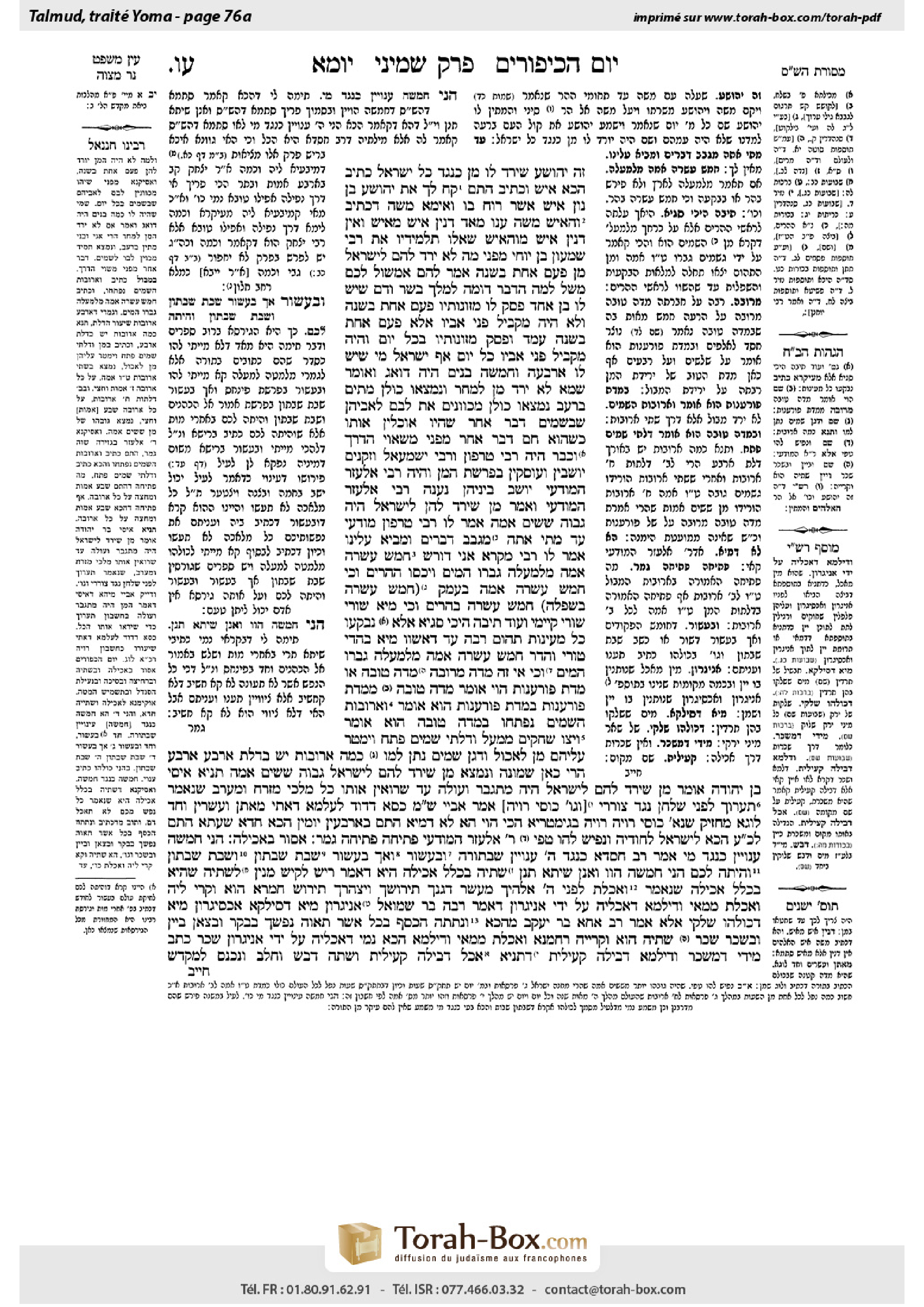
Yoma 76a: Talmud study for Daf Yomi
Daf Yomi is the daily study of one Talmud folio. Explore 37 tractates with scans, Hebrew text, Sefaria English and AI-generated French translations where annotated.
Passage selection and English or AI-generated French translation are available where the scan has annotations. Daf Study is independent of Torah-Box and Sefaria.
Browse Yoma · יומא · All tractatesYoma 76a text and translations
This page of Yoma includes the Aramaic text, an English translation and an AI-generated French translation, alongside the scan above.
יומא ע״ו א · Aramaic and Hebrew text
זֶה יְהוֹשֻׁעַ שֶׁיָּרַד לוֹ מָן כְּנֶגֶד כׇּל יִשְׂרָאֵל. כְּתִיב הָכָא ״אִישׁ״, וּכְתִיב הָתָם: ״קַח לְךָ אֶת יְהוֹשֻׁעַ בִּן נוּן אִישׁ אֲשֶׁר רוּחַ בּוֹ״. וְאֵימָא מֹשֶׁה, דִּכְתִיב: ״וְהָאִישׁ מֹשֶׁה עָנָו מְאֹד״? דָּנִין ״אִישׁ״ מֵ״אִישׁ״, וְאֵין דָּנִין ״אִישׁ״ מִ״וְּהָאִישׁ״.
שָׁאֲלוּ תַּלְמִידָיו אֶת רַבִּי שִׁמְעוֹן בֶּן יוֹחַי: מִפְּנֵי מָה לֹא יָרַד לָהֶם לְיִשְׂרָאֵל מָן פַּעַם אַחַת בַּשָּׁנָה? אָמַר לָהֶם: אֶמְשׁוֹל לָכֶם מָשָׁל: לְמָה הַדָּבָר דּוֹמֶה? לְמֶלֶךְ בָּשָׂר וָדָם שֶׁיֵּשׁ לוֹ בֵּן אֶחָד, פָּסַק לוֹ מְזוֹנוֹתָיו פַּעַם אַחַת בַּשָּׁנָה, וְלֹא הָיָה מַקְבִּיל פְּנֵי אָבִיו אֶלָּא פַּעַם אַחַת בַּשָּׁנָה. עָמַד וּפָסַק מְזוֹנוֹתָיו בְּכׇל יוֹם, וְהָיָה מַקְבִּיל פְּנֵי אָבִיו כׇּל יוֹם.
אַף יִשְׂרָאֵל, מִי שֶׁיֵּשׁ לוֹ אַרְבָּעָה וַחֲמִשָּׁה בָּנִים הָיָה דּוֹאֵג וְאוֹמֵר: שֶׁמָּא לֹא יֵרֵד מָן לְמָחָר, וְנִמְצְאוּ כּוּלָּן מֵתִים בָּרָעָב, נִמְצְאוּ כּוּלָּן מְכַוְּונִים אֶת לִבָּם לַאֲבִיהֶן שֶׁבַּשָּׁמַיִם.
דָּבָר אַחֵר: שֶׁהָיוּ אוֹכְלִין אוֹתוֹ כְּשֶׁהוּא חַם. דָּבָר אַחֵר: מִפְּנֵי מַשּׂאוֹי הַדֶּרֶךְ.
וּכְבָר הָיָה רַבִּי טַרְפוֹן וְרַבִּי יִשְׁמָעֵאל וּזְקֵנִים יוֹשְׁבִין וְעוֹסְקִין בְּפָרָשַׁת הַמָּן, וְהָיָה רַבִּי אֶלְעָזָר הַמּוֹדָעִי יוֹשֵׁב בֵּינֵיהֶן. נַעֲנָה רַבִּי אֶלְעָזָר הַמּוֹדָעִי וְאָמַר: מָן שֶׁיָּרַד לָהֶן לְיִשְׂרָאֵל הָיָה גָּבוֹהַּ שִׁשִּׁים אַמָּה. אָמַר לוֹ רַבִּי טַרְפוֹן: מוֹדָעִי, עַד מָתַי אַתָּה מְגַבֵּב דְּבָרִים וּמֵבִיא עָלֵינוּ!
אָמַר לוֹ: רַבִּי, מִקְרָא אֲנִי דּוֹרֵשׁ: ״חֲמֵשׁ עֶשְׂרֵה אַמָּה מִלְמַעְלָה גָּבְרוּ הַמָּיִם וַיְכֻסּוּ הֶהָרִים״, וְכִי חֲמֵשׁ עֶשְׂרֵה אַמָּה בָּעֵמֶק, (חֲמֵשׁ עֶשְׂרֵה בַּשְּׁפֵלָה,) חֲמֵשׁ עֶשְׂרֵה בֶּהָרִים? וְכִי מַיָּא שׁוּרֵי שׁוּרֵי קָיְימִי. וְעוֹד: תֵּיבָה הֵיכִי סַגִּיָא? אֶלָּא, נִבְקְעוּ כׇּל מַעְיְנוֹת תְּהוֹם רַבָּה עַד דְּאַשְׁווֹ מַיָּא בַּהֲדֵי טוּרֵי, וַהֲדַר ״חֲמֵשׁ עֶשְׂרֵה אַמָּה מִלְמַעְלָה גָּבְרוּ הַמָּיִם״.
וְכִי אֵי זֶה מִדָּה מְרוּבָּה, מִדָּה טוֹבָה אוֹ מִדַּת פּוּרְעָנוּת? הֱוֵי אוֹמֵר: מִדָּה טוֹבָה מִמִּדַּת פּוּרְעָנוּת, בְּמִדַּת פּוּרְעָנוּת הוּא אוֹמֵר: ״וַאֲרוּבּוֹת הַשָּׁמַיִם נִפְתָּחוּ״. בְּמִדָּה טוֹבָה הוּא אוֹמֵר: ״וַיְצַו שְׁחָקִים מִמָּעַל וְדַלְתֵי שָׁמַיִם פָּתָח וַיַּמְטֵר עֲלֵיהֶם מָן לֶאֱכוֹל וּדְגַן שָׁמַיִם נָתַן לָמוֹ״.
כַּמָּה אֲרוּבּוֹת יֵשׁ בְּדֶלֶת — אַרְבַּע אַרְבַּע, הֲרֵי כָּאן שְׁמוֹנֶה, וְנִמְצָא מָן שֶׁיָּרַד לָהֶם לְיִשְׂרָאֵל גָּבוֹהַּ שִׁשִּׁים אַמָּה.
תַּנְיָא, אִיסִי בֶּן יְהוּדָה אוֹמֵר: מָן שֶׁיָּרַד לָהֶם לְיִשְׂרָאֵל הָיָה מִתְגַּבֵּר וְעוֹלֶה עַד שֶׁרוֹאִין אוֹתוֹ כׇּל מַלְכֵי מִזְרָח וּמַעֲרָב, שֶׁנֶּאֱמַר: ״תַּעֲרוֹךְ לְפָנַי שֻׁלְחָן נֶגֶד צוֹרְרָי [וְגוֹ׳ כּוֹסִי רְוָיָה]״, אָמַר אַבָּיֵי: שְׁמַע מִינַּהּ כָּסָא דְּדָוִד לְעָלְמָא דְּאָתֵי, מָאתַן וְעֶשְׂרִין וְחַד לוּגָּא מַחֲזִיק, שֶׁנֶּאֱמַר: ״כּוֹסִי רְוָיָה״, רְוָיָה בְּגִימַטְרִיָּא הָכִי הָוֵי.
הָא לָא דָּמְיָא. הָתָם בְּאַרְבְּעִין יוֹמִין, הָכָא חֲדָא שַׁעְתָּא. הָתָם לְכוּלֵּי עָלְמָא, הָכָא לְיִשְׂרָאֵל לְחוֹדֵיהּ, וּנְפִישׁ לְהוּ טְפֵי. רַבִּי אֶלְעָזָר הַמּוֹדָעִי ״פְּתִיחָה״ ״פְּתִיחָה״ גָּמַר.
אָסוּר בַּאֲכִילָה. הָנֵי חֲמִשָּׁה עִנּוּיִין כְּנֶגֶד מִי? אָמַר רַב חִסְדָּא: כְּנֶגֶד חֲמִשָּׁה עִנּוּיִין שֶׁבַּתּוֹרָה: ״וּבֶעָשׂוֹר״, וְ״אַךְ בֶּעָשׂוֹר״, ״שַׁבַּת שַׁבָּתוֹן״, וְ״שַׁבַּת שַׁבָּתוֹן״, ״וְהָיְתָה לָכֶם״.
הָנֵי חֲמִשָּׁה הָווּ? וַאֲנַן שִׁיתָּא תְּנַן! שְׁתִיָּה בִּכְלַל אֲכִילָה הִיא. דְּאָמַר רֵישׁ לָקִישׁ: מִנַּיִן לִשְׁתִיָּה שֶׁהִיא בִּכְלַל אֲכִילָה, שֶׁנֶּאֱמַר: ״וְאָכַלְתָּ לִפְנֵי ה׳ אֱלֹהֶיךָ מַעְשַׂר דְּגָנְךָ תִּירוֹשְׁךָ וְיִצְהָרֶךָ״, תִּירוֹשׁ חַמְרָא הוּא, וְקָרֵי לֵיהּ ״וְאָכַלְתָּ״.
מִמַּאי? וְדִילְמָא דְּאַכְלֵיהּ עַל יְדֵי אֲנִיגְרוֹן! דְּאָמַר רַבָּה בַּר שְׁמוּאֵל: אַנִיגְרוֹן מַיָּא דְסִילְקָא, אַכְּסִיגְרוֹן מַיָּא דְּכוּלְּהוּ שִׁלְקֵי.
אֶלָּא אָמַר רַב אַחָא בַּר יַעֲקֹב, מֵהָכָא: ״וְנָתַתָּה הַכֶּסֶף בְּכֹל אֲשֶׁר תְּאַוֶּה נַפְשְׁךָ בַּבָּקָר וּבַצֹּאן בְּיַיִן וּבַשֵּׁכָר״. שֵׁכָר שְׁתִיָּה הוּא, וְקַרְיֵיהּ רַחֲמָנָא ״וְאָכַלְתָּ״.
מִמַּאי? וְדִילְמָא הָכָא נָמֵי דְּאַכְלֵיהּ עַל יְדֵי אֲנִיגְרוֹן! ״שֵׁכָר״ כְּתִב, מִידֵּי דִּמְשַׁכַּר. וְדִילְמָא דְּבֵילָה קְעִילִית? דְּתַנְיָא: אָכַל דְּבֵילָה קְעִילִית וְשָׁתָה דְּבַשׁ וְחָלָב וְנִכְנַס לַמִּקְדָּשׁ —
Yoma 76a · English translation
the verse is referring to Joshua, for whom manna fell corresponding to all the rest of the Jewish people, when he waited for Moses at Mount Sinai during the forty days Moses was on the mountain. The verses allude to this: “Man” is written here, and “man” is written there: “Take to you Joshua, the son of Nun, a man in whom there is spirit, and lay your hand upon him” (Numbers 27:18). From here, the Gemara learns that the “man” is Joshua. The Gemara asks: Say that the verse is referring to Moses, about whom it is written: “Now the man Moses was very humble” (Numbers 12:3). The Gemara answers: We can learn a verbal analogy to the word “man” from the word “man,” but we cannot learn a verbal analogy to the word “man” from the phrase “the man,” which is used to refer to Moses.
Furthermore, with regard to the manna: The students of Rabbi Shimon ben Yoḥai asked him: Why didn’t the manna fall for the Jewish people just once a year to take care of all their needs, instead of coming down every day? He said to them: I will give you a parable: To what does this matter compare? To a king of flesh and blood who has only one son. He granted him an allowance for food once a year and the son greeted his father only once a year, when it was time for him to receive his allowance. So he arose and granted him his food every day, and his son visited him every day.
So too, in the case of the Jewish people, someone who had four or five children would be worried and say: Perhaps the manna will not fall tomorrow and we will all die of starvation. Consequently, everyone directed their hearts to their Father in heaven every day. The manna that fell each day was sufficient only for that day, so that all of the Jewish people would pray to God for food for the next day.
Alternatively, they received manna daily so that they would be able to eat it while it was hot and fresh. Alternatively, they received manna daily due to the hardship of carrying on the journey. They did not stay in the same place all those years, and it would have been difficult for them to carry the manna from one place to another. Therefore, the manna fell wherever they went.
§ It is told: Rabbi Tarfon, and Rabbi Yishmael, and the Elders were sitting and discussing the passage about the manna and Rabbi Elazar HaModa’i was sitting among them. Rabbi Elazar HaModa’i responded and said: The manna that fell for the Jewish people was sixty cubits high. Rabbi Tarfon said to him: Moda’i, how long will you collect words and bring upon us teachings that have no basis?
He said to him: Rabbi, I am interpreting a verse. How so? It states about the Flood: “Fifteen cubits above did the waters prevail; and the mountains were covered” (Genesis 7:20). Is it possible that it would be fifteen cubits high from a valley, fifteen cubits from the plain, and fifteen cubits from the mountains? Did the water stand as though in layers, conforming to the height of the land below it? Furthermore, how could the Ark travel over water that was at different levels? Rather: “On the same day were all the fountains of the great deep broken up” (Genesis 7:11), until the water rose and was level with the mountains. Afterward, the verse states that “fifteen cubits above did the waters prevail.”
Rabbi Elazar HaModa’i continues: But which attribute is greater, the attribute of goodness or the attribute of retribution? One must say the attribute of goodness is greater than the attribute of retribution. With regard to the attribute of retribution, in the case of the Flood, the verse states: “And the windows of heaven were opened” (Genesis 7:11), which indicates that there were only windows. Whereas, with regard to the attribute of goodness, in the case of the manna, the verse states: “He commanded the skies above, and opened the doors of heaven, and rained down manna upon them to eat and gave them heavenly grain” (Psalms 78:23–24).
Based on this, the Gemara calculates: The area of how many windows are in a door? Four. A door is equivalent to four windows in size. One adds another four for the second door, as the verse uses the plural “doors,” which implies that there were two doors. This equals the area of eight windows. If the depth of water in the Flood is based on the phrase “windows of heaven,” implying two windows, then the manna fell at a rate four times that of the water of the Flood. Since the water of the Flood reached a depth of fifteen cubits, it turns out that the manna that fell for the Jewish people was sixty cubits high, i.e., four times as high.
Similarly, it was taught in a baraita that Isi ben Yehuda said: The manna that fell for the Jewish people would accumulate and ascend until all the kings of the East and West could see it, as it is stated: “You prepared a table before me in the presence of my enemies; you anointed my head with oil; my cup runs over” (Psalms 23:5). God prepared food for the Jewish people, so that their enemies would see their greatness over the world. “My cup runs over [revaya]”; Abaye said: We learn from this that the cup of David in the next world holds 221 log, since it is stated: “My cup runs over,” and the word revaya has that numerical value.
The Gemara asks how Rabbi Elazar HaModa’i can compare the depth of the Flood waters with the amount of manna that fell in the desert: This is not similar, and the calculation is inaccurate. There, in the case of the Flood, the water rose fifteen cubits in forty days; but here, in the case of the manna, it took only one hour every day to fall. Conversely, there the Flood was for everyone and covered the whole world; whereas here the manna was for the Jewish people alone. And there would be much more manna for them than sixty cubits, which is the measurement put forth by Rabbi Elazar HaModa’i. The Gemara answers: Rabbi Elazar HaModa’i derived “opening” in the verse: “He commanded the skies above, and opened the doors of heaven” (Psalms 78:23), from “opening” in the verse: “And the windows of heaven were opened” (Genesis 7:11). He used a verbal analogy that teaches that the skies opened in both instances in the same way.
§ The mishna taught that as per the five prohibited activities on Yom Kippur it is prohibited to engage in eating and in drinking, and in bathing, and in smearing the body with oil, and in wearing shoes, and in conjugal relations. The Gemara asks: These five afflictions of Yom Kippur, to what do they correspond? Where is the Torah source or allusion to them? Rav Ḥisda said: They are based on the five times that the afflictions of Yom Kippur are mentioned in the Torah. It is stated: (1) “And on the tenth of this seventh month you shall have a holy convocation, and you shall afflict your souls” (Numbers 29:7); (2) “But on the tenth of this seventh month is the day of atonement, it shall be a holy convocation for you and you shall afflict your souls” (Leviticus 23:27); (3) “It shall be for you a Shabbat of solemn rest, and you shall afflict your souls (Leviticus 23:32); (4) “It is a Shabbat of solemn rest [shabbaton] for you, and you shall afflict your souls” (Leviticus 16:31); (5) “And it shall be a statute for you forever, in the seventh month on the tenth of the month, you shall afflict your souls” (Leviticus 16:29).
The Gemara asks: Are these five the only afflictions? We learn in the mishna that there are six: Eating, drinking, bathing, smearing oil, conjugal relations, and wearing shoes. The Gemara answers: Drinking is included in the prohibition of eating; both together are considered a single affliction. As Reish Lakish said: From where do we derive that drinking is included in the concept of eating? As it is stated: “And you shall eat before the Lord your God, in the place where He shall choose to cause His name to dwell there, the tithe of your grain, of your wine [tirosh], and of your oil” (Deuteronomy 14:23). Tirosh is wine, yet the verse calls the drinking of wine eating with the phrase “and you shall eat,” meaning that eating also refers to drinking.
The Gemara rejects this answer: From where do you draw this conclusion? Perhaps the wine was eaten as anigron, a sauce made of oil, beet juice, and garum mixed with wine. As Rabba bar Shmuel said: Anigron is beet juice and wine mixed together. Akhsigron is water that comes from boiled vegetables that have wine mixed into them. The vegetables are mixed with the wine and eaten. It is possible for wine to literally be eaten. Therefore, the verse does not prove that drinking is included in eating.
Rather, Rav Aḥa bar Ya’akov said: From here there is a proof as the verse states: “And you shall spend that money on all that your soul desires, on oxen, or on sheep, or on wine, or on strong drink [sheikhar] or whatever your soul desires, and you shall eat” (Deuteronomy 14:26). Strong drink is a drink, but the Merciful One calls its consumption eating, in the phrase “and you shall eat.”
The Gemara rejects this proof: From where do you draw this conclusion? Perhaps here too it was eaten as anigron? The Gemara rejects this: Here that answer is insufficient because the verse writes “strong drink [sheikhar],” meaning something that intoxicates. Beverages that generally intoxicate do not do so when they are in a mixture. The Gemara asks: Perhaps sheikhar does not refer to wine but to a food that causes intoxication, such as a sweet dried fig from Keilah. As it was taught in a baraita: A priest who ate a sweet dried fig from Keilah or drank honey or milk, thereby becoming intoxicated, and entered the Temple to serve
Yoma 76a · Traduction française (IA)
Le verset fait référence à Josué, pour qui la manne tombait en quantité égale à celle qui tombait pour tout le reste du peuple juif, lorsqu’il attendait Moïse au mont Sinaï pendant les quarante jours que celui-ci passa sur la montagne. Les versets y font allusion : le mot « man » est écrit ici, et le mot « homme » est écrit là : « Prends Josué, fils de Noun, un homme en qui réside l’esprit, et pose ta main sur lui » (Nombres 27, 18). La Guemara en déduit que l’« homme » est Josué. La Guemara demande : Disons que le verset fait référence à Moïse, au sujet duquel il est écrit : « Or l’homme Moïse était très humble » (Nombres 12, 3). La Guemara répond : On peut établir une analogie verbale entre le mot « homme » et un autre mot « homme », mais on ne peut pas établir d’analogie verbale entre le mot « homme » et l’expression « l’homme », qui désigne Moïse.
En outre, au sujet de la manne, les élèves de Rabbi Shimon ben Yoḥai lui demandèrent : Pourquoi la manne ne tombait-elle pas pour le peuple juif une seule fois par an, de façon à pourvoir à tous ses besoins, au lieu de tomber chaque jour ? Il leur répondit : Je vais vous donner une parabole. À quoi cela ressemble-t-il ? À un roi de chair et de sang qui n’a qu’un seul fils. Il lui accordait une allocation pour sa nourriture une fois par an, et le fils ne rendait visite à son père qu’une fois par an, au moment de recevoir son allocation. Le père se mit alors à lui accorder sa nourriture chaque jour, et son fils lui rendait visite tous les jours.
De même, dans le cas du peuple juif, celui qui avait quatre ou cinq enfants s’inquiétait et se disait : « Peut-être la manne ne tombera-t-elle pas demain, et nous mourrons tous de faim. » Par conséquent, tous tournaient chaque jour leur cœur vers leur Père céleste. La manne qui tombait chaque jour ne suffisait que pour cette journée, afin que tout le peuple juif prie Dieu pour obtenir sa nourriture du lendemain.
Autre explication : ils recevaient la manne chaque jour afin de pouvoir la manger chaude et fraîche. Autre explication : ils recevaient la manne chaque jour pour leur éviter la difficulté de la transporter pendant le voyage. Ils ne restaient pas au même endroit pendant toutes ces années, et il leur aurait été difficile de transporter la manne d’un endroit à un autre. C’est pourquoi la manne tombait partout où ils allaient.
§ On raconte que Rabbi Tarfon, Rabbi Yishmael et les Anciens étaient assis et discutaient du passage relatif à la manne, tandis que Rabbi Elazar HaModa’i était assis parmi eux. Rabbi Elazar HaModa’i prit la parole et dit : « La manne qui tombait pour le peuple juif s’élevait à soixante coudées. » Rabbi Tarfon lui dit : « Moda’i, combien de temps encore vas-tu collecter des paroles et nous apporter des enseignements sans fondement ? »
Il lui dit : « Rabbi, j’interprète un verset. Comment ? À propos du Déluge, il est écrit : “Les eaux s’élevèrent de quinze coudées au-dessus, et les montagnes furent recouvertes” (Genèse 7, 20). Est-il possible que l’eau ait atteint quinze coudées au-dessus d’une vallée, quinze coudées au-dessus d’une plaine et quinze coudées au-dessus des montagnes ? L’eau se tenait-elle comme en couches, épousant la hauteur du terrain situé au-dessous d’elle ? De plus, comment l’arche aurait-elle pu naviguer sur une eau dont le niveau variait selon les endroits ? En réalité, “le même jour, toutes les sources du grand abîme jaillirent” (Genèse 7, 11), jusqu’à ce que l’eau monte et atteigne le niveau des montagnes. Ensuite, le verset dit que “les eaux s’élevèrent de quinze coudées au-dessus”. »
Rabbi Elazar HaModa’i poursuit : Mais quelle qualité est la plus grande, celle de la bonté ou celle du châtiment ? Il faut dire que la qualité de la bonté est plus grande que celle du châtiment. Pour la qualité du châtiment, dans le cas du Déluge, le verset dit : « Les fenêtres du ciel s’ouvrirent » (Genèse 7, 11), ce qui indique qu’il n’y avait que des fenêtres. En revanche, pour la qualité de la bonté, dans le cas de la manne, le verset dit : « Il commanda aux cieux d’en haut, ouvrit les portes du ciel, fit pleuvoir sur eux la manne pour nourriture et leur donna le blé du ciel » (Psaumes 78, 23-24).
Sur cette base, la Guemara fait le calcul suivant : quelle est la superficie d’une porte par rapport à celle des fenêtres ? Quatre fenêtres. Une porte équivaut à quatre fenêtres en superficie. On en ajoute quatre autres pour la seconde porte, puisque le verset emploie le pluriel « portes », ce qui implique qu’il y en avait deux. Cela équivaut à la superficie de huit fenêtres. Si la profondeur de l’eau du Déluge est déterminée d’après l’expression « fenêtres du ciel », qui implique deux fenêtres, alors la manne tombait à un rythme quatre fois supérieur à celui de l’eau du Déluge. Puisque l’eau du Déluge atteignit une profondeur de quinze coudées, il s’ensuit que la manne qui tombait pour le peuple juif atteignait soixante coudées de hauteur, soit quatre fois plus.
De même, il a été enseigné dans une baraïta qu’Isi ben Yehuda disait : « La manne qui tombait pour le peuple juif s’accumulait et s’élevait jusqu’à ce que tous les rois d’Orient et d’Occident puissent la voir », comme il est dit : « Tu dresses devant moi une table en présence de mes ennemis ; tu oins ma tête d’huile ; ma coupe déborde » (Psaumes 23, 5). Dieu préparait de la nourriture pour le peuple juif afin que ses ennemis voient sa grandeur dans le monde. « Ma coupe déborde [revaya] » : Abaye dit : Nous apprenons de là que la coupe de David dans le monde à venir contient 221 log, car il est dit : « Ma coupe déborde », et le mot revaya a cette valeur numérique.
La Guemara demande comment Rabbi Elazar HaModa’i peut comparer la profondeur des eaux du Déluge à la quantité de manne tombée dans le désert : les deux cas ne sont pas comparables et le calcul est inexact. Dans le premier cas, celui du Déluge, l’eau monta de quinze coudées en quarante jours ; dans le second, celui de la manne, celle-ci ne tombait qu’une heure par jour. Inversement, le Déluge concerna tout le monde et recouvrit la terre entière, tandis que la manne était destinée au seul peuple juif. Il aurait donc dû y avoir pour eux beaucoup plus de manne que les soixante coudées avancées par Rabbi Elazar HaModa’i. La Guemara répond : Rabbi Elazar HaModa’i a établi une analogie verbale entre le terme « ouvrit » du verset « Il commanda aux cieux d’en haut et ouvrit les portes du ciel » (Psaumes 78, 23) et le terme « s’ouvrirent » du verset « Les fenêtres du ciel s’ouvrirent » (Genèse 7, 11). Il s’est appuyé sur une analogie verbale qui enseigne que les cieux s’ouvrirent de la même manière dans les deux cas.
§ La Michna enseignait que, parmi les cinq activités interdites à Yom Kippour, il est interdit de manger, de boire, de se baigner, de s’enduire le corps d’huile, de porter des chaussures et d’avoir des relations conjugales. La Guemara demande : À quoi correspondent ces cinq afflictions de Yom Kippour ? Quelle est leur source dans la Torah, ou quelle allusion y trouve-t-on ? Rav Ḥisda dit : Elles reposent sur les cinq occurrences de l’affliction de Yom Kippour dans la Torah. Il est écrit : (1) « Le dixième jour de ce septième mois, vous aurez une sainte convocation, et vous vous affligerez » (Nombres 29, 7) ; (2) « Mais le dixième jour de ce septième mois est le jour des expiations ; vous aurez une sainte convocation, et vous vous affligerez » (Lévitique 23, 27) ; (3) « Ce sera pour vous un Chabbat de repos solennel, et vous vous affligerez » (Lévitique 23, 32) ; (4) « C’est un Chabbat de repos solennel [shabbaton] pour vous, et vous vous affligerez » (Lévitique 16, 31) ; (5) « Ce sera pour vous une loi perpétuelle : au septième mois, le dixième jour du mois, vous vous affligerez » (Lévitique 16, 29).
La Guemara demande : Ces cinq afflictions sont-elles les seules ? Nous apprenons dans la Michna qu’il y en a six : manger, boire, se baigner, s’enduire d’huile, avoir des relations conjugales et porter des chaussures. La Guemara répond : Boire est inclus dans l’interdiction de manger ; les deux ensemble sont considérés comme une seule affliction. Car Reish Lakish a dit : D’où savons-nous que boire est inclus dans la notion de manger ? Comme il est dit : « Tu mangeras devant le Seigneur ton Dieu, dans le lieu qu’Il choisira pour y faire résider Son nom, la dîme de ton blé, de ton vin [tirosh] et de ton huile » (Deutéronome 14, 23). Tirosh désigne le vin, et pourtant le verset qualifie la consommation de vin de fait de manger, avec l’expression « tu mangeras », ce qui signifie que manger désigne aussi le fait de boire.
La Guemara rejette cette réponse : D’où tires-tu cette conclusion ? Peut-être le vin était-il consommé sous forme d’anigron, une sauce faite d’huile, de jus de betterave et de garum mélangés à du vin. Car Rabba bar Shmuel a dit : « L’anigron est un mélange de jus de betterave et de vin. L’akhsigron est l’eau provenant de légumes bouillis, à laquelle on mélange du vin. » Les légumes sont mélangés au vin et mangés. Il est donc possible de manger littéralement du vin. Par conséquent, le verset ne prouve pas que boire est inclus dans manger.
En réalité, Rav Aḥa bar Ya’akov dit : Il y a une preuve dans ce verset : « Tu dépenseras cet argent pour tout ce que ton âme désire, pour des bœufs, des moutons, du vin, des boissons fortes [sheikhar] ou tout ce que ton âme désire, et tu mangeras » (Deutéronome 14, 26). Une boisson forte est une boisson, mais le Miséricordieux qualifie sa consommation de fait de manger, avec l’expression « et tu mangeras ».
La Guemara rejette cette preuve : D’où tires-tu cette conclusion ? Peut-être, ici aussi, le vin était-il consommé sous forme d’anigron ? La Guemara rejette cette possibilité : ici, cette réponse ne convient pas, car le verset dit « boisson forte [sheikhar] », c’est-à-dire une boisson qui enivre. Les boissons qui enivrent habituellement ne le font pas lorsqu’elles sont mélangées à d’autres ingrédients. La Guemara demande : Peut-être sheikhar ne désigne-t-il pas le vin, mais un aliment qui provoque l’ivresse, comme une figue sèche sucrée de Keilah. Car il a été enseigné dans une baraïta : Un prêtre qui mangea une figue sèche sucrée de Keilah, ou qui but du miel ou du lait, et qui, devenu ivre, entra dans le Temple pour y officier
Traduction française générée par IA à partir de l’édition anglaise de Sefaria. Vérifie toujours un passage avec le texte source.
Text from Sefaria: William Davidson Edition - Vocalized Aramaic (CC BY NC); William Davidson Edition - English (CC BY NC).