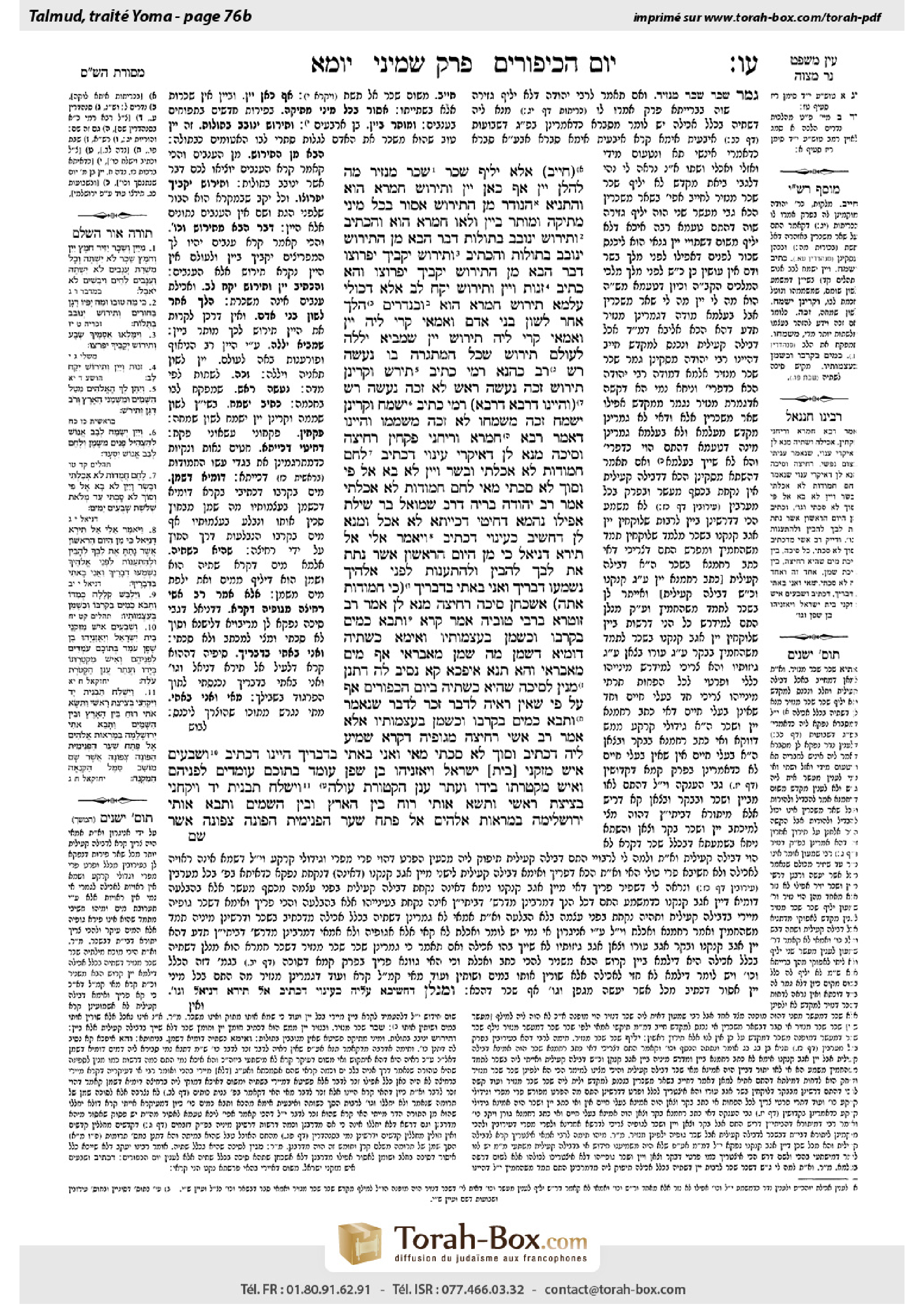
Yoma 76b: Talmud study for Daf Yomi
Daf Yomi is the daily study of one Talmud folio. Explore 37 tractates with scans, Hebrew text, Sefaria English and AI-generated French translations where annotated.
Passage selection and English or AI-generated French translation are available where the scan has annotations. Daf Study is independent of Torah-Box and Sefaria.
Browse Yoma · יומא · All tractatesYoma 76b text and translations
This page of Yoma includes the Aramaic text, an English translation and an AI-generated French translation, alongside the scan above.
יומא ע״ו ב · Aramaic and Hebrew text
(חַיָּיב).
אֶלָּא: יָלֵיף ״שֵׁכָר״ ״שֵׁכָר״ מִנָּזִיר, מָה לְהַלָּן — יַיִן, אַף כָּאן יַיִן.
וְתִירוֹשׁ חַמְרָא הוּא? וְהָתַנְיָא: הַנּוֹדֵר מִן הַתִּירוֹשׁ — אָסוּר בְּכׇל מִינֵי מְתִיקָה וּמוּתָּר בְּיַיִן! וְלָאו חַמְרָא הוּא? וְהָכְתִיב: ״וְתִירוֹשׁ יְנוֹבֵב בְּתוּלוֹת״, דָּבָר הַבָּא מִן הַתִּירוֹשׁ — יְנוֹבֵב בְּתוּלוֹת.
וְהָכְתִיב: ״וְתִירוֹשׁ יְקָבֶיךָ יִפְרוֹצוּ״! דָּבָר הַבָּא מִן הַתִּירוֹשׁ — יְקָבֶיךָ יִפְרוֹצוּ.
וְהָא כְּתִיב ״זְנוּת וְיַיִן וְתִירוֹשׁ יִקַּח לֵב״! אֶלָּא, דְּכוּלֵּי עָלְמָא תִּירוֹשׁ חַמְרָא הוּא, וּבִנְדָרִים הַלֵּךְ אַחַר לְשׁוֹן בְּנֵי אָדָם.
וְאַמַּאי קָרֵי לֵיהּ יַיִן, וְאַמַּאי קָרֵי לֵיהּ תִּירוֹשׁ? יַיִן — שֶׁמֵּבִיא יְלָלָה לְעוֹלָם. תִּירוֹשׁ — שֶׁכׇּל הַמִּתְגָּרֶה בּוֹ נַעֲשָׂה רָשׁ.
רַב כָּהֲנָא רָמֵי: כְּתִיב ״תִּירָשׁ״, וְקָרֵינַן ״תִּירוֹשׁ״. זָכָה — נַעֲשָׂה רֹאשׁ, לֹא זָכָה — נַעֲשָׂה רָשׁ. (וְהַיְינוּ דְּרָבָא דְּרָבָא) רָמֵי, כְּתִיב: ״יְשַׁמַּח״, וְקָרֵינַן יְשַׂמַּח. זָכָה — מְשַׂמְּחוֹ, לֹא זָכָה — מְשַׁמְּמוֹ. וְהַיְינוּ דְּאָמַר רָבָא: חַמְרָא וְרֵיחָנֵי — פַּקְחֻין.
רְחִיצָה וְסִיכָה, מְנָא לַן דְּאִיקְּרִי עִינּוּי. דִּכְתִיב: ״לֶחֶם חֲמוּדוֹת לֹא אָכַלְתִּי וּבָשָׂר וָיַיִן לֹא בָא אֶל פִּי וְסוֹךְ לֹא סָכְתִּי״. מַאי ״לֶחֶם חֲמוּדוֹת לֹא אָכַלְתִּי״? אָמַר רַב יְהוּדָה בְּרֵיהּ דְּרַב שְׁמוּאֵל בַּר שִׁילַת: אֲפִילּוּ נַהֲמָא דְּחִיטֵּי דַּכְיָיתָא, לָא אֲכַל.
וּמְנָא לַן דַּחֲשִׁיב כְּעִינּוּי — דִּכְתִיב: ״וַיֹּאמֶר אֵלַי אַל תִּירָא דָנִיֵּאל כִּי מִן הַיּוֹם הָרִאשׁוֹן אֲשֶׁר נָתַתָּ אֶת לִבְּךָ לְהָבִין וּלְהִתְעַנּוֹת לִפְנֵי אֱלֹהֶיךָ נִשְׁמְעוּ דְבָרֶיךָ וַאֲנִי בָאתִי בִּדְבָרֶיךָ״. (״כִּי חֲמוּדוֹת אָתָּה״.)
אַשְׁכְּחַן סִיכָה, רְחִיצָה מְנָא לַן? אָמַר רַב זוּטְרָא בְּרַבִּי טוֹבִיָּה, אָמַר קְרָא: ״וַתָּבֹא כַמַּיִם בְּקִרְבּוֹ וְכַשֶּׁמֶן בְּעַצְמוֹתָיו״. וְאֵימָא כִּשְׁתִיָּה! דּוּמְיָא דְּשֶׁמֶן: מָה שֶׁמֶן מֵאַבָּרַאי, אַף מַיִם מֵאַבָּרַאי.
וְהָא תַּנָּא אִיפְּכָא קָא נָסֵיב לַהּ, דִּתְנַן: מִנַּיִן לְסִיכָה שֶׁהִיא כִּשְׁתִיָּה בְּיוֹם הַכִּפּוּרִים? אַף עַל פִּי שֶׁאֵין רְאָיָה לַדָּבָר, זֵכֶר לַדָּבָר, שֶׁנֶּאֱמַר: ״וַתָּבֹא כַמַּיִם בְּקִרְבּוֹ וְכַשֶּׁמֶן בְּעַצְמוֹתָיו״! אֶלָּא אָמַר רַב אָשֵׁי: רְחִיצָה מִגּוּפֵיהּ דִּקְרָא שְׁמִיעַ לֵיהּ, דִּכְתִיב: ״וְסוֹךְ לֹא סָכְתִּי״.
מַאי: ״וַאֲנִי בָּאתִי בִּדְבָרֶיךָ״? הַיְינוּ דִּכְתִיב: ״וְשִׁבְעִים אִישׁ מִזִּקְנֵי [בֵית] יִשְׂרָאֵל וְיַאֲזַנְיָהוּ בֶן שָׁפָן עוֹמֵד בְּתוֹכָם עוֹמְדִים לִפְנֵיהֶם וְאִישׁ מִקְטַרְתּוֹ בְּיָדוֹ וַעֲתַר עֲנַן הַקְּטוֹרֶת עֹלֶה״. ״וַיִּשְׁלַח תַּבְנִית יָד וַיִּקָּחֵנִי בְּצִיצִת רֹאשִׁי וַתִּשָּׂא אוֹתִי רוּחַ בֵּין הָאָרֶץ וּבֵין הַשָּׁמַיִם וַתָּבֵא אוֹתִי יְרוּשָׁלַיְמָה בְּמַרְאוֹת אֱלֹהִים אֶל פֶּתַח שַׁעַר הַפְּנִימִית הַפּוֹנֶה צָפוֹנָה אֲשֶׁר
Yoma 76b · English translation
is liable for violating the prohibition: “Drink no wine nor strong drink [sheikhar]” (Leviticus 10:9). Consequently, the term sheikhar in the text can be understood here as the sweet dried fig.
Rather, the Gemara rejects this and states: It is derived through a verbal analogy of “sheikhar” and “sheikhar” stated in the verses of the nazirite (Numbers 6:3). Just as there, in the case of the nazirite, sheikhar means strong wine, so too, here, it means strong wine and not sweet dried figs.
The Gemara returns to the meaning of the word tirosh: Is tirosh wine? Isn’t it taught in a baraita: One who vows not to benefit from tirosh is not allowed sweet foods, e.g., sweet fruits, but is allowed wine. Therefore, tirosh is not wine but sweet food. The Gemara rejects this: And is tirosh not wine? But isn’t it written: “Tirosh shall make the young women flourish [yenovev]” (Zechariah 9:17). The word yenovev comes from the word niv, speech. Consequently, tirosh is a food that tempts the heart and mouth of the drinker, even of virgins, who are modest and reticent. Since sweet foods do not have this effect, tirosh must be wine. The Gemara replies: This is not a proof, since we could explain it otherwise: Something that comes from tirosh, such as wine, causes virgins to come forth; tirosh itself means sweet grapes. Perhaps wine is called tirosh only by extension because it is made from tirosh.
The Gemara challenges this: But isn’t it written: “And your vats shall overflow with tirosh” (Proverbs 3:10). This description implies that tirosh is wine rather than sweet grapes. The Gemara answers: This too is not a proof that tirosh means wine. We could say that the vats shall overflow with something that comes from tirosh, i.e., wine; yet tirosh itself means sweet fruits.
The Gemara objects: But it is written: “Harlotry, and wine, and tirosh take away the heart” (Hosea 4:11). Since tirosh leads the heart astray, it is clear that it is wine. Therefore, the Gemara accepts that tirosh means wine. Rather, according to everyone, the word tirosh in the Bible refers to wine, but vows follow colloquial language. During the time of the Mishna, tirosh meant sweet fruits; the term included grapes but not wine. When dealing with vows, the intention of the speaker is what must be determined, but no inference can be drawn from colloquial language to the biblical definition of the word.
The Gemara asks: And if so, why does the Bible call it wine and why does it call it tirosh? The Gemara explains: “Wine” suggests that it brings lament to the world because drunkenness causes most sins. There is a phonetic resemblance between the yayin, wine, and ta’aniya va’aniya, sorrow and howling, which Rashi (on Job 2:5) explains as lament. “Tirosh” shows that those who indulge in it become poor [rash].
Rav Kahana raised a contradiction: It is written as tirash but we read it tirosh. This should be understood as follows: If one merits and drinks appropriately, he is made a head [rosh]; if one does not merit and does not drink appropriately, he is made poor [rash]. The Gemara comments: This is the same as what Rava said, as Rava raised a contradiction: It is written: “And wine that makes glad [yishamaḥ] the heart of man” (Psalms 104:15) with a shin, but we read it yisamaḥ with a sin. This teaches: If one merits, wine makes him happy [same’aḥ]; if one does not merit, it makes him confounded [shamem]. This is the same as what Rava said: Wine and good scents make me wise, meaning that wine benefits one who deserves it.
§ The Gemara asks: From where do we derive that abstaining from bathing and smearing oil on oneself is called affliction? The Gemara answers: As it is written “I ate no pleasant bread, neither did meat nor wine enter my mouth, neither did I anoint myself at all” (Daniel 10:3). The Gemara explains the verse: What is the meaning of “I ate no pleasant bread”? Rav Yehuda, son of Rav Shmuel bar Sheilat, said: He did not eat even bread made from refined wheat; he ate only wheat mixed with bran.
The Gemara continues to show that abstaining from smearing oil on oneself is considered an affliction: And from where do we derive that abstaining from the activities that Daniel describes is considered affliction? As it is written: “Then he said to me: Fear not, Daniel, for from the first day that you set your heart to understand and to afflict yourself before your God, your words were heard, and I have come due to your words” (Daniel 10:12). “For you are greatly loved” (Daniel 9:23).
We have found proof that abstaining from smearing oil on oneself is considered affliction; from where do we derive that abstaining from bathing is also called affliction? Rav Zutra, son of Rabbi Toviya, said: The verse states: “And it came into his innards like water, and like oil into his bones” (Psalms 109:18). This means that the water with which one bathes and the oil with which one smears himself are absorbed into the body. Just as abstaining from smearing oil is considered an affliction, so too, abstaining from bathing is considered an affliction. The Gemara objects: But say that “came into his innards like water” is referring to drinking rather than smearing oil. The Gemara rejects this: It is similar to oil. Just as the oil described in the verse is smeared from outside the body and not drunk, so too, the water mentioned in the verse is used for bathing from the outside. It is not drunk.
The Gemara asks: But the tanna took the opposite meaning, as we learned in a mishna: From where do we derive that smearing oil is like drinking on Yom Kippur? Although there is no explicit proof of the matter from the Bible, there is an allusion to the matter from the verse, as it is stated: “And it came into his innards like water, and like oil into his bones” (Psalms 109:18), meaning that oil on the body is like water within it. Therefore, the phrase “and it came into his innards like water” is referring to the act of drinking water. Rather, Rav Ashi said: Bathing is derived from the same verse cited above, as it is written: “Neither did I anoint myself at all” (Daniel 10:3). This teaches that Daniel did not do any anointing, including bathing. Consequently, the same source prohibits both of these activities.
Apropos the verses from Daniel, the Gemara asks: What did the angel mean when he said to Daniel: “And I have come due to your words” (Daniel 10:12)? From this, it seems that the angel was able to come only because of Daniel. The Gemara answers: This is as it is written: “And there stood before them seventy men of the Elders of the house of Israel, and Jaazaniah, son of Shaphan, standing in the midst of them, each man with his censer in his hand, and a thick cloud of incense went up” (Ezekiel 8:11). Ezekiel saw the Elders of the house of Israel worshipping foreign gods. “And the form of a hand was put forth, and I was taken by a lock of my head; and a spirit lifted me up between the earth and the heaven, and brought me in the visions of God to Jerusalem, to the door of the gate of the inner court that faces northward where
Yoma 76b · Traduction française (IA)
est passible d’avoir transgressé l’interdiction : « Ne buvez ni vin ni boisson forte [sheikhar] » (Lévitique 10:9). Par conséquent, le terme sheikhar dans le verset peut ici être compris comme désignant la figue sèche sucrée.
La Guemara rejette plutôt cette explication et affirme que cela se déduit par analogie verbale entre « sheikhar » et « sheikhar », termes employés dans les versets concernant le nazir (Nombres 6:3). De même que là, dans le cas du nazir, sheikhar désigne du vin fort, de même ici, il désigne du vin fort et non des figues sèches sucrées.
La Guemara revient au sens du mot tirosh : tirosh désigne-t-il le vin ? N’est-il pas enseigné dans une baraïta que celui qui fait vœu de ne pas tirer profit du tirosh ne peut consommer d’aliments sucrés, par exemple des fruits sucrés, mais peut consommer du vin ? Par conséquent, tirosh ne désigne pas le vin, mais les aliments sucrés. La Guemara rejette cette objection : tirosh ne désignerait-il pas le vin ? N’est-il pas écrit : « Tirosh fera s’épanouir les jeunes femmes [yenovev] » (Zacharie 9:17) ? Le mot yenovev vient du mot niv, « parole ». Par conséquent, tirosh est un aliment qui séduit le cœur et la bouche de celui qui le boit, même des vierges, qui sont pudiques et réservées. Puisque les aliments sucrés n’ont pas cet effet, tirosh doit désigner le vin. La Guemara répond que ce n’est pas une preuve, car on pourrait l’expliquer autrement : quelque chose qui provient du tirosh, comme le vin, fait sortir les vierges ; tirosh lui-même désigne les raisins sucrés. Peut-être le vin est-il appelé tirosh uniquement par extension, parce qu’il est fabriqué à partir du tirosh.
La Guemara objecte : mais n’est-il pas écrit : « Tes cuves déborderont de tirosh » (Proverbes 3:10) ? Cette description implique que tirosh désigne le vin plutôt que les raisins sucrés. La Guemara répond que cela non plus ne prouve pas que tirosh signifie le vin. On pourrait dire que les cuves déborderont de quelque chose qui provient du tirosh, c’est-à-dire du vin ; tirosh lui-même désigne toutefois les fruits sucrés.
La Guemara objecte : mais il est écrit : « La débauche, le vin et le tirosh enlèvent le cœur » (Osée 4:11). Puisque le tirosh égare le cœur, il est clair qu’il s’agit de vin. La Guemara admet donc que tirosh signifie le vin. En réalité, selon tous, le mot tirosh dans la Bible désigne le vin, mais les vœux suivent l’usage courant. À l’époque de la Michna, tirosh désignait les fruits sucrés ; le terme comprenait les raisins, mais pas le vin. Dans le cas des vœux, il faut déterminer l’intention de celui qui parle, mais on ne peut déduire la définition biblique d’un mot de son usage courant.
La Guemara demande : si tel est le cas, pourquoi la Bible l’appelle-t-elle vin et pourquoi l’appelle-t-elle tirosh ? La Guemara explique : « Vin » suggère qu’il apporte le deuil dans le monde, car l’ivresse provoque la plupart des péchés. Il existe une ressemblance phonétique entre yayin, « vin », et ta’aniya va’aniya, « chagrin et lamentations », que Rachi (sur Job 2:5) explique comme désignant une lamentation. « Tirosh » montre que ceux qui en abusent deviennent pauvres [rash].
Rav Kahana souleva une contradiction : le texte s’écrit tirash, mais se lit tirosh. Il faut comprendre ainsi : si quelqu’un en est digne et boit comme il convient, il devient un chef [rosh] ; s’il n’en est pas digne et ne boit pas comme il convient, il devient pauvre [rash]. La Guemara fait remarquer que c’est la même chose que ce que Rava a dit, car Rava souleva une contradiction : il est écrit : « Et le vin qui réjouit [yishamaḥ] le cœur de l’homme » (Psaumes 104:15), avec un shin, mais cela se lit yisamaḥ, avec un sin. Cela enseigne que si quelqu’un en est digne, le vin le rend heureux [same’aḥ] ; s’il n’en est pas digne, il le rend confus [shamem]. C’est la même chose que ce que Rava a dit : le vin et les bonnes odeurs aiguisent mon esprit, c’est-à-dire que le vin est bénéfique à celui qui le mérite.
§ La Guemara demande : d’où savons-nous que s’abstenir de se laver et de s’enduire d’huile est considéré comme une affliction ? La Guemara répond : comme il est écrit : « Je n’ai mangé aucun pain agréable, la viande et le vin n’entrèrent pas dans ma bouche et je ne m’oignis d’aucune huile » (Daniel 10:3). La Guemara explique le verset : que signifie « Je n’ai mangé aucun pain agréable » ? Rav Yehouda, fils de Rav Shmuel bar Sheilat, a dit : il n’a même pas mangé de pain fait de blé raffiné ; il n’a mangé que du blé mélangé à du son.
La Guemara poursuit en montrant que s’abstenir de s’enduire d’huile est considéré comme une affliction : d’où savons-nous que s’abstenir des activités décrites par Daniel est considéré comme une affliction ? Comme il est écrit : « Alors il me dit : N’aie pas peur, Daniel, car dès le premier jour où tu as résolu de comprendre et de t’affliger devant ton Dieu, tes paroles ont été entendues, et je suis venu à cause de tes paroles » (Daniel 10:12). « Car tu es très aimé » (Daniel 9:23).
Nous avons trouvé une preuve que s’abstenir de s’enduire d’huile est considéré comme une affliction ; d’où savons-nous que s’abstenir de se laver est également considéré comme une affliction ? Rav Zoutra, fils de Rabbi Toviya, a dit : le verset dit : « Et cela entra dans ses entrailles comme de l’eau, et dans ses os comme de l’huile » (Psaumes 109:18). Cela signifie que l’eau avec laquelle on se lave et l’huile dont on s’enduit sont absorbées par le corps. De même que s’abstenir de s’enduire d’huile est considéré comme une affliction, de même s’abstenir de se laver est considéré comme une affliction. La Guemara objecte : mais ne pourrait-on pas dire que « cela entra dans ses entrailles comme de l’eau » fait référence au fait de boire, et non à celui de s’enduire d’huile ? La Guemara rejette cette explication : le verset établit une comparaison avec l’huile. De même que l’huile mentionnée dans le verset est appliquée à l’extérieur du corps et non bue, de même l’eau mentionnée dans le verset sert à se laver à l’extérieur. Elle n’est pas bue.
La Guemara demande : mais le tanna a retenu le sens inverse, comme nous l’avons appris dans une Michna : d’où déduisons-nous que s’enduire d’huile équivaut à boire le jour de Yom Kippour ? Bien qu’il n’y ait pas de preuve explicite à ce sujet dans la Bible, il y en a une allusion dans le verset, comme il est dit : « Et cela entra dans ses entrailles comme de l’eau, et dans ses os comme de l’huile » (Psaumes 109:18), ce qui signifie que l’huile sur le corps équivaut à l’eau à l’intérieur du corps. Par conséquent, l’expression « cela entra dans ses entrailles comme de l’eau » fait référence au fait de boire de l’eau. Rav Ashi a plutôt dit : le fait de se laver se déduit du même verset cité plus haut, car il est écrit : « Je ne m’oignis d’aucune huile » (Daniel 10:3). Cela enseigne que Daniel ne se livra à aucune onction, y compris au fait de se laver. Par conséquent, la même source interdit ces deux activités.
À propos des versets de Daniel, la Guemara demande : qu’a voulu dire l’ange lorsqu’il dit à Daniel : « Et je suis venu à cause de tes paroles » (Daniel 10:12) ? Cela semble indiquer que l’ange n’a pu venir que grâce à Daniel. La Guemara répond : cela correspond à ce qui est écrit : « Et soixante-dix hommes des anciens de la maison d’Israël se tenaient devant eux, et Yaazania, fils de Shaphan, se tenait au milieu d’eux, chacun son encensoir à la main, et une épaisse nuée d’encens s’élevait » (Ézéchiel 8:11). Ézéchiel vit les anciens de la maison d’Israël adorer des divinités étrangères. « Et une forme de main fut tendue, et elle me saisit par une mèche de mes cheveux ; un esprit m’éleva entre la terre et le ciel et me transporta, dans les visions de Dieu, à Jérusalem, à l’entrée de la porte de la cour intérieure qui fait face au nord, là où
Traduction française générée par IA à partir de l’édition anglaise de Sefaria. Vérifie toujours un passage avec le texte source.
Text from Sefaria: William Davidson Edition - Vocalized Aramaic (CC BY NC); William Davidson Edition - English (CC BY NC).