Yoma 77a: Talmud study for Daf Yomi
Daf Yomi is the daily study of one Talmud folio. Explore 37 tractates with scans, Hebrew text, Sefaria English and AI-generated French translations where annotated.
Passage selection and English or AI-generated French translation are available where the scan has annotations. Daf Study is independent of Torah-Box and Sefaria.
Browse Yoma · יומא · All tractatesYoma 77a text and translations
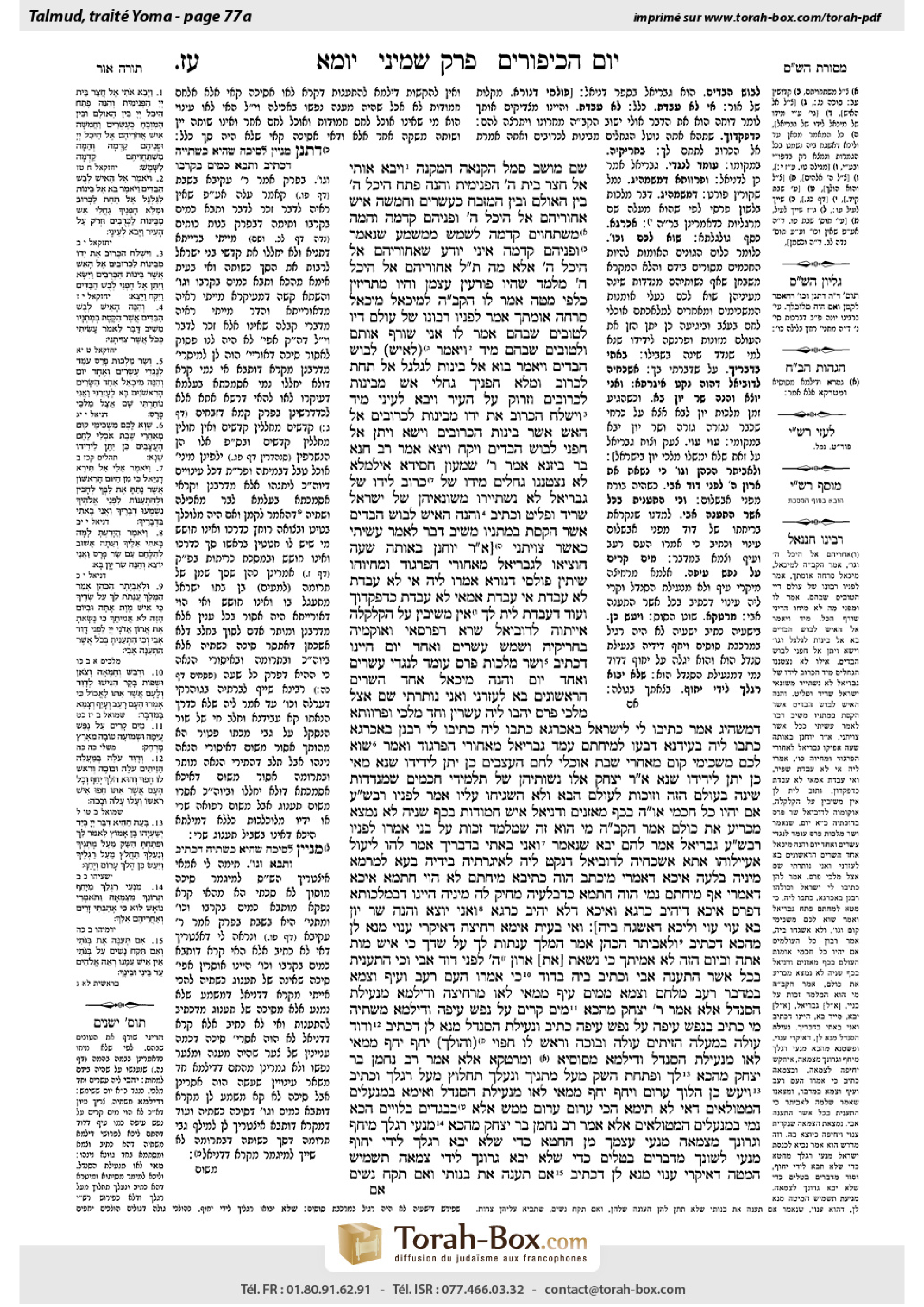
This page of Yoma includes the Aramaic text, an English translation and an AI-generated French translation, alongside the scan above.
יומא ע״ז א · Aramaic and Hebrew text
שָׁם מוֹשַׁב סֵמֶל הַקִּנְאָה הַמַּקְנֶה״, ״וַיָּבֵא אוֹתִי אֶל חֲצַר בֵּית ה׳ הַפְּנִימִית וְהִנֵּה פֶתַח הֵיכַל ה׳ בֵּין הָאוּלָם וּבֵין הַמִּזְבֵּחַ כְּעֶשְׂרִים וַחֲמִשָּׁה אִישׁ אֲחוֹרֵיהֶם אֶל הֵיכַל ה׳ וּפְנֵיהֶם קֵדְמָה וְהֵמָּה מִשְׁתַּחֲוִים קֵדְמָה לַשָּׁמֶשׁ״. מִמַּשְׁמַע שֶׁנֶּאֱמַר ״וּפְנֵיהֶם קֵדְמָה״, אֵינִי יוֹדֵעַ שֶׁאֲחוֹרֵיהֶם אֶל הֵיכַל ה׳? אֶלָּא, מָה תַּלְמוּד לוֹמַר ״אֲחוֹרֵיהֶם אֶל הֵיכַל ה׳ — מְלַמֵּד שֶׁהָיוּ פּוֹרְעִין עַצְמָן וְהָיוּ מַתְרִיזִין כְּלַפֵּי מַטָּה.
אָמַר לוֹ הַקָּדוֹשׁ בָּרוּךְ הוּא לְמִיכָאֵל: מִיכָאֵל! סָרְחָה אוּמָּתֶךָ. אָמַר לְפָנָיו: רִבּוֹנוֹ שֶׁל עוֹלָם, דַּיִּי לַטּוֹבִים שֶׁבָּהֶם! אָמַר לוֹ: אֲנִי שׂוֹרֵף אוֹתָם וְלַטּוֹבִים שֶׁבָּהֶם, מִיָּד: ״וַיֹּאמֶר (לָאִישׁ) לְבוּשׁ הַבַּדִּים וַיֹּאמֶר בּוֹא אֶל בֵּינוֹת לַגַּלְגַּל אֶל תַּחַת לַכְּרוּב וּמַלֵּא חׇפְנֶיךָ גַחֲלֵי אֵשׁ מִבֵּינוֹת לַכְּרוּבִים וּזְרוֹק עַל הָעִיר וַיָּבֹא לְעֵינָי״. מִיָּד: ״וַיִּשְׁלַח הַכְּרוּב אֶת יָדוֹ מִבֵּינוֹת לַכְּרוּבִים אֶל הָאֵשׁ אֲשֶׁר בֵּינוֹת הַכְּרוּבִים וַיִּשָּׂא וַיִּתֵּן אֶל חׇפְנֵי לְבוּשׁ הַבַּדִּים וַיִּקַּח וַיֵּצֵא״.
אָמַר רַב חָנָא בַּר בִּיזְנָא אָמַר רַבִּי שִׁמְעוֹן חֲסִידָא: אִילְמָלֵא לֹא נִצְטַנְּנוּ גֶּחָלִים מִיָּדוֹ שֶׁל כְּרוּב לְיָדוֹ שֶׁל גַּבְרִיאֵל — לֹא נִשְׁתַּיְּירוּ מִשּׂוֹנְאֵיהֶן שֶׁל יִשְׂרָאֵל שָׂרִיד וּפָלִיט.
וּכְתִיב: ״וְהִנֵּה הָאִישׁ לְבוּשׁ הַבַּדִּים אֲשֶׁר הַקֶּסֶת בְּמׇתְנָיו מֵשִׁיב דָּבָר לֵאמֹר עָשִׂיתִי כַּאֲשֶׁר צִוִּיתָנִי״. אָמַר רַבִּי יוֹחָנָן: בְּאוֹתָהּ שָׁעָה הוֹצִיאוּ לְגַבְרִיאֵל מֵאֲחוֹרֵי הַפַּרְגּוֹד, וּמַחְיוּהוּ שִׁיתִּין פּוּלְסֵי דְנוּרָא. אֲמַרוּ לֵיהּ: אִי לָא עֲבַדְתְּ — לָא עֲבַדְתְּ, אִי עֲבַדְתְּ — אַמַּאי לָא עֲבַדְתְּ כִּדְפַקְּדוּךְ? וְעוֹד: דַּעֲבַדְתְּ, לֵית לָךְ אֵין מְשִׁיבִין עַל הַקַּלְקָלָה?
אַיְיתוּהּ לְדוּבִּיאֵל שָׂרָא דְפָרְסָאֵי וְאוֹקְמוּהּ בַּחֲרִיקֵיהּ, וְשַׁמֵּשׁ עֶשְׂרִים וְאֶחָד יוֹם. הַיְינוּ דִּכְתִיב: ״וְשַׂר מַלְכוּת פָּרַס עוֹמֵד לְנֶגְדִּי עֶשְׂרִים וְאֶחָד יוֹם וְהִנֵּה מִיכָאֵל אַחַד הַשָּׂרִים הָרִאשׁוֹנִים בָּא לְעׇזְרֵנִי וַאֲנִי נוֹתַרְתִּי שָׁם אֵצֶל מַלְכֵי פָרָס״, יְהַבוּ לֵיהּ עֶשְׂרִין וְחַד מַלְכֵי וּפַרְווֹתָא דְּמַשְׁהִיג.
אֲמַר: כְּתִיבוּ לִי לְיִשְׂרָאֵל בְּאַכְּרָגָא. כְּתַבוּ לֵיהּ. כְּתִיבוּ לִי רַבָּנַן בְּאַכְּרָגָא. כְּתַבוּ לֵיהּ. בְּעִידָּנָא דְּבָעוּ לְמִיחְתַּם, עָמַד גַּבְרִיאֵל מֵאֲחוֹרֵי הַפַּרְגּוֹד וְאָמַר: ״שָׁוְא לָכֶם מַשְׁכִּימֵי קוּם מְאַחֲרֵי שֶׁבֶת אוֹכְלֵי לֶחֶם הָעֲצָבִים כֵּן יִתֵּן לִידִידוֹ שֵׁנָא״, מַאי ״כֵּן יִתֵּן לִידִידוֹ שֵׁנָא״? אָמַר רַבִּי יִצְחָק: אֵלּוּ נְשׁוֹתֵיהֶן שֶׁל תַּלְמִידֵי חֲכָמִים שֶׁמְּנַדְּדוֹת שֵׁינָה בָּעוֹלָם הַזֶּה וְזוֹכוֹת לָעוֹלָם הַבָּא, וְלֹא הִשְׁגִּיחוּ עָלָיו.
אָמַר לְפָנָיו: רִבּוֹנוֹ שֶׁל עוֹלָם! אִם יִהְיוּ כׇּל חַכְמֵי אוּמּוֹת הָעוֹלָם בְּכַף מֹאזְנַיִם, וְדָנִיֵּאל אִישׁ חֲמוּדוֹת בְּכַף שְׁנִיָּה, לֹא נִמְצָא מַכְרִיעַ אֶת כּוּלָּם?! אָמַר הַקָּדוֹשׁ בָּרוּךְ הוּא: מִי הוּא זֶה שֶׁמְּלַמֵּד זְכוּת עַל בָּנַי? אָמְרוּ לְפָנָיו: רִבּוֹנוֹ שֶׁל עוֹלָם, גַּבְרִיאֵל. אָמַר לָהֶם: יָבֹא. שֶׁנֶּאֱמַר: ״וַאֲנִי בָאתִי בִּדְבָרֶיךָ״. אֲמַר לְהוּ: לֵיעוּל. אַעַיְילוּהוּ.
אֲתָא, אַשְׁכְּחֵיהּ לְדוּבִּיאֵל דְּנָקֵט לֵיהּ לְאִיגַּרְתֵּיהּ בִּידֵיהּ, בְּעָא לְמִרְמַא מִינֵּיהּ, בַּלְעַהּ. אִיכָּא דְּאָמְרִי: מִיכְתָּב הֲוָה כְּתִיבָא, מִיחְתָּם לָא הֲוָה חֲתִימָא. אִיכָּא דְּאָמְרִי: אַף מִיחְתָּם נָמֵי הֲוָה חֲתִימָא, כִּדְבַלְעַהּ, מְחֵיק לַהּ מִינֵּיהּ. הַיְינוּ דִּבְמַלְכוּתָא דְפָרַס, אִיכָּא דְּיָהֵיב כְּרָגָא וְאִיכָּא דְּלָא יָהֵיב כְּרָגָא: ״וַאֲנִי יוֹצֵא וְהִנֵּה שַׂר יָוָן בָּא״, עַוִּי עַוִּי וְלֵיכָּא דְּאַשְׁגַּח בֵּיהּ.
וְאִי בָּעֵית אֵימָא: רְחִיצָה דְּאִיקְּרִי עִנּוּי מְנָא לַן — מֵהָכָא, דִּכְתִיב: ״וּלְאֶבְיָתָר הַכֹּהֵן אָמַר הַמֶּלֶךְ עֲנָתוֹת לֵךְ עַל שָׂדְךָ כִּי אִישׁ מָוֶת אָתָּה וּבַיּוֹם הַזֶּה לֹא אֲמִיתֶךָ כִּי נָשָׂאתָ [אֶת] אֲרוֹן ה׳ לִפְנֵי דָּוִד אָבִי וְכִי הִתְעַנִּיתָ בְּכֹל אֲשֶׁר הִתְעַנָּה אָבִי״. וּכְתִיב בֵּיהּ בְּדָוִד: ״כִּי אָמְרוּ הָעָם רָעֵב וְעָיֵף וְצָמֵא בַּמִּדְבָּר״. רָעֵב מִלֶּחֶם, וְצָמֵא מִמַּיִם, עָיֵף מִמַּאי — לָאו מֵרְחִיצָה? וְדִילְמָא מִנְּעִילַת הַסַּנְדָּל?
אֶלָּא אָמַר רַבִּי יִצְחָק, מֵהָכָא: ״מַיִם קָרִים עַל נֶפֶשׁ עֲיֵפָה״. וְדִילְמָא מִשְּׁתִיָּה? מִי כְּתִיב ״בְּנֶפֶשׁ עֲיֵפָה״? ״עַל נֶפֶשׁ עֲיֵפָה״ כְּתִיב.
וּנְעִילַת הַסַּנְדָּל מְנָא לַן? דִּכְתִיב: ״וְדָוִד עוֹלֶה בְמַעֲלֵה הַזֵּיתִים עוֹלֶה וּבוֹכֶה וְרֹאשׁ לוֹ חָפוּי (וְהוֹלֵךְ) יָחֵף״, יָחֵף מִמַּאי — לָאו מִנְּעִילַת הַסַּנְדָּל? וְדִילְמָא מִסּוּסְיָא וּמַרְטְקָא.
אֶלָּא אָמַר רַב נַחְמָן בַּר יִצְחָק, מֵהָכָא: ״לֵךְ וּפִתַּחְתָּ הַשַּׂק מֵעַל מׇתְנֶיךָ וְנַעַלְךָ תַחֲלוֹץ מֵעַל רַגְלֶךָ״, וּכְתִיב: ״וַיַּעַשׂ כֵּן הָלוֹךְ עָרוֹם וְיָחֵף״. יָחֵף מִמַּאי — לָאו מִנְּעִילַת הַסַּנְדָּל? וְאֵימָא בְּמִנְעָלִים הַמְטוּלָּאִים? דְּאִי לָא תֵּימָא הָכִי, ״עָרוֹם״ — עָרוֹם מַמָּשׁ, אֶלָּא בִּבְגָדִים בְּלוּיִים, הָכָא נָמֵי בְּמִנְעָלִים הַמְטוּלָּאִים.
אֶלָּא אָמַר רַב נַחְמָן בַּר יִצְחָק, מֵהָכָא: ״מִנְעִי רַגְלֵךְ מִיָּחֵף וּגְרוֹנֵךְ מִצִּמְאָה״, מִנְעִי עַצְמְךָ מִן הַחֵטְא כְּדֵי שֶׁלֹּא יָבֹא רַגְלְךָ לִידֵי יִחוּף, מִנְעִי לְשׁוֹנֵךְ מִדְּבָרִים בְּטֵלִים כְּדֵי שֶׁלֹּא יָבֹא גְּרוֹנֵךְ לִידֵי צִמְאָה.
תַּשְׁמִישׁ הַמִּטָּה דְּאִיקְּרִי עִנּוּי מְנָא לַן? דִּכְתִיב: ״אִם תְּעַנֶּה אֶת בְּנוֹתַי וְאִם תִּקַּח נָשִׁים״.
Yoma 77a · English translation
there was the seat of the image of jealousy, which provokes jealousy” (Ezekiel 8:3). “And he brought me into the inner court of the Lord’s House, and behold at the opening of the Entrance Hall of the Sanctuary of God, between the porch and the altar were about twenty-five men with their backs toward the Temple of the Lord, and their faces toward the east, and they worshipped the sun toward the east” (Ezekiel 8:16). The Gemara explains: From the fact that it is stated “and their faces toward the east,” is it not clear that their backs were to the Sanctuary, which is in the west? Rather, what is the meaning when the verse states “their backs toward the Temple of the Lord”? This teaches that they would uncover themselves and defecate downward, toward the Divine Presence. The verse used a euphemism to refrain from vulgar language.
The Holy One, Blessed be He, said to Michael, the ministering angel of the Jewish people: Michael, your nation has sinned (see Daniel 10:21). He replied: Master of the Universe, may it be enough for the good people among them to save them from destruction. He said to him: I will burn them and the good among them because the good do not rebuke the wicked. Immediately, God spoke to Gabriel: “He spoke to the man clothed in linen and said: Go in between the wheelwork and beneath the cherub, and fill your hands with coals of fire from between the cherubs, and scatter them over the city; and he came before my eyes” (Ezekiel 10:2). Immediately: “And the cherub stretched out his hand from between the cherubs into the fire that was between the cherubs, and took and put it into the hands of him that was clothed in linen, who took it and went out” (Ezekiel 10:7).
Rav Ḥana bar Bizna said that Rabbi Shimon Ḥasida said: If it were not for the fact that the embers cooled as they were passed from the hand of the cherub to the hand of Gabriel, instead of Gabriel taking the embers directly himself as he had been told, not a remnant or a refugee of the enemies of the Jewish people, a euphemism for the Jewish people themselves, would have survived. The cooling of the embers limited the punishment.
The Gemara continues. And it is written: “And behold, the man clothed in linen with the slate by his side, reported the matter saying: I have done as You have commanded me” (Ezekiel 9:11). Rabbi Yoḥanan said: At that moment, they cast out Gabriel from behind the curtain [pargod], where the inner angels reside, and they struck him with sixty blows [pulsei] of fire. They said to him: If you did not do it, you did not do it; if you did do it, why did you not do it according to what you were commanded but deviated from what you were instructed to do? Moreover, after you already did it, do you not have knowledge of the principle: One should not deliver a report about destruction? If one is sent on a mission of destruction, he should not deliver a detailed report of its success but should only hint at it.
They then brought Dubiel, the ministering angel of the Persians and put him in the place of [baḥarikei] Gabriel and he served for twenty-one days. As it is written: “But the prince of the kingdom of Persia stood opposed to me for twenty-one days, but, lo, Michael, one of the chief princes, came to help me and I remained there beside the kings of Persia” (Daniel 10:13). Corresponding to those twenty-one days, they gave him, the ministering angel of Persia, twenty-one kings who ruled and the seaport of Mashhig.
The ministering angel of the Persians said: Write for me that the Jews must pay taxes [akarga] to the Persians. They wrote it for him as he asked. He said: Write for me that the Sages must pay taxes. They wrote this for him. When they wanted to sign the documents, Gabriel stood from behind the curtain and said: “It is vain for you who rise early who sit up late to eat the bread of sorrow, for He gives His beloved sleep” (Psalms 127:2). What does “for He gives His beloved sleep” mean? Rav Yitzḥak said: These are the wives of Torah scholars who disturb their sleep in this world by staying up waiting for their husbands, who rise early and return late from learning Torah, and they thereby merit the World-to-Come. Gabriel asked: Is this the reward they deserve, to pay more taxes? They did not listen to Gabriel.
He said before Him: Master of the Universe, if all the wise men of other nations were placed on one side of the scale, and Daniel the beloved man were on the other side, would he not outweigh them? The Holy One, Blessed be He, said: Who is the one who teaches the virtue of My children? They said to Him: Master of the Universe, it is Gabriel. He said to them: Let him come from behind the partition, as it is stated: “And I have come due to your words” (Daniel 10:12), meaning that Gabriel was permitted to enter from behind the partition because he mentioned Daniel’s name. God then said to the other angels: Let him ascend. They brought him up.
He came and found Dubiel the ministering angel of the Persians holding the letter in his hand. Gabriel wanted to take the letter from him, but Dubiel swallowed it. Some say the letter was written, but it was not signed. Some say it was also signed, but when he swallowed it, the signature was erased. The Gemara comments: This is why, in the kingdom of Persia, there are those who pay taxes and there are those who do not pay taxes, as the decree was not finalized. It also states there: “And when I depart from him, the prince of Greece comes” (Daniel 10:20). Gabriel screamed and screamed that the kings of Greece should not rule over the Jews, but no one listened to him.
§ The Gemara returns to the issue of whether refraining from bathing is considered affliction. If you wish, say instead: The fact that bathing is considered affliction, from where do we derive this? As it is written: “And to Ebiathar the priest the king said: Get to Anatoth to your fields, for you are deserving of death. But I will not put you to death today, because you carried the Ark of the Lord God before David my father, and because you have been afflicted in all that my father was afflicted” (I Kings 2:26). And it is written with regard to David: “For they said the people is hungry, and weary, and thirsty in the wilderness” (II Samuel 17:29). Hunger means from lack of bread to eat, and thirst means from lack of water to drink. The word weary means lack from what? Is it not from bathing? The comparison of the verses suggests that that too is affliction. The Gemara challenges: And perhaps “weary” means from lack of wearing shoes? Therefore, this does not teach us that refraining from bathing is considered an affliction.
Rather, another source needs to be found. Rav Yitzḥak said: It can be derived from here: “As cold water on a weary soul, so is good news from a far country” (Proverbs 25:25). This implies that the word weary is used to describe someone who has not bathed. The Gemara asks: But perhaps the verse is referring to weariness from not drinking? The Gemara rejects this: Is it written: As cold water in a weary soul? That would mean that it entered one like a drink. Rather, “on a weary soul” is written, which implies bathing.
§ The Gemara clarifies the next point in the mishna: The fact that not wearing shoes is considered an affliction, from where do we derive this? As it is written: “And David went up by the ascent of the Mount of Olives, and wept as he went up, and he had his head covered, and was walking barefoot” (II Samuel 15:30). Barefoot implies a lack of what? Is it not a lack of wearing shoes? All these deprivations are described as affliction. The Gemara rejects this: No, perhaps he was barefoot from a horse and whip. Even if he was wearing shoes, a king without a horse and whip was considered as if he were going barefoot.
Rather, Rav Naḥman bar Yitzḥak said: We learn it from here, as it states: “Go and loose the sackcloth from your loins, and remove your shoe from your foot” (Isaiah 20:2). And it is written: “And he did so, walking naked and barefoot” (Isaiah 20:2). Barefoot implies a lack of what? Is it not a lack of wearing shoes? The Gemara challenges: And say that perhaps the meaning of barefoot is that Isaiah walked with patched shoes. Because if you do not say this, but you claim that the verse is to be understood literally, does “naked” mean actually naked? Rather, the meaning is that Isaiah walked in ragged garments. Here too, the meaning is that he walked in patched shoes.
Rather, a different source must be found. Rav Naḥman bar Yitzḥak said that we derive it from here: It states: “Withhold your foot from being barefoot, and your throat from thirst” (Jeremiah 2:25), meaning: Keep yourself from sin, so that your feet will not come to be barefoot; keep your tongue from idle talk, so that your throat will not come to be thirsty. Consequently, we learn that being barefoot is considered an affliction.
§ The Gemara continues to clarify another of the afflictions of Yom Kippur: From where do we derive the halakha that refraining from conjugal relations is called affliction? As it is written, Laban said to Jacob: “If you shall afflict my daughters, and if you shall take other wives beside my daughters” (Genesis 31:50).
Yoma 77a · Traduction française (IA)
« Il y avait là le siège de l’idole de la Jalousie, qui provoque la jalousie » (Ézéchiel 8:3). « Il me fit entrer dans la cour intérieure de la Maison de l’Éternel ; et voici qu’à l’entrée du vestibule du Sanctuaire de Dieu, entre le portique et l’autel, se tenaient environ vingt-cinq hommes, le dos tourné vers le Temple de l’Éternel et le visage vers l’est ; ils se prosternaient devant le soleil, en direction de l’est » (Ézéchiel 8:16). La Guemara explique : Le fait qu’il soit écrit « le visage vers l’est » ne montre-t-il pas clairement que leur dos était tourné vers le Sanctuaire, qui se trouve à l’ouest ? Que signifie donc « le dos tourné vers le Temple de l’Éternel » ? Cela enseigne qu’ils se découvraient et déféquaient vers le bas, en direction de la Présence divine. Le verset emploie un euphémisme pour éviter une expression vulgaire.
Le Saint, béni soit-Il, dit à Mikhaël, l’ange tutélaire du peuple juif : « Mikhaël, ton peuple a péché » (voir Daniel 10:21). Il répondit : « Maître de l’Univers, que les hommes vertueux parmi eux suffisent à les sauver de la destruction. » Il lui dit : « Je les brûlerai, eux et les hommes vertueux parmi eux, car les vertueux ne réprimandent pas les méchants. » Aussitôt, Dieu parla à Gabriel : « Il parla à l’homme vêtu de lin et dit : “Passe entre les roues, sous le chérubin, remplis tes mains de charbons ardents pris entre les chérubins et répands-les sur la ville” ; et il vint sous mes yeux » (Ézéchiel 10:2). Aussitôt : « Le chérubin tendit la main depuis l’espace entre les chérubins vers le feu qui se trouvait entre eux, en prit et en mit dans les mains de celui qui était vêtu de lin ; celui-ci les prit et sortit » (Ézéchiel 10:7).
Rav Ḥana bar Bizna dit au nom de Rabbi Shimon Ḥasida : Si les braises ne s’étaient pas refroidies en passant de la main du chérubin à celle de Gabriel, au lieu que Gabriel les prenne directement lui-même comme il en avait reçu l’ordre, pas un seul survivant ni un seul rescapé des ennemis du peuple juif — euphémisme désignant le peuple juif lui-même — n’aurait échappé à la destruction. Le refroidissement des braises limita la punition.
La Guemara poursuit. Il est écrit : « Voici que l’homme vêtu de lin, avec l’encrier à son côté, rendit compte en disant : “J’ai fait comme Tu me l’as ordonné” » (Ézéchiel 9:11). Rabbi Yoḥanan dit : À ce moment-là, ils firent sortir Gabriel de derrière le rideau [pargod], où résident les anges intérieurs, et le frappèrent de soixante coups [pulsei] de feu. Ils lui dirent : « Si tu ne l’as pas fait, tu ne l’as pas fait ; mais si tu l’as fait, pourquoi ne l’as-tu pas fait conformément à l’ordre reçu, et as-tu dévié des instructions ? De plus, après l’avoir déjà fait, ne connais-tu pas le principe suivant : on ne doit pas rendre compte d’une destruction ? Lorsqu’on est envoyé pour une mission de destruction, on ne doit pas détailler sa réussite, mais seulement y faire allusion. »
Ils amenèrent alors Dubiel, l’ange tutélaire des Perses, et le mirent à la place de [baḥarikei] Gabriel ; il remplit ses fonctions pendant vingt et un jours. Comme il est écrit : « Le prince du royaume de Perse s’opposa à moi pendant vingt et un jours ; mais voici que Mikhaël, l’un des principaux princes, vint à mon secours, et je restai là auprès des rois de Perse » (Daniel 10:13). En contrepartie de ces vingt et un jours, ils lui donnèrent, à l’ange tutélaire de la Perse, vingt et un rois qui régnèrent ainsi que le port de Mashhig.
L’ange tutélaire des Perses dit : « Écrivez-moi que les Juifs doivent payer des impôts [akarga] aux Perses. » Ils l’écrivirent comme il le demandait. Il dit : « Écrivez-moi que les Sages doivent payer des impôts. » Ils l’écrivirent pour lui. Au moment où ils s’apprêtaient à signer les documents, Gabriel se leva de derrière le rideau et dit : « C’est en vain que vous vous levez tôt et vous couchez tard pour manger le pain de la douleur, car Il donne le sommeil à ceux qu’Il aime » (Psaumes 127:2). Que signifie « car Il donne le sommeil à ceux qu’Il aime » ? Rav Yitzḥak dit : Il s’agit des épouses des érudits en Torah, qui troublent leur sommeil dans ce monde en veillant pour attendre leurs maris, lesquels se lèvent tôt et rentrent tard après avoir étudié la Torah ; elles méritent ainsi le Monde futur. Gabriel demanda : « Est-ce là la récompense qu’elles méritent, de payer davantage d’impôts ? » Ils ne prêtèrent pas attention à Gabriel.
Il dit devant Lui : « Maître de l’Univers, si tous les sages des autres nations étaient placés sur un plateau de la balance et Daniel, l’homme bien-aimé, sur l’autre, ne pèserait-il pas plus lourd qu’eux ? » Le Saint, béni soit-Il, dit : « Qui est celui qui fait valoir les mérites de Mes enfants ? » Ils Lui répondirent : « Maître de l’Univers, c’est Gabriel. » Il leur dit : « Qu’il vienne de derrière la cloison », comme il est dit : « Je suis venu à cause de tes paroles » (Daniel 10:12), ce qui signifie que Gabriel fut autorisé à entrer depuis derrière la cloison parce qu’il avait mentionné le nom de Daniel. Dieu dit alors aux autres anges : « Qu’il monte. » Ils le firent monter.
Il vint et trouva Dubiel, l’ange tutélaire des Perses, tenant la lettre à la main. Gabriel voulut la lui prendre, mais Dubiel l’avala. Certains disent que la lettre avait été rédigée, mais pas signée. D’autres disent qu’elle avait aussi été signée, mais que, lorsqu’il l’avala, la signature fut effacée. La Guemara commente : C’est pourquoi, dans le royaume de Perse, certains paient des impôts et d’autres n’en paient pas, car le décret ne fut pas définitivement arrêté. Il est aussi dit là : « Lorsque je le quitterai, le prince de Grèce viendra » (Daniel 10:20). Gabriel cria à plusieurs reprises pour que les rois de Grèce ne règnent pas sur les Juifs, mais personne ne l’écouta.
§ La Guemara revient à la question de savoir si s’abstenir de se laver est considéré comme une affliction. Si tu le souhaites, dis plutôt : D’où déduisons-nous que le fait de se laver est considéré comme une affliction ? Il est écrit : « Le roi dit à Ebiatar le prêtre : “Va à Anatot, dans tes champs, car tu mérites la mort. Mais je ne te ferai pas mourir aujourd’hui, parce que tu as porté l’arche du Seigneur Dieu devant David, mon père, et parce que tu as été affligé dans tout ce dont mon père a été affligé” » (I Rois 2:26). Et, au sujet de David, il est écrit : « Le peuple a faim, il est épuisé et assoiffé dans le désert » (II Samuel 17:29). La faim signifie qu’il manque de pain à manger, et la soif, qu’il manque d’eau à boire. De quoi manque-t-on lorsqu’on est « épuisé » ? N’est-ce pas de bain ? La comparaison des versets suggère que cela aussi constitue une affliction. La Guemara objecte : Peut-être que « épuisé » signifie qu’il lui manque des chaussures ? Par conséquent, cela ne nous apprend pas que s’abstenir de se laver est considéré comme une affliction.
Il faut donc trouver une autre source. Rav Yitzḥak dit : On peut le déduire d’ici : « Comme de l’eau fraîche pour une âme épuisée, ainsi est une bonne nouvelle venant d’un pays lointain » (Proverbes 25:25). Cela implique que le mot « épuisée » sert à décrire une personne qui ne s’est pas baignée. La Guemara demande : Mais peut-être le verset parle-t-il de l’épuisement dû au manque de boisson ? La Guemara rejette cette hypothèse : Est-il écrit « comme de l’eau fraîche dans une âme épuisée » ? Cela signifierait que l’eau est entrée en elle comme une boisson. Or, il est écrit « pour une âme épuisée », ce qui implique qu’on s’y baigne.
§ La Guemara précise le point suivant de la Michna : D’où déduisons-nous que ne pas porter de chaussures est considéré comme une affliction ? Il est écrit : « David monta la pente du mont des Oliviers ; il montait en pleurant, la tête couverte, et marchait pieds nus » (II Samuel 15:30). « Pieds nus » implique un manque de quoi ? N’est-ce pas l’absence de chaussures ? Toutes ces privations sont décrites comme des afflictions. La Guemara rejette cette explication : Non, peut-être était-il privé de cheval et de fouet. Même s’il portait des chaussures, un roi sans cheval ni fouet était considéré comme s’il marchait pieds nus.
Il faut donc plutôt dire que Rav Naḥman bar Yitzḥak dit : Nous l’apprenons d’ici, car il est dit : « Va, dénoue le sac de tes reins et retire ta chaussure de ton pied » (Isaïe 20:2). Et il est écrit : « Il fit ainsi, marchant nu et pieds nus » (Isaïe 20:2). « Pieds nus » implique un manque de quoi ? N’est-ce pas l’absence de chaussures ? La Guemara objecte : Peut-être que l’expression « pieds nus » signifie qu’Isaïe marchait avec des chaussures rapiécées. Car, si tu ne l’admets pas, mais prétends que le verset doit être compris au sens littéral, « nu » signifie-t-il qu’il était réellement nu ? Non : cela signifie qu’Isaïe marchait avec des vêtements en haillons. Ici aussi, cela signifie qu’il marchait avec des chaussures rapiécées.
Il faut donc trouver une autre source. Rav Naḥman bar Yitzḥak dit que nous le déduisons d’ici : il est écrit : « Retiens ton pied de marcher pieds nus, et ta gorge de la soif » (Jérémie 2:25), c’est-à-dire : garde-toi de pécher afin que tes pieds ne se retrouvent pas nus ; garde ta langue des paroles vaines afin que ta gorge ne soit pas assoiffée. Nous apprenons donc que marcher pieds nus est considéré comme une affliction.
§ La Guemara poursuit en précisant une autre des afflictions de Yom Kippour : D’où déduisons-nous la halakha selon laquelle s’abstenir de relations conjugales est appelé une affliction ? Il est écrit que Laban dit à Jacob : « Si tu affliges mes filles et si tu prends d’autres femmes en plus de mes filles » (Genèse 31:50).
Traduction française générée par IA à partir de l’édition anglaise de Sefaria. Vérifie toujours un passage avec le texte source.
Text from Sefaria: William Davidson Edition - Vocalized Aramaic (CC BY NC); William Davidson Edition - English (CC BY NC).