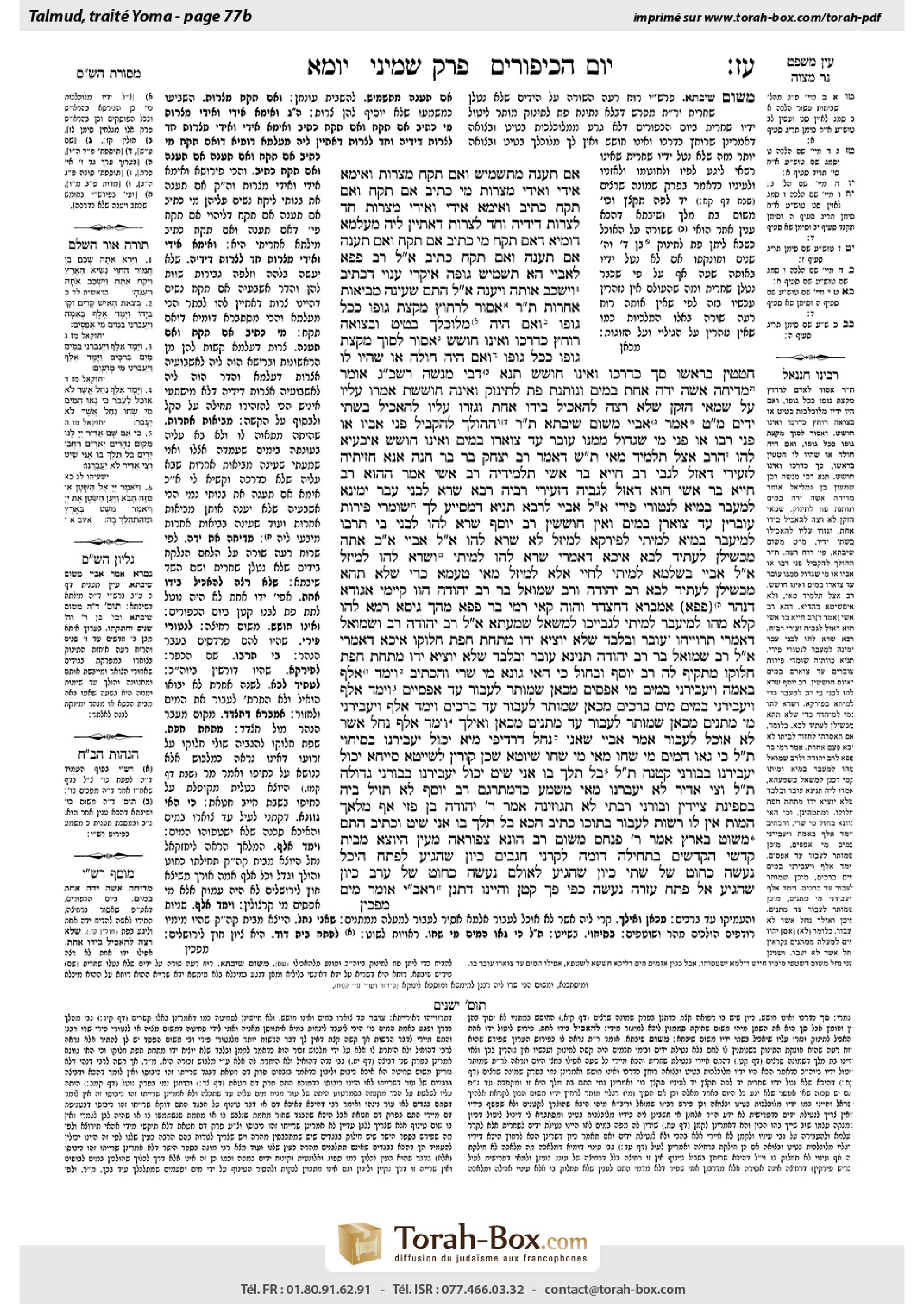
Yoma 77b: Talmud study for Daf Yomi
Daf Yomi is the daily study of one Talmud folio. Explore 37 tractates with scans, Hebrew text, Sefaria English and AI-generated French translations where annotated.
Passage selection and English or AI-generated French translation are available where the scan has annotations. Daf Study is independent of Torah-Box and Sefaria.
Browse Yoma · יומא · All tractatesYoma 77b text and translations
This page of Yoma includes the Aramaic text, an English translation and an AI-generated French translation, alongside the scan above.
יומא ע״ז ב · Aramaic and Hebrew text
״אִם תְּעַנֶּה״ — מִתַּשְׁמִישׁ, ״וְאִם תִּקַּח״ — מִצָּרוֹת. וְאֵימָא אִידֵּי וְאִידֵּי מִצָּרוֹת? מִי כְּתִיב ״אִם תִּקַּח״? ״וְאִם תִּקַּח״ כְּתִיב.
וְאֵימָא אִידֵּי וְאִידֵּי מִצָּרוֹת, חַד לְצָרוֹת דִּידֵיהּ, וְחַד לְצָרוֹת דְּאָתְיָין לֵיהּ מֵעָלְמָא, דּוּמְיָא דְּ״אִם תִּקַּח״! מִי כְּתִיב ״אִם תִּקַּח וְאִם תְּעַנֶּה״? ״אִם תְּעַנֶּה וְאִם תִּקַּח״ כְּתִיב.
אֲמַר לֵיהּ רַב פָּפָּא לְאַבָּיֵי: הָא תַּשְׁמִישׁ גּוּפֵהּ אִיקְּרִי עִנּוּי, דִּכְתִיב: ״וַיִּשְׁכַּב אוֹתָהּ וַיְעַנֶּהָ״! אֲמַר לֵיהּ: הָתָם שֶׁעִינָּהּ מִבִּיאוֹת אֲחֵרוֹת.
תָּנוּ רַבָּנַן: אָסוּר לִרְחוֹץ מִקְצָת גּוּפוֹ כְּכׇל גּוּפוֹ, וְאִם הָיָה מְלוּכְלָךְ בְּטִיט וּבְצוֹאָה — רוֹחֵץ כְּדַרְכּוֹ וְאֵינוֹ חוֹשֵׁשׁ. אָסוּר לָסוּךְ מִקְצָת גּוּפוֹ כְּכׇל גּוּפוֹ, וְאִם הָיָה חוֹלֶה, אוֹ שֶׁהָיוּ לוֹ חֲטָטִין בְּרֹאשׁוֹ — סָךְ כְּדַרְכּוֹ וְאֵינוֹ חוֹשֵׁשׁ.
תְּנָא דְּבֵי מְנַשֶּׁה: רַבָּן שִׁמְעוֹן בֶּן גַּמְלִיאֵל אוֹמֵר: מְדִיחָה אִשָּׁה יָדָהּ אַחַת בְּמַיִם, וְנוֹתֶנֶת פַּת לַתִּינוֹק, וְאֵינָהּ חוֹשֶׁשֶׁת.
אָמְרוּ עָלָיו עַל שַׁמַּאי הַזָּקֵן שֶׁלֹּא רָצָה לְהַאֲכִיל בְּיָדוֹ אַחַת, וְגָזְרוּ עָלָיו לְהַאֲכִיל בִּשְׁתֵּי יָדַיִם. מַאי טַעְמָא? אָמַר אַבָּיֵי: מִשּׁוּם שִׁיבְתָּא.
תָּנוּ רַבָּנַן: הַהוֹלֵךְ לְהַקְבִּיל פְּנֵי אָבִיו אוֹ פְּנֵי רַבּוֹ, אוֹ פְּנֵי מִי שֶׁגָּדוֹל מִמֶּנּוּ — עוֹבֵר עַד צַוָּארוֹ בְּמַיִם וְאֵינוֹ חוֹשֵׁשׁ.
אִיבַּעְיָא לְהוּ: הָרַב אֵצֶל תַּלְמִיד מַאי? תָּא שְׁמַע, דְּאָמַר רַב יִצְחָק בַּר בַּר חָנָה: אֲנָא חֲזֵיתֵיהּ לִזְעֵירִי דַּאֲזַל לְגַבֵּי רַב חִיָּיא בַּר אָשֵׁי תַּלְמִידֵיהּ. רַב אָשֵׁי אָמַר: הָהוּא רַב חִיָּיא בַּר אָשֵׁי הוּא דַּאֲזַל לְגַבֵּיהּ דִּזְעֵירִי רַבֵּיהּ.
רָבָא שְׁרָא לִבְנֵי עֲבַר יַמִּינָא לְמֶעְבַּר בְּמַיָּא לְנַטּוֹרֵי פֵּירֵי. אֲמַר לֵיהּ אַבָּיֵי לְרָבָא, תַּנְיָא דִּמְסַיַּיע לָךְ: שׁוֹמְרֵי פֵּׂירוֹת עוֹבְרִין עַד צַוָּארָן בְּמַיִם וְאֵין חוֹשְׁשִׁין.
רַב יוֹסֵף שְׁרָא לְהוּ לִבְנֵי בֵּי תַרְבּוּ לְמִיעְבַּר בְּמַיָּא לְמֵיתֵי לְפִירְקָא, לְמֵיזַל לָא שְׁרָא לְהוּ. אֲמַר לֵיהּ אַבָּיֵי: אִם כֵּן אַתָּה מַכְשִׁילָן לֶעָתִיד לָבֹא. אִיכָּא דְּאָמְרִי: שְׁרָא לְהוּ לְמֵיתֵי וּשְׁרָא לְהוּ לְמֵיזַל, אֲמַר לֵיהּ אַבָּיֵי: בִּשְׁלָמָא לְמֵיתֵי — לְחַיֵּי, אֶלָּא לְמֵיזַל מַאי טַעְמָא? כְּדֵי שֶׁלֹּא תְּהֵא מַכְשִׁילָן לֶעָתִיד לָבֹא.
רַב יְהוּדָה וְרַב שְׁמוּאֵל בַּר רַב יְהוּדָה הֲווֹ קָיְימִי אַגּוּדָּא דִּנְהַר (פָּפָּא) אַמַּבָּרָא דְחַצְדַּד, וַהֲוָה קָאֵי רָמֵי בַּר פָּפָּא מֵהָךְ גִּיסָא. רְמָא לְהוּ קָלָא: מַהוּ לְמִיעְבַּר לְמֵיתֵי לְגַבַּיְיכוּ לְמִשְׁאַל שְׁמַעְתָּא? אֲמַר לֵיהּ רַב יְהוּדָה: רַב וּשְׁמוּאֵל דְּאָמְרִי תַּרְוַיְיהוּ — עוֹבֵר, וּבִלְבַד שֶׁלֹּא יוֹצִיא יָדוֹ מִתַּחַת חֵפֶת חֲלוּקוֹ. אִיכָּא דְּאָמְרִי, אֲמַר לֵיהּ רַב שְׁמוּאֵל בַּר רַב יְהוּדָה, תְּנֵינָא: עוֹבֵר, וּבִלְבַד שֶׁלֹּא יוֹצִיא יָדוֹ מִתַּחַת חֵפֶת חֲלוּקוֹ.
מַתְקֵיף לַהּ רַב יוֹסֵף: וּבְחוֹל כִּי הַאי גַּוְנָא מִי שְׁרֵי? וְהָכְתִיב: ״וַיָּמׇד אֶלֶף בָּאַמָּה וַיַּעֲבִירֵנִי בַמַּיִם מֵי אׇפְסָיִם״ — מִכָּאן שֶׁמּוּתָּר לַעֲבוֹר עַד אׇפְסַיִים.
״וַיָּמׇד אֶלֶף וַיַּעֲבִירֵנִי בַמַּיִם מַיִם בִּרְכָּיִם״ — מִכָּאן שֶׁמּוּתָּר לַעֲבוֹר עַד בִּרְכַּיִם. ״וַיָּמׇד אֶלֶף וַיַּעֲבִירֵנִי מֵי מׇתְנָיִם״ — מִכָּאן שֶׁמּוּתָּר לַעֲבוֹר עַד מׇתְנַיִם. מִכָּאן וְאֵילָךְ: ״וַיָּמׇד אֶלֶף נַחַל אֲשֶׁר לֹא אוּכַל לַעֲבוֹר״!
אָמַר אַבָּיֵי: שָׁאנֵי נַחַל דִּרְדִיפִי מַיָּא.
יָכוֹל יַעֲבִירֶנּוּ בְּסִיחוּי — תַּלְמוּד לוֹמַר: ״כִּי גָאוּ הַמַּיִם מֵי שָׂחוּ״. מַאי ״מֵי שָׂחוּ״ — שִׁיּוּטָא, שֶׁכֵּן קוֹרִין לְשַׁיָּיטָא סַיָּיחָא. יָכוֹל יַעֲבִירֶנּוּ בְּבוּרְנִי קְטַנָּה — תַּלְמוּד לוֹמַר: ״בַּל תֵּלֶךְ בּוֹ אֳנִי שַׁיִט״. יָכוֹל יַעֲבִירֶנּוּ בְּבוּרְנִי גְּדוֹלָה — תַּלְמוּד לוֹמַר: ״וְצִי אַדִּיר לֹא יַעַבְרֶנּוּ״. מַאי מַשְׁמַע? כְּדִמְתַרְגֵּם רַב יוֹסֵף: לָא תֵּזִיל בֵּיהּ בִּסְפִינַת צַיָּידִין וּבוּרְנִי רַבְּתִי לֹא תְּגוּזִינֵּהּ.
אָמַר רַבִּי יְהוּדָה בֶּן פַּזִּי: אַף מַלְאַךְ הַמָּוֶת אֵין לוֹ רְשׁוּת לַעֲבוֹר בְּתוֹכוֹ, כְּתִיב הָכָא: ״בַּל תֵּלֶךְ בּוֹ אֳנִי שַׁיִט״, וּכְתִיב הָתָם: ״מִשּׁוּט בָּאָרֶץ״.
אָמַר רַבִּי פִּנְחָס מִשּׁוּם רַב הוּנָא צִפּוֹרָאָה: מַעְיָן הַיּוֹצֵא מִבֵּית קׇדְשֵׁי הַקֳּדָשִׁים, בַּתְּחִילָּה דּוֹמֶה לְקַרְנֵי חֲגָבִים, כֵּיוָן שֶׁהִגִּיעַ לְפֶתַח הֵיכָל — נַעֲשֶׂה כְּחוּט שֶׁל שֶׁתִי, כֵּיוָן שֶׁהִגִּיעַ לָאוּלָם — נַעֲשֶׂה כְּחוּט שֶׁל עֵרֶב, כֵּיוָן שֶׁהִגִּיעַ אֶל פֶּתַח עֲזָרָה — נַעֲשֶׂה כְּפִי פַּךְ קָטָן, וְהַיְינוּ דִּתְנַן, רַבִּי אֱלִיעֶזֶר בֶּן יַעֲקֹב אוֹמֵר: מַיִם
Yoma 77b · English translation
This can be explained as: “If you shall afflict my daughters” by refraining from conjugal relations, “and if you shall take other wives” causing them to suffer from additional rival wives. The Gemara objects: And say that this phrase and that phrase are both referring to taking rival wives. The Gemara rejects this: Is it written: If you take? “And if you shall take” is written. Therefore, the clauses must be referring to two different kinds of affliction.
The Gemara challenges further: And say that this phrase and that phrase are referring to taking rival wives. One phrase is referring to his wives’ current rivals. “If you shall afflict” means that Jacob should not elevate the position of the two maidservants, Bilhah and Zilpah, to the status of wife, which would make them co-wives with Laban’s daughters. And one phrase is referring to rivals who might come to him from the world at large, which would be similar in meaning to “if you shall take.” The Gemara rejects this: Is it written: If you take and if you afflict? It is logical to first state the more severe warning and then the less severe one. But according to this proposed reading that “take” refers to rivals from the world at large and “afflict” refers to elevating the status of maidservants, the text would have first mentioned the less painful affliction of elevating the maidservants and then followed it with a warning about taking new rival wives, as “if you shall afflict and if you shall take” is written.
Rav Pappa said to Abaye: But conjugal relations themselves are called affliction, as it is written: “And Shechem the son of Hamor the Hivite, the prince of the land, saw her; and he took her, and he lay with her and afflicted her” (Genesis 34:2). If so, how can it be said that the affliction is in withholding conjugal relations? He said to him: There, Shechem afflicted her from different relations, meaning he slept with her in an unnatural way. That type of relations is clearly an affliction.
§ The Gemara clarifies some of the prohibitions relating to Yom Kippur. The Sages taught: It is prohibited to bathe part of the body just as it is prohibited to bathe the whole body. But if one is dirty from mud or excrement, he may bathe in his usual manner, and he need not be concerned about transgressing, since his goal is not pleasure. Similarly, it is prohibited to smear oil on part of the body just as it is prohibited to smear oil on the whole body. But if one was sick and needed to smear oil on his body for medicinal purposes, or if one had scabs on his head that would hurt if he did not smear oil on himself, he may smear oil in his usual manner, and he need not be concerned about transgressing.
The school of Menashe taught that Rabban Shimon ben Gamliel says: A woman may rinse one hand in water, so that she does not touch food before she has washed her hands in the morning, and give bread to her child, and she need not be concerned about violating the prohibition of bathing on Yom Kippur.
They said about Shammai the Elder that he did not want to feed his children with one hand, to avoid having to wash it. This prevented the children from eating during all of Yom Kippur. Due to concerns about the health and the suffering of his children, they decreed that he must feed them with two hands, forcing him to wash both hands. What is the reason that they also said in general that one must wash his hands before touching food? Abaye said: Due to an evil spirit named Shivta, who resides on hands that have not been washed in the morning.
§ The Sages taught: One who goes to greet his father or his teacher, or to greet one who is greater than him in wisdom, and has to cross a river on the way, may cross the water until his neck is in the water, and he need not be concerned that he is violating the prohibition against bathing on Yom Kippur.
A dilemma was raised before them, i.e., the students discussing this question: What is the law concerning a teacher going to visit his student? May he enter the water in order to teach his student? The Gemara tries to bring a proof: Come and hear from what Rav Yitzḥak bar bar Ḥana said: I saw Ze’iri, who went through a river on his way to Rav Ḥiyya bar Ashi, his student. Rav Ashi said: This was not the case. Rather, in that case, it was the student Rav Ḥiyya bar Ashi who went to Ze’iri, his teacher. Therefore, this incident does not answer the question.
Rava permitted those who lived on the right side of the Euphrates to pass through the water to guard the fruit in their fields on Yom Kippur. Abaye said to Rava: A baraita was taught that supports your opinion. We learned: Guards of fruit may cross the river until their necks are in the water, and they need not be concerned that they are violating the prohibition against bathing on Yom Kippur.
Rav Yosef permitted the people of the village of Bei Tarbu to cross in the water to come to the lecture he delivered on Yom Kippur. He did not, however, permit them to go back home through the water. Abaye said to him: If so, you are obstructing them from coming in the future. They will not come to the lecture knowing they will be prohibited from returning home. Some say the incident happened differently: Rav Yosef permitted them to come and permitted them to go back through the water. Abaye said to him: Granted, you allow them to come, that is well. But what is the reason you allow them to go back? He said to him: So as not to obstruct them from coming in the future.
It is told: Rav Yehuda and Rav Shmuel bar Rav Yehuda were standing on the bank of the Pappa River next to the Ḥatzdad crossing, and Rami bar Pappa was standing on the other side of the river. He raised his voice to them and asked: What is the ruling with regard to crossing over to come to you to ask a halakha? Rav Yehuda said to him: It is Rav and Shmuel who both say: One may cross in the water, provided that he does not remove his hand from under the hem of his cloak. One may not raise the hems of his cloak to his shoulders to keep them dry, since this form of carrying renders one liable to bring a sin-offering. Rather, one should walk normally and get his clothes wet in the water. Some say this is not how the incident happened. Rather, Rav Shmuel bar Rav Yehuda said to him: We learned in a baraita: One may cross over, provided that he does not remove his hand from the hem of his cloak.
Rav Yosef strongly objects to this: And on a weekday is it permitted to walk in such deep water that it presents a danger of drowning? But isn’t it written with regard to the river that, in the future, will issue forth from the Holy of Holies: “He measured a thousand cubits, and he led me through the water; the water was ankle deep” (Ezekiel 47:3); from here it is derived that one is permitted to pass through water that reaches up to the ankles.
Rav Yosef continues explaining the verse: “Again he measured a thousand and he led me through the water, the water was knee deep” (Ezekiel 47:4); from here it is derived that one is permitted to pass through water that reaches up to the knees. “He measured a thousand and led me through the water up to the waist” (Ezekiel 47:4); from here it is derived that one is permitted to pass through water that reaches up to the waist. From this point forward: “And he measured a thousand, a river that I could not pass through” (Ezekiel 47:5). This implies that one is never permitted to pass through water that is more than waist high, because it is dangerous.
Abaye said: That is not a proof, because a river with fast flowing water is different. If it is higher than one’s waist, he could drown. However, one is permitted to cross still water even if it is deeper than that.
§ Apropos the river that will flow in the future, the Gemara explains additional verses in Ezekiel. One might think that Ezekiel could cross the river by swimming. The verse states: “For the water had swollen into saḥu waters” (Ezekiel 47:5). What does “saḥu waters” mean? Water that can be traversed only with a boat [shiyuta], as sailing [shayta] is sometimes called swimming [sayḥa]. I might have thought Ezekiel could pass across in a small boat [burni]. Therefore, the verse states: “No galley with oars shall go” (Isaiah 33:21). I might have thought he could pass through in a large boat. Therefore, the verse states: “Neither shall a fishing boat [tzi adir] be able to cross it” (Isaiah 33:21). The Gemara asks: From where can it be inferred that the words tzi adir mean fishing boat? The Gemara explains: This is how Rav Yosef translated this verse: A fishing boat [sfinat tzayyadin] will not travel on it and a large ship will not cross it.
The Gemara continues its discussion of the river that will in the future come out of the Holy of Holies. Rabbi Yehuda ben Pazi said: Even the Angel of Death does not have permission to pass through it to the other side of this river, and proof of this is in the verse, as it is written here: “No galley with oars [ani shayt] can travel” and as it was written there: “Then Satan answered the Lord and said: From going to and fro [mishut] the earth and from walking up and down in it” (Job 1:7). Even Satan, who is also the Angel of Death, cannot cross through this river.
The Gemara cites more midrashim about the river that will flow from the Holy of Holies. Rabbi Pineḥas said in the name of Rav Huna of Tzippori: The spring that comes forth from inside the Holy of Holies is at first very narrow and resembles grasshoppers’ antennae in width. Once it reaches the opening of the Sanctuary it becomes as thick as the thread of the warp; once it reaches the Entrance Hall of the Sanctuary, it becomes as thick as the thread of the woof, which is wider than the warp thread. Once it reaches the opening of the Temple courtyard it becomes like the mouth of a small jug. This is as we learned in a mishna: Rav Eliezer ben Ya’akov says: Water,
Yoma 77b · Traduction française (IA)
Cela peut s’expliquer ainsi : « Si tu maltraites mes filles » en t’abstenant de relations conjugales, « et si tu prends d’autres femmes » en les faisant souffrir de la présence de coépouses supplémentaires. La Guemara objecte : Et si ces deux expressions désignaient toutes deux la prise de coépouses ? La Guemara rejette cette possibilité : Est-il écrit : « Si tu prends » ? Il est écrit : « Et si tu prends ». Les deux clauses doivent donc désigner deux formes différentes de maltraitance.
La Guemara poursuit son objection : Et si ces deux expressions désignaient la prise de coépouses ? L’une ferait référence aux rivales actuelles de ses femmes. « Si tu maltraites » signifierait que Jacob ne devait pas élever Bilha et Zilpa, les deux servantes, au rang d’épouses, ce qui en ferait les coépouses des filles de Laban. L’autre ferait référence aux rivales qu’il pourrait prendre parmi les femmes du monde entier, ce qui aurait un sens proche de « si tu prends ». La Guemara rejette cette possibilité : Est-il écrit : « Si tu prends et si tu maltraites » ? Il est logique d’énoncer d’abord l’avertissement le plus grave, puis le moins grave. Or, selon cette interprétation, où « prendre » désignerait des rivales parmi les femmes du monde entier et « maltraiter » l’élévation des servantes au rang d’épouses, le texte aurait d’abord mentionné la maltraitance moins grave consistant à élever les servantes, puis aurait averti contre la prise de nouvelles coépouses, alors qu’il est écrit : « Si tu maltraites et si tu prends ».
Rav Pappa dit à Abaye : Pourtant, les relations conjugales elles-mêmes sont qualifiées de maltraitance, comme il est écrit : « Sichem, fils de Hamor le Hivvite, prince du pays, la vit ; il la prit, coucha avec elle et la maltraita » (Genèse 34, 2). Si tel est le cas, comment peut-on dire que la maltraitance consiste à s’abstenir de relations conjugales ? Il lui répondit : Là, Sichem la maltraita en ayant avec elle des relations d’un autre type, c’est-à-dire en couchant avec elle d’une manière contre nature. Ce type de relations constitue clairement une maltraitance.
§ La Guemara précise certaines des interdictions relatives à Yom Kippour. Les Sages ont enseigné : Il est interdit de laver une partie du corps, tout comme il est interdit de laver le corps entier. Toutefois, si quelqu’un est sali par de la boue ou des excréments, il peut se laver comme à son habitude et n’a pas à craindre de transgresser, puisque son intention n’est pas de se faire plaisir. De même, il est interdit de s’enduire d’huile sur une partie du corps, tout comme il est interdit de s’en enduire sur le corps entier. Toutefois, si quelqu’un est malade et doit s’enduire le corps d’huile à des fins médicinales, ou s’il a des croûtes sur la tête qui lui feraient mal s’il ne s’enduisait pas d’huile, il peut le faire comme à son habitude et n’a pas à craindre de transgresser.
L’école de Menashé a enseigné que Rabban Shimon ben Gamliel dit : Une femme peut se rincer une main à l’eau afin de ne pas toucher de nourriture avant de s’être lavé les mains le matin, puis donner du pain à son enfant ; elle n’a pas à craindre de transgresser l’interdiction de se laver à Yom Kippour.
On raconte à propos de Shammaï l’Ancien qu’il ne voulait pas nourrir ses enfants d’une seule main, afin d’éviter de devoir la laver. De ce fait, les enfants ne mangeaient pas pendant toute la journée de Yom Kippour. En raison des préoccupations concernant la santé et les souffrances de ses enfants, les Sages décrétèrent qu’il devait les nourrir des deux mains, ce qui l’obligeait à se laver les deux mains. Pourquoi a-t-on également dit, de manière générale, qu’il faut se laver les mains avant de toucher de la nourriture ? Abaye dit : À cause d’un esprit malfaisant nommé Shivta, qui réside sur les mains que l’on n’a pas lavées le matin.
§ Les Sages ont enseigné : Celui qui se rend pour saluer son père ou son maître, ou une personne dont la sagesse est supérieure à la sienne, et doit traverser une rivière en chemin, peut traverser l’eau jusqu’au cou sans craindre de transgresser l’interdiction de se laver à Yom Kippour.
Une question fut soulevée devant eux, c’est-à-dire par les étudiants qui en discutaient : quelle est la halakha concernant un maître qui se rend chez son élève ? Peut-il entrer dans l’eau afin d’enseigner à son élève ? La Guemara tente d’apporter une preuve : Écoutez ce que Rav Yitzḥak bar bar Ḥana a dit : J’ai vu Ze’iri traverser une rivière pour se rendre chez Rav Ḥiyya bar Ashi, son élève. Rav Ashi dit : Les choses ne se sont pas passées ainsi. C’était plutôt l’élève, Rav Ḥiyya bar Ashi, qui était allé chez Ze’iri, son maître. Cet épisode ne répond donc pas à la question.
Rava autorisa les habitants de la rive droite de l’Euphrate à traverser l’eau afin de surveiller les fruits dans leurs champs à Yom Kippour. Abaye dit à Rava : Une baraïta appuie ton opinion. Nous avons appris : Les gardiens des fruits peuvent traverser la rivière jusqu’à ce que l’eau leur arrive au cou, sans craindre de transgresser l’interdiction de se laver à Yom Kippour.
Rav Yosef autorisa les habitants du village de Bei Tarbu à traverser l’eau pour assister à son cours à Yom Kippour. Il ne les autorisa cependant pas à rentrer chez eux en traversant l’eau. Abaye lui dit : Dans ce cas, tu les empêches de venir à l’avenir. Ils ne viendront pas au cours s’ils savent qu’il leur sera interdit de rentrer chez eux. Certains rapportent l’épisode autrement : Rav Yosef les autorisa à venir et à rentrer en traversant l’eau. Abaye lui dit : Soit, tu les autorises à venir, c’est bien. Mais pourquoi les autorises-tu à repartir ? Il lui répondit : Pour ne pas les empêcher de venir à l’avenir.
Il est rapporté : Rav Yehuda et Rav Shmuel bar Rav Yehuda se tenaient sur la rive de la rivière Pappa, près du passage de Ḥatzdad, tandis que Rami bar Pappa se tenait sur l’autre rive. Il leur cria : Quelle est la règle concernant le fait de traverser pour venir vous consulter au sujet d’une halakha ? Rav Yehuda lui répondit : Rav et Shmuel disent tous deux qu’on peut traverser l’eau, à condition de ne pas retirer sa main de sous l’ourlet de son manteau. On ne doit pas relever les pans de son manteau jusqu’aux épaules pour les garder secs, car cette manière de porter rend passible d’un sacrifice expiatoire. Il faut plutôt marcher normalement et laisser ses vêtements se mouiller dans l’eau. Selon certains, l’épisode ne s’est pas déroulé ainsi. Rav Shmuel bar Rav Yehuda lui dit plutôt : Nous avons appris dans une baraïta : On peut traverser, à condition de ne pas retirer sa main de l’ourlet de son manteau.
Rav Yosef s’y oppose vivement : Même en semaine, est-il permis de marcher dans une eau si profonde qu’elle présente un risque de noyade ? Pourtant, à propos de la rivière qui jaillira à l’avenir du Saint des Saints, il est écrit : « Il mesura mille coudées et me fit traverser l’eau ; l’eau arrivait aux chevilles » (Ézéchiel 47, 3). On en déduit qu’il est permis de traverser une eau qui arrive aux chevilles.
Rav Yosef poursuit son explication du verset : « Il mesura encore mille coudées et me fit traverser l’eau ; l’eau arrivait aux genoux » (Ézéchiel 47, 4). On en déduit qu’il est permis de traverser une eau qui arrive aux genoux. « Il mesura mille coudées et me fit traverser l’eau, qui arrivait à la taille » (Ézéchiel 47, 4). On en déduit qu’il est permis de traverser une eau qui arrive à la taille. À partir de là : « Il mesura mille coudées ; c’était une rivière que je ne pouvais pas traverser » (Ézéchiel 47, 5). Cela implique qu’il n’est jamais permis de traverser une eau qui dépasse la taille, car cela présente un danger.
Abaye dit : Cela ne constitue pas une preuve, car une rivière au courant rapide est différente. Si l’eau dépasse la taille, on risque de se noyer. Toutefois, il est permis de traverser une eau calme, même si elle est plus profonde.
§ À propos de la rivière qui coulera à l’avenir, la Guemara explique d’autres versets d’Ézéchiel. On aurait pu penser qu’Ézéchiel pouvait traverser la rivière à la nage. Le verset dit : « Car l’eau avait enflé et était devenue des eaux saḥu » (Ézéchiel 47, 5). Que signifie « eaux saḥu » ? Des eaux que l’on ne peut traverser qu’en bateau [shiyuta], car naviguer [shayta] se dit parfois nager [sayḥa]. On aurait pu penser qu’Ézéchiel pouvait traverser dans une petite embarcation [burni]. Le verset dit donc : « Aucun navire à rames ne pourra y naviguer » (Isaïe 33, 21). On aurait pu penser qu’il pouvait la traverser dans un grand bateau. Le verset dit donc : « Aucun bateau de pêche [tzi adir] ne pourra la traverser » (Isaïe 33, 21). La Guemara demande : D’où peut-on déduire que les mots tzi adir désignent un bateau de pêche ? La Guemara explique : C’est ainsi que Rav Yosef a traduit ce verset : Un bateau de pêche [sfinat tzayyadin] n’y naviguera pas et un grand navire ne la traversera pas.
La Guemara poursuit son examen de la rivière qui sortira à l’avenir du Saint des Saints. Rabbi Yehuda ben Pazi dit : Même l’Ange de la Mort n’a pas la permission de traverser cette rivière pour atteindre l’autre rive. La preuve en est le verset, car on lit ici : « Aucun navire à rames [ani shayt] ne peut naviguer », et là : « Le Satan répondit à l’Éternel et dit : De parcourir [mishut] la terre et d’y circuler » (Job 1, 7). Même Satan, qui est aussi l’Ange de la Mort, ne peut traverser cette rivière.
La Guemara cite d’autres midrachim sur la rivière qui coulera du Saint des Saints. Rabbi Pineḥas dit au nom de Rav Huna de Tzippori : La source qui jaillit de l’intérieur du Saint des Saints est d’abord très étroite, de la largeur des antennes des sauterelles. Lorsqu’elle atteint l’ouverture du Sanctuaire, elle devient aussi épaisse que le fil de chaîne ; lorsqu’elle atteint le Vestibule du Sanctuaire, elle devient aussi épaisse que le fil de trame, plus large que le fil de chaîne. Lorsqu’elle atteint l’ouverture de la cour du Temple, elle devient comme l’embouchure d’une petite cruche. C’est ce que nous avons appris dans une Michna : Rav Eliezer ben Ya’akov dit : L’eau,
Traduction française générée par IA à partir de l’édition anglaise de Sefaria. Vérifie toujours un passage avec le texte source.
Text from Sefaria: William Davidson Edition - Vocalized Aramaic (CC BY NC); William Davidson Edition - English (CC BY NC).