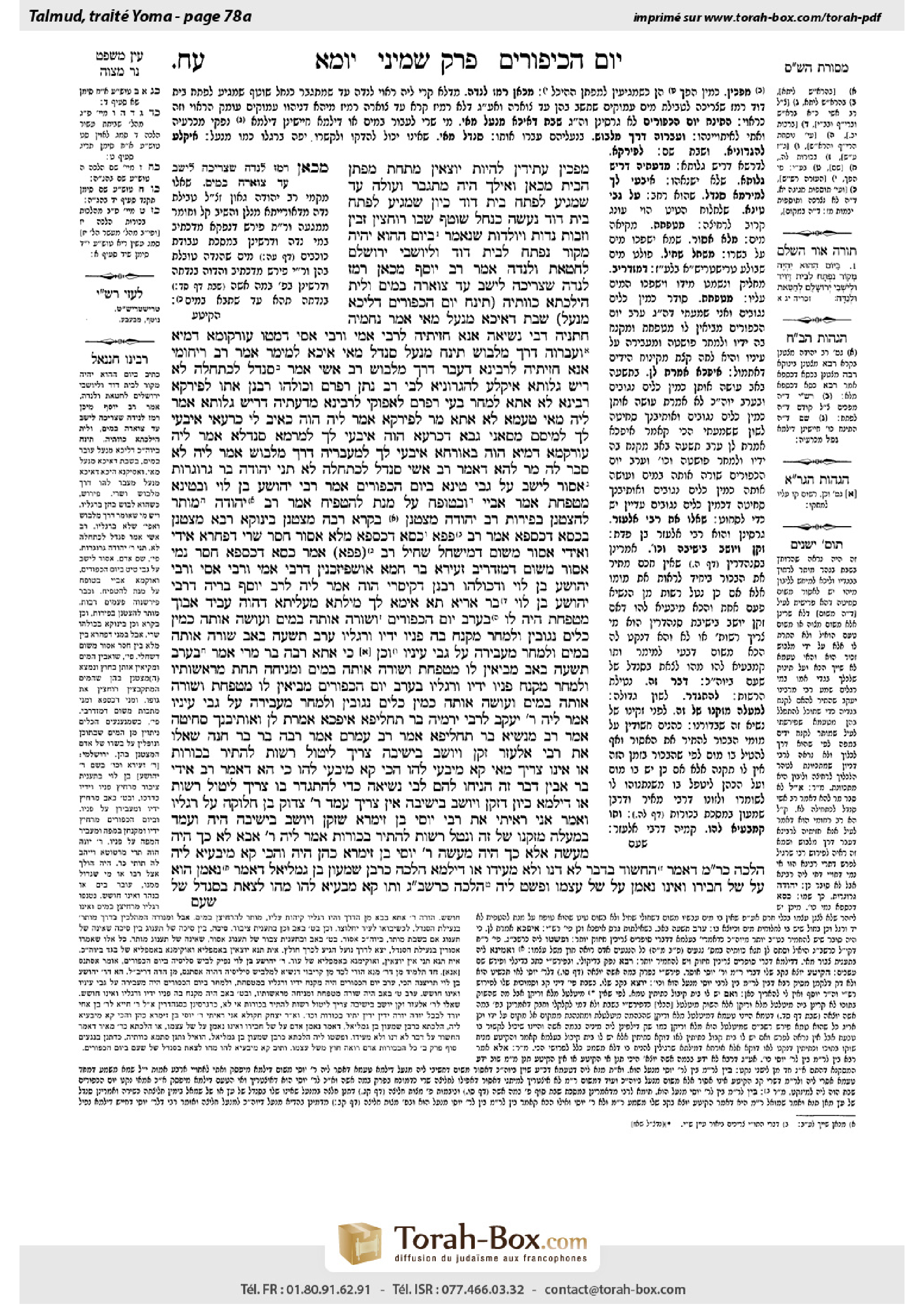
Yoma 78a: Talmud study for Daf Yomi
Daf Yomi is the daily study of one Talmud folio. Explore 37 tractates with scans, Hebrew text, Sefaria English and AI-generated French translations where annotated.
Passage selection and English or AI-generated French translation are available where the scan has annotations. Daf Study is independent of Torah-Box and Sefaria.
Browse Yoma · יומא · All tractatesYoma 78a text and translations
This page of Yoma includes the Aramaic text, an English translation and an AI-generated French translation, alongside the scan above.
יומא ע״ח א · Aramaic and Hebrew text
מְפַכִּין עֲתִידִין לִהְיוֹת יוֹצְאִין מִתַּחַת מִפְתַּן הַבַּיִת. מִכָּאן וְאֵילָךְ הָיָה מִתְגַּבֵּר וְעוֹלֶה עַד שֶׁמַּגִּיעַ לְפֶתַח בֵּית דָּוִד, כֵּיוָן שֶׁמַּגִּיעַ לְפֶתַח בֵּית דָּוִד נַעֲשֶׂה כְּנַחַל שׁוֹטֵף שֶׁבּוֹ רוֹחֲצִין זָבִין וְזָבוֹת נִדּוֹת וְיוֹלְדוֹת, שֶׁנֶּאֱמַר: ״בַּיּוֹם הַהוּא יִהְיֶה מָקוֹר נִפְתָּח לְבֵית דָּוִד וּלְיוֹשְׁבֵי יְרוּשָׁלִָם לְחַטַּאת וּלְנִדָּה״.
אָמַר רַב יוֹסֵף: מִכָּאן רֶמֶז לְנִדָּה שֶׁצְּרִיכָה לֵישֵׁב עַד צַוָּארָהּ בַּמַּיִם. וְלֵית הִילְכְתָא כְּווֹתֵיהּ.
(תִּינַח יוֹם הַכִּפּוּרִים דְּלֵיכָּא מִנְעָל,) שַׁבָּת דְּאִיכָּא מִנְעָל, מַאי? אֲמַר נְחֶמְיָה חַתְנֵיהּ דְּבֵי נְשִׂיאָה: אֲנָא חֲזֵיתֵיהּ לְרַבִּי אַמֵּי וְרַבִּי אַסִּי דִּמְטוֹ עוּרְקוּמָא דְמַיָּא, וְעַבְרוּהּ דֶּרֶךְ מַלְבּוּשׁ.
תִּינַח מִנְעָל, סַנְדָּל מַאי אִיכָּא לְמֵימַר? אָמַר רַב רִיחוּמִי: אֲנָא חֲזֵיתֵיהּ לְרָבִינָא דְּעָבַר דֶּרֶךְ מַלְבּוּשׁ. רַב אָשֵׁי אָמַר: סַנְדָּל לְכַתְּחִלָּה לָא.
רֵישׁ גָּלוּתָא אִיקְּלַע לְהַגְרוֹנְיָא לְבֵי רַב נָתָן, רַפְרָם וְכוּלְּהוּ רַבָּנַן אֲתוֹ לְפִירְקָא, רָבִינָא לָא אֲתָא. לִמְחַר, בָּעֵי רַפְרָם לְאַפּוֹקֵי לְרָבִינָא מִדַּעְתֵּיהּ דְּרֵישׁ גָּלוּתָא, אֲמַר לֵיהּ מַאי טַעְמָא לָא אֲתָא מָר לְפִירְקָא? אֲמַר לֵיהּ: הֲוָה כָּאֵיב לִי כַּרְעַאי. אִיבְּעִי לָךְ לְמֵיסַם מְסָאנֵי. גַּבָּא דְכַרְעָא הֲוָה.
אִיבְּעִי לָךְ לְמִרְמֵא סַנְדָּלָא. אֲמַר לֵיהּ: עוּרְקְמָא דְמַיָּא הֲוָה בְּאוֹרְחָא. אִיבְּעִי לָךְ לְמֶעְבְּרֵיהּ דֶּרֶךְ מַלְבּוּשׁ. אֲמַר לֵיהּ: לָא סָבַר לַהּ מָר לְהָא דְּאָמַר רַב אָשֵׁי: סַנְדָּל לְכַתְּחִלָּה לָא?!
תָּנֵי יְהוּדָה בַּר גְּרוֹגְרוֹת: אָסוּר לֵישֵׁב עַל גַּבֵּי טִינָא בְּיוֹם הַכִּפּוּרִים. אָמַר רַבִּי יְהוֹשֻׁעַ בֶּן לֵוִי: וּבְטִינָא מְטַפַּחַת. אָמַר אַבָּיֵי: וּבְטוֹפֵחַ עַל מְנָת לְהַטְפִּיחַ. אָמַר רַב יְהוּדָה: מוּתָּר לְהִצְטַנֵּן בְּפֵירוֹת. רַב יְהוּדָה מִצְטַנֵּן בְּקָרָא.
רַבָּה מִצְטַנֵּן בְּיָנוֹקָא, רָבָא מִצְטַנֵּן בְּכָסָא דְכַסְפָּא. אָמַר רַב פָּפָּא: כָּסָא דְכַסְפָּא, מָלֵא — אָסוּר, חָסֵר — שְׁרֵי. דְּפַחְרָא — אִידֵּי וְאִידֵּי אָסוּר, מִשּׁוּם דְּמִישְׁחָל שָׁחֵיל. רַב אָמַר: כָּסָא דְכַסְפָּא, חָסֵר — נָמֵי אָסוּר, מִשּׁוּם דְּמִזְדָרֵיב.
זְעֵירָא בַּר חָמָא אוּשְׁפִּיזְכָנֵיהּ דְּרַבִּי אַמֵּי וְרַבִּי אַסִּי וְרַבִּי יְהוֹשֻׁעַ בֶּן לֵוִי וּדְכוּלְּהוּ רַבָּנַן דְּקֵיסָרִי הֲוָה. אֲמַר לֵיהּ לְרַב יוֹסֵף בְּרֵיהּ דְּרַבִּי יְהוֹשֻׁעַ בֶּן לֵוִי: בַּר אַרְיָא! תָּא אֵימָא לָךְ מִילְּתָא מְעַלַּיְתָא דַּהֲוָה עָבֵיד אֲבוּךְ: מִטְפַּחַת הָיָה לוֹ בְּעֶרֶב יוֹם הַכִּפּוּרִים, וְשׁוֹרֶה אוֹתָהּ בְּמַיִם, וְעוֹשֶׂה אוֹתָהּ כְּמִין כֵּלִים נְגוּבִין, וּלְמָחָר מְקַנֵּחַ בָּהּ פָּנָיו יָדָיו וְרַגְלָיו. עֶרֶב תִּשְׁעָה בְּאָב, שׁוֹרֶה אוֹתָהּ בְּמַיִם, וּלְמָחָר מַעֲבִירָהּ עַל גַּבֵּי עֵינָיו.
וְכֵן כִּי אֲתָא רַבָּה בַּר מָרִי, אָמַר: בְּעֶרֶב תִּשְׁעָה בְּאָב מְבִיאִין לוֹ מִטְפַּחַת וְשׁוֹרֶה אוֹתָהּ בְּמַיִם וּמַנִּיחָהּ תַּחַת מְרַאֲשׁוֹתָיו, וּלְמָחָר, מְקַנֵּחַ פָּנָיו יָדָיו וְרַגְלָיו. בְּעֶרֶב יוֹם הַכִּפּוּרִים מְבִיאִין לוֹ מִטְפַּחַת וְשׁוֹרֶה אוֹתָהּ בְּמַיִם, וְעוֹשֶׂה אוֹתָהּ כְּמִין כֵּלִים נְגוּבִין, וּלְמָחָר מַעֲבִירָהּ עַל גַּבֵּי עֵינָיו. אֲמַר לֵיהּ רַבִּי יַעֲקֹב לְרַבִּי יִרְמְיָה בַּר תַּחְלִיפָא: אִיפְּכָא אֲמַרְתְּ לַן, וְאוֹתֵיבְנָךְ סְחִיטָה.
אָמַר רַב מְנַשְּׁיָא בַּר תַּחְלִיפָא אָמַר רַב עַמְרָם אָמַר רַבָּה בַּר בַּר חָנָה: שָׁאֲלוּ אֶת רַבִּי אֶלְעָזָר: זָקֵן וְיוֹשֵׁב בִּישִׁיבָה, צָרִיךְ לִיטּוֹל רְשׁוּת לְהַתִּיר בְּכוֹרוֹת, אוֹ אֵינוֹ צָרִיךְ?
מַאי קָא מִיבְּעֵי לְהוּ? הָכִי קָא מִיבְּעֵי לְהוּ, כִּי הָא דְּאָמַר רַב אִידִי בַּר אָבִין: דָּבָר זֶה הִנִּיחוּ לָהֶם לְבֵי נְשִׂיאָה כְּדֵי לְהִתְגַּדֵּר בּוֹ: צָרִיךְ לִיטּוֹל רְשׁוּת; אוֹ דִילְמָא, כֵּיוָן דְּזָקֵן וְיוֹשֵׁב בִּישִׁיבָה, אֵין צָרִיךְ. עָמַד רַבִּי צָדוֹק בֶּן חָקוֹלָא עַל רַגְלָיו, וְאָמַר: אֲנִי רָאִיתִי אֶת רַבִּי יוֹסֵי בֶּן זִימְרָא, שֶׁזָּקֵן וְיוֹשֵׁב בִּישִׁיבָה הָיָה, וְעָמַד בְּמַעֲלָה מִזְּקֵנוֹ שֶׁל זֶה, וְנָטַל רְשׁוּת לְהַתִּיר בְּכוֹרוֹת.
אֲמַר לֵיהּ רַבִּי אַבָּא: לֹא כָּךְ הָיָה מַעֲשֶׂה, אֶלָּא כָּךְ הָיָה מַעֲשֶׂה: רַבִּי יוֹסֵי בֶּן זִימְרָא כֹּהֵן הָיָה, וְהָכִי קָא מִיבַּעְיָא לֵיהּ: הֲלָכָה כְּרַבִּי מֵאִיר, דְּאָמַר: הֶחָשׁוּד בְּדָבָר — לֹא דָּנוֹ, וְלֹא מְעִידוֹ. אוֹ דִילְמָא הֲלָכָה כְּרַבָּן שִׁמְעוֹן בֶּן גַּמְלִיאֵל, דְּאָמַר: נֶאֱמָן הוּא עַל שֶׁל חֲבֵירוֹ וְאֵינוֹ נֶאֱמָן עַל שֶׁל עַצְמוֹ. וּפְשַׁט לֵיהּ: הֲלָכָה כְּרַבָּן שִׁמְעוֹן בֶּן גַּמְלִיאֵל.
וְתוּ קָא מִבַּעְיָא לְהוּ: מַהוּ לָצֵאת בְּסַנְדָּל שֶׁל
Yoma 78a · English translation
in the future, will bubble from under the threshold of the Temple. From this point forward, the spring will grow in strength and rise until it reaches the opening of David’s house, i.e., his grave, which is outside of Jerusalem. When it reaches the opening of David’s house, it will become a flowing river in which zavim and zavot, menstruating women, and women after childbirth will bathe to purify themselves. As it is stated: “On that day there shall be a fountain opened for the house of David and to the inhabitants of Jerusalem for purification and for sprinkling” (Zechariah 13:1).
Rav Yosef said: From here, there is an allusion that a menstruating woman must be able to sit up to her neck in water, i.e., that this is the appropriate depth for waters of a ritual bath to purify. The Gemara comments: But the halakha is not in accordance with his opinion. Rather, the depth of the water is irrelevant. As long as the water can cover an entire adult body, the ritual bath is kosher.
§ The Gemara investigates the permissibility of crossing water in order to fulfill a mitzva: It works out well that on Yom Kippur it is permitted because there are no shoes, and there is no problem going through water barefoot. However, on Shabbat, when there are shoes, what is the halakha? Is one permitted to cross water wearing shoes? Is there a concern that his shoe might come off and he may pick it up, thereby violating the prohibition of carrying out? Neḥemya, the son-in-law of the Nasi, said: I saw Rabbi Ami and Rabbi Asi come to a pool of water that they had to cross on Shabbat, and they crossed it while wearing their shoes without removing them first.
The Gemara asks: It works out well that shoes are permitted, since one can tie them tightly, but what is there to say about sandals? Since they do not fit tightly on the foot, they might come off in the water. Rav Riḥumi said: I saw Ravina cross a river while wearing sandals on his feet. Rav Ashi said: If he is wearing sandals, he should not cross the water ab initio, lest the sandal fall off his foot and he violate the prohibition of carrying on Shabbat by picking it up.
Incidental to this, the Gemara reports: The Exilarch came to deliver a lecture in Rav Natan’s study hall in Hagronya. Rafram and all the Sages came to the lecture, but Ravina did not come. The next day, when he came, Rafram wanted to remove any anger towards Ravina from the mind of the Exilarch, for missing the lecture. Rafram therefore asked Ravina: What is the reason that the Master did not come to the lecture? He said to him: My foot hurt. He said to him: You should have put shoes on. Ravina answered him: It was the back of the foot that hurt, so wearing shoes would have been hard for me.
Rafram said to Ravina: You should have worn sandals, which leave the heel exposed. He said to him: There was a pool of water on the way that I would have had to cross. He said to him: You should have crossed it wearing the sandals. He said to him: Does the Master not hold with that which Rav Ashi said: One should not wear sandals when crossing a river on Shabbat, ab initio? From this conversation, the Exilarch understood that Ravina meant no disrespect in not attending the lecture.
§ The Gemara continues to discuss the laws of Yom Kippur: Yehuda bar Gerogarot taught: It is prohibited to sit on damp clay on Yom Kippur. Rabbi Yehoshua ben Levi said: This prohibition applies only when the clay is dripping wet, when one feels its wetness when touching it. Abaye said in clarification: It must be dripping wet enough to make something else wet. Rav Yehuda said: One is permitted to cool off with fruit on Yom Kippur, and it is not considered bathing. Similarly, when Rav Yehuda suffered from the heat on Yom Kippur he cooled off by putting a squash on himself.
Rabba cooled off by placing a baby [yanuka] next to him, because a baby’s body is cold. Rava cooled off with a silver cup. Rav Pappa said: If the silver cup is full, it is prohibited; however, if it is not full, it is permitted. With regard to a ceramic cup, both this and that are prohibited, since the water seeps through the cup, causing a violation of the prohibition of bathing. Rav Ashi said: A silver cup that is not full is also prohibited because it can slip [mizderiv] from his hand and spill.
Ze’eira bar Ḥama, the host of the home where Rabbi Ami, and Rabbi Asi, and Rabbi Yehoshua ben Levi, and all the Sages of Caesarea stayed, said to Rav Yosef, son of Rabbi Yehoshua ben Levi: Son of a lion, come, I will tell you about a wonderful custom that your father used to perform. He had a cloth that he would prepare on the day before Yom Kippur by soaking it in water and wringing it out, making it almost like a dried cloth. And the next day he wiped his face, hands, and feet with it. On the day before the Ninth of Av, on which the prohibition of bathing is by rabbinic law and not Torah law, he would soak the cloth in water and the next day pass it over his eyes.
Similarly, when Rabba bar Mari came from Eretz Yisrael he said: The day before the Ninth of Av they bring one a cloth, and he may soak it in water and place it under his head. The next day, when only some moisture remains, he may wipe his face, hands, and feet with it. On the day before Yom Kippur, they bring one a cloth, and he may soak it in water and wring it out to make it like a dried cloth. The next day, he may pass it over his eyes. Rabbi Ya’akov said to Rabbi Yirmeya bar Taḥlifa: You told us the opposite. What you told us about Yom Kippur was really what he did on the Ninth of Av, and we objected to you with regard to the prohibition of wringing, since Yom Kippur has the same prohibition of wringing that Shabbat has.
§ Rav Menashya bar Taḥalifa said that Rav Amram said that Rabba bar bar Ḥana said: They asked Rabbi Elazar ben Pedat: Must an Elder who sits and studies Torah in a yeshiva receive permission from the Nasi to permit him to render firstborn animals permitted, like others who must get permission from the Nasi to render firstborn animals permitted, or not? A firstborn animal may not be eaten until it has a blemish. Knowing which blemishes are permanent and permit the animal to be eaten and which are temporary is specialized knowledge.
The Gemara asks: What are they asking? What is the basis of the question? The Gemara explains: This is what they are asking, like this statement of Rav Idi bar Avin, who said: This matter, the authority of the Nasi to grant permission, was given to the house of the Nasi to raise its stature. Therefore, must permission be received, since the request itself honors the Nasi? Or, perhaps because the individual in question is an Elder who sits and studies Torah in a yeshiva, there is no need. Rav Tzadok ben Ḥaluka rose to his feet and said: I saw Rabbi Yosei ben Zimra, who was an Elder who sat in the yeshiva and who stood before the grandfather of this current Nasi, ask permission from him to permit firstborn animals.
Rabbi Abba said to him: The way you described it was not how the incident was. Rather this was the incident: Rabbi Yosei ben Zimra was a priest, and he raised the following dilemma: Is the halakha in accordance with the opinion of Rabbi Meir, who said: One who is suspect in a certain area may not judge it and may not testify about it? Priests are suspected of inflicting blemishes on firstborn animals because after the destruction of the Temple, even priests may not benefit from a firstborn animal until it becomes blemished. The question was not one of seeking permission from the Nasi, but it was a question of halakha. Are priests who are Torah scholars also suspected of inflicting blemishes? Or perhaps the halakha is in accordance with the opinion of Rabban Shimon ben Gamliel, who said: One who is suspect is believed about his fellow but is not believed about himself. He resolved the question for him: The halakha is in accordance with the opinion of Rabban Shimon ben Gamliel.
§ They raised another dilemma before them, the same Sages mentioned: What is the halakha with regard to going out in sandals made of
Yoma 78a · Traduction française (IA)
à l’avenir, jaillira sous le seuil du Temple. À partir de là, la source gagnera en puissance et s’élèvera jusqu’à atteindre l’entrée de la maison de David, c’est-à-dire son tombeau, situé à l’extérieur de Jérusalem. Lorsqu’elle atteindra l’entrée de la maison de David, elle deviendra un fleuve où les zavim et les zavot, les femmes menstruées et les femmes ayant accouché se baigneront pour se purifier. Comme il est dit : « En ce jour-là, une source sera ouverte pour la maison de David et pour les habitants de Jérusalem, afin de les purifier et de les asperger » (Zacharie 13, 1).
Rav Yosef dit : On trouve ici une allusion au fait qu’une femme menstruée doit pouvoir s’asseoir dans l’eau jusqu’au cou, c’est-à-dire que telle est la profondeur appropriée pour que l’eau d’un mikvé puisse purifier. La Guemara fait remarquer : Toutefois, la halakha ne suit pas son avis. La profondeur de l’eau est plutôt sans importance. Tant que l’eau peut recouvrir entièrement le corps d’un adulte, le mikvé est casher.
§ La Guemara examine s’il est permis de traverser un cours d’eau pour accomplir une mitsva : pour Yom Kippour, cela ne pose pas de difficulté, car on ne porte pas de chaussures et l’on peut traverser l’eau pieds nus. Mais qu’en est-il de Chabbat, lorsqu’on porte des chaussures ? Est-il permis de traverser l’eau en les gardant ? Faut-il craindre que la chaussure se détache et que la personne la ramasse, transgressant ainsi l’interdiction de transporter ? Neḥemya, le gendre du Nassi, dit : J’ai vu Rabbi Ami et Rabbi Asi arriver à un bassin qu’ils devaient traverser pendant Chabbat ; ils l’ont traversé en gardant leurs chaussures, sans les retirer au préalable.
La Guemara demande : Il est compréhensible que les chaussures soient permises, puisqu’on peut les lacer fermement ; mais qu’en est-il des sandales ? Comme elles ne tiennent pas fermement au pied, elles risquent de se détacher dans l’eau. Rav Riḥumi dit : J’ai vu Ravina traverser une rivière en portant des sandales. Rav Ashi dit : S’il porte des sandales, il ne doit pas traverser l’eau a priori, de crainte que la sandale ne se détache de son pied et qu’il ne transgresse l’interdiction de transporter pendant Chabbat en la ramassant.
À ce propos, la Guemara rapporte : L’Exilarque vint donner un enseignement dans la maison d’étude de Rav Natan, à Hagronya. Rafram et tous les Sages assistèrent à cet enseignement, mais Ravina n’y vint pas. Le lendemain, lorsqu’il arriva, Rafram voulut dissiper toute rancœur de l’Exilarque envers Ravina pour avoir manqué l’enseignement. Rafram demanda donc à Ravina : « Pour quelle raison le Maître n’est-il pas venu à l’enseignement ? » Il lui répondit : « J’avais mal au pied. » Rafram lui dit : « Tu aurais dû mettre des chaussures. » Ravina lui répondit : « C’est l’arrière du pied qui me faisait mal ; porter des chaussures m’aurait donc été pénible. »
Rafram dit à Ravina : « Tu aurais dû porter des sandales, qui laissent le talon découvert. » Il lui répondit : « Il y avait sur le chemin un bassin que j’aurais dû traverser. » Rafram lui dit : « Tu aurais dû le traverser en portant les sandales. » Ravina lui répondit : « Le Maître ne partage-t-il pas l’avis de Rav Ashi, selon lequel on ne doit pas traverser une rivière en sandales a priori pendant Chabbat ? » À la suite de cette conversation, l’Exilarque comprit que Ravina n’avait pas manqué l’enseignement par manque de respect.
§ La Guemara poursuit son examen des lois de Yom Kippour : Yehuda bar Gerogarot enseigna : Il est interdit de s’asseoir sur de l’argile humide pendant Yom Kippour. Rabbi Yehoshua ben Levi dit : Cette interdiction ne s’applique que lorsque l’argile est détrempée et que l’on sent son humidité au toucher. Abaye précisa : Elle doit être assez détrempée pour mouiller autre chose. Rav Yehuda dit : Il est permis de se rafraîchir avec des fruits pendant Yom Kippour, et cela n’est pas considéré comme un bain. De même, lorsque Rav Yehuda souffrait de la chaleur pendant Yom Kippour, il se rafraîchissait en posant une courge sur lui.
Rabba se rafraîchissait en plaçant près de lui un bébé [yanuka], car le corps d’un bébé est froid. Rava se rafraîchissait avec un gobelet en argent. Rav Pappa dit : Si le gobelet en argent est plein, cela est interdit ; s’il n’est pas plein, cela est permis. Quant à un gobelet en céramique, les deux cas sont interdits, car l’eau suinte à travers le gobelet et entraîne ainsi une transgression de l’interdiction de se baigner. Rav Ashi dit : Même un gobelet en argent qui n’est pas plein est interdit, car il peut glisser [mizderiv] de sa main et se renverser.
Ze’eira bar Ḥama, l’hôte chez qui séjournaient Rabbi Ami, Rabbi Asi, Rabbi Yehoshua ben Levi et tous les Sages de Césarée, dit à Rav Yosef, fils de Rabbi Yehoshua ben Levi : « Fils du lion, viens, je vais te raconter une belle coutume que ton père avait l’habitude de suivre. Il avait un linge qu’il préparait la veille de Yom Kippour en le faisant tremper dans l’eau puis en l’essorant, de sorte qu’il était presque sec. Le lendemain, il s’en essuyait le visage, les mains et les pieds. La veille du Neuf Av, où l’interdiction de se baigner relève d’un décret rabbinique et non de la Torah, il faisait tremper le linge dans l’eau et, le lendemain, se le passait sur les yeux. »
De même, lorsque Rabba bar Mari arriva d’Eretz Israël, il dit : « La veille du Neuf Av, on apporte à quelqu’un un linge ; il peut le faire tremper dans l’eau et le placer sous sa tête. Le lendemain, lorsqu’il ne reste qu’un peu d’humidité, il peut s’en essuyer le visage, les mains et les pieds. La veille de Yom Kippour, on apporte à quelqu’un un linge ; il peut le faire tremper dans l’eau et l’essorer afin qu’il soit comme un linge sec. Le lendemain, il peut se le passer sur les yeux. » Rabbi Ya’akov dit à Rabbi Yirmeya bar Taḥlifa : « Tu nous as rapporté le contraire. Ce que tu nous as dit au sujet de Yom Kippour correspondait en réalité à ce qu’il faisait au Neuf Av, et nous t’avons objecté l’interdiction d’essorer, puisque Yom Kippour comporte la même interdiction d’essorer que Chabbat. »
§ Rav Menashya bar Taḥalifa dit au nom de Rav Amram, qui le dit au nom de Rabba bar bar Ḥana : On demanda à Rabbi Elazar ben Pedat : « Un ancien qui siège et étudie la Torah dans une yéchiva doit-il obtenir l’autorisation du Nassi pour être habilité à statuer sur les animaux premiers-nés, comme les autres qui doivent obtenir l’autorisation du Nassi à cette fin, ou non ? » Un animal premier-né ne peut être consommé tant qu’il n’a pas un défaut. Il faut des connaissances spécialisées pour distinguer les défauts permanents, qui permettent de consommer l’animal, des défauts temporaires.
La Guemara demande : Que demandent-ils ? Sur quoi porte leur question ? La Guemara explique : Leur question porte sur cette déclaration de Rav Idi bar Avin, qui dit : « L’autorité d’accorder cette autorisation a été conférée à la maison du Nassi afin d’accroître son prestige. » Faut-il donc obtenir cette autorisation, puisque le fait de la demander honore le Nassi ? Ou bien n’est-elle pas nécessaire, compte tenu du fait que la personne en question est un ancien qui siège et étudie la Torah dans une yéchiva ? Rav Tzadok ben Ḥaluka se leva et dit : « J’ai vu Rabbi Yosei ben Zimra, un ancien qui siégeait à la yéchiva, se présenter devant le grand-père du Nassi actuel et lui demander l’autorisation de statuer sur les animaux premiers-nés. »
Rabbi Abba lui dit : « L’incident ne s’est pas déroulé comme tu l’as décrit. Voici plutôt ce qui s’est passé : Rabbi Yosei ben Zimra était prêtre et souleva le dilemme suivant : La halakha suit-elle l’avis de Rabbi Meir, selon lequel une personne soupçonnée dans un domaine ne peut ni juger une affaire relevant de ce domaine ni témoigner à son sujet ? Les prêtres sont soupçonnés de provoquer des défauts chez les animaux premiers-nés, car, après la destruction du Temple, même les prêtres ne peuvent tirer profit d’un animal premier-né tant qu’il n’a pas acquis un défaut. La question ne portait pas sur une demande d’autorisation au Nassi, mais sur la halakha : les prêtres érudits en Torah sont-ils eux aussi soupçonnés de provoquer des défauts ? Ou bien la halakha suit-elle l’avis de Rabban Shimon ben Gamliel, selon lequel une personne soupçonnée est crue lorsqu’elle témoigne au sujet d’autrui, mais non lorsqu’elle témoigne pour elle-même ? Il trancha le dilemme pour lui : la halakha suit l’avis de Rabban Shimon ben Gamliel. »
§ Les mêmes Sages soulevèrent devant eux un autre dilemme : quelle est la halakha concernant le fait de sortir avec des sandales faites de
Traduction française générée par IA à partir de l’édition anglaise de Sefaria. Vérifie toujours un passage avec le texte source.
Text from Sefaria: William Davidson Edition - Vocalized Aramaic (CC BY NC); William Davidson Edition - English (CC BY NC).