Yoma 78b: Talmud study for Daf Yomi
Daf Yomi is the daily study of one Talmud folio. Explore 37 tractates with scans, Hebrew text, Sefaria English and AI-generated French translations where annotated.
Passage selection and English or AI-generated French translation are available where the scan has annotations. Daf Study is independent of Torah-Box and Sefaria.
Browse Yoma · יומא · All tractatesYoma 78b text and translations
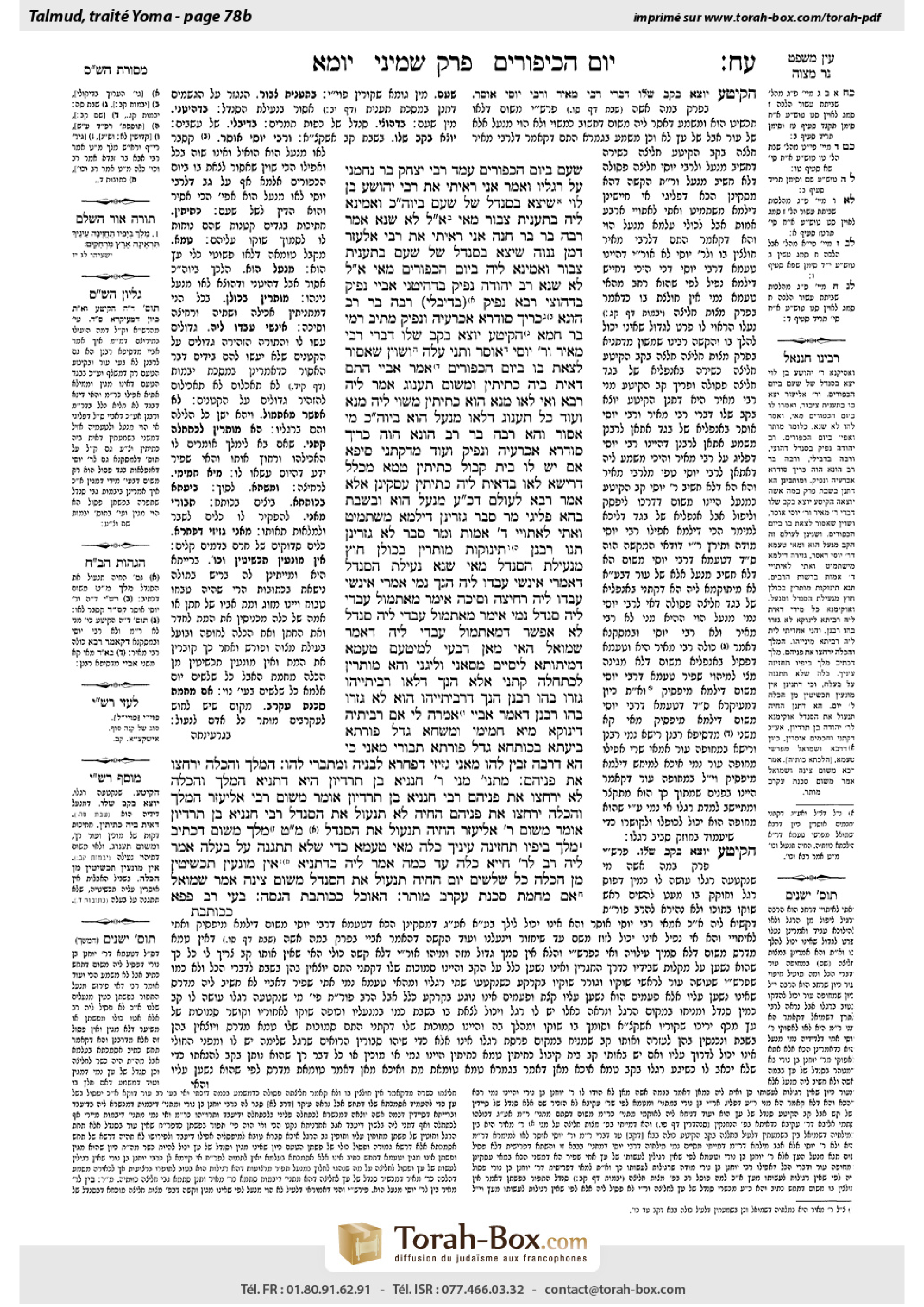
This page of Yoma includes the Aramaic text, an English translation and an AI-generated French translation, alongside the scan above.
יומא ע״ח ב · Aramaic and Hebrew text
שַׁעַם בְּיוֹם הַכִּפּוּרִים? עָמַד רַבִּי יִצְחָק בַּר נַחְמָנִי עַל רַגְלָיו, וְאָמַר: אֲנִי רָאִיתִי אֶת רַבִּי יְהוֹשֻׁעַ בֶּן לֵוִי שֶׁיָּצָא בְּסַנְדָּל שֶׁל שַׁעַם בְּיוֹם הַכִּפּוּרִים. וְאָמֵינָא לֵיהּ: בְּתַעֲנִית צִבּוּר מַאי? אֲמַר לֵיהּ: לָא שְׁנָא. אָמַר רַבָּה בַּר בַּר חָנָה: אֲנִי רָאִיתִי אֶת רַבִּי אֶלְעָזָר דְּמִן נִנְוֵה שֶׁיָּצָא בְּסַנְדָּל שֶׁל שַׁעַם בְּתַעֲנִית צִבּוּר, וְאָמֵינָא לֵיהּ: בְּיוֹם הַכִּפּוּרִים מַאי? אֲמַר לֵיהּ: לָא שְׁנָא. רַב יְהוּדָה נָפֵיק בִּדְהִיטָנֵי. אַבָּיֵי נָפֵיק בִּדְהוּצֵי. רָבָא נָפֵיק (בִּדְיַבְלֵי). רַבָּה בַּר רַב הוּנָא כָּרֵיךְ סוּדָרָא אַכַּרְעֵיהּ וְנָפֵיק.
מֵתִיב רָמֵי בַּר חָמָא: הַקִּיטֵּעַ יוֹצֵא בְּקַב שֶׁלּוֹ, דִּבְרֵי רַבִּי מֵאִיר. וְרַבִּי יוֹסֵי אוֹסֵר. וְתָנֵי עֲלַהּ: וְשָׁוִין שֶׁאָסוּר לָצֵאת בּוֹ בְּיוֹם הַכִּפּוּרִים. אָמַר אַבָּיֵי: הָתָם דְּאִית בֵּיהּ כְּתִיתִין, וּמִשּׁוּם תַּעֲנוּג.
אֲמַר לֵיהּ רָבָא: וְאִי לָאו מָנָא הוּא — כְּתִיתִין מְשַׁוֵּי לֵיהּ מָנָא? וְעוֹד: כׇּל תַּעֲנוּג דְּלָאו מִנְעָל הוּא, בְּיוֹם הַכִּפּוּרִים מִי אָסוּר? וְהָא רַבָּה בַּר רַב הוּנָא הֲוָה כָּרֵיךְ סוּדָרָא אַכַּרְעֵיהּ וְנָפֵיק! וְעוֹד, מִדְּקָתָנֵי סֵיפָא: אִם יֵשׁ לוֹ בֵּית קִבּוּל כְּתִיתִין — טָמֵא, מִכְּלָל דְּרֵישָׁא לָאו בִּדְאִית לֵיהּ כְּתִיתִין עָסְקִינַן.
אֶלָּא אָמַר רָבָא: לְעוֹלָם דְּכוּלֵּי עָלְמָא מִנְעָל הוּא, וּבְשַׁבָּת בְּהָא פְּלִיגִי: מָר סָבַר גָּזְרִינַן דִּילְמָא מִשְׁתְּמִיט וְאָתֵי לְאֵתוֹיֵי אַרְבַּע אַמּוֹת, וּמַר סָבַר לָא גָּזְרִינַן.
תָּנוּ רַבָּנַן: תִּינוֹקוֹת מוּתָּרִין בְּכוּלָּן, חוּץ מִנְּעִילַת הַסַּנְדָּל. מַאי שְׁנָא נְעִילַת הַסַּנְדָּל, דְּאָמְרִי: אִינָשֵׁי עֲבַדוּ לֵיהּ, הָנָךְ נָמֵי אָמְרִי: אִינָשֵׁי עֲבַדוּ לֵיהּ! רְחִיצָה וְסִיכָה, אֵימַר מֵאֶתְמוֹל עָבְדִי לֵיהּ.
סַנְדָּל נָמֵי, אֵימַר מֵאֶתְמוֹל עָבְדִי לֵיהּ! סַנְדָּל לָא אֶפְשָׁר דְּמֵאֶתְמוֹל עָבְדִי לֵיהּ. דַּאֲמַר שְׁמוּאֵל: הַאי מַאן דְּבָעֵי לְמִיטְעַם טַעְמָא דְמִיתוּתָא — לִיסְיַים מְסָאנֵי וְלִיגְנֵי.
וְהָא מוּתָּרִין לְכַתְּחִלָּה קָתָנֵי! אֶלָּא: הָנָךְ דְּלָאו רְבִיתַיְיהוּ — גְּזַרוּ בְּהוּ רַבָּנַן, הָנָךְ דִּרְבִיתַיְיהוּ הוּא — לָא גְּזַרוּ בְּהוּ רַבָּנַן. דְּאָמַר אַבָּיֵי, אֲמַרָה לִי אֵם: רְבִיתֵיהּ דְּיָנוֹקָא — מַיָּא חַמִּימֵי וּמִשְׁחָא. גְּדַל פּוּרְתָּא — בֵּיעֲתָא בְּכוּתָּחָא. גְּדַל פּוּרְתָּא — תַּבּוֹרֵי מָאנֵי. כִּי הָא דְּרַבָּה זָבֵין לְהוּ מָאנֵי גְּזִיזֵי דְּפַחְרָא לִבְנֵיהּ, וּמְתַבְּרִי לְהוּ.
הַמֶּלֶךְ וְהַכַּלָּה יִרְחֲצוּ אֶת פְּנֵיהֶם. מַתְנִיתִין מַנִּי? רַבִּי חֲנַנְיָא בֶּן תְּרַדְיוֹן הִיא, דְּתַנְיָא: הַמֶּלֶךְ וְהַכִּלָּה לֹא יִרְחֲצוּ אֶת פְּנֵיהֶם. רַבִּי חֲנַנְיָא בֶּן תְּרַדְיוֹן אוֹמֵר מִשּׁוּם רַבִּי אֱלִיעֶזֶר: הַמֶּלֶךְ וְהַכַּלָּה יִרְחֲצוּ אֶת פְּנֵיהֶם. הַחַיָּה לֹא תִּנְעוֹל אֶת הַסַּנְדָּל. רַבִּי חֲנַנְיָא בֶּן תְּרַדְיוֹן אוֹמֵר מִשּׁוּם רַבִּי אֱלִיעֶזֶר: הַחַיָּה תִּנְעוֹל אֶת הַסַּנְדָּל.
מַאי טַעְמָא? מֶלֶךְ, מִשּׁוּם דִּכְתִיב: ״מֶלֶךְ בְּיׇפְיוֹ תֶּחֱזֶינָה עֵינֶיךָ״. כַּלָּה מַאי טַעְמָא — כְּדֵי שֶׁלֹּא תִּתְגַּנֶּה עַל בַּעְלָהּ. אֲמַר לֵיהּ רַב לְרַבִּי חִיָּיא: כַּלָּה עַד כַּמָּה? אֲמַר לֵיהּ, כִּדְתַנְיָא: אֵין מוֹנְעִין תַּכְשִׁיטִין מִן הַכַּלָּה כׇּל שְׁלֹשִׁים יוֹם.
הַחַיָּה תִּנְעוֹל אֶת הַסַּנְדָּל — מִשּׁוּם צִינָּה.
אָמַר שְׁמוּאֵל: אִם מֵחֲמַת סַכָּנַת עַקְרָב — מוּתָּר.
הָאוֹכֵל כְּכוֹתֶבֶת הַגַּסָּה. בָּעֵי רַב פָּפָּא:
Yoma 78b · English translation
cork on Yom Kippur? Is it considered a shoe, and therefore it may not be worn on Yom Kippur, or not? Rabbi Yitzḥak bar Naḥmani stood on his feet to testify and said: I saw that Rabbi Yehoshua ben Levi went out on Yom Kippur in cork sandals, and I said to him: What is the law on a communal fast that is decreed in a time of drought, when shoes are similarly prohibited? Are reed sandals permitted? He said to me: It is no different, and such sandals are permitted even on a communal fast day. Rabba bar bar Ḥana said: I saw Rabbi Elazar from Nineveh go out in cork sandals on a communal fast day, and I said to him: What is the law on Yom Kippur? He said to me: It is no different, and it is permitted. The Gemara reports: Rav Yehuda went out on Yom Kippur in reed sandals. Abaye went out in sandals made of palm fiber. Rava went out in sandals braided with reeds. None of these sandals are considered to be shoes. Rabba bar Rav Huna wrapped a scarf around his feet and went out.
Rami bar Ḥama raised an objection: We learned that an amputee may go out with his wooden prosthetic leg on Shabbat, since it is like a shoe; these are the words of Rabbi Meir. But Rabbi Yosei prohibits it. And a baraita was taught in that regard as an addendum to that mishna: And they agree that it is prohibited to go out wearing it on Yom Kippur. As this indicates that even wooden shoes are prohibited, the materials worn by the aforementioned amora’im should also be prohibited. Abaye said: There, in the case of Yom Kippur, it is prohibited because there are rags in the prosthesis. The prohibition is not due to the shoes but due to the pleasure of the comfort, which is prohibited on Yom Kippur.
Rava said to him: And if the prosthetic leg is not a garment, meaning that it is not a shoe, do the rags make it into a garment? Only shoes are forbidden, not other garments. And furthermore, any other kind of pleasure that is not the pleasure of wearing shoes, is it prohibited on Yom Kippur? Only certain afflictions are mandated on Yom Kippur; activities that are not specifically restricted by those afflictions are permitted. And Rabba bar Rav Huna would wrap a scarf on his feet and go out, demonstrating that the comfort provided by rags is permitted on Yom Kippur. Furthermore, the continuation of the baraita contradicts your explanation that the prohibition is due to the comfort provided by the rags. From the fact that it teaches in the latter clause: If the prosthetic leg has a receptacle designed for rags it is susceptible to ritual impurity like all wooden utensils which have receptacles, it may be inferred that in the first clause we are not dealing with a prosthetic leg that has a hollow space designed for rags. Abaye’s position is thereby rejected.
Rather, Rava said: Actually, according to everyone, a prosthetic leg is considered to be a shoe, and with regard to Shabbat this is what they disagree about: One Sage, Rabbi Yosei holds that we decree a prohibition of wearing a prosthetic leg on Shabbat lest the leg slip off and one come to carry it four cubits in the public domain; and one Sage, Rabbi Meir, holds that we do not decree such a rule.
§ The Sages taught: Young children are permitted to perform all of the prohibited activities on Yom Kippur, except for wearing shoes. The Gemara asks: What is different about wearing shoes? It is because observers who see a child wearing shoes will say that adults did this for him, i.e., put them on for him, since he cannot do it for himself. But if that is the reason, with regard to those other prohibitions also, like bathing and smearing oil, they will say that adults did this for him, and children should be prohibited from those activities as well. The Gemara explains: With regard to bathing and smearing oil, they could say that they did this for him yesterday, since one cannot be certain when the child was bathed.
The Gemara asks: If so, we could say this with regard to shoes as well. They could say that they did this for him yesterday. The Gemara answers: In the case of shoes, it is impossible to say an adult did it for him yesterday, since the child would not have worn shoes at night. As Shmuel said: He who desires a taste of death should put on shoes and go to sleep.
The Gemara asks: But the mishna is teaching that they are permitted to wear shoes ab initio. If so, it is permitted for an adult to perform these acts for a child even on the day of Yom Kippur, and the observer will not think that the adult has done anything wrong. Rather, we must explain the mishna as follows: The Sages decreed against performing those actions that are not necessary for the child’s growth, but the Sages did not decree against performing those actions that are necessary for the child’s growth. As Abaye said: My mother told me: A child’s growth requires hot water and oil for smearing. When he grows a little, he must eat egg with kutaḥa, a pickled dip made with milk. When he grows a little more, he must have vessels to break, since he will enjoy breaking them. This is like Rabba who bought cracked ceramic vessels for his children, and they broke them for their enjoyment.
§ We learned in the mishna that according to Rabbi Eliezer, the king and the bride may wash their faces on Yom Kippur. The Gemara asks: Who is the tanna of the mishna? The Gemara answers: It is the opinion of Rabbi Ḥananya ben Teradyon, as it was taught in a baraita: The king and the bride may not wash their faces on Yom Kippur. Rabbi Ḥananya ben Teradyon says in the name of Rabbi Eliezer: A king and a bride may wash their faces. The Rabbis said: A new mother may not wear shoes on Yom Kippur. Rabbi Ḥananya ben Teradyon says in the name of Rabbi Eliezer: A new mother may wear shoes.
The Gemara asks: According to Rabbi Eliezer’s opinion, what is the reason that the king may wash his face? Because it is written: “Your eyes shall see the king in his beauty” (Isaiah 33:17). A king should always look regal before his nation. What is the reason that a bride may wash her face? So that she should not appear repulsive to her husband. Since it is only the beginning of their marriage, her husband may be disgusted at seeing her otherwise. Rav said to Rabbi Ḥiyya: For how long after her wedding is a woman considered a bride? He said to him: As it was taught in a baraita: If she becomes a mourner, we do not prevent the bride from wearing perfumes during the entire first thirty days of her marriage. This shows that for the first thirty days, her appearance is most critical.
A new mother may wear shoes. What is the reason for this? Due to the cold there is concern that she will become ill, as she is weak from the birth.
Shmuel said: If a man is worried about walking barefoot on Yom Kippur due to the danger of scorpions, he is permitted to wear shoes, since one need not put himself in danger.
§ We learned in the mishna: On Yom Kippur, one who eats food the volume of a large date is liable. Rav Pappa asked:
Yoma 78b · Traduction française (IA)
un sabot en liège le jour de Yom Kippour ? Est-il considéré comme une chaussure et, par conséquent, interdit le jour de Yom Kippour, ou non ? Rabbi Yitzḥak bar Naḥmani se leva pour témoigner et dit : J’ai vu Rabbi Yehoshua ben Levi sortir le jour de Yom Kippour avec des sandales en liège, et je lui ai demandé : Quelle est la halakha concernant un jeûne communautaire décrété en période de sécheresse, lorsque les chaussures sont également interdites ? Les sandales de roseau sont-elles permises ? Il m’a répondu : Il n’y a pas de différence, et ces sandales sont permises même un jour de jeûne communautaire. Rabba bar bar Ḥana dit : J’ai vu Rabbi Elazar de Ninive sortir avec des sandales en liège un jour de jeûne communautaire, et je lui ai demandé : Quelle est la halakha le jour de Yom Kippour ? Il m’a répondu : Il n’y a pas de différence, et elles sont permises. La Guemara rapporte : Rav Yehuda sortit le jour de Yom Kippour avec des sandales de roseau. Abaye sortit avec des sandales en fibres de palmier. Rava sortit avec des sandales tressées en roseaux. Aucune de ces sandales n’est considérée comme une chaussure. Rabba bar Rav Huna s’enveloppa les pieds dans une écharpe et sortit.
Rami bar Ḥama objecta : Nous avons appris qu’un amputé peut sortir le Chabbat avec sa jambe de bois, puisqu’elle est comme une chaussure ; telle est l’opinion de Rabbi Meir. Mais Rabbi Yosei l’interdit. À ce sujet, une baraïta a été enseignée en complément de cette Michna : Ils conviennent qu’il est interdit de sortir avec cette jambe le jour de Yom Kippour. Puisque cela indique que même les chaussures en bois sont interdites, les chaussures faites des matériaux portés par les amoraïm mentionnés précédemment devraient elles aussi être interdites. Abaye dit : Dans ce cas, celui de Yom Kippour, cela est interdit parce que la prothèse contient des chiffons. L’interdit ne tient pas aux chaussures, mais au confort qu’elles procurent, plaisir interdit le jour de Yom Kippour.
Rava lui dit : Et si la prothèse n’est pas un vêtement, c’est-à-dire si ce n’est pas une chaussure, les chiffons en font-ils un vêtement ? Seules les chaussures sont interdites, pas les autres vêtements. De plus, tout autre type de plaisir qui ne provient pas du port de chaussures est-il interdit le jour de Yom Kippour ? Seules certaines privations sont prescrites le jour de Yom Kippour ; les activités qui ne sont pas spécifiquement visées par ces privations sont permises. Rabba bar Rav Huna s’enveloppait les pieds d’une écharpe et sortait, ce qui montre que le confort procuré par les chiffons est permis le jour de Yom Kippour. En outre, la suite de la baraïta contredit ton explication selon laquelle l’interdit est dû au confort procuré par les chiffons. Puisqu’elle enseigne dans sa dernière partie : « Si la jambe de bois comporte un logement destiné aux chiffons, elle est susceptible de contracter l’impureté rituelle, comme tous les ustensiles en bois pourvus d’un réceptacle », on peut en déduire que, dans la première partie, il n’est pas question d’une jambe de bois comportant une cavité destinée aux chiffons. La position d’Abaye est ainsi réfutée.
Rava dit plutôt : En réalité, tous conviennent qu’une jambe de bois est considérée comme une chaussure. Leur désaccord au sujet du Chabbat porte sur le point suivant : Rabbi Yosei estime que nous décrétons l’interdiction de porter une jambe de bois le Chabbat, de peur qu’elle ne se détache et que l’on en vienne à la transporter sur quatre coudées dans le domaine public ; Rabbi Meir, lui, estime que nous ne décrétons pas une telle interdiction.
§ Les Sages ont enseigné : Les jeunes enfants sont autorisés à accomplir toutes les activités interdites le jour de Yom Kippour, à l’exception du port de chaussures. La Guemara demande : En quoi le port de chaussures diffère-t-il ? Ceux qui voient un enfant porter des chaussures diront que des adultes les lui ont mises, puisqu’il ne peut pas le faire lui-même. Mais, si telle est la raison, pour les autres interdictions aussi, comme le bain et l’application d’huile, ils diront que des adultes l’ont fait pour lui ; il faudrait donc également interdire ces activités aux enfants. La Guemara explique : Pour le bain et l’application d’huile, on pourrait dire que des adultes l’ont fait pour lui la veille, car on ne peut pas savoir avec certitude quand l’enfant a été baigné.
La Guemara demande : Dans ce cas, on pourrait aussi dire cela à propos des chaussures : des adultes les lui ont mises la veille. La Guemara répond : Pour les chaussures, il est impossible de dire qu’un adulte les lui a mises la veille, puisque l’enfant n’aurait pas porté de chaussures pendant la nuit. Car Shmuel a dit : Celui qui désire goûter à la mort n’a qu’à mettre des chaussures et aller se coucher.
La Guemara demande : Mais la Michna enseigne qu’ils sont autorisés à porter des chaussures d’emblée. Dans ce cas, un adulte peut accomplir ces actes pour un enfant même le jour de Yom Kippour, et les observateurs ne penseront pas que l’adulte a fait quelque chose de répréhensible. Il faut donc plutôt expliquer la Michna ainsi : Les Sages ont interdit les actes qui ne sont pas nécessaires à la croissance de l’enfant, mais ils n’ont pas interdit ceux qui lui sont nécessaires. Comme l’a dit Abaye : Ma mère m’a dit que la croissance d’un enfant nécessite de l’eau chaude et de l’huile à appliquer. Lorsqu’il grandit un peu, il doit manger un œuf avec du kutaḥa, une sauce marinée préparée avec du lait. Lorsqu’il grandit encore un peu, il lui faut des récipients à casser, car il prendra plaisir à les briser. C’est ce que faisait Rabba, qui achetait des récipients en céramique fêlés pour ses enfants, et ceux-ci les cassaient pour s’amuser.
§ Nous avons appris dans la Michna que, selon Rabbi Eliezer, le roi et la mariée peuvent se laver le visage le jour de Yom Kippour. La Guemara demande : De quel tanna la Michna rapporte-t-elle l’opinion ? La Guemara répond : C’est l’opinion de Rabbi Ḥananya ben Teradyon, comme cela a été enseigné dans une baraïta : Le roi et la mariée ne peuvent pas se laver le visage le jour de Yom Kippour. Rabbi Ḥananya ben Teradyon dit au nom de Rabbi Eliezer : Un roi et une mariée peuvent se laver le visage. Les Rabbins ont dit : Une accouchée ne peut pas porter de chaussures le jour de Yom Kippour. Rabbi Ḥananya ben Teradyon dit au nom de Rabbi Eliezer : Une accouchée peut porter des chaussures.
La Guemara demande : Selon l’opinion de Rabbi Eliezer, pourquoi le roi peut-il se laver le visage ? Parce qu’il est écrit : « Tes yeux verront le roi dans sa beauté » (Isaïe 33,17). Un roi doit toujours se présenter avec majesté devant son peuple. Pourquoi une mariée peut-elle se laver le visage ? Afin qu’elle ne paraisse pas repoussante aux yeux de son mari. Comme leur mariage ne fait que commencer, son mari pourrait être dégoûté de la voir autrement. Rav dit à Rabbi Ḥiyya : Combien de temps après son mariage une femme est-elle considérée comme une mariée ? Il lui répondit : Comme cela a été enseigné dans une baraïta : Si elle devient endeuillée, nous n’empêchons pas la mariée de porter des parfums pendant les trente premiers jours de son mariage. Cela montre que, durant les trente premiers jours, son apparence revêt une importance particulière.
Une accouchée peut porter des chaussures. Pourquoi ? En raison du froid, on craint qu’elle ne tombe malade, car elle est affaiblie par l’accouchement.
Shmuel a dit : Si un homme craint de marcher pieds nus le jour de Yom Kippour à cause des scorpions, il est autorisé à porter des chaussures, car nul n’est tenu de s’exposer au danger.
§ Nous avons appris dans la Michna : Le jour de Yom Kippour, celui qui mange une quantité de nourriture équivalant au volume d’une grosse datte est passible. Rav Pappa demanda :
Traduction française générée par IA à partir de l’édition anglaise de Sefaria. Vérifie toujours un passage avec le texte source.
Text from Sefaria: William Davidson Edition - Vocalized Aramaic (CC BY NC); William Davidson Edition - English (CC BY NC).