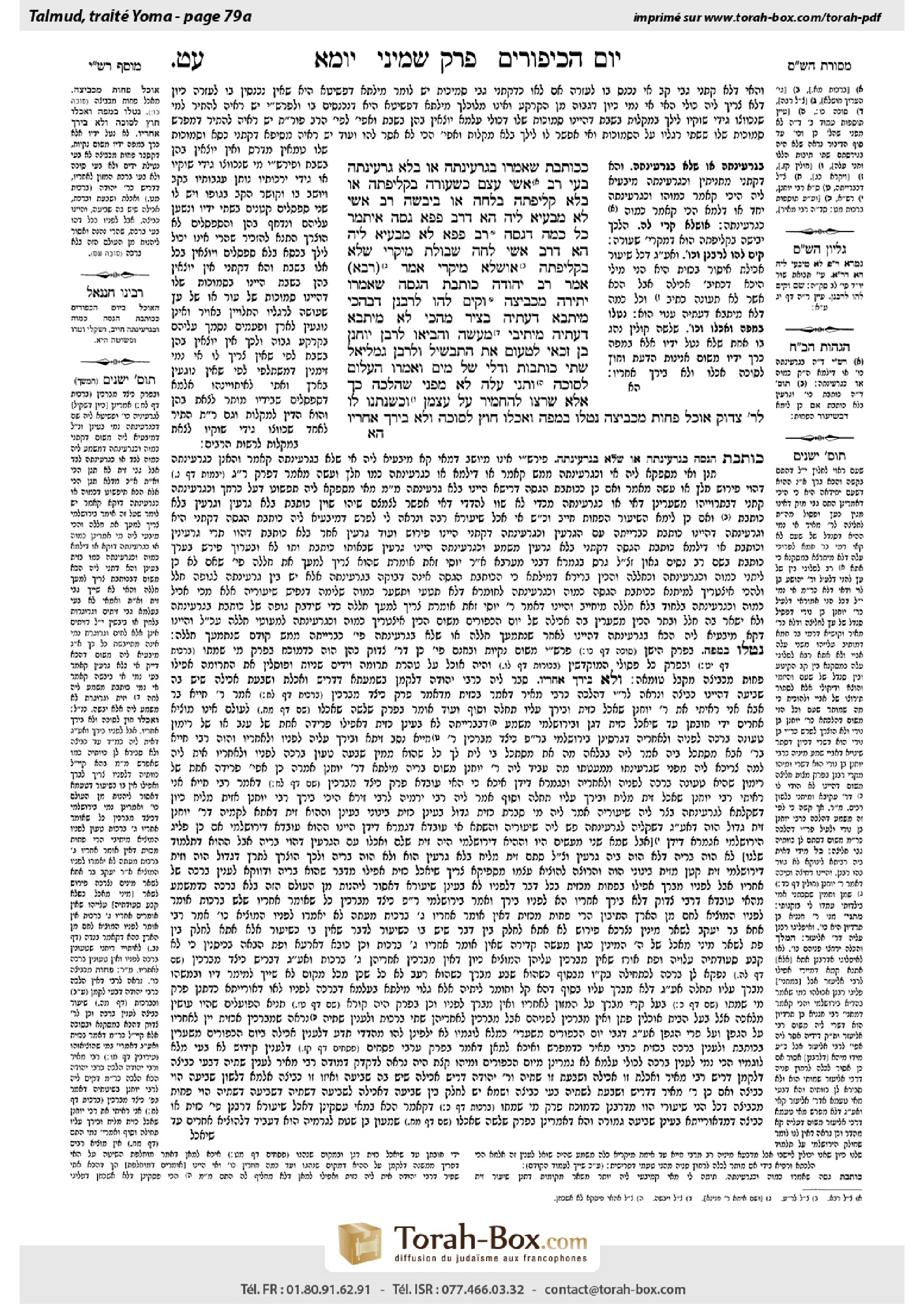
Yoma 79a: Talmud study for Daf Yomi
Daf Yomi is the daily study of one Talmud folio. Explore 37 tractates with scans, Hebrew text, Sefaria English and AI-generated French translations where annotated.
Passage selection and English or AI-generated French translation are available where the scan has annotations. Daf Study is independent of Torah-Box and Sefaria.
Browse Yoma · יומא · All tractatesYoma 79a text and translations
This page of Yoma includes the Aramaic text, an English translation and an AI-generated French translation, alongside the scan above.
יומא ע״ט א · Aramaic and Hebrew text
כְּכוֹתֶבֶת שֶׁאָמְרוּ, בְּגַרְעִינָתָהּ: אוֹ בְּלֹא גַּרְעִינָתָהּ? בָּעֵי רַב אָשֵׁי: עֶצֶם כִּשְׂעוֹרָה, בִּקְלִיפָּתָהּ אוֹ בְּלֹא קְלִיפָּתָהּ, בְּלַחָה אוֹ בִּיבֵשָׁה? רַב אָשֵׁי לָא מִבַּעְיָא לֵיהּ הָא דְּרַב פָּפָּא, ״גַּסָּה״ אִיתְּמַר — כֹּל כַּמָּה דְּגַסָּה. רַב פָּפָּא לָא מִבַּעְיָא לֵיהּ הָא דְּרַב אָשֵׁי: לַחָה — שִׁבּוֹלֶת מִיקְּרֵי, שֶׁלֹּא בִּקְלִיפָּתָהּ — אוּשְׁלָא מִיקְּרֵי.
אָמַר (רָבָא) אָמַר רַב יְהוּדָה: כּוֹתֶבֶת הַגַּסָּה שֶׁאָמְרוּ, יְתֵירָה מִכְּבֵיצָה. וְקִים לְהוּ לְרַבָּנַן דִּבְהָכִי מִיַּתְּבָא דַּעְתֵּיהּ, בְּצִיר מֵהֲכִי — לָא מִיַּתְּבָא דַּעְתֵּיהּ. מֵיתִיבִי: מַעֲשֶׂה וְהֵבִיאוּ לְרַבָּן יוֹחָנָן בֶּן זַכַּאי לִטְעוֹם אֶת הַתַּבְשִׁיל, וּלְרַבָּן גַּמְלִיאֵל שְׁתֵּי כוֹתָבוֹת וּדְלִי שֶׁל מַיִם. וְאָמְרוּ: הַעֲלוּם לַסּוּכָּה. וְתָנֵי עֲלַהּ: לָא מִפְּנֵי שֶׁהֲלָכָה כָּךְ, אֶלָּא שֶׁרָצוּ לְהַחֲמִיר עַל עַצְמָן.
וּכְשֶׁנָּתְנוּ לוֹ לְרַבִּי צָדוֹק אוֹכֶל פָּחוֹת מִכְּבֵיצָה — נְטָלוֹ בְּמַפָּה וַאֲכָלוֹ חוּץ לַסּוּכָּה, וְלֹא בֵּירַךְ אַחֲרָיו.
Yoma 79a · English translation
The large date-bulk that they said is the measure that determines liability for eating on Yom Kippur, does this refer to the volume of a large date with its pit or without its pit? Rav Ashi asked a similar question: The mishna that states that a bone that is a barley-grain-bulk imparts ritual impurity, does this refer to the volume of a barley grain with its husk or without its husk? And is that referring to a wet kernel or a dry one? The Gemara clarifies: Rav Ashi did not ask the question that Rav Pappa asked, regarding the size of the date-bulk on Yom Kippur because the answer was clear to him. Since it is stated in the mishna: Large, it means as large as possible, which must include the pit. Conversely, Rav Pappa did not ask the question that Rav Ashi asked regarding the size of the barley-grain-bulk because the answer was clear to him. Wet barley is called shibbolet and not barley; without its shell it is no longer called barley but is called ushla. Therefore, the mishna must be referring to dry barley within its shell.
Rava said that Rav Yehuda said: The volume of a large date that they said is larger than an egg-bulk. The Sages have an accepted tradition that with this amount of food, the mind of the one who eats is settled, and he is not afflicted. Less than this amount, the mind is not settled. The Gemara raises an objection from what we have learned: An incident happened on the festival of Sukkot. They brought a cooked dish to Rabban Yoḥanan ben Zakkai to taste, and they brought to Rabban Gamliel two dates and a tankard of water. Rabban Yoḥanan ben Zakkai and Rabban Gamliel said to them: Bring them up to the sukka, and we will eat there. And a baraita was taught in that regard: They did not act this way because that is the halakha, that such food must be eaten in the sukka. Rather, they wished to be stringent upon themselves and not eat anything outside of the sukka.
On the other hand, the Gemara reports: And when they gave Rabbi Tzadok food that was less than an egg-bulk to eat, he held it in a cloth and did not wash his hands. And he ate it outside of the sukka and did not recite Grace after Meals afterward.
Yoma 79a · Traduction française (IA)
La grosse datte dont les Sages ont dit qu’elle constitue la mesure qui rend passible celui qui mange le jour de Yom Kippour désigne-t-elle le volume d’une grosse datte avec son noyau ou sans son noyau ? Rav Ashi posa une question similaire : la Michna qui enseigne qu’un os de la grosseur d’un grain d’orge transmet l’impureté rituelle désigne-t-elle le volume d’un grain d’orge avec son enveloppe ou sans son enveloppe ? Et s’agit-il d’un grain humide ou d’un grain sec ? La Guemara précise que Rav Ashi ne posa pas la question de Rav Pappa au sujet de la grosseur de datte le jour de Yom Kippour, car la réponse lui était claire. Puisque la Michna dit « grosse », cela signifie aussi grosse que possible, ce qui doit inclure le noyau. À l’inverse, Rav Pappa ne posa pas la question de Rav Ashi au sujet de la grosseur d’un grain d’orge, car la réponse lui était claire. L’orge humide est appelée shibbolet, et non orge ; sans son enveloppe, elle n’est plus appelée orge, mais ushla. La Michna doit donc parler d’orge sèche avec son enveloppe.
Rava a dit au nom de Rav Yehouda : le volume d’une grosse datte dont les Sages ont parlé est supérieur à celui d’un œuf. Les Sages ont une tradition reçue selon laquelle une telle quantité de nourriture apaise l’esprit de celui qui la mange, qui n’est alors pas affligé. Une quantité moindre n’apaise pas l’esprit. La Guemara soulève une objection à partir de ce que nous avons appris : un épisode eut lieu pendant la fête de Soukkot. On apporta un plat cuit à Rabban Yoḥanan ben Zakkaï pour qu’il y goûte, et l’on apporta à Rabban Gamliel deux dattes et une cruche d’eau. Rabban Yoḥanan ben Zakkaï et Rabban Gamliel leur dirent : « Portez-les dans la soukka, et nous mangerons là-bas. » À ce sujet, une baraïta fut enseignée : ils n’agirent pas ainsi parce que telle est la halakha, selon laquelle de tels aliments doivent être consommés dans la soukka. Ils souhaitaient plutôt s’imposer une rigueur et ne rien manger en dehors de la soukka.
D’un autre côté, la Guemara rapporte que, lorsqu’on donna à Rabbi Tzadok une quantité de nourriture inférieure à celle d’un œuf, il la tint dans un linge et ne se lava pas les mains. Il la mangea en dehors de la soukka et ne récita pas ensuite le Birkat Hamazone.
Traduction française générée par IA à partir de l’édition anglaise de Sefaria. Vérifie toujours un passage avec le texte source.
Text from Sefaria: William Davidson Edition - Vocalized Aramaic (CC BY NC); William Davidson Edition - English (CC BY NC).