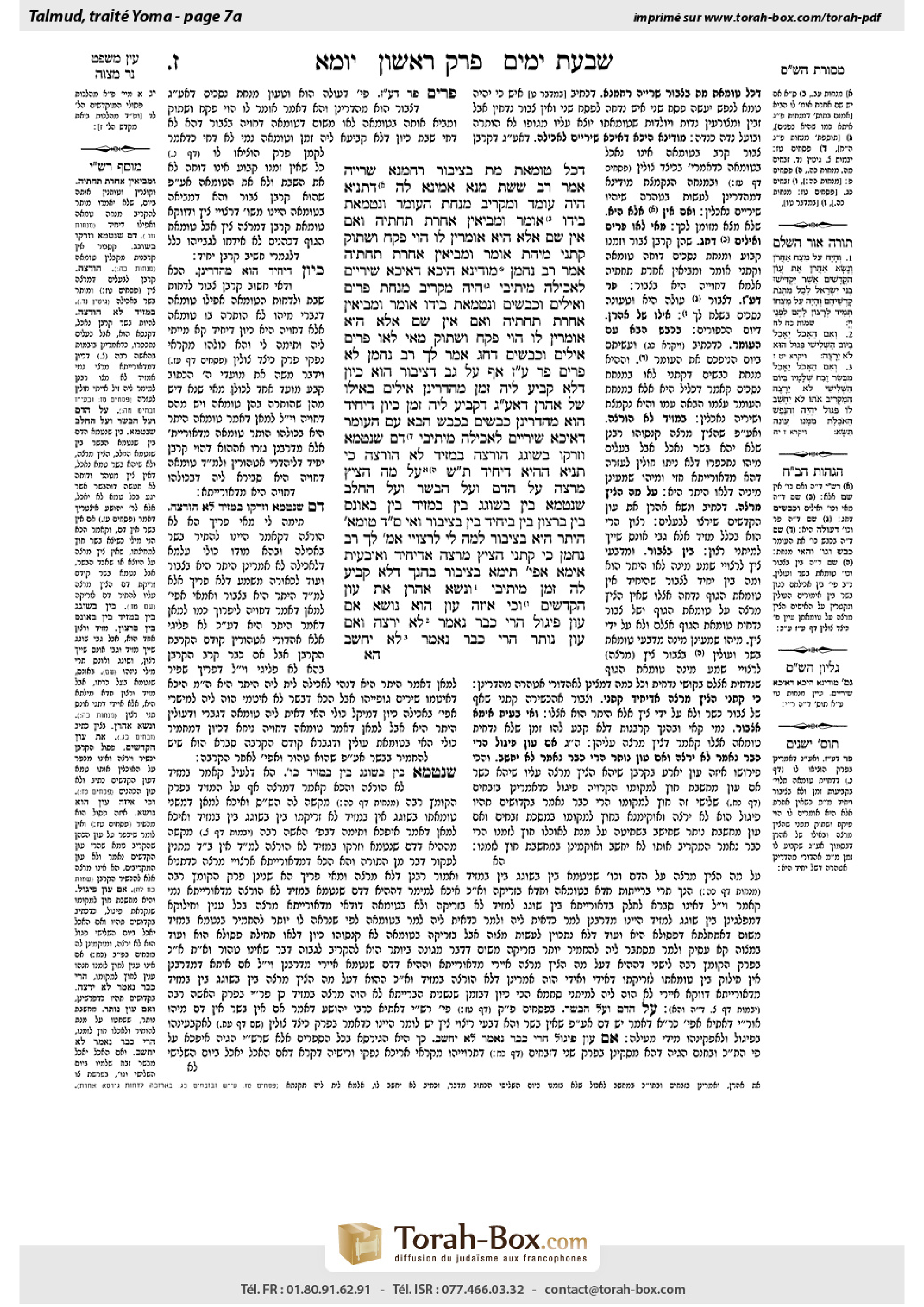
Yoma 7a: Talmud study for Daf Yomi
Daf Yomi is the daily study of one Talmud folio. Explore 37 tractates with scans, Hebrew text, Sefaria English and AI-generated French translations where annotated.
Passage selection and English or AI-generated French translation are available where the scan has annotations. Daf Study is independent of Torah-Box and Sefaria.
Browse Yoma · יומא · All tractatesYoma 7a text and translations
This page of Yoma includes the Aramaic text, an English translation and an AI-generated French translation, alongside the scan above.
יומא ז׳ א · Aramaic and Hebrew text
דְּכֹל טוּמְאַת מֵת בְּצִיבּוּר רַחֲמָנָא שַׁרְיַיהּ.
אָמַר רַב שֵׁשֶׁת: מְנָא אָמֵינָא לַהּ, דְּתַנְיָא: הָיָה עוֹמֵד וּמַקְרִיב מִנְחַת הָעוֹמֶר וְנִטְמֵאת בְּיָדוֹ, אוֹמֵר וּמְבִיאִין אַחֶרֶת תַּחְתֶּיהָ. וְאִם אֵין שָׁם אֶלָּא הִיא, אוֹמְרִין לוֹ: הֱוֵי פִּקֵּחַ וּשְׁתוֹק.
קָתָנֵי מִיהַת אוֹמֵר וּמְבִיאִין אַחֶרֶת תַּחְתֶּיהָ! אָמַר רַב נַחְמָן: מוֹדֵינָא הֵיכָא דְּאִיכָּא שִׁירַיִים לַאֲכִילָה.
מֵיתִיבִי: הָיָה מַקְרִיב מִנְחַת פָּרִים וְאֵילִים וּכְבָשִׂים, וְנִטְמֵאת בְּיָדוֹ, אוֹמֵר וּמְבִיאִין אַחֶרֶת תַּחְתֶּיהָ. וְאִם אֵין שָׁם אֶלָּא הִיא, אוֹמְרִין לוֹ: הֱוֵי פִּקֵּחַ וּשְׁתוֹק.
מַאי לָאו, פָּרִים אֵילִים וּכְבָשִׂים דְּחַג!
אָמַר לְךָ רַב נַחְמָן: לָא: פָּרִים — פַּר עֲבוֹדָה זָרָה, אַף עַל גַּב דְּצִיבּוּר הוּא, כֵּיוָן דְּלָא קְבִיעַ לֵיהּ זְמַן — מַהְדְּרִינַן. אֵילִים — בְּאֵילוֹ שֶׁל אַהֲרֹן, דְּאַף עַל גַּב דִּקְבִיעַ לֵיהּ זְמַן, כֵּיוָן דְּיָחִיד הוּא — מְהַדְּרִינַן. כְּבָשִׂים — בְּכֶבֶשׂ הַבָּא עִם הָעוֹמֶר, דְּאִיכָּא שִׁירַיִים לַאֲכִילָה.
מֵיתִיבִי: דָּם שֶׁנִּטְמָא וּזְרָקוֹ, בְּשׁוֹגֵג — הוּרְצָה, בְּמֵזִיד — לֹא הוּרְצָה. כִּי תַּנְיָא הָהִיא דְּיָחִיד.
תָּא שְׁמַע: עַל מָה הַצִּיץ מְרַצֶּה, עַל הַדָּם וְעַל הַבָּשָׂר וְעַל הַחֵלֶב שֶׁנִּטְמָא, בֵּין בְּשׁוֹגֵג בֵּין בְּמֵזִיד, בֵּין בְּאוֹנֶס בֵּין בְּרָצוֹן, בֵּין בְּיָחִיד בֵּין בְּצִיבּוּר. וְאִי סָלְקָא דַּעְתָּךְ טוּמְאָה הֶיתֵּר הִיא בְּצִיבּוּר — לְמָה לִי לְרַצּוֹיֵי?
אָמַר לְךָ רַב נַחְמָן: כִּי קָתָנֵי ״הַצִּיץ מְרַצֶּה״ אַדְּיָחִיד. וְאִיבָּעֵית אֵימָא: אֲפִילּוּ תֵּימָא בְּצִיבּוּר, בְּהָנָךְ דְּלָא קְבִיעַ לָהּ זְמַן.
מֵיתִיבִי: ״וְנָשָׂא אַהֲרֹן אֶת עֲוֹן הַקֳּדָשִׁים״, וְכִי אֵיזֶה עָוֹן הוּא נוֹשֵׂא? אִם עֲוֹן פִּיגּוּל — הֲרֵי כְּבָר נֶאֱמַר: ״לֹא יֵרָצֶה״, וְאִם עֲוֹן נוֹתָר — הֲרֵי כְּבָר נֶאֱמַר: ״לֹא יֵחָשֵׁב״,
Yoma 7a · English translation
as in all situations of impurity imparted by corpses in cases involving the public, the Merciful One permits those who are impure to perform the Temple service.
The Gemara analyzes the rationale behind the two opinions. Rav Sheshet said: From where do I derive to say that impurity is overridden in cases involving the public? It is as it was taught in a baraita: If a priest was standing and sacrificing the omer meal-offering and it became impure in his hand, the priest, who was aware of what transpired, says that it is impure and the priests bring another meal-offering in its stead. And if the meal-offering in his hand is the only meal-offering available there, the other priests say to him: Be shrewd and keep silent; do not tell anyone that it is impure.
In any case, it is teaching that he says that it is impure and the priests bring another meal-offering in its place. Apparently, when it is possible to perform the service in a state of purity, even in cases involving the public, it is preferable to do so, and the prohibition of ritual impurity is not permitted. Rav Naḥman rejected the proof and said: I concede that in a case where there are remnants of the offering designated for eating it must be performed in purity wherever possible. Although it is permitted to sacrifice an offering when impure, the mitzva to eat portions of the offering must be performed in a state of purity. Therefore, in cases where portions of the offering are eaten, the preference is to sacrifice the offering in a state of purity.
The Gemara raises an objection to the opinion of Rav Naḥman from the Tosefta: If a priest was sacrificing the meal-offering accompanying the sacrifice of bulls, rams, or sheep, and the meal-offering became impure in his hand, the priest says that it is impure and the priests bring another meal-offering in its stead. And if the meal-offering in his hand is the only meal-offering available there, the other priests say to him: Be shrewd and keep silent; do not tell anyone that it is impure.
What, is it not referring to the bulls, rams, and sheep of the festival of Sukkot, which are communal offerings that are not eaten? Apparently, even in cases of communal offerings, the priests seek to perform the service in a state of purity and the prohibition of impurity is not permitted but merely overridden.
Rav Naḥman could have said to you: No, the bulls mentioned in the Tosefta are not standard communal offerings. Rather, the reference is to the bull sacrificed when the entire community engages in idolatry unwittingly. Although this offering is a communal offering, since it has no specific time fixed for its sacrifice, we seek out a pure meal-offering in its stead.
Similarly, the rams mentioned in the Tosefta are not additional offerings of the Festival. Rather, the reference is to the ram of Aaron sacrificed on Yom Kippur. Although it has a specific time fixed for its sacrifice, since it is an offering brought by an individual, the High Priest, we seek out a pure meal-offering in its stead, as service in a state of impurity is permitted only for communal offerings.
The sheep mentioned are not those for the daily offerings or the additional offerings of the Festival. Rather, the reference is to the sheep that accompanies the omer meal-offering, as in that case, there are remnants designated for eating. Therefore, the meal-offering must be offered in purity.
The Gemara raises an additional objection to the opinion of Rav Naḥman: With regard to blood that became impure and a priest sprinkled it on the altar, if he did so unwittingly, the offering is accepted. If he sprinkled the blood intentionally, the offering is not accepted. Apparently, even in cases involving the public, performing service in the Temple in a state of impurity is not permitted. This objection is rejected: When that baraita was taught, it was with regard to the offering of an individual, where the prohibition of impurity is certainly in effect.
The Gemara continues: Come and hear a different argument based on that which was taught in a baraita. For what does the frontplate worn by the High Priest effect acceptance? It effects acceptance for the blood, for the flesh, and for the fat of an offering that became impure in the Temple, whether it became impure unwittingly or whether it became impure intentionally, whether it was due to circumstances beyond his control or whether it was done willfully, whether it was in the framework of an individual offering or whether it was in the framework of a communal offering. And if it enters your mind that impurity is permitted in cases involving the public, why do I need the frontplate to effect acceptance? If the prohibition of impurity is permitted, no pardon is necessary.
The Gemara responds that Rav Naḥman could have said to you: When the baraita teaches that the frontplate effects acceptance it is not referring to the entire list of items cited in the baraita; it is referring to an individual offering brought in impurity, not to a communal offering. The communal offering is mentioned only in the sense that in that case too, impurity is permitted, albeit for a different reason. Or if you wish, say instead: Even if you say that the frontplate effects acceptance for a communal offering, it is only for those offerings that lack a fixed time. Rav Naḥman concedes that with regard to those communal offerings that have no specific time fixed for their sacrifice, the prohibition of performing the service in impurity remains in effect and requires the acceptance effected by the frontplate.
The Gemara raises an objection. It is stated: “And Aaron will gain forgiveness for the sin committed in the sacred things that the children of Israel shall hallow in all their sacred gifts, and it shall be always upon his forehead that they may be accepted favorably before the Lord” (Exodus 28:38). And for which sin does the frontplate gain forgiveness? If it is for the sin of piggul, an offering disqualified by the intention to sacrifice or eat it after the permitted time, it has already been stated: “And if it is eaten at all on the third day, it is piggul; it shall not be accepted” (Leviticus 19:7). There is no acceptance of an offering that became piggul. And if it is for the sin of notar, meat of an offering left after the permitted time for eating it passed, it has already been stated: “And if any of the flesh of the sacrifice of his peace-offerings is eaten on the third day, it shall not be accepted, neither shall it be credited to he who offered it” (Leviticus 7:18).
Yoma 7a · Traduction française (IA)
comme dans tous les cas d’impureté due à un cadavre concernant la collectivité, le Miséricordieux permet aux personnes impures d’accomplir le service du Temple.
La Guemara examine le raisonnement qui sous-tend les deux opinions. Rav Sheshet dit : D’où puis-je déduire que l’impureté est écartée dans les cas concernant la collectivité ? De ce qui a été enseigné dans une baraïta : si un prêtre était en train d’offrir l’oblation de l’omer et qu’elle devint impure dans sa main, le prêtre, qui savait ce qui s’était passé, dit qu’elle est impure, et les prêtres en apportent une autre à sa place. Mais si l’oblation qu’il tient est la seule disponible, les autres prêtres lui disent : « Sois avisé et tais-toi ; ne dis à personne qu’elle est impure. »
Quoi qu’il en soit, il est enseigné qu’il dit qu’elle est impure et que les prêtres en apportent une autre à sa place. Apparemment, lorsqu’il est possible d’accomplir le service en état de pureté, même dans les cas concernant la collectivité, il est préférable de le faire, et l’interdiction liée à l’impureté n’est pas levée. Rav Naḥman rejette cette preuve et dit : Je reconnais que, lorsqu’il reste des parts de l’offrande destinées à être consommées, il faut, chaque fois que possible, l’accomplir en état de pureté. Bien qu’il soit permis d’offrir un sacrifice en état d’impureté, la mitsva de consommer les parts du sacrifice doit être accomplie en état de pureté. C’est pourquoi, dans les cas où des parts du sacrifice sont consommées, il est préférable de l’offrir en état de pureté.
La Guemara soulève une objection contre l’opinion de Rav Naḥman à partir de la Tossefta : si un prêtre était en train d’offrir l’oblation accompagnant le sacrifice de taureaux, de béliers ou de moutons, et que l’oblation devint impure dans sa main, le prêtre dit qu’elle est impure et les prêtres en apportent une autre à sa place. Mais si l’oblation qu’il tient est la seule disponible, les autres prêtres lui disent : « Sois avisé et tais-toi ; ne dis à personne qu’elle est impure. »
N’est-il pas question des taureaux, des béliers et des moutons de la fête de Souccot, qui sont des sacrifices collectifs dont la viande n’est pas consommée ? Apparemment, même dans le cas de sacrifices collectifs, les prêtres cherchent à accomplir le service en état de pureté ; l’interdiction liée à l’impureté n’est pas levée, mais seulement écartée.
Rav Naḥman aurait pu te répondre : Non, les taureaux mentionnés dans la Tossefta ne sont pas des sacrifices collectifs ordinaires. Il s’agit plutôt du taureau offert lorsque toute la communauté pratique involontairement l’idolâtrie. Bien que ce sacrifice soit collectif, comme aucune date précise n’est fixée pour son offrande, on cherche à lui substituer une oblation pure. De même, les béliers mentionnés dans la Tossefta ne sont pas les sacrifices supplémentaires de la fête. Il s’agit plutôt du bélier d’Aaron offert à Yom Kippour. Bien qu’une date précise soit fixée pour son offrande, comme c’est un sacrifice offert par un particulier, le grand prêtre, on cherche à lui substituer une oblation pure, car le service en état d’impureté n’est permis que pour les sacrifices collectifs. Les moutons mentionnés ne sont pas ceux des sacrifices quotidiens ni des sacrifices supplémentaires de la fête. Il s’agit plutôt du mouton qui accompagne l’oblation de l’omer, car, dans ce cas, il reste des parts destinées à être consommées. Par conséquent, l’oblation doit être offerte en état de pureté.
La Guemara soulève une autre objection contre l’opinion de Rav Naḥman : si du sang est devenu impur et qu’un prêtre l’a aspergé sur l’autel, le sacrifice est agréé s’il l’a fait involontairement. S’il a aspergé le sang intentionnellement, le sacrifice n’est pas agréé. Apparemment, même dans les cas concernant la collectivité, il n’est pas permis d’accomplir le service du Temple en état d’impureté. Cette objection est rejetée : lorsque cette baraïta a été enseignée, elle concernait le sacrifice d’un particulier, pour lequel l’interdiction liée à l’impureté s’applique certainement.
La Guemara poursuit : Considère un autre argument, fondé sur ce qui a été enseigné dans une baraïta. Pour quoi la plaque frontale portée par le grand prêtre obtient-elle l’agrément ? Elle l’obtient pour le sang, la chair et la graisse d’un sacrifice devenus impurs dans le Temple, que l’impureté soit survenue involontairement ou intentionnellement, qu’elle résulte de circonstances indépendantes de sa volonté ou qu’elle ait été provoquée délibérément, que ce soit dans le cadre d’un sacrifice individuel ou d’un sacrifice collectif. Or, si tu penses que l’impureté est permise dans les cas concernant la collectivité, pourquoi ai-je besoin de la plaque frontale pour obtenir l’agrément ? Si l’interdiction liée à l’impureté est levée, aucun pardon n’est nécessaire.
La Guemara répond que Rav Naḥman aurait pu te dire : lorsque la baraïta enseigne que la plaque frontale obtient l’agrément, elle ne vise pas toute la liste des éléments cités dans la baraïta ; elle vise un sacrifice individuel offert en état d’impureté, et non un sacrifice collectif. Le sacrifice collectif n’est mentionné que pour indiquer que, dans ce cas également, l’impureté est permise, mais pour une autre raison. Ou bien, si tu préfères, dis plutôt ceci : même si tu dis que la plaque frontale obtient l’agrément pour un sacrifice collectif, cela ne concerne que les sacrifices dont la date n’est pas fixée. Rav Naḥman reconnaît que, pour les sacrifices collectifs dont aucune date précise n’est fixée, l’interdiction d’accomplir le service en état d’impureté reste en vigueur et nécessite l’agrément obtenu par la plaque frontale.
La Guemara soulève une objection. Il est dit : « Aaron expiera la faute commise à l’égard des choses saintes que les enfants d’Israël consacreront, dans tous leurs dons sacrés ; elle sera toujours sur son front, afin qu’ils soient favorablement agréés devant le Seigneur » (Exode 28:38). Et pour quelle faute la plaque frontale obtient-elle le pardon ? Si c’est pour la faute de piggul, c’est-à-dire un sacrifice disqualifié par l’intention de l’offrir ou de le consommer après le délai permis, il est déjà dit : « Si l’on en mange quoi que ce soit le troisième jour, c’est du piggul ; il ne sera pas agréé » (Lévitique 19:7). Un sacrifice devenu piggul ne peut pas être agréé. Et si c’est pour la faute de notar, c’est-à-dire de la viande d’un sacrifice laissée après l’expiration du délai permis pour la consommer, il est déjà dit : « Si l’on mange de la chair du sacrifice de ses offrandes de paix le troisième jour, il ne sera pas agréé et cela ne sera pas porté au compte de celui qui l’a offert » (Lévitique 7:18).
Traduction française générée par IA à partir de l’édition anglaise de Sefaria. Vérifie toujours un passage avec le texte source.
Text from Sefaria: William Davidson Edition - Vocalized Aramaic (CC BY NC); William Davidson Edition - English (CC BY NC).