Yoma 7b: Talmud study for Daf Yomi
Daf Yomi is the daily study of one Talmud folio. Explore 37 tractates with scans, Hebrew text, Sefaria English and AI-generated French translations where annotated.
Passage selection and English or AI-generated French translation are available where the scan has annotations. Daf Study is independent of Torah-Box and Sefaria.
Browse Yoma · יומא · All tractatesYoma 7b text and translations
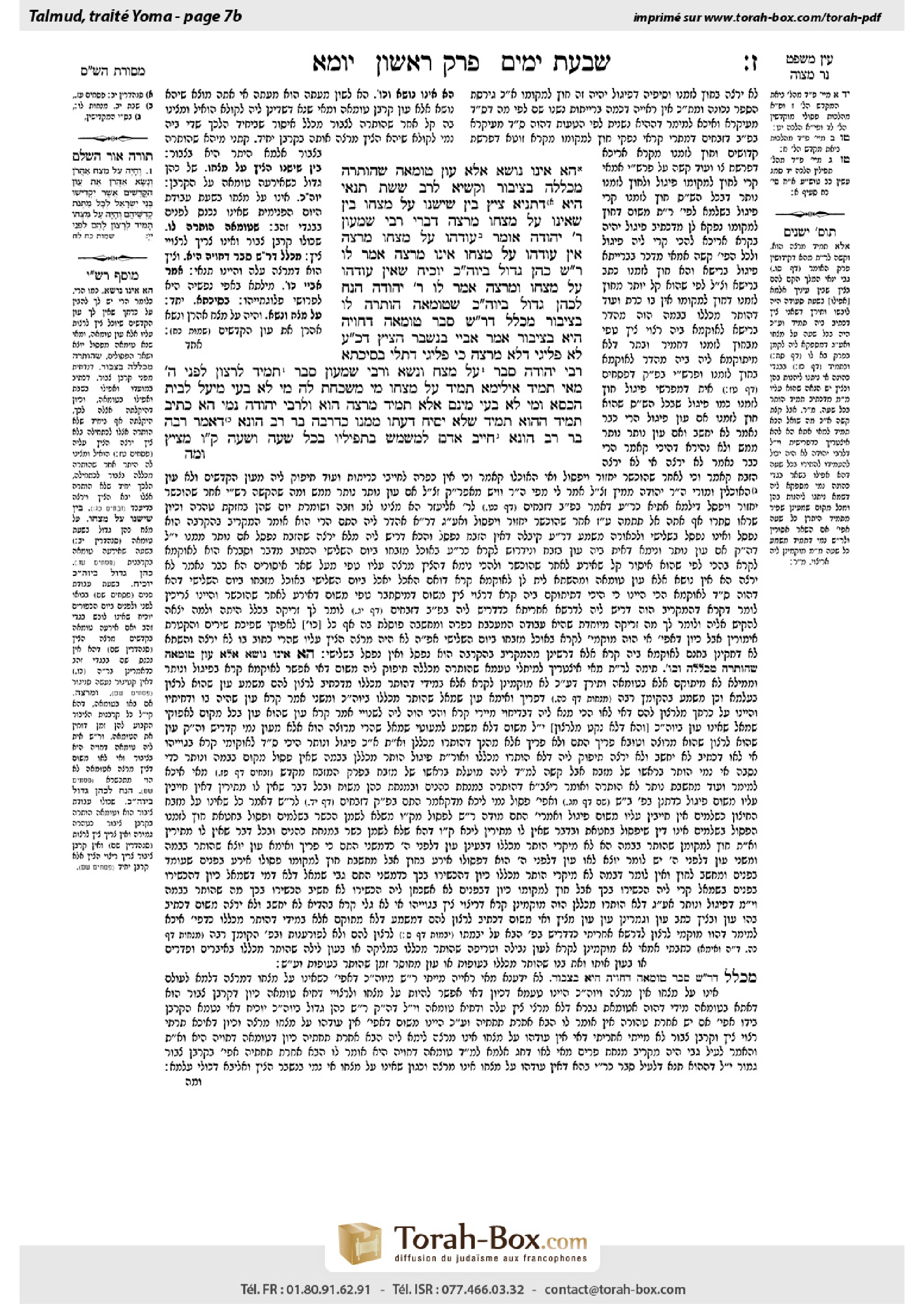
This page of Yoma includes the Aramaic text, an English translation and an AI-generated French translation, alongside the scan above.
יומא ז׳ ב · Aramaic and Hebrew text
הָא אֵינוֹ נוֹשֵׂא אֶלָּא עֲוֹן טוּמְאָה שֶׁהוּתְּרָה מִכְּלָלָהּ בְּצִיבּוּר. וְקַשְׁיָא לְרַב שֵׁשֶׁת! תַּנָּאֵי הִיא. דְּתַנְיָא: צִיץ, בֵּין שֶׁיֶּשְׁנוֹ עַל מִצְחוֹ בֵּין שֶׁאֵינוֹ עַל מִצְחוֹ — מְרַצֶּה, דִּבְרֵי רַבִּי שִׁמְעוֹן.
רַבִּי יְהוּדָה אוֹמֵר: עוֹדֵהוּ עַל מִצְחוֹ — מְרַצֶּה. אֵין עוֹדֵהוּ עַל מִצְחוֹ — אֵינוֹ מְרַצֶּה. אָמַר לוֹ רַבִּי שִׁמְעוֹן: כֹּהֵן גָּדוֹל בְּיוֹם הַכִּפּוּרִים יוֹכִיחַ, שֶׁאֵין עוֹדֵהוּ עַל מִצְחוֹ, וּמְרַצֶּה!
אָמַר לוֹ רַבִּי יְהוּדָה: הַנַּח לְכֹהֵן גָּדוֹל בְּיוֹם הַכִּפּוּרִים, שֶׁטּוּמְאָה הוּתְּרָה לוֹ בְּצִיבּוּר. מִכְּלָל דְּרַבִּי שִׁמְעוֹן סָבַר טוּמְאָה דְּחוּיָה הִיא בְּצִיבּוּר.
אָמַר אַבָּיֵי: בְּנִשְׁבַּר הַצִּיץ דְּכוּלֵּי עָלְמָא לָא פְּלִיגִי דְּלָא מְרַצֶּה. כִּי פְּלִיגִי דִּתְלֵי בְּסִיכְּתָא, רַבִּי יְהוּדָה סָבַר: ״עַל מֵצַח ... וְנָשָׂא״,
וְרַבִּי שִׁמְעוֹן סָבַר ״תָּמִיד לְרָצוֹן לִפְנֵי ה׳״. מַאי ״תָּמִיד״? אִילֵּימָא: תָּמִיד עַל מִצְחוֹ, מִי מַשְׁכַּחַתְּ לַהּ?! מִי לָא בָּעֵי מֵיעַל לְבֵית הַכִּסֵּא, וּמִי לָא בָּעֵי מֵינַם?! אֶלָּא: תָּמִיד מְרַצֶּה הוּא.
וּלְרַבִּי יְהוּדָה נָמֵי, הָא כְּתִיב ״תָּמִיד״! הָהוּא תָּמִיד שֶׁלֹּא יַסִּיחַ דַּעְתּוֹ מִמֶּנּוּ, כִּדְרַבָּה בַּר רַב הוּנָא. דְּאָמַר רַבָּה בַּר רַב הוּנָא: חַיָּיב אָדָם לְמַשְׁמֵשׁ בִּתְפִילָּיו בְּכׇל שָׁעָה וְשָׁעָה, קַל וָחוֹמֶר מִצִּיץ:
Yoma 7b · English translation
Apparently, the frontplate gains forgiveness only for the sin of impurity, which was exempted from its general prohibition in cases involving the public. This poses a difficulty to the opinion of Rav Sheshet, who said that the prohibition of impurity is overridden in cases involving the public, as the baraita clearly states that impurity is permitted. The Gemara responds: According to Rav Sheshet, the question of whether the prohibition of impurity is permitted or overridden in cases involving the public is the subject of a dispute between tanna’im, as it was taught in a baraita: The frontplate effects acceptance whether it is on the High Priest’s forehead or whether it is not on the High Priest’s forehead when the offering becomes impure. This is the statement of Rabbi Shimon.
Rabbi Yehuda says: As long as it is on his forehead it effects acceptance; if it is no longer on his forehead it does not effect acceptance. Rabbi Shimon said to Rabbi Yehuda: The case of the High Priest on Yom Kippur can prove that your statement is incorrect, as on Yom Kippur when the High priest wears only four linen garments the frontplate is no longer on his forehead, and it still effects acceptance.
Rabbi Yehuda said to him: Leave the case of the High Priest on Yom Kippur, as the atonement of the frontplate is unnecessary because the prohibition of performing the Temple service in impurity is permitted in cases involving the public. Learn by inference that Rabbi Shimon holds that impurity is overridden in cases involving the public, and that is why the atonement of the frontplate is necessary. The dispute between Rav Sheshet and Rav Naḥman is based on a tannaitic dispute, and the baraita cited above is in accordance with the opinion of Rabbi Yehuda.
The Gemara proceeds to analyze the tannaitic dispute between Rabbi Shimon and Rabbi Yehuda. Abaye said: In a case where the frontplate broke, everyone, including Rabbi Shimon, agrees that the frontplate no longer effects acceptance. When they disagree is in a case where the frontplate is not on his forehead but is hanging on a peg. Rabbi Yehuda holds that the verse: “And it shall be on the forehead of Aaron and Aaron shall gain forgiveness for the sin committed in the sacred things” (Exodus 28:38) means that the frontplate atones for sin as long as it is on his forehead.
And Rabbi Shimon holds that emphasis should be placed on the end of that verse: “It shall be always upon his forehead that they may be accepted before the Lord.” From this, Rabbi Shimon derived that the frontplate always effects acceptance, even when it is not upon the High Priest’s forehead, as what is the meaning of the word always in the verse? If we say that it means that the frontplate must always be on the High Priest’s forehead, do you find that situation in reality? Doesn’t he need to enter the bathroom, when he must remove the frontplate bearing the name of God? Similarly, doesn’t he need to sleep, at which time he removes the priestly vestments? Rather, it means that the frontplate always effects acceptance, whether or not it is on his forehead.
The Gemara asks: And according to Rabbi Yehuda as well, isn’t it written: “Always”? Clearly it does not mean that the frontplate must always be on his forehead. The Gemara answers: That term: “Always,” teaches that the High Priest must always be aware that the frontplate is on his head, and that he should not be distracted from it. This is in accordance with the statement of Rabba bar Rav Huna, as Rabba bar Rav Huna said: A person must touch the phylacteries on his head and on his arm each and every hour, to maintain awareness of their presence. This is derived by means of an a fortiori inference from the frontplate:
Yoma 7b · Traduction française (IA)
Il apparaît que le diadème n’obtient le pardon que pour la faute d’impureté, dont l’interdiction générale a été levée dans les cas concernant la collectivité. Cela pose une difficulté à l’opinion de Rav Sheshet, qui a dit que l’interdiction de l’impureté est écartée dans les cas concernant la collectivité, puisque la baraïta affirme clairement que l’impureté est permise. La Guemara répond : selon Rav Sheshet, la question de savoir si l’interdiction de l’impureté est permise ou écartée dans les cas concernant la collectivité fait l’objet d’une controverse entre tannaïm, comme il est enseigné dans une baraïta : le diadème obtient l’agrément, qu’il soit sur le front du Grand Prêtre ou qu’il n’y soit pas lorsque l’offrande devient impure. Telle est l’opinion de Rabbi Shimon.
Rabbi Yehuda dit : Tant qu’il est sur son front, il obtient l’agrément ; s’il n’y est plus, il ne l’obtient pas. Rabbi Shimon dit à Rabbi Yehuda : Le cas du Grand Prêtre à Yom Kippour prouve que ton affirmation est incorrecte : à Yom Kippour, lorsque le Grand Prêtre ne porte que quatre vêtements de lin, le diadème n’est plus sur son front et, pourtant, il obtient l’agrément.
Rabbi Yehuda lui dit : Écarte le cas du Grand Prêtre à Yom Kippour, car l’expiation opérée par le diadème n’est pas nécessaire, puisque l’interdiction d’accomplir le service du Temple en état d’impureté est permise dans les cas concernant la collectivité. Déduis-en que Rabbi Shimon considère que l’impureté est écartée dans les cas concernant la collectivité, et que c’est pourquoi l’expiation opérée par le diadème est nécessaire. La controverse entre Rav Sheshet et Rav Naḥman repose sur une controverse entre tannaïm, et la baraïta citée plus haut correspond à l’opinion de Rabbi Yehuda.
La Guemara poursuit l’analyse de la controverse entre Rabbi Shimon et Rabbi Yehuda. Abaye dit : Dans le cas où le diadème s’est brisé, tous, y compris Rabbi Shimon, conviennent qu’il n’obtient plus l’agrément. Leur désaccord porte sur le cas où le diadème n’est pas sur son front, mais est suspendu à un crochet. Rabbi Yehuda considère que le verset : « Il sera sur le front d’Aaron, et Aaron obtiendra le pardon pour la faute commise dans les choses saintes » (Exode 28, 38) signifie que le diadème expie la faute tant qu’il est sur son front.
Rabbi Shimon, lui, considère qu’il faut mettre l’accent sur la fin de ce verset : « Il sera toujours sur son front, afin qu’ils obtiennent l’agrément devant l’Éternel. » Rabbi Shimon en déduit que le diadème obtient toujours l’agrément, même lorsqu’il n’est pas sur le front du Grand Prêtre. Que signifie en effet le mot « toujours » dans le verset ? Si l’on dit qu’il signifie que le diadème doit toujours être sur le front du Grand Prêtre, une telle situation est-elle possible en réalité ? N’a-t-il pas besoin d’aller aux toilettes, moment où il doit retirer le diadème portant le nom de Dieu ? De même, n’a-t-il pas besoin de dormir, moment où il retire les vêtements sacerdotaux ? Cela signifie plutôt que le diadème obtient toujours l’agrément, qu’il soit ou non sur son front.
La Guemara demande : Mais, pour Rabbi Yehuda aussi, n’est-il pas écrit : « Toujours » ? Il est clair que cela ne signifie pas que le diadème doit toujours être sur son front. La Guemara répond : Le terme « toujours » enseigne que le Grand Prêtre doit toujours savoir que le diadème est sur sa tête et ne pas en détourner son attention. Cela correspond à l’enseignement de Rabba bar Rav Huna, car Rabba bar Rav Huna a dit : Une personne doit toucher ses téfilines sur la tête et sur le bras à chaque heure, afin de rester consciente de leur présence. Cela se déduit par raisonnement a fortiori du diadème :
Traduction française générée par IA à partir de l’édition anglaise de Sefaria. Vérifie toujours un passage avec le texte source.
Text from Sefaria: William Davidson Edition - Vocalized Aramaic (CC BY NC); William Davidson Edition - English (CC BY NC).