Yoma 8a: Talmud study for Daf Yomi
Daf Yomi is the daily study of one Talmud folio. Explore 37 tractates with scans, Hebrew text, Sefaria English and AI-generated French translations where annotated.
Passage selection and English or AI-generated French translation are available where the scan has annotations. Daf Study is independent of Torah-Box and Sefaria.
Browse Yoma · יומא · All tractatesYoma 8a text and translations
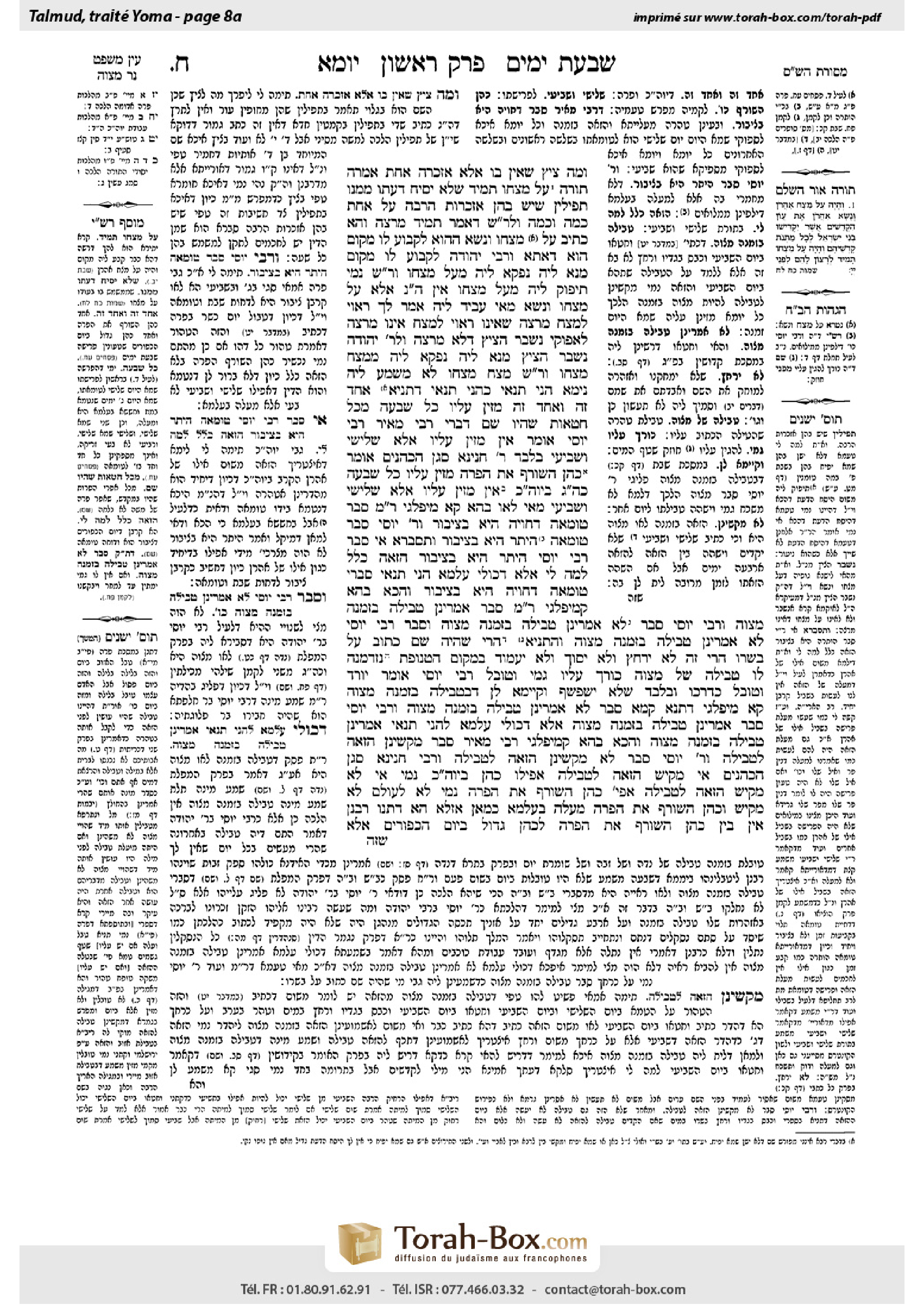
This page of Yoma includes the Aramaic text, an English translation and an AI-generated French translation, alongside the scan above.
יומא ח׳ א · Aramaic and Hebrew text
וּמָה צִיץ, שֶׁאֵין בּוֹ אֶלָּא אַזְכָּרָה אַחַת, אָמְרָה תּוֹרָה: ״עַל מִצְחוֹ תָּמִיד״ — שֶׁלֹּא יַסִּיחַ דַּעְתּוֹ מִמֶּנּוּ. תְּפִילִּין שֶׁיֵּשׁ בָּהֶן אַזְכָּרוֹת הַרְבֵּה — עַל אַחַת כַּמָּה וְכַמָּה.
וּלְרַבִּי שִׁמְעוֹן דְּאָמַר תָּמִיד מְרַצֶּה, וְהָא כְּתִיב ״עַל מִצְחוֹ וְנָשָׂא״! הָהוּא לִקְבּוֹעַ לוֹ מָקוֹם הוּא דַּאֲתָא.
וְרַבִּי יְהוּדָה לִקְבּוֹעַ לוֹ מָקוֹם מְנָא לֵיהּ? נָפְקָא לֵיהּ מֵ״עַל מִצְחוֹ״. וְרַבִּי שִׁמְעוֹן נָמֵי, תִּיפּוֹק לֵיהּ מֵ״עַל מִצְחוֹ״? אִין הָכִי נָמֵי.
אֶלָּא, ״עַל מִצְחוֹ וְנָשָׂא״ מַאי עָבֵיד לֵיהּ? אָמַר לָךְ: רָאוּי לַמֵּצַח מְרַצֶּה, שֶׁאֵינוֹ רָאוּי לַמֵּצַח אֵינוֹ מְרַצֶּה. לְאַפּוֹקֵי נִשְׁבַּר הַצִּיץ, דְּלֹא מְרַצֶּה.
וּלְרַבִּי יְהוּדָה, נִשְׁבַּר הַצִּיץ מְנָא לֵיהּ? נָפְקָא לֵיהּ מִ״מֵּצַח״ ״מִצְחוֹ״. וְרַבִּי שִׁמְעוֹן, ״מֵצַח״ ״מִצְחוֹ״ לָא מַשְׁמַע לֵיהּ.
נֵימָא הָנֵי תַּנָּאֵי כְּהָנֵי תַּנָּאֵי. דְּתַנְיָא: אֶחָד זֶה וְאֶחָד זֶה מַזִּין עָלָיו כׇּל שִׁבְעָה מִכׇּל חַטָּאוֹת שֶׁהָיוּ שָׁם — דִּבְרֵי רַבִּי מֵאִיר. רַבִּי יוֹסֵי אוֹמֵר: אֵין מַזִּין עָלָיו אֶלָּא שְׁלִישִׁי וּשְׁבִיעִי בִּלְבַד. רַבִּי חֲנִינָא סְגַן הַכֹּהֲנִים אוֹמֵר: כֹּהֵן הַשּׂוֹרֵף אֶת הַפָּרָה מַזִּין עָלָיו כׇּל שִׁבְעָה, כֹּהֵן גָּדוֹל בְּיוֹם הַכִּפּוּרִים אֵין מַזִּין עָלָיו אֶלָּא שְׁלִישִׁי וּשְׁבִיעִי.
מַאי לָאו בְּהָא קָא מִיפַּלְגִי, רַבִּי מֵאִיר סָבַר: טוּמְאָה דְּחוּיָה הִיא בְּצִיבּוּר. וְרַבִּי יוֹסֵי סָבַר: טוּמְאָה הֶיתֵּר הִיא בְּצִיבּוּר.
וְתִסְבְּרָא? אִי סָבַר רַבִּי יוֹסֵי הֶיתֵּר הִיא בְּצִיבּוּר — הַזָּאָה כְּלָל לְמָה לִי? אֶלָּא דְּכוּלֵּי עָלְמָא הָנֵי תַּנָּאֵי סָבְרִי טוּמְאָה דְּחוּיָה הִיא בְּצִיבּוּר.
וְהָכָא בְּהָא קָמִיפַּלְגִי, רַבִּי מֵאִיר סָבַר: אָמְרִינַן טְבִילָה בִּזְמַנָּהּ מִצְוָה. וְרַבִּי יוֹסֵי סָבַר: לָא אָמְרִינַן טְבִילָה בִּזְמַנָּהּ מִצְוָה.
וְסָבַר רַבִּי יוֹסֵי לָא אָמְרִינַן טְבִילָה בִּזְמַנָּהּ מִצְוָה? וְהָתַנְיָא: הֲרֵי שֶׁהָיָה שֵׁם כָּתוּב עַל בְּשָׂרוֹ — הֲרֵי זֶה לֹא יִרְחַץ וְלֹא יָסוּךְ וְלֹא יַעֲמוֹד בִּמְקוֹם הַטִּנּוֹפֶת. נִזְדַּמְּנָה לוֹ טְבִילָה שֶׁל מִצְוָה — כּוֹרֵךְ עָלָיו גֶּמִי וְטוֹבֵל. רַבִּי יוֹסֵי אוֹמֵר: יוֹרֵד וְטוֹבֵל כְּדַרְכּוֹ, וּבִלְבַד שֶׁלֹּא יְשַׁפְשֵׁף.
וְקַיְימָא לַן דְּבִטְבִילָה בִּזְמַנָּהּ מִצְוָה קָא מִיפַּלְגִי, דְּתַנָּא קַמָּא סָבַר: לָא אָמְרִינַן טְבִילָה בִּזְמַנָּהּ מִצְוָה, וְרַבִּי יוֹסֵי סָבַר: אָמְרִינַן טְבִילָה בִּזְמַנָּהּ מִצְוָה. אֶלָּא, דְּכוּלֵּי עָלְמָא לְהָנֵי תַּנָּאֵי אָמְרִינַן טְבִילָה בִּזְמַנָּהּ מִצְוָה.
וְהָכָא בְּהָא קָמִיפַּלְגִי, רַבִּי מֵאִיר סָבַר: מַקְּשִׁינַן הַזָּאָה לִטְבִילָה, וְרַבִּי יוֹסֵי סָבַר: לָא מַקְּשִׁינַן הַזָּאָה לִטְבִילָה.
וְרַבִּי חֲנִינָא סְגַן הַכֹּהֲנִים? אִי מַקֵּישׁ הַזָּאָה לִטְבִילָה — אֲפִילּוּ כֹּהֵן בְּיוֹם הַכִּפּוּרִים נָמֵי, אִי לָא מַקֵּישׁ הַזָּאָה לִטְבִילָה — אֲפִילּוּ כֹּהֵן הַשּׂוֹרֵף אֶת הַפָּרָה נָמֵי לָא!
לְעוֹלָם לָא מַקֵּישׁ, וְכֹהֵן הַשּׂוֹרֵף אֶת הַפָּרָה מַעֲלָה בְּעָלְמָא.
כְּמַאן אָזְלָא הָא דְּתָנוּ רַבָּנַן: אֵין בֵּין כֹּהֵן הַשּׂוֹרֵף אֶת הַפָּרָה לְכֹהֵן גָּדוֹל בְּיוֹם הַכִּפּוּרִים אֶלָּא
Yoma 8a · English translation
Just as with regard to the frontplate, which has only one mention of God’s name, the Torah said: “It shall be always upon his forehead,” teaching that that he should not be distracted from it, with regard to phylacteries, which have numerous mentions of God’s name in their four passages from the Torah, all the more so one may not be distracted from them.
The Gemara asks: And according to Rabbi Shimon, who says that the verse: “It shall be always upon his forehead,” teaches that the frontplate effects acceptance even when it is not on the High Priest’s forehead, isn’t it also written: “On his forehead…and shall gain forgiveness”? The Gemara answers: That verse comes to establish the place where the High Priest should position the frontplate, not to indicate that it effects acceptance only when it is on his forehead.
The Gemara asks: And according to Rabbi Yehuda, from where does he derive the halakha to establish the frontplate’s place on the High Priest’s forehead? The Gemara answers: He derives it from that which is written: “On his forehead.” The Gemara asks: And Rabbi Shimon, too, let him derive the placement of the frontplate from: “On his forehead.” The Gemara responds: Yes, it is indeed so; that is Rabbi Shimon’s source.
The Gemara asks: Rather, if so, with regard to the verse: “On his forehead…and shall gain forgiveness,” what does Rabbi Shimon do with that verse? The Gemara responds that Rabbi Shimon could have said to you: The frontplate that is intact and fit for placement on the High Priest’s forehead effects acceptance; that which is not fit for placement on the High Priest’s forehead does not effect acceptance. This comes to exclude a case where the frontplate broke, in which case it does not effect acceptance.
The Gemara asks: And according to Rabbi Yehuda, from where does he derive the ruling that in a case where the frontplate broke it does not effect acceptance? The Gemara responds: He derives it from the fact that the Torah did not say forehead, and instead said his forehead, teaching that it must be fit for the forehead of the High Priest. And Rabbi Shimon does not learn anything from the difference between forehead and his forehead.
§ The Gemara suggests: Let us say that the dispute between these tanna’im, Rabbi Yehuda and Rabbi Shimon, who disagree with regard to a case of impurity involving the public, is like the dispute between those tanna’im, as it was taught in a baraita: Both in this case of a High Priest prior to Yom Kippur and in that case of a priest prior to burning the red heifer, on all seven days of his sequestering one sprinkles upon him purification water mixed with ashes from all the previous red heifer sin-offerings that were safeguarded there in the Temple. This is the statement of Rabbi Meir. Since these priests may have become impure with impurity imparted by a corpse at any point prior to their sequestering, one sprinkles the water upon them during all seven days, as there is no certainty which are the third and seventh days.
Rabbi Yosei says: One sprinkles the water upon him only on the third and seventh days, not on all seven, as sprinkling upon him twice is sufficient to purify him.
Rabbi Ḥanina, the deputy High Priest, says: With regard to the priest who burns the heifer, one sprinkles the water upon him all seven days. However, with regard to the High Priest on Yom Kippur, one sprinkles the water upon him only on the third and seventh days.
The Gemara clarifies: What, is it not with regard to this point that they disagree? Rabbi Meir holds: The prohibition against performing the Temple service in a state of impurity is overridden in cases involving the public. Therefore, one sprinkles the water upon the priest all seven days to ensure purification. And Rabbi Yosei holds: The prohibition against performing the Temple service in a state of impurity is permitted in cases involving the public. Therefore, it may be sufficient to sprinkle the water on the third and the seventh days.
This suggestion surprises the Gemara: And how can you understand the opinion of Rabbi Yosei in that manner? If Rabbi Yosei holds that impurity imparted by a corpse is permitted in cases involving the public, why do I need sprinkling at all? Rather, it must be that everyone, i.e., both tanna’im, holds that impurity imparted by a corpse is overridden in cases involving the public, and that is why sprinkling is necessary.
And here the tanna’im disagree with regard to this matter. Rabbi Meir holds: We say that immersion at its appointed time is a mitzva. Beginning with the moment that an impure person is eligible for immersion, whenever he immerses, even if he delays doing so, he is purified. Nevertheless, it is a mitzva to immerse as soon as one is eligible. It is similarly a mitzva to have the purification waters sprinkled as soon as the priest is eligible. Since there is concern that perhaps the High Priest became impure during the three days prior to his sequestering, there is an obligation to sprinkle him each day beginning with day one, since that might be the third day of his impurity. And Rabbi Yosei holds: We do not say that immersion at its appointed time is a mitzva, and the same is true with regard to sprinkling. Therefore, sprinkling on the third and seventh days of his sequestering is sufficient, despite their not necessarily being the third and seventh days of his impurity.
And does Rabbi Yosei hold that we do not say that immersion at its appointed time is a mitzva? Wasn’t it taught in a baraita: With regard to one who had a sacred name of God written on his flesh, he may neither bathe, nor smear oil on his flesh, nor stand in a place of filth. If an immersion by means of which he fulfills a mitzva happened to present itself to him, he wraps a reed over God’s name and then descends and immerses, allowing the water to penetrate so that there will be no interposition between him and the water. Rabbi Yosei says: Actually, he descends and immerses in his usual manner, and he need not wrap a reed over the name, provided that he does not rub the spot and erase the name.
And we maintain that it is with regard to the issue of whether immersion at the appointed time is a mitzva that they disagree. The first tanna holds: We do not say that immersion at its appointed time is a mitzva. Therefore, one must wait to immerse until he procures a reed with which to cover God’s name, even if it means delaying the immersion. And Rabbi Yosei holds: We say that immersion at its appointed time is a mitzva. Therefore, one must not delay the immersion until he procures a reed but must immerse immediately. The dispute between Rabbi Meir and Rabbi Yosei was not based on whether or not immersion on time is a mitzva. Rather, it must be that everyone agrees that according to these tanna’im we say that immersion at its appointed time is a mitzva.
And here they disagree with regard to this matter. Rabbi Meir holds: We equate sprinkling with immersion; just as immersion at its appointed time is a mitzva, so too, sprinkling at its appointed time is a mitzva. And Rabbi Yosei holds: We do not equate sprinkling with immersion; although immersion at its appointed time is a mitzva, sprinkling at its appointed time is not.
The Gemara asks: And with regard to the opinion of Rabbi Ḥanina, the deputy High Priest, why does he distinguish between sprinkling purification water on the High Priest before Yom Kippur and doing so to the priest before he burns the red heifer? If he equates sprinkling with immersion, then one should sprinkle purification water all seven days even on the High Priest prior to Yom Kippur. If he does not equate sprinkling with immersion, then even on the priest who burns the red heifer one would also not sprinkle purification waters all seven days.
The Gemara answers: Actually, Rabbi Ḥanina, the deputy High Priest, does not equate sprinkling with immersion, and fundamentally, one need not sprinkle purification water all seven days in either case. And with regard to the priest who burns the heifer, the Sages merely established a higher standard. This is one of the many stringencies that the Sages instituted with regard to the priest who burns the heifer in an attempt to underscore that the ritual must be performed in purity.
The Gemara asks: With whose opinion, among the tanna’im cited above, does the following baraita that the Sages taught, correspond? The only difference between the priest who burns the heifer and the High Priest performing the service on Yom Kippur is
Yoma 8a · Traduction française (IA)
De même que, concernant le tsits, qui ne comporte qu’une seule mention du nom de Dieu, la Torah dit : « Il sera toujours sur son front », enseignant qu’il ne doit pas s’en distraire, à plus forte raison ne doit-on pas se distraire des tefillin, qui contiennent de nombreuses mentions du nom de Dieu dans leurs quatre passages de la Torah.
La Guemara demande : Et selon Rabbi Shimon, qui dit que le verset « Il sera toujours sur son front » enseigne que le tsits produit son effet expiatoire même lorsqu’il n’est pas sur le front du Grand Prêtre, n’est-il pas également écrit : « Sur son front… et il obtiendra le pardon » ? La Guemara répond : Ce verset vient fixer l’endroit où le Grand Prêtre doit placer le tsits, et non indiquer qu’il ne produit son effet expiatoire que lorsqu’il est sur son front.
La Guemara demande : Et selon Rabbi Yehouda, d’où déduit-il la halakha qui fixe l’emplacement du tsits sur le front du Grand Prêtre ? La Guemara répond : Il le déduit de ce qui est écrit : « Sur son front ». La Guemara demande : Rabbi Shimon aussi, qu’il déduise de « sur son front » l’emplacement du tsits. La Guemara répond : Oui, c’est bien ainsi ; telle est la source de Rabbi Shimon.
La Guemara demande : Mais alors, concernant le verset « Sur son front… et il obtiendra le pardon », que fait Rabbi Shimon de ce verset ? La Guemara répond que Rabbi Shimon aurait pu te dire : Le tsits qui est intact et apte à être placé sur le front du Grand Prêtre produit son effet expiatoire ; celui qui n’est pas apte à être placé sur le front du Grand Prêtre ne le produit pas. Cela exclut le cas où le tsits s’est brisé : dans ce cas, il ne produit pas son effet expiatoire.
La Guemara demande : Et selon Rabbi Yehouda, d’où déduit-il la règle selon laquelle, si le tsits s’est brisé, il ne produit pas son effet expiatoire ? La Guemara répond : Il le déduit du fait que la Torah n’a pas dit « front », mais « son front », enseignant qu’il doit être apte à être porté sur le front du Grand Prêtre. Quant à Rabbi Shimon, il ne tire aucun enseignement de la différence entre « front » et « son front ».
§ La Guemara propose : Peut-on dire que le désaccord entre ces tannaïm, Rabbi Yehouda et Rabbi Shimon, qui divergent au sujet d’un cas d’impureté affectant la collectivité, correspond au désaccord entre ces autres tannaïm ? Car il a été enseigné dans une baraïta : Tant dans le cas du Grand Prêtre avant Yom Kippour que dans celui du prêtre avant la combustion de la vache rousse, pendant chacun des sept jours de sa mise à l’écart, on l’asperge d’eau de purification mêlée aux cendres de tous les sacrifices expiatoires de la vache rousse antérieurs, conservées là dans le Temple. Telle est l’opinion de Rabbi Meïr. Comme ces prêtres ont pu contracter l’impureté transmise par un cadavre à tout moment avant leur mise à l’écart, on les asperge pendant les sept jours, car on ne sait pas avec certitude quels sont les troisième et septième jours. Rabbi Yossi dit : On ne l’asperge que le troisième et le septième jour, et non pendant les sept jours, car deux aspersions suffisent à le purifier. Rabbi Ḥanina, le suppléant du Grand Prêtre, dit : Pour le prêtre qui brûle la vache, on l’asperge pendant les sept jours. Cependant, pour le Grand Prêtre à Yom Kippour, on ne l’asperge que le troisième et le septième jour.
La Guemara précise : N’est-ce pas sur ce point qu’ils divergent ? Rabbi Meïr considère que l’interdiction d’accomplir le service du Temple en état d’impureté est écartée dans les cas qui concernent la collectivité. Par conséquent, on asperge le prêtre pendant les sept jours afin de s’assurer qu’il soit purifié. Rabbi Yossi considère que l’interdiction d’accomplir le service du Temple en état d’impureté est permise dans les cas qui concernent la collectivité. Par conséquent, il peut suffire de l’asperger le troisième et le septième jour.
Cette proposition étonne la Guemara : Comment peux-tu comprendre ainsi l’opinion de Rabbi Yossi ? Si Rabbi Yossi considère que l’impureté transmise par un cadavre est permise dans les cas qui concernent la collectivité, pourquoi faudrait-il l’asperger ? Il faut plutôt dire que tous, c’est-à-dire les deux tannaïm, considèrent que l’impureté transmise par un cadavre est écartée dans les cas qui concernent la collectivité ; c’est pourquoi l’aspersion est nécessaire.
Les tannaïm divergent ici sur ce point. Rabbi Meïr considère que l’immersion en son temps prescrit est une mitsva. À partir du moment où une personne impure est en mesure de s’immerger, elle est purifiée lorsqu’elle s’immerge, même si elle tarde à le faire. Néanmoins, c’est une mitsva de s’immerger dès qu’on en est en mesure. De même, c’est une mitsva de faire asperger l’eau de purification dès que le prêtre en est en mesure. Puisqu’il est à craindre que le Grand Prêtre ait contracté l’impureté au cours des trois jours précédant sa mise à l’écart, il faut l’asperger chaque jour à partir du premier, car celui-ci pourrait être le troisième jour de son impureté. Rabbi Yossi considère que l’immersion en son temps prescrit n’est pas une mitsva, et il en va de même pour l’aspersion. Par conséquent, il suffit de l’asperger les troisième et septième jours de sa mise à l’écart, même si ceux-ci ne sont pas nécessairement les troisième et septième jours de son impureté.
Et Rabbi Yossi considère-t-il que l’immersion en son temps prescrit n’est pas une mitsva ? N’a-t-il pas été enseigné dans une baraïta : Celui qui a le nom sacré de Dieu inscrit sur sa chair ne peut ni se baigner, ni s’enduire le corps d’huile, ni se tenir dans un lieu malpropre. Si l’occasion se présente à lui de s’immerger pour accomplir une mitsva, il recouvre le nom de Dieu d’un roseau, puis descend et s’immerge, en laissant l’eau pénétrer afin qu’il n’y ait aucun obstacle entre lui et l’eau. Rabbi Yossi dit : En réalité, il descend et s’immerge comme à son habitude ; il n’a pas besoin de recouvrir le nom d’un roseau, à condition de ne pas frotter l’endroit et d’effacer le nom.
Or, nous soutenons que leur désaccord porte sur la question de savoir si l’immersion en son temps prescrit est une mitsva. Le premier tanna considère que l’immersion en son temps prescrit n’est pas une mitsva. Par conséquent, il doit attendre d’avoir obtenu un roseau pour recouvrir le nom de Dieu avant de s’immerger, même si cela retarde l’immersion. Rabbi Yossi considère que l’immersion en son temps prescrit est une mitsva. Par conséquent, il ne doit pas retarder l’immersion jusqu’à obtenir un roseau, mais doit s’immerger immédiatement. Le désaccord entre Rabbi Meïr et Rabbi Yossi ne portait pas sur la question de savoir si l’immersion au moment prescrit est une mitsva. Il faut plutôt dire que tous conviennent que, selon ces tannaïm, l’immersion en son temps prescrit est une mitsva.
Ils divergent ici sur ce point. Rabbi Meïr considère que nous assimilons l’aspersion à l’immersion : de même que l’immersion en son temps prescrit est une mitsva, l’aspersion en son temps prescrit est également une mitsva. Rabbi Yossi considère que nous n’assimilons pas l’aspersion à l’immersion : bien que l’immersion en son temps prescrit soit une mitsva, l’aspersion en son temps prescrit n’en est pas une.
La Guemara demande : Et concernant l’opinion de Rabbi Ḥanina, le suppléant du Grand Prêtre, pourquoi distingue-t-il l’aspersion d’eau de purification sur le Grand Prêtre avant Yom Kippour de celle sur le prêtre avant qu’il ne brûle la vache rousse ? S’il assimile l’aspersion à l’immersion, il faudrait asperger d’eau de purification le Grand Prêtre aussi pendant les sept jours précédant Yom Kippour. S’il ne les assimile pas, alors on n’aspergerait pas non plus le prêtre qui brûle la vache rousse pendant les sept jours.
La Guemara répond : En réalité, Rabbi Ḥanina, le suppléant du Grand Prêtre, n’assimile pas l’aspersion à l’immersion et, fondamentalement, il n’est nécessaire d’asperger d’eau de purification pendant les sept jours dans aucun des deux cas. Quant au prêtre qui brûle la vache, les Sages ont simplement institué une exigence plus stricte. C’est l’une des nombreuses rigueurs instituées par les Sages concernant le prêtre qui brûle la vache, afin de souligner que le rituel doit être accompli en état de pureté.
La Guemara demande : À l’opinion de qui, parmi les tannaïm cités plus haut, correspond la baraïta suivante, enseignée par les Sages ? La seule différence entre le prêtre qui brûle la vache rousse et le Grand Prêtre qui accomplit le service à Yom Kippour est
Traduction française générée par IA à partir de l’édition anglaise de Sefaria. Vérifie toujours un passage avec le texte source.
Text from Sefaria: William Davidson Edition - Vocalized Aramaic (CC BY NC); William Davidson Edition - English (CC BY NC).