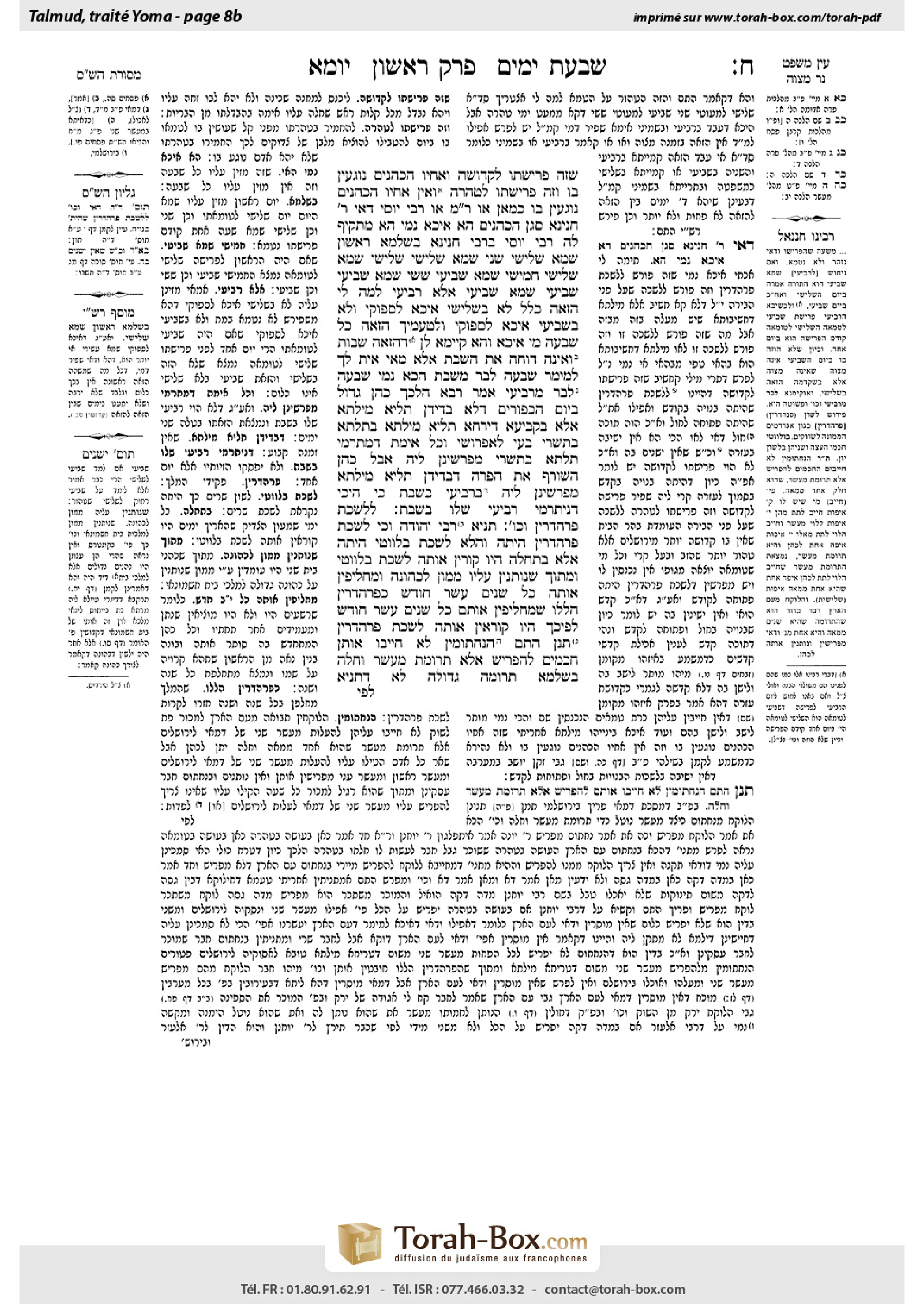
Yoma 8b: Talmud study for Daf Yomi
Daf Yomi is the daily study of one Talmud folio. Explore 37 tractates with scans, Hebrew text, Sefaria English and AI-generated French translations where annotated.
Passage selection and English or AI-generated French translation are available where the scan has annotations. Daf Study is independent of Torah-Box and Sefaria.
Browse Yoma · יומא · All tractatesYoma 8b text and translations
This page of Yoma includes the Aramaic text, an English translation and an AI-generated French translation, alongside the scan above.
יומא ח׳ ב · Aramaic and Hebrew text
שֶׁזֶּה פְּרִישָׁתוֹ לִקְדוּשָּׁה וְאֶחָיו הַכֹּהֲנִים נוֹגְעִין בּוֹ, וְזֶה פְּרִישָׁתוֹ לְטׇהֳרָה וְאֵין אֶחָיו הַכֹּהֲנִים נוֹגְעִין בּוֹ. כְּמַאן — אוֹ רַבִּי מֵאִיר אוֹ רַבִּי יוֹסֵי. דְּאִי רַבִּי חֲנִינָא סְגַן הַכֹּהֲנִים — הָא אִיכָּא נָמֵי הָא.
מַתְקֵיף לַהּ רַבִּי יוֹסֵי בְּרַבִּי חֲנִינָא: בִּשְׁלָמָא רִאשׁוֹן — שֶׁמָּא שְׁלִישִׁי. שֵׁנִי — שֶׁמָּא שְׁלִישִׁי. שְׁלִישִׁי — שֶׁמָּא שְׁלִישִׁי. חֲמִישִׁי — שֶׁמָּא שְׁבִיעִי. שִׁשִּׁי — שֶׁמָּא שְׁבִיעִי. שְׁבִיעִי — שֶׁמָּא שְׁבִיעִי.
אֶלָּא רְבִיעִי לְמָה לִי הַזָּאָה כְּלָל? לָא בִּשְׁלִישִׁי אִיכָּא לְסַפּוֹקֵי, וְלֹא בִּשְׁבִיעִי אִיכָּא לְסַפּוֹקֵי?
וּלְטַעְמָיךְ, הַזָּאָה כׇּל שִׁבְעָה מִי אִיכָּא? וְהָא קַיְימָא לַן דְּהַזָּאָה שְׁבוּת וְאֵינָהּ דּוֹחָה אֶת הַשַּׁבָּת! אֶלָּא מַאי אִית לָךְ לְמֵימַר — שִׁבְעָה לְבַר מִשַּׁבָּת, הָכָא נָמֵי — שִׁבְעָה לְבַר מֵרְבִיעִי.
אָמַר רָבָא: הִלְכָּךְ כֹּהֵן גָּדוֹל בְּיוֹם הַכִּפּוּרִים, דְּלָא בְּדִידַן תַּלְיָא מִילְּתָא, אֶלָּא בִּקְבִיעָא דְיַרְחָא תַּלְיָא מִילְּתָא — בִּתְלָתָא בְּתִשְׁרִי בָּעֵי לְאַפְרוֹשֵׁי, וְכׇל אֵימַת דְּמִתְרְמֵי תְּלָתָא בְּתִשְׁרִי מַפְרְשִׁינַן לֵיהּ. אֲבָל כֹּהֵן הַשּׂוֹרֵף אֶת הַפָּרָה, דִּבְדִידַן תַּלְיָא מִילְּתָא — מַפְרְשִׁינַן לֵיהּ בִּרְבִיעִי בְּשַׁבָּת, כִּי הֵיכִי דְּנִיתְרְמֵי רְבִיעִי שֶׁלּוֹ בְּשַׁבָּת.
לְלִשְׁכַּת פַּרְהֶדְרִין. תַּנְיָא רַבִּי יְהוּדָה: וְכִי לִשְׁכַּת פַּרְהֶדְרִין הָיְתָה? וַהֲלֹא לִשְׁכַּת בָּלְווֹטֵי הָיְתָה!
אֶלָּא, בַּתְּחִלָּה הָיוּ קוֹרִין אוֹתָהּ לִשְׁכַּת בָּלְווֹטֵי. וּמִתּוֹךְ שֶׁנּוֹתְנִין עָלָיו מָמוֹן לַכְּהוּנָּה, וּמַחֲלִיפִין אוֹתָהּ כׇּל שְׁנֵים עָשָׂר חוֹדֶשׁ כְּפַרְהֶדְרִין הַלָּלוּ שֶׁמַּחְלִיפִין אוֹתָם כׇּל שְׁנֵים עָשָׂר חוֹדֶשׁ, לְפִיכָךְ הָיוּ קוֹרְאִין אוֹתָהּ לִשְׁכַּת פַּרְהֶדְרִין.
תְּנַן הָתָם: הַנַּחְתּוֹמִין — לֹא חִיְּיבוּ אוֹתָן חֲכָמִים לְהַפְרִישׁ אֶלָּא תְּרוּמַת מַעֲשֵׂר וְחַלָּה.
בִּשְׁלָמָא תְּרוּמָה גְּדוֹלָה לָא, דְּתַנְיָא:
Yoma 8b · English translation
that the sequestering of this High Priest prior to Yom Kippur is for the purpose of sanctity, i.e., to ensure that he appreciates the gravity of the occasion and to fill him with reverence in preparation for entering the Holy of Holies. His brethren, the priests, may touch him, as the objective of his sequestering is unrelated to any concern of impurity. In contrast, the sequestering of that priest who burns the heifer is for the purpose of purity, and his brethren, the priests, may not touch him. In accordance with whose opinion is this baraita? It is in accordance with the opinion of either Rabbi Meir or Rabbi Yosei. As, if it were in accordance with the opinion of Rabbi Ḥanina, the deputy High Priest, isn’t there also this difference between the two priests: One sprinkles purification waters on the priest who burns the heifer all seven days that he is sequestered, whereas one sprinkles purification waters on the High Priest before Yom Kippur only on the third and seventh days?
§ Rabbi Yosei, son of Rabbi Ḥanina, strongly objects to the opinion that one sprinkles purification waters on the priest who burns the heifer all seven days because those days may be the third or seventh day of his impurity. Granted, on the first day of the seven one sprinkles the water, as perhaps it is the third day of his impurity; and on the second day of the seven one sprinkles the water, as perhaps it is the third day of his impurity, if he became impure the day before he was sequestered. The same is true for the third day; one sprinkles the water, as perhaps that is the third day of his impurity. By the same token, on the fifth day one sprinkles the water, as perhaps that is the seventh day of his impurity if he became impure two days before he was sequestered. On the sixth day one sprinkles the water, as perhaps that is the seventh day of his impurity if he became impure the day before he was sequestered. On the seventh day one sprinkles the water, as perhaps that is the seventh day of his impurity.
However, on the fourth day after he was sequestered, why do I require sprinkling at all? Neither with regard to the possibility that it may be the third day of his impurity is there uncertainty, since he has already been sequestered for three days, nor with regard to the possibility that it may be the seventh day of his impurity is there uncertainty, as even if it were, sprinkling would be useless because he did not have purification water sprinkled on him on the third day of his impurity. Nothing is accomplished by sprinkling the water on the priest on the fourth day.
The Gemara asks: And according to your reasoning, is there ever sprinkling on the priest all seven days? Don’t we maintain that sprinkling is prohibited by rabbinic decree issued to enhance the character of Shabbat as a day of rest, and therefore, sprinkling does not override Shabbat. Rather, what have you to say? When it was instituted to sprinkle the water on the priest, it was for seven days except for Shabbat. Here too, say that sprinkling is performed for seven days except for the fourth day of sequestering.
Rava said: Therefore, with regard to the High Priest on Yom Kippur, where the matter of the beginning of the seven-day period is not dependent on us; rather, the matter is dependent on the determination of the first day of the new month, for that reason it is required to remove the High Priest from his home on the third of Tishrei, and whenever the third of Tishrei occurs on a weekday, we remove him from his house. Therefore, both on the fourth day of his sequestering and on Shabbat, no sprinkling is performed. However, with regard to the priest who burns the heifer, where the matter of the beginning of the seven-day period is dependent on us, we remove him from his home on the fourth day of the week, Wednesday, so that the fourth day of his sequestering will occur on Shabbat. In that way, sprinkling will not be performed only one day of the seven, as the day on which sprinkling is prohibited will coincide with the day on which sprinkling is unnecessary.
§ Having discussed the obligation to sequester the High Priest prior to Yom Kippur, the Gemara interprets the next matter in the mishna: The High Priest is removed from his house to the Chamber of Parhedrin. It was taught in a baraita that Rabbi Yehuda said: And was it called the Chamber of Parhedrin, the chamber for the annual royal appointees? Wasn’t it called the Chamber of Balvatei, the chamber for ministers and council heads?
Rather, initially, during the era of Shimon HaTzaddik and his colleagues, who were rewarded with long lives due to their righteousness, they would call it the Chamber of Balvatei, a term connoting significance, since it was a place designated for the High Priest. However, because people were giving money in order to be appointed to the High Priesthood, the position was filled by unworthy individuals. Due to their wickedness, they did not survive the year, and they were replaced every twelve months like the parhedrin who are replaced every twelve months. Therefore, the chamber was called disparagingly the Chamber of Parhedrin. Since the High Priest was replaced every year, the new appointee would renovate the chamber to reflect his own more elaborate tastes.
Apropos the Parhedrin chamber, the Gemara discusses a related halakha. We learned in a mishna there in tractate Demai: With regard to doubtfully tithed produce, i.e., produce purchased from an am ha’aretz with regard to whom there is uncertainty whether or not he tithed the produce, the Sages required bakers to separate only teruma of the tithe, which is one one-hundredth of the produce that is given to the priests, and ḥalla, separated from the dough and given to priests.
The Gemara asks: Granted, teruma gedola, which is equal to approximately one-fiftieth of the produce and is given to a priest, need not be separated from doubtfully-tithed produce, as it was taught in a baraita:
Yoma 8b · Traduction française (IA)
Le retrait de ce grand prêtre avant Yom Kippour a pour but la sainteté, c’est-à-dire de lui faire prendre conscience de la gravité de l’occasion et de le remplir de révérence avant son entrée dans le Saint des Saints. Ses frères prêtres peuvent le toucher, car son retrait n’a aucun rapport avec une quelconque préoccupation d’impureté. En revanche, le retrait de ce prêtre qui brûle la génisse a pour but la pureté, et ses frères prêtres ne peuvent pas le toucher. Selon l’opinion de qui cette baraïta a-t-elle été enseignée ? Elle est conforme à l’opinion de Rabbi Meïr ou de Rabbi Yossi. En effet, si elle était conforme à celle de Rabbi Ḥanina, le grand prêtre adjoint, n’y aurait-il pas également cette différence entre les deux prêtres : on asperge le prêtre qui brûle la génisse avec les eaux de purification pendant les sept jours de son retrait, tandis qu’on n’asperge le grand prêtre avant Yom Kippour que les troisième et septième jours ?
§ Rabbi Yossi, fils de Rabbi Ḥanina, s’oppose vivement à l’opinion selon laquelle on asperge le prêtre qui brûle la génisse avec les eaux de purification pendant les sept jours, au motif que certains de ces jours peuvent correspondre au troisième ou au septième jour de son impureté. Il est logique de l’asperger le premier jour de ces sept jours, car il se peut que ce soit le troisième jour de son impureté ; et de l’asperger le deuxième jour, car il se peut que ce soit le troisième jour de son impureté s’il est devenu impur la veille de son retrait. Il en va de même pour le troisième jour : on l’asperge, car il se peut que ce soit le troisième jour de son impureté. De même, le cinquième jour, on l’asperge, car il se peut que ce soit le septième jour de son impureté s’il est devenu impur deux jours avant son retrait. Le sixième jour, on l’asperge, car il se peut que ce soit le septième jour de son impureté s’il est devenu impur la veille de son retrait. Le septième jour, on l’asperge, car il se peut que ce soit le septième jour de son impureté.
Mais, le quatrième jour après son retrait, pourquoi faudrait-il procéder à une aspersion ? Il n’y a aucune incertitude quant à la possibilité que ce soit le troisième jour de son impureté, puisqu’il est déjà en retrait depuis trois jours ; il n’y a pas non plus d’incertitude quant à la possibilité que ce soit le septième jour de son impureté, car même si c’était le cas, l’aspersion serait inutile, puisqu’on ne l’a pas aspergé avec les eaux de purification le troisième jour de son impureté. Asperger le prêtre le quatrième jour ne sert à rien.
La Guemara demande : Et selon ton raisonnement, asperge-t-on jamais le prêtre pendant les sept jours ? Ne tenons-nous pas pour établi que l’aspersion est interdite par décret rabbinique afin de préserver le caractère du Chabbat comme jour de repos, et que, par conséquent, elle ne l’emporte pas sur le Chabbat ? Que réponds-tu donc ? Lorsque l’aspersion du prêtre a été instituée, elle était prévue pendant sept jours, à l’exception du Chabbat. Ici aussi, dis que l’aspersion est effectuée pendant sept jours, à l’exception du quatrième jour du retrait.
Rava dit : Par conséquent, pour le grand prêtre avant Yom Kippour, puisque le début de la période de sept jours ne dépend pas de nous, mais de la détermination du premier jour du mois, il faut retirer le grand prêtre de son domicile le 3 Tichri ; chaque fois que le 3 Tichri tombe un jour de semaine, on le retire de chez lui. Ainsi, aucune aspersion n’a lieu ni le quatrième jour de son retrait ni le Chabbat. En revanche, pour le prêtre qui brûle la génisse, puisque le début de la période de sept jours dépend de nous, on le retire de son domicile le quatrième jour de la semaine, le mercredi, afin que le quatrième jour de son retrait tombe un Chabbat. De cette façon, l’aspersion ne sera omise qu’un seul jour sur les sept, puisque le jour où l’aspersion est interdite coïncidera avec celui où elle est inutile.
§ Après avoir évoqué l’obligation de retirer le grand prêtre avant Yom Kippour, la Guemara interprète la suite de la Michna : On retire le grand prêtre de son domicile pour le conduire dans la Chambre de Parhedrin. Une baraïta enseigne que Rabbi Yehouda a dit : Était-elle donc appelée Chambre de Parhedrin, la chambre des fonctionnaires royaux nommés pour un an ? N’était-elle pas appelée Chambre des Balvatei, la chambre des ministres et des chefs du conseil ?
En fait, au début, à l’époque de Chimon HaTsaddik et de ses collègues, qui, grâce à leur piété, furent récompensés par une longue vie, on l’appelait Chambre des Balvatei, terme qui évoque l’importance, car c’était un lieu réservé au grand prêtre. Cependant, comme des gens versaient de l’argent pour être nommés à la grande prêtrise, cette fonction échut à des individus indignes. En raison de leur méchanceté, ils ne survivaient pas à l’année et étaient remplacés tous les douze mois, comme les parhedrin, eux aussi remplacés tous les douze mois. C’est pourquoi la chambre fut appelée, de manière péjorative, Chambre de Parhedrin. Le grand prêtre étant remplacé chaque année, le nouveau titulaire rénovait la chambre selon ses goûts, plus fastueux.
À propos de la Chambre de Parhedrin, la Guemara examine une halakha connexe. Nous avons appris dans une Michna du traité Demai : concernant les produits dont le prélèvement des dîmes est douteux, c’est-à-dire les produits achetés à un am ha’aretz dont on ne sait pas s’il en a prélevé les dîmes, les Sages ont exigé des boulangers qu’ils ne prélèvent que la terouma de la dîme, soit un centième des produits donné aux prêtres, ainsi que la ḥalla, prélevée sur la pâte et donnée aux prêtres.
La Guemara demande : Il est logique qu’il ne soit pas nécessaire de prélever la terouma gedola, qui représente environ un cinquantième des produits et est donnée à un prêtre, sur des produits dont le prélèvement des dîmes est douteux, comme l’enseigne une baraïta :
Traduction française générée par IA à partir de l’édition anglaise de Sefaria. Vérifie toujours un passage avec le texte source.
Text from Sefaria: William Davidson Edition - Vocalized Aramaic (CC BY NC); William Davidson Edition - English (CC BY NC).