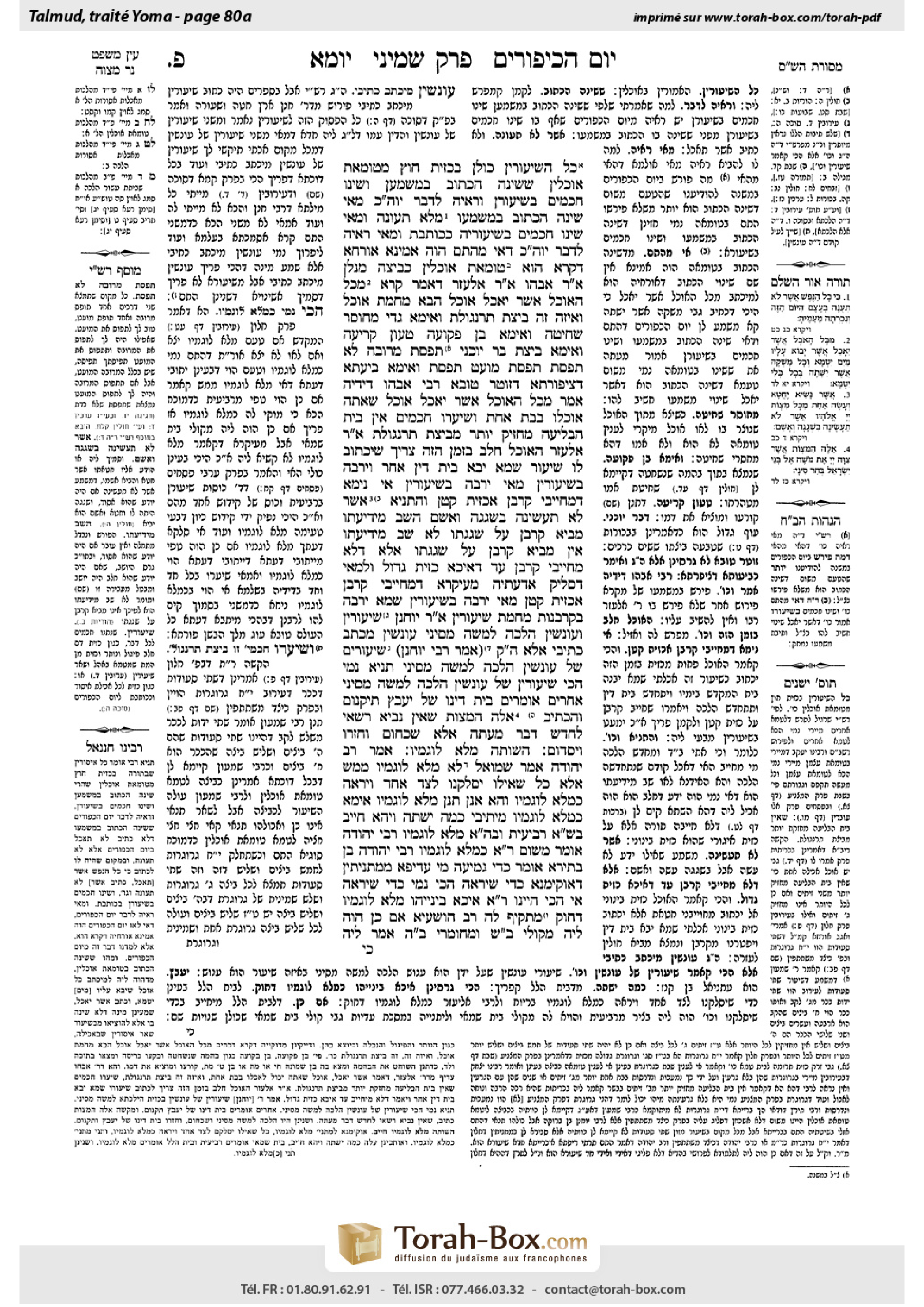
Yoma 80a: Talmud study for Daf Yomi
Daf Yomi is the daily study of one Talmud folio. Explore 37 tractates with scans, Hebrew text, Sefaria English and AI-generated French translations where annotated.
Passage selection and English or AI-generated French translation are available where the scan has annotations. Daf Study is independent of Torah-Box and Sefaria.
Browse Yoma · יומא · All tractatesYoma 80a text and translations
This page of Yoma includes the Aramaic text, an English translation and an AI-generated French translation, alongside the scan above.
יומא פ׳ א · Aramaic and Hebrew text
כׇּל הַשִּׁיעוּרִין כּוּלָּן בִּכְזַיִת, חוּץ מִטּוּמְאַת אוֹכָלִין, שֶׁשִּׁינָּה הַכָּתוּב בְּמַשְׁמָעָן, וְשִׁינּוּ חֲכָמִים בְּשִׁיעוּרָן. וּרְאָיָה לַדָּבָר — יוֹם הַכִּפּוּרִים. מַאי שִׁינָּה הַכָּתוּב בְּמַשְׁמָעוֹ — מִ״לֹּא תְעוּנֶּה״, וּמַאי שִׁינּוּ חֲכָמִים בְּשִׁיעוּרֵיהּ — כְּכוֹתֶבֶת.
וּמַאי רְאָיָה לַדָּבָר יוֹם הַכִּפּוּרִים? דְּאִי מֵהָתָם, הֲוָה אָמֵינָא: אוֹרְחָא דִקְרָא הוּא.
טוּמְאַת אוֹכָלִין כְּבֵיצָה מְנָלַן? אָמַר רַבִּי אֲבָהוּ אָמַר רַבִּי אֶלְעָזָר: דְּאָמַר קְרָא: ״מִכׇּל הָאוֹכֶל אֲשֶׁר יֵאָכֵל״, אוֹכֶל הַבָּא מֵחֲמַת אוֹכֶל, וְאֵיזֶה — זֶה בֵּיצַת תַּרְנְגוֹלֶת. וְאֵימָא גְּדִי! מְחוּסָּר שְׁחִיטָה. וְאֵימָא בֶּן פְּקוּעָה! טָעוּן קְרִיעָה.
וְאֵימָא בֵּיצַת בַּר יוֹכָנִי! תָּפַסְתָּ מְרוּבֶּה לֹא תָּפַסְתָּ, תָּפַסְתָּ מוּעָט תָּפַסְתָּ. וְאֵימָא בֵּיעֲתָא דְּצִיפַּורְתָּא דְּזוּטַר טוּבָא!
רַבִּי אֲבָהוּ דִּידֵיהּ, אָמַר: ״מִכׇּל הָאוֹכֶל אֲשֶׁר יֵאָכֵל״, אוֹכֶל שֶׁאַתָּה אוֹכְלוֹ בְּבַת אַחַת. וְשִׁיעֲרוּ חֲכָמִים: אֵין בֵּית הַבְּלִיעָה מַחֲזִיק יוֹתֵר מִבֵּיצַת תַּרְנְגוֹלֶת.
אָמַר רַבִּי אֶלְעָזָר: הָאוֹכֵל חֵלֶב בִּזְמַן הַזֶּה צָרִיךְ שֶׁיִּכְתּוֹב לוֹ שִׁיעוּר, שֶׁמָּא יָבֹא בֵּית דִּין אַחֵר וְיַרְבֶּה בְּשִׁיעוּרִין.
מַאי יַרְבֶּה בְּשִׁיעוּרִין? אִי נֵימָא דִּמְחַיְּיבִי קׇרְבָּן אַכַּזַּיִת קָטָן, וְהָתַנְיָא: ״אֲשֶׁר לֹא תֵעָשֶׂינָה בִּשְׁגָגָה וְאָשֵׁם״, הַשָּׁב מִידִיעָתוֹ — מֵבִיא קׇרְבָּן עַל שִׁגְגָתוֹ.
לֹא שָׁב מִידִיעָתוֹ — אֵין מֵבִיא קׇרְבָּן עַל שִׁגְגָתוֹ.
אֶלָּא: דְּלָא מְחַיְּיבִי קׇרְבָּן עַד דְּאִיכָּא כְּזַיִת גָּדוֹל.
וּלְמַאי דִּסְלֵיק אַדַּעְתִּין מֵעִיקָּרָא דִּמְחַיְּיבִי קׇרְבָּן אַכַּזַּיִת קָטָן, מַאי ״יַרְבֶּה בְּשִׁיעוּרִין״? שֶׁמָּא יַרְבֶּה בְּקׇרְבָּנוֹת מֵחֲמַת שִׁיעוּרִין.
אָמַר רַבִּי יוֹחָנָן: שִׁיעוּרִין וָעוֹנָשִׁין הֲלָכָה לְמֹשֶׁה מִסִּינַי. עוֹנָשִׁין מִכְתָּב כְּתִיבִי! אֶלָּא הָכִי קָאָמַר: (אָמַר רַבִּי יוֹחָנָן:) שִׁיעוּרִים שֶׁל עוֹנָשִׁין — הֲלָכָה לְמֹשֶׁה מִסִּינַי.
תַּנְיָא נָמֵי הָכִי: שִׁיעוּרִין שֶׁל עוֹנָשִׁין הֲלָכָה לְמֹשֶׁה מִסִּינַי. אֲחֵרִים אוֹמְרִים: בֵּית דִּינוֹ שֶׁל יַעְבֵּץ תִּיקְּנוּם. וְהָכְתִיב: ״אֵלֶּה הַמִּצְוֹת״, שֶׁאֵין נָבִיא רַשַּׁאי לְחַדֵּשׁ דָּבָר מֵעַתָּה! אֶלָּא, שְׁכָחוּם וְחָזְרוּ וְיִסְּדוּם.
הַשּׁוֹתֶה מְלֹא לוּגְמָיו. אָמַר רַב יְהוּדָה אָמַר שְׁמוּאֵל: לֹא מְלֹא לוּגְמָיו מַמָּשׁ, אֶלָּא כׇּל שֶׁאִילּוּ יְסַלְּקֶנּוּ לְצַד אֶחָד וְיֵרָאֶה כִּמְלֹא לוּגְמָיו. וְהָא אֲנַן תְּנַן ״מְלֹא לוּגְמָיו״! אֵימָא: ״כִּמְלֹא לוּגְמָיו״.
מֵיתִיבִי: כַּמָּה יִשְׁתֶּה וִיהֵא חַיָּיב? בֵּית שַׁמַּאי אוֹמְרִים: רְבִיעִית, וּבֵית הִלֵּל אוֹמְרִים: מְלֹא לוּגְמָיו. רַבִּי יְהוּדָה אוֹמֵר מִשּׁוּם רַבִּי אֱלִיעֶזֶר: כִּמְלֹא לוּגְמָיו. רַבִּי יְהוּדָה בֶּן בְּתֵירָא אוֹמֵר: כְּדֵי גְמִיעָה.
מִי עֲדִיפָא מִמַּתְנִיתִין דְּאוֹקֵימְנָא כְּדֵי שֶׁיֵּרָאֶה, הָכִי נָמֵי כְּדֵי שֶׁיֵּרָאֶה! אִי הָכִי, הַיְינוּ רַבִּי אֱלִיעֶזֶר! אִיכָּא בֵּינַיְיהוּ מְלֹא לוּגְמָיו דָּחוּק.
מַתְקֵיף לַהּ רַב הוֹשַׁעְיָא: אִם כֵּן, הָוֵה לֵיהּ מִקּוּלֵּי בֵּית שַׁמַּאי וּמֵחוּמְרֵי בֵּית הִלֵּל! אֲמַר לֵיהּ:
Yoma 80a · English translation
All the measures in the Torah connected to eating are the volume of an olive-bulk, except for the amount of food that renders objects impure, because the verse changed its expression in this case, and the Sages altered the measure accordingly. The proof of this, that the Sages gave it a different measure because the verse used different language for it, is from Yom Kippur. Also in the case of Yom Kippur the Sages assigned a different measure because the verse used a different phrase. The Gemara asks: How did the Sages learn that the verse changed its expression? They learned from: “Any soul which shall not be afflicted” (Leviticus 23:29). The verse does not state: Any soul that shall eat, but rather: “Any soul which shall not be afflicted.” How did the Sages change its measure? One does not violate the prohibition unless he has eaten the volume of a large date-bulk, as opposed to the usual olive-bulk.
The Gemara asks: And what does the baraita mean when it says: A proof for this is from Yom Kippur? Why is the verse pertaining to ritual impurity not sufficient to show that the Sages changed the measure based on the different words in the verse? The Gemara answers: If we learned it only from there, the case of impurity, I would have said that that is the style of the verse, and no halakha can be derived from it. Therefore, the verse pertaining to Yom Kippur teaches that whenever a verse deviates from the usual language, it implies a change in the halakha as well.
§ The Gemara asks: From where do we derive that the measure for impure foods is the volume of an egg-bulk? Rabbi Abbahu said that Rabbi Elazar said that the verse states: “Of all food [okhel] which may be eaten [ye’akhel], on which water comes shall be ritually impure” (Leviticus 11:34). The double usage of the root akhal teaches that the ritual impurity of food applies even to the amount which can be described as food that comes on account of food, i.e., food that comes from another food. And which food is that? A chicken egg. The Gemara asks: And say it is referring to a kid, which comes from a mother goat, and is therefore also food that comes from another food. The Gemara answers: It lacks ritual slaughter. The young goat is not yet food, since it is not edible until it has been slaughtered. The Gemara asks further: And say it is referring to a ben pekua. Since the slaughter of its mother made it fit to eat, the fetus itself need not be slaughtered, even if it survives and continues to live independently of its mother. The Gemara answers: The calf still requires cutting, since it cannot be eaten live, but it does not require ritual slaughter.
The Gemara asks: Even if we claim that the measure for impure foods is an egg-bulk, one could say it is referring to the giant egg-bulk of the bird called bar yokhani. The Gemara answers: If you grasped many, you did not grasp anything; if you grasped few, you grasped something. This means that in a case of doubt, take the smaller number, as it is included in the larger number. Therefore, the correct measure is the volume of a chicken egg. The Gemara questions this: If so, say it is referring to a very small bird’s egg. Consequently, no proof can be brought from the verse that the volume of a chicken egg is the measure for ritual impurity.
Rabbi Abbahu himself said: The verse states: “Of all food which may be eaten.” This is referring to food that you can eat at one time. The Sages estimated: The esophagus cannot hold more than the volume of a chicken’s egg, and therefore this is the measure used for the ritual impurity of foods.
Incidental to the discussion on Torah measures, Rabbi Elazar said: One who unwittingly eats forbidden fat even today must write down the exact measure that he ate, lest another court come in the future and increase the measure.
The Gemara asks: What does it mean to increase the measure? If we say that a future court will obligate him to bring an offering even for the bulk of a small olive, which is less than what is considered an olive-bulk today, he would not be liable to bring a guilt-offering. Wasn’t it taught in a baraita: It was said with regard to guilt-offerings: “And if any one of the common people sin through error, in doing any of the things which the Lord has commanded not to be done, and be guilty” (Leviticus 4:27)? This teaches that one who repents due to his awareness, i.e., one who repents following becoming aware that he performed a transgression, brings an offering for his unwitting transgression.
However, one who does not repent due to his awareness that he sinned does not bring an offering for his unwitting action. Similarly, if one eats less than an olive-bulk, based on the current measures, he will not be obligated to bring a guilt-offering in the future if the measures change, even if the amount that he ate equals the volume of a revised olive-bulk. This is because the individual would not be bringing his offering because he became aware he had sinned, but because the Torah measures had been changed.
Rather, it should be explained as follows: It is possible that in the future a court will not obligate one to bring an offering until he has eaten the bulk of a large olive, which is more than today’s amount. One should write down how much he ate, since in the future a court might rule that the amount he ate is less than the size of an olive, and therefore he will not be obligated to bring an offering.
The Gemara returns to its first suggestion: According to what entered his mind initially, that in the future a court might obligate him to bring an offering for the bulk of a small olive, what is the meaning of increase the measure? Rabbi Elazar should have said decrease the measure. The Gemara answers: The statement may have meant that perhaps there will be an increase in offerings that are brought due to the smaller measure for liability.
With regard to this topic, Rabbi Yoḥanan said: Measures and punishments are halakha transmitted to Moses from Sinai. The Gemara expresses surprise at this: The punishments for all transgressions are written explicitly in the Torah, and therefore are not part of an oral transmission from Moses. Rather, this is what was said: Rabbi Yoḥanan said: Measures that determine liability for punishments are halakha transmitted to Moses from Sinai.
The Gemara comments: This was also taught in a baraita: Measures of punishments are halakha transmitted to Moses from Sinai. Others say: These measures were instituted by the court of Jabez. The Gemara questions this: How can this be? Isn’t it written: “These are the mitzvot which the Lord commanded Moses for the children of Israel at Mount Sinai” (Leviticus 27:34). The word “these” underscores that a prophet is not permitted to introduce any new element related to the Torah and its mitzvot from here on. Rather, over the course of time, the people forgot the measures; subsequently the prophets reestablished the measures and taught them to the masses.
§ We learned in the mishna that one who drinks a cheekful on Yom Kippur is liable. Rabbi Yehuda said that Shmuel said: This does not mean two cheeks actually full. Rather, the measure that determines liability is the volume of liquid if one pushes the drink to one side of his mouth, and it appears as though his cheek were full. The Gemara questions this: Didn’t we learn in the mishna: A cheekful, in the plural form, meaning two cheeks full? The Gemara answers: Say: Like two cheeks full in appearance. If viewed from only one side, one whose cheek is full appears as if his entire mouth is full.
The Gemara raises an objection to this from a baraita: How much does one need to drink on Yom Kippur to be liable? Beit Shammai say: A quarter-log, and Beit Hillel say: Two cheeks full. Rabbi Yehuda says in the name of Rabbi Eliezer: Like two cheeks full in appearance from the side, i.e. a single cheekful. Rabbi Yehuda ben Beteira says: The amount that one can swallow in one gulp. In this baraita, Beit Hillel’s opinion is that the measure for drinking on Yom Kippur is a cheekful. This implies that a cheekful means an actual cheekful.
The Gemara expresses surprise: Is the baraita preferable to the mishna? Since it was established that the measure in the mishna is so that it appears like a cheekful, so too, the baraita can be explained as meaning an amount that looks like two cheeks full. The Gemara questions further: If so, Beit Hillel require an amount that appears like two cheeks full; this is identical with the opinion of Rabbi Eliezer, who says: Like two cheeks full. The Gemara answers: We could say that the practical difference between them is evident in the case of a paltry cheekful, which is not a complete mouthful but slightly less. According to Beit Hillel, one is not liable unless he drinks a full cheekful; but according to Rabbi Eliezer, one is liable even for a paltry mouthful.
Rav Hoshaya strongly objects to this understanding: If so, if Beit Hillel’s measure is a single cheekful, then this is an instance of Beit Shammai’s leniencies and Beit Hillel’s stringencies, since the measure of a quarter-log is larger than a single cheekful. If so, why isn’t this debate listed in tractate Eduyyot, which lists all the cases where Beit Shammai are more lenient than Beit Hillel? He said to him:
Yoma 80a · Traduction française (IA)
Toutes les mesures de la Torah relatives à la consommation sont du volume d’une olive, à l’exception de la quantité de nourriture qui rend les objets impurs : dans ce cas, le verset emploie une autre expression, et les Sages ont fixé en conséquence une mesure différente. La preuve que les Sages lui ont attribué une mesure différente en raison de la formulation particulière du verset vient de Yom Kippour. Là aussi, les Sages ont fixé une mesure différente parce que le verset emploie une autre expression. La Guemara demande : Comment les Sages ont-ils appris que le verset changeait de formulation ? Ils l’ont appris de ces mots : « Toute âme qui ne s’affligera pas » (Lévitique 23:29). Le verset ne dit pas : « Toute âme qui mangera », mais plutôt : « Toute âme qui ne s’affligera pas ». Comment les Sages ont-ils modifié la mesure ? On ne transgresse l’interdit que si l’on a consommé le volume d’une grosse datte, et non le volume habituel d’une olive.
La Guemara demande : Que signifie donc la baraïta lorsqu’elle dit : « La preuve en est le cas de Yom Kippour » ? Pourquoi le verset relatif à l’impureté rituelle ne suffit-il pas à montrer que les Sages ont modifié la mesure en fonction de sa formulation particulière ? La Guemara répond : Si nous l’avions appris de ce seul passage, celui qui traite de l’impureté, j’aurais dit qu’il s’agit simplement du style du verset et qu’on ne peut en déduire aucune halakha. Le verset relatif à Yom Kippour enseigne donc que chaque fois qu’un verset s’écarte de la formulation habituelle, cela implique également un changement de halakha.
§ La Guemara demande : D’où déduisons-nous que la mesure des aliments impurs est du volume d’un œuf ? Rabbi Abbahou a dit au nom de Rabbi Elazar que le verset énonce : « De tout aliment [okhel] qui peut être mangé [ye’akhel], sur lequel vient de l’eau, sera impur » (Lévitique 11:34). La répétition de la racine akhal enseigne que l’impureté rituelle des aliments s’applique même à la quantité qui peut être désignée comme un aliment provenant d’un aliment, c’est-à-dire un aliment issu d’un autre aliment. Et de quel aliment s’agit-il ? D’un œuf de poule. La Guemara demande : Pourquoi ne s’agirait-il pas d’un chevreau, qui provient d’une chèvre et constitue donc lui aussi un aliment issu d’un autre aliment ? La Guemara répond : Il lui manque l’abattage rituel. Le chevreau n’est pas encore un aliment, puisqu’il n’est comestible qu’après avoir été abattu rituellement. La Guemara demande encore : Pourquoi ne s’agirait-il pas d’un ben pekoua ? Puisque l’abattage rituel de sa mère l’a rendu propre à la consommation, le fœtus n’a pas besoin d’être abattu lui-même, même s’il survit et continue à vivre indépendamment de sa mère. La Guemara répond : Le veau doit encore être découpé, car il ne peut être mangé vivant, mais il n’a pas besoin d’être abattu rituellement.
La Guemara demande : Même si nous affirmons que la mesure des aliments impurs est du volume d’un œuf, on pourrait dire qu’il s’agit de l’énorme œuf de l’oiseau appelé bar yokhani. La Guemara répond : Si tu saisis une grande quantité, tu n’as rien saisi ; si tu en saisis peu, tu as saisi quelque chose. Cela signifie qu’en cas de doute, on retient la plus petite quantité, puisqu’elle est incluse dans la plus grande. La mesure correcte est donc le volume d’un œuf de poule. La Guemara objecte : Dans ce cas, pourquoi ne s’agirait-il pas de l’œuf d’un très petit oiseau ? Par conséquent, le verset ne permet pas de prouver que le volume d’un œuf de poule est la mesure déterminant l’impureté rituelle.
Rabbi Abbahou lui-même a dit : Le verset énonce : « De tout aliment qui peut être mangé ». Cela désigne un aliment que l’on peut manger en une seule fois. Les Sages ont estimé que l’œsophage ne peut contenir plus que le volume d’un œuf de poule ; c’est donc la mesure retenue pour l’impureté rituelle des aliments.
À propos des mesures de la Torah, Rabbi Elazar a dit : Celui qui consomme involontairement de la graisse interdite, même de nos jours, doit noter la quantité exacte qu’il a consommée, de peur qu’un tribunal futur n’augmente la mesure.
La Guemara demande : Que signifie « augmenter la mesure » ? Si nous disons qu’un tribunal futur l’obligera à apporter un sacrifice même pour le volume d’une petite olive, inférieur à ce qui est considéré aujourd’hui comme le volume d’une olive, il ne serait pas tenu d’apporter un sacrifice de culpabilité. N’a-t-il pas été enseigné dans une baraïta, au sujet des sacrifices de culpabilité : « Si l’un des gens du peuple pèche par inadvertance en faisant l’une des choses que l’Éternel a ordonné de ne pas faire, et se rend coupable » (Lévitique 4:27) ? Cela enseigne que celui qui se repent après avoir pris conscience de sa faute, c’est-à-dire après avoir appris qu’il a commis une transgression, apporte un sacrifice pour sa transgression involontaire.
En revanche, celui qui ne se repent pas après avoir pris conscience de son péché n’apporte pas de sacrifice pour son acte involontaire. De même, si quelqu’un consomme moins que le volume d’une olive selon les mesures actuelles, il ne sera pas tenu, à l’avenir, d’apporter un sacrifice de culpabilité si les mesures changent, même si la quantité consommée équivaut au volume d’une olive selon la nouvelle mesure. En effet, il n’apporterait pas son sacrifice parce qu’il aurait pris conscience de son péché, mais parce que les mesures de la Torah auraient été modifiées.
Il faut plutôt expliquer ainsi : Il se peut qu’à l’avenir un tribunal n’oblige quelqu’un à apporter un sacrifice qu’après qu’il a consommé le volume d’une grosse olive, supérieur à la quantité actuelle. Il doit noter la quantité qu’il a consommée, car un tribunal pourrait décider à l’avenir que cette quantité est inférieure au volume d’une olive et qu’il n’est donc pas tenu d’apporter un sacrifice.
La Guemara revient à sa première hypothèse : selon ce qui lui était venu à l’esprit au départ, à savoir qu’un tribunal pourrait, à l’avenir, l’obliger à apporter un sacrifice pour le volume d’une petite olive, que signifie « augmenter la mesure » ? Rabbi Elazar aurait dû dire « diminuer la mesure ». La Guemara répond : Cette déclaration peut vouloir dire qu’il y aura peut-être davantage de sacrifices apportés en raison de la réduction de la mesure déterminant la responsabilité.
À ce sujet, Rabbi Yoḥanan a dit : Les mesures et les peines sont des halakhot transmises à Moïse au Sinaï. La Guemara s’en étonne : Les peines relatives à toutes les transgressions sont explicitement écrites dans la Torah et ne relèvent donc pas d’une transmission orale par Moïse. Il faut plutôt comprendre ainsi : Rabbi Yoḥanan a dit que les mesures déterminant la responsabilité encourue pour les peines sont des halakhot transmises à Moïse au Sinaï.
La Guemara fait remarquer : Cela a également été enseigné dans une baraïta : Les mesures déterminant les peines sont des halakhot transmises à Moïse au Sinaï. D’autres disent que ces mesures ont été instituées par le tribunal de Yabets. La Guemara objecte : Comment est-ce possible ? N’est-il pas écrit : « Tels sont les commandements que l’Éternel donna à Moïse pour les enfants d’Israël au mont Sinaï » (Lévitique 27:34) ? Le mot « tels » souligne qu’un prophète n’est pas autorisé à introduire désormais aucun élément nouveau concernant la Torah et ses mitsvot. Il faut plutôt dire qu’au fil du temps, le peuple a oublié les mesures ; les prophètes les ont ensuite rétablies et les ont enseignées au peuple.
§ Nous avons appris dans la Michna que celui qui boit l’équivalent d’une joue pleine à Yom Kippour est passible. Rabbi Yehouda a dit au nom de Chmouel : cela ne signifie pas que les deux joues soient réellement pleines. La mesure déterminant la responsabilité est plutôt le volume de liquide que l’on peut pousser d’un côté de la bouche, de sorte que l’on a l’impression que la joue est pleine. La Guemara objecte : N’avons-nous pas appris dans la Michna « une joue pleine », au pluriel, c’est-à-dire les deux joues pleines ? La Guemara répond : Il faut dire : « comme si les deux joues étaient pleines ». Vue d’un seul côté, une personne dont une joue est pleine semble avoir toute la bouche pleine.
La Guemara soulève une objection à partir d’une baraïta : quelle quantité faut-il boire à Yom Kippour pour être passible ? Beit Chammaï disent : un quart de log ; Beit Hillel disent : deux joues pleines. Rabbi Yehouda dit au nom de Rabbi Eliezer : l’équivalent de deux joues pleines vu de côté, c’est-à-dire une seule joue pleine. Rabbi Yehouda ben Beteira dit : la quantité que l’on peut avaler d’une seule gorgée. Dans cette baraïta, selon Beit Hillel, la mesure à boire à Yom Kippour est deux joues pleines. Cela implique que cette expression désigne deux joues réellement pleines.
La Guemara s’étonne : La baraïta fait-elle davantage autorité que la Michna ? Puisqu’il a été établi que, dans la Michna, la mesure correspond à ce qui semble remplir une joue, on peut également expliquer que la baraïta désigne une quantité qui semble remplir les deux joues. La Guemara pose une autre question : Dans ce cas, Beit Hillel exigent une quantité qui semble remplir les deux joues ; cela revient à l’opinion de Rabbi Eliezer, qui dit : « l’équivalent de deux joues pleines ». La Guemara répond : On pourrait dire que la différence pratique entre eux apparaît dans le cas d’une joue presque pleine, qui ne correspond pas à une bouche pleine, mais est légèrement inférieure. Selon Beit Hillel, on n’est pas passible à moins d’avoir bu une joue entière ; selon Rabbi Eliezer, en revanche, on est passible même pour une quantité qui remplit à peine la bouche.
Rav Hoshaya s’oppose vivement à cette interprétation : Dans ce cas, si la mesure de Beit Hillel est une seule joue pleine, il s’agit d’un cas où Beit Chammaï sont plus indulgents et Beit Hillel plus stricts, puisque la mesure d’un quart de log est supérieure à celle d’une seule joue pleine. Pourquoi ce débat n’est-il donc pas répertorié dans le traité Eduyyot, qui énumère tous les cas où Beit Chammaï sont plus indulgents que Beit Hillel ? Il lui dit :
Traduction française générée par IA à partir de l’édition anglaise de Sefaria. Vérifie toujours un passage avec le texte source.
Text from Sefaria: William Davidson Edition - Vocalized Aramaic (CC BY NC); William Davidson Edition - English (CC BY NC).