Yoma 80b: Talmud study for Daf Yomi
Daf Yomi is the daily study of one Talmud folio. Explore 37 tractates with scans, Hebrew text, Sefaria English and AI-generated French translations where annotated.
Passage selection and English or AI-generated French translation are available where the scan has annotations. Daf Study is independent of Torah-Box and Sefaria.
Browse Yoma · יומא · All tractatesYoma 80b text and translations
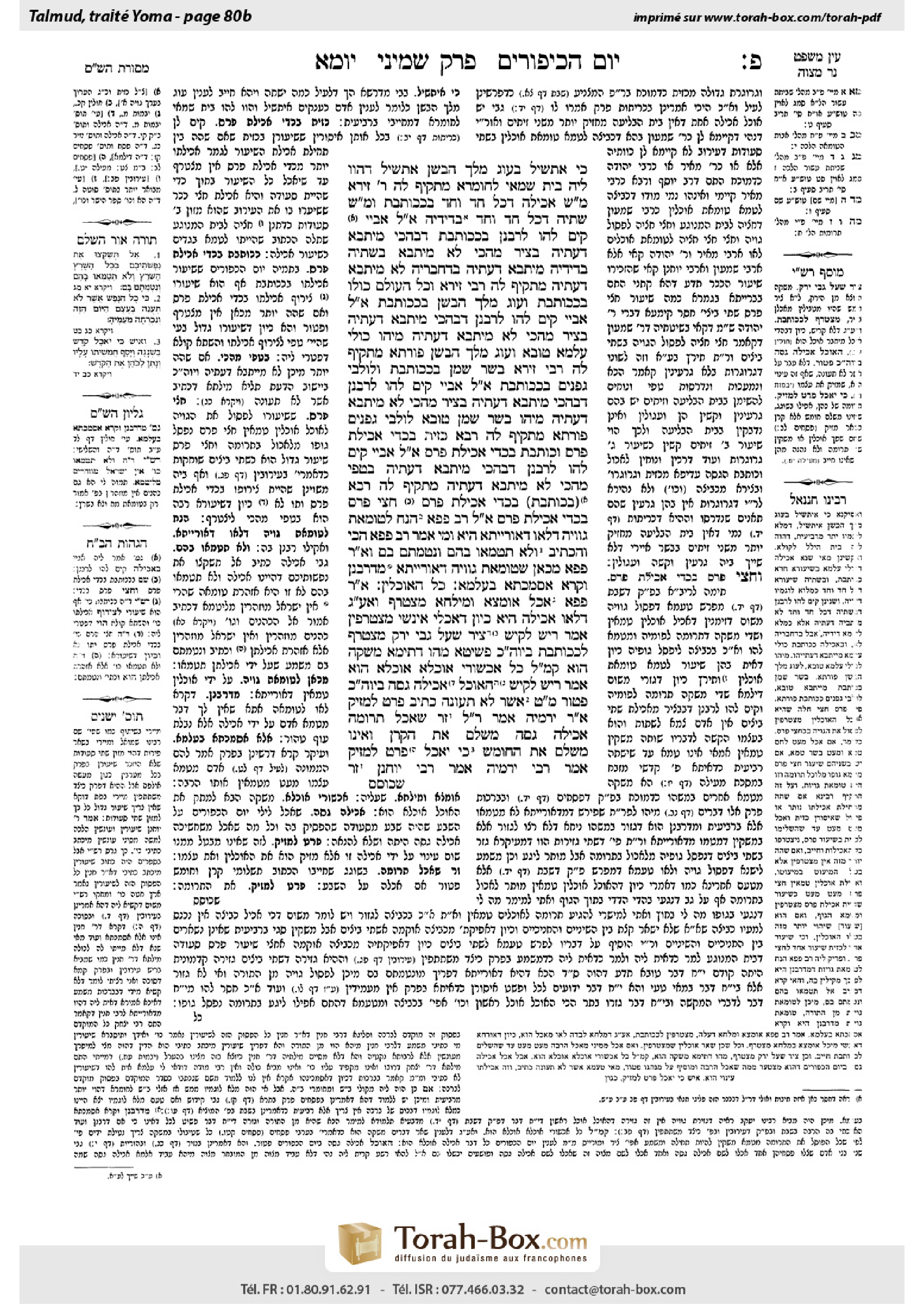
This page of Yoma includes the Aramaic text, an English translation and an AI-generated French translation, alongside the scan above.
יומא פ׳ ב · Aramaic and Hebrew text
כִּי אִתְּשִׁיל, בְּעוֹג מֶלֶךְ הַבָּשָׁן אִתְּשִׁיל, דְּהָווּ לְהוּ בֵּית שַׁמַּאי לְחוּמְרָא.
מַתְקֵיף לַהּ רַבִּי זֵירָא: מַאי שְׁנָא אֲכִילָה, דְּכׇל חַד וְחַד — בִּכְכוֹתֶבֶת, וּמַאי שְׁנָא שְׁתִיָּה, דְּכׇל חַד וְחַד בְּדִידֵיהּ? אֲמַר לֵיהּ אַבָּיֵי: קִים לְהוּ לְרַבָּנַן בִּכְכוֹתֶבֶת, דִּבְהָכִי מִיַּתְּבָא דַּעְתֵּיהּ, בְּצִיר מֵהָכִי — לָא מִיַּתְּבָא. בִּשְׁתִיָּה, בְּדִידֵיהּ מִיַּתְּבָא דַּעְתֵּיהּ, בִּדְחַבְרֵיהּ — לָא מִיַּתְּבָא דַּעְתֵּיהּ.
מַתְקֵיף לַהּ רַבִּי זֵירָא: וְכׇל הָעוֹלָם כּוּלּוֹ בִּכְכוֹתֶבֶת וְעוֹג מֶלֶךְ הַבָּשָׁן בִּכְכוֹתֶבֶת? אֲמַר לֵיהּ אַבָּיֵי: קִים לְהוּ לְרַבָּנַן דִּבְהָכִי מִיַּתְּבָא דַּעְתֵּיהּ, בְּצִיר מֵהָכִי לָא מִיַּתְּבָא דַּעְתֵּיהּ, מִיהוּ, כּוּלֵּי עָלְמָא — טוּבָא, וְעוֹג מֶלֶךְ הַבָּשָׁן — פּוּרְתָּא.
מַתְקֵיף לַהּ רַבִּי זֵירָא בָּשָׂר שָׁמֵן בִּכְכוֹתֶבֶת, וְלוּלְבֵי גְפָנִים בִּכְכוֹתֶבֶת? אֲמַר לֵיהּ אַבָּיֵי: קִים לְהוּ לְרַבָּנַן דִּבְהָכִי מִיַּתְּבָא דַּעְתֵּיהּ, בְּצִיר מֵהָכִי — לָא מִיַּתְּבָא דַּעְתֵּיהּ. מִיהוּ בָּשָׂר שָׁמֵן — טוּבָא, לוּלְבֵי גְפָנִים — פּוּרְתָּא.
מַתְקֵיף לַהּ רָבָא: כְּזַיִת בִּכְדֵי אֲכִילַת פְּרָס, וְכוֹתֶבֶת בִּכְדֵי אֲכִילַת פְּרָס?! אֲמַר לֵיהּ אַבָּיֵי: קִים לְהוּ לְרַבָּנַן דִּבְהָכִי מִיַּתְּבָא דַּעְתֵּיהּ, בִּטְפֵי מֵהָכִי — לָא מִיַּתְּבָא דַּעְתֵּיהּ.
מַתְקֵיף לַהּ רָבָא: (בְּכוֹתֶבֶת) בִּכְדֵי אֲכִילַת פְּרָס, חֲצִי פְרָס — בִּכְדֵי אֲכִילַת פְּרָס?! אֲמַר לֵיהּ רַב פָּפָּא: הַנַּח לְטוּמְאַת גְּוִויָּה דְּלָאו דְּאוֹרָיְיתָא הִיא.
וּמִי אָמַר רַב פָּפָּא הָכִי? וְהָכְתִיב: ״וְלֹא תִטַּמְּאוּ בָּהֶם וְנִטְמֵתֶם בָּם״, וְאָמַר רַב פָּפָּא: מִכָּאן שֶׁטּוּמְאַת גְּוִויָּה דְּאוֹרָיְיתָא! מִדְּרַבָּנַן, וּקְרָא — אַסְמַכְתָּא בְּעָלְמָא.
כׇּל הָאוֹכָלִין. אָמַר רַב פָּפָּא: אֲכַל אוּמְצָא וּמִילְחָא — מִצְטָרֵף. וְאַף עַל גַּב דְּלָאו אֲכִילָה הִיא, כֵּיוָן דְּאָכְלִי אִינָשֵׁי — מִצְטָרְפִין. אָמַר רֵישׁ לָקִישׁ: צִיר שֶׁעַל גַּבֵּי יָרָק מִצְטָרֵף לִכְכוֹתֶבֶת בְּיוֹם הַכִּפּוּרִים. פְּשִׁיטָא! מַהוּ דְּתֵימָא מַשְׁקֶה הוּא, קָא מַשְׁמַע לַן: כׇּל אַכְשׁוֹרֵי אוּכְלָא — אוּכְלָא הוּא.
אָמַר רֵישׁ לָקִישׁ: הָאוֹכֵל אֲכִילָה גַּסָּה בְּיוֹם הַכִּפּוּרִים — פָּטוּר. מַאי טַעְמָא? ״אֲשֶׁר לֹא תְעוּנֶּה״ כְּתִיב, פְּרָט לְמַזִּיק.
אָמַר רַבִּי יִרְמְיָה אָמַר רֵישׁ לָקִישׁ: זָר שֶׁאָכַל תְּרוּמָה אֲכִילָה גַּסָּה — מְשַׁלֵּם אֶת הַקֶּרֶן וְאֵינוֹ מְשַׁלֵּם אֶת הַחוֹמֶשׁ. ״כִּי יֹאכַל״ — פְּרָט לְמַזִּיק. אָמַר רַבִּי יִרְמְיָה אָמַר רַבִּי יוֹחָנָן: זָר
Yoma 80b · English translation
When this question with regard to the measure of liquid was asked, it was not asked about an average-sized person, for whom a mouthful is smaller than a quarter-log. Rather, the question was asked even about Og, king of Bashan, in which case, it is Beit Shammai who are stringent, for Og’s cheekful is much more than a quarter-log.
Rabbi Zeira strongly objects to this halakha with regard to the measure for liability for drinking: What is different with regard to eating, in that all people have the same measure, the volume of a large date; and what is different with regard to drinking, where each and every person is liable according to his own measure, i.e., every individual’s measure depends on the size of his own mouth? Abaye said to him: The Sages have an accepted tradition with regard to the volume of the large date, that eating this amount settles his mind, but less than this amount does not settle his mind. However, with regard to drinking, his mind is settled with the amount of his own cheekful, but his mind is not settled with the cheekful of his fellow who is smaller than him.
Rabbi Zeira strongly objects to this for a different reason: Is everyone of average size satisfied with eating the volume of a large date, and even Og, king of Bashan, is also satisfied with the volume of a large date? If not, there should also be relative measures for eating. Abaye said to him: The Sages have an accepted tradition that this amount settles his mind, but less than this amount does not settle his mind. However, everyone of average size has his mind greatly settled, whereas Og, king of Bashan, has his mind only a little settled. But even so, this measure settles the mind of any person and relieves his affliction.
Rabbi Zeira strongly objects to this further: If it is on account of settling one’s mind, the following question can be raised: If one ate fatty meat, his mind would be settled with the volume of a large date, but if he ate edible grapevine shoots, would his mind similarly be settled with the volume of a large date? Abaye said to him: The Sages have an accepted tradition that with this measure one’s mind is settled, but with less than this measure his mind is not settled. However, with fatty meat, his mind is greatly settled; if one ate the same measure of grapevine shoots, his mind is only a little settled.
Rava strongly objects to this: For all prohibitions of eating, the measure that determines liability is the volume of an olive-bulk consumed within the time it takes to eat a half-loaf of bread. All forbidden food eaten within that period combines to the measure of an olive-bulk. However, one who eats an olive-bulk over a longer period is exempt. Yet, on Yom Kippur one who eats the volume of a large date, which is a larger measure, is culpable if this amount is eaten within the time it would take to eat a half-loaf of bread. This appears to be a leniency, since one must eat a larger measure in the same time period of time. Why is there not a longer period of time for liability on Yom Kippur, to reflect the larger measure? Abaye said to him: The Sages have an accepted tradition that one who eats within this duration of time, his mind is settled; but one who eats within a longer duration of time, his mind is not settled, and he remains in a state of affliction.
Rava strongly objects to this: The measure for liability for eating on Yom Kippur is the volume of a large date consumed within the time it takes to eat a half-loaf of bread; but the measure for eating impure foods that render one ritually impure is half of a half-loaf, which is two egg-bulks, a much larger volume, and this must also be consumed within the time it takes to eat a half-loaf of bread. Rav Pappa said to him: Do not raise a challenge from here. Leave aside ritual impurity of the body contracted through consuming impure foods because that is not by Torah law but by rabbinic law. The Sages were lenient in this matter. If one does not consume that amount of impure food within this time period, he is not rendered impure.
The Gemara challenges this: But did Rav Pappa actually say that the rendering of ritual impurity of the body through the consumption of impure foods is by rabbinic law? But he appears to say the opposite in another statement: Isn’t it written: “You shall not make yourselves detestable with any creeping thing that creeps, neither shall you make yourselves impure with them, that you should be impure thereby” (Leviticus 11:43). And Rav Pappa said: From here, from the Torah’s usage of the word “impure” with regard to the prohibition of eating, we learn that ritual impurity of the body is by Torah law. The Gemara answers: Rav Pappa did not mean that the law is actually Torah law. The law is indeed rabbinic law, and the verse brought as proof is a mere support.
§ We learned in the mishna: All types of foods combine to form a measure of liability with regard to eating on Yom Kippur. Rav Pappa said: If one ate meat and the salt that was on it, these combine to make the volume of a large date. Although consuming salt alone is not considered eating, since people do eat meat with salt together, they combine into one measure. Similarly, Reish Lakish said: Brine on a vegetable combines with the vegetable to make the volume of a large date with regard to the prohibition of eating on Yom Kippur. The Gemara expresses surprise at this: It is obvious. Why should the brine not combine with the vegetable, considering that it is itself food? The Gemara answers: Lest you say that brine is a beverage, and food and drinks do not combine, it teaches us that any item that prepares food for eating is considered a food.
§ Reish Lakish said: One who eats in an excessive manner on Yom Kippur, to the degree that he forces himself to continue eating even when full is exempt, e.g., one who ate beyond being satiated on Yom Kippur eve and then ate something else as soon as the fast began. What is the reason for that? Because the Torah does not mention the prohibition of eating on Yom Kippur, but it was written “any soul which shall not be afflicted in that same day, he shall be cut off from his people” (Leviticus 23:29), excluding one who harms himself, e.g., one who does not enjoy his food at all.
Similarly, Rabbi Yirmeya said that Reish Lakish said: A non-priest who ate teruma in an excessive manner pays the principal, that which he took, and does not pay the additional fifth, which one who illegally eats teruma pays to the priest as a penalty. This is because it states about one who eats teruma: “And if a man eat of the sacred thing in error, then he shall add a fifth to it, and give the priest the sacred thing” (Leviticus 22:14). The word “eat” excludes one who is not eating but harming himself. He does, however, pay the principal, since he caused a loss to the priest. The fifth is only paid by one who eats normally, not excessively. Similarly, Rabbi Yirmeya said that Rabbi Yoḥanan said: A non-priest
Yoma 80b · Traduction française (IA)
Lorsque cette question concernant la mesure de liquide fut posée, elle ne portait pas sur une personne de taille moyenne, pour qui une gorgée est inférieure à un quart de log. Elle portait plutôt même sur Og, roi du Bashan ; dans ce cas, ce sont les disciples de Beit Shammaï qui sont stricts, car la quantité contenue dans la joue d’Og dépasse largement un quart de log.
Rabbi Zeïra soulève une objection catégorique à cette halakha concernant la mesure qui entraîne la responsabilité pour avoir bu : en quoi la consommation de nourriture se distingue-t-elle, puisque la mesure est identique pour tous, à savoir le volume d’une grosse datte ? Et en quoi la boisson se distingue-t-elle, puisque chacun est passible selon sa propre mesure, c’est-à-dire que la mesure de chaque individu dépend de la taille de sa propre bouche ? Abayé lui répondit : Les Sages ont reçu par tradition que le volume d’une grosse datte apaise son esprit, mais qu’une quantité inférieure ne l’apaise pas. En revanche, pour la boisson, son esprit est apaisé par la quantité que contient sa propre joue, mais pas par celle que contient la joue de son prochain, si celui-ci est plus petit que lui.
Rabbi Zeïra soulève une objection catégorique à cela pour une autre raison : toute personne de taille moyenne est-elle rassasiée par le volume d’une grosse datte, et Og, roi du Bashan, l’est-il lui aussi par ce même volume ? Si ce n’est pas le cas, il devrait également y avoir des mesures relatives pour la consommation de nourriture. Abayé lui répondit : Les Sages ont reçu par tradition que cette quantité apaise son esprit, mais qu’une quantité inférieure ne l’apaise pas. Toutefois, l’esprit de toute personne de taille moyenne est grandement apaisé, tandis que celui d’Og, roi du Bashan, ne l’est que légèrement. Malgré cela, cette mesure apaise l’esprit de toute personne et soulage son affliction.
Rabbi Zeïra soulève encore une objection catégorique : si la mesure est déterminée par le fait d’apaiser l’esprit, on peut poser la question suivante : si quelqu’un mange de la viande grasse, son esprit sera apaisé par le volume d’une grosse datte ; mais s’il mange des pousses de vigne comestibles, son esprit sera-t-il pareillement apaisé par le volume d’une grosse datte ? Abayé lui répondit : Les Sages ont reçu par tradition que cette mesure apaise l’esprit, mais qu’une quantité inférieure ne l’apaise pas. Toutefois, la viande grasse apaise grandement son esprit ; s’il mange la même quantité de pousses de vigne, son esprit n’est apaisé que légèrement.
Rava soulève une objection catégorique : pour toutes les interdictions alimentaires, la mesure qui entraîne la responsabilité est le volume d’une olive consommé dans le temps nécessaire pour manger une demi-miche. Tous les aliments interdits consommés pendant cette période s’additionnent pour atteindre le volume d’une olive. En revanche, celui qui mange le volume d’une olive sur une période plus longue est exempt. Pourtant, le jour de Yom Kippour, celui qui mange le volume d’une grosse datte, une mesure plus importante, est passible si cette quantité est consommée dans le temps nécessaire pour manger une demi-miche. Cela semble constituer un allègement, puisqu’il faut manger une quantité plus importante dans le même laps de temps. Pourquoi ne pas prévoir, pour entraîner la responsabilité le jour de Yom Kippour, une durée plus longue qui tiendrait compte de la mesure plus importante ? Abayé lui répondit : Les Sages ont reçu par tradition que celui qui mange dans ce laps de temps a l’esprit apaisé, tandis que celui qui mange sur une période plus longue ne l’a pas et demeure dans un état d’affliction.
Rava soulève une objection catégorique : la mesure qui entraîne la responsabilité pour la consommation de nourriture le jour de Yom Kippour est le volume d’une grosse datte consommé dans le temps nécessaire pour manger une demi-miche ; mais la mesure pour la consommation d’aliments impurs qui rendent rituellement impur est une demi-miche, soit deux volumes d’œuf, quantité bien plus importante, qui doit elle aussi être consommée dans le temps nécessaire pour manger une demi-miche. Rav Pappa lui répondit : Ne soulève pas d’objection à partir de ce cas. Laisse de côté l’impureté rituelle du corps contractée par la consommation d’aliments impurs, car elle relève non pas de la Torah, mais de la loi rabbinique. Les Sages ont été indulgents en la matière : si l’on ne consomme pas cette quantité d’aliments impurs dans ce délai, on ne devient pas impur.
La Guemara objecte : Rav Pappa a-t-il réellement dit que l’impureté rituelle du corps contractée par la consommation d’aliments impurs relève de la loi rabbinique ? Pourtant, dans un autre enseignement, il semble affirmer le contraire : n’est-il pas écrit : « Vous ne vous rendrez pas abominables par aucun reptile qui rampe, et vous ne vous rendrez pas impurs par eux, de sorte que vous en deveniez impurs » (Lévitique 11:43) ? Et Rav Pappa a dit : C’est de là, de l’emploi par la Torah du mot « impur » à propos de l’interdiction de manger, que nous apprenons que l’impureté rituelle du corps relève de la Torah. La Guemara répond : Rav Pappa ne voulait pas dire que la loi relève effectivement de la Torah. La loi relève bien de la loi rabbinique, et le verset cité comme preuve n’est qu’un appui.
§ Nous avons appris dans la Michna : toutes les sortes d’aliments s’additionnent pour constituer la mesure qui entraîne la responsabilité en cas de consommation le jour de Yom Kippour. Rav Pappa a dit : si quelqu’un mange de la viande et le sel qui se trouve dessus, ils s’additionnent pour atteindre le volume d’une grosse datte. Bien que la consommation de sel seul ne soit pas considérée comme manger, puisque les gens mangent la viande avec le sel, ils s’additionnent pour constituer une seule mesure. De même, Reish Lakish a dit : la saumure d’un légume s’additionne au légume pour atteindre le volume d’une grosse datte, en ce qui concerne l’interdiction de manger le jour de Yom Kippour. La Guemara s’en étonne : cela va de soi. Pourquoi la saumure ne s’additionnerait-elle pas au légume, puisqu’elle est elle-même un aliment ? La Guemara répond : cela nous enseigne que, même si tu pourrais penser que la saumure est une boisson et que les aliments et les boissons ne s’additionnent pas, tout élément qui prépare un aliment à être mangé est considéré comme un aliment.
§ Reish Lakish a dit : celui qui mange de manière excessive le jour de Yom Kippour, au point de se forcer à continuer de manger même lorsqu’il est rassasié, est exempt. C’est le cas, par exemple, de celui qui a mangé au-delà de la satiété la veille de Yom Kippour, puis mange encore quelque chose dès que le jeûne commence. Quelle en est la raison ? La Torah ne formule pas l’interdiction de manger le jour de Yom Kippour ; elle dit plutôt : « Toute personne qui ne s’affligera pas en ce même jour sera retranchée de son peuple » (Lévitique 23:29), ce qui exclut celui qui se fait du tort, par exemple celui qui ne prend aucun plaisir à sa nourriture.
De même, Rabbi Yirmeya a dit au nom de Reish Lakish : un non-prêtre qui a mangé de la terouma de manière excessive paie le principal, c’est-à-dire ce qu’il a pris, mais ne paie pas le cinquième supplémentaire, que celui qui mange illicitement de la terouma doit verser au prêtre à titre de pénalité. En effet, il est dit au sujet de celui qui mange de la terouma : « Si un homme mange par erreur d’une chose consacrée, il y ajoutera un cinquième et donnera au prêtre la chose consacrée » (Lévitique 22:14). Le mot « mange » exclut celui qui ne mange pas, mais se fait du tort. Il paie toutefois le principal, puisqu’il a causé une perte au prêtre. Le cinquième n’est payé que par celui qui mange normalement, et non de manière excessive. De même, Rabbi Yirmeya a dit au nom de Rabbi Yoḥanan : un non-prêtre
Traduction française générée par IA à partir de l’édition anglaise de Sefaria. Vérifie toujours un passage avec le texte source.
Text from Sefaria: William Davidson Edition - Vocalized Aramaic (CC BY NC); William Davidson Edition - English (CC BY NC).