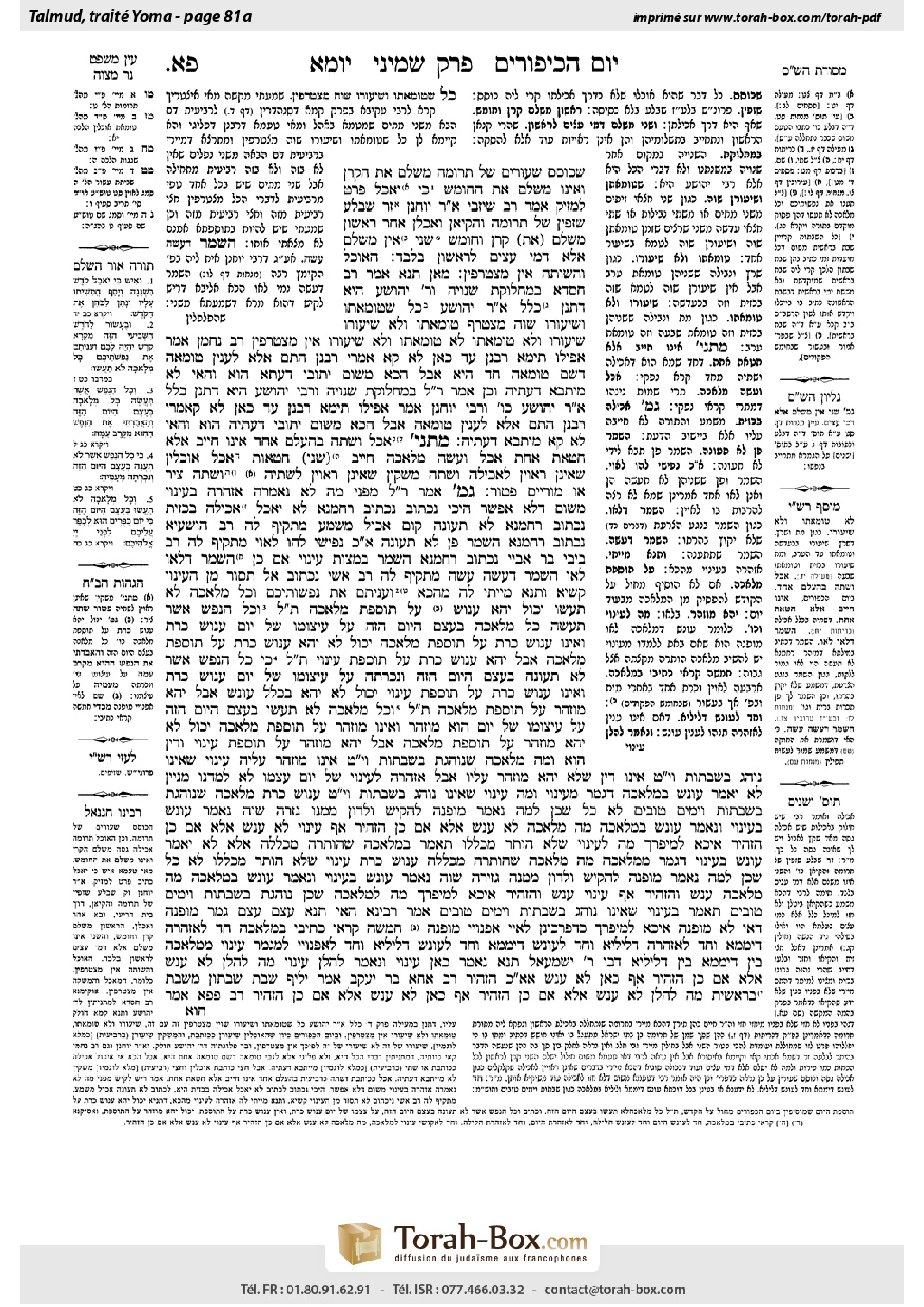
Yoma 81a: Talmud study for Daf Yomi
Daf Yomi is the daily study of one Talmud folio. Explore 37 tractates with scans, Hebrew text, Sefaria English and AI-generated French translations where annotated.
Passage selection and English or AI-generated French translation are available where the scan has annotations. Daf Study is independent of Torah-Box and Sefaria.
Browse Yoma · יומא · All tractatesYoma 81a text and translations
This page of Yoma includes the Aramaic text, an English translation and an AI-generated French translation, alongside the scan above.
יומא פ״א א · Aramaic and Hebrew text
שֶׁכּוֹסֵס שְׂעוֹרִים שֶׁל תְּרוּמָה — מְשַׁלֵּם אֶת הַקֶּרֶן וְאֵינוֹ מְשַׁלֵּם אֶת הַחוֹמֶשׁ. ״כִּי יֹאכַל״ — פְּרָט לְמַזִּיק.
אָמַר רַב שֵׁיזְבִי אָמַר רַבִּי יוֹחָנָן: זָר שֶׁבָּלַע שִׁזְפִין שֶׁל תְּרוּמָה וֶהֱקִיאָן וַאֲכָלָן אַחֵר, רִאשׁוֹן — מְשַׁלֵּם (אֶת) קֶרֶן וָחוֹמֶשׁ. שֵׁנִי — אֵין מְשַׁלֵּם אֶלָּא דְּמֵי עֵצִים לָרִאשׁוֹן בִּלְבַד.
הָאוֹכֵל וְהַשּׁוֹתֶה אֵין מִצְטָרְפִין. מַאן תַּנָּא? אָמַר רַב חִסְדָּא: בְּמַחְלוֹקֶת שְׁנוּיָה, וְרַבִּי יְהוֹשֻׁעַ הִיא. דִּתְנַן, כְּלָל אָמַר רַבִּי יְהוֹשֻׁעַ: כֹּל שֶׁטּוּמְאָתוֹ וְשִׁיעוּרוֹ שָׁוֶה — מִצְטָרֵף.
טוּמְאָתוֹ וְלֹא שִׁיעוּרוֹ, שִׁיעוּרוֹ וְלֹא טוּמְאָתוֹ, לֹא טוּמְאָתוֹ וְלֹא שִׁיעוּרוֹ — אֵין מִצְטָרְפִין.
רַב נַחְמָן אָמַר: אֲפִילּוּ תֵּימָא רַבָּנַן, עַד כָּאן לָא קָא אָמְרִי רַבָּנַן הָתָם, אֶלָּא לְעִנְיַן טוּמְאָה, דְּשֵׁם טוּמְאָה חַד הִיא. אֲבָל הָכָא, מִשּׁוּם יַתּוֹבֵי דַּעְתָּא הוּא, וְהַאי לָא מִיַּתְּבָא דַּעְתֵּיהּ.
וְכֵן אָמַר רֵישׁ לָקִישׁ: בְּמַחְלוֹקֶת שְׁנוּיָה, וְרַבִּי יְהוֹשֻׁעַ הִיא, דִּתְנַן: כְּלָל אָמַר רַבִּי יְהוֹשֻׁעַ כּוּ׳. וְרַבִּי יוֹחָנָן אָמַר: אֲפִילּוּ תֵּימָא רַבָּנַן, עַד כָּאן לָא קָאָמְרִי רַבָּנַן הָתָם אֶלָּא לְעִנְיַן טוּמְאָה, אֲבָל הָכָא, מִשּׁוּם יַתּוֹבֵי דַּעְתֵּיהּ הוּא, וְהַאי לָא קָא מִיַּתְּבָא דַּעְתֵּיהּ.
מַתְנִי׳ אָכַל וְשָׁתָה בְּהֶעְלֵם אֶחָד — אֵינוֹ חַיָּיב אֶלָּא חַטָּאת אַחַת. אָכַל וְעָשָׂה מְלָאכָה — חַיָּיב שְׁתֵּי חַטָּאוֹת. אָכַל אוֹכָלִין שֶׁאֵינָן רְאוּיִן לַאֲכִילָה, וְשָׁתָה מַשְׁקִין שֶׁאֵינָן רְאוּיִן לִשְׁתִיָּה, וְשָׁתָה צִיר אוֹ מוּרְיָיס — פָּטוּר.
גְּמָ׳ אָמַר רֵישׁ לָקִישׁ: מִפְּנֵי מָה לֹא נֶאֶמְרָה אַזְהָרָה בְּעִינּוּי? מִשּׁוּם דְּלָא אֶפְשָׁר. הֵיכִי נִכְתּוֹב? נִכְתּוֹב רַחֲמָנָא ״לֹא יֵאָכֵל״ — אֲכִילָה בִּכְזַיִת! נִכְתּוֹב רַחֲמָנָא ״לֹא תְעוּנֶּה״ — קוּם אֱכוֹל מַשְׁמַע.
מַתְקֵיף לַהּ רַב הוֹשַׁעְיָא: נִכְתּוֹב רַחֲמָנָא ״הִשָּׁמֶר פֶּן לֹא תְעוּנֶּה״! אִם כֵּן נְפִישִׁי לְהוּ לָאוֵי.
מַתְקֵיף לַהּ רַב בִּיבִי בַּר אַבָּיֵי: נִכְתּוֹב רַחֲמָנָא ״הִשָּׁמֶר בְּמִצְוַת עִינּוּי״! אִם כֵּן ״הִשָּׁמֶר״ דְּלָאו — לָאו, ״הִשָּׁמֶר״ דַּעֲשֵׂה — עֲשֵׂה! מַתְקֵיף לַהּ רַב אָשֵׁי: נִכְתּוֹב: ״אַל תָּסוּר מִן הָעִינּוּי״! קַשְׁיָא.
וְתַנָּא מַיְיתֵי לַהּ מֵהָכָא: ״וְעִנִּיתֶם אֶת נַפְשׁוֹתֵיכֶם וְכׇל מְלָאכָה לֹא תַעֲשׂוּ״. יָכוֹל יְהֵא עָנוּשׁ עַל תּוֹסֶפֶת מְלָאכָה — תַּלְמוּד לוֹמַר: ״וְכׇל הַנֶּפֶשׁ אֲשֶׁר תַּעֲשֶׂה כׇּל מְלָאכָה בְּעֶצֶם הַיּוֹם הַזֶּה״ — עַל עִיצּוּמוֹ שֶׁל יוֹם עָנוּשׁ כָּרֵת, וְאֵינוֹ עָנוּשׁ כָּרֵת עַל תּוֹסֶפֶת מְלָאכָה.
יָכוֹל לֹא יְהֵא עָנוּשׁ כָּרֵת עַל תּוֹסֶפֶת מְלָאכָה, אֲבָל יְהֵא עָנוּשׁ כָּרֵת עַל תּוֹסֶפֶת עִינּוּי — תַּלְמוּד לוֹמַר: ״כִּי כׇל הַנֶּפֶשׁ אֲשֶׁר לֹא תְעוּנֶּה בְּעֶצֶם הַיּוֹם הַזֶּה וְנִכְרְתָה״. עַל עִיצּוּמוֹ שֶׁל יוֹם עָנוּשׁ כָּרֵת, וְאֵינוֹ עָנוּשׁ כָּרֵת עַל תּוֹסֶפֶת עִינּוּי.
יָכוֹל לֹא יְהֵא בִּכְלַל עוֹנֶשׁ, אֲבָל יְהֵא מוּזְהָר עַל תּוֹסֶפֶת מְלָאכָה — תַּלְמוּד לוֹמַר: ״וְכׇל מְלָאכָה לֹא תַעֲשׂוּ בְּעֶצֶם הַיּוֹם הַזֶּה״. עַל עִיצּוּמוֹ שֶׁל יוֹם הוּא מוּזְהָר, וְאֵינוֹ מוּזְהָר עַל תּוֹסֶפֶת מְלָאכָה.
יָכוֹל לֹא יְהֵא מוּזְהָר עַל תּוֹסֶפֶת מְלָאכָה, אֲבָל יְהֵא מוּזְהָר עַל תּוֹסֶפֶת עִינּוּי — וְדִין הוּא: וּמָה מְלָאכָה שֶׁנּוֹהֶגֶת בְּשַׁבָּתוֹת וְיוֹם טוֹב אֵינוֹ מוּזְהָר עָלֶיהָ, עִינּוּי, שֶׁאֵינוֹ נוֹהֵג בְּשַׁבָּתוֹת וְיוֹם טוֹב — אֵינוֹ דִּין שֶׁלֹּא יְהֵא מוּזְהָר עָלָיו?!
אֲבָל אַזְהָרָה לְעִינּוּי שֶׁל יוֹם עַצְמוֹ לֹא לָמַדְנוּ מִנַּיִין. לֹא יֹאמַר עוֹנֶשׁ בִּמְלָאכָה, דְּגָמַר מֵעִינּוּי: וּמָה עִינּוּי שֶׁאֵינוֹ נוֹהֵג בְּשַׁבָּתוֹת וְיוֹם טוֹב עָנוּשׁ כָּרֵת, מְלָאכָה שֶׁנּוֹהֶגֶת בְּשַׁבָּתוֹת וְיָמִים טוֹבִים — לֹא כׇּל שֶׁכֵּן? לָמָּה נֶאֱמַר — מוּפְנֶה לְהַקִּישׁ וְלָדוּן מִמֶּנּוּ גְּזֵרָה שָׁוָה: נֶאֱמַר עוֹנֶשׁ בְּעִינּוּי וְנֶאֱמַר עוֹנֶשׁ בִּמְלָאכָה, מָה מְלָאכָה — לֹא עָנַשׁ אֶלָּא אִם כֵּן הִזְהִיר, אַף עִינּוּי — לֹא עָנַשׁ אֶלָּא אִם כֵּן הִזְהִיר.
אִיכָּא לְמִיפְרַךְ: מָה לְעִינּוּי שֶׁלֹּא הוּתַּר מִכְּלָלוֹ, תֹּאמַר בִּמְלָאכָה שֶׁהוּתְּרָה מִכְּלָלָהּ!
אֶלָּא: לֹא יֵאָמֵר עוֹנֶשׁ בְּעִינּוּי, דְּגָמַר מִמְּלָאכָה. מָה מְלָאכָה שֶׁהוּתְּרָה מִכְּלָלָהּ — עָנוּשׁ כָּרֵת, עִינּוּי שֶׁלֹּא הוּתַּר מִכְּלָלוֹ — לֹא כׇּל שֶׁכֵּן. לָמָּה נֶאֱמַר — מוּפְנֶה, לְהַקִּישׁ וְלָדוּן מִמֶּנּוּ גְּזֵירָה שָׁוָה: נֶאֱמַר עוֹנֶשׁ בְּעִינּוּי וְנֶאֱמַר עוֹנֶשׁ בִּמְלָאכָה, מָה מְלָאכָה עָנַשׁ וְהִזְהִיר — אַף עִינּוּי עָנַשׁ וְהִזְהִיר.
אִיכָּא לְמִיפְרַךְ: מָה לִמְלָאכָה — שֶׁכֵּן נוֹהֶגֶת בְּשַׁבָּתוֹת וְיָמִים טוֹבִים. תֹּאמַר בְּעִינּוּי — שֶׁאֵינוֹ נוֹהֵג בְּשַׁבָּתוֹת וְיָמִים טוֹבִים!
אָמַר רָבִינָא: הַאי תַּנָּא, ״עֶצֶם״ ״עֶצֶם״ גָּמַר. מוּפְנֶה, דְּאִי לָא מוּפְנֶה — אִיכָּא לְמִיפְרַךְ כִּדְפָרְכִינַן!
לָאיֵי, אִפְּנוֹיֵי מוּפְנֶה. חַמְשָׁה קְרָאֵי כְּתִיבִי בִּמְלָאכָה, חַד לְאַזְהָרָה דִימָמָא, וְחַד לְאַזְהָרָה דְלֵילְיָא, וְחַד לְעוֹנֶשׁ דִּימָמָא, וְחַד לְעוֹנֶשׁ דְּלֵילְיָא, וְחַד לְאַפְנוֹיֵי לְמִגְמַר עִינּוּי מִמְּלָאכָה, בֵּין דִּימָמָא בֵּין דְּלֵילְיָא.
רַבִּי יִשְׁמָעֵאל תָּנָא: נֶאֱמַר כָּאן עִינּוּי, וְנֶאֱמַר לְהַלָּן עִינּוּי. מָה לְהַלָּן — לֹא עָנַשׁ אֶלָּא אִם כֵּן הִזְהִיר, אַף כָּאן — לֹא עָנַשׁ אֶלָּא אִם כֵּן הִזְהִיר. רַב אַחָא בַּר יַעֲקֹב אָמַר: יָלֵיף ״שַׁבַּת שַׁבָּתוֹן״ מִשַּׁבַּת בְּרֵאשִׁית: מָה לְהַלָּן — לֹא עָנַשׁ אֶלָּא אִם כֵּן הִזְהִיר, אַף כָּאן — לֹא עָנַשׁ אֶלָּא אִם כֵּן הִזְהִיר.
רַב פָּפָּא אָמַר:
Yoma 81a · English translation
who chews on barley of teruma that has not been ground or baked pays the principal and not an extra fifth. The reason is that it states “eats” (Leviticus 22:14), which excludes one who harms himself. Consuming raw barley is considered self-harm, not eating.
Rav Sheizvi said that Rabbi Yoḥanan said: In the case of a non-priest who swallowed plums of teruma whole and vomited them out, whereupon another person ate them, the first one pays the principal plus a fifth. When the first one benefited from the plums, he acquired them and must therefore pay for them, and the second one must pay their worth to the first one. Since they are only fit for fuel after the first one vomited them out, the second person is considered to have damaged their value as fuel. Therefore, he pays only the price of wood, i.e., fuel, to the first person.
§ It was taught in the mishna that food and drink do not combine. The Gemara asks: Who is the tanna who taught this? Rav Ḥisda said: This halakha is taught as a dispute, and the mishna is in accordance with the opinion of Rabbi Yehoshua. As we learned in a mishna: Rabbi Yehoshua stated a general principle: Any item that is identical to another item in its type of ritual impurity, e.g., impurity that lasts only until evening, and its measure for impurity, e.g., an olive-bulk, combines with the other item to reach one measure to render other items impure. Therefore, two half olive-bulk pieces of two corpses or of two animal carcasses, or two half lentil-bulk pieces from two creeping animals all combine to render other items impure.
However, if one item is identical to another in its ritual impurity but not its measure, e.g., half a lentil-bulk of a creeping animal and half an olive-bulk of an animal carcass, which both impart impurity until nightfall; or if its measure is identical but not its type of ritual impurity, e.g., half an olive-bulk from a corpse, which imparts impurity for seven days, and half an olive-bulk from an animal carcass, which imparts impurity until nightfall; and all the more so, when neither its ritual impurity nor its measure are identical, then the items do not combine. Here, too, although both eating and drinking are prohibited on their own, they do not combine because they do not have the same measure that imparts impurity.
Rav Naḥman said: Even if you say that the mishna is in accordance with the opinion of the Rabbis, until now we have heard the Rabbis say there that items with different measures combine only with respect to ritual impurity. Since the phenomenon of ritual impurity is one concept, different types combine. But here, in the case of Yom Kippur, the measure that determines liability is set due to settling the mind, and this combination of eating and drinking together does not settle the mind.
And similarly, Reish Lakish said: This question of whether food and drink combine to reach a measure that determines liability on Yom Kippur is taught as a dispute. The approach brought in the mishna that states that they do not combine is in accordance with the opinion of Rabbi Yehoshua, as we learned in a mishna: Rabbi Yehoshua stated a general principle with regard to whether items with different types of impurity and measures combine, as Rav Ḥisda explained above. And Rabbi Yoḥanan said in accordance with the opinion of Rav Naḥman: Even if you say that the mishna is in accordance with the opinion of the Rabbis, until now we have heard the Rabbis say there that items with different measures combine only with regard to ritual impurity. But here, in the case of Yom Kippur, the measure that determines liability is set due to settling the mind, and this combination of eating and drinking together does not settle the mind.
MISHNA: If one ate and drank unwittingly within one lapse of awareness, e.g., he forgot that it is Yom Kippur, he is liable to bring only one sin-offering. However, if he ate and performed labor unwittingly, he is liable to bring two sin-offerings, as by doing so he violated two separate prohibitions. If he ate foods that are not fit for eating, or drank liquids that are not fit for drinking, or drank fish brine or the briny liquid in which fish are pickled, he is exempt, as that is not the typical manner of eating or drinking.
GEMARA: Reish Lakish said: Why is there no warning stated about affliction; why did the Torah not state explicitly that it is prohibited to eat and drink on Yom Kippur? It is because it was not possible to write it that way. The Gemara explains: How could the Merciful One write it? Let the Merciful One write: One shall not eat on Yom Kippur. The term eat prohibits eating the amount of an olive-bulk, whereas on Yom Kippur the actual prohibited measure is a large date-bulk. Let the Merciful One write: Do not be afflicted. That indicates the opposite of affliction, and would mean: Get up and eat. Therefore, it is written: “For whatsoever soul it be that shall not be afflicted on that same day, he shall be cut off from his people” (Leviticus 23:29).
Rav Hoshaya strongly objects to this: Let the Merciful One write it in this manner: Guard yourself lest you not be afflicted. The Gemara answers: If so, there would be too many negative mitzvot, as the following are all expressions of prohibition: Guard, lest, and not. One would then say that there are three prohibitions against eating.
Rav Beivai bar Abaye strongly objects to this: Let the Merciful One write: Guard yourself in the mitzva of affliction. The Gemara rejects this: If so, there is a principle: If the words guard yourself are written about a prohibition, it is considered to be a prohibition; if the words guard yourself are written about a positive mitzva, it is considered to be a positive mitzva. Had the Torah written it that way, one would understand that there is a positive mitzva of affliction, but there is no element of prohibition. Rav Ashi strongly objects to this: Let the Merciful One write: Do not stray from afflicting yourself, which would imply a negative mitzva. The Gemara says: Indeed, this is difficult. The Gemara concedes that it could have been written in this manner.
§ With regard to the prohibitions against eating and labor, the Gemara says: And a tanna cites the prohibitions relating to affliction on Yom Kippur from here: It is stated: “And you shall afflict your souls, you shall do no manner of labor” (Numbers 29:7). The Gemara considers: One might have thought that performing labor during the extension of the period of prohibition of labor, added before Yom Kippur actually begins, is punishable by karet. Therefore, the verse states: “And whatsoever soul it be that does any manner of labor on that same day” (Leviticus 23:30), which teaches that performing labor on that very day is punishable by karet, but labor performed during the extension of the period of prohibition of labor is not punishable by karet.
The baraita continues: One might have thought that performing labor during the extension of the period of prohibition of labor is not punishable by karet, but not afflicting oneself during the extension of the period of affliction is punishable by karet. Therefore, the verse states: “For whatsoever soul it be that shall not be afflicted on that same day, he shall be cut off from his people” (Leviticus 23:29), which teaches that not afflicting oneself on that very day is punishable by karet, but not afflicting oneself during the extension of the period of affliction is not punishable by karet.
The baraita continues: One might have thought that one who performs labor during the extension would not be included in the punishment of karet, but he would be warned against performing labor during the extension of the period of prohibition of labor with a prohibition incurring the punishment of lashes; therefore, the verse states: “And you shall do no manner of labor on that same day” (Leviticus 23:28). That teaches that he is warned not to perform labor on that very day, but he is not warned against performing labor during the extension of the period of prohibition of labor, and therefore he is not liable to receive lashes for doing so.
The baraita continues: One might have thought: He would not be warned with regard to performing labor during the extension of the period of prohibition of labor that it is a prohibition that incurs lashes; but he would be warned with regard to not being in a state of affliction during the extension of the period of affliction that it is a prohibition that incurs lashes. However, that is incorrect, and it is learned from a logical derivation that it is not so: Just as with regard to labor, whose prohibition is observed on both Shabbatot and Festivals, one is not warned about the extension added to the day, is it not logical that with regard to affliction, which is not observed on Shabbatot and Festivals, he should not be warned about or liable to receive lashes for the extension?
The baraita comments: But the warning about lashes during the very day itself we have not learned. From where is it derived? The Torah need not state the punishment of karet for performing labor, since one can learn it by logical derivation from the punishment of not being in a state of affliction, as follows: Just as the requirement of affliction, which is not observed on Shabbatot and Festivals, is punishable by karet on Yom Kippur, with regard to the prohibition of labor, which is observed on all Shabbatot and Festivals, is it not all the more so? If so, why is the punishment for labor stated explicitly? It is available to compare and learn a verbal analogy from it: A punishment with regard to affliction is stated, and a punishment with regard to labor is stated. Just as with regard to labor one is punished only if he was warned first with a negative mitzva, so too, with regard to affliction, one is punished only if he was warned.
The Gemara rejects this: This comparison can be refuted. How so? Whereas affliction has no permitted exceptions from its general prohibition, as the mitzva to afflict oneself applies to all the Jewish people, what can you say with regard to labor, which has permitted exceptions from its general prohibition? It is permitted to perform the Temple services on Yom Kippur, which include prohibited labors, e.g., slaughtering animals and offering incense. Consequently, there is no proof that the mitzva of affliction is more lenient than the prohibition of labor.
Rather, say as follows: The Torah need not say the punishment for not being in a state of affliction, since one can learn it from the punishment for performing labor through an a fortiori inference. How so? Just as labor, for which exceptions from the general prohibition are permitted, e.g., performing the Temple service on Yom Kippur, and yet labor is punishable by karet, with regard to not being in a state of affliction, which has no permitted exceptions from its general prohibition, is it not all the more so that one who does not afflict himself should be liable to receive karet? If so, why is it nevertheless stated? It is available to compare and learn a verbal analogy: Punishment is stated with regard to affliction, and punishment is stated with regard to labor. Just as for labor the Torah punished and warned, so too, for affliction the Torah punished and warned.
The Gemara rejects this: This comparison can be refuted, and one might say the opposite: Whereas the prohibition of labor is observed on Shabbatot and Festivals, can you say the same about affliction, which is not observed on Shabbatot and Festivals?
Ravina said: We did not properly understand the teaching of this baraita, as this tanna derived a verbal analogy from the words “on that same day” (Leviticus 23:29) stated with regard to affliction, and “on that same day” (Leviticus 23:28) stated with regard to labor. The Gemara comments: We must say that it is available, meaning that in both places, the phrase “on that same day” is unnecessary within its own context and comes only to teach this verbal analogy; as, if it were not available, it could be refuted, as we refuted it above.
The Gemara responds: No, it is certainly available, and we may learn from it, as five verses are written with regard to the prohibition of labor on Yom Kippur. One to teach a warning with regard to the prohibition of labor on the day of Yom Kippur itself; and one for a warning with regard to labor on the night of Yom Kippur; and one for the punishment of karet for performing labor on the day; and one for the punishment for performing labor at night; and one verse to be available to derive the requirement of affliction from the prohibition of labor, both during the day and night, using a verbal analogy.
The school of Rabbi Yishmael taught an alternative verbal analogy for the derivation: “Affliction” is stated here, with regard to Yom Kippur, and “affliction” is stated later, with regard to a man who rapes a woman: “Because he has afflicted his neighbor’s wife” (Deuteronomy 22:24). Just as there, in the case of rape, the Torah did not punish unless there was prior warning, so too here, in the case of Yom Kippur, the Torah did not punish unless there was prior warning. Rav Aḥa bar Ya’akov said a different proof: Derive a verbal analogy from the words “Shabbat of solemn rest” (Leviticus 16:31) written with regard to Yom Kippur from the words “Shabbat of solemn rest” (Exodus 31:15, 32:5; Leviticus 23:3) written with regard to the weekly Shabbat, which commemorates the Shabbat of Creation. Just as there, in the case of Shabbat, the Torah did not punish unless there was prior warning, so too here, in the case of Yom Kippur, the Torah did not punish unless there was prior warning.
Rav Pappa said:
Yoma 81a · Traduction française (IA)
Celui qui mâche de l’orge de terouma qui n’a été ni moulue ni cuite paie le principal, mais pas le cinquième supplémentaire. La raison en est que le verset dit « mange » (Lévitique 22:14), ce qui exclut celui qui se fait du mal. Consommer de l’orge crue est considéré comme se faire du mal, et non comme manger.
Rav Sheizvi a dit que Rabbi Yoḥanan a dit : Dans le cas d’un non-prêtre qui a avalé entières des prunes de terouma, puis les a vomies, après quoi une autre personne les a mangées, le premier paie le principal plus un cinquième. Comme le premier a tiré profit des prunes, il en a acquis la propriété et doit donc les payer, et le second doit en payer la valeur au premier. Puisqu’après avoir été vomies, elles ne peuvent plus servir que de combustible, le second est considéré comme ayant diminué leur valeur en tant que combustible. Il ne paie donc au premier que le prix du bois, c’est-à-dire du combustible.
§ La Michna enseigne que les aliments et les boissons ne se combinent pas. La Guemara demande : Quel est le tanna qui a enseigné cela ? Rav Ḥisda a dit : Cette halakha fait l’objet d’une controverse, et la Michna suit l’opinion de Rabbi Yehoshua. En effet, nous avons appris dans une Michna que Rabbi Yehoshua a posé un principe général : Tout élément qui est identique à un autre par son type d’impureté rituelle — par exemple une impureté qui ne dure que jusqu’au soir — et par sa mesure d’impureté — par exemple le volume d’une olive — se combine avec cet autre élément pour atteindre la mesure nécessaire pour rendre d’autres éléments impurs. Ainsi, deux morceaux d’un demi-volume d’olive provenant de deux cadavres ou de deux carcasses animales, ou deux morceaux d’un demi-volume de lentille provenant de deux animaux rampants, se combinent tous pour rendre d’autres éléments impurs.
En revanche, si un élément est identique à un autre par son type d’impureté rituelle, mais non par sa mesure — par exemple un demi-volume de lentille provenant d’un animal rampant et un demi-volume d’olive provenant d’une carcasse animale, qui transmettent tous deux l’impureté jusqu’à la tombée de la nuit —, ou si sa mesure est identique, mais non son type d’impureté rituelle — par exemple un demi-volume d’olive provenant d’un cadavre, qui transmet l’impureté pendant sept jours, et un demi-volume d’olive provenant d’une carcasse animale, qui transmet l’impureté jusqu’à la tombée de la nuit —, et à plus forte raison si ni le type d’impureté rituelle ni la mesure ne sont identiques, alors les éléments ne se combinent pas. Ici aussi, bien que manger et boire soient chacun interdits séparément, ils ne se combinent pas, car ils n’ont pas la même mesure déterminant l’impureté.
Rav Naḥman a dit : Même si tu dis que la Michna suit l’opinion des Rabbins, jusqu’à présent nous avons entendu les Rabbins dire là-bas que des éléments de mesures différentes ne se combinent que pour ce qui est de l’impureté rituelle. Puisque l’impureté rituelle constitue une seule notion, des types différents se combinent. Mais ici, dans le cas de Yom Kippour, la mesure qui détermine la responsabilité est fixée en fonction de l’apaisement de l’esprit, et cette combinaison du fait de manger et de boire ensemble n’apaise pas l’esprit.
De même, Reish Lakish a dit : La question de savoir si les aliments et les boissons se combinent pour atteindre la mesure qui détermine la responsabilité à Yom Kippour fait l’objet d’une controverse. L’opinion présentée dans la Michna, selon laquelle ils ne se combinent pas, suit celle de Rabbi Yehoshua, comme nous l’avons appris dans une Michna : Rabbi Yehoshua a posé un principe général concernant la combinaison d’éléments de types d’impureté et de mesures différents, comme Rav Ḥisda l’a expliqué plus haut. Et Rabbi Yoḥanan a dit, conformément à l’opinion de Rav Naḥman : Même si tu dis que la Michna suit l’opinion des Rabbins, jusqu’à présent nous avons entendu les Rabbins dire là-bas que des éléments de mesures différentes ne se combinent que pour ce qui est de l’impureté rituelle. Mais ici, dans le cas de Yom Kippour, la mesure qui détermine la responsabilité est fixée en fonction de l’apaisement de l’esprit, et cette combinaison du fait de manger et de boire ensemble n’apaise pas l’esprit.
MICHNA : Si quelqu’un a mangé et bu par inadvertance au cours d’une seule et même perte de conscience — par exemple, s’il a oublié que c’était Yom Kippour —, il est tenu d’apporter un seul sacrifice expiatoire. En revanche, s’il a mangé et effectué un travail interdit par inadvertance, il est tenu d’apporter deux sacrifices expiatoires, car il a ainsi transgressé deux interdictions distinctes. S’il a mangé des aliments impropres à la consommation, bu des liquides impropres à la consommation, ou bu de la saumure de poisson ou le liquide salé dans lequel les poissons sont conservés, il est exempté, car ce n’est pas la manière habituelle de manger ou de boire.
GUEMARA : Reish Lakish a dit : Pourquoi n’est-il pas formulé d’avertissement au sujet de l’affliction ? Pourquoi la Torah n’a-t-elle pas explicitement interdit de manger et de boire à Yom Kippour ? C’est qu’il n’était pas possible de le formuler ainsi. La Guemara explique : Comment le Miséricordieux aurait-il pu l’écrire ? Qu’il écrive : « On ne mangera pas à Yom Kippour. » Le terme « manger » interdit de consommer le volume d’une olive, alors qu’à Yom Kippour, la mesure effectivement interdite est celle d’une grosse datte. Que le Miséricordieux écrive : « Ne vous affligez pas. » Cela indiquerait le contraire de l’affliction et signifierait : « Levez-vous et mangez. » C’est pourquoi il est écrit : « Toute personne qui ne s’affligera pas en ce même jour sera retranchée de son peuple » (Lévitique 23:29).
Rav Hoshaya s’oppose vivement à cela : Que le Miséricordieux l’écrive ainsi : « Prends garde de ne pas t’affliger. » La Guemara répond : Dans ce cas, il y aurait trop de mitsvot négatives, car les termes « prends garde », « de peur que » et « ne pas » expriment tous une interdiction. On dirait alors qu’il y a trois interdictions de manger.
Rav Beivai bar Abaye s’oppose vivement à cela : Que le Miséricordieux écrive : « Prends garde à la mitsva d’affliction. » La Guemara rejette cette proposition : Il existe un principe : lorsque les mots « prends garde » sont écrits à propos d’une interdiction, ils sont considérés comme une interdiction ; lorsqu’ils sont écrits à propos d’une mitsva positive, ils sont considérés comme une mitsva positive. Si la Torah l’avait écrit ainsi, on aurait compris qu’il existe une mitsva positive de s’affliger, mais aucun élément d’interdiction. Rav Ashi s’oppose vivement à cela : Que le Miséricordieux écrive : « Ne t’écarte pas de l’affliction de toi-même », ce qui impliquerait une mitsva négative. La Guemara dit : En effet, cela pose une difficulté. La Guemara reconnaît que cela aurait pu être formulé ainsi.
§ À propos des interdictions de manger et de travailler, la Guemara dit : Et un tanna déduit d’ici les interdictions relatives à l’affliction à Yom Kippour : il est dit « Vous vous affligerez, vous ne ferez aucun travail » (Nombres 29:7). La Guemara examine la question : On aurait pu penser que celui qui effectue un travail pendant la période d’extension de l’interdiction du travail, ajoutée avant le début effectif de Yom Kippour, est passible de karet. Le verset dit donc : « Toute personne qui fera un travail quelconque en ce même jour » (Lévitique 23:30), ce qui enseigne que celui qui effectue un travail ce jour même est passible de karet, mais que celui qui travaille pendant la période d’extension de l’interdiction du travail ne l’est pas.
La baraïta poursuit : On aurait pu penser que celui qui effectue un travail pendant la période d’extension de l’interdiction du travail n’est pas passible de karet, mais que celui qui ne s’afflige pas pendant la période d’extension de l’obligation d’affliction est passible de karet. Le verset dit donc : « Toute personne qui ne s’affligera pas en ce même jour sera retranchée de son peuple » (Lévitique 23:29), ce qui enseigne que celui qui ne s’afflige pas ce jour même est passible de karet, mais que celui qui ne s’afflige pas pendant la période d’extension de l’obligation d’affliction ne l’est pas.
La baraïta poursuit : On aurait pu penser que celui qui travaille pendant la période d’extension ne serait pas passible de karet, mais qu’il serait averti de ne pas travailler pendant la période d’extension de l’interdiction du travail, sous peine de flagellation. Le verset dit donc : « Vous ne ferez aucun travail en ce même jour » (Lévitique 23:28). Cela enseigne qu’il est averti de ne pas travailler ce jour même, mais qu’il n’est pas averti de ne pas travailler pendant la période d’extension de l’interdiction du travail ; il n’est donc pas passible de flagellation pour l’avoir fait.
La baraïta poursuit : On aurait pu penser qu’il ne serait pas averti que travailler pendant la période d’extension de l’interdiction du travail constitue une interdiction passible de flagellation, mais qu’il serait averti que ne pas s’affliger pendant la période d’extension de l’obligation d’affliction constitue une interdiction passible de flagellation. Cela est toutefois inexact, et un raisonnement logique montre qu’il n’en est pas ainsi : de même que pour le travail, dont l’interdiction est observée pendant les Chabbatot et les fêtes, on n’est pas averti au sujet de l’extension ajoutée à la journée, n’est-il pas logique que pour l’affliction, qui n’est pas observée pendant les Chabbatot et les fêtes, on ne soit pas averti et ne soit pas passible de flagellation au titre de cette extension ?
La baraïta fait remarquer : Mais nous n’avons pas appris qu’il y ait un avertissement passible de flagellation pour le jour même. D’où cela se déduit-il ? La Torah n’a pas besoin d’énoncer la peine de karet pour le travail, puisqu’on peut la déduire logiquement de la peine encourue pour ne pas s’affliger, comme suit : de même que le fait de ne pas s’affliger, bien que l’affliction ne soit pas observée pendant les Chabbatot et les fêtes, est passible de karet à Yom Kippour, à plus forte raison en va-t-il ainsi de l’interdiction du travail, qui est observée pendant tous les Chabbatot et toutes les fêtes. Si tel est le cas, pourquoi la peine pour le travail est-elle explicitement énoncée ? Elle permet d’établir une analogie verbale : une peine est énoncée au sujet de l’affliction, et une peine est énoncée au sujet du travail. De même que pour le travail, on n’est puni que si l’on a d’abord été averti par une mitsva négative, de même, pour l’affliction, on n’est puni que si l’on a été averti.
La Guemara rejette cela : cette comparaison peut être réfutée. En effet, l’affliction ne connaît aucune exception autorisée à son interdiction générale, car la mitsva de s’affliger s’applique à tout le peuple juif. Que peut-on dire, en revanche, du travail, qui connaît des exceptions autorisées à son interdiction générale ? Il est permis d’effectuer les services du Temple à Yom Kippour, bien qu’ils comprennent des travaux interdits, par exemple l’abattage des animaux et l’offrande de l’encens. Par conséquent, rien ne prouve que la mitsva d’affliction soit plus clémente que l’interdiction du travail.
Dès lors, dis plutôt ceci : la Torah n’a pas besoin d’énoncer la peine encourue pour ne pas s’affliger, puisqu’on peut la déduire de la peine encourue pour le travail au moyen d’un raisonnement a fortiori. Comment ? De même que le travail, pour lequel des exceptions à l’interdiction générale sont autorisées — par exemple l’accomplissement du service du Temple à Yom Kippour — est néanmoins passible de karet, à plus forte raison celui qui ne s’afflige pas, alors qu’aucune exception à l’interdiction générale de l’affliction n’est autorisée, est-il passible de karet. Si tel est le cas, pourquoi cela est-il néanmoins énoncé ? Ce passage permet d’établir une analogie verbale : une peine est énoncée au sujet de l’affliction et une peine est énoncée au sujet du travail. De même que la Torah a prévu une peine et un avertissement pour le travail, de même elle a prévu une peine et un avertissement pour l’affliction.
La Guemara rejette cela : cette comparaison peut être réfutée, et l’on pourrait dire le contraire : l’interdiction du travail est observée pendant les Chabbatot et les fêtes ; peux-tu en dire autant de l’affliction, qui n’est pas observée pendant les Chabbatot et les fêtes ?
Ravina a dit : Nous n’avons pas correctement compris l’enseignement de cette baraïta, car ce tanna a déduit une analogie verbale des mots « en ce même jour » (Lévitique 23:29), énoncés au sujet de l’affliction, et des mots « en ce même jour » (Lévitique 23:28), énoncés au sujet du travail. La Guemara fait remarquer : Nous devons dire que cette expression est disponible, c’est-à-dire que, dans les deux passages, l’expression « en ce même jour » est superflue dans son contexte propre et ne sert qu’à enseigner cette analogie verbale ; car, si elle n’était pas disponible, l’analogie pourrait être réfutée, comme nous l’avons fait plus haut.
La Guemara répond : Non, l’expression est bel et bien disponible, et nous pouvons en tirer une déduction, car cinq versets sont écrits au sujet de l’interdiction du travail à Yom Kippour. L’un enseigne l’avertissement concernant l’interdiction du travail le jour même de Yom Kippour ; un autre, l’avertissement concernant le travail pendant la nuit de Yom Kippour ; un autre, la peine de karet pour avoir travaillé le jour ; un autre, la peine pour avoir travaillé la nuit ; et un verset est disponible pour déduire de l’interdiction du travail l’obligation d’affliction, aussi bien pendant le jour que pendant la nuit, au moyen d’une analogie verbale.
L’école de Rabbi Yishmael a enseigné une autre analogie verbale pour cette déduction : le terme « affliction » apparaît ici, à propos de Yom Kippour, et le terme « affliction » apparaît plus loin, à propos d’un homme qui viole une femme : « Parce qu’il a humilié la femme de son prochain » (Deutéronome 22:24). De même que là-bas, dans le cas du viol, la Torah ne punit que s’il y a eu un avertissement préalable, de même ici, dans le cas de Yom Kippour, la Torah ne punit que s’il y a eu un avertissement préalable. Rav Aḥa bar Ya’akov a donné une autre preuve : déduis une analogie verbale des mots « Chabbat de repos complet » (Lévitique 16:31), écrits à propos de Yom Kippour, à partir des mots « Chabbat de repos complet » (Exode 31:15, 32:5 ; Lévitique 23:3), écrits à propos du Chabbat hebdomadaire, qui commémore le Chabbat de la Création. De même que là-bas, dans le cas du Chabbat, la Torah ne punit que s’il y a eu un avertissement préalable, de même ici, dans le cas de Yom Kippour, la Torah ne punit que s’il y a eu un avertissement préalable.
Rav Pappa a dit :
Traduction française générée par IA à partir de l’édition anglaise de Sefaria. Vérifie toujours un passage avec le texte source.
Text from Sefaria: William Davidson Edition - Vocalized Aramaic (CC BY NC); William Davidson Edition - English (CC BY NC).