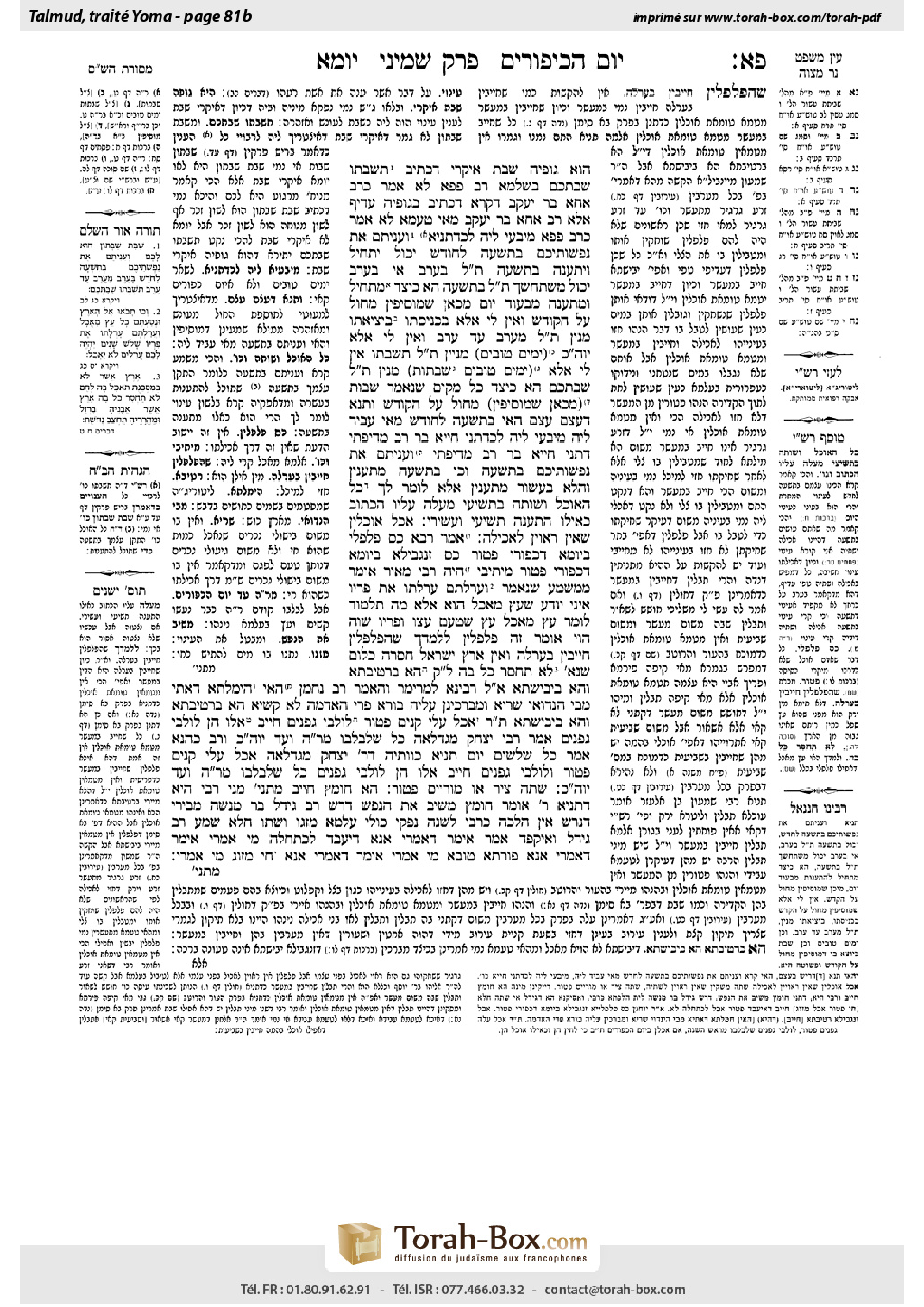
Yoma 81b: Talmud study for Daf Yomi
Daf Yomi is the daily study of one Talmud folio. Explore 37 tractates with scans, Hebrew text, Sefaria English and AI-generated French translations where annotated.
Passage selection and English or AI-generated French translation are available where the scan has annotations. Daf Study is independent of Torah-Box and Sefaria.
Browse Yoma · יומא · All tractatesYoma 81b text and translations
This page of Yoma includes the Aramaic text, an English translation and an AI-generated French translation, alongside the scan above.
יומא פ״א ב · Aramaic and Hebrew text
הוּא גּוּפֵיהּ שַׁבָּת אִיקְּרִי, דִּכְתִיב: ״תִּשְׁבְּתוּ שַׁבַּתְּכֶם״. בִּשְׁלָמָא רַב פָּפָּא לָא אָמַר כְּרַב אַחָא בַּר יַעֲקֹב — דִּקְרָא דִּכְתִיב בְּגוּפֵיהּ עֲדִיף. אֶלָּא רַב אַחָא בַּר יַעֲקֹב, מַאי טַעְמָא לָא אָמַר כְּרַב פָּפָּא?
מִיבְּעֵי לֵיהּ לְכִדְתַנְיָא: ״וְעִנִּיתֶם אֶת נַפְשׁוֹתֵיכֶם בְּתִשְׁעָה לַחוֹדֶשׁ״. יָכוֹל יַתְחִיל וְיִתְעַנֶּה בְּתִשְׁעָה — תַּלְמוּד לוֹמַר: ״בָּעֶרֶב״. אִי בָּעֶרֶב — יָכוֹל מִשֶּׁתֶּחְשַׁךְ? תַּלְמוּד לוֹמַר: ״בְּתִשְׁעָה״. הָא כֵּיצַד? מַתְחִיל וּמִתְעַנֶּה מִבְּעוֹד יוֹם, מִכָּאן שֶׁמּוֹסִיפִין מֵחוֹל עַל הַקּוֹדֶשׁ.
וְאֵין לִי אֶלָּא בִּכְנִיסָתוֹ, בִּיצִיאָתוֹ מִנַּיִן — תַּלְמוּד לוֹמַר: ״מֵעֶרֶב עַד עֶרֶב״. וְאֵין לִי אֶלָּא יוֹם הַכִּפּוּרִים, (יָמִים טוֹבִים) מִנַּיִין — תַּלְמוּד לוֹמַר: ״תִּשְׁבְּתוּ״. אֵין לִי אֶלָּא (יָמִים טוֹבִים, שַׁבָּתוֹת) מִנַּיִן — תַּלְמוּד לוֹמַר: ״שַׁבַּתְּכֶם״. הָא כֵּיצַד? כׇּל מָקוֹם שֶׁנֶּאֱמַר שְׁבוּת, (מִכָּאן שֶׁ)מוֹסִיפִין מֵחוֹל עַל הַקּוֹדֶשׁ.
וְתַנָּא דְּ״עֶצֶם״ ״עֶצֶם״, הַאי ״בְּתִשְׁעָה לַחוֹדֶשׁ״ מַאי עָבֵיד לֵיהּ? מִיבְּעֵי לֵיהּ לְכִדְתָנֵי חִיָּיא בַּר רַב מִדִּיפְתִּי. דְּתָנֵי חִיָּיא בַּר רַב מִדִּיפְתִּי: ״וְעִנִּיתֶם אֶת נַפְשׁוֹתֵיכֶם בְּתִשְׁעָה״, וְכִי בְּתִשְׁעָה מִתְעַנִּין? וַהֲלֹא בֶּעָשׂוֹר מִתְעַנִּין! אֶלָּא לוֹמַר לְךָ: כָּל הָאוֹכֵל וְשׁוֹתֶה בִּתְשִׁיעִי, מַעֲלֶה עָלָיו הַכָּתוּב כְּאִילּוּ הִתְעַנָּה תְּשִׁיעִי וַעֲשִׂירִי.
אָכַל אוֹכָלִין שֶׁאֵין רְאוּיִן לַאֲכִילָה. אָמַר רָבָא: כַּס פִּלְפְּלֵי בְּיוֹמָא דְכִפּוּרֵי — פָּטוּר. כַּס זַנְגְּבִילָא בְּיוֹמָא דְכִפּוּרֵי — פָּטוּר.
מֵיתִיבִי, הָיָה רַבִּי מֵאִיר אוֹמֵר: מִמַּשְׁמַע שֶׁנֶּאֱמַר: ״וַעֲרַלְתֶּם עׇרְלָתוֹ אֶת פִּרְיוֹ״, אֵינִי יוֹדֵעַ שֶׁעֵץ מַאֲכָל הוּא! אֶלָּא מָה תַּלְמוּד לוֹמַר ״עֵץ מַאֲכָל״? עֵץ שֶׁטַּעַם עֵצוֹ וּפִרְיוֹ שָׁוֶה, הֱוֵי אוֹמֵר זֶה פִּלְפְּלִין, לְלַמֶּדְךָ שֶׁהַפִּלְפְּלִין חַיָּיבִין בְּעׇרְלָה. וְאֵין אֶרֶץ יִשְׂרָאֵל חֲסֵרָה כְּלוּם, שֶׁנֶּאֱמַר ״לֹא תֶחְסַר כֹּל בָּהּ״!
לָא קַשְׁיָא: הָא — בְּרַטִּיבְתָּא, וְהָא — בְּיַבִּישְׁתָּא.
אֲמַר לֵיהּ רָבִינָא לְמָרִימָר: וְהָאָמַר רַב נַחְמָן, הַאי הִימְלְתָא דְּאָתֵי מִבֵּי הִנְדּוּאֵי — שַׁרְיָא, וּמְבָרְכִינַן עֲלֵיהּ: ״בּוֹרֵא פְּרִי הָאֲדָמָה״. לָא קַשְׁיָא: הָא בְּרַטִּיבְתָּא, וְהָא בְּיַבִּישְׁתָּא.
תָּנוּ רַבָּנַן: אָכַל עֲלֵי קָנִים — פָּטוּר. לוּלְבֵי גְפָנִים — חַיָּיב. אֵלּוּ הֵן לוּלְבֵי גְפָנִים? אָמַר רַבִּי יִצְחָק מִגְדְּלָאָה: כׇּל שֶׁלִּבְלְבוּ מֵרֹאשׁ הַשָּׁנָה וְעַד יוֹם הַכִּפּוּרִים. וְרַב כָּהֲנָא אָמַר: כׇּל שְׁלֹשִׁים יוֹם. תַּנְיָא כְּווֹתֵיהּ דְּרַבִּי יִצְחָק מִגְדְּלָאָה: אָכַל עֲלֵי קָנִים — פָּטוּר, וְלוּלְבֵי גְפָנִים — חַיָּיב. אֵלּוּ הֵן לוּלְבֵי גְפָנִים — כׇּל שֶׁלִּבְלְבוּ מֵרֹאשׁ הַשָּׁנָה וְעַד יוֹם הַכִּפּוּרִים.
שָׁתָה צִיר אוֹ מוּרְיָיס — פָּטוּר. הָא חוֹמֶץ — חַיָּיב. מַתְנִיתִין מַנִּי? רַבִּי הִיא. דְּתַנְיָא: רַבִּי אוֹמֵר: חוֹמֶץ מֵשִׁיב אֶת הַנֶּפֶשׁ.
דָּרֵשׁ רַב גִּידֵּל בַּר מְנַשֶּׁה מִבֵּירֵי דְנַרֶשׁ: אֵין הֲלָכָה כְּרַבִּי. לְשָׁנָה נָפְקִי כּוּלֵּי עָלְמָא מָזְגוּ וְשָׁתוּ חַלָּא. שְׁמַע רַב גִּידֵּל וְאִיקְּפַד. אֲמַר: אֵימַר דַּאֲמַרִי אֲנָא — דִּיעֲבַד, לְכַתְּחִלָּה מִי אֲמַרִי? אֵימַר דַּאֲמַרִי אֲנָא — פּוּרְתָּא, טוּבָא מִי אֲמַרִי? אֵימַר דַּאֲמַרִי אֲנָא — חַי, מָזוּג מִי אֲמַרִי?
Yoma 81b · English translation
Yom Kippur itself is called “Shabbat,” as it is written: “From evening until evening, you shall rest on your Shabbat” (Leviticus 23:32). The Gemara compares the various opinions. Granted, Rav Pappa did not say as Rav Aḥa bar Ya’akov did because a verse that is written about the matter itself is preferable to a verbal analogy. But what is the reason that Rav Aḥa bar Ya’akov did not state his opinion in accordance with the opinion of Rav Pappa?
The Gemara answers: He requires this verse of “keep your Shabbat” for that which was taught in a baraita: The verse states: “And you shall afflict your souls on the ninth day of the month at evening, from evening until evening, you shall rest on your Shabbat” (Leviticus 23:32). One might have thought that one should start to afflict oneself on the ninth of Tishrei; therefore, the verse states “at evening.” If the Torah had stated only “at evening,” one might have thought that the fast starts only when darkness falls; therefore, the verse states “on the ninth,” implying that one begins to fast on the ninth of Tishrei. How can these verses be reconciled? One begins to fast while it is still daytime; from here it is derived that one sanctifies and extends from the non-sacred weekday to the sacred day of Yom Kippur.
I have derived only that one must add time at the beginning of Yom Kippur. From where do I derive that one adds time at the conclusion of Yom Kippur? The verse states: “From evening until evening” (Leviticus 23:32), implying that one adds at the end as well, just as he does at the beginning. And I have derived only the mitzva of adding to Yom Kippur; from where is it derived that one must also sanctify and append time before and after Festivals? The verse states: “You shall rest” (Leviticus 23:32), to teach that this rule applies even to Festivals, on which one is commanded to rest. I have derived only that one adds an extension to Festivals; from where do I derive that one must also sanctify and append to Shabbatot? The verse states: “Your Shabbat” (Leviticus 23:32). How so? Every place the term: Rest [shevut] is stated, it teaches from here that one sanctifies and appends from the non-sacred weekday to the sacred.
The Gemara asks: And the tanna who learns a verbal analogy from the words “that same day,” “that same day,” what does he do with the phrase: “On the ninth day of the month”? The Gemara answers: He requires it, in accordance with that which Ḥiyya bar Rav of Difti taught. As Ḥiyya bar Rav of Difti taught: It states: “And you shall afflict your souls on the ninth day of the month” (Leviticus 23:32). But does one afflict oneself on the ninth of Tishrei? Doesn’t one in fact afflict oneself on the tenth of Tishrei? Rather, the verse comes to tell you: Anyone who eats and drinks on the ninth of Tishrei and then fasts on the tenth, the verse ascribes him credit as though he fasted on both the ninth and the tenth. The verse alludes to this when it states that the fast is on the ninth.
§ It was taught in the mishna: If one ate food that is not fit for eating, he is exempt. Rava said: If one chews raw pepper on Yom Kippur, he is exempt, since this is not considered eating. Similarly, if one chews ginger [zangvila] on Yom Kippur, he is exempt.
The Gemara raises an objection to this. Rabbi Meir would say about the verse: “And when you shall come into the land, and shall have planted all manner of trees for food, then you shall count the fruit of it as forbidden [orla]; three years it shall be forbidden to you, it shall not be eaten” (Leviticus 19:23). From the implication of what is stated: “Then you shall count the fruit of it as forbidden,” do I not know that the verse is referring to “trees for food,” since it uses the word “fruit”? Rather, what is the meaning when the verse states “trees for food”? It includes a tree whose wood and fruit taste the same, i.e., a tree that is itself eaten in addition to its fruit. One must say that this is referring to pepper that grows on a tree, to teach you that even pepper is subject to the halakha of orla. And this also teaches that Eretz Yisrael lacks nothing, as even pepper can grow there, as it is stated among the listed praises of Eretz Yisrael: “You will not lack anything in it” (Deuteronomy 8:9). In any event, it has been derived that pepper is called food, which contradicts Rava’s statement.
The Gemara answers: This is not difficult. This statement about edible pepper is referring to fresh pepper, which is moist; and that halakha pertaining to Yom Kippur is referring to dry pepper, which is not considered food.
Ravina said to Mareimar: But didn’t Rav Naḥman say that it is permitted to eat this cooked ginger [himalta] that comes from India, and there is no concern that gentiles may have cooked it. And we recite the blessing: Who creates the fruit of the ground, over it. Apparently, ginger is edible. The Gemara answers: This is not difficult: This statement is referring to wet ginger, which is considered food; and that earlier statement pertaining to Yom Kippur, which maintained that ginger is not food, is referring to dry ginger.
The Sages taught in a baraita: If one ate leaves of reeds on Yom Kippur, he is exempt, but if one ate grapevine shoots he is liable. The Gemara clarifies: What are these grapevine shoots? Rabbi Yitzḥak from the city of Migdal said: All shoots that sprouted between Rosh HaShana and Yom Kippur and are still very soft are considered food. And Rav Kahana said: All shoots that sprouted up to thirty days before Yom Kippur are considered food. The Gemara comments: It was taught in a baraita in accordance with the opinion of Rabbi Yitzḥak from Migdal: If one ate leaves of reeds he is exempt, but if one ate grapevine shoots he is liable. What are these grapevine shoots? They are all those that sprouted between Rosh HaShana and Yom Kippur.
It was taught in the mishna that if on Yom Kippur one drank fish brine or the briny liquid in which fish are pickled, he is exempt. The Gemara comments: From the language of the mishna it may be inferred that if one drank vinegar, he is liable. Who is the tanna of the mishna? It is Rabbi Yehuda HaNasi, as it was taught in a baraita that Rabbi Yehuda HaNasi says: Vinegar revives the spirit and is therefore considered a beverage.
The Gemara relates: Rav Giddel bar Menashe from the town of Birei DeNeresh taught in a public lecture that the halakha is not in accordance with the opinion of Rabbi Yehuda HaNasi, and vinegar is not considered a beverage. The next year everyone went out and mixed vinegar with water and drank vinegar on Yom Kippur. Rav Giddel heard this and became angry with them for their actions. He said: Say that I said one is not liable for drinking vinegar only after the fact; however, did I say it is permitted to drink it ab initio? Furthermore: Say that I said my statement with regard to one who drinks a little, but did I say it is permitted to drink a lot? Furthermore: Say that I said my statement in reference to pure vinegar, which is very strong, but did I say anything about diluted vinegar? That is certainly prohibited.
Yoma 81b · Traduction française (IA)
Yom Kippour lui-même est appelé « Shabbat », comme il est écrit : « Du soir au soir, vous observerez votre Shabbat » (Lévitique 23:32). La Guemara compare les différentes opinions. Certes, Rav Pappa ne s’est pas exprimé comme Rav Aḥa bar Ya’akov, car un verset qui traite directement du sujet est préférable à une analogie verbale. Mais pourquoi Rav Aḥa bar Ya’akov n’a-t-il pas formulé son opinion conformément à celle de Rav Pappa ?
La Guemara répond : Il a besoin de ce verset, « observez votre Shabbat », pour l’enseignement de la baraïta suivante : le verset dit : « Vous vous affligerez le neuvième jour du mois, au soir ; du soir au soir, vous observerez votre Shabbat » (Lévitique 23:32). On aurait pu penser qu’il faut commencer à s’affliger le neuvième de Tishri ; le verset dit donc : « au soir ». Si la Torah n’avait indiqué que « au soir », on aurait pu penser que le jeûne ne commence qu’à la tombée de la nuit ; le verset dit donc : « le neuvième », ce qui implique que l’on commence à jeûner le neuvième de Tishri. Comment concilier ces versets ? On commence à jeûner alors qu’il fait encore jour. On en déduit qu’il faut sanctifier et prolonger le jour saint de Yom Kippour en empiétant sur le jour profane qui le précède.
J’ai seulement déduit qu’il faut ajouter du temps au début de Yom Kippour. D’où déduit-on qu’il faut aussi ajouter du temps à la fin de Yom Kippour ? Le verset dit : « Du soir au soir » (Lévitique 23:32), ce qui implique qu’on ajoute également du temps à la fin, comme au début. Je n’ai déduit que la mitsva d’ajouter du temps à Yom Kippour ; d’où déduit-on qu’il faut aussi sanctifier et prolonger les jours précédant et suivant les fêtes ? Le verset dit : « Vous observerez » (Lévitique 23:32), pour enseigner que cette règle s’applique également aux fêtes, durant lesquelles il est commandé de se reposer. Je n’ai déduit que l’ajout d’un temps aux fêtes ; d’où déduit-on qu’il faut aussi sanctifier et prolonger les Shabbatot ? Le verset dit : « Votre Shabbat » (Lévitique 23:32). Comment cela ? Partout où figure le terme « repos » [shevut], on apprend de ce verset qu’il faut sanctifier et prolonger le temps profane pour l’ajouter au temps sacré.
La Guemara demande : Et que fait le tanna qui déduit une analogie verbale des expressions « ce même jour » et « ce même jour » avec la formule « le neuvième jour du mois » ? La Guemara répond : Il en a besoin pour l’enseignement de Ḥiyya bar Rav de Difti. En effet, Ḥiyya bar Rav de Difti a enseigné : Il est écrit : « Vous vous affligerez le neuvième jour du mois » (Lévitique 23:32). Mais s’afflige-t-on le neuvième de Tishri ? Ne s’afflige-t-on pas en réalité le dixième de Tishri ? Le verset vient plutôt t’enseigner que quiconque mange et boit le neuvième de Tishri, puis jeûne le dixième, le verset lui en attribue le mérite comme s’il avait jeûné à la fois le neuvième et le dixième. Le verset y fait allusion en indiquant que le jeûne a lieu le neuvième.
§ Il a été enseigné dans la Michna : Si quelqu’un a mangé un aliment impropre à la consommation, il est exempté. Rava a dit : Si quelqu’un mâche du poivre cru à Yom Kippour, il est exempté, car cela n’est pas considéré comme manger. De même, s’il mâche du gingembre [zangvila] à Yom Kippour, il est exempté.
La Guemara soulève une objection. Rabbi Meïr disait au sujet du verset : « Lorsque vous entrerez dans le pays et que vous y planterez toutes sortes d’arbres fruitiers, vous considérerez leur fruit comme interdit [orla] ; pendant trois ans, il vous sera interdit, vous n’en mangerez pas » (Lévitique 19:23). D’après ce qui est dit : « Vous considérerez leur fruit comme interdit », ne sais-je pas déjà que le verset parle d’« arbres fruitiers », puisqu’il emploie le mot « fruit » ? Que signifie donc la mention des « arbres fruitiers » ? Elle inclut un arbre dont le bois et le fruit ont le même goût, c’est-à-dire un arbre que l’on mange lui-même, en plus de son fruit. Il faut donc dire qu’il s’agit du poivrier, un arbre, pour t’enseigner que le poivre aussi est soumis à la halakha de l’orla. Cela enseigne également que rien ne manque en Eretz Israël, puisque même le poivre peut y pousser, comme il est dit parmi les louanges de la terre d’Israël : « Tu n’y manqueras de rien » (Deutéronome 8:9). Quoi qu’il en soit, on a déduit que le poivre est appelé un aliment, ce qui contredit la déclaration de Rava.
La Guemara répond : Il n’y a pas de difficulté. La déclaration au sujet du poivre comestible concerne le poivre frais, qui est humide, tandis que la halakha relative à Yom Kippour concerne le poivre sec, qui n’est pas considéré comme un aliment.
Ravina dit à Mareimar : Mais Rav Naḥman n’a-t-il pas dit qu’il est permis de manger ce gingembre cuit [himalta] qui vient d’Inde, sans craindre que des non-Juifs l’aient fait cuire ? Et nous récitons à son sujet la bénédiction : « Qui crée le fruit de la terre ». Il semble donc que le gingembre soit comestible. La Guemara répond : Il n’y a pas de difficulté : cette déclaration concerne le gingembre frais, qui est considéré comme un aliment, tandis que la déclaration précédente relative à Yom Kippour, selon laquelle le gingembre n’est pas un aliment, concerne le gingembre sec.
Les Sages ont enseigné dans une baraïta : Si quelqu’un mange des feuilles de roseau à Yom Kippour, il est exempté ; mais s’il mange des pousses de vigne, il est passible. La Guemara précise : Que sont ces pousses de vigne ? Rabbi Yitzḥak, de la ville de Migdal, a dit : Toutes les pousses qui ont germé entre Roch Hachana et Yom Kippour et qui sont encore très tendres sont considérées comme des aliments. Rav Kahana a dit : Toutes les pousses qui ont germé au cours des trente jours précédant Yom Kippour sont considérées comme des aliments. La Guemara commente : Une baraïta a été enseignée conformément à l’opinion de Rabbi Yitzḥak de Migdal : Si quelqu’un mange des feuilles de roseau, il est exempté ; mais s’il mange des pousses de vigne, il est passible. Que sont ces pousses de vigne ? Toutes celles qui ont germé entre Roch Hachana et Yom Kippour.
Il a été enseigné dans la Michna que si, à Yom Kippour, quelqu’un boit de la saumure de poisson ou le liquide salé dans lequel le poisson est mariné, il est exempté. La Guemara commente : On peut déduire de la formulation de la Michna que si quelqu’un boit du vinaigre, il est passible. Qui est le tanna de la Michna ? C’est Rabbi Yehouda HaNassi, comme l’enseigne une baraïta : Rabbi Yehouda HaNassi dit que le vinaigre ranime l’esprit et est donc considéré comme une boisson.
La Guemara rapporte : Rav Giddel bar Menashe, de la ville de Birei DeNeresh, enseigna publiquement que la halakha ne suit pas l’opinion de Rabbi Yehouda HaNassi et que le vinaigre n’est pas considéré comme une boisson. L’année suivante, tout le monde sortit, mélangea du vinaigre à de l’eau et en but à Yom Kippour. Rav Giddel l’apprit et se mit en colère contre eux à cause de leur conduite. Il leur dit : Admettons que j’aie dit qu’on n’est pas passible pour avoir bu du vinaigre après coup ; ai-je dit qu’il est permis d’en boire a priori ? De plus, admettons que ma déclaration concernait quelqu’un qui en boit un peu ; ai-je dit qu’il est permis d’en boire beaucoup ? Enfin, admettons que ma déclaration concernait du vinaigre pur, qui est très fort ; ai-je dit quoi que ce soit au sujet du vinaigre dilué ? Cela est certainement interdit.
Traduction française générée par IA à partir de l’édition anglaise de Sefaria. Vérifie toujours un passage avec le texte source.
Text from Sefaria: William Davidson Edition - Vocalized Aramaic (CC BY NC); William Davidson Edition - English (CC BY NC).