Yoma 82a: Talmud study for Daf Yomi
Daf Yomi is the daily study of one Talmud folio. Explore 37 tractates with scans, Hebrew text, Sefaria English and AI-generated French translations where annotated.
Passage selection and English or AI-generated French translation are available where the scan has annotations. Daf Study is independent of Torah-Box and Sefaria.
Browse Yoma · יומא · All tractatesYoma 82a text and translations
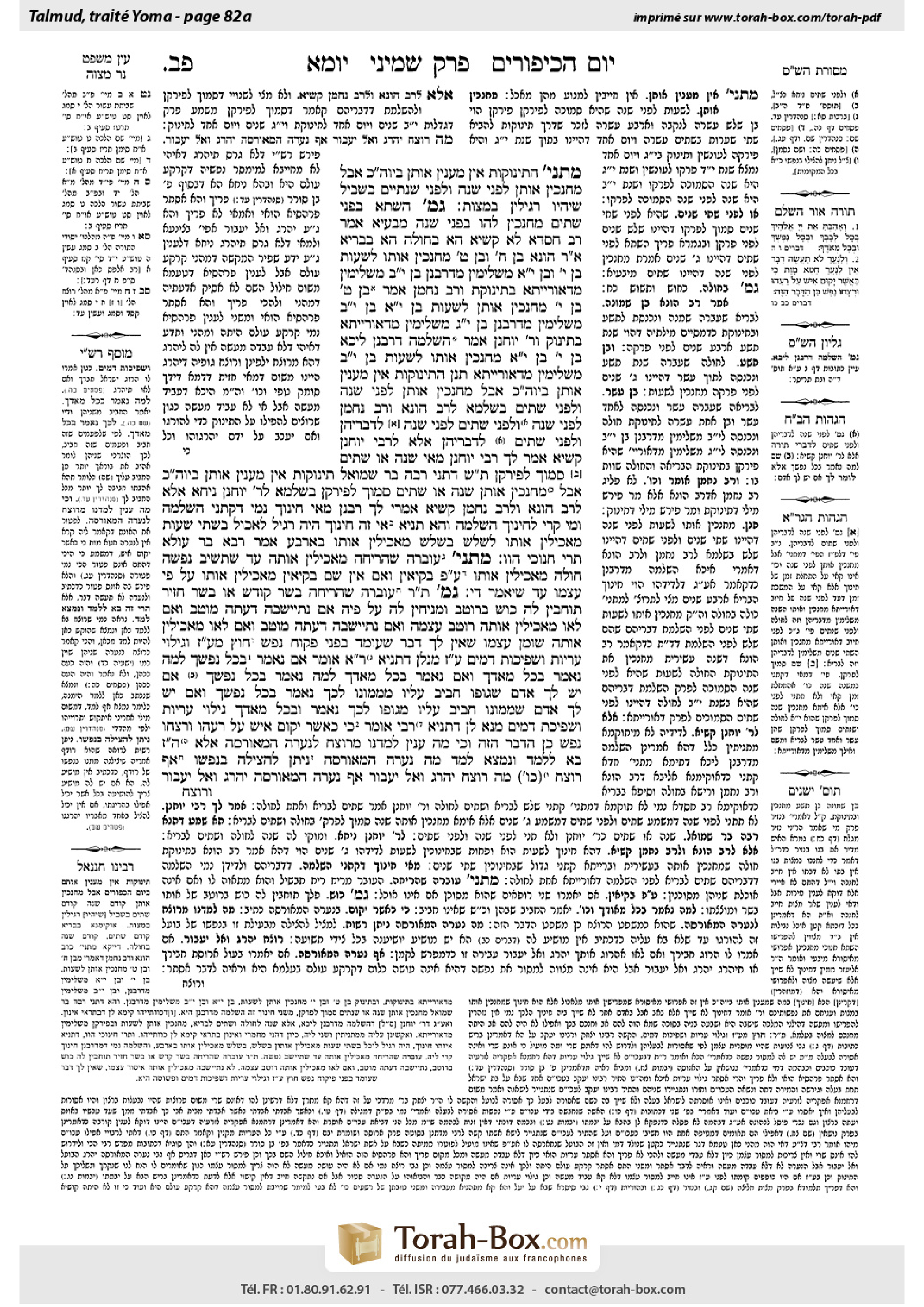
This page of Yoma includes the Aramaic text, an English translation and an AI-generated French translation, alongside the scan above.
יומא פ״ב א · Aramaic and Hebrew text
מַתְנִי׳ הַתִּינוֹקוֹת אֵין מְעַנִּין אוֹתָן בְּיוֹם הַכִּפּוּרִים, אֲבָל מְחַנְּכִין אוֹתָן לִפְנֵי שָׁנָה וְלִפְנֵי שְׁנָתַיִים, בִּשְׁבִיל שֶׁיִּהְיוּ רְגִילִין בְּמִצְוֹת.
גְּמָ׳ הַשְׁתָּא בִּפְנֵי שְׁתַּיִם מְחַנְּכִין לְהוּ — בִּפְנֵי שָׁנָה מִבַּעְיָא? אָמַר רַב חִסְדָּא, לָא קַשְׁיָא: הָא — בְּחוֹלֶה, הָא — בְּבָרִיא.
אָמַר רַב הוּנָא: בֶּן שְׁמוֹנֶה וּבֶן תֵּשַׁע — מְחַנְּכִין אוֹתוֹ לְשָׁעוֹת. בֶּן עֶשֶׂר וּבֶן אַחַת עֶשְׂרֵה — מַשְׁלִימִין מִדְּרַבָּנַן, בֶּן שְׁתֵּים עֶשְׂרֵה — מַשְׁלִימִין מִדְּאוֹרָיְיתָא בְּתִינוֹקֶת. וְרַב נַחְמָן אָמַר: בֶּן תֵּשַׁע בֶּן עֶשֶׂר — מְחַנְּכִין אוֹתָן לְשָׁעוֹת, בֶּן אַחַת עֶשְׂרֵה בֶּן שְׁתֵּים עֶשְׂרֵה — מַשְׁלִימִין מִדְּרַבָּנַן, בֶּן שְׁלֹשׁ עֶשְׂרֵה — מַשְׁלִימִין מִדְּאוֹרָיְיתָא בְּתִינוֹק. וְרַבִּי יוֹחָנָן אָמַר: הַשְׁלָמָה דְּרַבָּנַן לֵיכָּא. בֶּן עֶשֶׂר בֶּן אַחַת עֶשְׂרֵה — מְחַנְּכִין אוֹתוֹ לְשָׁעוֹת, בֶּן שְׁתֵּים עֶשְׂרֵה — מַשְׁלִימִין מִדְּאוֹרָיְיתָא.
תְּנַן: הַתִּינוֹקוֹת אֵין מְעַנִּין אוֹתָן בַּיּוֹם הַכִּפּוּרִים, אֲבָל מְחַנְּכִין אוֹתָן לִפְנֵי שָׁנָה וְלִפְנֵי שְׁתַּיִם. בִּשְׁלָמָא לְרַב הוּנָא וְרַב נַחְמָן — לִפְנֵי שָׁנָה וְלִפְנֵי שְׁתַּיִם. לִפְנֵי שָׁנָה — לְדִבְרֵיהֶן, וְלִפְנֵי שְׁתַּיִם — לְדִבְרֵיהֶן.
אֶלָּא לְרַבִּי יוֹחָנָן, קַשְׁיָא? אָמַר לָךְ רַבִּי יוֹחָנָן: מַאי שָׁנָה אוֹ שְׁתַּיִם — סָמוּךְ לְפִירְקָן.
תָּא שְׁמַע, דְּתָנֵי רַבָּה בַּר שְׁמוּאֵל: תִּינוֹקוֹת אֵין מְעַנִּין אוֹתָן בְּיוֹם הַכִּפּוּרִים, אֲבָל מְחַנְּכִין אוֹתָן שָׁנָה אוֹ שְׁתַּיִם סָמוּךְ לְפִירְקָן. בִּשְׁלָמָא לְרַבִּי יוֹחָנָן — נִיחָא, אֶלָּא לְרַב הוּנָא וּלְרַב נַחְמָן — קַשְׁיָא! אָמְרִי לָךְ רַבָּנַן: מַאי חִינּוּךְ נָמֵי דְּקָתָנֵי — הַשְׁלָמָה.
וּמִי קָרֵי לְחִינּוּךְ הַשְׁלָמָה, וְהָא תַּנְיָא: אֵי זֶה חִינּוּךְ? הָיָה רָגִיל לֶאֱכוֹל בִּשְׁתֵּי שָׁעוֹת — מַאֲכִילִין אוֹתוֹ לְשָׁלֹשׁ. בְּשָׁלֹשׁ — מַאֲכִילִין אוֹתוֹ בְּאַרְבַּע. אָמַר רָבָא בַּר עוּלָּא: תְּרֵי חִנּוּכֵי הָווּ.
מַתְנִי׳ עוּבָּרָה שֶׁהֵרִיחָה — מַאֲכִילִין אוֹתָהּ עַד שֶׁתָּשִׁיב נַפְשָׁהּ. חוֹלֶה — מַאֲכִילִין אוֹתוֹ עַל פִּי בְּקִיאִין, וְאִם אֵין שָׁם בְּקִיאִין — מַאֲכִילִין אוֹתוֹ עַל פִּי עַצְמוֹ עַד שֶׁיֹּאמַר דַּי.
גְּמָ׳ תָּנוּ רַבָּנַן: עוּבָּרָה שֶׁהֵרִיחָה בְּשַׂר קוֹדֶשׁ אוֹ בְּשַׂר חֲזִיר — תּוֹחֲבִין לָהּ כּוּשׁ בְּרוֹטֶב, וּמַנִּיחִין לָהּ עַל פִּיהָ, אִם נִתְיַישְּׁבָה דַּעְתָּהּ — מוּטָב, וְאִם לָאו — מַאֲכִילִין אוֹתָהּ רוֹטֶב עַצְמוֹ, וְאִם נִתְיַישְּׁבָה דַּעְתָּהּ — מוּטָב, וְאִם לָאו — מַאֲכִילִין אוֹתָהּ שׁוּמָּן עַצְמוֹ. שֶׁאֵין לְךָ דָּבָר שֶׁעוֹמֵד בִּפְנֵי פִּקּוּחַ נֶפֶשׁ, חוּץ מֵעֲבוֹדָה זָרָה וְגִילּוּי עֲרָיוֹת וּשְׁפִיכוּת דָּמִים.
עֲבוֹדָה זָרָה מְנָלַן — דְּתַנְיָא, רַבִּי אֱלִיעֶזֶר אוֹמֵר: אִם נֶאֱמַר ״בְּכׇל נַפְשְׁךָ״, לָמָּה נֶאֱמַר ״בְּכׇל מְאֹדֶךָ״? וְאִם נֶאֱמַר ״בְּכׇל מְאֹדֶךָ״, לָמָּה נֶאֱמַר ״בְּכׇל נַפְשְׁךָ״?
אִם יֵשׁ לְךָ אָדָם שֶׁגּוּפוֹ חָבִיב עָלָיו מִמָּמוֹנוֹ — לְכָךְ נֶאֱמַר ״בְּכׇל נַפְשְׁךָ״, וְאִם יֵשׁ לָךְ אָדָם שֶׁמָּמוֹנוֹ חָבִיב עָלָיו מִגּוּפוֹ — לְכָךְ נֶאֱמַר ״וּבְכׇל מְאֹדֶךָ״.
גִּילּוּי עֲרָיוֹת וּשְׁפִיכַת דָּמִים מְנָא לַן — דְּתַנְיָא, רַבִּי אוֹמֵר: ״כִּי כַּאֲשֶׁר יָקוּם אִישׁ עַל רֵעֵהוּ וּרְצָחוֹ נֶפֶשׁ כֵּן הַדָּבָר הַזֶּה״. וְכִי מָה עִנְיָן לָמַדְנוּ מֵרוֹצֵחַ לְנַעֲרָה הַמְאוֹרָסָה?
אֶלָּא: הֲרֵי זֶה בָּא לְלַמֵּד, וְנִמְצָא לָמֵד: מָה נַעֲרָה הַמְאוֹרָסָה נִיתָּן לְהַצִּילָהּ בְּנַפְשׁוֹ — אַף רוֹצֵחַ (כּוּ׳). מָה רוֹצֵחַ יֵהָרֵג וְאַל יַעֲבוֹר — אַף נַעֲרָה הַמְאוֹרָסָה יֵהָרֵג וְאַל יַעֲבוֹר.
Yoma 82a · English translation
MISHNA: With regard to the children, one does not afflict them by withholding food on Yom Kippur; however, one trains them one year before or two years before they reach majority, by means of a partial fast lasting several hours, so that they will be accustomed to fulfill mitzvot.
GEMARA: The Gemara asks about the wording of the mishna: Since it is stated that one trains children two years before their maturity, is it necessary to say that one trains them one year before? This expression in the mishna is superfluous. Rav Ḥisda said: This is not difficult. This statement that one trains children one year before their maturity is referring to a feeble child; that statement that one trains children two years before their maturity is referring to a healthy child.
Rav Huna said: One trains a healthy child of eight years and nine years to fast for several hours; at ten years and eleven years, they complete the fast by rabbinic law; at twelve years they complete the fast by Torah law. This applies to girls who reach maturity and become obligated in mitzvot at age twelve. And Rav Naḥman said: At nine years and ten years one trains them to fast for several hours; at eleven and twelve years they complete the fast by rabbinic law; at thirteen years they complete the fast by Torah law. This applies to boys. And Rabbi Yoḥanan said: There is no obligation with regard to children completing the fast by rabbinic law. Rather, at ten and eleven years, one trains them to fast for several hours; and at twelve years girls are obligated to complete their fast by Torah law.
§ We learned in the mishna: With regard to the children, one does not afflict them by withholding food on Yom Kippur; however, one trains them for one year before or two years before they reach maturity. Granted, this makes sense according to the opinion of Rav Huna and Rav Naḥman, who hold that for one or two years before reaching maturity there is a rabbinic law requiring children to complete the fast. The mishna that states one year before or two years before should be understood as follows: A feeble child is obligated to complete the fast on Yom Kippur in the year before reaching maturity by rabbinic law, and a healthy child is obligated to complete the fast on Yom Kippur in the two years before reaching maturity by rabbinic law (Vilna Gaon).
But according to Rabbi Yoḥanan, who holds that there is no rabbinic law to complete the fast, this is difficult. In his opinion, what is the difference between one year before and two years before? Rabbi Yoḥanan could have said to you: What is the meaning of one year or two years? One year is referring not to the year before the year preceding their maturity, i.e. the two years preceding it, but actually to the year preceding their maturity. The phrase: One or two years, indicates that there is a difference between those who are required for one year and those who required for two, which depends on their health: The healthy child is required to fast two years, but one year is sufficient for a feeble child.
Come and hear that which Rabba bar Shmuel taught in a baraita: With regard to children, one does not afflict them by withholding food on Yom Kippur; however, one trains them one year for a feeble child or two years for a healthy child preceding their maturity. Granted, according to the opinion of Rabbi Yoḥanan, this works out well; but according to Rav Huna and Rav Naḥman, who say that there is an additional year that one is required to complete the fast according to rabbinic law, this is difficult. The Rabbis could say to you: What is this training that is also taught there? It is referring to fasting a complete day, which is required by rabbinic law. By rabbinic law, the time of completing the fast for a healthy child is two years before he reaches maturity.
The Gemara asks: And is training called completion? Doesn’t training mean that the child performs only part of the mitzva? Wasn’t it taught explicitly in a baraita: What is training? If the child was accustomed to eat every day at the second hour of the day, one feeds him at the third hour, so he will begin to understand the concept of affliction. If he was accustomed to eat at the third hour, one feeds him at the fourth hour. Rava bar Ulla said: This is not difficult; these are two different types of training. There is training of small children to wait slightly longer before eating, and training of older children, in which one habituates them to fasting a full day.
MISHNA: With regard to a pregnant woman who smelled food and was overcome by a craving to eat it, one feeds her until she recovers, as failure to do so could lead to a life-threatening situation. If a person is ill and requires food due to potential danger, one feeds him according to the advice of medical experts who determine that he indeed requires food. And if there are no experts there, one feeds him according to his own instructions, until he says that he has eaten enough and needs no more.
GEMARA: The Sages taught in a baraita: With regard to a pregnant woman who smelled consecrated meat or pig meat and craved those specific foods, one inserts a thin reed into the juice of that item and places it on her mouth. If her mind become settled with that, it is well. And if not, one feeds her the gravy itself of that forbidden food. If her mind becomes settled with that, it is well. And if not, one feeds her the fat of the forbidden food itself, as there is no halakha that stands in the way of saving a life except for the prohibitions against idol worship, and forbidden sexual relationships, and bloodshed.
The Gemara clarifies: With regard to the halakha that the prohibition against idol worship takes precedence over saving one’s life, from where do we derive this? As it was taught in a baraita that Rabbi Eliezer says: If it is stated: “And you shall love the Lord your God with all your heart, and with all your soul” (Deuteronomy 6:5), why is it stated in the continuation of the verse: “And with all your might” (Deuteronomy 6:5)? And if it is stated: “With all your might,” why is it stated: “With all your soul”? One of these statements appears to be superfluous.
Rather, it is to teach that if there is a person whose body is more beloved to him than his property, therefore it is stated: “With all your soul.” The verse teaches that one must be willing to sacrifice his life to sanctify God’s name. And if there is a person whose property is more beloved to him than his body, therefore it is stated: “With all your might.” Rabbi Eliezer understands the phrase “with all your might” to mean: With all your possessions. Therefore, one must be prepared to forfeit his life rather than be saved through idol worship.
§ With regard to the concept that one must surrender his life rather than have forbidden sexual relations or shed blood through murder, from where do we derive this? As it was taught in a baraita that Rabbi Yehuda HaNasi says: It is stated about the rape of a betrothed woman: “For as when a man rises against his fellow and slays him, even so is this matter” (Deuteronomy 22:26). One might ask: What idea did we learn about a betrothed woman from a murderer? The halakha of a betrothed woman is clear; what new point is learned by comparing it to the halakha of a murderer?
Rather, this halakha about the murderer, which appears to come to teach about the betrothed woman, is found to actually be the subject of teaching. The inference is as follows: Just as with regard to the betrothed woman, permission is given to save her at the cost of the life of her attacker, so too, the murderer may be saved from committing the crime at the cost of his life, i.e., one may save the victim by killing the attacker. Another teaching is derived in the opposite direction, from the case of murder to the case of rape. Just as the murderer is subject to the halakha of let him be killed, and let him not transgress, i.e., one must even allow himself to be killed rather than take the life of another, so too, a man must surrender his life rather than engage in forbidden sexual relations with a betrothed young woman. By inference, the halakha of let him be killed, and let him not transgress, applies to all forbidden sexual relations.
Yoma 82a · Traduction française (IA)
MICHNA : On n’impose pas aux enfants l’affliction consistant à les priver de nourriture à Yom Kippour. Toutefois, un an ou deux avant qu’ils n’atteignent la majorité, on les habitue au moyen d’un jeûne partiel de quelques heures, afin qu’ils s’accoutument à accomplir les mitsvot.
GUEMARA : La Guemara s’interroge sur la formulation de la Michna : puisqu’il est dit qu’on habitue les enfants deux ans avant leur majorité, est-il nécessaire de préciser qu’on les habitue un an avant ? Cette expression de la Michna est superflue. Rav Ḥisda dit : Il n’y a pas de difficulté. La mention d’un an avant leur majorité concerne un enfant fragile ; celle de deux ans avant leur majorité concerne un enfant robuste.
Rav Houna dit : On habitue un enfant robuste, à huit et neuf ans, à jeûner quelques heures ; à dix et onze ans, il accomplit le jeûne complet selon la loi rabbinique ; à douze ans, il accomplit le jeûne complet selon la Torah. Cela concerne les filles, qui atteignent la majorité et sont astreintes aux mitsvot à l’âge de douze ans. Rav Naḥman dit : À neuf et dix ans, on les habitue à jeûner quelques heures ; à onze et douze ans, elles accomplissent le jeûne complet selon la loi rabbinique ; à treize ans, elles accomplissent le jeûne complet selon la Torah. Cela concerne les garçons. Rabbi Yoḥanan dit : Les enfants ne sont pas tenus d’accomplir le jeûne complet selon la loi rabbinique. Au contraire, à dix et onze ans, on les habitue à jeûner quelques heures ; et à douze ans, les filles sont tenues d’accomplir le jeûne complet selon la Torah.
§ Nous avons appris dans la Michna : On n’impose pas aux enfants l’affliction consistant à les priver de nourriture à Yom Kippour. Toutefois, un an ou deux avant leur majorité, on les habitue. Cela se comprend bien selon l’opinion de Rav Houna et de Rav Naḥman, qui soutiennent que, durant l’année ou les deux années précédant leur majorité, les enfants sont tenus, selon la loi rabbinique, d’accomplir le jeûne complet. La Michna, qui mentionne un an ou deux ans avant, doit être comprise ainsi : un enfant fragile est tenu, selon la loi rabbinique, d’accomplir le jeûne complet de Yom Kippour durant l’année précédant sa majorité ; un enfant robuste est tenu, selon la loi rabbinique, d’accomplir le jeûne complet de Yom Kippour durant les deux années précédant sa majorité (Vilna Gaon).
Mais selon Rabbi Yoḥanan, qui soutient qu’aucune loi rabbinique n’impose d’accomplir le jeûne complet, cela pose une difficulté. Selon son opinion, quelle différence y a-t-il entre un an avant et deux ans avant ? Rabbi Yoḥanan aurait pu te répondre : Que signifient les mots « un an ou deux ans » ? « Un an » ne désigne pas l’année précédant l’année qui précède leur majorité, c’est-à-dire les deux années qui la précèdent, mais bien l’année précédant leur majorité. L’expression « un ou deux ans » indique une différence entre ceux qui doivent jeûner pendant un an et ceux qui doivent jeûner pendant deux ans, selon leur état de santé : l’enfant robuste doit jeûner pendant deux ans, tandis qu’un an suffit pour un enfant fragile.
Viens et entends ce qu’a enseigné Rabba bar Shmouel dans une baraïta : On n’impose pas aux enfants l’affliction consistant à les priver de nourriture à Yom Kippour. Toutefois, on les habitue un an avant leur majorité s’il s’agit d’un enfant fragile, ou deux ans avant s’il s’agit d’un enfant robuste. Cela convient selon l’opinion de Rabbi Yoḥanan ; mais selon Rav Houna et Rav Naḥman, qui disent qu’il existe une année supplémentaire durant laquelle les enfants sont tenus, selon la loi rabbinique, d’accomplir le jeûne complet, cela pose une difficulté. Les Sages pourraient te répondre : Que désigne ici cette habituation, également mentionnée là-bas ? Elle désigne le jeûne d’une journée entière, qui est requis selon la loi rabbinique. Selon la loi rabbinique, un enfant robuste doit accomplir le jeûne complet deux ans avant sa majorité.
La Guemara demande : Le fait d’habituer un enfant est-il appelé « accomplissement » ? L’habituation ne signifie-t-elle pas que l’enfant n’accomplit qu’une partie de la mitsva ? N’a-t-on pas explicitement enseigné dans une baraïta : Que signifie « habituer » ? Si l’enfant avait l’habitude de manger chaque jour à la deuxième heure de la journée, on le nourrit à la troisième heure, afin qu’il commence à comprendre la notion d’affliction. S’il avait l’habitude de manger à la troisième heure, on le nourrit à la quatrième heure. Rava bar Oula dit : Il n’y a pas de difficulté ; il s’agit de deux formes différentes d’habituation. Les jeunes enfants sont habitués à attendre un peu plus longtemps avant de manger, tandis que les enfants plus âgés sont habitués à jeûner une journée entière.
MICHNA : Si une femme enceinte sent une nourriture et est saisie par une envie irrépressible d’en manger, on la nourrit jusqu’à ce qu’elle se rétablisse, car ne pas le faire pourrait entraîner un danger de mort. Si une personne est malade et a besoin de nourriture en raison d’un danger potentiel, on la nourrit selon l’avis des experts médicaux, qui déterminent qu’elle en a effectivement besoin. S’il n’y a pas d’experts sur place, on la nourrit selon ses propres indications, jusqu’à ce qu’elle dise avoir suffisamment mangé et ne plus avoir besoin de nourriture.
GUEMARA : Les Sages ont enseigné dans une baraïta : Si une femme enceinte sent de la viande consacrée ou de la viande de porc et désire précisément ces aliments, on trempe un fin roseau dans le jus de l’aliment concerné et on le pose sur sa bouche. Si cela apaise son esprit, tant mieux. Sinon, on lui donne le jus de cet aliment interdit lui-même. Si cela apaise son esprit, tant mieux. Sinon, on lui donne la graisse de cet aliment interdit lui-même, car aucune halakha ne fait obstacle au sauvetage d’une vie, à l’exception des interdictions de l’idolâtrie, des relations sexuelles interdites et du meurtre.
La Guemara précise : Concernant la halakha selon laquelle l’interdiction de l’idolâtrie prime sur le sauvetage d’une vie, d’où la déduisons-nous ? Car il a été enseigné dans une baraïta que Rabbi Eliezer dit : S’il est écrit : « Tu aimeras le Seigneur ton Dieu de tout ton cœur et de toute ton âme » (Deutéronome 6:5), pourquoi est-il écrit dans la suite du verset : « et de toute ta force » (Deutéronome 6:5) ? Et s’il est écrit « de toute ta force », pourquoi est-il écrit « de toute ton âme » ? L’une de ces expressions semble superflue.
Au contraire, cela enseigne que si une personne est plus attachée à sa vie qu’à ses biens, il est écrit : « de toute ton âme ». Le verset enseigne qu’on doit être prêt à sacrifier sa vie pour sanctifier le nom de Dieu. Et si une personne est plus attachée à ses biens qu’à sa vie, il est écrit : « de toute ta force ». Rabbi Eliezer comprend l’expression « de toute ta force » comme signifiant : « de tous tes biens ». Par conséquent, on doit être prêt à perdre la vie plutôt que d’être sauvé en pratiquant l’idolâtrie.
§ Concernant l’idée qu’on doit donner sa vie plutôt que d’avoir des relations sexuelles interdites ou de commettre un meurtre, d’où la déduisons-nous ? Car il a été enseigné dans une baraïta que Rabbi Yehouda HaNassi dit : À propos du viol d’une jeune fille fiancée, il est écrit : « Car, comme un homme se dresse contre son prochain et le tue, ainsi en est-il de cette affaire » (Deutéronome 22:26). On pourrait demander : Qu’avons-nous appris concernant une jeune fille fiancée à partir du cas d’un meurtrier ? La halakha relative à une jeune fille fiancée est claire ; quel nouvel enseignement tire-t-on en la comparant à la halakha relative au meurtrier ?
Au contraire, cette halakha concernant le meurtrier, qui semble destinée à enseigner quelque chose au sujet de la jeune fille fiancée, se révèle elle-même être l’objet de l’enseignement. Voici la déduction : de même que, dans le cas de la jeune fille fiancée, il est permis de la sauver au prix de la vie de son agresseur, de même, on peut empêcher le meurtrier de commettre son crime au prix de sa vie, c’est-à-dire sauver la victime en tuant l’agresseur. Un autre enseignement est déduit dans le sens inverse, du cas du meurtre à celui du viol. De même que le meurtrier est soumis à la règle « Qu’il soit tué plutôt que de transgresser », c’est-à-dire qu’il doit même accepter d’être tué plutôt que de prendre la vie d’autrui, de même, un homme doit donner sa vie plutôt que d’avoir des relations sexuelles interdites avec une jeune fille fiancée. On en déduit que la règle « Qu’il soit tué plutôt que de transgresser » s’applique à toutes les relations sexuelles interdites.
Traduction française générée par IA à partir de l’édition anglaise de Sefaria. Vérifie toujours un passage avec le texte source.
Text from Sefaria: William Davidson Edition - Vocalized Aramaic (CC BY NC); William Davidson Edition - English (CC BY NC).