Yoma 82b: Talmud study for Daf Yomi
Daf Yomi is the daily study of one Talmud folio. Explore 37 tractates with scans, Hebrew text, Sefaria English and AI-generated French translations where annotated.
Passage selection and English or AI-generated French translation are available where the scan has annotations. Daf Study is independent of Torah-Box and Sefaria.
Browse Yoma · יומא · All tractatesYoma 82b text and translations
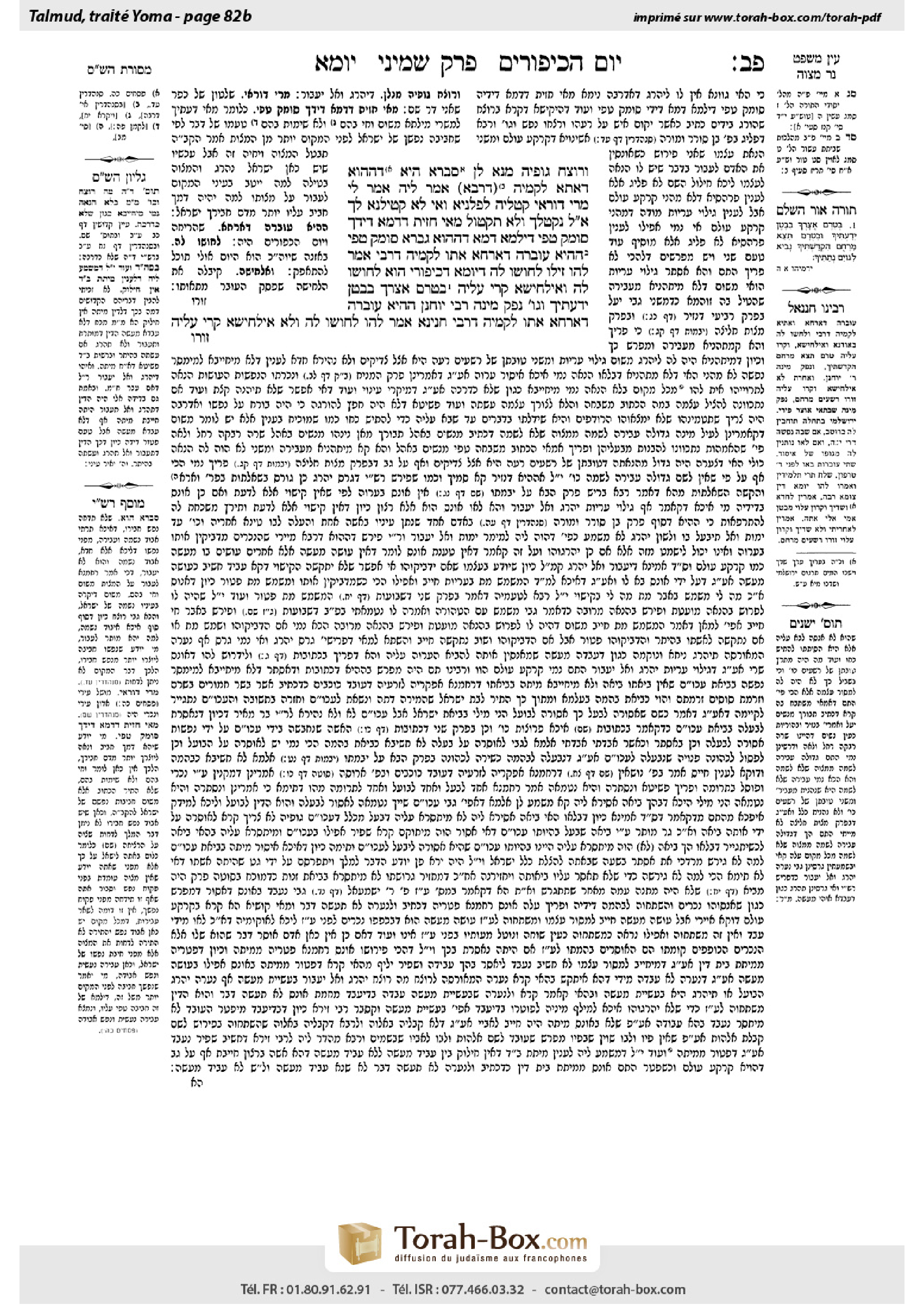
This page of Yoma includes the Aramaic text, an English translation and an AI-generated French translation, alongside the scan above.
יומא פ״ב ב · Aramaic and Hebrew text
וְרוֹצֵחַ גּוּפֵיהּ מְנָא לַן? סְבָרָא הִיא: דְּהָהוּא דַּאֲתָא לְקַמֵּיהּ (דְּרָבָא), אֲמַר לֵיהּ, אֲמַר לִי מָרֵי דּוּרַאי: קִטְלֵיהּ לִפְלָנְיָא, וְאִי לָא — קָטֵילְנָא לָךְ. אֲמַר לֵיהּ: נִקְטְלָךְ וְלָא תִּקְטוֹל. מַאי חָזֵית דִּדְמָא דִּידָךְ סוּמָּק טְפֵי? דִּילְמָא דְּמָא דְּהָהוּא גַּבְרָא סוּמָּק טְפֵי!
הָהִיא עוּבָּרָה דְּאָרַחָא, אֲתוֹ לְקַמֵּיהּ דְּרַבִּי, אֲמַר לְהוּ: זִילוּ לְחוּשׁוּ לַהּ דְּיוֹמָא דְכִיפּוּרֵי הוּא. לְחוּשׁוּ לָהּ וְאִילְּחִישָׁא. קָרֵי עֲלֵיהּ: ״בְּטֶרֶם אֶצָּרְךָ בַבֶּטֶן יְדַעְתִּיךָ וְגוֹ׳״. נְפַק מִינַּהּ רַבִּי יוֹחָנָן.
הָהִיא עוּבָּרָה דְּאָרַחָא, אֲתוֹ לְקַמֵּיהּ דְּרַבִּי חֲנִינָא. אֲמַר לְהוּ: לְחוּשׁוּ לָהּ, וְלָא אִילְּחִישָׁא. קָרֵי עֲלֵיהּ:
Yoma 82b · English translation
The Gemara asks: And with regard to the murderer himself, from where do we derive this halakha that he should be killed rather than transgress the prohibition against murder? The Gemara answers: It is derived through reason, as it was told: A certain person came before Rava. He said to Rava: The master of the village where I live said to me: Kill so-and-so, and if you do not do so, I will kill you. What should I do? Rava said to him: Let yourself be killed, and you should not kill. Rava reasoned: What did you see to make you think that your blood is redder and more important than his? Perhaps the blood of that man is redder, and he is more important than you. If so, it is logical that one must not kill another person to save himself.
§ With respect to a pregnant woman who smells food, it is told: A certain pregnant woman smelled a food and craved it. Those involved came before Rabbi Yehuda HaNasi to ask how to proceed. He said to those who were inquiring: Go and whisper to her that today is Yom Kippur. They whispered to her, and this whispering helped; she stopped craving the food. Rabbi Yehuda HaNasi read this verse about the baby she was carrying: “Before I formed you in the belly I knew you, and before you came forth out of the womb I sanctified you” (Jeremiah 1:5), and indeed, the baby who came out of that woman was Rabbi Yoḥanan.
The Gemara relates another story: A certain pregnant woman smelled food and had a craving to eat it on Yom Kippur. Those involved came before Rabbi Ḥanina to ask how to proceed. He said to them: Whisper to her that today is Yom Kippur. They whispered to her, but she did not accept the whisper and continued to crave the food. Rabbi Ḥanina read this verse about the baby:
Yoma 82b · Traduction française (IA)
La Guemara demande : Et concernant le meurtrier lui-même, d’où déduisons-nous cette halakha, selon laquelle il doit se laisser tuer plutôt que de transgresser l’interdit du meurtre ? La Guemara répond : Cela se déduit par le raisonnement, comme dans le récit suivant. Un homme vint trouver Rava et lui dit : « Le maître du village où j’habite m’a dit : “Tue untel, sinon je te tuerai.” Que dois-je faire ? » Rava lui répondit : « Laisse-toi tuer et ne tue pas. » Rava raisonna ainsi : « Qu’as-tu vu pour penser que ton sang est plus rouge et plus précieux que le sien ? Peut-être le sang de cet homme est-il plus rouge, et lui-même plus important que toi. » Il est donc logique qu’on ne doive pas tuer une autre personne pour se sauver.
§ Au sujet d’une femme enceinte qui sent une nourriture et en a envie, on raconte : Une femme enceinte sentit une nourriture et en eut envie. Les personnes concernées vinrent trouver Rabbi Yehuda HaNasi pour lui demander comment procéder. Il dit à ceux qui l’interrogeaient : « Allez lui murmurer qu’aujourd’hui, c’est Yom Kippour. » Ils le lui murmurèrent, et cela eut l’effet voulu : elle cessa d’avoir envie de cette nourriture. Rabbi Yehuda HaNasi cita à propos du bébé qu’elle portait le verset : « Avant que je te forme dans le ventre, je t’ai connu, et avant que tu sortes de la matrice, je t’ai consacré » (Jérémie 1:5). Et, en effet, le bébé qui naquit de cette femme fut Rabbi Yoḥanan.
La Guemara rapporte une autre histoire : Une femme enceinte sentit une nourriture et eut envie d’en manger le jour de Yom Kippour. Les personnes concernées vinrent trouver Rabbi Ḥanina pour lui demander comment procéder. Il leur dit : « Murmurez-lui qu’aujourd’hui, c’est Yom Kippour. » Ils le lui murmurèrent, mais elle ne tint pas compte de leurs paroles et continua d’avoir envie de cette nourriture. Rabbi Ḥanina cita à propos du bébé le verset :
Traduction française générée par IA à partir de l’édition anglaise de Sefaria. Vérifie toujours un passage avec le texte source.
Text from Sefaria: William Davidson Edition - Vocalized Aramaic (CC BY NC); William Davidson Edition - English (CC BY NC).