Yoma 83a: Talmud study for Daf Yomi
Daf Yomi is the daily study of one Talmud folio. Explore 37 tractates with scans, Hebrew text, Sefaria English and AI-generated French translations where annotated.
Passage selection and English or AI-generated French translation are available where the scan has annotations. Daf Study is independent of Torah-Box and Sefaria.
Browse Yoma · יומא · All tractatesYoma 83a text and translations
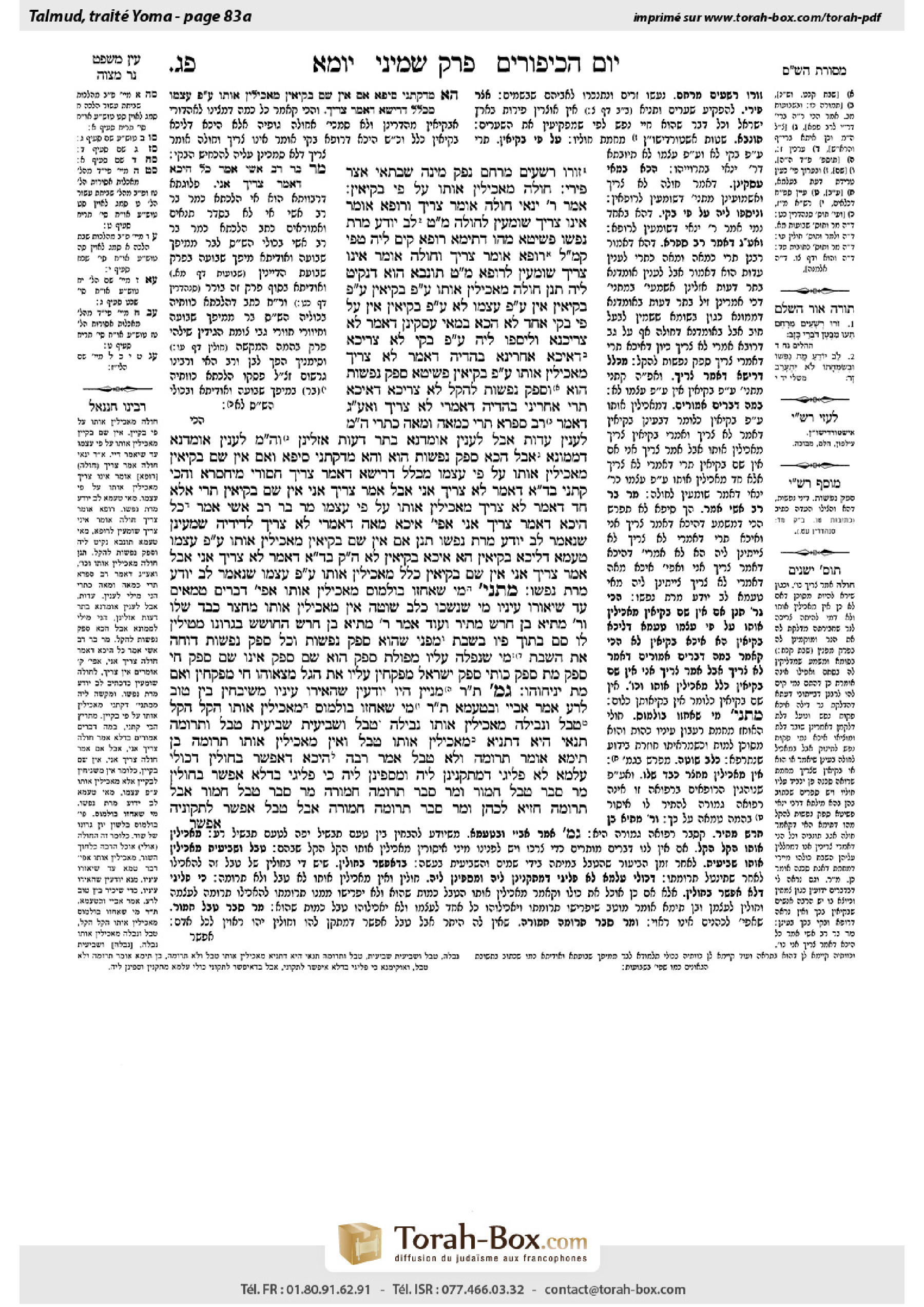
This page of Yoma includes the Aramaic text, an English translation and an AI-generated French translation, alongside the scan above.
יומא פ״ג א · Aramaic and Hebrew text
״זוֹרוּ רְשָׁעִים מֵרָחֶם״. נְפַק מִינַּהּ שַׁבְּתַאי אָצַר פֵּירֵי.
חוֹלֶה מַאֲכִילִין אוֹתוֹ עַל פִּי בְּקִיאִין. אָמַר רַבִּי יַנַּאי: חוֹלֶה אוֹמֵר צָרִיךְ, וְרוֹפֵא אוֹמֵר אֵינוֹ צָרִיךְ — שׁוֹמְעִין לַחוֹלֶה. מַאי טַעְמָא — ״לֵב יוֹדֵעַ מׇרַּת נַפְשׁוֹ״. פְּשִׁיטָא! מַהוּ דְּתֵימָא: רוֹפֵא קִים לֵיהּ טְפֵי, קָא מַשְׁמַע לַן.
רוֹפֵא אוֹמֵר צָרִיךְ, וְחוֹלֶה אוֹמֵר אֵינוֹ צָרִיךְ — שׁוֹמְעִין לָרוֹפֵא. מַאי טַעְמָא — תּוּנְבָּא הוּא דְּנָקֵיט לֵיהּ.
תְּנַן: חוֹלֶה — מַאֲכִילִין אוֹתוֹ עַל פִּי בְּקִיאִין. עַל פִּי בְּקִיאִין — אִין, עַל פִּי עַצְמוֹ — לָא! עַל פִּי בְּקִיאִין — אִין, עַל פִּי בָּקִי אֶחָד — לָא!
הָכָא בְּמַאי עָסְקִינַן, דְּאָמַר לָא צְרִיכְנָא. וְלִיסְפּוֹ לֵיהּ עַל פִּי בָּקִי! לָא צְרִיכָא, דְּאִיכָּא אַחֲרִינָא בַּהֲדֵיהּ דְּאָמַר לָא צְרִיךְ — מַאֲכִילִין אוֹתוֹ עַל פִּי בְּקִיאִין.
פְּשִׁיטָא, סְפֵק נְפָשׁוֹת הוּא, וּסְפֵק נְפָשׁוֹת לְהָקֵל! לָא צְרִיכָא, דְּאִיכָּא תְּרֵי אַחֲרִינֵי בַּהֲדֵיהּ דְּאָמְרִי לָא צְרִיךְ. וְאַף עַל גַּב דְּאָמַר רַב סָפְרָא: תְּרֵי כִּמְאָה וּמְאָה כִּתְרֵי, הָנֵי מִילֵּי לְעִנְיַן עֵדוּת, אֲבָל לְעִנְיַן אוּמְדָּנָא — בָּתַר דֵּעוֹת אָזְלִינַן.
וְהָנֵי מִילֵּי לְעִנְיַן אוּמְדָּנָא דְמָמוֹנָא, אֲבָל הָכָא סְפֵק נְפָשׁוֹת הוּא.
וְהָא מִדְּקָתָנֵי סֵיפָא: וְאִם אֵין שָׁם בְּקִיאִין מַאֲכִילִין אוֹתוֹ עַל פִּי עַצְמוֹ, מִכְּלָל דְּרֵישָׁא דְּאָמַר צָרִיךְ! חַסּוֹרֵי מִיחַסְּרָא וְהָכִי קָתָנֵי: בַּמֶּה דְּבָרִים אֲמוּרִים — דְּאָמַר לֹא צָרִיךְ אֲנִי, אֲבָל אָמַר צָרִיךְ אֲנִי, אֵין שָׁם בְּקִיאִין תְּרֵי אֶלָּא חַד דְּאָמַר לֹא צָרִיךְ — מַאֲכִילִין אוֹתוֹ עַל פִּי עַצְמוֹ.
מָר בַּר רַב אָשֵׁי אָמַר: כֹּל הֵיכָא דְּאָמַר צָרִיךְ אֲנִי, אֲפִילּוּ אִיכָּא מְאָה דְּאָמְרִי לֹא צָרִיךְ לְדִידֵיהּ שָׁמְעִינַן — שֶׁנֶּאֱמַר: ״לֵב יוֹדֵעַ מׇרַּת נַפְשׁוֹ״.
תְּנַן: אִם אֵין שָׁם בְּקִיאִין — מַאֲכִילִין אוֹתוֹ עַל פִּי עַצְמוֹ. טַעְמָא דְּלֵיכָּא בְּקִיאִין, הָא אִיכָּא בְּקִיאִין לָא! הָכִי קָאָמַר: בַּמֶּה דְּבָרִים אֲמוּרִים — דְּאָמַר ״לֹא צָרִיךְ אֲנִי״, אֲבָל אָמַר ״צָרִיךְ אֲנִי״, אֵין שָׁם בְּקִיאִין כְּלָל — מַאֲכִילִין אוֹתוֹ עַל פִּי עַצְמוֹ, שֶׁנֶּאֱמַר: ״לֵב יוֹדֵעַ מׇרַּת נַפְשׁוֹ״.
מַתְנִי׳ מִי שֶׁאֲחָזוֹ בּוּלְמוֹס — מַאֲכִילִין אוֹתוֹ אֲפִילּוּ דְּבָרִים טְמֵאִים, עַד שֶׁיֵּאוֹרוּ עֵינָיו. מִי שֶׁנְּשָׁכוֹ כֶּלֶב שׁוֹטֶה — אֵין מַאֲכִילִין אוֹתוֹ מֵחֲצַר כָּבֵד שֶׁלּוֹ. וְרַבִּי מַתְיָא בֶּן חָרָשׁ מַתִּיר.
וְעוֹד אָמַר רַבִּי מַתְיָא בֶּן חָרָשׁ: הַחוֹשֵׁשׁ בִּגְרוֹנוֹ — מְטִילִין לוֹ סַם בְּתוֹךְ פִּיו בְּשַׁבָּת, מִפְּנֵי שֶׁהוּא סְפֵק נְפָשׁוֹת, וְכׇל סְפֵק נְפָשׁוֹת דּוֹחֶה אֶת הַשַּׁבָּת.
מִי שֶׁנָּפְלָה עָלָיו מַפּוֹלֶת, סָפֵק הוּא שָׁם סָפֵק אֵינוֹ שָׁם, סָפֵק חַי סָפֵק מֵת, סָפֵק גּוֹי סָפֵק יִשְׂרָאֵל, מְפַקְּחִין עָלָיו אֶת הַגַּל. מְצָאוּהוּ חַי — מְפַקְּחִין, וְאִם מֵת — יְנִיחוּהוּ.
גְּמָ׳ תָּנוּ רַבָּנַן: מִנַּיִין הָיוּ יוֹדְעִין שֶׁהֵאִירוּ עֵינָיו — מִשֶּׁיַּבְחִין בֵּין טוֹב לָרַע. אָמַר אַבָּיֵי: וּבְטַעְמָא.
תָּנוּ רַבָּנַן: מִי שֶׁאֲחָזוֹ בּוּלְמוֹס — מַאֲכִילִין אוֹתוֹ הַקַּל הַקַּל, טֶבֶל וּנְבֵילָה — מַאֲכִילִין אוֹתוֹ נְבֵילָה. טֶבֶל וּשְׁבִיעִית — שְׁבִיעִית.
טֶבֶל וּתְרוּמָה — תַּנָּאֵי הִיא. דְּתַנְיָא: מַאֲכִילִין אוֹתוֹ טֶבֶל וְאֵין מַאֲכִילִין אוֹתוֹ תְּרוּמָה. בֶּן תֵּימָא אוֹמֵר: תְּרוּמָה וְלֹא טֶבֶל. אָמַר רַבָּה: הֵיכָא דְּאֶפְשָׁר בְּחוּלִּין, דְּכוּלֵּי עָלְמָא לָא פְּלִיגִי דִּמְתַקְּנִינַן לֵיהּ וּמַסְפִּינַן לֵיהּ.
כִּי פְּלִיגִי בִּדְלָא אֶפְשָׁר בְּחוּלִּין. מָר סָבַר טֶבֶל חָמוּר, וּמַר סָבַר תְּרוּמָה חֲמוּרָה. מָר סָבַר טֶבֶל חָמוּר — אֲבָל תְּרוּמָה חַזְיָא לְכֹהֵן. וּמַר סָבַר תְּרוּמָה חֲמוּרָה, אֲבָל טֶבֶל אֶפְשָׁר לְתַקּוֹנֵיהּ.
Yoma 83a · English translation
“The wicked are estranged from the womb” (Psalms 58:4), i.e., it is clear they are estranged already in their mother’s womb. Indeed, Shabbetai the hoarder of fruits came out of her. He hoarded fruit during years of famine in order to inflate its price and profit at the expense of poor people.
§ It was taught in the mishna: If a person is ill and requires food due to potential danger, one feeds him according to the advice of medical experts. Rabbi Yannai said: If an ill person says he needs to eat, and a doctor says he does not need to eat, one listens to the ill person. What is the reason for this halakha? It is because the verse states: “The heart knows the bitterness of its soul” (Proverbs 14:10), meaning an ill person knows the intensity of his pain and weakness, and doctors cannot say otherwise. The Gemara asks: It is obvious that a person knows himself better than anyone else does. Why does this need to be stated explicitly? The Gemara answers: It is lest you say that the doctor is more certain because he has had more experience with this condition. Therefore, the verse teaches us that even so, it is the ill person who knows his own suffering better than anyone else.
However, in the opposite case, if a doctor says that the ill person needs food, but the ill person himself says he does not need to eat, one listens to the doctor. What is the reason for this halakha? It is because confusion [tunba] has taken hold of the ill person on account of his illness, and his judgment is impaired. Consequently, he himself does not know how much he needs food.
§ We learned in the mishna: If a person is ill, one feeds him according to the advice of medical experts. This implies that if there are experts present, then according to the advice of experts, yes, one feeds the ill person; but at his own instructions, no, one does not feed him, contrary to Rabbi Yannai’s opinion. It further implies that according to the advice of several experts, yes, one feeds an ill person; however, according to the advice of only one expert, no, one does not feed him. There appears to be a requirement for at least two doctors, which also contradicts Rabbi Yannai’s opinion that the opinion of one expert is sufficient to override the opinion of the ill person.
The Gemara rejects this: With what are we dealing here? We are dealing with a unique circumstance: The ill person says I do not need food, and the consultation of experts is required. The Gemara suggests: But let them feed him according to the advice of one expert, as Rabbi Yannai said that in such a circumstance one feeds the ill person based on the advice of one doctor. The Gemara answers: No, the requirement of two experts is necessary in a case where there is another, third expert with him who says that the ill person does not need to eat. In such a case, one feeds the ill person according to the advice of two experts who agree that he requires it.
The Gemara asks: If so, this is obvious, since it is a case of uncertainty concerning a life-threatening situation, and in all cases of uncertainty concerning a life-threatening situation, the halakha is lenient. The Gemara answers: No, this halakha is necessary in a case where there are two other doctors who, along with the ill person, say that he does not need food. And although Rav Safra said that two witnesses are like one hundred witnesses, and one hundred witnesses are like two witnesses, that rule applies specifically to the matter of testimony; however, in the matter of assessing a situation, we follow the majority of opinions. Therefore, one might think in this case that the ill person should not be fed because the opinion of two doctors plus the ill person should override the opposing opinion of two other doctors.
Generally speaking, two or more witnesses constitute complete testimony, and there is no difference between the testimony of two and the testimony of a large number of people. However, this principle of following the majority applies specifically to assessing monetary issues, but here it is a case of uncertainty concerning a life-threatening situation. Therefore, although it is the opinion of two doctors against the opinion of two doctors and the ill person, the ill person must eat.
The Gemara asks: But from the fact that it is taught in the latter clause of the mishna that if there are no experts present one feeds him according to his own opinion, by inference, the first clause of the mishna is referring to a case where the ill person said he needs to eat. In that case, the mishna states that one follows the experts’ opinion, not his own, and feeds him. The Gemara answers: The mishna is incomplete and is teaching the following: In what case is this statement that he may eat only based on the advice of experts said? It is when the ill person said: I do not need to eat. But if he said: I do need to eat, and instead of two experts there is only one who says that he does not need to eat, one feeds him according to his own opinion.
Mar bar Rav Ashi said: Any instance where an ill person says: I need to eat, even if there are one hundred expert doctors who say that he does not need to eat, we listen to his own opinion and feed him, as it is stated: “The heart knows the bitterness of its soul” (Proverbs 14:10).
We learned in the mishna: If an ill person himself says he needs to eat and there are no experts present, one feeds him according to his own opinion. This implies that the reason one feeds him is because there are no experts present. One may infer from this that if there were experts present, no, one would not feed the ill person based on his own opinion but would instead listen to the advice of the experts. The Gemara rejects this: This is what the mishna is saying: In what case is this statement that one follows the opinion of the experts said? It is when the ill person said: I do not need to eat. However, if he said: I do need to eat, it is considered as if there were no experts there at all; we feed him based on his opinion, as it is stated: “The heart knows the bitterness of its soul” (Proverbs 14:10). All the experts are ignored in the face of the ill person’s own sensitivities.
MISHNA: In the case of one who is seized with the life-threatening illness bulmos, causing him unbearable hunger pangs and impaired vision, one may feed him even impure foods on Yom Kippur or any other day until his eyes recover, as the return of his sight indicates that he is recovering. In the case of one whom a mad dog bit, one may not feed him from the lobe of the dog’s liver. This was thought to be a remedy for the bite, but the Rabbis deem it ineffective. And Rabbi Matya ben Ḥarash permits feeding it to him, as he deems it effective.
And furthermore, Rabbi Matya ben Ḥarash said: With regard to one who suffers pain in his throat, one may place medicine inside his mouth on Shabbat, although administering a remedy is prohibited on Shabbat. This is because there is uncertainty whether or not it is a life-threatening situation for him, as it is difficult to ascertain the severity of internal pain. And a case of uncertainty concerning a life-threatening situation overrides Shabbat.
Similarly, with regard to one upon whom a rockslide fell, and there is uncertainty whether he is there under the debris or whether he is not there; and there is uncertainty whether he is still alive or whether he is dead; and there is uncertainty whether the person under the debris is a gentile or whether he is a Jew, one clears the pile from atop him. One may perform any action necessary to rescue him from beneath the debris. If they found him alive after beginning to clear the debris, they continue to clear the pile until they can extricate him. And if they found him dead, they should leave him, since one may not desecrate Shabbat to preserve the dignity of the dead.
GEMARA: The Sages taught: From where would they know that his eyes had recovered their sight? It is from when he can discern between good and bad food, since under the influence of bulmos one eats food indiscriminately. Abaye said: It is with tasting. When he can distinguish the tastes of different foods his eyesight must have also recovered. For example, at night, although it is dark, the sign that his eyesight has been restored is that he is able to detect difference in tastes (Me’iri).
§ The Sages taught: In the case of one who is seized with bulmos and must be fed until his vision is restored, one feeds him the items whose prohibition is least severe first. If he must be fed forbidden foods, he should first be fed those whose level of prohibition is least severe. For instance, if there is untithed produce and an unslaughtered animal carcass [neveila] or any other non-kosher meat, one feeds him the neveila, as the prohibition of untithed produced warrants death at the hand of Heaven, but eating non-kosher meat is a transgression punishable only by lashes. If there is untithed produce and produce from the Sabbatical Year, he is fed the produce from the Sabbatical Year. Untithed produce warrants death at the hand of Heaven, whereas the produce of a Sabbatical Year is prohibited by a positive mitzva and there is no punishment associated with it.
If they have untithed produce and teruma, there is a dispute between tanna’im as to which food they should feed him, as it was taught in a baraita: One feeds him untithed produce and does not feed him teruma. Ben Teima says: It is better to feed him teruma and not feed him untithed produce. Rabba said: Where it is possible to feed him non-sacred food by separating tithes from untithed produce and thereby rendering the remainder permitted, everyone agrees that one should make the produce fit for consumption by separating tithes and then feed it to him, even on Shabbat, when it is otherwise prohibited to separate tithes.
Where they disagree, it is in a case where it is impossible to feed him non-sacred food because there is no way to separate tithes. One Sage holds that the prohibition of untithed produce is more severe; and one Sage holds that the prohibition of teruma is more severe. The two sides reason as follows. One Sage holds that the prohibition of untithed produce is more severe because it is prohibited to everyone; but teruma is fit for a priest, and therefore one could say that its prohibition is less severe. And one Sage holds that teruma is more severe because non-priests may never eat it, while untithed produce can be made fit to eat, and therefore, even while it is still untithed, the prohibition against eating it is less severe.
Yoma 83a · Traduction française (IA)
« Les méchants sont éloignés dès le ventre maternel » (Psaumes 58:4), c’est-à-dire qu’il est clair qu’ils sont déjà éloignés alors qu’ils sont encore dans le ventre de leur mère. En effet, Shabbetai, l’accapareur de fruits, était issu d’elle. Il avait accaparé des fruits pendant les années de famine afin d’en faire monter le prix et de s’enrichir aux dépens des pauvres.
§ Il a été enseigné dans la Michna : Si une personne est malade et a besoin de nourriture en raison d’un danger potentiel pour sa vie, on la nourrit selon l’avis des experts médicaux. Rabbi Yannai a dit : Si un malade affirme qu’il a besoin de manger, mais qu’un médecin dit qu’il n’en a pas besoin, on écoute le malade. Quelle est la raison de cette halakha ? Le verset dit : « Le cœur connaît l’amertume de son âme » (Proverbes 14:10), ce qui signifie qu’un malade connaît l’intensité de sa douleur et de sa faiblesse, et que les médecins ne peuvent affirmer le contraire. La Guemara demande : Il est évident qu’une personne se connaît mieux que quiconque. Pourquoi faut-il l’énoncer explicitement ? La Guemara répond : Il aurait pu te venir à l’esprit que le médecin est plus sûr de son jugement, parce qu’il a davantage d’expérience avec cette affection. Le verset nous enseigne donc que, malgré cela, le malade connaît sa propre souffrance mieux que quiconque.
En revanche, dans le cas contraire, si un médecin affirme que le malade a besoin de nourriture, mais que le malade lui-même dit qu’il n’a pas besoin de manger, on écoute le médecin. Quelle est la raison de cette halakha ? C’est que la confusion [tunba] s’est emparée du malade en raison de sa maladie et que son jugement est altéré. Par conséquent, il ne sait pas lui-même de quelle quantité de nourriture il a besoin.
§ Nous avons appris dans la Michna : Si une personne est malade, on la nourrit selon l’avis des experts médicaux. Cela implique que, si des experts sont présents, on nourrit le malade selon leur avis, mais pas selon ses propres instructions, ce qui contredit l’opinion de Rabbi Yannai. Cela implique en outre que l’on nourrit le malade selon l’avis de plusieurs experts, mais pas selon celui d’un seul. Il semblerait donc qu’il faille au moins deux médecins, ce qui contredit également l’opinion de Rabbi Yannai, selon laquelle l’avis d’un seul expert suffit à prévaloir sur celui du malade.
La Guemara rejette cette déduction : De quelle situation s’agit-il ici ? D’un cas particulier : le malade dit qu’il n’a pas besoin de nourriture, et l’on doit consulter des experts. La Guemara propose : Mais qu’on le nourrisse selon l’avis d’un seul expert, puisque Rabbi Yannai a dit que, dans une telle situation, on nourrit le malade selon l’avis d’un seul médecin. La Guemara répond : Non. La nécessité de consulter deux experts concerne un cas où un autre médecin, un troisième, est également présent et affirme que le malade n’a pas besoin de manger. Dans ce cas, on nourrit le malade selon l’avis des deux experts qui s’accordent à dire qu’il en a besoin.
La Guemara demande : Si c’est le cas, cela va de soi, puisqu’il s’agit d’une incertitude concernant une situation mettant la vie en danger et que, dans tous les cas d’incertitude de ce genre, la halakha est de se montrer indulgent. La Guemara répond : Non. Cette halakha est nécessaire dans un cas où deux autres médecins, avec le malade, affirment qu’il n’a pas besoin de nourriture. Et bien que Rav Safra ait dit que deux témoins équivalent à cent témoins, et que cent témoins équivalent à deux témoins, cette règle s’applique spécifiquement en matière de témoignage ; en revanche, pour évaluer une situation, on suit l’avis de la majorité. On pourrait donc penser que, dans ce cas, il ne faut pas nourrir le malade, car l’avis des deux médecins et le sien devrait prévaloir sur celui des deux autres médecins.
En règle générale, deux témoins ou davantage constituent un témoignage complet, et il n’y a pas de différence entre le témoignage de deux personnes et celui d’un grand nombre. Toutefois, le principe consistant à suivre la majorité s’applique spécifiquement à l’évaluation de questions financières ; ici, il s’agit d’une incertitude concernant une situation mettant la vie en danger. Par conséquent, bien que l’avis de deux médecins s’oppose à celui de deux autres médecins et du malade, le malade doit manger.
La Guemara demande : Mais puisque la dernière partie de la Michna enseigne que, si aucun expert n’est présent, on nourrit le malade selon son propre avis, on peut en déduire que la première partie de la Michna concerne un cas où le malade a dit qu’il avait besoin de manger. Dans ce cas, la Michna indique qu’on suit l’avis des experts et non le sien, et qu’on le nourrit. La Guemara répond : La Michna est incomplète et enseigne ceci : Dans quel cas dit-on qu’il ne peut manger que sur l’avis des experts ? Lorsque le malade a dit : « Je n’ai pas besoin de manger. » Mais s’il a dit : « J’ai besoin de manger », et qu’au lieu de deux experts il n’y en a qu’un seul qui affirme qu’il n’a pas besoin de manger, on le nourrit selon son propre avis.
Mar bar Rav Ashi a dit : Chaque fois qu’un malade dit : « J’ai besoin de manger », même si cent médecins experts affirment qu’il n’a pas besoin de manger, on écoute son propre avis et on le nourrit, comme il est dit : « Le cœur connaît l’amertume de son âme » (Proverbes 14:10).
Nous avons appris dans la Michna : Si un malade dit lui-même qu’il a besoin de manger et qu’aucun expert n’est présent, on le nourrit selon son propre avis. Cela implique qu’on le nourrit parce qu’aucun expert n’est présent. On peut en déduire que si des experts étaient présents, on ne nourrirait pas le malade selon son propre avis, mais qu’on écouterait celui des experts. La Guemara rejette cette déduction : Voici ce que dit la Michna : Dans quel cas dit-on qu’on suit l’avis des experts ? Lorsque le malade a dit : « Je n’ai pas besoin de manger. » En revanche, s’il a dit : « J’ai besoin de manger », c’est comme si aucun expert n’était présent ; on le nourrit selon son avis, comme il est dit : « Le cœur connaît l’amertume de son âme » (Proverbes 14:10). L’avis de tous les experts est écarté devant les sensations propres du malade.
MICHNA : Dans le cas d’une personne saisie par le bulmos, une affection mettant sa vie en danger qui provoque des douleurs de faim insupportables et une vision altérée, on peut lui donner à manger même des aliments impurs, à Yom Kippour comme n’importe quel autre jour, jusqu’à ce que sa vue se rétablisse, car le retour de sa vue indique qu’elle se rétablit. Dans le cas d’une personne mordue par un chien enragé, on ne peut pas lui donner à manger le lobe du foie du chien. On pensait que c’était un remède contre la morsure, mais les Sages le jugent inefficace. Rabbi Matya ben Ḥarash permet de le lui donner, car il le juge efficace.
De plus, Rabbi Matya ben Ḥarash a dit : Pour une personne qui souffre de la gorge, on peut placer un médicament dans sa bouche pendant Chabbat, bien qu’il soit interdit d’administrer un remède pendant Chabbat. En effet, il est incertain que sa situation mette ou non sa vie en danger, car il est difficile d’évaluer la gravité d’une douleur interne. Or, une incertitude concernant une situation mettant la vie en danger l’emporte sur Chabbat.
De même, lorsqu’un éboulement s’est abattu sur une personne, s’il est incertain qu’elle se trouve ou non sous les décombres, s’il est incertain qu’elle soit encore vivante ou déjà morte, et s’il est incertain que la personne ensevelie soit un non-Juif ou un Juif, on dégage les décombres qui la recouvrent. On peut accomplir toute action nécessaire pour la secourir. Si on la trouve vivante après avoir commencé à dégager les décombres, on continue jusqu’à pouvoir l’en extraire. Et si on la trouve morte, on la laisse, car il est interdit de profaner Chabbat pour préserver la dignité des morts.
GUEMARA : Les Sages ont enseigné : Comment savaient-ils que sa vue s’était rétablie ? Lorsqu’il peut distinguer les aliments bons des mauvais, car, sous l’emprise du bulmos, on mange sans faire de distinction entre les aliments. Abaye a dit : On le vérifie par le goût. Lorsqu’il peut distinguer les saveurs des différents aliments, sa vue doit également s’être rétablie. Par exemple, la nuit, même s’il fait sombre, le signe que sa vue s’est rétablie est qu’il est capable de distinguer les saveurs (Meïri).
§ Les Sages ont enseigné : Dans le cas d’une personne saisie par le bulmos, à qui il faut donner à manger jusqu’au rétablissement de sa vue, on commence par lui donner les aliments dont l’interdit est le moins sévère. Si l’on doit lui donner des aliments interdits, on commence par ceux dont le degré d’interdit est le moins sévère. Par exemple, s’il y a des produits non dîmés et une carcasse d’animal non abattu rituellement [neveila] ou une autre viande non cachère, on lui donne la neveila, car la consommation de produits non dîmés est passible de la mort par la main du Ciel, tandis que la consommation de viande non cachère est une transgression passible uniquement de coups. S’il y a des produits non dîmés et des produits de l’année sabbatique, on lui donne les produits de l’année sabbatique. La consommation de produits non dîmés est passible de la mort par la main du Ciel, tandis que les produits de l’année sabbatique sont interdits par un commandement positif et qu’aucune peine n’est associée à leur consommation.
S’il y a des produits non dîmés et de la terouma, les tannaïm sont en désaccord sur les aliments qu’il faut lui donner, comme il a été enseigné dans une baraïta : On lui donne des produits non dîmés, mais on ne lui donne pas de terouma. Ben Teima dit : Il vaut mieux lui donner de la terouma que des produits non dîmés. Rabba a dit : Lorsqu’il est possible de lui donner des aliments non consacrés en prélevant les dîmes des produits non dîmés, ce qui rend le reste permis, tous conviennent qu’il faut rendre les produits propres à la consommation en prélevant les dîmes, puis les lui donner, même pendant Chabbat, alors qu’il est normalement interdit de prélever les dîmes.
Le désaccord porte sur le cas où il est impossible de lui donner des aliments non consacrés, parce qu’il n’existe aucun moyen de prélever les dîmes. Un Sage considère que l’interdit des produits non dîmés est plus sévère ; un autre considère que l’interdit de la terouma est plus sévère. Les deux avis raisonnent ainsi. Selon un Sage, l’interdit des produits non dîmés est plus sévère, car ils sont interdits à tous ; la terouma, en revanche, convient à un prêtre, et l’on pourrait donc dire que son interdit est moins sévère. Selon un autre Sage, l’interdit de la terouma est plus sévère, car les non-prêtres ne peuvent jamais en manger, tandis que les produits non dîmés peuvent être rendus propres à la consommation ; par conséquent, même tant que leurs dîmes n’ont pas été prélevées, l’interdit de les consommer est moins sévère.
Traduction française générée par IA à partir de l’édition anglaise de Sefaria. Vérifie toujours un passage avec le texte source.
Text from Sefaria: William Davidson Edition - Vocalized Aramaic (CC BY NC); William Davidson Edition - English (CC BY NC).