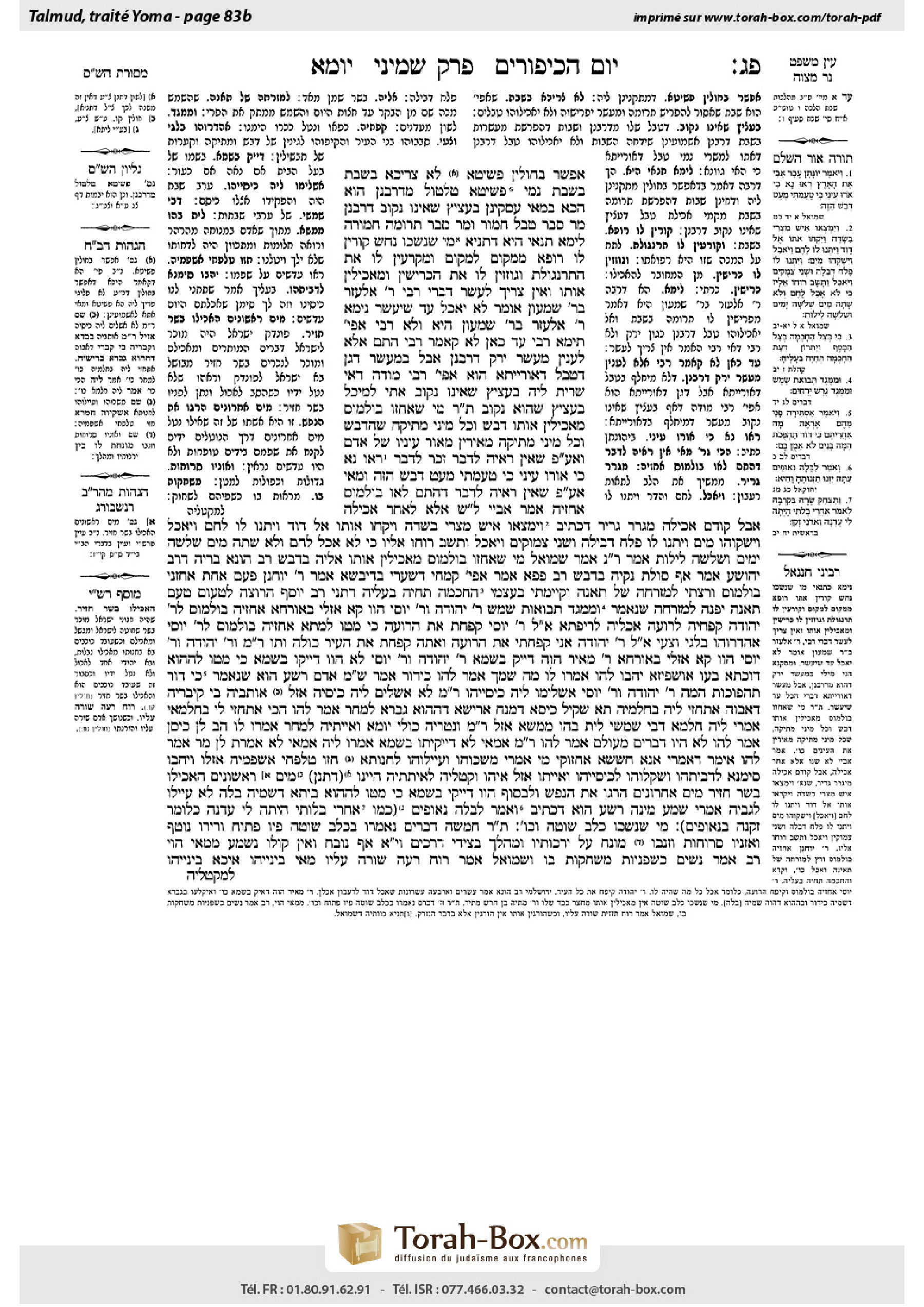
Yoma 83b: Talmud study for Daf Yomi
Daf Yomi is the daily study of one Talmud folio. Explore 37 tractates with scans, Hebrew text, Sefaria English and AI-generated French translations where annotated.
Passage selection and English or AI-generated French translation are available where the scan has annotations. Daf Study is independent of Torah-Box and Sefaria.
Browse Yoma · יומא · All tractatesYoma 83b text and translations
This page of Yoma includes the Aramaic text, an English translation and an AI-generated French translation, alongside the scan above.
יומא פ״ג ב · Aramaic and Hebrew text
אֶפְשָׁר בְּחוּלִּין — פְּשִׁיטָא? לָא צְרִיכָא, בְּשַׁבָּת.
בְּשַׁבָּת נָמֵי, פְּשִׁיטָא — טִלְטוּל מִדְּרַבָּנַן הוּא! הָכָא בְּמַאי עָסְקִינַן — בְּעָצִיץ שֶׁאֵינוֹ נָקוּב, דְּרַבָּנַן.
מָר סָבַר טֶבֶל חָמוּר, וּמַר סָבַר תְּרוּמָה חֲמוּרָה.
לֵימָא תַּנָּאֵי הִיא. דְּתַנְיָא: מִי שֶׁנְּשָׁכוֹ נָחָשׁ — קוֹרִין לוֹ רוֹפֵא מִמָּקוֹם לְמָקוֹם, וּמְקָרְעִין לוֹ אֶת הַתַּרְנְגוֹלֶת, וְגוֹזְזִין לוֹ אֶת הַכְּרֵישִׁין, וּמַאֲכִילִין אוֹתוֹ, וְאֵין צָרִיךְ לְעַשֵּׂר, דִּבְרֵי רַבִּי. רַבִּי אֶלְעָזָר בְּרַבִּי שִׁמְעוֹן אוֹמֵר: לֹא יֹאכַל עַד שֶׁיְּעַשֵּׂר.
נֵימָא רַבִּי אֶלְעָזָר בְּרַבִּי שִׁמְעוֹן הִיא, וְלָא רַבִּי!
אֲפִילּוּ תֵּימָא רַבִּי, עַד כָּאן לָא קָאָמַר רַבִּי הָתָם — אֶלָּא לְעִנְיַן מַעְשַׂר יָרָק דְּרַבָּנַן, אֲבָל בְּמַעְשַׂר דָּגָן דְּטֶבֶל דְּאוֹרָיְיתָא הוּא, אֲפִילּוּ רַבִּי מוֹדֶה, דְּאִי שָׁרֵית לֵיהּ בְּעָצִיץ שֶׁאֵינוֹ נָקוּב — אָתֵי לְמֵיכַל בְּעָצִיץ שֶׁהוּא נָקוּב.
תָּנוּ רַבָּנַן מִי: שֶׁאֲחָזוֹ בּוּלְמוּס — מַאֲכִילִין אוֹתוֹ דְּבַשׁ וְכׇל מִינֵי מְתִיקָה, שֶׁהַדְּבַשׁ וְכׇל מִינֵי מְתִיקָה מְאִירִין מְאוֹר עֵינָיו שֶׁל אָדָם. וְאַף עַל פִּי שֶׁאֵין רְאָיָה לַדָּבָר, זֵכֶר לַדָּבָר: ״רְאוּ נָא כִּי אוֹרוּ עֵינַי כִּי טָעַמְתִּי מְעַט דְּבַשׁ הַזֶּה״.
וּמַאי: ״אַף עַל פִּי שֶׁאֵין רְאָיָה לַדָּבָר״! דְּהָתָם לָאו בּוּלְמוּס אַחְזֵיה.
אָמַר אַבָּיֵי: לֹא שָׁנוּ, אֶלָּא לְאַחַר אֲכִילָה, אֲבָל קוֹדֶם אֲכִילָה מִגְרָר גָּרֵיר, דִּכְתִיב: ״וַיִּמְצְאוּ אִישׁ מִצְרִי בַּשָּׂדֶה וַיִּקְחוּ אוֹתוֹ אֶל דָּוִד וַיִּתְּנוּ לוֹ לֶחֶם וַיֹּאכַל וַיַּשְׁקוּהוּ מָיִם. וַיִּתְּנוּ לוֹ פֶלַח דְּבֵילָה וּשְׁנֵי צִמּוּקִים וַיֹּאכַל וַתָּשׇׁב רוּחוֹ אֵלָיו כִּי לֹא אָכַל לֶחֶם וְלֹא שָׁתָה מַיִם שְׁלֹשָׁה יָמִים וּשְׁלֹשָׁה לֵילוֹת״.
אָמַר רַב נַחְמָן אָמַר שְׁמוּאֵל: מִי שֶׁאֲחָזוֹ בּוּלְמוּס — מַאֲכִילִין אוֹתוֹ אַלְיָה בִּדְבַשׁ. רַב הוּנָא בְּרֵיהּ דְּרַב יְהוֹשֻׁעַ אָמַר: אַף סוֹלֶת נְקִיָּה בִּדְבַשׁ. רַב פָּפָּא אָמַר: אֲפִילּוּ קִמְחָא דִשְׂעָרֵי בְּדוּבְשָׁא. אָמַר רַבִּי יוֹחָנָן: פַּעַם אַחַת אֲחָזַנִי בּוּלְמוּס וְרַצְתִּי לְמִזְרָחָהּ שֶׁל תְּאֵנָה, וְקִיַּימְתִּי בְּעַצְמִי: ״הַחׇכְמָה תְּחַיֶּה בְעָלֶיהָ״. דְּתָנֵי רַב יוֹסֵף: הָרוֹצֶה לִטְעוֹם טַעַם תְּאֵנָה — יִפְנֶה לְמִזְרָחָהּ, שֶׁנֶּאֱמַר: ״וּמִמֶּגֶד תְּבוּאוֹת שָׁמֶשׁ״.
רַבִּי יְהוּדָה וְרַבִּי יוֹסֵי הֲווֹ קָא אָזְלִי בְּאוֹרְחָא. אַחְזֵיה בּוּלְמוּס לְרַבִּי יְהוּדָה, קַפְּחֵיהּ לְרוֹעֶה אַכְלֵיהּ לְרִיפְתָּא. אָמַר לֵיהּ רַבִּי יוֹסֵי: קִפַּחְתָּ אֶת הָרוֹעֶה. כִּי מְטוֹ לְמָתָא, אַחְזֵיה בּוּלְמוּס לְרַבִּי יוֹסֵי. אַהְדְּרוּהוּ בְּלָגֵי וְצָעֵי, אֲמַר לֵיהּ רַבִּי יְהוּדָה: אֲנִי קִפַּחְתִּי אֶת הָרוֹעֶה, וְאַתָּה קִפַּחְתָּ אֶת הָעִיר כּוּלָּהּ.
וְתוּ: רַבִּי מֵאִיר וְרַבִּי יְהוּדָה וְרַבִּי יוֹסֵי הֲווֹ קָא אָזְלִי בְּאוֹרְחָא, רַבִּי מֵאִיר הֲוָה דָּיֵיק בִּשְׁמָא, רַבִּי יְהוּדָה וְרַבִּי יוֹסֵי לָא הֲווֹ דָּיְיקִי בִּשְׁמָא. כִּי מְטוֹ לְהָהוּא דּוּכְתָּא, בְּעוֹ אוּשְׁפִּיזָא. יְהַבוּ לְהוּ. אֲמַרוּ לֵיהּ: מָה שְׁמָךְ? אֲמַר לְהוּ: ״כִּידוֹר״. אֲמַר: שְׁמַע מִינַּהּ אָדָם רָשָׁע הוּא, שֶׁנֶּאֱמַר: ״כִּי דוֹר תַּהְפּוּכוֹת הֵמָּה״. רַבִּי יְהוּדָה וְרַבִּי יוֹסֵי אַשְׁלִימוּ לֵיהּ כִּיסַיְיהוּ. רַבִּי מֵאִיר לָא אַשְׁלֵים לֵיהּ כִּיסֵיהּ, אֲזַל אוֹתְבֵיהּ בֵּי קִיבְרֵיהּ דַּאֲבוּהּ.
אִתְחֲזִי לֵיהּ בְּחֶלְמֵיהּ: תָּא שְׁקֵיל כִּיסָא דְּמַנַּח אַרֵישָׁא דְּהָהוּא גַּבְרָא. לִמְחַר אֲמַר לְהוּ: הָכִי אִתְחֲזִי לִי בְּחֶלְמַאי. אָמְרִי לֵיהּ: חֶלְמָא דְּבֵי שִׁמְשֵׁי לֵית בְּהוּ מַמָּשָׁא, אֲזַל רַבִּי מֵאִיר וְנַטְרֵיהּ כּוּלֵּי יוֹמָא וְאַיְּיתְיֵהּ.
לִמְחַר אֲמַרוּ לֵיהּ: הַב לַן כִּיסַן. אֲמַר לְהוּ: לֹא הָיוּ דְבָרִים מֵעוֹלָם. אֲמַר לְהוּ רַבִּי מֵאִיר: אַמַּאי לָא דָּיְיקִיתוּ בִּשְׁמָא? אֲמַרוּ לֵיהּ: אַמַּאי לָא אֲמַרְתְּ לַן מָר? אֲמַר לְהוּ: אֵימַר דַּאֲמַרִי אֲנָא חֲשָׁשָׁא, אַחְזוֹקֵי מִי אֲמַרִי?
מַשְׁכוּהוּ וְעַיְּילוּהוּ לַחֲנוּתָא, חֲזוֹ טְלָפְחֵי אַשְּׂפָמֵיהּ, אֲזַלוּ וִיהַבוּ סִימָנָא לִדְבֵיתְהוּ וְשַׁקְלוּהּ לְכִיסַיְיהוּ וְאַיְיתוֹ. אֲזַל אִיהוּ וְקַטְלֵיהּ לְאִיתְּתֵיהּ.
הַיְינוּ (דִּתְנַן): מַיִם רִאשׁוֹנִים הֶאֱכִילוּ בְּשַׂר חֲזִיר. מַיִם אַחֲרוֹנִים הָרְגוּ אֶת הַנֶּפֶשׁ.
וּלְבַסּוֹף הֲווֹ דָּיְיקִי בִּשְׁמָא. כִּי מְטוֹ לְהָהוּא בֵּיתָא דִּשְׁמֵיהּ ״בָּלָה״, לָא עֲיַילוּ לְגַבֵּיהּ. אָמְרִי: שְׁמַע מִינַּהּ רָשָׁע הוּא. דִּכְתִיב: ״וָאֹמַר לַבָּלָה נִאוּפִים״, (כְּמוֹ: ״אַחֲרֵי בְלוֹתִי הָיְתָה לִּי עֶדְנָה״, כְּלוֹמַר: זָקְנָה בְּנִאוּפִים).
מִי שֶׁנְּשָׁכוֹ כֶּלֶב שׁוֹטֶה וְכוּ׳. תָּנוּ רַבָּנַן, חֲמִשָּׁה דְּבָרִים נֶאֶמְרוּ בְּכֶלֶב שׁוֹטֶה: פִּיו פָּתוּחַ, וְרִירוֹ נוֹטֵף, וְאׇזְנָיו סְרוּחוֹת, וּזְנָבוֹ מוּנָּח עַל יַרְכוֹתָיו, וּמְהַלֵּךְ בְּצִידֵּי דְּרָכִים. וְיֵשׁ אוֹמְרִים: אַף נוֹבֵחַ וְאֵין קוֹלוֹ נִשְׁמָע. מִמַּאי הָוֵי? רַב אָמַר: נָשִׁים כַּשְׁפָנִיּוֹת מְשַׂחֲקוֹת בּוֹ, וּשְׁמוּאֵל אָמַר: רוּחַ רָעָה שׁוֹרָה עָלָיו.
מַאי בֵּינַיְיהוּ? אִיכָּא בֵּינַיְיהוּ
Yoma 83b · English translation
It was stated that, according to Rabba, if it is possible to make the untithed produce fit and then feed him with non-sacred food, one should do so. The Gemara is surprised at this: It is obvious that if it is possible to tithe the produce and feed him that, one should do so. Why must it be stated? The Gemara explains: No, it is necessary to state this with regard to a case on Shabbat, when it is generally prohibited to separate terumot and tithes. Even so, the Sages said that it is better to separate terumot and tithes on Shabbat rather than feed the ill person untithed produce.
The Gemara asks: With regard to Shabbat it is also obvious, since the prohibition against separating terumot and tithes is merely a prohibition against moving, which is prohibited by rabbinic law. That is certainly less severe than the prohibition against eating untithed produce. The Gemara answers: With what are we dealing here? We are dealing with fruits grown in an imperforate container, which are not subject to teruma by Torah law but by rabbinic law. The Gemara teaches that it is preferable to transgress the rabbinic prohibition of tithing the fruit on Shabbat rather than feed the ill person untithed produce, although in this case the prohibition is rabbinic.
§ The Gemara now discusses the aforementioned two opinions: One Sage, ben Teima, holds that untithed produce is more severe, and therefore one must tithe the fruit although it is prohibited to separate teruma on Shabbat; and one Sage, the first tanna, holds that teruma is more severe.
Let us say that Rabba’s view is one side of a dispute between tanna’im, as it was taught in a baraita: In the case of one whom a snake bit on Shabbat and who is in danger, one calls a doctor for him to come from one place to another; and one tears a chicken apart for him if he needs its meat for healing; and one harvests leeks from the ground and feeds them to him for healing purposes, and one need not separate tithes; this is the statement of Rabbi Yehuda HaNasi. Rabbi Elazar, son of Rabbi Shimon, says: He should not eat it unless it has been tithed.
Let us say that Rabba’s statement that one must separate teruma and tithes from the fruit for the ill person on Shabbat, even from untithed produce prohibited by rabbinic law, corresponds to the view of Rabbi Elazar, son of Rabbi Shimon. He says that one must tithe the leeks for the ill person even on Shabbat, although leeks, like all other vegetables, are considered untithed produce only by rabbinic law. And Rabba’s opinion does not follow the view of Rabbi Yehuda HaNasi.
The Gemara rejects this: Even if you say that Rabba holds in accordance with the view of Rabbi Yehuda HaNasi, Rabbi Yehuda HaNasi is saying that one should not separate tithes only there, with regard to the requirement to take the tithe from vegetables, like leeks, which is rabbinic in origin. This requirement was decreed lest one come to confuse vegetables with produce that is untithed by Torah law. However, with regard to the tithe of grains, which have the status of untithed produce by Torah law, although in this particular circumstance their untithed status is rabbinic because the grains grew in an imperforate container, even Rabbi Yehuda HaNasi concedes that the produce must be tithed. Because if it is permitted for him to eat without separating tithes from produce grown in an imperforate container, he may err and come to eat from grain grown in a perforated pot, which is considered untithed produce by Torah law. Consequently, one must separate tithes on Shabbat before feeding an ill person, even according to the opinion of Rabbi Yehuda HaNasi.
The Sages taught in a baraita: In the case of one who is seized with bulmos, one feeds him honey and all types of sweet foods, as the honey and all types of sweet foods restore the sight of his eyes. And although there is no clear proof for the matter, there is an allusion to the matter. Jonathan said: “See, I pray you, how my eyes are brightened because I tasted a little of this honey” (I Samuel 14:29).
The Gemara asks: And why does the baraita say: Although there is no clear proof for the matter, when that verse is a strong proof? The Gemara answers: There, Jonathan was not seized with bulmos, he was merely very hungry. Therefore, the episode provides no evidence that honey or sweet foods are the remedy for bulmos.
Abaye said: They taught that honey restores one’s eyesight only after eating other food, but before eating other food it whets one’s appetite, as it is written: “And they found an Egyptian man in the field, and brought him to David, and they gave him bread and he ate, and they gave him water to drink; and they gave him a piece of a cake of figs, and two clusters of raisins, and he ate, and his spirit was restored; for he had eaten no bread nor drunk any water for three days and three nights” (I Samuel 30:11–12). This indicates that sweets are given after the main course and not before it.
Rav Naḥman said that Shmuel said: In the case of one who is seized with bulmos, one feeds him a sheep’s tail with honey, since the combination of the fatty meat and the honey helps greatly. Rav Huna, son of Rav Yehoshua, said: Also, fine wheat flour with honey is a remedy. Rav Pappa said: Even barley flour with honey is good for curing bulmos. Rabbi Yoḥanan said: Once I was seized with bulmos and I ran to the east side of a fig tree and found ripe figs there, which I ate. Figs on a tree do not all ripen at once but ripen first on the side where the sun rises, so Rabbi Yoḥanan searched first for figs on the east side of the tree. And I thereby fulfilled the verse: “Wisdom preserves the lives of those who have it” (Ecclesiastes 7:12). As Rav Yosef taught: One who wishes to taste the flavor of the fig should turn to the east, as it is stated: “And for the precious things of the sun’s fruits” (Deuteronomy 33:14), implying that the sun ripens fruit and makes them sweet.
The Gemara relates that Rabbi Yehuda and Rabbi Yosei were walking on the road when Rabbi Yehuda was seized with bulmos. He overpowered a nearby shepherd and ate the bread that the shepherd had in his hand, since his life was in danger. Rabbi Yosei said to him: You have robbed that shepherd. When they reached the city, Rabbi Yosei was seized with bulmos, and all the people of the city surrounded him with jugs [lagei] and plates with all sorts of sweets. Rabbi Yehuda said to him in jest: I robbed only the shepherd, but you have robbed the entire city.
§ And furthermore, it is told: Rabbi Meir and Rabbi Yehuda and Rabbi Yosei were walking on the road together. Rabbi Meir would analyze names and discern one’s nature from his name, while Rabbi Yehuda and Rabbi Yosei were not apt to analyze names. When they came to a certain place, they looked for lodging and were given it. They said to the innkeeper: What is your name? He said to them: My name is Kidor. Rabbi Meir said to himself: Perhaps one can learn from this that he is a wicked person, as it is stated: “For they are a generation [ki dor] of upheavals” (Deuteronomy 32:20). Since it was Friday afternoon, Rabbi Yehuda and Rabbi Yosei entrusted their purses to him. Rabbi Meir did not entrust his purse to him but went and placed it at the grave of the innkeeper’s father.
The innkeeper’s father appeared to the innkeeper in a dream and said to him: Go take the purse placed at the head of that man, i.e., the innkeeper’s father. The following day, he said to the Sages: This is what appeared to me in my dream. They said to him: Dreams during twilight on Shabbat evening have no substance and should not be trusted. Even so, Rabbi Meir went and guarded his money all that day and then took it.
The next day, the rabbis said to the innkeeper: Give us our purses. He said to them: These matters never occurred; you never gave me any purses. Rabbi Meir said to them: Why didn’t you analyze his name to learn that he is a wicked man? They said to him: Why didn’t the Master tell us? He said to them: I said one should be suspicious, but have I said a person should be established as wicked? Could I say to you with certainty that he is wicked based on his name alone?
What did they do? They dragged the innkeeper and brought him to a store and gave him wine to drink. After he drank the wine, they saw lentils on his mustache, showing that he had eaten lentils that day. They went and gave this sign to his wife. They said that the innkeeper had ordered that their money be returned to them upon the sign that he ate lentils at his last meal. And they took their purses and went. He went and killed his wife out of anger that she did this.
This is as we learned in a baraita: Due to a person’s laxity in the first washing, they fed him pork. There was an innkeeper who was accustomed to feed pork to gentiles and kosher meat to Jews. He distinguished between Jews and gentiles by watching to see whether they performed the ritual hand-washing before eating. One time, a Jew came and ate without washing his hands before the meal, and the innkeeper gave him pork to eat. Laxity in the final washing, the washing of one’s hands and mouth after a meal, caused the innkeeper to kill the person. This is similar to that story, as had the wicked innkeeper washed his mouth, the rabbis would not have known that he had eaten lentils.
And in the end, they too, Rabbi Yehuda and Rabbi Yosei, would analyze names. When they came to a house of a landlord named Bala, they did not enter. They said: Conclude from here that he is certainly wicked, as it is written: “I said of her who was worn out [bala] by adulteries” (Ezekiel 23:43), as it states: “After I am grown old [beloti] shall I have pleasure?” (Genesis 18:12). “Worn out by adulteries” means aged through adulteries.
§ It was taught that in the case of one whom a mad dog bit, one does not feed him the lobe of its liver. The Gemara clarifies the concept of the mad dog. The Sages taught in a baraita: Five signs were said about a mad dog: Its mouth is always open; and its saliva drips; and its ears are floppy and do not stand up; and its tail rests on its legs; and it walks on the edges of roads. And some say it also barks and its voice is not heard. The Gemara asks: From where did the dog become mad? Rav said: Witches play with it and practice their magic on it, causing it to become mad. And Shmuel said: An evil spirit rests upon it.
The Gemara asks: What is the practical difference between these two opinions? The Gemara answers: There is a practical difference between them with regard to
Yoma 83b · Traduction française (IA)
Il a été enseigné que, selon Rabba, s’il est possible de rendre consommables les produits dont les dîmes n’ont pas été prélevées, puis de nourrir le malade avec des aliments profanes, il faut le faire. La Guemara s’en étonne : il est évident que, s’il est possible de prélever les dîmes sur les produits et de les lui donner à manger, il faut le faire. Pourquoi est-il nécessaire de le préciser ? La Guemara explique : non, il était nécessaire de le préciser pour un cas survenant le Chabbat, jour où il est généralement interdit de prélever la terouma et les dîmes. Malgré cela, les Sages ont dit qu’il vaut mieux prélever la terouma et les dîmes le Chabbat que de donner au malade des produits dont les dîmes n’ont pas été prélevées.
La Guemara demande : même pour le Chabbat, cela va de soi, puisque l’interdiction de prélever la terouma et les dîmes consiste seulement en une interdiction de déplacer, qui relève du droit rabbinique. Elle est certainement moins grave que l’interdiction de consommer des produits dont les dîmes n’ont pas été prélevées. La Guemara répond : de quoi parlons-nous ici ? De fruits cultivés dans un récipient non perforé, qui ne sont soumis à la terouma que par décret rabbinique et non par la Torah. La Guemara enseigne qu’il vaut mieux transgresser l’interdiction rabbinique de prélever les dîmes sur les fruits le Chabbat que de donner au malade des produits dont les dîmes n’ont pas été prélevées, bien que, dans ce cas, l’interdiction soit rabbinique.
§ La Guemara examine maintenant les deux opinions mentionnées précédemment : un Sage, ben Teima, estime que les produits dont les dîmes n’ont pas été prélevées sont soumis à une interdiction plus grave ; il faut donc prélever les dîmes sur les fruits, bien qu’il soit interdit de prélever la terouma le Chabbat. Un autre Sage, le premier tanna, estime que la terouma est soumise à une interdiction plus grave.
Disons que l’avis de Rabba correspond à l’une des positions d’une controverse entre tannaïm, comme on l’a enseigné dans une baraïta : dans le cas d’un homme mordu par un serpent le Chabbat et dont la vie est en danger, on appelle un médecin pour qu’il vienne d’un endroit à un autre ; on découpe un poulet pour lui s’il a besoin de sa viande comme remède ; on arrache des poireaux de terre et on les lui donne à des fins thérapeutiques, sans qu’il soit nécessaire d’en prélever les dîmes. Telle est la déclaration de Rabbi Yehuda HaNassi. Rabbi Elazar, fils de Rabbi Shimon, dit : il ne doit pas en manger tant que les dîmes n’ont pas été prélevées.
Disons que la déclaration de Rabba, selon laquelle il faut prélever la terouma et les dîmes sur les fruits destinés au malade le Chabbat, même lorsqu’il s’agit de produits dont les dîmes n’ont pas été prélevées et dont l’interdiction est rabbinique, correspond à l’avis de Rabbi Elazar, fils de Rabbi Shimon. Celui-ci dit qu’il faut prélever les dîmes sur les poireaux destinés au malade, même le Chabbat, bien que les poireaux, comme tous les autres légumes, ne soient considérés comme des produits dont les dîmes n’ont pas été prélevées qu’en vertu d’un décret rabbinique. L’avis de Rabba ne correspond donc pas à celui de Rabbi Yehuda HaNassi.
La Guemara rejette cette conclusion : même si tu dis que Rabba est d’accord avec Rabbi Yehuda HaNassi, celui-ci dit qu’il ne faut pas prélever les dîmes uniquement dans ce cas, concernant l’obligation de prélever les dîmes sur les légumes, comme les poireaux, obligation d’origine rabbinique. Cette obligation a été décrétée de crainte que l’on en vienne à confondre les légumes avec les produits dont les dîmes n’ont pas été prélevées selon la Torah écrite. En revanche, pour les céréales, dont le statut de produits dont les dîmes n’ont pas été prélevées découle de la Torah écrite, même si, dans cette situation particulière, ce statut est rabbinique parce qu’elles ont poussé dans un récipient non perforé, Rabbi Yehuda HaNassi reconnaît lui aussi qu’il faut prélever les dîmes sur ces produits. En effet, s’il est permis au malade de manger sans prélever les dîmes sur des produits cultivés dans un récipient non perforé, il risque de se tromper et d’en venir à manger des céréales cultivées dans un pot perforé, considérées comme des produits dont les dîmes n’ont pas été prélevées selon la Torah écrite. Par conséquent, il faut prélever les dîmes le Chabbat avant de nourrir un malade, même selon l’avis de Rabbi Yehuda HaNassi.
Les Sages ont enseigné dans une baraïta : dans le cas d’une personne saisie de boulimos, on la nourrit de miel et de toutes sortes d’aliments sucrés, car le miel et ces aliments lui rendent la vue. Bien qu’il n’y ait pas de preuve explicite à ce sujet, il existe une allusion à cette idée. Jonathan dit : « Voyez, je vous prie, comme mes yeux se sont éclaircis parce que j’ai goûté un peu de ce miel » (I Samuel 14:29).
La Guemara demande : pourquoi la baraïta dit-elle qu’il n’y a pas de preuve explicite à ce sujet, alors que ce verset constitue une preuve solide ? La Guemara répond : dans ce passage, Jonathan n’était pas saisi de boulimos ; il avait simplement très faim. Cet épisode ne prouve donc pas que le miel ou les aliments sucrés sont le remède contre la boulimos.
Abayé dit : ils ont enseigné que le miel rend la vue seulement après avoir mangé d’autres aliments ; avant cela, il ouvre l’appétit, comme il est écrit : « Ils trouvèrent un Égyptien dans la campagne, l’amenèrent à David, lui donnèrent du pain et il mangea, puis de l’eau à boire ; ils lui donnèrent ensuite un morceau de gâteau de figues et deux grappes de raisins secs, et il mangea ; il reprit des forces, car il n’avait mangé aucun pain ni bu aucune eau depuis trois jours et trois nuits » (I Samuel 30:11–12). Cela indique que les douceurs sont servies après le plat principal, et non avant.
Rav Naḥman dit au nom de Shmuel : lorsqu’une personne est saisie de boulimos, on la nourrit d’une queue de mouton avec du miel, car l’association de la viande grasse et du miel est très efficace. Rav Huna, fils de Rav Yehoshua, dit : la farine de blé fine avec du miel est également un remède. Rav Pappa dit : même la farine d’orge avec du miel est efficace contre la boulimos. Rabbi Yoḥanan dit : un jour, j’ai été saisi de boulimos et j’ai couru vers le côté est d’un figuier ; j’y ai trouvé des figues mûres et je les ai mangées. Les figues d’un arbre ne mûrissent pas toutes en même temps, mais mûrissent d’abord du côté où le soleil se lève ; Rabbi Yoḥanan a donc commencé par chercher des figues du côté est de l’arbre. J’ai ainsi accompli le verset : « La sagesse préserve la vie de ceux qui la possèdent » (Ecclésiaste 7:12). Car Rav Yosef a enseigné : celui qui souhaite goûter la saveur de la figue doit se tourner vers l’est, comme il est dit : « et des fruits précieux mûris par le soleil » (Deutéronome 33:14), ce qui implique que le soleil fait mûrir les fruits et les rend doux.
La Guemara raconte que Rabbi Yehuda et Rabbi Yosei marchaient sur la route lorsque Rabbi Yehuda fut saisi de boulimos. Il maîtrisa un berger qui se trouvait à proximité et mangea le pain que celui-ci tenait à la main, car sa vie était en danger. Rabbi Yosei lui dit : « Tu as volé ce berger. » Lorsqu’ils arrivèrent en ville, Rabbi Yosei fut saisi de boulimos, et tous les habitants l’entourèrent avec des cruches [lagei] et des plats remplis de toutes sortes de douceurs. Rabbi Yehuda lui dit en plaisantant : « Moi, je n’ai volé que le berger, mais toi, tu as volé toute la ville. »
§ De plus, il est raconté que Rabbi Meïr, Rabbi Yehuda et Rabbi Yosei marchaient ensemble sur la route. Rabbi Meïr avait l’habitude d’analyser les noms et de discerner le caractère d’une personne à partir de son nom, tandis que Rabbi Yehuda et Rabbi Yosei n’étaient pas portés à analyser les noms. Lorsqu’ils arrivèrent en un certain lieu, ils cherchèrent un hébergement et on leur en donna un. Ils demandèrent à l’aubergiste : « Comment t’appelles-tu ? » Il leur répondit : « Je m’appelle Kidor. » Rabbi Meïr se dit : « On peut peut-être en déduire que c’est un homme méchant », comme il est écrit : « Car ils sont une génération [ki dor] de perversité » (Deutéronome 32:20). C’était le vendredi après-midi ; Rabbi Yehuda et Rabbi Yosei confièrent leurs bourses à l’aubergiste. Rabbi Meïr, lui, ne lui confia pas sa bourse et alla la déposer sur la tombe du père de l’aubergiste.
Le père de l’aubergiste apparut en rêve à celui-ci et lui dit : « Va prendre la bourse déposée à la tête de cet homme », c’est-à-dire à la tête du père de l’aubergiste. Le lendemain, l’aubergiste dit aux Sages : « Voilà ce qui m’est apparu en rêve. » Ils lui répondirent : « Les rêves faits au crépuscule, à l’entrée du Chabbat, n’ont pas de substance et ne doivent pas être pris au sérieux. » Malgré cela, Rabbi Meïr alla garder son argent toute cette journée, puis le reprit.
Le lendemain, les rabbins dirent à l’aubergiste : « Rends-nous nos bourses. » Il leur répondit : « Cela ne s’est jamais produit ; vous ne m’avez confié aucune bourse. » Rabbi Meïr leur dit : « Pourquoi n’avez-vous pas analysé son nom pour comprendre que c’était un homme méchant ? » Ils lui demandèrent : « Pourquoi le Maître ne nous l’a-t-il pas dit ? » Il leur répondit : « J’ai dit qu’il fallait se méfier, mais ai-je dit qu’on pouvait le tenir pour un homme méchant ? Pouvais-je vous affirmer avec certitude qu’il était méchant en me fondant uniquement sur son nom ? »
Que firent-ils ? Ils traînèrent l’aubergiste jusqu’à une boutique et lui donnèrent du vin à boire. Après qu’il eut bu, ils remarquèrent des lentilles sur sa moustache, ce qui montrait qu’il avait mangé des lentilles ce jour-là. Ils allèrent transmettre ce signe à sa femme. Ils lui dirent que l’aubergiste avait ordonné qu’on leur rende leur argent si un signe indiquait qu’il avait mangé des lentilles lors de son dernier repas. Ils reprirent alors leurs bourses et partirent. L’aubergiste alla tuer sa femme, furieux qu’elle ait agi ainsi.
C’est ce qu’on a enseigné dans une baraïta : sa négligence lors de la première ablution fit qu’on lui donna du porc à manger. Il y avait un aubergiste qui avait l’habitude de servir du porc aux non-Juifs et de la viande cachère aux Juifs. Il distinguait les Juifs des non-Juifs en observant s’ils se lavaient rituellement les mains avant de manger. Un jour, un Juif vint et mangea sans se laver les mains avant le repas ; l’aubergiste lui donna du porc à manger. Sa négligence lors de l’ablution finale, celle des mains et de la bouche après le repas, entraîna sa mort. Cette histoire est semblable à celle-là : si le méchant aubergiste s’était lavé la bouche, les rabbins n’auraient pas su qu’il avait mangé des lentilles.
Finalement, Rabbi Yehuda et Rabbi Yosei se mirent eux aussi à analyser les noms. Lorsqu’ils arrivèrent à la maison d’un propriétaire nommé Bala, ils n’y entrèrent pas. Ils dirent : « Déduisons-en qu’il est certainement méchant », comme il est écrit : « J’ai dit de celle qui était usée [bala] par ses adultères » (Ézéchiel 23:43), comme il est dit : « Après que je serai vieille [beloti], connaîtrai-je encore le plaisir ? » (Genèse 18:12). « Usée par ses adultères » signifie vieillie à force d’adultères.
§ Il a été enseigné que, dans le cas d’une personne mordue par un chien enragé, on ne lui donne pas à manger le lobe de son foie. La Guemara précise ce qu’est un chien enragé. Les Sages ont enseigné dans une baraïta : cinq signes caractérisent un chien enragé : sa gueule est toujours ouverte ; sa salive coule ; ses oreilles sont tombantes et ne se dressent pas ; sa queue repose sur ses pattes ; et il marche sur les bords des routes. Certains disent qu’il aboie aussi, mais que sa voix ne s’entend pas. La Guemara demande : qu’est-ce qui a rendu le chien enragé ? Rav dit : des sorcières jouent avec lui et pratiquent leur magie sur lui, ce qui le rend enragé. Shmuel dit : un esprit malfaisant s’est posé sur lui.
La Guemara demande : quelle est la différence pratique entre ces deux avis ? La Guemara répond : il y a entre eux une différence pratique en ce qui concerne
Traduction française générée par IA à partir de l’édition anglaise de Sefaria. Vérifie toujours un passage avec le texte source.
Text from Sefaria: William Davidson Edition - Vocalized Aramaic (CC BY NC); William Davidson Edition - English (CC BY NC).