Yoma 84a: Talmud study for Daf Yomi
Daf Yomi is the daily study of one Talmud folio. Explore 37 tractates with scans, Hebrew text, Sefaria English and AI-generated French translations where annotated.
Passage selection and English or AI-generated French translation are available where the scan has annotations. Daf Study is independent of Torah-Box and Sefaria.
Browse Yoma · יומא · All tractatesYoma 84a text and translations
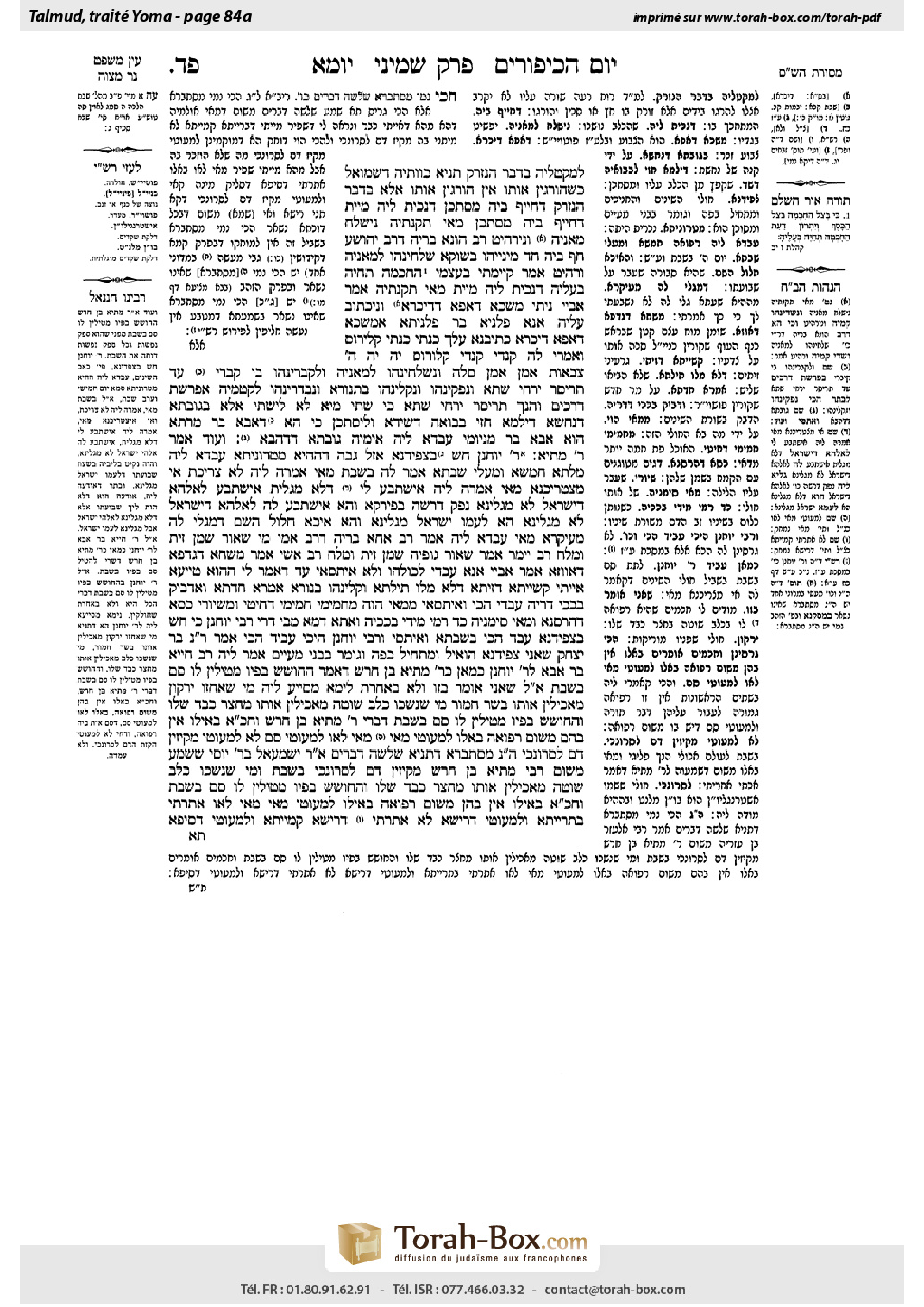
This page of Yoma includes the Aramaic text, an English translation and an AI-generated French translation, alongside the scan above.
יומא פ״ד א · Aramaic and Hebrew text
לְמִקְטְלֵיהּ בְּדָבָר הַנִּזְרָק.
תַּנְיָא כְּווֹתֵיהּ דִּשְׁמוּאֵל. כְּשֶׁהוֹרְגִין אוֹתוֹ — אֵין הוֹרְגִין אוֹתוֹ אֶלָּא בְּדָבָר הַנִּזְרָק. דְּחָיֵיף בֵּיהּ — מִסְתַּכַּן, דְּנָכֵית לֵיהּ — מָיֵית. דְּחָיֵיף בֵּיהּ — מִסְתַּכַּן: מַאי תַּקַּנְתֵּיהּ? נִישַׁלַּח מָאנֵיהּ וְנִירְהַיט. רַב הוּנָא בְּרֵיהּ דְּרַב יְהוֹשֻׁעַ חַף בֵּיהּ חַד מִינַּיְיהוּ בְּשׁוּקָא, שַׁלְּחִינְהוּ לְמָאנֵיהּ וְרָהֵיט. אֲמַר: קִיַּימְתִּי בְּעַצְמִי ״הַחׇכְמָה תְּחַיֶּה בְעָלֶיהָ״.
דְּנָכֵית לֵיהּ מָיֵית: מַאי תַּקַּנְתֵּיהּ? אָמַר אַבָּיֵי: נֵיתֵי מַשְׁכָּא דְּאַפָּא דִּיכְרָא וְנִיכְתּוֹב עֲלֵיהּ: אֲנָא פְּלָנְיָא בַּר פְּלָנִיתָא אַמַּשְׁכָּא דְּאַפָּא דִּיכְרָא כָּתֵיבְנָא עֲלָךְ: ״כַּנְתִּי כַּנְתִּי קְלֵירוֹס״. וְאָמְרִי לַהּ: ״קַנְדִּי קַנְדִּי קְלוֹרוֹס, יָהּ יָהּ ה׳ צְבָאוֹת אָמֵן אָמֵן סֶלָה״. וְנִשְׁלְחִינְהוּ לְמָאנֵיהּ וְלִקְבְּרִינְהוּ בֵּי קִבְרֵי עַד תְּרֵיסַר יַרְחֵי שַׁתָּא, וְנַפְּקִינְהוּ וְנִקְלִינְהוּ בְּתַנּוּרָא וּנְבַדְּרִינְהוּ לְקִטְמֵיהּ אַפָּרָשַׁת דְּרָכִים. וְהָנָךְ תְּרֵיסַר יַרְחֵי שַׁתָּא, כִּי שָׁתֵי מַיָּא — לָא לִישְׁתֵּי אֶלָּא בְּגוּבְתָּא דִנְחָשָׁא, דִּילְמָא חָזֵי בָּבוּאָה דְּשֵׁידָא וְלִיסְתַּכַּן. כִּי הָא דְּאַבָּא בַּר מָרְתָא הוּא אַבָּא בַּר מִנְיוֹמֵי, עֲבַדָא לֵיהּ אִימֵּיהּ גּוּבְתָּא דְּדַהֲבָא.
וְעוֹד אָמַר רַבִּי מַתְיָא: רַבִּי יוֹחָנָן חָשׁ בְּצַפְדִּינָא. אֲזַל גַּבַּהּ דְּהַהִיא מַטְרוֹנִיתָא, עֲבַדָא לֵיהּ מִלְּתָא חַמְשָׁא וּמַעֲלֵי שַׁבְּתָא. אֲמַר לַהּ: בְּשַׁבָּת מַאי? אֲמַרָה לֵיהּ: לָא צְרִיכַתְּ. אִי מִצְטְרִיכְנָא מַאי? אֲמַרָה לֵיהּ: אִישְׁתְּבַע לִי דְּלָא מְגַלֵּית, אִישְׁתְּבַע: לֵאלָהָא דְיִשְׂרָאֵל לָא מְגַלֵּינָא. נְפַק דַּרְשַׁהּ בְּפִירְקָא.
וְהָא אִישְׁתְּבַע לַהּ! לֵאלָהָא דְיִשְׂרָאֵל לָא מְגַלֵּינָא. הָא לְעַמּוֹ יִשְׂרָאֵל — מְגַלֵּינָא. וְהָא אִיכָּא חִלּוּל הַשֵּׁם! דִּמְגַלֵּי לַהּ מֵעִיקָּרָא.
מַאי עֲבַדָא לֵיהּ? אָמַר רַב אַחָא בְּרֵיהּ דְּרַב אַמֵּי: מֵי שְׂאוֹר, שֶׁמֶן זַיִת, וָמֶלַח. רַב יֵימַר אֲמַר: שְׂאוֹר גּוּפֵיהּ, שֶׁמֶן זַיִת, וָמֶלַח. רַב אָשֵׁי אָמַר: מִשְׁחָא דְּגַדְפָּא דַאֲווֹזָא. אָמַר אַבָּיֵי: אֲנָא עֲבַדִי לְכוּלְּהוּ וְלָא אִיתַּסַּאי, עַד דַּאֲמַר לִי הַהוּא טַיָּיעָא: אַיְיתִי קַשְׁיָיתָא דְזֵיתָא דְּלָא מְלוֹ תִּילְתָּא, וּקְלִינְהוּ בְּנוּרָא אַמָּרָא חַדְתָּא, וְאַדְבֵּיק בְּכַכֵּי דָרֵיה. עֲבַדִי הָכִי וְאִיתַּסַּאי.
מִמַּאי הֲוָה? מֵחַמִּימֵי חַמִּימֵי דְּחִיטֵּי, וּמִשִּׁיּוּרֵי כָּסָא דְהַרְסָנָא. וּמַאי סִימָנֵיהּ — כַּד רָמֵי מִידֵּי בְּכַכֵּיהּ וְאָתֵא דְּמָא מִבֵּי דָרֵי. רַבִּי יוֹחָנָן כִּי חָשׁ בְּצַפְדִּינָא, עֲבַד הָכִי בְּשַׁבְּתָא וְאִיתַּסִּי. וְרַבִּי יוֹחָנָן הֵיכִי עָבֵיד הָכִי? אֲמַר רַב נַחְמָן בַּר יִצְחָק: שָׁאנֵי צַפְדִּינָא הוֹאִיל וּמַתְחִיל בַּפֶּה, וְגוֹמֵר בִּבְנֵי מֵעַיִים.
אֲמַר לֵיהּ רַב חִיָּיא בַּר אַבָּא לְרַבִּי יוֹחָנָן: כְּמַאן — כְּרַבִּי מַתְיָא בֶּן חָרָשׁ, דְּאָמַר: הַחוֹשֵׁשׁ בְּפִיו מְטִילִין לוֹ סַם בְּשַׁבָּת. אֲמַר לֵיהּ: שֶׁאֲנִי אוֹמֵר בְּזוֹ, וְלֹא בְּאַחֶרֶת.
לֵימָא מְסַיַּיע לֵיהּ: מִי שֶׁאֲחָזוֹ יֵרָקוֹן — מַאֲכִילִין אוֹתוֹ בְּשַׂר חֲמוֹר, מִי שֶׁנְּשָׁכוֹ כֶּלֶב שׁוֹטֶה — מַאֲכִילִין אוֹתוֹ מֵחֲצַר כָּבֵד שֶׁלּוֹ, וְהַחוֹשֵׁשׁ בְּפִיו — מְטִילִין לוֹ סַם בְּשַׁבָּת, דִּבְרֵי רַבִּי מַתְיָא בֶּן חָרָשׁ. וַחֲכָמִים אוֹמְרִים: בְּאֵילּוּ אֵין בָּהֶם מִשּׁוּם רְפוּאָה. ״בְּאֵלּוּ״ לְמַעוֹטֵי מַאי? מַאי לָאו, לְמַעוֹטֵי סַם?
לָא, לְמַעוֹטֵי: מַקִּיזִין דָּם לִסְרוֹנְכֵי. הָכִי נָמֵי מִסְתַּבְּרָא. דְּתַנְיָא: שְׁלֹשָׁה דְּבָרִים אָמַר רַבִּי יִשְׁמָעֵאל בְּרַבִּי יוֹסֵי שֶׁשָּׁמַע מִשּׁוּם רַבִּי מַתְיָא בֶּן חָרָשׁ: מַקִּיזִין דָּם לִסְרוֹנְכֵי בְּשַׁבָּת, וּמִי שֶׁנְּשָׁכוֹ כֶּלֶב שׁוֹטֶה — מַאֲכִילִין אוֹתוֹ מֵחֲצַר כָּבֵד שֶׁלּוֹ, וְהַחוֹשֵׁשׁ בְּפִיו מְטִילִין לוֹ סַם בְּשַׁבָּת.
וַחֲכָמִים אוֹמְרִים: בְּאֵילּוּ אֵין בָּהֶן מִשּׁוּם רְפוּאָה. ״בְּאֵילּוּ״ לְמַעוֹטֵי מַאי? מַאי לָאו, אַתַּרְתֵּי בָּתְרָיָיתָא וּלְמַעוֹטֵי דְּרֵישָׁא! לָא: אַתַּרְתֵּי דְּרֵישָׁא קַמָּיָיתָא, וּלְמַעוֹטֵי דְּסֵיפָא.
Yoma 84a · English translation
killing it with an object that is thrown from a distance like an arrow rather than with one’s hands. If the dog is possessed by an evil spirit, one should avoid direct contact with it.
The Gemara comments: This was taught in a baraita in accordance with the opinion of Shmuel: When one kills a mad dog, he should kill it only with a thrown object. Furthermore, one who is rubbed by a mad dog will become dangerously ill, while one bitten by the dog will die. The Gemara asks: What is the remedy for one who is rubbed by mad dog and becomes dangerously ill? The Gemara answers: Let him take off his clothing and run. The Gemara relates: Rav Huna, son of Rav Yehoshua, was rubbed by one of these mad dogs in the market, whereupon he took off his clothing and ran. He said: I have fulfilled the verse: “Wisdom preserves the lives of those who have it” (Ecclesiastes 7:12).
The Gemara continues to discuss the baraita: One bitten by a mad dog will die. The Gemara asks: What is the remedy? Abaye said: Let him bring the skin of a male hyena and write on it: I, so-and-so, son of so-and-so, am writing this spell about you upon the skin of a male hyena: Kanti kanti kelirus. And some say he should write: Kandi kandi keloros. He then writes names of God, Yah, Yah, Lord of Hosts, amen amen Selah. And let him take off his clothes and bury them in a cemetery for twelve months of the year, after which he should take them out, and burn them in an oven, and scatter the ashes at a crossroads. And during those twelve months of the year, when his clothes are buried, when he drinks water, let him drink only from a copper tube and not from a spring, lest he see the image of the demon in the water and be endangered, like the case of Abba bar Marta, who is also called Abba bar Manyumi, whose mother made him a gold tube for this purpose.
§ The mishna said: And furthermore, Rabbi Matya ben Ḥarash said: With regard to one who suffers pain in his throat, one may place medicine inside his mouth on Shabbat, although administering a remedy is prohibited on Shabbat. The Gemara discusses a related incident: Rabbi Yoḥanan suffered from the illness tzefidna, which first affects the teeth and gums and then the intestines. He went to a certain gentile matron [matronita] who was a well-known healer. She prepared a medicine for him on Thursday and Friday. He said to her: What shall I do on Shabbat, when I cannot come to collect the medicine from you? She said to him: You will not need it. He asked her: If I do need it, what shall I do? She said to him: Swear to me that you will not reveal the remedy; then I will tell you, and you can prepare it yourself should you need it. He swore: To the God of the Jews, I will not reveal it. She told him the remedy. Rabbi Yoḥanan then went out and taught it publicly, revealing the secret of the remedy.
The Gemara is surprised at this: But he swore to her that he would not reveal it. The Gemara answers that in his vow he declared: I will not reveal it to the God of the Jews. However, his words imply: I will reveal it to His people, the Jews. The Gemara asks: Still, there is a desecration of God’s name, as the matron now thinks that a great man of Rabbi Yoḥanan’s stature broke his vow. The Gemara answers: He revealed it to her at the outset. As soon as she revealed the remedy to him, he told her that his vow would not prevent him from publicizing the remedy.
The Gemara asks: What was the medicine that she prepared for him? Rav Aḥa, son of Rav Ami, said: It was water in which leaven was steeped, olive oil, and salt. Rav Yeimar said: It was leaven itself, olive oil, and salt. Rav Ashi said: The remedy was fat from the bone marrow of a goose’s wing. Abaye said: I made all of these medicines and was not cured from this ailment, until a certain Arab told me the remedy for it: Take olive seeds that are less than one-third ripe, and burn them in a fire on top of a new hoe, and stick them along the row of gums. I did this and was cured.
§ The Gemara asks: From where does this disease tzefidna come? It is from eating wheat bread that is too hot and fish remains fried in oil. What is the sign of this sickness? When one puts something between his teeth, blood comes out from his gums. When Rabbi Yoḥanan suffered from tzefidna, he prepared this medicine described above on Shabbat and was cured. The Gemara asks: And how did Rabbi Yoḥanan prepare this medicine on Shabbat for an ailment which affects only the gums but is not life-threatening? Rav Naḥman bar Yitzḥak said: Tzefidna is different, since it does indeed begin in the mouth and appears to be an illness of the teeth, but it ends up in the intestines and is dangerous.
Rav Ḥiyya bar Abba said to Rabbi Yoḥanan: In accordance with whose opinion did you do this? Was it not in accordance with the opinion of Rabbi Matya ben Ḥarash, who said: In the case of one who suffers pain in his mouth, one puts medicine in his mouth on Shabbat, which is a minority opinion? Rabbi Yoḥanan said to him: It is so, but I say the Sages agreed with him about taking medicine in this case alone, but no other. If so, with regard to medicine on Shabbat, the view of Rabbi Matya ben Ḥarash is not a minority opinion.
Let us say that this baraita supports him: With regard to one who is seized with yerakon, one feeds him donkey meat as medicine; with regard to one whom a mad dog bit, one feeds him the lobe of its liver; in the case of one who has pain in his mouth, one puts medicine in his mouth on Shabbat; this is the statement of Rabbi Matya ben Ḥarash. And the Rabbis say: These have no value as a remedy. The Rabbis used the term these, to exclude what? What, is it not to exclude this medicine for tzefidna, which the Rabbis agree is permitted on Shabbat?
The Gemara rejects this: No, it excludes a different remedy, which Rabbi Matya suggests: Bloodletting to heal the ailment serunkhi is permitted on Shabbat. The Gemara comments: So too, this is reasonable to say, as it was taught in a baraita: Rabbi Yishmael, son of Rabbi Yosei, said three things that he heard in the name of Rabbi Matya ben Ḥarash: One may let blood for serunkhi on Shabbat; and in the case of one whom a mad dog bit, one feeds him the lobe of its liver; and in the case of one who has pain in his mouth, one puts medicine in his mouth on Shabbat.
And the Rabbis say: These have no value as a remedy. The Rabbis used the term these to exclude what? What, is it not to limit their argument only to the latter two items, which do not cure anything, and to exclude the first item, bloodletting for serunkhi, which everyone agrees is an effective remedy? The Gemara rejects this: No, there is no proof from here, since it is possible to say that it is referring to the first two items of the first baraita and excludes the latter clause with regard to medicine on Shabbat, which they agree with.
Yoma 84a · Traduction française (IA)
en le tuant avec un objet lancé à distance, comme une flèche, plutôt qu’à mains nues. Si le chien est possédé par un mauvais esprit, il faut éviter tout contact direct avec lui.
La Guemara commente : cela a été enseigné dans une baraïta, conformément à l’opinion de Chmouel : lorsqu’on tue un chien enragé, on ne doit le tuer qu’avec un objet lancé. De plus, celui qui est effleuré par un chien enragé tombera gravement malade, tandis que celui qui est mordu par le chien mourra. La Guemara demande : quel est le remède pour celui qui a été effleuré par un chien enragé et tombe gravement malade ? La Guemara répond : qu’il enlève ses vêtements et coure. La Guemara rapporte : Rav Houna, fils de Rav Yehochoua, fut effleuré par l’un de ces chiens enragés au marché ; il enleva alors ses vêtements et courut. Il dit : « J’ai accompli le verset : “La sagesse préserve la vie de ceux qui la possèdent” » (Ecclésiaste 7, 12).
La Guemara poursuit l’examen de la baraïta : celui qui est mordu par un chien enragé mourra. La Guemara demande : quel est le remède ? Abayé dit : qu’il apporte la peau d’une hyène mâle et y écrive : « Moi, Untel, fils d’Untel, j’écris sur toi cette incantation, sur la peau d’une hyène mâle : Kanti kanti kelirus. » Certains disent qu’il doit écrire : « Kandi kandi keloros. » Il écrit ensuite les noms de Dieu : Yah, Yah, Seigneur des Armées, amen, amen, Sélah. Qu’il enlève ses vêtements et les enterre dans un cimetière pendant douze mois ; ensuite, qu’il les déterre, les brûle dans un four et disperse les cendres à un carrefour. Durant ces douze mois, tant que ses vêtements sont enterrés, lorsqu’il boit de l’eau, qu’il ne boive qu’au moyen d’un tube de cuivre et non à une source, de peur qu’il ne voie dans l’eau l’image du démon et ne soit mis en danger, comme dans le cas d’Abba bar Marta, également appelé Abba bar Manyoumi, dont la mère lui fabriqua à cette fin un tube en or.
§ La Michna disait : « De plus, Rabbi Matya ben Ḥarash a dit : Celui qui souffre d’un mal de gorge peut recevoir un médicament dans la bouche pendant Chabbat, bien que l’administration d’un remède soit interdite pendant Chabbat. » La Guemara évoque un incident lié à cette question : Rabbi Yoḥanan souffrait de la maladie appelée tzefidna, qui atteint d’abord les dents et les gencives, puis les intestins. Il se rendit chez une matrone non juive [matronita], guérisseuse réputée. Elle lui prépara un médicament pour jeudi et vendredi. Il lui dit : « Que ferai-je pendant Chabbat, lorsque je ne pourrai pas venir chercher le médicament chez toi ? » Elle lui répondit : « Tu n’en auras pas besoin. » Il lui demanda : « Et si j’en ai besoin, que ferai-je ? » Elle lui dit : « Jure-moi que tu ne révéleras pas le remède ; alors je te le dirai, et tu pourras le préparer toi-même si tu en as besoin. » Il jura : « Par le Dieu des Juifs, je ne le révélerai pas. » Elle lui indiqua le remède. Rabbi Yoḥanan sortit alors et le divulgua publiquement, révélant ainsi le secret du remède.
La Guemara s’en étonne : mais il lui avait juré qu’il ne le révélerait pas. La Guemara répond que, dans son serment, il avait déclaré : « Je ne le révélerai pas au Dieu des Juifs. » Toutefois, ses paroles sous-entendent : « Je le révélerai à Son peuple, les Juifs. » La Guemara demande : malgré tout, cela ne constitue-t-il pas une profanation du nom de Dieu, puisque la matrone pense maintenant qu’un grand homme du rang de Rabbi Yoḥanan a violé son serment ? La Guemara répond : il le lui révéla d’emblée. Dès qu’elle lui eut révélé le remède, il lui dit que son serment ne l’empêcherait pas de le rendre public.
La Guemara demande : quel était le médicament qu’elle lui avait préparé ? Rav Aḥa, fils de Rav Ami, dit : de l’eau dans laquelle on avait fait tremper du levain, de l’huile d’olive et du sel. Rav Yeimar dit : du levain lui-même, de l’huile d’olive et du sel. Rav Achi dit : le remède était de la graisse provenant de la moelle de l’aile d’une oie. Abayé dit : j’ai préparé tous ces médicaments, mais je n’ai pas guéri de cette maladie, jusqu’à ce qu’un certain Arabe m’en indique le remède : prends des olives mûres à moins d’un tiers, fais-les brûler sur le feu, au-dessus d’une houe neuve, puis applique-les le long de la rangée des gencives. Je l’ai fait et j’ai guéri.
§ La Guemara demande : d’où vient cette maladie, la tzefidna ? Elle vient de la consommation de pain de blé trop chaud et de restes de poisson frit dans l’huile. Quel est le signe de cette maladie ? Lorsqu’on met quelque chose entre ses dents, du sang sort de ses gencives. Lorsque Rabbi Yoḥanan souffrit de la tzefidna, il prépara pendant Chabbat le médicament décrit plus haut et guérit. La Guemara demande : comment Rabbi Yoḥanan a-t-il pu préparer pendant Chabbat ce médicament contre une maladie qui ne touche que les gencives et ne met pas la vie en danger ? Rav Naḥman bar Yitzḥak dit : la tzefidna est différente, car elle commence effectivement dans la bouche et semble être une maladie des dents, mais finit par atteindre les intestins et devient dangereuse.
Rav Ḥiyya bar Abba dit à Rabbi Yoḥanan : « Selon l’opinion de qui as-tu agi ainsi ? N’est-ce pas celle de Rabbi Matya ben Ḥarash, qui a dit que, dans le cas de celui qui souffre d’un mal de bouche, on lui met un médicament dans la bouche pendant Chabbat ? C’est une opinion minoritaire. » Rabbi Yoḥanan lui répondit : « C’est exact, mais je dis que les Sages se sont rangés à son avis uniquement pour prendre un médicament dans ce cas, et dans aucun autre. » Ainsi, en ce qui concerne la prise de médicaments pendant Chabbat, l’avis de Rabbi Matya ben Ḥarash n’est pas minoritaire.
Disons que cette baraïta vient étayer son avis : celui qui est atteint de yerakon reçoit de la viande d’âne comme remède ; celui qui a été mordu par un chien enragé reçoit le lobe de son foie ; et celui qui souffre d’un mal de bouche reçoit un médicament dans la bouche pendant Chabbat. Telle est la déclaration de Rabbi Matya ben Ḥarash. Les Sages disent : « Ces remèdes sont sans effet. » En employant le terme « ces », à quoi les Sages font-ils exception ? N’est-ce pas à ce médicament contre la tzefidna, que les Sages reconnaissent comme étant permis pendant Chabbat ?
La Guemara rejette cette interprétation : non, il s’agit d’un autre remède, que Rabbi Matya propose : la saignée pour soigner l’affection appelée serunkhi est permise pendant Chabbat. La Guemara commente : il est également raisonnable de le dire, car il a été enseigné dans une baraïta : Rabbi Yichmaël, fils de Rabbi Yossi, a rapporté trois choses qu’il avait entendues au nom de Rabbi Matya ben Ḥarash : on peut pratiquer une saignée pour la serunkhi pendant Chabbat ; celui qui a été mordu par un chien enragé reçoit le lobe de son foie ; et celui qui souffre d’un mal de bouche reçoit un médicament dans la bouche pendant Chabbat.
Les Sages disent : « Ces remèdes sont sans effet. » En employant le terme « ces », à quoi les Sages font-ils exception ? N’est-ce pas pour limiter leur désaccord aux deux derniers éléments, qui ne guérissent rien, et exclure le premier, la saignée pour la serunkhi, que tous reconnaissent comme un remède efficace ? La Guemara rejette cette interprétation : non, on ne peut en tirer aucune preuve, car il est possible de dire que cela renvoie aux deux premiers éléments de la première baraïta, et que l’exception porte sur la dernière clause, concernant le médicament administré pendant Chabbat, dont ils reconnaissent l’efficacité.
Traduction française générée par IA à partir de l’édition anglaise de Sefaria. Vérifie toujours un passage avec le texte source.
Text from Sefaria: William Davidson Edition - Vocalized Aramaic (CC BY NC); William Davidson Edition - English (CC BY NC).