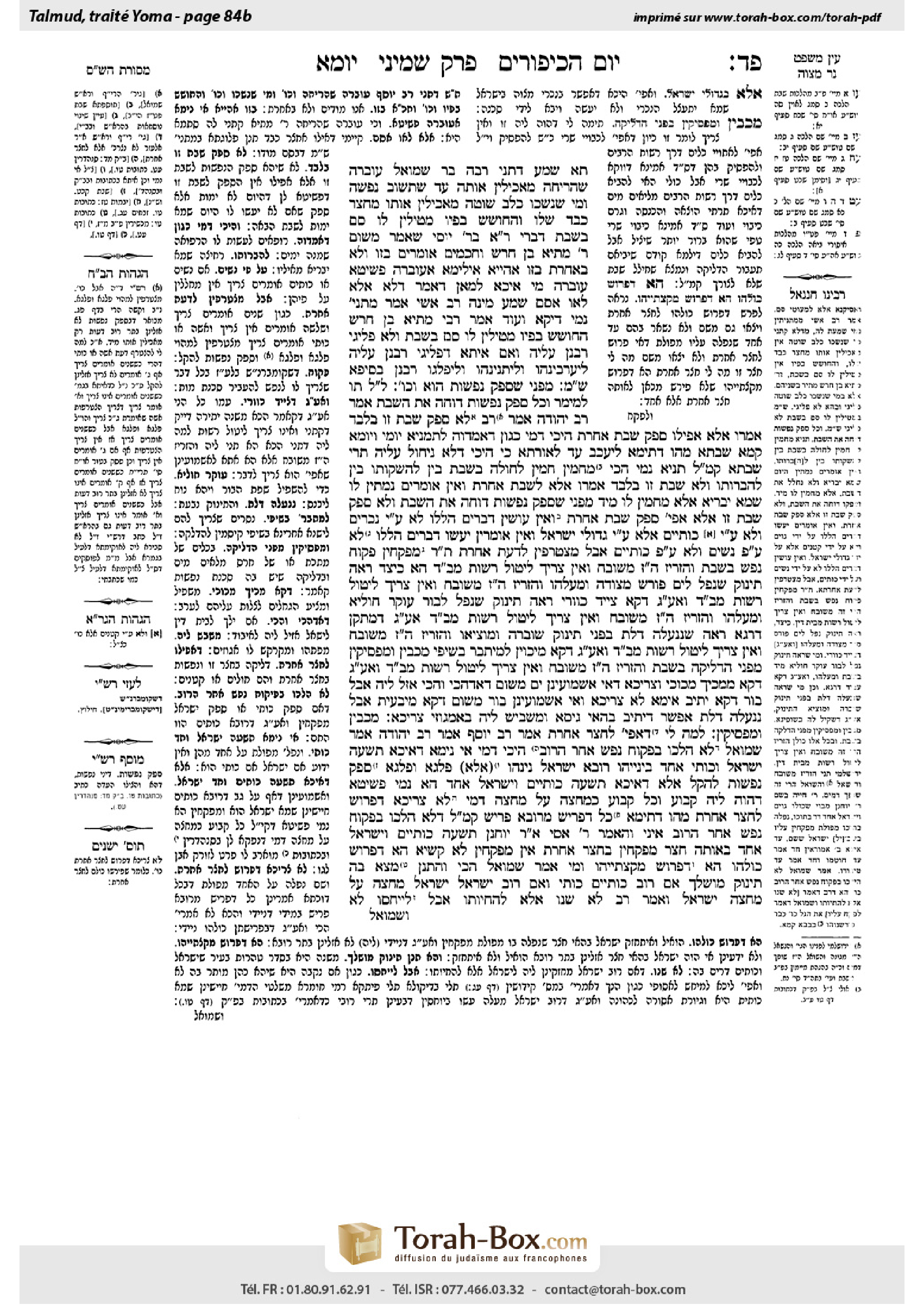
Yoma 84b: Talmud study for Daf Yomi
Daf Yomi is the daily study of one Talmud folio. Explore 37 tractates with scans, Hebrew text, Sefaria English and AI-generated French translations where annotated.
Passage selection and English or AI-generated French translation are available where the scan has annotations. Daf Study is independent of Torah-Box and Sefaria.
Browse Yoma · יומא · All tractatesYoma 84b text and translations
This page of Yoma includes the Aramaic text, an English translation and an AI-generated French translation, alongside the scan above.
יומא פ״ד ב · Aramaic and Hebrew text
תָּא שְׁמַע, דְּתָנֵי רַבָּה בַּר שְׁמוּאֵל: עוּבָּרָה שֶׁהֵרִיחָה — מַאֲכִילִין אוֹתָהּ עַד שֶׁתָּשׁוּב נַפְשָׁהּ, וּמִי שֶׁנְּשָׁכוֹ כֶּלֶב שׁוֹטֶה — מַאֲכִילִין אוֹתוֹ מֵחֲצַר כָּבֵד שֶׁלּוֹ, וְהַחוֹשֵׁשׁ בְּפִיו — מְטִילִין לוֹ סַם בְּשַׁבָּת, דִּבְרֵי רַבִּי אֶלְעָזָר בְּרַבִּי יוֹסֵי, שֶׁאָמַר מִשּׁוּם רַבִּי מַתְיָא בֶּן חָרָשׁ. וַחֲכָמִים אוֹמְרִים: בָּזוֹ וְלֹא בְּאַחֶרֶת. ״בְּזוֹ״ אַהֵיָיא? אִילֵּימָא אַעוּבָּרָה, פְּשִׁיטָא! עוּבָּרָה מִי אִיכָּא לְמַאן דְּאָמַר דְּלָא? אֶלָּא לָאו — אַסַּם. שְׁמַע מִינַּהּ.
רַב אָשֵׁי אָמַר: מַתְנִיתִין נָמֵי דַּיְקָא — וְעוֹד אָמַר רַבִּי מַתְיָא בֶּן חָרָשׁ: הַחוֹשֵׁשׁ בְּפִיו מְטִילִין לוֹ סַם בְּשַׁבָּת, וְלָא פְּלִיגִי רַבָּנַן עֲלֵיהּ. וְאִם אִיתָא דִּפְלִיגִי רַבָּנַן עֲלֵיהּ, לִיעָרְבִינְהוּ וְלִיתְנִינְהוּ, וְלִיפַּלְגוּ רַבָּנַן בְּסֵיפָא. שְׁמַע מִינַּהּ.
מִפְּנֵי שֶׁסְּפֵק נְפָשׁוֹת הוּא וְכוּ׳. לְמָה לִי תּוּ לְמֵימַר: ״וְכׇל סְפֵק נְפָשׁוֹת דּוֹחֶה אֶת הַשַּׁבָּת״? אָמַר רַב יְהוּדָה אָמַר רַב: לֹא סָפֵק שַׁבָּת זוֹ בִּלְבַד אָמְרוּ, אֶלָּא אֲפִילּוּ סָפֵק שַׁבָּת אַחֶרֶת.
הֵיכִי דָּמֵי? כְּגוֹן דְּאַמְדוּהּ לִתְמָנְיָא יוֹמֵי, וְיוֹמָא קַמָּא שַׁבְּתָא. מַהוּ דְּתֵימָא: לִיעַכַּב עַד לְאוּרְתָּא כִּי הֵיכִי דְּלָא נֵיחוּל עֲלֵיהּ תְּרֵי שַׁבָּתָא, קָא מַשְׁמַע לַן.
תַּנְיָא נָמֵי הָכִי: מְחַמִּין חַמִּין לַחוֹלֶה בְּשַׁבָּת, בֵּין לְהַשְׁקוֹתוֹ בֵּין לְהַבְרוֹתוֹ. וְלֹא שַׁבָּת זוֹ בִּלְבַד אָמְרוּ, אֶלָּא לְשַׁבָּת אַחֶרֶת. וְאֵין אוֹמְרִים: נַמְתִּין לוֹ שֶׁמָּא יַבְרִיא, אֶלָּא מְחַמִּין לוֹ מִיָּד, מִפְּנֵי שֶׁסְּפֵק נְפָשׁוֹת דּוֹחֶה אֶת הַשַּׁבָּת. וְלֹא סָפֵק שַׁבָּת זוֹ, אֶלָּא אֲפִילּוּ סָפֵק שַׁבָּת אַחֶרֶת.
וְאֵין עוֹשִׂין דְּבָרִים הַלָּלוּ, לֹא עַל יְדֵי גּוֹיִם, וְלֹא עַל יְדֵי כּוּתִיִּים, אֶלָּא עַל יְדֵי גְּדוֹלֵי יִשְׂרָאֵל. וְאֵין אוֹמְרִין יֵעָשׂוּ דְּבָרִים הַלָּלוּ, לֹא עַל פִּי נָשִׁים, וְלֹא עַל פִּי כּוּתִיִּים, אֲבָל מִצְטָרְפִין לְדַעַת אַחֶרֶת.
תָּנוּ רַבָּנַן: מְפַקְּחִין פִּקּוּחַ נֶפֶשׁ בְּשַׁבָּת, וְהַזָּרִיז הֲרֵי זֶה מְשׁוּבָּח, וְאֵין צָרִיךְ לִיטּוֹל רְשׁוּת מִבֵּית דִּין. הָא כֵּיצַד? רָאָה תִּינוֹק שֶׁנָּפַל לַיָּם — פּוֹרֵשׂ מְצוּדָה וּמַעֲלֵהוּ, וְהַזָּרִיז הֲרֵי זֶה מְשׁוּבָּח, וְאֵין צָרִיךְ לִיטּוֹל רְשׁוּת מִבֵּית דִּין. וְאַף עַל גַּב דְּקָא צָיֵיד כְּווֹרֵי. רָאָה תִּינוֹק שֶׁנָּפַל לְבוֹר — עוֹקֵר חוּלְיָא וּמַעֲלֵהוּ, וְהַזָּרִיז הֲרֵי זֶה מְשׁוּבָּח, וְאֵין צָרִיךְ לִיטּוֹל רְשׁוּת מִבֵּית דִּין. אַף עַל גַּב דִּמְתַקֵּן דַּרְגָּא.
רָאָה שֶׁנִּנְעֲלָה דֶּלֶת בִּפְנֵי תִּינוֹק — שׁוֹבְרָהּ וּמוֹצִיאוֹ, וְהַזָּרִיז הֲרֵי זֶה מְשׁוּבָּח, וְאֵין צָרִיךְ לִיטּוֹל רְשׁוּת מִבֵּית דִּין. וְאַף עַל גַּב דְּקָא מִיכַּוֵּין לְמִיתְבַּר בְּשִׁיפֵי. מְכַבִּין וּמַפְסִיקִין מִפְּנֵי הַדְּלֵיקָה בְּשַׁבָּת, וְהַזָּרִיז הֲרֵי זֶה מְשׁוּבָּח, וְאֵין צָרִיךְ לִיטּוֹל רְשׁוּת מִבֵּית דִּין. וְאַף עַל גַּב דְּקָא מְמַכֵּיךְ מַכּוֹכֵי.
וּצְרִיכָא: דְּאִי אַשְׁמְעִינַן יָם — מִשּׁוּם דְּאַדְּהָכִי וְהָכִי אָזֵל לֵיהּ, אֲבָל בּוֹר, דְּקָא יָתֵיב — אֵימָא לָא, צְרִיכָא.
וְאִי אַשְׁמְעִינַן בּוֹר — מִשּׁוּם דְּקָא מִיבְּעִית, אֲבָל נִנְעֲלָה דֶּלֶת, אֶפְשָׁר דְּיָתֵיב בְּהַאי גִּיסָא וּמְשַׁבֵּישׁ לֵיהּ בְּאַמְגּוֹזֵי. צְרִיכָא.
מְכַבִּין וּמַפְסִיקִין. לְמָה לִי? דַּאֲפִילּוּ לְחָצֵר אַחֶרֶת.
אָמַר רַב יוֹסֵף אָמַר רַב יְהוּדָה אָמַר שְׁמוּאֵל: לֹא הָלְכוּ בְּפִקּוּחַ נֶפֶשׁ אַחַר הָרוֹב. הֵיכִי דָּמֵי? אִי נֵימָא דְּאִיכָּא תִּשְׁעָה יִשְׂרָאֵל וְגוֹי אֶחָד בֵּינַיְיהוּ — רוּבָּא יִשְׂרָאֵל נִינְהוּ, (אֶלָּא) פַּלְגָא וּפַלְגָא, סְפֵק נְפָשׁוֹת לְהָקֵל.
אֶלָּא דְּאִיכָּא תִּשְׁעָה גּוֹיִם וְיִשְׂרָאֵל אֶחָד. הָא נָמֵי פְּשִׁיטָא — דְּהָוֵה לֵיהּ קָבוּעַ, וְכׇל קָבוּעַ כְּמֶחֱצָה עַל מֶחֱצָה דָּמֵי!
לָא צְרִיכָא, דִּפְרוּשׁ לְחָצֵר אַחֶרֶת, מַהוּ דְּתֵימָא: כׇּל דְּפָרֵישׁ — מֵרוּבָּא פָּרֵישׁ, קָא מַשְׁמַע לַן דְּלָא הָלְכוּ בְּפִקּוּחַ נֶפֶשׁ אַחַר הָרוֹב.
אִינִי?! וְהָאָמַר רַבִּי אַסִּי אָמַר רַבִּי יוֹחָנָן: תִּשְׁעָה גּוֹיִם וְיִשְׂרָאֵל אֶחָד בְּאוֹתָהּ חָצֵר — מְפַקְּחִין, בְּחָצֵר אַחֶרֶת — אֵין מְפַקְּחִין! לָא קַשְׁיָא: הָא דִּפְרוּשׁ כּוּלְּהוּ, הָא דִּפְרוּשׁ מִקְצָתַיְיהוּ.
וּמִי אָמַר שְׁמוּאֵל הָכִי? וְהָתְנַן: מָצָא בָהּ תִּינוֹק מוּשְׁלָךְ, אִם רוֹב גּוֹיִם — גּוֹי, וְאִם רוֹב יִשְׂרָאֵל — יִשְׂרָאֵל, מֶחֱצָה עַל מֶחֱצָה — יִשְׂרָאֵל. וְאָמַר רַב: לֹא שָׁנוּ אֶלָּא לְהַחְיוֹתוֹ, אֲבָל לְיַיחֲסוֹ לֹא.
Yoma 84b · English translation
Come and hear a proof for the matter, as Rabba bar Shmuel taught in the following baraita: With regard to a pregnant woman who smells and craves food, one feeds her until she is satisfied, even on Yom Kippur; and in the case of one whom a mad dog bit, one feeds him from the lobe of its liver; and in the case of one who has pain in his mouth, one places medicine in his mouth on Shabbat; this is the statement of Rabbi Elazar, son of Rabbi Yosei, who said it in the name of Rabbi Matya ben Ḥarash. And the Rabbis say: In this case and no other. The Gemara clarifies: To which case is this one referring? If we say they said this about a pregnant woman, it is obvious; is there anyone who says one should not give a pregnant woman food? Rather, is it not referring to the halakha pertaining to medicine on Shabbat, which they agree is permitted? Learn from this that the Rabbis did not disagree about this.
Rav Ashi said: The wording of the mishna is also precise in accordance with this approach, as it was taught in the mishna: And furthermore, Rabbi Matya ben Ḥarash said: In the case of one who suffers pain in his mouth, one places medicine in his mouth on Shabbat, and the Rabbis do not disagree with him and say otherwise. And if it is so that the Rabbis disagree with him, then let the mishna combine the two halakhot and teach them together, and let the Rabbis disagree with both points in the latter clause. Since the mishna was not written this way, but instead the dispute of the Rabbis appears after Rabbi Matya’s statement about the mad dog, learn from here that the Rabbis did not disagree with him about the halakha with regard to medicine.
§ The mishna states that one with pain in his throat should be given medicine on Shabbat because it is a case of uncertainty concerning a life-threatening situation. The Gemara asks: Why do I need to say furthermore: And any case of uncertainty concerning a life-threatening situation overrides Shabbat? Rav Yehuda said that Rav said: They stated this not only in a case where there is uncertainty with regard to this Shabbat, but even if the uncertainty is with regard to a different future Shabbat.
What are the circumstances in which uncertainty would arise as to whether or not his life will be in danger in the future? They are a case where doctors assess that an ill person needs a certain treatment for eight days, and the first day of his illness is Shabbat. Lest you say: He should wait until evening and begin his treatment after Shabbat so they will not need to desecrate two Shabbatot for his sake, therefore it teaches us that one must immediately desecrate Shabbat for his sake. This is the halakha, despite the fact that an additional Shabbat will be desecrated as a result, because there is uncertainty about whether his life is in danger.
That was also taught in a baraita: One heats water for an ill person on Shabbat, whether to give him to drink or to wash him, since it might help him recover. And they did not say it is permitted to desecrate only the current Shabbat for him, but even a different, future Shabbat. And one must not say: Let us wait and perform this labor for him after Shabbat, perhaps he will get well in the meantime. Rather, one heats it for him immediately because any case of uncertainty concerning a life-threatening situation overrides Shabbat. And this is so not only with regard to uncertainty whether his life is in danger on the current Shabbat, but even in a case of uncertainty with regard to danger on a different Shabbat.
And these acts should not be performed by gentiles or Samaritans but should be done by the greatest of the Jewish people, i.e., their scholars, who know how to act properly. And one does not say: These actions may be performed based on the advice of women or Samaritans, since they are not considered experts able to declare a person ill enough to override Shabbat. However, the opinions of these people do combine with an additional opinion, meaning that if there is a dispute, their opinions may be considered when coming to a decision.
§ The Sages taught in a baraita: One engages in saving a life on Shabbat, and one who is vigilant to do so is praiseworthy. And one need not take permission from a court but hurries to act on his own. How so? If one sees a child who fell into the sea, he spreads a fisherman’s net and raises him from the water. And one who is vigilant and acts quickly is praiseworthy, and one need not seek permission from a court, although in doing so he catches fish in the net as well. Similarly, if one sees a child fall into a pit and the child cannot get out, he digs part of the ground out around the edge of the pit to create a makeshift step and raises him out. And one who is vigilant and acts quickly is praiseworthy, and one need not seek permission from a court, although in doing so he fashions a step.
Similarly, if one sees that a door is locked before a child and the child is scared and crying, he breaks the door and takes the child out. And one who is vigilant and acts quickly is praiseworthy, and one need not seek permission from a court, although he intends to break it into boards to be used later. Similarly, one may extinguish a fire by placing a barrier of metal or clay vessels filled with water in front of it on Shabbat when life is endangered. And one who is vigilant and acts quickly is praiseworthy, and one need not seek permission from a court, although he leaves the coals, which can be used for cooking after Shabbat.
The Gemara comments: And it is necessary to teach these examples, since each one suggests an original idea. As, had it taught us the halakha of the child who fell into the sea, we would have said: He must act quickly in that case because in the meantime, if he delays, the child will be swept away by the waves and disappear, and therefore the rescuer need not seek permission; but in the case of a child who fell into a pit, who remains there and is in no further danger, one might say the rescuer need not hurry but should request permission from the court first. Therefore, the baraita explains: No, it is necessary to tell us that case, too.
And if it had taught us the case of the pit, one might have thought it is because the child is scared at being trapped; but when a door is locked before a child, it is possible to sit on the other side of the door and amuse him with the sound of nuts until Shabbat is over. Therefore, it is necessary to teach that in this case, too, one does not delay but acts immediately because a life is possibly in danger.
It was taught in a baraita that one may extinguish a fire by placing a barrier in front of it on Shabbat. The Gemara asks: Why do I need this? What new point is taught by this additional case of a life-endangering situation? The Gemara answers: This halakha applies even if the fire is spreading toward another courtyard. Not only may this be done to save the lives of people in the courtyard on fire; it may also be done to prevent the fire from spreading to an adjacent courtyard.
§ Rav Yosef said that Rav Yehuda said that Shmuel said: With regard to saving a life, the Sages did not follow the majority as they do in other areas of halakha. The Gemara asks: What are the circumstances? When does one not follow the majority? If we say that one does not follow the majority in a case where there are nine Jews and one gentile among them and a building collapses on one of them, then in that case the majority of people are Jews and yet one desecrates Shabbat to save the trapped person. In such a case one is in fact following the majority. Alternatively, if the group is half Jews and half gentiles, the ruling is lenient with regard to a case of uncertainty concerning a life-threatening situation. But this, too, is not a case where one follows the minority, as there is an even chance that the victim is a Jew.
Rather, it is referring to a case where there are nine gentiles and one Jew. However, this too is obvious. One saves the trapped individual because the group is in a fixed location, and there is a principle that whenever a group is in a fixed location it is considered as though it were evenly divided. In this case, despite the fact that the group’s majority is gentile, it is considered as though it were composed half of Jews and half of gentiles.
The Gemara answers: No, it is necessary to teach that one does not follow the majority in a case where one individual did not remain with the group in their courtyard but separated and went to another courtyard, and a building collapses on him. Lest you say: One should follow the principle that whatever is separated from a group is considered to have left from the majority, and since there was a majority of gentiles there the individual who left the group was probably a gentile, and it is not necessary to clear the debris for a gentile on Shabbat, therefore it teaches us that with regard to uncertainty in a situation of saving a life, one does not follow the majority.
The Gemara asks: Is that so? But didn’t Rav Asi say that Rabbi Yoḥanan said: If there are nine gentiles and one Jew and a building collapses on one of them, if it is in that same courtyard one removes the debris, but in another courtyard one does not remove the debris? The Gemara answers: This is not difficult; there is no contradiction between the halakhot. This case, where one removes the debris, is when they all left for another courtyard and it is clear that the Jew was among them. Consequently, the principle of being in a fixed location still applies, and it is considered a case of uncertainty. That other situation is when only a minority of them left for the other courtyard, and it is unknown whether the Jew left with them.
The Gemara asks: Did Shmuel actually say this, that one does not follow the majority with regard to saving a life? Didn’t we learn in a mishna: If one finds an abandoned child in a city and his parents are unknown, if the majority of the city are gentiles the child is considered a gentile; and if the majority of the city are Jews the child is considered a Jew; if the city is composed of half gentiles and half Jews, the child is considered a Jew? And Rav said: They taught this, that he is a Jew, only with respect to sustaining him but not with respect to attributing a lineage to him. One does not say that he is definitely Jewish based on the majority. Therefore, with regard to the halakhot of marriage, his status remains uncertain. If the abandoned child is a girl, she is not permitted to marry a priest, who may marry only a woman of certain lineage.
Yoma 84b · Traduction française (IA)
Viens et entends une preuve à ce sujet, comme l’a enseigné Rabba bar Shmuel dans la baraïta suivante : lorsqu’une femme enceinte sent une odeur de nourriture et en a envie, on lui donne à manger jusqu’à ce qu’elle soit rassasiée, même à Yom Kippour ; lorsqu’un homme a été mordu par un chien enragé, on lui donne à manger le lobe de son foie ; et lorsqu’une personne a mal à la bouche, on lui met un médicament dans la bouche le Chabbat. Telle est la déclaration de Rabbi Elazar, fils de Rabbi Yosei, qui l’a rapportée au nom de Rabbi Matya ben Ḥarash. Les Sages disent : dans ce cas-là, et dans aucun autre. La Guemara précise : à quel cas cela fait-il référence ? Si nous disons que cette déclaration concerne la femme enceinte, cela va de soi ; qui dirait qu’il ne faut pas donner à manger à une femme enceinte ? Il s’agit donc, n’est-ce pas, de la halakha concernant le médicament le Chabbat, qu’ils conviennent qu’il est permis d’administrer ? Déduis de là que les Sages ne sont pas en désaccord sur ce point.
Rav Ashi a dit : la formulation de la Michna est également précise selon cette approche, car la Michna enseigne : « Et de plus, Rabbi Matya ben Ḥarash a dit : lorsqu’une personne a mal à la bouche, on lui met un médicament dans la bouche le Chabbat », et les Sages ne le contredisent pas en affirmant le contraire. Or, si les Sages étaient en désaccord avec lui, la Michna aurait dû réunir les deux halakhot et les enseigner ensemble, les Sages contestant les deux points dans la dernière partie. Puisque la Michna n’est pas formulée ainsi, mais que le désaccord des Sages apparaît après la déclaration de Rabbi Matya sur le chien enragé, déduis de là que les Sages ne sont pas en désaccord avec lui au sujet de la halakha concernant le médicament.
§ La Michna enseigne qu’on doit donner un médicament à celui qui a mal à la gorge le Chabbat, car il s’agit d’un cas de doute concernant un danger de mort. La Guemara demande : pourquoi faut-il ajouter : « Et tout cas de doute concernant un danger de mort l’emporte sur le Chabbat » ? Rav Yehouda a dit au nom de Rav : cette règle a été énoncée non seulement dans le cas où le doute concerne le Chabbat en cours, mais même si le doute concerne un autre Chabbat à venir.
Dans quelles circonstances peut-on avoir un doute quant au fait que sa vie sera ou non en danger à l’avenir ? Il s’agit du cas où des médecins estiment qu’un malade a besoin d’un traitement pendant huit jours et où le premier jour de sa maladie tombe un Chabbat. De peur que tu ne dises : qu’il attende le soir et commence son traitement après le Chabbat, afin qu’il ne soit pas nécessaire de profaner deux Chabbatot pour lui, la Michna nous enseigne qu’il faut profaner immédiatement le Chabbat pour lui. Telle est la halakha, bien qu’un Chabbat supplémentaire soit profané en conséquence, car il existe un doute quant au fait que sa vie soit en danger.
Cela a également été enseigné dans une baraïta : on chauffe de l’eau pour un malade le Chabbat, que ce soit pour la lui faire boire ou pour le laver, car cela peut l’aider à guérir. Les Sages n’ont pas dit qu’il est permis de profaner uniquement le Chabbat en cours pour lui, mais aussi un autre Chabbat à venir. On ne doit pas dire : attendons et accomplissons ce travail pour lui après le Chabbat ; peut-être guérira-t-il entre-temps. Au contraire, on chauffe l’eau pour lui immédiatement, car tout cas de doute concernant un danger de mort l’emporte sur le Chabbat. Cela vaut non seulement lorsqu’il existe un doute quant au danger pour sa vie le Chabbat en cours, mais aussi lorsqu’il existe un doute concernant un danger lors d’un autre Chabbat.
Ces actes ne doivent pas être accomplis par des non-Juifs ou des Samaritains, mais par les plus éminents parmi les Juifs, c’est-à-dire leurs sages, qui savent comment agir correctement. On ne dit pas que ces actes peuvent être accomplis sur l’avis de femmes ou de Samaritains, car ceux-ci ne sont pas considérés comme des experts capables de déclarer qu’une personne est assez malade pour justifier la profanation du Chabbat. Toutefois, leurs avis peuvent être pris en compte avec un avis supplémentaire ; autrement dit, en cas de désaccord, ils peuvent être considérés au moment de prendre une décision.
§ Les Sages ont enseigné dans une baraïta : on s’emploie à sauver une vie le Chabbat, et celui qui se montre diligent à le faire est digne d’éloges. Il n’est pas nécessaire de demander l’autorisation d’un tribunal ; on s’empresse d’agir de sa propre initiative. Comment cela ? Si quelqu’un voit un enfant tomber dans la mer, il déploie un filet de pêcheur et le sort de l’eau. Celui qui se montre diligent et agit rapidement est digne d’éloges, et il n’est pas nécessaire de demander l’autorisation d’un tribunal, bien qu’en agissant ainsi il attrape également des poissons dans le filet. De même, si quelqu’un voit un enfant tomber dans une fosse et que celui-ci ne peut en sortir, il creuse une partie du sol au bord de la fosse pour créer une marche de fortune et le fait sortir. Celui qui se montre diligent et agit rapidement est digne d’éloges, et il n’est pas nécessaire de demander l’autorisation d’un tribunal, bien qu’en agissant ainsi il façonne une marche.
De même, si quelqu’un voit qu’une porte est verrouillée devant un enfant qui a peur et pleure, il brise la porte et fait sortir l’enfant. Celui qui se montre diligent et agit rapidement est digne d’éloges, et il n’est pas nécessaire de demander l’autorisation d’un tribunal, bien qu’il ait l’intention de la briser en planches pour les réutiliser par la suite. De même, on peut éteindre un incendie le Chabbat en plaçant devant lui une barrière composée de récipients en métal ou en argile remplis d’eau, lorsqu’une vie est en danger. Celui qui se montre diligent et agit rapidement est digne d’éloges, et il n’est pas nécessaire de demander l’autorisation d’un tribunal, bien qu’il laisse les braises, qui pourront servir à cuisiner après le Chabbat.
La Guemara fait remarquer : il faut enseigner ces exemples, car chacun présente une idée nouvelle. En effet, si la baraïta nous avait enseigné la halakha concernant l’enfant tombé dans la mer, nous aurions dit : il doit agir rapidement dans ce cas, car entre-temps, s’il tarde, l’enfant sera emporté par les vagues et disparaîtra ; c’est pourquoi celui qui le secourt n’a pas besoin de demander l’autorisation. Mais dans le cas d’un enfant tombé dans une fosse, qui y reste et ne court pas d’autre danger, on pourrait dire que celui qui le secourt n’a pas besoin de se hâter et doit d’abord demander l’autorisation au tribunal. La baraïta précise donc : non, il était également nécessaire de nous enseigner ce cas.
Et si la baraïta nous avait enseigné le cas de la fosse, on aurait pu penser que c’est parce que l’enfant a peur d’être coincé ; mais lorsqu’une porte est verrouillée devant un enfant, on peut s’asseoir de l’autre côté de la porte et le distraire en faisant tinter des noix, jusqu’à la fin du Chabbat. Il était donc nécessaire d’enseigner que, dans ce cas aussi, on ne tarde pas, mais on agit immédiatement, car une vie est peut-être en danger.
Une baraïta a enseigné qu’on peut éteindre un incendie le Chabbat en plaçant une barrière devant lui. La Guemara demande : pourquoi cela est-il nécessaire ? Quel nouvel élément ce cas supplémentaire de danger de mort enseigne-t-il ? La Guemara répond : cette halakha s’applique même si l’incendie se propage en direction d’une autre cour. On peut agir ainsi non seulement pour sauver la vie des personnes dans la cour en feu, mais aussi pour empêcher le feu de se propager à une cour voisine.
§ Rav Yosef a dit au nom de Rav Yehouda, qui l’a dit au nom de Shmuel : lorsqu’il s’agit de sauver une vie, les Sages ne suivent pas la majorité comme ils le font dans les autres domaines de la halakha. La Guemara demande : dans quelles circonstances ? Quand ne suit-on pas la majorité ? Si nous disons qu’on ne suit pas la majorité dans le cas où neuf Juifs et un non-Juif se trouvent parmi les personnes sur lesquelles un bâtiment s’effondre, alors la majorité des personnes sont juives et pourtant on profane le Chabbat pour sauver la personne ensevelie. Dans un tel cas, on suit en fait la majorité. Autre possibilité : le groupe est composé pour moitié de Juifs et pour moitié de non-Juifs ; la décision est alors indulgente en cas de doute concernant un danger de mort. Mais là encore, ce n’est pas un cas où l’on suit la minorité, car il y a une chance égale que la victime soit juive.
Il s’agit plutôt d’un cas où il y a neuf non-Juifs et un Juif. Toutefois, cela aussi va de soi. On sauve la personne ensevelie parce que le groupe se trouve en un lieu fixe, et qu’il existe un principe selon lequel, chaque fois qu’un groupe se trouve en un lieu fixe, on le considère comme s’il était divisé également. Dans ce cas, bien que la majorité du groupe soit non juive, on le considère comme composé pour moitié de Juifs et pour moitié de non-Juifs.
La Guemara répond : non, il était nécessaire d’enseigner qu’on ne suit pas la majorité dans le cas où une personne n’est pas restée avec le groupe dans leur cour, mais s’en est séparée et est allée dans une autre cour, où un bâtiment s’effondre sur elle. De peur que tu ne dises : il faut suivre le principe selon lequel tout ce qui se sépare d’un groupe est considéré comme provenant de la majorité ; puisqu’il y avait là une majorité de non-Juifs, la personne qui a quitté le groupe était probablement non juive, et il n’est pas nécessaire de déblayer les décombres le Chabbat pour un non-Juif, la Guemara nous enseigne qu’en cas de doute dans une situation où il faut sauver une vie, on ne suit pas la majorité.
La Guemara demande : est-ce bien ainsi ? Rav Asi n’a-t-il pas dit au nom de Rabbi Yoḥanan : s’il y a neuf non-Juifs et un Juif et qu’un bâtiment s’effondre sur l’un d’eux, si cela se produit dans cette même cour, on déblaye les décombres, mais si cela se produit dans une autre cour, on ne les déblaye pas ? La Guemara répond : il n’y a pas de difficulté ; les halakhot ne se contredisent pas. Le cas où l’on déblaye les décombres est celui où ils sont tous partis dans une autre cour et où il est certain que le Juif était parmi eux. Par conséquent, le principe du lieu fixe s’applique toujours et le cas est considéré comme un cas de doute. L’autre situation est celle où seule une minorité d’entre eux est partie dans l’autre cour, et où l’on ne sait pas si le Juif est parti avec eux.
La Guemara demande : Shmuel a-t-il réellement dit cela, qu’on ne suit pas la majorité lorsqu’il s’agit de sauver une vie ? N’avons-nous pas appris dans une Michna : si quelqu’un trouve dans une ville un enfant abandonné dont les parents sont inconnus, si la majorité des habitants de la ville sont non juifs, l’enfant est considéré comme non juif ; si la majorité des habitants sont juifs, l’enfant est considéré comme juif ; si la ville est composée pour moitié de non-Juifs et pour moitié de Juifs, l’enfant est considéré comme juif ? Rav a dit : ils ont enseigné qu’il est juif uniquement en ce qui concerne le fait de le nourrir, mais pas en ce qui concerne l’établissement de son ascendance. On ne dit pas qu’il est certainement juif sur la base de la majorité. Par conséquent, pour les halakhot du mariage, son statut demeure incertain. Si l’enfant abandonné est une fille, elle n’est pas autorisée à épouser un prêtre, qui ne peut épouser qu’une femme dont l’ascendance est certaine.
Traduction française générée par IA à partir de l’édition anglaise de Sefaria. Vérifie toujours un passage avec le texte source.
Text from Sefaria: William Davidson Edition - Vocalized Aramaic (CC BY NC); William Davidson Edition - English (CC BY NC).