Yoma 85a: Talmud study for Daf Yomi
Daf Yomi is the daily study of one Talmud folio. Explore 37 tractates with scans, Hebrew text, Sefaria English and AI-generated French translations where annotated.
Passage selection and English or AI-generated French translation are available where the scan has annotations. Daf Study is independent of Torah-Box and Sefaria.
Browse Yoma · יומא · All tractatesYoma 85a text and translations
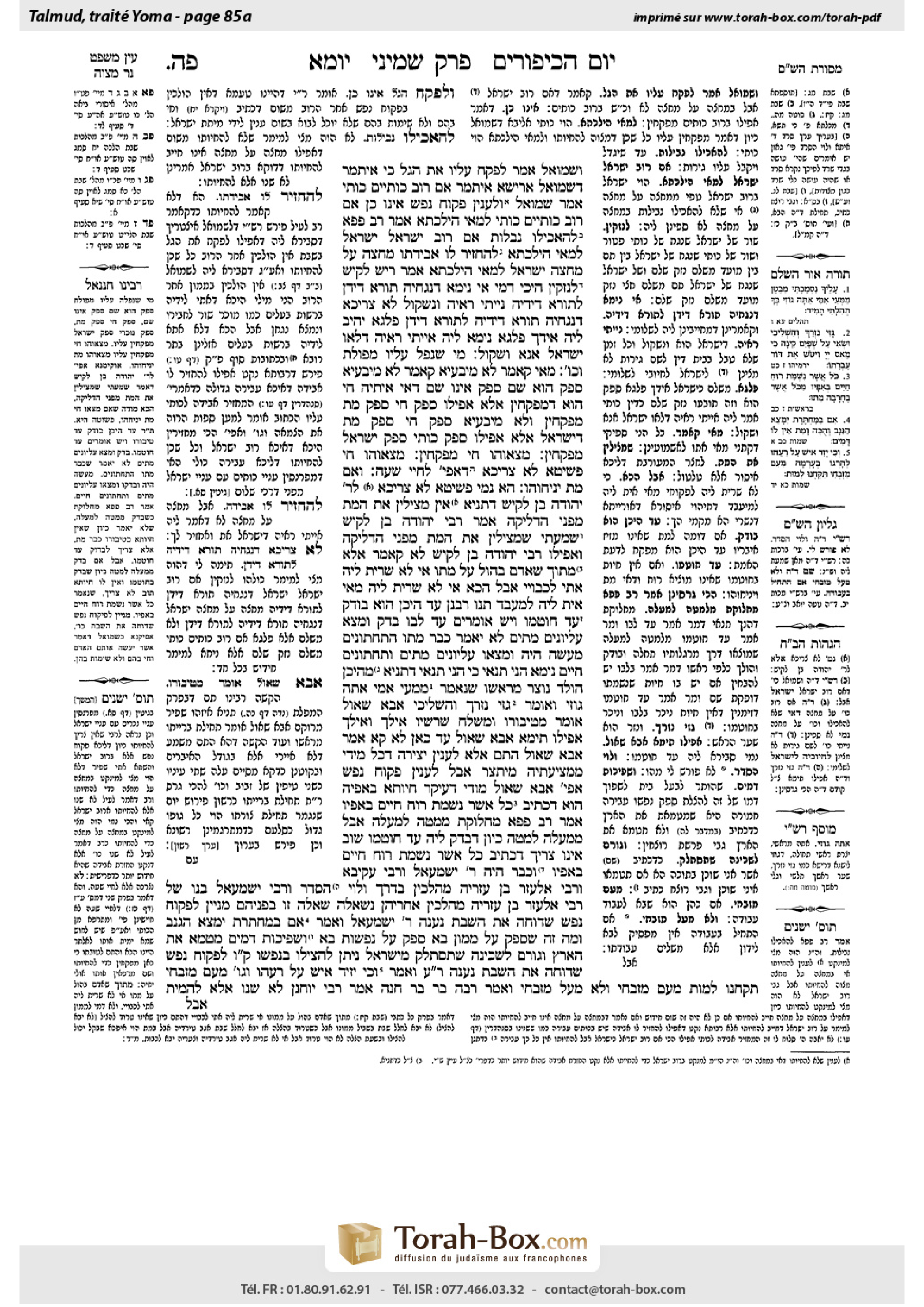
This page of Yoma includes the Aramaic text, an English translation and an AI-generated French translation, alongside the scan above.
יומא פ״ה א · Aramaic and Hebrew text
וּשְׁמוּאֵל אָמַר לְפַקֵּחַ עָלָיו אֶת הַגַּל. כִּי אִיתְּמַר דִּשְׁמוּאֵל — אַרֵישָׁא אִיתְּמַר: אִם רוֹב גּוֹיִם — גּוֹי, אָמַר שְׁמוּאֵל: וּלְעִנְיַן פִּקּוּחַ נֶפֶשׁ אֵינוֹ כֵּן.
אִם רוֹב גּוֹיִם — גּוֹי, לְמַאי הִילְכְתָא? אָמַר רַב פָּפָּא: לְהַאֲכִילוֹ נְבֵלוֹת. אִם רוֹב יִשְׂרָאֵל — יִשְׂרָאֵל, לְמַאי הִילְכְתָא? לְהַחְזִיר לוֹ אֲבֵידָתוֹ.
מֶחֱצָה עַל מֶחֱצָה — יִשְׂרָאֵל, לְמַאי הִילְכְתָא? אָמַר רֵישׁ לָקִישׁ: לִנְזָקִין. הֵיכִי דָּמֵי? אִי נֵימָא דְּנַגְחֵיהּ תּוֹרָא דִּידַן לְתוֹרָא דִּידֵיהּ — נַיְיתֵי רְאָיָה וְנִשְׁקוֹל!
לָא צְרִיכָא, דְּנַגְחֵיהּ תּוֹרָא דִּידֵיהּ לְתוֹרָא דִּידַן, פַּלְגָא — יָהֵיב לֵיהּ, אִידַּךְ פַּלְגָא — נֵימָא לֵיהּ: אַיְיתִי רְאָיָה דְּלָאו יִשְׂרָאֵל אֲנָא וּשְׁקוֹל.
מִי שֶׁנָּפְלָה עָלָיו מַפּוֹלֶת וְכוּ׳. מַאי קָאָמַר?
לָא מִיבַּעְיָא קָאָמַר: לָא מִיבַּעְיָא סָפֵק הוּא שָׁם סָפֵק אֵינוֹ שָׁם, דְּאִי אִיתֵיהּ חַי — הוּא דִּמְפַקְּחִין, אֶלָּא אֲפִילּוּ סָפֵק חַי סָפֵק מֵת — מְפַקְּחִין. וְלָא מִיבַּעְיָא סָפֵק חַי סָפֵק מֵת, דְּיִשְׂרָאֵל, אֶלָּא אֲפִילּוּ סָפֵק גּוֹי סָפֵק יִשְׂרָאֵל — מְפַקְּחִין.
מְצָאוּהוּ חַי — מְפַקְּחִין. מְצָאוּהוּ חַי, פְּשִׁיטָא! לָא צְרִיכָא, דַּאֲפִילּוּ לְחַיֵּי שָׁעָה.
וְאִם מֵת יַנִּיחוּהוּ. הָא נָמֵי פְּשִׁיטָא? לָא צְרִיכָא, לְרַבִּי יְהוּדָה בֶּן לָקִישׁ. דְּתַנְיָא: אֵין מַצִּילִין אֶת הַמֵּת מִפְּנֵי הַדְּלֵיקָה, אָמַר רַבִּי יְהוּדָה בֶּן לָקִישׁ: שָׁמַעְתִּי שֶׁמַּצִּילִין אֶת הַמֵּת מִפְּנֵי הַדְּלֵיקָה. וַאֲפִילּוּ רַבִּי יְהוּדָה בֶּן לָקִישׁ לָא קָאָמַר אֶלָּא מִתּוֹךְ שֶׁאָדָם בָּהוּל עַל מֵתוֹ, אִי לָא שָׁרֵית לֵיהּ — אָתֵי לְכַבּוֹיֵי. אֲבָל הָכָא, אִי לָא שָׁרֵית לֵיהּ — מַאי אִית לֵיהּ לְמֶעְבַּד?
תָּנוּ רַבָּנַן: עַד הֵיכָן הוּא בּוֹדֵק? עַד חוֹטְמוֹ. וְיֵשׁ אוֹמְרִים: עַד לִבּוֹ. בָּדַק וּמָצָא עֶלְיוֹנִים מֵתִים, לֹא יֹאמַר: כְּבָר מֵתוּ הַתַּחְתּוֹנִים. מַעֲשֶׂה הָיָה וּמָצְאוּ עֶלְיוֹנִים מֵתִים וְתַחְתּוֹנִים חַיִּים.
נֵימָא הָנֵי תַּנָּאֵי כִּי הָנֵי תַּנָּאֵי. דְּתַנְיָא: מֵהֵיכָן הַוָּלָד נוֹצָר — מֵרֹאשׁוֹ, שֶׁנֶּאֱמַר: ״מִמְּעֵי אִמִּי אַתָּה גוֹזִי״, וְאוֹמֵר: ״גׇּזִּי נִזְרֵךְ וְהַשְׁלִיכִי״. אַבָּא שָׁאוּל אוֹמֵר: מִטִּיבּוּרוֹ, וּמְשַׁלֵּחַ שׇׁרָשָׁיו אֵילָךְ וְאֵילָךְ.
אֲפִילּוּ תֵּימָא אַבָּא שָׁאוּל, עַד כָּאן לָא קָא אָמַר אַבָּא שָׁאוּל הָתָם אֶלָּא לְעִנְיַן יְצִירָה, דְּכֹל מִידֵּי מִמְּצִיעֲתֵיהּ מִיתְּצַר, אֲבָל לְעִנְיַן פִּקּוּחַ נֶפֶשׁ — אֲפִילּוּ אַבָּא שָׁאוּל מוֹדֵי דְּעִיקַּר חַיּוּתָא בְּאַפֵּיהּ הוּא, דִּכְתִיב: ״כׇּל אֲשֶׁר נִשְׁמַת רוּחַ חַיִּים בְּאַפָּיו״.
אָמַר רַב פָּפָּא: מַחְלוֹקֶת מִמַּטָּה לְמַעְלָה, אֲבָל מִמַּעְלָה לְמַטָּה, כֵּיוָן דִּבְדַק לֵיהּ עַד חוֹטְמוֹ — שׁוּב אֵינוֹ צָרִיךְ, דִּכְתִיב: ״כֹּל אֲשֶׁר נִשְׁמַת רוּחַ חַיִּים בְּאַפָּיו״.
וּכְבָר הָיָה רַבִּי יִשְׁמָעֵאל וְרַבִּי עֲקִיבָא וְרַבִּי אֶלְעָזָר בֶּן עֲזַרְיָה מְהַלְּכִין בַּדֶּרֶךְ, וְלֵוִי הַסַּדָּר וְרַבִּי יִשְׁמָעֵאל בְּנוֹ שֶׁל רַבִּי אֶלְעָזָר בֶּן עֲזַרְיָה מְהַלְּכִין אַחֲרֵיהֶן. נִשְׁאֲלָה שְׁאֵלָה זוֹ בִּפְנֵיהֶם: מִנַּיִין לְפִקּוּחַ נֶפֶשׁ שֶׁדּוֹחֶה אֶת הַשַּׁבָּת?
נַעֲנָה רַבִּי יִשְׁמָעֵאל וְאָמַר: ״אִם בַּמַּחְתֶּרֶת יִמָּצֵא הַגַּנָּב״ — וּמָה זֶה, שֶׁסָּפֵק עַל מָמוֹן בָּא סָפֵק עַל נְפָשׁוֹת בָּא, וּשְׁפִיכוּת דָּמִים מְטַמֵּא אֶת הָאָרֶץ, וְגוֹרֵם לַשְּׁכִינָה שֶׁתִּסְתַּלֵּק מִיִּשְׂרָאֵל, נִיתָּן לְהַצִּילוֹ בְּנַפְשׁוֹ — קַל וָחוֹמֶר לְפִקּוּחַ נֶפֶשׁ שֶׁדּוֹחֶה אֶת הַשַּׁבָּת.
נַעֲנָה רַבִּי עֲקִיבָא וְאָמַר: ״וְכִי יָזִיד אִישׁ עַל רֵעֵהוּ וְגוֹ׳ מֵעִם מִזְבְּחִי תִּקָּחֶנּוּ לָמוּת״. ״מֵעִם מִזְבְּחִי״ — וְלֹא מֵעַל מִזְבְּחִי. וְאָמַר רַבָּה בַּר בַּר חָנָה אָמַר רַבִּי יוֹחָנָן: לֹא שָׁנוּ אֶלָּא לְהָמִית,
Yoma 85a · English translation
And Shmuel said: This halakha of the status of a found child is with regard to removing debris from on top of him, implying that if there is a majority of gentiles in the city where he is found, one does not violate Shabbat by removing the debris from the child to save his life. This implies that one does follow the majority in the case of saving a life. The Gemara answers: When this statement of Shmuel was stated, it was stated with regard to the first halakha. Shmuel’s intent was to be lenient, and his statement should be understood as follows: If the majority are gentiles, he is a gentile. Shmuel said: But with regard to the matter of saving a life it is not so. Rather, one saves him based on the uncertainty.
§ It was taught that if there is a majority of gentiles in the city, a foundling is considered to have the status of a gentile. The Gemara asks: To what halakha does this statement relate? Rav Pappa said: It relates to feeding him non-kosher food. One need not protect the child from every prohibition and may even feed him non-kosher food, as though he were a gentile. It was further taught: If there is a majority of Jews, he is a Jew. The Gemara asks: To what halakha does this relate? The Gemara answers: It relates to returning a lost object to him. In such a case it is assumed that he is definitely a Jew. Consequently, Jews must return lost objects to him, whereas there is no obligation to return lost objects to gentiles.
It was further stated: If the city is half gentile and half Jewish, the foundling has the status of a Jew. The Gemara asks: To what halakha does this relate? Reish Lakish said: It is referring to halakhot of damages. The Gemara asks: What are the circumstances? If we say that our ox, i.e., an ox belonging to another Jew, gored his ox, one could ask: How can he make a claim like a Jew? Let him bring proof that he is Jewish, and only then may he take the money for damages, since the burden of proof rests upon the claimant. Since he cannot prove his Jewish status, he has no claim.
The Gemara answers: No, it is necessary when his innocuous ox, which has gored fewer than three times, gored our ox, i.e., an ox belonging to a Jew, in which case he gives him half, which is what a Jew pays for damages caused by an innocuous ox. However, a gentile must make full restitution for the damage caused. The foundling does not pay the other half, which a gentile gives to a Jew if his ox harms a Jew’s ox. Let me say to the one who suffered the damage: Bring proof that I am not a Jew and take the money. In that case, the burden of proof rests upon the one who suffered the damage.
§ It was taught in the mishna: With regard to one upon whom a rockslide fell, and there is uncertainty whether he is there under the debris or whether he is not there; and there is uncertainty whether he is still alive or whether he is dead; and there is uncertainty whether the person under the debris is a gentile or whether he is Jew, one clears the pile from atop him. The Gemara asks: What is the mishna saying? Why does it bring three different uncertainties to illustrate the principle that one violates Shabbat to save a life even in a case of uncertainty?
The Gemara explains: It is speaking using the style of: Needless to say, and the mishna should be understood as follows: Needless to say, in a case where it is uncertain whether he is there or not there, one removes the debris, since if he is there and he is alive, one must clear the debris. But even if it is uncertain whether he is alive or dead, one must clear the debris. And needless to say, when there is uncertainty whether he is alive or dead, but it is certain that he is a Jew, one must clear the debris. Rather, one must clear the debris even if there is uncertainty whether he is a gentile or a Jew.
§ The mishna taught: If they found him alive, they continue to remove the debris. The Gemara is surprised at this: If they find him alive, it is obvious that they remove the debris, since that is saving a life. The Gemara answers: No, it is necessary to teach that one must desecrate Shabbat for his sake even if it is clear that he will live only a short while and will die soon after.
§ The mishna taught: If they found him dead, they should leave him. The Gemara is surprised at this: Isn’t this also obvious? What allowance might there be to desecrate Shabbat for the sake of a corpse? The Gemara answers: No, this ruling is necessary according to the opinion of Rabbi Yehuda ben Lakish, as it was taught in a baraita: One may not save a corpse from a fire, since one may not violate Shabbat for the sake of the dead. Rabbi Yehuda ben Lakish said: I heard that one may save a corpse from a fire. The Gemara challenges: Even Rabbi Yehuda ben Lakish said this only with regard to a fire because a person is agitated over his dead relative, whose body might burn in the fire. If you do not permit him to remove the corpse he may come to extinguish the fire and transgress a severe Torah prohibition. However, here, in the case of a rockslide or building collapse, if you do not permit him to remove the debris, what might he do? In this case, there is no concern of Shabbat desecration, and preserving the dignity of the dead does not override Shabbat.
The Rabbis taught: If a person is buried under a collapsed building, until what point does one check to clarify whether the victim is still alive? Until what point is he allowed to continue clearing the debris? They said: One clears until the victim’s nose. If there is no sign of life, i.e., if he is not breathing, he is certainly dead. And some say: One clears until the victim’s heart to check for a heartbeat. If several people are buried and one checked and found the upper ones under the debris dead, he should not say: The lower ones are likely also already dead, and there is no point in continuing to search. There was an incident where they found the upper ones dead and the lower ones alive.
The Gemara comments: Let us say that the dispute between these tanna’im who disagree about checking for signs of life is like the dispute between these tanna’im who disagree about the formation of the fetus. As it was taught in a baraita: From what point is the fetus created? It is from its head, as it is stated: “You are He Who took me [gozi] out of my mother’s womb” (Psalms 71:6), and it says: “Cut off [gozi] your hair, and cast it away” (Jeremiah 7:29). These verses suggest that one is created from the head, the place of the hair. Abba Shaul says: A person is created from his navel, and he sends his roots in every direction until he attains the image of a person. The tanna who says that the presence of life is determined based on the nose holds in accordance with the opinion of the tanna who maintains that the formation of a fetus begins with its head. Likewise, the tanna who says the presence of life is determined based on the heart holds in accordance with the opinion of the one who thinks the formation of a fetus begins with its navel.
The Gemara rejects this: Even if you say that the formation of a fetus from the navel is the opinion of Abba Shaul, he may nevertheless require one to check the nose for signs of life. Until now, Abba Shaul spoke there only about formation, saying that everything is created from its middle; however, as for saving a life, even Abba Shaul admits that the main sign of life is in the nose, as it is written: “All in whose nostrils was the breath of the spirit of life” (Genesis 7:22).
Rav Pappa said: The dispute with regard to how far to check for signs of life applies when the digger begins removing the rubble from below, starting with the feet, to above. In such a case it is insufficient to check until his heart; rather, one must continue removing rubble until he is able to check his nose for breath. But if one cleared the rubble from above to below, once he checked as far as the victim’s nose he is not required to check further, as it is written: “All in whose nostrils was the breath of the spirit of life” (Genesis 7:22).
§ The Gemara relates: It once happened that Rabbi Yishmael, and Rabbi Akiva, and Rabbi Elazar ben Azarya were walking on the road, and Levi HaSadar and Rabbi Yishmael, son of Rabbi Elazar ben Azarya, were walking respectfully behind them, since they were younger and did not walk alongside their teachers. This question was asked before them: From where is it derived that saving a life overrides Shabbat?
Rabbi Yishmael answered and said that it is stated: “If a thief be found breaking in and be struck so that he dies, there shall be no blood-guiltiness for him” (Exodus 22:1). Now, if this is true for the thief, where there is uncertainty whether he comes to take money or to take lives, and it is known that bloodshed renders the land impure, since it is stated about a murderer: “And you shall not defile the land” (Numbers 35:34), and it causes the Divine Presence to depart from the Jewish people, as the verse continues: “In the midst of which I dwell, for I the Lord dwell in the midst of the children of Israel” (Numbers 35:34), and even so the home owner is permitted to save himself at the cost of the thief’s life, then a fortiori saving a life overrides Shabbat.
Rabbi Akiva answered and said that it is stated: “And if a man comes purposefully upon his neighbor to slay him with guile, you shall take him from My altar, that he may die” (Exodus 21:14). The phrase “take him from My altar” implies that if the murderer is a priest and comes to perform the service, one does not wait for him to do so but takes him to his execution immediately. But one should not take him from on top of My altar. If he already began the service and is in the midst of it, one does not take him down from the altar immediately but instead allows him to finish his service. And Rabba bar bar Ḥana said that Rabbi Yoḥanan said: They taught only that a priest is not removed from the altar in order to execute him for murder,
Yoma 85a · Traduction française (IA)
Et Shmuel dit : Cette halakha concernant le statut d’un enfant trouvé porte sur le dégagement des décombres qui le recouvrent. Cela implique que, si les non-Juifs sont majoritaires dans la ville où on l’a trouvé, on ne profane pas Chabbat en dégageant les décombres pour lui sauver la vie. Cela implique donc que, pour sauver une vie, on suit la majorité. La Guemara répond : Lorsque cette déclaration de Shmuel a été rapportée, elle concernait la première halakha. Shmuel entendait se montrer indulgent, et sa déclaration doit être comprise ainsi : si les non-Juifs sont majoritaires, l’enfant est non juif. Shmuel dit : Mais, lorsqu’il s’agit de sauver une vie, il n’en va pas ainsi. Au contraire, on le sauve en raison du doute.
§ Il a été enseigné que, si les non-Juifs sont majoritaires dans la ville, l’enfant trouvé est considéré comme non juif. La Guemara demande : À quelle halakha cette déclaration se rapporte-t-elle ? Rav Pappa dit : Elle concerne le fait de lui donner des aliments non cachers. Il n’est pas nécessaire de protéger l’enfant de chaque interdiction ; on peut même lui donner des aliments non cachers, comme s’il était non juif. Il a également été enseigné que, si les Juifs sont majoritaires, l’enfant est juif. La Guemara demande : À quelle halakha cela se rapporte-t-il ? La Guemara répond : Cela concerne la restitution d’un objet perdu. Dans ce cas, on présume qu’il est bien juif. Par conséquent, les Juifs doivent lui restituer les objets perdus, tandis qu’ils ne sont pas tenus de restituer les objets perdus aux non-Juifs.
Il a également été dit : Si la ville compte autant de non-Juifs que de Juifs, l’enfant trouvé a le statut d’un Juif. La Guemara demande : À quelle halakha cela se rapporte-t-il ? Reish Lakish dit : Cela concerne les halakhot relatives aux dommages. La Guemara demande : Dans quelles circonstances ? Si l’on suppose que notre bœuf, c’est-à-dire un bœuf appartenant à un autre Juif, a encorné son bœuf, on peut demander : Comment peut-il présenter une réclamation comme un Juif ? Qu’il apporte la preuve qu’il est juif, et alors seulement il pourra recevoir l’indemnisation, puisque la charge de la preuve incombe au demandeur. Comme il ne peut pas prouver qu’il est juif, il n’a aucun droit à indemnisation.
La Guemara répond : Non, cela est nécessaire dans le cas où son bœuf inoffensif, qui n’a pas encorné trois fois, a encorné notre bœuf, c’est-à-dire un bœuf appartenant à un Juif. Dans ce cas, il lui verse la moitié, comme le ferait un Juif pour les dommages causés par un bœuf inoffensif. En revanche, un non-Juif doit indemniser intégralement les dommages causés. L’enfant trouvé ne verse pas l’autre moitié, qu’un non-Juif doit payer à un Juif si son bœuf blesse le bœuf de ce dernier. On pourrait dire à celui qui a subi le dommage : « Apporte la preuve que je ne suis pas juif, et prends l’argent. » Dans ce cas, la charge de la preuve incombe à celui qui a subi le dommage.
§ Il a été enseigné dans la Michna : À propos d’une personne sur laquelle un éboulement s’est produit, si l’on ne sait pas si elle se trouve sous les décombres ou non, si l’on ne sait pas si elle est encore en vie ou déjà morte, et si l’on ne sait pas si la personne ensevelie est non juive ou juive, on dégage les décombres qui la recouvrent. La Guemara demande : Que dit la Michna ? Pourquoi présente-t-elle trois incertitudes différentes pour illustrer le principe selon lequel on profane Chabbat afin de sauver une vie, même en cas de doute ?
La Guemara explique : La Michna s’exprime selon le procédé du « à plus forte raison » et doit être comprise ainsi : Il va sans dire que, lorsqu’on ne sait pas si la personne se trouve là ou non, on dégage les décombres, car si elle s’y trouve et qu’elle est en vie, il faut les dégager. Mais même si l’on ne sait pas si elle est vivante ou morte, il faut dégager les décombres. Et, à plus forte raison, lorsqu’on ne sait pas si elle est vivante ou morte, mais qu’on sait qu’elle est juive, il faut dégager les décombres. En fait, il faut les dégager même si l’on ne sait pas si elle est non juive ou juive.
§ La Michna enseigne : Si on l’a trouvé vivant, on continue à dégager les décombres. La Guemara s’en étonne : S’ils le trouvent vivant, il est évident qu’ils dégagent les décombres, puisque cela revient à sauver une vie. La Guemara répond : Non, il était nécessaire d’enseigner qu’on doit profaner Chabbat pour lui même s’il est certain qu’il ne vivra que peu de temps et mourra peu après.
§ La Michna enseigne : Si on l’a trouvé mort, on le laisse. La Guemara s’en étonne : Cela aussi n’est-il pas évident ? En quoi pourrait-on être autorisé à profaner Chabbat pour un cadavre ? La Guemara répond : Non, cette décision est nécessaire selon l’opinion de Rabbi Yehuda ben Lakish, comme cela a été enseigné dans une baraïta : On ne peut pas sauver un cadavre d’un incendie, car on ne profane pas Chabbat pour les morts. Rabbi Yehuda ben Lakish dit : J’ai entendu qu’on peut sauver un cadavre d’un incendie. La Guemara objecte : Même Rabbi Yehuda ben Lakish n’a dit cela qu’à propos d’un incendie, parce qu’une personne est bouleversée par son proche défunt, dont le corps risque de brûler dans le feu. Si on ne l’autorise pas à retirer le cadavre, elle pourrait éteindre le feu et transgresser une grave interdiction de la Torah écrite. Mais ici, dans le cas d’un éboulement ou de l’effondrement d’un bâtiment, si on ne l’autorise pas à dégager les décombres, que pourrait-elle faire ? Dans ce cas, il n’y a aucun risque qu’elle profane Chabbat, et préserver la dignité des morts ne l’emporte pas sur Chabbat.
Les Rabbins ont enseigné : Lorsqu’une personne est ensevelie sous un bâtiment effondré, jusqu’où faut-il examiner pour établir si la victime est encore vivante ? Jusqu’où peut-on continuer à dégager les décombres ? Ils ont répondu : On dégage jusqu’au nez de la victime. S’il n’y a aucun signe de vie, c’est-à-dire si elle ne respire pas, elle est certainement morte. Certains disent : On dégage jusqu’au cœur de la victime pour vérifier s’il bat. Si plusieurs personnes sont ensevelies et qu’après avoir examiné les personnes situées en haut sous les décombres, on constate qu’elles sont mortes, on ne doit pas dire : « Celles qui se trouvent plus bas sont probablement déjà mortes elles aussi ; il est donc inutile de poursuivre les recherches. » Il est arrivé qu’on trouve les personnes situées en haut mortes et celles du bas vivantes.
La Guemara fait remarquer : Ne pourrait-on pas dire que le désaccord entre ces tannaïm au sujet de la vérification des signes de vie correspond au désaccord entre ces tannaïm au sujet de la formation du fœtus ? En effet, il a été enseigné dans une baraïta : À partir de quel point le fœtus se forme-t-il ? À partir de sa tête, comme il est dit : « C’est toi qui m’as fait sortir [gozi] du ventre de ma mère » (Psaumes 71,6), et il est dit : « Coupe [gozi] tes cheveux et jette-les » (Jérémie 7,29). Ces versets suggèrent que l’être humain se forme à partir de la tête, là où poussent les cheveux. Abba Shaul dit : L’être humain se forme à partir de son nombril et envoie ses racines dans toutes les directions jusqu’à prendre la forme d’un être humain. Le tanna qui dit que la présence de vie se détermine d’après le nez suit l’opinion du tanna selon lequel la formation du fœtus commence par la tête. De même, le tanna qui dit que la présence de vie se détermine d’après le cœur suit l’opinion de celui qui pense que la formation du fœtus commence par le nombril.
La Guemara rejette cette déduction : Même si l’on dit que l’opinion selon laquelle le fœtus se forme à partir du nombril est celle d’Abba Shaul, il peut néanmoins exiger qu’on vérifie les signes de vie au niveau du nez. Jusqu’à présent, Abba Shaul ne parlait que de la formation, affirmant que tout se forme à partir de son milieu ; mais, lorsqu’il s’agit de sauver une vie, Abba Shaul admet lui aussi que le principal signe de vie se trouve dans le nez, comme il est écrit : « Tous ceux qui avaient dans leurs narines le souffle de l’esprit de vie » (Genèse 7,22).
Rav Pappa dit : Le désaccord sur la limite jusqu’à laquelle vérifier les signes de vie concerne le cas où celui qui creuse commence à dégager les décombres par le bas, en partant des pieds et en remontant. Dans ce cas, il ne suffit pas de vérifier jusqu’au cœur ; il faut continuer à dégager les décombres jusqu’à pouvoir vérifier si la victime respire par le nez. Mais si l’on dégage les décombres du haut vers le bas, après avoir vérifié jusqu’au nez de la victime, il n’est pas nécessaire d’aller plus loin, comme il est écrit : « Tous ceux qui avaient dans leurs narines le souffle de l’esprit de vie » (Genèse 7,22).
§ La Guemara rapporte : Un jour, Rabbi Yishmael, Rabbi Akiva et Rabbi Elazar ben Azarya marchaient sur la route, tandis que Levi HaSadar et Rabbi Yishmael, fils de Rabbi Elazar ben Azarya, marchaient respectueusement derrière eux, car ils étaient plus jeunes et ne marchaient pas aux côtés de leurs maîtres. On leur posa cette question : D’où apprend-on que sauver une vie l’emporte sur Chabbat ?
Rabbi Yishmael répondit : Il est dit : « Si un voleur est surpris en train de s’introduire par effraction et qu’il est frappé et meurt, il n’y aura pas de culpabilité de sang à son égard » (Exode 22,1). Or, si cela est vrai dans le cas du voleur, alors qu’on ne sait pas s’il vient prendre de l’argent ou attenter à des vies, et que l’on sait que l’effusion de sang rend le pays impur, puisqu’il est dit au sujet d’un meurtrier : « Vous ne souillerez pas le pays » (Nombres 35,34), et qu’elle provoque le départ de la Présence divine du peuple juif, comme le poursuit le verset : « Au milieu duquel je réside, car moi, l’Éternel, je réside au milieu des enfants d’Israël » (Nombres 35,34), et que, malgré cela, le propriétaire de la maison est autorisé à se sauver au prix de la vie du voleur, alors, à plus forte raison, sauver une vie l’emporte sur Chabbat.
Rabbi Akiva répondit : Il est dit : « Si un homme s’en prend délibérément à son prochain pour le tuer par ruse, tu le prendras de Mon autel pour qu’il meure » (Exode 21,14). L’expression « tu le prendras de Mon autel » implique que, si le meurtrier est un prêtre venu accomplir le service, on ne l’attend pas pour qu’il l’accomplisse ; on le conduit immédiatement à son exécution. Mais il ne faut pas le prendre alors qu’il se trouve sur Mon autel. S’il a déjà commencé le service et qu’il est en train de l’accomplir, on ne le fait pas immédiatement descendre de l’autel ; on le laisse plutôt achever son service. Et Rabba bar bar Ḥana dit au nom de Rabbi Yoḥanan : Ils ont enseigné uniquement qu’un prêtre n’est pas retiré de l’autel pour être exécuté pour meurtre,
Traduction française générée par IA à partir de l’édition anglaise de Sefaria. Vérifie toujours un passage avec le texte source.
Text from Sefaria: William Davidson Edition - Vocalized Aramaic (CC BY NC); William Davidson Edition - English (CC BY NC).